

A quick spelling set for busy elementary school students
 |
Description
Book Introduction
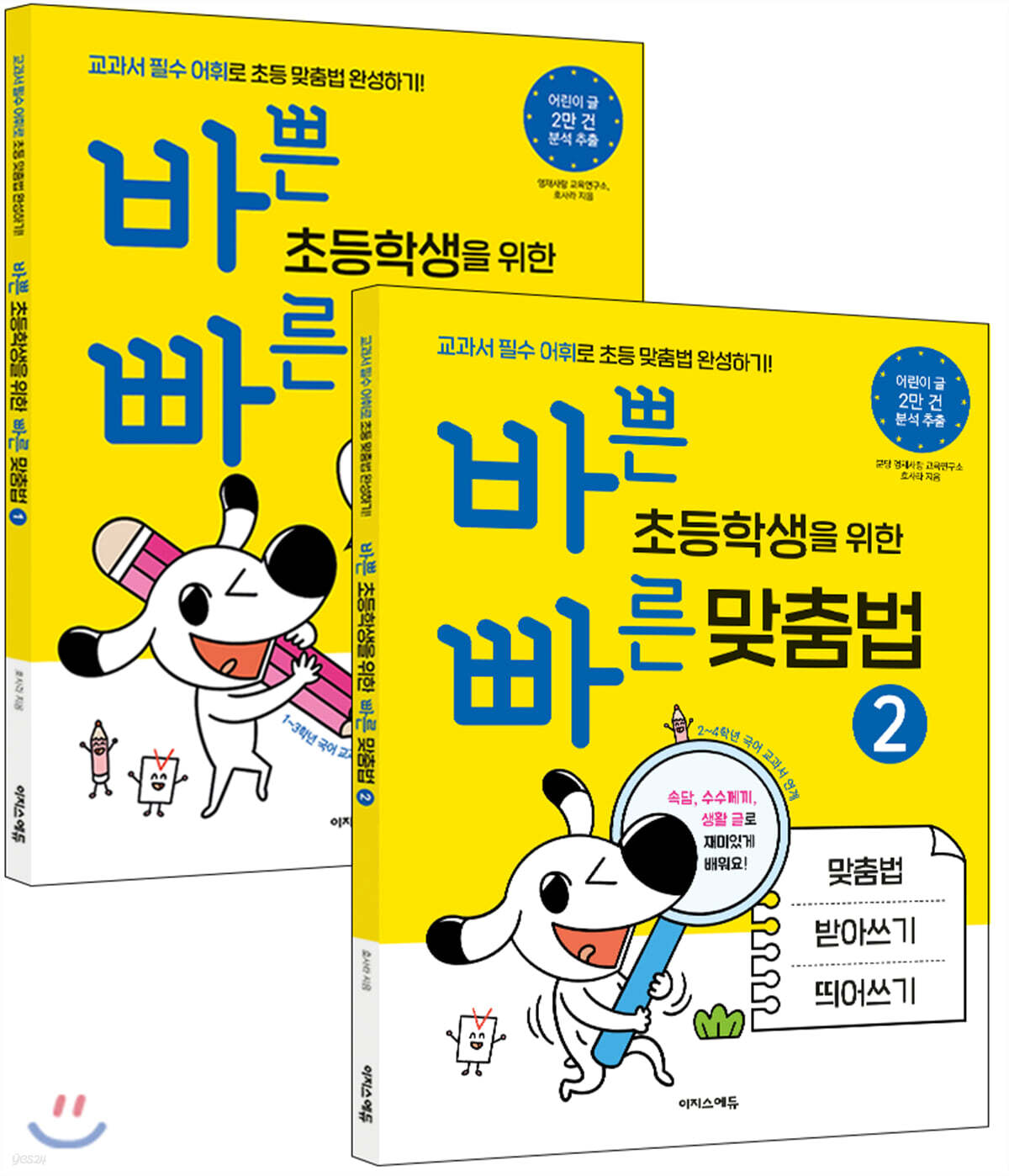
Complete elementary school spelling with essential textbook vocabulary! Have fun learning with proverbs, riddles, and life stories! "Busy Spelling for Busy Elementary Students" (hereafter, "Busy Spelling"), a set of volumes 1 and 2 (a total of 2 volumes), covers essential elementary spelling, dictation, and spacing all at once! "Busy Spelling" teaches spelling through reading and writing everyday texts like proverbs, riddles, diaries, and letters, as if reading a fun book. The Youngjae Love Education Research Institute analyzed 20,000 pieces of writing by actual elementary school students and designed it to solve common mistakes. It was also scientifically designed to be an effective spelling study method, reflecting the grammar acquisition process of children taught over 15 years. It uses essential vocabulary selected from Korean language textbooks for 1st to 4th graders, so it is immediately helpful for studying Korean. |
- You can preview some of the book's contents.
Preview
index
Quick Spelling for Busy Elementary Students 1
First yard.
Learn spelling through riddles and everyday phrases
01.
A Mysterious Riddle 1
02.
Mysterious Riddle 2
03.
Birthday party invitation
04.
Patsooni and Kongdol's Text 1
05.
Patsooni and Kongdol's Text 2
06.
Funny Proverb 1
07.
Funny Proverb 2
08.
New and amazing colored paper
09.
First yard review
10.
Dictation practice
Second yard.
Learning spelling through diaries and letters
[diary]
11.
Aunt's wedding
12.
Visit the aquarium
13.
ducks by the stream
14.
Playing with soap bubbles with my younger sibling
15.
Hotteok made by dad
[letter]
16.
To the eraser
17.
To the grandmother I miss
18.
To King Sejong
19.
To my beloved brother
20.
To the polar bear
21.
Second yard review
22.
Dictation practice
Third yard.
Learning spelling simultaneously
23.
Spring came secretly
24.
Sister's true feelings
25.
dizzying carousel
26.
floral pajamas
27.
Sparrow, sparrow
28.
Watermelon seed game
29.
Third Yard Review
30.
Dictation practice
Fourth yard.
Learning spelling through stories and reading reviews
[story]
31.
Heungbu and Nolbu
32.
Are you in hibernation?
33.
Ants and grasshoppers
34.
Taeyang's self-introduction
[Reading Review]
35.
The life of a general I want to emulate
36.
The Liar and Shepherd Boy
37.
Chimpanzee's mother
38.
Kongjwi's kind heart
39.
Fourth Yard Review
40.
Dictation practice
Fifth yard.
Learn spelling through explanatory and argumentative texts
[Explanation]
41.
Hell in Paris, Parisian Hell
42.
The cicada's talent
43.
lizard with a broken tail
44.
Various greetings from around the world
[Claim]
45.
Be sure to bring a coat!
46.
Let's use the playground safely!
47.
Fifth Yard Review
48.
Dictation practice
Quick Spelling for Busy Elementary School Students 2
First yard.
Learn spelling through riddles and everyday phrases
01.
A Mysterious Riddle 1
02.
Patsooni and Kongdol's Text 1
03.
Birthday party invitation
04.
Funny Proverb 1
05.
Mysterious Riddle 2
06.
Patsooni and Kongdol's Text 2
07.
Funny Proverb 2
08.
New dumpling commercial
09.
First yard review
10.
Dictation practice
Second yard.
Learning spelling through diaries and friendly letters
[diary]
11.
Friend's Snail
12.
I went to visit my grandmother who was sick.
13.
The day I became closer to 'faith'
14.
Broken scarecrow
15.
I got a cousin
[letter]
16.
To the sanitation workers, ladies and gentlemen
17.
To the tree frog
18.
To the farmer lady
19.
To Santa Claus
20.
To my father
21.
Second yard review
22.
Dictation practice
Third yard.
Learning spelling simultaneously
23.
Don't ignore me just because I'm the youngest!
24.
Ugly Bokdong
25.
Hey guys, do you know?
26.
Baekrokdam
27.
Lunar New Year scenery
28.
Superpowers Our Dad
29.
Third Yard Review
30.
Dictation practice
Fourth yard.
Learning spelling through stories and reading reviews
[story]
31.
Red Fan, Blue Fan (Folk Tale)
32.
Seolmundae Halmang (Folk Tale)
33.
Tying a Bell Around the Cat's Neck (Aesop's Fables)
34.
The Happy Prince (masterpiece fairy tale)
[Reading Review]
35.
children in poor countries
36.
Funny cloud names
37.
Amazing scientific knowledge
38.
Beautiful chrysanthemum
39.
Fourth Yard Review
40.
Dictation practice
Fifth yard.
Learn spelling through explanatory and argumentative texts
[Explanation]
41.
The first living organism to go into space
42.
Unique signs from around the world
43.
Bee Dialogue
44.
Joseon's greatest scientist
[Claim]
45.
We need trash cans at the playground.
46.
The easiest way to beat disease
47.
Fifth Yard Review
48.
Dictation practice
First yard.
Learn spelling through riddles and everyday phrases
01.
A Mysterious Riddle 1
02.
Mysterious Riddle 2
03.
Birthday party invitation
04.
Patsooni and Kongdol's Text 1
05.
Patsooni and Kongdol's Text 2
06.
Funny Proverb 1
07.
Funny Proverb 2
08.
New and amazing colored paper
09.
First yard review
10.
Dictation practice
Second yard.
Learning spelling through diaries and letters
[diary]
11.
Aunt's wedding
12.
Visit the aquarium
13.
ducks by the stream
14.
Playing with soap bubbles with my younger sibling
15.
Hotteok made by dad
[letter]
16.
To the eraser
17.
To the grandmother I miss
18.
To King Sejong
19.
To my beloved brother
20.
To the polar bear
21.
Second yard review
22.
Dictation practice
Third yard.
Learning spelling simultaneously
23.
Spring came secretly
24.
Sister's true feelings
25.
dizzying carousel
26.
floral pajamas
27.
Sparrow, sparrow
28.
Watermelon seed game
29.
Third Yard Review
30.
Dictation practice
Fourth yard.
Learning spelling through stories and reading reviews
[story]
31.
Heungbu and Nolbu
32.
Are you in hibernation?
33.
Ants and grasshoppers
34.
Taeyang's self-introduction
[Reading Review]
35.
The life of a general I want to emulate
36.
The Liar and Shepherd Boy
37.
Chimpanzee's mother
38.
Kongjwi's kind heart
39.
Fourth Yard Review
40.
Dictation practice
Fifth yard.
Learn spelling through explanatory and argumentative texts
[Explanation]
41.
Hell in Paris, Parisian Hell
42.
The cicada's talent
43.
lizard with a broken tail
44.
Various greetings from around the world
[Claim]
45.
Be sure to bring a coat!
46.
Let's use the playground safely!
47.
Fifth Yard Review
48.
Dictation practice
Quick Spelling for Busy Elementary School Students 2
First yard.
Learn spelling through riddles and everyday phrases
01.
A Mysterious Riddle 1
02.
Patsooni and Kongdol's Text 1
03.
Birthday party invitation
04.
Funny Proverb 1
05.
Mysterious Riddle 2
06.
Patsooni and Kongdol's Text 2
07.
Funny Proverb 2
08.
New dumpling commercial
09.
First yard review
10.
Dictation practice
Second yard.
Learning spelling through diaries and friendly letters
[diary]
11.
Friend's Snail
12.
I went to visit my grandmother who was sick.
13.
The day I became closer to 'faith'
14.
Broken scarecrow
15.
I got a cousin
[letter]
16.
To the sanitation workers, ladies and gentlemen
17.
To the tree frog
18.
To the farmer lady
19.
To Santa Claus
20.
To my father
21.
Second yard review
22.
Dictation practice
Third yard.
Learning spelling simultaneously
23.
Don't ignore me just because I'm the youngest!
24.
Ugly Bokdong
25.
Hey guys, do you know?
26.
Baekrokdam
27.
Lunar New Year scenery
28.
Superpowers Our Dad
29.
Third Yard Review
30.
Dictation practice
Fourth yard.
Learning spelling through stories and reading reviews
[story]
31.
Red Fan, Blue Fan (Folk Tale)
32.
Seolmundae Halmang (Folk Tale)
33.
Tying a Bell Around the Cat's Neck (Aesop's Fables)
34.
The Happy Prince (masterpiece fairy tale)
[Reading Review]
35.
children in poor countries
36.
Funny cloud names
37.
Amazing scientific knowledge
38.
Beautiful chrysanthemum
39.
Fourth Yard Review
40.
Dictation practice
Fifth yard.
Learn spelling through explanatory and argumentative texts
[Explanation]
41.
The first living organism to go into space
42.
Unique signs from around the world
43.
Bee Dialogue
44.
Joseon's greatest scientist
[Claim]
45.
We need trash cans at the playground.
46.
The easiest way to beat disease
47.
Fifth Yard Review
48.
Dictation practice
Detailed image

Publisher's Review
Analysis of 20,000 elementary school essays! A comprehensive compilation of common mistakes!
Complete elementary school spelling with essential textbook vocabulary!
Children's spelling skills are in an emergency…
There has been a sharp increase in the number of parents who are concerned about the frequent spelling mistakes their children make as they advance in grade level.
This is the result of a decrease in dictation and diary writing, which are symbols of lower grade Korean language study, in many classrooms, while time spent watching videos and studying English has increased.
However, you need to know spelling well to be good at Korean.
'Korean language skills' are ultimately 'the ability to properly understand and convey the meaning', but if you can't distinguish between 'went' and 'same', or 'father is in the room' and 'father's bag', you will misunderstand the meaning and convey it incorrectly.
Have fun learning with proverbs, riddles, and life stories!
Children who make fewer spelling mistakes have one thing in common: they have a wealth of reading experience.
This means that the most natural way to learn spelling is to read and repeat it over and over again.
So this book is designed to help children learn spelling while reading fun texts like proverbs, riddles, diaries, and letters.
We have included texts from various fields to help students develop both knowledge and vocabulary, but at a length that is not burdensome for younger students.
Additionally, each article uses essential vocabulary selected from elementary Korean language textbooks for grades 1-4 published over the past 15 years to help students immediately learn Korean.
Analyzed 20,000 pieces of writing by elementary school students! All common spelling errors corrected!
Children remember things longer when they learn similar things together.
So, this book analyzed over 20,000 pieces of writing by elementary school students taught at the Bundang Youngjae Love Education Research Institute, categorized common mistakes into three areas, and organized them into groups so that students could learn similar things together.
1) Solve mistakes with words that sound different!
First of all, this is a word that is often misspelled because the pronunciation and spelling are different.
First, second, and third, focus on learning in the yard.
The sounds that change when you read them are marked in red, so read carefully.
The actual correct word writing is structured so that you write only the letters that are easy to get wrong by following the gray lines once, and then write the entire word again repeatedly.
Also, words that have the same final consonant sound but are different in type are learned intensively in the fourth yard, and words that are difficult to distinguish because they sound similar are learned intensively in the fifth yard.
2) Solving common mistakes in consonant and vowel spelling!
Children practice frequently mispronounced consonants and vowels by writing them in various styles.
In the first yard, we read 'Riddles and Life', in the second yard, 'Diaries and Letters', in the third yard, 'Poems', in the fourth yard, 'Stories and Reading Reviews', and in the fifth yard, 'Explanatory and Argumentative Writing'. Then, we structured the class so that students would complete the sentences in the previously read texts.
After covering the text and solving the problem, try to find and correct any mistakes in the text yourself.
This has the effect of double-crossing spelling practice and reading.
3) Solve confusing spacing mistakes!
Lastly, we practice grouping together similar spacing rules that children find confusing.
In the first yard, you learn that particles must be attached to the preceding word, in the second yard, you learn that they must be written separately if they have separate meanings, and in the third yard, you learn that words that modify and words that are modified must be written separately.
In the fourth and fifth chapters of Volume 2, you will learn a few things added to the content of Volume 1.
First, we learn that dependent nouns must be written with a space from the preceding word, and that words indicating units must be written with a space from the preceding word.
In the fifth yard, we learn that some words can be misunderstood as two words, as opposed to one, and in Volume 2, we also learn that commas (,) also occupy a space.
A scientific learning design that ensures you never forget what you've learned!
To avoid forgetting something you have studied, you must practice it repeatedly before your memory fades.
'Busy Spelling' reviews only the spelling and spacing mistakes that children often make among the things they learned before, at the end of each lesson.
We also finished with dictation practice by a professional voice actor to help you solve spelling, spacing, and dictation all at once.
The dictation practice presented the initial consonants and confusing letters as hints in gray letters to help children practice without giving up.
Also, we have included dictation practice questions from the text at the back of the book so that parents can cut them out and recite them themselves. Please have your child practice taking the tests repeatedly in the workbook.
You can study dictation more effectively.
It was created to reflect the grammar acquisition process of children I have taught for 15 years!
Most elementary spelling books are structured to first explain the principles and then apply them, much like teaching English grammar.
However, if you look at the grammar acquisition process of students taught by Dr. Hosara of the Gifted Love Education Research Institute for 15 years in the field, you will see that children never learn spelling by applying grammar.
Elementary school students learn much faster when they can intuitively learn by seeing and comparing 'correctly written' and 'incorrectly written'.
So, this book minimizes grammar explanations and organizes questions so that children can learn intuitively.
Mistakes are a learning experience! Give them a positive spin!
Since Hangul is a phonetic alphabet, it is not at all unusual for children to write as they sound when they first start writing.
Also, unlike writing, speech is spoken in chunks.
So, it is natural to write in a haphazard manner when you first start writing.
Children learn correct spelling by making tens of thousands of mistakes.
When studying this book, please encourage your children to make mistakes.
“Mistakes are also good learning.
“You learned what not to do.” Please guide your children to make their spelling studies a sweet experience!
Complete elementary school spelling with essential textbook vocabulary!
Children's spelling skills are in an emergency…
There has been a sharp increase in the number of parents who are concerned about the frequent spelling mistakes their children make as they advance in grade level.
This is the result of a decrease in dictation and diary writing, which are symbols of lower grade Korean language study, in many classrooms, while time spent watching videos and studying English has increased.
However, you need to know spelling well to be good at Korean.
'Korean language skills' are ultimately 'the ability to properly understand and convey the meaning', but if you can't distinguish between 'went' and 'same', or 'father is in the room' and 'father's bag', you will misunderstand the meaning and convey it incorrectly.
Have fun learning with proverbs, riddles, and life stories!
Children who make fewer spelling mistakes have one thing in common: they have a wealth of reading experience.
This means that the most natural way to learn spelling is to read and repeat it over and over again.
So this book is designed to help children learn spelling while reading fun texts like proverbs, riddles, diaries, and letters.
We have included texts from various fields to help students develop both knowledge and vocabulary, but at a length that is not burdensome for younger students.
Additionally, each article uses essential vocabulary selected from elementary Korean language textbooks for grades 1-4 published over the past 15 years to help students immediately learn Korean.
Analyzed 20,000 pieces of writing by elementary school students! All common spelling errors corrected!
Children remember things longer when they learn similar things together.
So, this book analyzed over 20,000 pieces of writing by elementary school students taught at the Bundang Youngjae Love Education Research Institute, categorized common mistakes into three areas, and organized them into groups so that students could learn similar things together.
1) Solve mistakes with words that sound different!
First of all, this is a word that is often misspelled because the pronunciation and spelling are different.
First, second, and third, focus on learning in the yard.
The sounds that change when you read them are marked in red, so read carefully.
The actual correct word writing is structured so that you write only the letters that are easy to get wrong by following the gray lines once, and then write the entire word again repeatedly.
Also, words that have the same final consonant sound but are different in type are learned intensively in the fourth yard, and words that are difficult to distinguish because they sound similar are learned intensively in the fifth yard.
2) Solving common mistakes in consonant and vowel spelling!
Children practice frequently mispronounced consonants and vowels by writing them in various styles.
In the first yard, we read 'Riddles and Life', in the second yard, 'Diaries and Letters', in the third yard, 'Poems', in the fourth yard, 'Stories and Reading Reviews', and in the fifth yard, 'Explanatory and Argumentative Writing'. Then, we structured the class so that students would complete the sentences in the previously read texts.
After covering the text and solving the problem, try to find and correct any mistakes in the text yourself.
This has the effect of double-crossing spelling practice and reading.
3) Solve confusing spacing mistakes!
Lastly, we practice grouping together similar spacing rules that children find confusing.
In the first yard, you learn that particles must be attached to the preceding word, in the second yard, you learn that they must be written separately if they have separate meanings, and in the third yard, you learn that words that modify and words that are modified must be written separately.
In the fourth and fifth chapters of Volume 2, you will learn a few things added to the content of Volume 1.
First, we learn that dependent nouns must be written with a space from the preceding word, and that words indicating units must be written with a space from the preceding word.
In the fifth yard, we learn that some words can be misunderstood as two words, as opposed to one, and in Volume 2, we also learn that commas (,) also occupy a space.
A scientific learning design that ensures you never forget what you've learned!
To avoid forgetting something you have studied, you must practice it repeatedly before your memory fades.
'Busy Spelling' reviews only the spelling and spacing mistakes that children often make among the things they learned before, at the end of each lesson.
We also finished with dictation practice by a professional voice actor to help you solve spelling, spacing, and dictation all at once.
The dictation practice presented the initial consonants and confusing letters as hints in gray letters to help children practice without giving up.
Also, we have included dictation practice questions from the text at the back of the book so that parents can cut them out and recite them themselves. Please have your child practice taking the tests repeatedly in the workbook.
You can study dictation more effectively.
It was created to reflect the grammar acquisition process of children I have taught for 15 years!
Most elementary spelling books are structured to first explain the principles and then apply them, much like teaching English grammar.
However, if you look at the grammar acquisition process of students taught by Dr. Hosara of the Gifted Love Education Research Institute for 15 years in the field, you will see that children never learn spelling by applying grammar.
Elementary school students learn much faster when they can intuitively learn by seeing and comparing 'correctly written' and 'incorrectly written'.
So, this book minimizes grammar explanations and organizes questions so that children can learn intuitively.
Mistakes are a learning experience! Give them a positive spin!
Since Hangul is a phonetic alphabet, it is not at all unusual for children to write as they sound when they first start writing.
Also, unlike writing, speech is spoken in chunks.
So, it is natural to write in a haphazard manner when you first start writing.
Children learn correct spelling by making tens of thousands of mistakes.
When studying this book, please encourage your children to make mistakes.
“Mistakes are also good learning.
“You learned what not to do.” Please guide your children to make their spelling studies a sweet experience!
GOODS SPECIFICS
- Publication date: April 10, 2021
- Page count, weight, size: 264 pages | 210*280*20mm
- ISBN13: 9791163032335
- ISBN10: 1163032336
- Reference book grade: Elementary school common
- Reference book usage semester: Common semester
- Reference book difficulty level: Easy Reference book difficulty level guide
You may also like
카테고리
korean


korean

![GQ KOREA Mark (Monthly): December [2025]](http://librairie.coreenne.fr/cdn/shop/files/8ef265dbbfbf186523ed75ba7319009d.jpg?v=1765340328&width=3840)


