

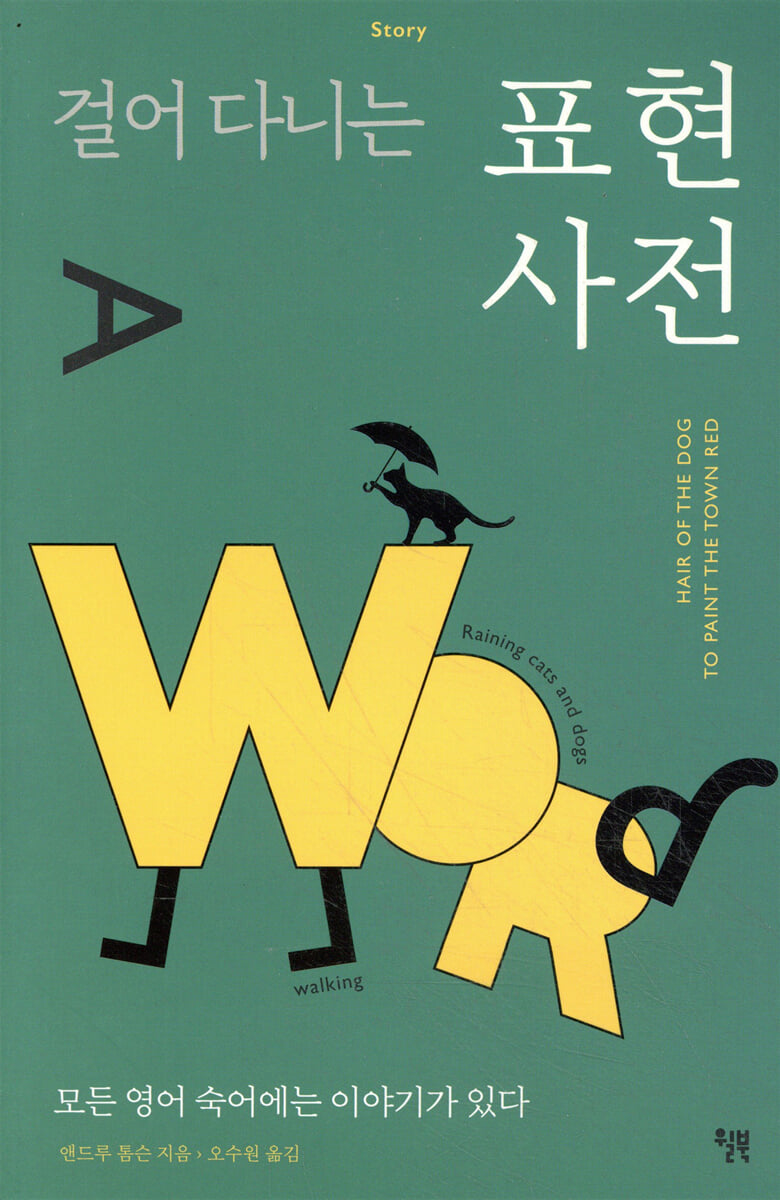
Walking Dictionary of Phrases
 |
Description
Book Introduction
English idioms that were passed over in movies and dramas,
The origins and story are all in this book!
A special dictionary filled with 400 English expressions steeped in history.
Highly recommended by international interpreter Hyunmo Ahn!
"The Walking Dictionary of Phrases" is a book that reveals the secrets behind the creation of all kinds of English idioms that made you wonder, "Why do these words mean what they mean?"
Why do we call something that wastes money a "white elephant"? Why does "face the music" mean paying the price for sin? When did the phrase "blood, sweat, and tears," made even more famous by BTS's song title, first come into use?
How did a politician nearing the end of his term come to be called a "lame duck"? Why are people who look exactly like their doppelgangers called "dead-ringers"? For those who want to truly understand the context of these meaningful, sometimes even witty, phrases, "The Walking Dictionary of Phrases" is here.
This book is packed with colorful stories about English idioms, revealing the influence of historical events, traces of superstitions and customs, and traces of trends from centuries ago, all intertwined with each expression.
As you learn the origins of over 400 different English expressions, you'll soon find yourself connected to the times and cultures the language has absorbed.
Strange expressions that I had passed by without even knowing the English, words and idioms that I had to memorize by rote.
If you overlook it, it's nothing more than a stumbling block that makes studying English more difficult. However, if you look closely at the stories behind these idiomatic expressions, you can discover an unexpectedly interesting and profound history.
Now we don't have to try hard to 'memorize idioms'.
The origins and story are all in this book!
A special dictionary filled with 400 English expressions steeped in history.
Highly recommended by international interpreter Hyunmo Ahn!
"The Walking Dictionary of Phrases" is a book that reveals the secrets behind the creation of all kinds of English idioms that made you wonder, "Why do these words mean what they mean?"
Why do we call something that wastes money a "white elephant"? Why does "face the music" mean paying the price for sin? When did the phrase "blood, sweat, and tears," made even more famous by BTS's song title, first come into use?
How did a politician nearing the end of his term come to be called a "lame duck"? Why are people who look exactly like their doppelgangers called "dead-ringers"? For those who want to truly understand the context of these meaningful, sometimes even witty, phrases, "The Walking Dictionary of Phrases" is here.
This book is packed with colorful stories about English idioms, revealing the influence of historical events, traces of superstitions and customs, and traces of trends from centuries ago, all intertwined with each expression.
As you learn the origins of over 400 different English expressions, you'll soon find yourself connected to the times and cultures the language has absorbed.
Strange expressions that I had passed by without even knowing the English, words and idioms that I had to memorize by rote.
If you overlook it, it's nothing more than a stumbling block that makes studying English more difficult. However, if you look closely at the stories behind these idiomatic expressions, you can discover an unexpectedly interesting and profound history.
Now we don't have to try hard to 'memorize idioms'.
- You can preview some of the book's contents.
Preview
index
introduction
1.
Sea World
2.
Sports and Games
3.
Work, Trade, and Money
4.
army
5.
politics
6.
Recreation and entertainment
7.
Long ago
8.
People and Fame
9.
literature
10.
The pleasure of food
11.
Biblical times
12.
Law and Security
13.
Animals and Nature
14.
Until death do us part
15.
Various topics
Search
1.
Sea World
2.
Sports and Games
3.
Work, Trade, and Money
4.
army
5.
politics
6.
Recreation and entertainment
7.
Long ago
8.
People and Fame
9.
literature
10.
The pleasure of food
11.
Biblical times
12.
Law and Security
13.
Animals and Nature
14.
Until death do us part
15.
Various topics
Search
Detailed image

Into the book
This book explains the fascinating origins of 400 expressions used every day in English-speaking countries.
We have classified the expressions into various categories.
You will now embark on a journey to explore the various worldly affairs.
What you are about to read is strange, wonderful, eccentric, and fascinating.
Sometimes it can be literally unbelievable.
--- p.11
At the time, gambling was illegal in many states in the United States, so when police raids stopped gambling, people would do anything to hide their dice.
The court dismissed the illegal gambling lawsuit if the dice could not be presented as evidence.
No dice, no conviction.
Because of this, some gamblers even swallowed the dice to avoid arrest.
--- p.98
The first recorded instance of this expression is in a 1761 letter from the English writer Horace Walpole to the American educational thinker Horace Mann.
The letter contains the following words:
“Do you know what a Bull and a Bear and a Lame Duck are?”
--- p.128
Achilles' mother, Thetis, dipped her son in the River Styx with the intention of making his skin as strong as armor and making him invulnerable to harm.
However, because I held my son's heel with my hand, the only weak spot was the heel that was not touched by the water.
--- p.227
Important dates became known as red-letter days, and many calendars today still follow this practice.
In many countries, including Norway, Denmark, Sweden, and South Korea, public holidays are called "red days" for this reason.
--- p.240
In fact, the term 'pidgin English' means 'business English', but the Chinese mispronounced 'business' as 'bijin', which became established as the word 'pidgin'.
We have classified the expressions into various categories.
You will now embark on a journey to explore the various worldly affairs.
What you are about to read is strange, wonderful, eccentric, and fascinating.
Sometimes it can be literally unbelievable.
--- p.11
At the time, gambling was illegal in many states in the United States, so when police raids stopped gambling, people would do anything to hide their dice.
The court dismissed the illegal gambling lawsuit if the dice could not be presented as evidence.
No dice, no conviction.
Because of this, some gamblers even swallowed the dice to avoid arrest.
--- p.98
The first recorded instance of this expression is in a 1761 letter from the English writer Horace Walpole to the American educational thinker Horace Mann.
The letter contains the following words:
“Do you know what a Bull and a Bear and a Lame Duck are?”
--- p.128
Achilles' mother, Thetis, dipped her son in the River Styx with the intention of making his skin as strong as armor and making him invulnerable to harm.
However, because I held my son's heel with my hand, the only weak spot was the heel that was not touched by the water.
--- p.227
Important dates became known as red-letter days, and many calendars today still follow this practice.
In many countries, including Norway, Denmark, Sweden, and South Korea, public holidays are called "red days" for this reason.
--- p.240
In fact, the term 'pidgin English' means 'business English', but the Chinese mispronounced 'business' as 'bijin', which became established as the word 'pidgin'.
--- p.416
Publisher's Review
English expressions that I've come across while watching a movie or listening to a song
Let's find out its origins and story in this book!
The expression “blood, sweat and tears” appeared in a famous speech by British Prime Minister Winston Churchill at the beginning of World War II.
As of 2016, this phrase is also famous as the title of a song by global superstar BTS that tells a story of maturity and growth.
But what did Winston Churchill originally mean when he used this expression in 1940?
The movie Call Me by Your Name, which has created numerous fans with its delicate directing and filming, contains lines that are closely connected to the theme.
“Until one day he asks the princess point-blank.” But then, why is asking point-blank ‘point-blank’?
The title of the Taiwanese teen film that broke the record for box office success, “You are the apple of my eye,” is “The Girl We Loved Back Then.”
Why is it that in English, people who are so precious that they wouldn't hurt even if you put them in your eye are compared to apples?
Like this, there are many unique expressions that appear in the media we encounter on a daily basis.
For those who want to understand more deeply and enjoy the context of the sometimes meaningful, sometimes witty words that pass by in movies, dramas, and music, "The Walking Dictionary of Phrases" is a must-read.
A special dictionary filled with 400 English expressions
Highly recommended by international interpreter Hyunmo Ahn!
Linguistic expressions have a variety of roots.
So, as you learn the origins of idioms, you will eventually come into contact with the time and culture that the language absorbed.
Their origins are sometimes so ancient that we cannot even find the first record, while in other cases they are surprisingly modern events.
In seemingly trivial expressions, we can sometimes find traces of historical events that shook a nation, traces of superstitions and customs once taken seriously, or traces of trends popular hundreds of years ago.
『Walking Dictionary of Phrases』 is packed with these colorful stories related to English expressions.
Among them, there are expressions that, at first glance, you would not think would have a curious history hidden within them.
The expression 'let the cat out of the bag', which means 'to reveal a secret', brings to mind the scene of taking a cat out of a bag, but it actually originated from a fraudulent act of selling cats in exchange for edible pork.
When you say, "Have you become a mute after eating honey?", "cat got your tongue?" sounds like it means the cat has eaten its tongue, but it comes from the nickname "cat with nine tails" for the whip used as a punishment on British ships in the 17th century.
The expression 'parting shot', which means 'a final farewell,' is thought to come from the word 'parting,' but it actually comes from the Partians of ancient Persia.
The "Walking Dictionary of Expressions" reveals and explains, one by one, the special origins of expressions that are so naturally used in everyday life that they are difficult to infer from their current form alone.
As you read, you will gain not only knowledge of English expressions but also historical knowledge.
Literature, sports, war, food, mythology…
The colorful origins and history of English expressions across all fields
This book organizes English idioms into themes such as 'Sea World,' 'Entertainment and Recreation,' 'Politics,' 'The Pleasures of Food,' 'Literature,' and 'Animals and Nature,' based on the subject matter or origin of each expression, rather than in monotonous alphabetical order, allowing for an engaging read focusing on the area of interest.
All together, there are over 400 different English expressions that would take more than a year to memorize, even if you memorize one a day.
If you open and read the parts you need or are curious about that day, you will soon find yourself immersed in the fascinating history hidden within the English language.
Broadcaster Hyunmo Ahn, who is also well-known as an excellent interpreter, describes the joy this book brings as “at some moments, bullets flash before your eyes, the sea breeze blows on your nose, and the sound of elephants crying echoes in your ears.”
Strange expressions that I had passed by without even knowing the English, words and idioms that I had to memorize by rote.
If you just pass by them, they're just stumbling blocks that make studying English boring, but if you look closely at the stories behind them, you'll discover unexpected, interesting, and profound stories.
The moment we encounter the interesting birth story that gives readers wings of imagination, we do not need to 'try hard to memorize idioms.'
Let's find out its origins and story in this book!
The expression “blood, sweat and tears” appeared in a famous speech by British Prime Minister Winston Churchill at the beginning of World War II.
As of 2016, this phrase is also famous as the title of a song by global superstar BTS that tells a story of maturity and growth.
But what did Winston Churchill originally mean when he used this expression in 1940?
The movie Call Me by Your Name, which has created numerous fans with its delicate directing and filming, contains lines that are closely connected to the theme.
“Until one day he asks the princess point-blank.” But then, why is asking point-blank ‘point-blank’?
The title of the Taiwanese teen film that broke the record for box office success, “You are the apple of my eye,” is “The Girl We Loved Back Then.”
Why is it that in English, people who are so precious that they wouldn't hurt even if you put them in your eye are compared to apples?
Like this, there are many unique expressions that appear in the media we encounter on a daily basis.
For those who want to understand more deeply and enjoy the context of the sometimes meaningful, sometimes witty words that pass by in movies, dramas, and music, "The Walking Dictionary of Phrases" is a must-read.
A special dictionary filled with 400 English expressions
Highly recommended by international interpreter Hyunmo Ahn!
Linguistic expressions have a variety of roots.
So, as you learn the origins of idioms, you will eventually come into contact with the time and culture that the language absorbed.
Their origins are sometimes so ancient that we cannot even find the first record, while in other cases they are surprisingly modern events.
In seemingly trivial expressions, we can sometimes find traces of historical events that shook a nation, traces of superstitions and customs once taken seriously, or traces of trends popular hundreds of years ago.
『Walking Dictionary of Phrases』 is packed with these colorful stories related to English expressions.
Among them, there are expressions that, at first glance, you would not think would have a curious history hidden within them.
The expression 'let the cat out of the bag', which means 'to reveal a secret', brings to mind the scene of taking a cat out of a bag, but it actually originated from a fraudulent act of selling cats in exchange for edible pork.
When you say, "Have you become a mute after eating honey?", "cat got your tongue?" sounds like it means the cat has eaten its tongue, but it comes from the nickname "cat with nine tails" for the whip used as a punishment on British ships in the 17th century.
The expression 'parting shot', which means 'a final farewell,' is thought to come from the word 'parting,' but it actually comes from the Partians of ancient Persia.
The "Walking Dictionary of Expressions" reveals and explains, one by one, the special origins of expressions that are so naturally used in everyday life that they are difficult to infer from their current form alone.
As you read, you will gain not only knowledge of English expressions but also historical knowledge.
Literature, sports, war, food, mythology…
The colorful origins and history of English expressions across all fields
This book organizes English idioms into themes such as 'Sea World,' 'Entertainment and Recreation,' 'Politics,' 'The Pleasures of Food,' 'Literature,' and 'Animals and Nature,' based on the subject matter or origin of each expression, rather than in monotonous alphabetical order, allowing for an engaging read focusing on the area of interest.
All together, there are over 400 different English expressions that would take more than a year to memorize, even if you memorize one a day.
If you open and read the parts you need or are curious about that day, you will soon find yourself immersed in the fascinating history hidden within the English language.
Broadcaster Hyunmo Ahn, who is also well-known as an excellent interpreter, describes the joy this book brings as “at some moments, bullets flash before your eyes, the sea breeze blows on your nose, and the sound of elephants crying echoes in your ears.”
Strange expressions that I had passed by without even knowing the English, words and idioms that I had to memorize by rote.
If you just pass by them, they're just stumbling blocks that make studying English boring, but if you look closely at the stories behind them, you'll discover unexpected, interesting, and profound stories.
The moment we encounter the interesting birth story that gives readers wings of imagination, we do not need to 'try hard to memorize idioms.'
GOODS SPECIFICS
- Publication date: September 27, 2021
- Page count, weight, size: 456 pages | 636g | 145*220*28mm
- ISBN13: 9791155814048
- ISBN10: 1155814045
You may also like
카테고리
korean


korean

![GQ KOREA Mark (Monthly): December [2025]](http://librairie.coreenne.fr/cdn/shop/files/8ef265dbbfbf186523ed75ba7319009d.jpg?v=1765340328&width=3840)


