

I am Malala
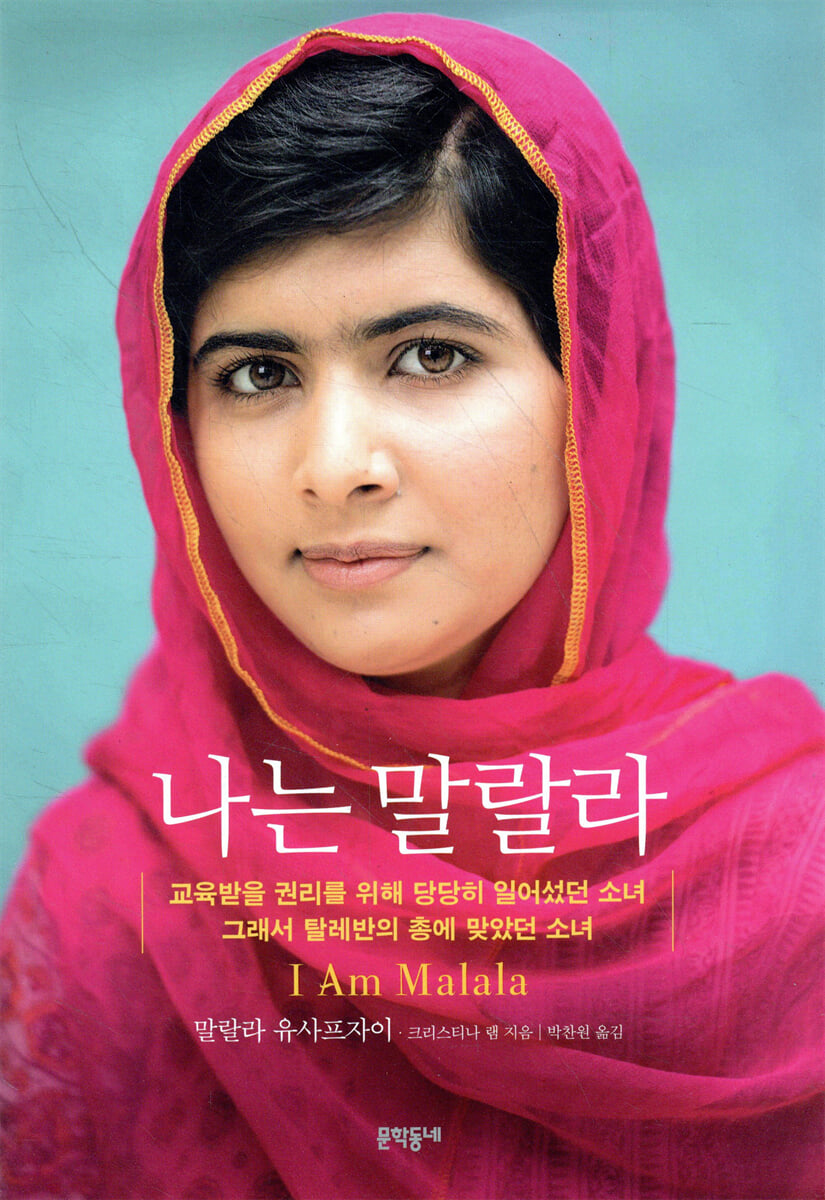 |
Description
Book Introduction
"At the age of eleven, I wrote a blog post about life under the Taliban on the BBC.
At the age of twelve, she started participating in the women's education movement.
At the age of fourteen, he received Pakistan's first peace prize.
At the age of fifteen, he was shot by the Taliban and almost died.
At the age of sixteen, he appealed to the world at the UN headquarters to work towards the education of all children.
The girl who became the youngest person ever to win the Nobel Peace Prize at the age of seventeen
Malala Yousafzai, and the story of all of us!"
At the age of twelve, she started participating in the women's education movement.
At the age of fourteen, he received Pakistan's first peace prize.
At the age of fifteen, he was shot by the Taliban and almost died.
At the age of sixteen, he appealed to the world at the UN headquarters to work towards the education of all children.
The girl who became the youngest person ever to win the Nobel Peace Prize at the age of seventeen
Malala Yousafzai, and the story of all of us!"
- You can preview some of the book's contents.
Preview
index
"prolog
Part 1
1. A daughter is born
2 My father, Mae
3 Growing up in school
4 Hometown Village
5 Reasons I Don't Wear Earrings and Why Pashtuns Don't Say Thank You
6 Children of the Garbage Mountain
7 The Mufti who tried to close our school
8. Autumn of Earthquakes
Part 2: Valley of Death
9 Radio Mullah
10 Toffees, Tennis Balls, and Buddha of Swat
11 Smart Students
12 Sea of Blood Square
13 Gul Makai's Diary
14 Strange Peace
15 Leaving the Valley
Part 3
16 Valley of Sorrow
17 Please make me taller
18 The Woman and the Sea
19 Covert Talibanization
20 Who is Malala?
Part 4
21 God, I entrust this child to you.
22 Journey into the Unknown
Part 5: Second Life
23 Girl shot in the head arrives in Birmingham
24 They took away the child's smile.
Epilogue One child, one teacher, one book, one pen
Glossary of Terms
Chronology of Key Events in Pakistan and Swat
Acknowledgements
About the Malala Fund
Part 1
1. A daughter is born
2 My father, Mae
3 Growing up in school
4 Hometown Village
5 Reasons I Don't Wear Earrings and Why Pashtuns Don't Say Thank You
6 Children of the Garbage Mountain
7 The Mufti who tried to close our school
8. Autumn of Earthquakes
Part 2: Valley of Death
9 Radio Mullah
10 Toffees, Tennis Balls, and Buddha of Swat
11 Smart Students
12 Sea of Blood Square
13 Gul Makai's Diary
14 Strange Peace
15 Leaving the Valley
Part 3
16 Valley of Sorrow
17 Please make me taller
18 The Woman and the Sea
19 Covert Talibanization
20 Who is Malala?
Part 4
21 God, I entrust this child to you.
22 Journey into the Unknown
Part 5: Second Life
23 Girl shot in the head arrives in Birmingham
24 They took away the child's smile.
Epilogue One child, one teacher, one book, one pen
Glossary of Terms
Chronology of Key Events in Pakistan and Swat
Acknowledgements
About the Malala Fund
Detailed image
.jpg)
Into the book
The year before I was born, a group called the Taliban, led by a one-eyed mullah, took control of Afghanistan and were burning down girls' schools.
The Taliban forced men to grow beards as long as a lantern and forced women to wear burqas.
(…) Even women were forbidden from laughing loudly or wearing white shoes.
White is a color only for men.
Women were imprisoned and beaten simply for wearing nail polish.
(…) When I heard of the atrocities being committed in Afghanistan, I was proud to be in Swat.
“Girls can go to school here too,” I used to say.
But the Taliban were very close by, and they were Pashtuns like us.
The sun was shining brightly in this valley, so I didn't see the clouds gathering over the mountain.
My father used to say:
“I will protect your freedom, Malala.
“Don’t lose your dreams.” ---pp.82~83
“God, I know you see everything.
But with so much going on, maybe, sometimes, you'll miss a few things.
Just like you didn't see the bombs falling in Afghanistan.
I know God would never be happy if he saw the children living in the garbage dump in our neighborhood.
God, give me strength and courage and make me perfect.
Then I too want to make this world perfect.
Malala.”---p.107
My father spoke to the people of Swat.
As long as there is one last classroom, one last teacher, and one last student alive, education will continue without stopping.
My parents never said I should drop out of school.
Not even once.
We loved school, but we didn't realize how precious education was until the Taliban stopped us from going.
Going to school, reading books, and doing homework wasn't just a way to pass the time; it was our future. ---p.174
“Education is education.
“We must learn everything, and then choose our path.” Education is neither Eastern nor Western; it is human. ---p.193
Some people choose the right path to survive, while others choose the wrong path.
A man shot a gun at me.
In a single second, the bullet swelled my brain, took away my hearing, and severed my left facial nerve.
After that one second, millions of people were praying for my life, and great doctors gave me my body back.
I was a good kid.
The only thing I ever wanted in my heart was to help people.
I didn't need any money or prizes.
I prayed to God every day.
“I want to help people.
Please help me to do that.”
The Taliban forced men to grow beards as long as a lantern and forced women to wear burqas.
(…) Even women were forbidden from laughing loudly or wearing white shoes.
White is a color only for men.
Women were imprisoned and beaten simply for wearing nail polish.
(…) When I heard of the atrocities being committed in Afghanistan, I was proud to be in Swat.
“Girls can go to school here too,” I used to say.
But the Taliban were very close by, and they were Pashtuns like us.
The sun was shining brightly in this valley, so I didn't see the clouds gathering over the mountain.
My father used to say:
“I will protect your freedom, Malala.
“Don’t lose your dreams.” ---pp.82~83
“God, I know you see everything.
But with so much going on, maybe, sometimes, you'll miss a few things.
Just like you didn't see the bombs falling in Afghanistan.
I know God would never be happy if he saw the children living in the garbage dump in our neighborhood.
God, give me strength and courage and make me perfect.
Then I too want to make this world perfect.
Malala.”---p.107
My father spoke to the people of Swat.
As long as there is one last classroom, one last teacher, and one last student alive, education will continue without stopping.
My parents never said I should drop out of school.
Not even once.
We loved school, but we didn't realize how precious education was until the Taliban stopped us from going.
Going to school, reading books, and doing homework wasn't just a way to pass the time; it was our future. ---p.174
“Education is education.
“We must learn everything, and then choose our path.” Education is neither Eastern nor Western; it is human. ---p.193
Some people choose the right path to survive, while others choose the wrong path.
A man shot a gun at me.
In a single second, the bullet swelled my brain, took away my hearing, and severed my left facial nerve.
After that one second, millions of people were praying for my life, and great doctors gave me my body back.
I was a good kid.
The only thing I ever wanted in my heart was to help people.
I didn't need any money or prizes.
I prayed to God every day.
“I want to help people.
Please help me to do that.”
---p.352
Publisher's Review
On October 10, 2014, the eyes of the world were focused on a girl attending a girls' school in Birmingham, England.
The Nobel Peace Committee announced that Kailash Satyarthi and Malala Yousafzai will be jointly awarded the 2014 Nobel Peace Prize for their fight against the oppression of children and young people and for their right to education.
This year, a Pakistani girl, just seventeen years old, won the award, becoming the youngest person ever to win a Nobel Prize in any category.
At a press conference after the class, Malala expressed her feelings about receiving the award.
“I believe that the Nobel Peace Prize was given to me not because of my past achievements, but because it was meant to encourage me to do better in the future.
(…) The Nobel Peace Prize is not the end, but the starting point.”
On July 12, 2013, at the United Nations Headquarters in New York, a Pakistani girl celebrating her sixteenth birthday was introduced by UN Secretary-General Ban Ki-moon and began to address the world.
Dressed in her favorite pink traditional dress and wearing the shawl of slain Pakistani first female Prime Minister Benazir Bhutto, Malala Yousafzai appealed to world leaders to provide free education to every child.
“Let us take up books and pens.
That book and pen are the most powerful weapons in the world.
“One child, one teacher, one book, one pen can change the world.”
A year earlier, on October 9, 2012, in Mingora, northern Pakistan, Malala was shot in the head by an assailant on a bus returning home from school.
Few expected her to survive.
As Malala teetered between life and death, the Taliban, a militant Islamic political group, issued a statement claiming they were the ones who shot her.
“Anyone who raises a voice against us will be dealt with in the same way.”
Who is this girl? How did an ordinary girl who read "Twilight" with her best friend, bickered with her younger brother, and competed for first place at school become a target of the Taliban, then ascend to the podium where world leaders stand, and become the youngest-ever Nobel Prize winner? "I Am Malala" captures that long and remarkable journey.
"I Am Malala" is the autobiographical chronicle of a girl whose only dream was to go to school, the story of a family who risked their lives fighting for girls' right to education in the Taliban-controlled Swat Valley in northern Pakistan, a brilliant overview of the turbulent modern history of Pakistan, and a voice from the field exposing the reality of Islamic fundamentalism and terrorism, the core of the typhoon of 21st-century world affairs.
It is also, above all, a moving record of the courage and conviction of those who fight against injustice and tyranny without remaining silent.
Malala's story first came to light in 2009, when she was eleven years old, when she began writing about life under the Taliban for the BBC's Urdu-language blog under the pen name Gul Makai.
After the shooting, world leaders such as UN Secretary-General Ban Ki-moon, US President Barack Obama, former British Prime Minister Gordon Brown, and stars such as Angelina Jolie, Madonna, and Beyoncé publicly expressed their support, and Malala became the youngest person to be nominated for the Nobel Peace Prize, creating a global phenomenon called 'Malala Syndrome'.
And in October 2014, she won the Nobel Peace Prize, becoming the youngest recipient ever. Korean readers of "I Am Malala" will also find a message of hope and profound resonance as they witness the story of a girl's voice bringing change to the world.
From the remote Swat valley in Pakistan to the UN headquarters in New York
Malala speaks of Malala
Malala Yousafzai was born and raised on July 12, 1997, in the Swat Valley region of northern Pakistan.
“I was born as a daughter in a country where a son is celebrated with a gun and a daughter is hidden behind a curtain, a country where a woman’s lifelong role is simply to cook and give birth to children.” (p. 19) Malala is a member of the Pashtun tribe, a warlike people who live mainly in Afghanistan and Pakistan and form the backbone of the Taliban militant group. They follow a unique code called “Pashtunwali,” which strictly restricts women’s social life.
However, Malala's father, Ziauddin Yousafzai, was a figure who opposed discrimination against women and practiced education by establishing several schools, including a girls' school, in the Swat Valley.
Due to her father's influence, Malala attended school regularly from a young age and came to understand the importance of education better than anyone else.
On September 11, 2001, when the World Trade Center in New York collapsed in a suicide attack following a hijacking of an airplane, the fate of Malala, living in a remote mountain village on the other side of the world, changed forever.
The Taliban, driven out of Afghanistan by the US war on terror, moved its base to northern Pakistan.
The peace that had been maintained precariously in the Swat Valley was shattered in 2007 when the Taliban took over the region in earnest.
Maulana Fazlullah, the leader of the Pakistani Taliban, first penetrated deeply into the community through radio broadcasts, which were the main source of information for the residents.
Taking advantage of the blind spot of most people not knowing Arabic, they preached Islamic law based on their own interpretation of the Quran.
At first, CDs, DVDs, televisions, etc. were banned and burned.
They then blew up power plants, gas pipelines, and schools.
By the end of 2008, more than 400 schools in the occupied territories had been destroyed.
Finally, at the end of 2008, an order was issued to close all girls' schools and girls were warned not to go to school starting the following January.
It was a harsh time, when the corpses of people brutally murdered for not following their orders piled up in the town square every day.
Back then, every day seemed like the worst day, every moment seemed like the worst time.
Wherever I went, I heard bad news.
A bomb exploded in this person's house, that school was blown up, and people were crying.
The story was endless and unbearable.
(…) A teacher living in Mata was murdered.
The reason was that he refused to wear shalwar pants with the hem raised above the ankles, as the Taliban did.
The teacher said that there is no such demand in any Islamic country.
The Taliban hanged him and shot his father.
_Page 177
At a time when everyone was holding their breath in fear, eleven-year-old Malala began to speak out.
In January 2009, she began writing a diary about life under the Taliban under the pen name 'Gul Makai' on the BBC's Urdu blog.
“If one man, Fazlulah, can destroy everything, why can’t one girl change it?” (p. 169) In this diary, Malala protested against the Taliban’s ban on girls’ education and the closure of schools, and reported the atrocities they were committing in Swat, which soon caused a worldwide sensation.
I began to understand that the pen and the words that came from it could be more powerful than machine guns, tanks, or helicopters.
We were realizing how to fight.
And we were learning how powerful we could be when we spoke.
_Main text, pages 186-187
Afterwards, Malala raised her voice even more through interviews with domestic and international media and the documentary "Class Ends in Swat Valley" produced by the New York Times, and she jumped into the education movement in earnest with her father.
He met with Richard Holbrooke, then US ambassador to Pakistan and Afghanistan, and General Athar Abbas, the chief spokesman for the Pakistani military, and urged them to work towards resolving the Swat issue.
We participated in the 'Swat Regional Children's Parliament' hosted by UNICEF and adopted a resolution demanding an end to child labor exploitation, support for education of children with disabilities and homeless people, and rebuilding all schools destroyed by the Taliban, and delivered it to the relevant officials, achieving some results.
In recognition of these activities, he was awarded the first Pakistan Youth Peace Award in December 2011.
The Taliban then began issuing death threats to Malala and her father, but the two refused to give in.
On October 9, 2012, Malala was shot by Taliban soldiers on her way home from school while on a school bus.
The bullet passed through Malala's head and neck and lodged in her shoulder near her spine.
It was a situation where life or death could not be guaranteed.
Malala was taken to a local hospital, where she underwent surgery to remove part of her skull due to brain swelling, and was transferred to Queen Elizabeth Hospital in Birmingham, England, on October 15 for intensive care.
After being discharged from the hospital in January 2013, Malala recovered her health with the support and encouragement of many people and has been attending Edgbaston Girls' School in Birmingham, England since March.
Due to threats to her safety, her family is unable to return to their home country of Pakistan and is staying in the UK, where her father, Ziauddin, works as an education officer at the Pakistani consulate in Birmingham.
Since then, Malala has continued to campaign for the right to education for children in underdeveloped countries such as Pakistan, Syria, Nigeria, and Kenya through interviews and speeches with various media outlets, including standing on the podium at the UN headquarters, and through the creation of the 'Malala Fund'.
Malala shares the state of children's education around the world and the current situation in Pakistan.
“I know this is going to be a big fight.
Worldwide, 57 million children are out of school, 32 million of whom are girls.
Sadly, our country, Pakistan, is the worst case scenario, with 5.1 million children unable to even attend primary school, despite the constitution guaranteeing the right to education for all children.
Fifty million adults in our country are illiterate, and two-thirds of them are women like my mother.
Schoolgirls continue to be murdered and schools bombed.
In March 2013, a girls' school in Karachi was attacked.
Just as the school's award ceremony was about to begin, a bomb and grenade were thrown into the playground, killing the school principal, Abdur Rashid, and injuring eight students, aged between five and ten.
One of them, an eight-year-old child, became disabled.
(…) The most shocking attack occurred in the city of Quetta in June.
A bus carrying 40 students to a girls' high school was hit by a suicide bomber, killing 14 people.
The terrorist, who followed the injured people being transported to the hospital, also opened fire on nurses.
The Taliban killing children wasn't the only problem.
Sometimes there were drone attacks, war, hunger, and sometimes family violence.
In June, two girls my age were murdered in Gilgit, a little north of Swat.
The reason was that they uploaded a video on the Internet showing themselves dancing in the rain while wearing traditional dresses and headscarves.
The two girls' stepbrother shot them.”
_Main text, pages 366-367
▶ Malala's UN speech
“It has been a long time and I am very honored to be able to speak today.
(…) Malala Day is not my day.
Today is a day for all the women and all the boys and girls who have raised their voices to defend their rights.
Countless human rights and social activists are fighting not only for human rights, but also for education, peace, and equality.
Thousands of innocent people lost their lives to terrorists, and millions more are still suffering from injuries.
I am one of them.
I want to speak today not for myself, but for the children.
I raise my voice not because I can, but because I want to speak up for the many who cannot.
I speak for the countless people who fought for the right to live in peace, to be treated with dignity, to have equal opportunities, and to have access to education.
On October 9, 2012, the Taliban shot me in the left forehead.
The Taliban thought they could silence us with guns, but they failed.
A multitude of voices burst out through the silence.
The terrorists thought they could change our target and destroy our passion with guns.
But they only took away my weakness, my fear, my despair.
Instead, new strength and courage were born within me.
I am still Malala.
Malala, with the same passion, the same hope, the same dream.
I am not at odds with anyone.
I am not here to seek revenge on the Taliban or any other terrorist group.
I am here to speak about the right of every child in the world to education.
I hope that the children of the Taliban and all extremists can also receive an education.
I don't even hate the Taliban member who shot me.
Even if I had a gun and he was in front of me, I wouldn't shoot him.
This is the compassion we learned from Muhammad, Jesus Christ, and Buddha.
It is a legacy of innovation from Martin Luther King and Nelson Mandela, and a philosophy of nonviolence learned from Gandhi and Mother Teresa.
And it is the spirit of forgiveness that I learned from my parents.
(…) In the darkness we realize the preciousness of light, and in silence we realize the preciousness of shouting.
And in SWAT, in front of those guns, we realized the value of books and pens.
The saying, 'the pen is mightier than the sword' is so true.
Extremists fear books and pens.
I fear the power of education.
(…) Extremists and terrorists who fear equality and change are exploiting the name of Islam, a religion of peace and fraternity, for their own personal gain.
Their terrorism and war are destroying schools and depriving children of education.
I urge all countries around the world to fight against terrorism and violence.
We ask you to protect children from violence and support women to receive education.
(…)
If we unite under the cause of education and arm ourselves with the weapon of knowledge, we can achieve this goal.
We must not forget the millions of people who suffer from poverty, injustice and ignorance, and the children who are deprived of their right to education.
We must fight against illiteracy, poverty, and terrorism with our most powerful weapons: books and pens.
One child, one teacher, one book, one pen can change the world.
Education is the only solution.
thank you."
▶ From UN Secretary-General Ban Ki-moon to Angelina Jolie,
World support for Malala
* As news of Malala's assassination spread, students across Pakistan staged protests in support of Malala, holding signs reading "I Am Malala."
* Actress Angelina Jolie contributed an article titled “We Are All Malala” to the Daily Beast, a news website affiliated with Newsweek.
“Malala is living proof that one brave voice can inspire countless men, women and children.” She is also raising funds to support the education of girls in Pakistan and Afghanistan.
* UN Secretary-General Ban Ki-moon expressed his support as follows:
“Malala Yousafzai was attacked by the Taliban because of her courage.
But they couldn't kill Malala's spirit.
She continues to spread an inspiring message about women's education.
The UN will stand with her.”
* Gordon Brown, former British Prime Minister and UN Special Envoy for Education, is running a petition campaign under the slogan "My Name is Malala" with the goal of ensuring that every child in the world has access to schooling by 2015.
* Paulo Coelho, the famous novelist of “The Alchemist,” said of Malala, “The terrorists showed what they fear most.
She tweeted a quote from Secretary-General Ban Ki-moon, saying, “It’s a girl holding a book,” and is participating in a campaign to support Malala.
* US President Barack Obama issued a statement immediately after the attack, calling the attack on Malala “reprehensible, reprehensible and tragic.”
Former Secretary of State Hillary Clinton also sent a message, saying, "It's very brave of you to stand up for girls' rights even when you face such threats."
* Madonna dedicated the song "Human Nature" to Malala during a concert, writing Malala's name on her back and showing it to the audience.
Beyoncé sent a card with a message of support to Malala while she was in her hospital bed, and shared it on Facebook.
* Global PR consulting firm Edelman and management consulting group McKinsey are sponsoring the Malala Fund.
▶ Malala's awards
Nominated for the 2011 International Children's Human Rights and Peace Prize, and winner of the Pakistan Youth Peace Prize
Nominated for Time Magazine's Person of the Year in 2012, winner of the Mother Teresa Memorial Award for Social Justice
Rome Peace and Humanitarian Action Award, 2012 Asian of the Year
Winner of the 2013 Simone de Beauvoir Award, youngest ever nominee for the Nobel Peace Prize
Selected as one of Time's 100 most influential people in the world, winner of the Tipperary Peace Prize
Winner of the International Children's Human Rights Peace Prize, Winner of the Amnesty International Ambassador of Conscience Award,
Harvard University Humanitarian Award, Sakharov Human Rights Award,
International Equality and Non-Discrimination Award
2014 Nobel Peace Prize winner, World Children's Prize nominee (Children's Nobel Prize)
Skoll Global Treasure Award recipient and honorary doctorate in civil law from King's College University in Halifax, Canada
▶ Overseas Reviews of "I Am Malala"
I can't take my eyes off it.
(…) It is difficult to think of a more poignant chronicle of war than “Anne Frank’s Diary.”
_The Washington Post
This biography showcases Malala's outstanding qualities.
Readers cannot help but admire her courage and determination.
The desire for education and reform seems genuine.
Moreover, a pure attitude is based on an unbreakable conviction.
He tells his story with such composure that you wouldn't believe he's sixteen.
_times
Malala's voice is both pure and restrainedly strong.
_Guardian
Malala Yousafzai's status as a symbol of peace and courage has been firmly established around the world.
_The New York Times
This moving story will not only shed light on the changes in Pakistan, but will also awaken our spirit of resistance.
_Time Out New York
Malala Yousafzai single-handedly put the issue of girls' and all children's right to education in the headlines.
She is a person worth listening to.
_Financial Times
A wonderful must-read.
(…) tells the story of international terrorism, her courage, her encouraging parents, and her journey of fighting for women's education, told in first-person.
_Marie Claire
It is written to be read smoothly, but does not miss out on any fascinating details.
(…) outstanding and amazing.
_AP News
Malala Yousafzai has not only become an international symbol of inspiration and courage, she has also inspired educators.
This is helping to make schools in Pakistan safer places.
_ABC.com
Rejoice! The Pakistani teenager who stood up to the Taliban is now a celebrity—and a celebrity with a real story to tell.
What a breath of fresh air in a genre overflowing with middle-aged TV stars.
Malala Yousafzai, along with co-author Christina Lamb, reinvigorated the "all about me" genre with I Am Malala.
_The Independent
The Nobel Peace Committee announced that Kailash Satyarthi and Malala Yousafzai will be jointly awarded the 2014 Nobel Peace Prize for their fight against the oppression of children and young people and for their right to education.
This year, a Pakistani girl, just seventeen years old, won the award, becoming the youngest person ever to win a Nobel Prize in any category.
At a press conference after the class, Malala expressed her feelings about receiving the award.
“I believe that the Nobel Peace Prize was given to me not because of my past achievements, but because it was meant to encourage me to do better in the future.
(…) The Nobel Peace Prize is not the end, but the starting point.”
On July 12, 2013, at the United Nations Headquarters in New York, a Pakistani girl celebrating her sixteenth birthday was introduced by UN Secretary-General Ban Ki-moon and began to address the world.
Dressed in her favorite pink traditional dress and wearing the shawl of slain Pakistani first female Prime Minister Benazir Bhutto, Malala Yousafzai appealed to world leaders to provide free education to every child.
“Let us take up books and pens.
That book and pen are the most powerful weapons in the world.
“One child, one teacher, one book, one pen can change the world.”
A year earlier, on October 9, 2012, in Mingora, northern Pakistan, Malala was shot in the head by an assailant on a bus returning home from school.
Few expected her to survive.
As Malala teetered between life and death, the Taliban, a militant Islamic political group, issued a statement claiming they were the ones who shot her.
“Anyone who raises a voice against us will be dealt with in the same way.”
Who is this girl? How did an ordinary girl who read "Twilight" with her best friend, bickered with her younger brother, and competed for first place at school become a target of the Taliban, then ascend to the podium where world leaders stand, and become the youngest-ever Nobel Prize winner? "I Am Malala" captures that long and remarkable journey.
"I Am Malala" is the autobiographical chronicle of a girl whose only dream was to go to school, the story of a family who risked their lives fighting for girls' right to education in the Taliban-controlled Swat Valley in northern Pakistan, a brilliant overview of the turbulent modern history of Pakistan, and a voice from the field exposing the reality of Islamic fundamentalism and terrorism, the core of the typhoon of 21st-century world affairs.
It is also, above all, a moving record of the courage and conviction of those who fight against injustice and tyranny without remaining silent.
Malala's story first came to light in 2009, when she was eleven years old, when she began writing about life under the Taliban for the BBC's Urdu-language blog under the pen name Gul Makai.
After the shooting, world leaders such as UN Secretary-General Ban Ki-moon, US President Barack Obama, former British Prime Minister Gordon Brown, and stars such as Angelina Jolie, Madonna, and Beyoncé publicly expressed their support, and Malala became the youngest person to be nominated for the Nobel Peace Prize, creating a global phenomenon called 'Malala Syndrome'.
And in October 2014, she won the Nobel Peace Prize, becoming the youngest recipient ever. Korean readers of "I Am Malala" will also find a message of hope and profound resonance as they witness the story of a girl's voice bringing change to the world.
From the remote Swat valley in Pakistan to the UN headquarters in New York
Malala speaks of Malala
Malala Yousafzai was born and raised on July 12, 1997, in the Swat Valley region of northern Pakistan.
“I was born as a daughter in a country where a son is celebrated with a gun and a daughter is hidden behind a curtain, a country where a woman’s lifelong role is simply to cook and give birth to children.” (p. 19) Malala is a member of the Pashtun tribe, a warlike people who live mainly in Afghanistan and Pakistan and form the backbone of the Taliban militant group. They follow a unique code called “Pashtunwali,” which strictly restricts women’s social life.
However, Malala's father, Ziauddin Yousafzai, was a figure who opposed discrimination against women and practiced education by establishing several schools, including a girls' school, in the Swat Valley.
Due to her father's influence, Malala attended school regularly from a young age and came to understand the importance of education better than anyone else.
On September 11, 2001, when the World Trade Center in New York collapsed in a suicide attack following a hijacking of an airplane, the fate of Malala, living in a remote mountain village on the other side of the world, changed forever.
The Taliban, driven out of Afghanistan by the US war on terror, moved its base to northern Pakistan.
The peace that had been maintained precariously in the Swat Valley was shattered in 2007 when the Taliban took over the region in earnest.
Maulana Fazlullah, the leader of the Pakistani Taliban, first penetrated deeply into the community through radio broadcasts, which were the main source of information for the residents.
Taking advantage of the blind spot of most people not knowing Arabic, they preached Islamic law based on their own interpretation of the Quran.
At first, CDs, DVDs, televisions, etc. were banned and burned.
They then blew up power plants, gas pipelines, and schools.
By the end of 2008, more than 400 schools in the occupied territories had been destroyed.
Finally, at the end of 2008, an order was issued to close all girls' schools and girls were warned not to go to school starting the following January.
It was a harsh time, when the corpses of people brutally murdered for not following their orders piled up in the town square every day.
Back then, every day seemed like the worst day, every moment seemed like the worst time.
Wherever I went, I heard bad news.
A bomb exploded in this person's house, that school was blown up, and people were crying.
The story was endless and unbearable.
(…) A teacher living in Mata was murdered.
The reason was that he refused to wear shalwar pants with the hem raised above the ankles, as the Taliban did.
The teacher said that there is no such demand in any Islamic country.
The Taliban hanged him and shot his father.
_Page 177
At a time when everyone was holding their breath in fear, eleven-year-old Malala began to speak out.
In January 2009, she began writing a diary about life under the Taliban under the pen name 'Gul Makai' on the BBC's Urdu blog.
“If one man, Fazlulah, can destroy everything, why can’t one girl change it?” (p. 169) In this diary, Malala protested against the Taliban’s ban on girls’ education and the closure of schools, and reported the atrocities they were committing in Swat, which soon caused a worldwide sensation.
I began to understand that the pen and the words that came from it could be more powerful than machine guns, tanks, or helicopters.
We were realizing how to fight.
And we were learning how powerful we could be when we spoke.
_Main text, pages 186-187
Afterwards, Malala raised her voice even more through interviews with domestic and international media and the documentary "Class Ends in Swat Valley" produced by the New York Times, and she jumped into the education movement in earnest with her father.
He met with Richard Holbrooke, then US ambassador to Pakistan and Afghanistan, and General Athar Abbas, the chief spokesman for the Pakistani military, and urged them to work towards resolving the Swat issue.
We participated in the 'Swat Regional Children's Parliament' hosted by UNICEF and adopted a resolution demanding an end to child labor exploitation, support for education of children with disabilities and homeless people, and rebuilding all schools destroyed by the Taliban, and delivered it to the relevant officials, achieving some results.
In recognition of these activities, he was awarded the first Pakistan Youth Peace Award in December 2011.
The Taliban then began issuing death threats to Malala and her father, but the two refused to give in.
On October 9, 2012, Malala was shot by Taliban soldiers on her way home from school while on a school bus.
The bullet passed through Malala's head and neck and lodged in her shoulder near her spine.
It was a situation where life or death could not be guaranteed.
Malala was taken to a local hospital, where she underwent surgery to remove part of her skull due to brain swelling, and was transferred to Queen Elizabeth Hospital in Birmingham, England, on October 15 for intensive care.
After being discharged from the hospital in January 2013, Malala recovered her health with the support and encouragement of many people and has been attending Edgbaston Girls' School in Birmingham, England since March.
Due to threats to her safety, her family is unable to return to their home country of Pakistan and is staying in the UK, where her father, Ziauddin, works as an education officer at the Pakistani consulate in Birmingham.
Since then, Malala has continued to campaign for the right to education for children in underdeveloped countries such as Pakistan, Syria, Nigeria, and Kenya through interviews and speeches with various media outlets, including standing on the podium at the UN headquarters, and through the creation of the 'Malala Fund'.
Malala shares the state of children's education around the world and the current situation in Pakistan.
“I know this is going to be a big fight.
Worldwide, 57 million children are out of school, 32 million of whom are girls.
Sadly, our country, Pakistan, is the worst case scenario, with 5.1 million children unable to even attend primary school, despite the constitution guaranteeing the right to education for all children.
Fifty million adults in our country are illiterate, and two-thirds of them are women like my mother.
Schoolgirls continue to be murdered and schools bombed.
In March 2013, a girls' school in Karachi was attacked.
Just as the school's award ceremony was about to begin, a bomb and grenade were thrown into the playground, killing the school principal, Abdur Rashid, and injuring eight students, aged between five and ten.
One of them, an eight-year-old child, became disabled.
(…) The most shocking attack occurred in the city of Quetta in June.
A bus carrying 40 students to a girls' high school was hit by a suicide bomber, killing 14 people.
The terrorist, who followed the injured people being transported to the hospital, also opened fire on nurses.
The Taliban killing children wasn't the only problem.
Sometimes there were drone attacks, war, hunger, and sometimes family violence.
In June, two girls my age were murdered in Gilgit, a little north of Swat.
The reason was that they uploaded a video on the Internet showing themselves dancing in the rain while wearing traditional dresses and headscarves.
The two girls' stepbrother shot them.”
_Main text, pages 366-367
▶ Malala's UN speech
“It has been a long time and I am very honored to be able to speak today.
(…) Malala Day is not my day.
Today is a day for all the women and all the boys and girls who have raised their voices to defend their rights.
Countless human rights and social activists are fighting not only for human rights, but also for education, peace, and equality.
Thousands of innocent people lost their lives to terrorists, and millions more are still suffering from injuries.
I am one of them.
I want to speak today not for myself, but for the children.
I raise my voice not because I can, but because I want to speak up for the many who cannot.
I speak for the countless people who fought for the right to live in peace, to be treated with dignity, to have equal opportunities, and to have access to education.
On October 9, 2012, the Taliban shot me in the left forehead.
The Taliban thought they could silence us with guns, but they failed.
A multitude of voices burst out through the silence.
The terrorists thought they could change our target and destroy our passion with guns.
But they only took away my weakness, my fear, my despair.
Instead, new strength and courage were born within me.
I am still Malala.
Malala, with the same passion, the same hope, the same dream.
I am not at odds with anyone.
I am not here to seek revenge on the Taliban or any other terrorist group.
I am here to speak about the right of every child in the world to education.
I hope that the children of the Taliban and all extremists can also receive an education.
I don't even hate the Taliban member who shot me.
Even if I had a gun and he was in front of me, I wouldn't shoot him.
This is the compassion we learned from Muhammad, Jesus Christ, and Buddha.
It is a legacy of innovation from Martin Luther King and Nelson Mandela, and a philosophy of nonviolence learned from Gandhi and Mother Teresa.
And it is the spirit of forgiveness that I learned from my parents.
(…) In the darkness we realize the preciousness of light, and in silence we realize the preciousness of shouting.
And in SWAT, in front of those guns, we realized the value of books and pens.
The saying, 'the pen is mightier than the sword' is so true.
Extremists fear books and pens.
I fear the power of education.
(…) Extremists and terrorists who fear equality and change are exploiting the name of Islam, a religion of peace and fraternity, for their own personal gain.
Their terrorism and war are destroying schools and depriving children of education.
I urge all countries around the world to fight against terrorism and violence.
We ask you to protect children from violence and support women to receive education.
(…)
If we unite under the cause of education and arm ourselves with the weapon of knowledge, we can achieve this goal.
We must not forget the millions of people who suffer from poverty, injustice and ignorance, and the children who are deprived of their right to education.
We must fight against illiteracy, poverty, and terrorism with our most powerful weapons: books and pens.
One child, one teacher, one book, one pen can change the world.
Education is the only solution.
thank you."
▶ From UN Secretary-General Ban Ki-moon to Angelina Jolie,
World support for Malala
* As news of Malala's assassination spread, students across Pakistan staged protests in support of Malala, holding signs reading "I Am Malala."
* Actress Angelina Jolie contributed an article titled “We Are All Malala” to the Daily Beast, a news website affiliated with Newsweek.
“Malala is living proof that one brave voice can inspire countless men, women and children.” She is also raising funds to support the education of girls in Pakistan and Afghanistan.
* UN Secretary-General Ban Ki-moon expressed his support as follows:
“Malala Yousafzai was attacked by the Taliban because of her courage.
But they couldn't kill Malala's spirit.
She continues to spread an inspiring message about women's education.
The UN will stand with her.”
* Gordon Brown, former British Prime Minister and UN Special Envoy for Education, is running a petition campaign under the slogan "My Name is Malala" with the goal of ensuring that every child in the world has access to schooling by 2015.
* Paulo Coelho, the famous novelist of “The Alchemist,” said of Malala, “The terrorists showed what they fear most.
She tweeted a quote from Secretary-General Ban Ki-moon, saying, “It’s a girl holding a book,” and is participating in a campaign to support Malala.
* US President Barack Obama issued a statement immediately after the attack, calling the attack on Malala “reprehensible, reprehensible and tragic.”
Former Secretary of State Hillary Clinton also sent a message, saying, "It's very brave of you to stand up for girls' rights even when you face such threats."
* Madonna dedicated the song "Human Nature" to Malala during a concert, writing Malala's name on her back and showing it to the audience.
Beyoncé sent a card with a message of support to Malala while she was in her hospital bed, and shared it on Facebook.
* Global PR consulting firm Edelman and management consulting group McKinsey are sponsoring the Malala Fund.
▶ Malala's awards
Nominated for the 2011 International Children's Human Rights and Peace Prize, and winner of the Pakistan Youth Peace Prize
Nominated for Time Magazine's Person of the Year in 2012, winner of the Mother Teresa Memorial Award for Social Justice
Rome Peace and Humanitarian Action Award, 2012 Asian of the Year
Winner of the 2013 Simone de Beauvoir Award, youngest ever nominee for the Nobel Peace Prize
Selected as one of Time's 100 most influential people in the world, winner of the Tipperary Peace Prize
Winner of the International Children's Human Rights Peace Prize, Winner of the Amnesty International Ambassador of Conscience Award,
Harvard University Humanitarian Award, Sakharov Human Rights Award,
International Equality and Non-Discrimination Award
2014 Nobel Peace Prize winner, World Children's Prize nominee (Children's Nobel Prize)
Skoll Global Treasure Award recipient and honorary doctorate in civil law from King's College University in Halifax, Canada
▶ Overseas Reviews of "I Am Malala"
I can't take my eyes off it.
(…) It is difficult to think of a more poignant chronicle of war than “Anne Frank’s Diary.”
_The Washington Post
This biography showcases Malala's outstanding qualities.
Readers cannot help but admire her courage and determination.
The desire for education and reform seems genuine.
Moreover, a pure attitude is based on an unbreakable conviction.
He tells his story with such composure that you wouldn't believe he's sixteen.
_times
Malala's voice is both pure and restrainedly strong.
_Guardian
Malala Yousafzai's status as a symbol of peace and courage has been firmly established around the world.
_The New York Times
This moving story will not only shed light on the changes in Pakistan, but will also awaken our spirit of resistance.
_Time Out New York
Malala Yousafzai single-handedly put the issue of girls' and all children's right to education in the headlines.
She is a person worth listening to.
_Financial Times
A wonderful must-read.
(…) tells the story of international terrorism, her courage, her encouraging parents, and her journey of fighting for women's education, told in first-person.
_Marie Claire
It is written to be read smoothly, but does not miss out on any fascinating details.
(…) outstanding and amazing.
_AP News
Malala Yousafzai has not only become an international symbol of inspiration and courage, she has also inspired educators.
This is helping to make schools in Pakistan safer places.
_ABC.com
Rejoice! The Pakistani teenager who stood up to the Taliban is now a celebrity—and a celebrity with a real story to tell.
What a breath of fresh air in a genre overflowing with middle-aged TV stars.
Malala Yousafzai, along with co-author Christina Lamb, reinvigorated the "all about me" genre with I Am Malala.
_The Independent
GOODS SPECIFICS
- Date of publication: October 10, 2014
- Format: Hardcover book binding method guide
- Page count, weight, size: 384 pages | 655g | 149*216*26mm
- ISBN13: 9788954625807
- ISBN10: 8954625800
You may also like
카테고리
korean


korean

![GQ KOREA Mark (Monthly): December [2025]](http://librairie.coreenne.fr/cdn/shop/files/8ef265dbbfbf186523ed75ba7319009d.jpg?v=1765340328&width=3840)


