

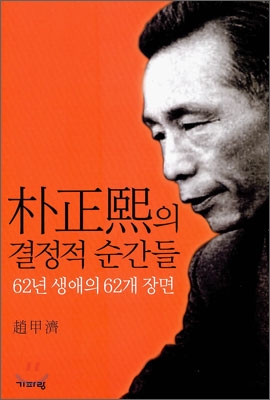
Park Chung-hee's Decisive Moments
 |
Description
Book Introduction
To mark the 30th anniversary of former President Park Chung-hee's death, we have compiled 62 scenes from the 13-volume biography of Park Chung-hee that highlight his human side and reorganized them.
From his birth and childhood to his participation in the Korean War, the May 16 military coup, and his presidency, 62 of the most dramatic scenes from his life unfold one by one.
You will be able to meet the 'human Park Chung-hee' through scenes that clearly reveal the face of former President Park Chung-hee, who loved all living things.
From his birth and childhood to his participation in the Korean War, the May 16 military coup, and his presidency, 62 of the most dramatic scenes from his life unfold one by one.
You will be able to meet the 'human Park Chung-hee' through scenes that clearly reveal the face of former President Park Chung-hee, who loved all living things.
- You can preview some of the book's contents.
Preview
index
preface
1 Exit and birth statement
2 Park Chung-hee's Handwritten Notes - 'My Boyhood'
3. Last place student
4 The detailed teacher seen by the disciples
5 The Path of a Soldier
6 Park Chung-hee on August 15, 1945
7 Become an Army Officer!
8 When he was most miserable
Park Chung-hee on the 6/25 Invasion Day
10 “Groom Yuk Young-soo and bride Park Chung-hee…”
Spring on the 38th parallel
12 Army's late-night staff meeting
13 The birth of Park Geun-hye and the death of Lee Yong-mun
14 days and people
15 Poor Soldiers
16 In the midst of the vortex of April 19
17 A letter written with a heavy heart
18 May 16 Military Revolution, on the Han River Bridge
19 The Powerful Man Who Secretly Washes His Socks
20 The historic meeting between Park Chung-hee and Lee Byung-chul
21 A bold request for aid from Kennedy
22 Visit Ulleungdo
23 A naked portrait of a fateful human being
24 The Wanderer
25 “Never again will there be an unfortunate soldier like me…”
26 1963 Presidential Election: A Choice by 150,000 Votes
27 Miners, go to West Germany!
28 June 3 Incident… Martial law again
29 Tears shed by the President and the miners together
30 Immature students and hypocritical intellectuals
31 Park Chung-hee-Johnson Summit and Deployment of Troops to South Korea
32 Hyeon-seok: Park Jeong-hyeong to Lee Je-jeong
33 “Students have taken the place of political thugs.”
Five hours of discussion with the 34 executive directors
35 "We will wipe out all the patients suffering from presidential disease."
36 The author of "The Martyr" sees his homeland
37 The rivalry between Park Chung-hee and Marcos
38 Candidate Park Chung-hee's election speech
39 North Korean special forces attack Seoul!
40 Fight while working, fight while working
41 Philosophy, Strategy, and Tactics of Unification
42 North Korean guerrilla forces land on the east coast
43 “This is how the people treat me!”
44 Purge of the Republican Party's faction
45 October Weixin - Second Coup
The inside story of the purge of Commander Yoon Pil-yong
47 Kim Dae-jung kidnapping incident
48 “Go into the tiger’s den!”
49 'The Archer of the Magic Bullet' Moon Se-gwang charges towards Park Chung-hee!
The president who lost his wife and became a poet
51 Diary of the day when Viet Nam fell
52 Uroko Oil was fake!
53 The day I got closest to war
Conflict with Carter over the withdrawal of US troops
55 A Grand Vision: Heavy Chemical Industry Construction
56 Dew Forest Project
57 Carter and Park Chung-hee, the rivals
58 Jeongma Incident and Kim So-yeon
59 Carbine and Hyojason
60 The Birth of Murder
61 Kim Jae-gyu shoots Park Chung-hee with the heart of a beast!
62 “Thus spoke Zarathustra”
1 Exit and birth statement
2 Park Chung-hee's Handwritten Notes - 'My Boyhood'
3. Last place student
4 The detailed teacher seen by the disciples
5 The Path of a Soldier
6 Park Chung-hee on August 15, 1945
7 Become an Army Officer!
8 When he was most miserable
Park Chung-hee on the 6/25 Invasion Day
10 “Groom Yuk Young-soo and bride Park Chung-hee…”
Spring on the 38th parallel
12 Army's late-night staff meeting
13 The birth of Park Geun-hye and the death of Lee Yong-mun
14 days and people
15 Poor Soldiers
16 In the midst of the vortex of April 19
17 A letter written with a heavy heart
18 May 16 Military Revolution, on the Han River Bridge
19 The Powerful Man Who Secretly Washes His Socks
20 The historic meeting between Park Chung-hee and Lee Byung-chul
21 A bold request for aid from Kennedy
22 Visit Ulleungdo
23 A naked portrait of a fateful human being
24 The Wanderer
25 “Never again will there be an unfortunate soldier like me…”
26 1963 Presidential Election: A Choice by 150,000 Votes
27 Miners, go to West Germany!
28 June 3 Incident… Martial law again
29 Tears shed by the President and the miners together
30 Immature students and hypocritical intellectuals
31 Park Chung-hee-Johnson Summit and Deployment of Troops to South Korea
32 Hyeon-seok: Park Jeong-hyeong to Lee Je-jeong
33 “Students have taken the place of political thugs.”
Five hours of discussion with the 34 executive directors
35 "We will wipe out all the patients suffering from presidential disease."
36 The author of "The Martyr" sees his homeland
37 The rivalry between Park Chung-hee and Marcos
38 Candidate Park Chung-hee's election speech
39 North Korean special forces attack Seoul!
40 Fight while working, fight while working
41 Philosophy, Strategy, and Tactics of Unification
42 North Korean guerrilla forces land on the east coast
43 “This is how the people treat me!”
44 Purge of the Republican Party's faction
45 October Weixin - Second Coup
The inside story of the purge of Commander Yoon Pil-yong
47 Kim Dae-jung kidnapping incident
48 “Go into the tiger’s den!”
49 'The Archer of the Magic Bullet' Moon Se-gwang charges towards Park Chung-hee!
The president who lost his wife and became a poet
51 Diary of the day when Viet Nam fell
52 Uroko Oil was fake!
53 The day I got closest to war
Conflict with Carter over the withdrawal of US troops
55 A Grand Vision: Heavy Chemical Industry Construction
56 Dew Forest Project
57 Carter and Park Chung-hee, the rivals
58 Jeongma Incident and Kim So-yeon
59 Carbine and Hyojason
60 The Birth of Murder
61 Kim Jae-gyu shoots Park Chung-hee with the heart of a beast!
62 “Thus spoke Zarathustra”
Publisher's Review
October 26th of this year marks the 30th anniversary of the death of President Park Chung-hee.
As we pass the milestone of '30 years,' we decided to look back on the life of President Park, who left a significant mark on modern Korean history, focusing on the 'human aspect.'
This book, in which the author (Cho Gap-je), a unique 'Park Chung-hee researcher', meticulously organizes his achievements to date, systematizes the life of President Park, who passed away at the age of 62, into 62 themes.
It is a massive volume of over 800 pages, and records his life from birth to school days, life as a teacher, military career, and presidency in an easy-to-understand and interesting chronological manner.
I hope that through this book, the true face of 'Park Chung-hee the Human' will once again be properly revealed to readers, especially to young people who have only learned about the dark side of history.
This book depicts President Park's life as it is, without any exaggeration.
Numerous episodes of mixed joy and sorrow were also inserted.
For example, when Mrs. Yuk Yeong-su was getting married in Daegu, the officiant (then mayor of Daegu) who had never met the bride and groom made a mistake and said, "The groom, Yuk Yeong-su, and the bride, Park Jeong-hee...", causing a burst of laughter among the guests. Even now, when I hear the story, I can't help but smile.
Also, the story of the then Chairman of the Supreme Council Park Chung-hee, who, as the highest leader of our country, visited Ulleungdo Island for the first time, barely escaped death twice due to rough waves, and joked, "I guess that's why no head of state has ever visited Ulleungdo Island," shows his great generosity.
Above all, this book contains nearly 10 poems and diaries written by President Park Chung-hee, who became a poet, missing his wife after losing her to a bullet.
Through such a very human poem, we can deeply feel the sorrowful feelings of the lonely president.
This poem, written the day after the state funeral for Mrs. Yuk Young-soo, brought tears to everyone's eyes.
"As a single white magnolia blossom falls in the wind / In the mourning house, in the heavy silence / Only the sound of cicadas / As if missing the departed / Under the August sun / The crimson-dyed zinnias / As if soothing the wounds of the heart / As a single white magnolia blossom falls in the spring breeze / My wife has gone alone and I am left alone / Where can I appeal to this heart-rending sorrow?"
A leader who laid the foundation for economic development
Even those who dislike President Park acknowledge that he laid a solid foundation for this country's economic development.
Truly, the life of poverty, where people lived off of 'grass roots and tree bark', was the background to the dazzling growth symbolized by the 'G20' today, and it was the sweat and tears shed by a strong-willed leader holding hands with the people.
A prime example of this is the story of our miners and nurses who were dispatched to Germany.
Testimony of Lee Ki-hong, former Economic Planning Board resident officer working at the Korean Embassy in Germany.
"At that time, under the leadership of Chairman Park, the entire nation was putting forth all its efforts to earn even a single dollar of foreign currency.
Chairman Park was working incredibly hard for a leader of a revolutionary government.
I thought he looked pitiful and lonely.
I reported this matter to the Economic Planning Board and decided to push it forward." (p.307)
The 'issue' referred to here was the dispatch of Korean miners to German coal mines.
The first group of miners boarded the plane in December 1963.
Ahead of the miners, 20 nurses also arrived in Germany.
Exactly one year later, in December 1964, President Park made an official visit to Germany.
Although he had a tight schedule, President Park was not one to turn away from his struggling compatriots.
"Miners, nurses.
I imagine that many people will be distressed by the thought of their families and homeland, but let us each remember why we came to this distant land and work hard for the honor of our country.
Even if we cannot achieve it in our lifetime, let us at least lay the foundation for prosperity like others for our descendants."
The 300 miners, 50 nurses, President Park and his wife, and their entourage all gathered there shed tears. (p. 334)
The 'Miracle of the Han River' that amazed people around the world was like this, one by one.
A revolutionary who loved all living things
President Park, who did not pay much attention to honorary doctorates, birthdays, or titles, had an innate dislike for authority.
He especially hated the tyranny of power.
He also hated empty formalities and decorations.
He was a person who always maintained a simple and humble attitude until his death.
The reason he was wearing a worn-out watch, a tie pin with the plating peeled off, and a worn-out belt when he died, and the reason the military doctor who examined the body 'never dreamed he was Your Excellency', was because he was that kind of person.
"He said in "The State, Revolution, and I" that "poverty is my teacher and benefactor" and that "I cannot spend 24 hours a day away from work related to this teacher and this benefactor.
He wrote, "The founding of an independent Korea based on a society of simple, hard-working, honest, and sincere people - that is all that I wish for."
He also emphasized that this is why he hates the privileged class, factional lineage, and the monarchical society."
A person who, living in an era of poverty, national ruin, and war, used the lump of resentment that had been buried deep in his heart as a detonator to explode the dormant energy of the nation.
Regarding the pouring criticism, Park Chung-hee, the revolutionary who “loved all living things,” met his end “calmly and resignedly” even after being pierced by a bullet in the chest, omitting any excuses, saying, “Spit on my grave when I die.”
--- Partial quote from the author's preface
As we pass the milestone of '30 years,' we decided to look back on the life of President Park, who left a significant mark on modern Korean history, focusing on the 'human aspect.'
This book, in which the author (Cho Gap-je), a unique 'Park Chung-hee researcher', meticulously organizes his achievements to date, systematizes the life of President Park, who passed away at the age of 62, into 62 themes.
It is a massive volume of over 800 pages, and records his life from birth to school days, life as a teacher, military career, and presidency in an easy-to-understand and interesting chronological manner.
I hope that through this book, the true face of 'Park Chung-hee the Human' will once again be properly revealed to readers, especially to young people who have only learned about the dark side of history.
This book depicts President Park's life as it is, without any exaggeration.
Numerous episodes of mixed joy and sorrow were also inserted.
For example, when Mrs. Yuk Yeong-su was getting married in Daegu, the officiant (then mayor of Daegu) who had never met the bride and groom made a mistake and said, "The groom, Yuk Yeong-su, and the bride, Park Jeong-hee...", causing a burst of laughter among the guests. Even now, when I hear the story, I can't help but smile.
Also, the story of the then Chairman of the Supreme Council Park Chung-hee, who, as the highest leader of our country, visited Ulleungdo Island for the first time, barely escaped death twice due to rough waves, and joked, "I guess that's why no head of state has ever visited Ulleungdo Island," shows his great generosity.
Above all, this book contains nearly 10 poems and diaries written by President Park Chung-hee, who became a poet, missing his wife after losing her to a bullet.
Through such a very human poem, we can deeply feel the sorrowful feelings of the lonely president.
This poem, written the day after the state funeral for Mrs. Yuk Young-soo, brought tears to everyone's eyes.
"As a single white magnolia blossom falls in the wind / In the mourning house, in the heavy silence / Only the sound of cicadas / As if missing the departed / Under the August sun / The crimson-dyed zinnias / As if soothing the wounds of the heart / As a single white magnolia blossom falls in the spring breeze / My wife has gone alone and I am left alone / Where can I appeal to this heart-rending sorrow?"
A leader who laid the foundation for economic development
Even those who dislike President Park acknowledge that he laid a solid foundation for this country's economic development.
Truly, the life of poverty, where people lived off of 'grass roots and tree bark', was the background to the dazzling growth symbolized by the 'G20' today, and it was the sweat and tears shed by a strong-willed leader holding hands with the people.
A prime example of this is the story of our miners and nurses who were dispatched to Germany.
Testimony of Lee Ki-hong, former Economic Planning Board resident officer working at the Korean Embassy in Germany.
"At that time, under the leadership of Chairman Park, the entire nation was putting forth all its efforts to earn even a single dollar of foreign currency.
Chairman Park was working incredibly hard for a leader of a revolutionary government.
I thought he looked pitiful and lonely.
I reported this matter to the Economic Planning Board and decided to push it forward." (p.307)
The 'issue' referred to here was the dispatch of Korean miners to German coal mines.
The first group of miners boarded the plane in December 1963.
Ahead of the miners, 20 nurses also arrived in Germany.
Exactly one year later, in December 1964, President Park made an official visit to Germany.
Although he had a tight schedule, President Park was not one to turn away from his struggling compatriots.
"Miners, nurses.
I imagine that many people will be distressed by the thought of their families and homeland, but let us each remember why we came to this distant land and work hard for the honor of our country.
Even if we cannot achieve it in our lifetime, let us at least lay the foundation for prosperity like others for our descendants."
The 300 miners, 50 nurses, President Park and his wife, and their entourage all gathered there shed tears. (p. 334)
The 'Miracle of the Han River' that amazed people around the world was like this, one by one.
A revolutionary who loved all living things
President Park, who did not pay much attention to honorary doctorates, birthdays, or titles, had an innate dislike for authority.
He especially hated the tyranny of power.
He also hated empty formalities and decorations.
He was a person who always maintained a simple and humble attitude until his death.
The reason he was wearing a worn-out watch, a tie pin with the plating peeled off, and a worn-out belt when he died, and the reason the military doctor who examined the body 'never dreamed he was Your Excellency', was because he was that kind of person.
"He said in "The State, Revolution, and I" that "poverty is my teacher and benefactor" and that "I cannot spend 24 hours a day away from work related to this teacher and this benefactor.
He wrote, "The founding of an independent Korea based on a society of simple, hard-working, honest, and sincere people - that is all that I wish for."
He also emphasized that this is why he hates the privileged class, factional lineage, and the monarchical society."
A person who, living in an era of poverty, national ruin, and war, used the lump of resentment that had been buried deep in his heart as a detonator to explode the dormant energy of the nation.
Regarding the pouring criticism, Park Chung-hee, the revolutionary who “loved all living things,” met his end “calmly and resignedly” even after being pierced by a bullet in the chest, omitting any excuses, saying, “Spit on my grave when I die.”
--- Partial quote from the author's preface
GOODS SPECIFICS
- Date of issue: October 12, 2009
- Page count, weight, size: 812 pages | 1,072g | 153*224*40mm
- ISBN13: 9788991965201
- ISBN10: 8991965202
You may also like
카테고리
korean


korean

![GQ KOREA Mark (Monthly): December [2025]](http://librairie.coreenne.fr/cdn/shop/files/8ef265dbbfbf186523ed75ba7319009d.jpg?v=1765340328&width=3840)


