

Rudolph J
 |
Description
Book Introduction
The most shining Christmas of a being that has lost its light
On the day when Christmas was safely over, Rudolph J's red nose lost its shine.
As he returns to his hometown and endures an unfamiliar and fearful daily life, a new Rudolph K, 'Rookie', appears before him and asks for his teachings.
Despite repeated rejections, Rookie does not return, and their slightly uncomfortable 'living together' finally begins.
Rudolph J tells Rookie the 'conditions for becoming Rudolph' one by one, and in the process, the two learn each other's speed.
One day before Christmas, after sending Rookie off to Santa Village, an avalanche covers Santa Village… … .
So, how will Rudolf J face this crisis? "Rudolf J" is the first book in the "Sweet Old Writings" series, and it reimagines the wisdom of Hong Woo-won's classic prose "Nomasul (老馬說)" by the late Joseon Dynasty writer, through the insight and picture book language of author Yoo Jun-jae.
The journey of a being who has lost his light, moving from loss and fear to learning and caring, conveys both joy and lyricism, and tells a story that rekindles the inner light in both children and adults.
On the day when Christmas was safely over, Rudolph J's red nose lost its shine.
As he returns to his hometown and endures an unfamiliar and fearful daily life, a new Rudolph K, 'Rookie', appears before him and asks for his teachings.
Despite repeated rejections, Rookie does not return, and their slightly uncomfortable 'living together' finally begins.
Rudolph J tells Rookie the 'conditions for becoming Rudolph' one by one, and in the process, the two learn each other's speed.
One day before Christmas, after sending Rookie off to Santa Village, an avalanche covers Santa Village… … .
So, how will Rudolf J face this crisis? "Rudolf J" is the first book in the "Sweet Old Writings" series, and it reimagines the wisdom of Hong Woo-won's classic prose "Nomasul (老馬說)" by the late Joseon Dynasty writer, through the insight and picture book language of author Yoo Jun-jae.
The journey of a being who has lost his light, moving from loss and fear to learning and caring, conveys both joy and lyricism, and tells a story that rekindles the inner light in both children and adults.
- You can preview some of the book's contents.
Preview
Detailed image

Publisher's Review
“I thought and thought about myself, who no longer shines.”
"Your light will never fade." The story of Rudolph, who lost his light, inspired by the philosophy of an old horse.
『Rudolf J』 starts from the “Old Horse Theory” by Nampa Hong Woo-won (1605-1687).
“My hooves can push through frost and snow, and my tusks can block the cold wind, so I will graze, drink water, and nourish myself.”
These sentences contain the philosophy of self-awareness and a dignified exit, along with the idea of 'the dignity of living according to one's nature.'
The classical philosophy of dealing with a ‘useless being’ through the mouth of an ‘old horse’ is revived in 『Rudolf J』 as a narrative of the relationship between a ‘retreating being’ and a ‘rising being.’
Rudolph J's red nose, which once pulled Santa's sleigh and lit up the night sky, one day sagged like the waning moon.
“I wish you had some time to yourself.” J, who was told to part ways with Santa, who he thought would be with him for the rest of his life, returns to his hometown and endures loneliness and fear alone.
Then, a new Rudolph K, 'Rookie', comes to ask for his teachings, and after several rejections, their slightly uncomfortable 'living together' begins.
J teaches Rookie step by step the lessons to become Rudolph, and Rookie gradually realizes that 'becoming Rudolph means giving all of your light.'
As Rookie accumulates learning, he becomes stronger, and while teaching Rookie, J also learns that true light does not shine from the nose, but rather shines again when you give your heart completely to someone.
After sending Rookie back to Santa Village, Rudolph J, who is now alone again, finally faces the truth contained in Santa's letter...
“Your light will not fade away.
It's quietly shining inside you.
“You will find that light again.” One day before Christmas, an avalanche hits Santa Village, and Rudolph J willingly digs and digs down into the snow to rescue Santa and Rookie who are buried in the snowdrift.
Indeed, what kind of Christmas will they have in the face of this ordeal?
"Rudolph J" is a story about a being who has lost his light and passes it on to another being.
Even if my light, which always seemed to shine, goes out, the light within me will always make a way.
The warmth of 'red' permeating the black and white snowy field, 'Rudolph J' is a picture book that adds lyricism that lingers for a long time with the magnificent texture of the snowy field and the quiet winter light on top of a solid narrative.
After closing the bookcase, a small warmth lingers like residual heat in the cold winter air.
Artist Yoo Jun-jae creates scenes that never lose their warmth by layering printmaking techniques and digital layers to create light and shade that seems to spread across the paper, and by using layered textures to bring out the mountain ridges and the texture of snow and wind.
The warm, saturated black and white captures the tone of the story, and small warmth and red light slowly spread through each page.
The characters, including Rudolph J, are depicted in a simple and warm manner, but their expressions of emotion are restrained, leaving the reader to fill in the remaining blanks on their own.
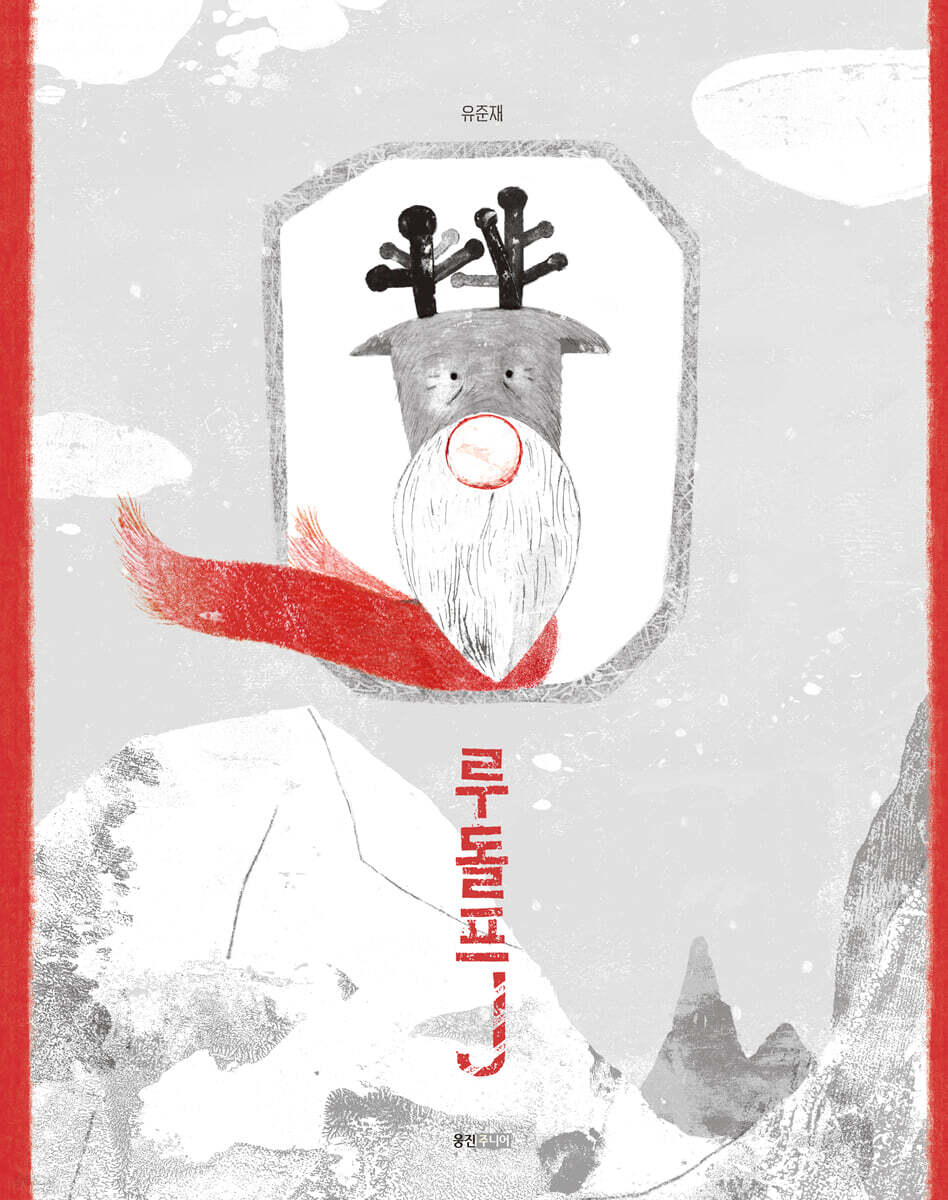
Even on the cover, that feeling is condensed at a glance.
A dot of red on a gray snowy field, Rudolph J's nose and Rookie's red scarf are the only colors that symbolize the undying heart.
The vertical title and red spine lead readers into the story like a path through a snowstorm, and the text breathes with static cuts and wide margins.
As you turn the page, the red lines and surfaces, position, concentration, and size change, continuing the flow of emotions. The gray snowfield and ashen darkness of the beginning calmly embrace J's loneliness, but with the appearance of Rookie, they convey a colorful imagery.
In the avalanche scene, rapid brushstrokes and slanted framing add tension, while the concise, affectionate style allows the painting to speak first.
The scenes showing Rudolph's conditions are rhythmically enhanced with cartoon-style arrangements and infographics.
In this way, 『Rudolph J』 is a book remembered for its warmth that transcends color and the emotional rhythm that encompasses the events.
Sweet Old Writings Stewed and Boiled, Letting Them Seep into Today's Hearts "Sweet Old Writings Stewed" "Sweet Old Writings Stewed" is a series of creative picture books that re-boils classic prose with today's language and pictures and delivers them to readers.
Based on the spirit of Yeonam Park Ji-won's 'beopgochangsin (法古創新)' - leaning on the old to create the new - rather than directly translating the original text, I aim to 'slowly condense' thoughts and emotions from the wide world of prose, including treatises, essays, narratives, folk tales, and travelogues, and reconstruct them with a contemporary sensibility.
The series title, ‘Sweet Old Writings’, contains the meaning of ‘softly boiling old writings and melting them into today’s hearts’, and the first book, ‘Rudolph J’, is a work that reinterprets the ‘Old Horse Tale’ by Hong Woo-won, a writer from the late Joseon Dynasty, with today’s illustrations and stories.
"Sweet Old Writings" is like a process of sincerity that burns when rushed and becomes watery when stopped, and by adjusting the temperature of text and images, it preserves the framework of the classics while boldly experimenting with formats and techniques, presenting a highly complete creative picture book that "tells stories that resonate even now."
Sometimes one story becomes a volume, and sometimes several stories are compiled into one volume. Through the author's perspective, the expression, theme, and worldview of the original work are reinterpreted, and by overlaying today's sensibilities with old thoughts and wisdom, they convey small lights and warmth that move our daily lives again.
“Yesterday, today, and tomorrow rotate like a wheel, but they are always new.” _Lee Deok-mu
Author's Note
The middle school student ahead of me jumped over the fence.
I also jumped over and fell with a bang! I rubbed my fallen knee.
I'm exactly fifty years old.
Standing on the ambiguous border between being neither young nor old.
“It’s better not to take big risks at our age.” I almost leaned in to those words, but then I happened to receive a thick stack of old prose from the planner and designer, Seon-a Ko.
As I was reading, I stopped in front of Hong Woo-won's "Noma Theory."
As the old horse left its owner, I saw my face, which no longer sparkled, reflected in the story of its fate.
Three years passed like that.
I tried to let go several times, but I couldn't.
Because it feels like you're letting me go.
Yeah, just because you've lost your light doesn't mean you've lost your way.
The desire to hold on to something, that was the Rudolph J inside me.
No one can avoid time.
I just hope that dreams and imaginations never grow old.
This winter, I plan to make a proper snowman.
Very cool.
Red hat, go stone eyes, branch arms… … .
Just those few things alone make me want to see that expression come alive again, that sparkling moment again.
Reviewer's Note
Aging is the accumulation of time, but that accumulation does not always lead to dignity.
Sometimes experience is mistaken for decadence, wisdom for a thing of the past that is now obsolete.
Isn't the same true of the classics of our time? What use are these outdated texts to us today?
Through the story of an old horse and a retired Rudolph, Rudolph J will provide an answer to that question.
Professor Lee Seung-eun (Professor, Department of Korean Language and Literature, Korea University)
"Your light will never fade." The story of Rudolph, who lost his light, inspired by the philosophy of an old horse.
『Rudolf J』 starts from the “Old Horse Theory” by Nampa Hong Woo-won (1605-1687).
“My hooves can push through frost and snow, and my tusks can block the cold wind, so I will graze, drink water, and nourish myself.”
These sentences contain the philosophy of self-awareness and a dignified exit, along with the idea of 'the dignity of living according to one's nature.'
The classical philosophy of dealing with a ‘useless being’ through the mouth of an ‘old horse’ is revived in 『Rudolf J』 as a narrative of the relationship between a ‘retreating being’ and a ‘rising being.’
Rudolph J's red nose, which once pulled Santa's sleigh and lit up the night sky, one day sagged like the waning moon.
“I wish you had some time to yourself.” J, who was told to part ways with Santa, who he thought would be with him for the rest of his life, returns to his hometown and endures loneliness and fear alone.
Then, a new Rudolph K, 'Rookie', comes to ask for his teachings, and after several rejections, their slightly uncomfortable 'living together' begins.
J teaches Rookie step by step the lessons to become Rudolph, and Rookie gradually realizes that 'becoming Rudolph means giving all of your light.'
As Rookie accumulates learning, he becomes stronger, and while teaching Rookie, J also learns that true light does not shine from the nose, but rather shines again when you give your heart completely to someone.
After sending Rookie back to Santa Village, Rudolph J, who is now alone again, finally faces the truth contained in Santa's letter...
“Your light will not fade away.
It's quietly shining inside you.
“You will find that light again.” One day before Christmas, an avalanche hits Santa Village, and Rudolph J willingly digs and digs down into the snow to rescue Santa and Rookie who are buried in the snowdrift.
Indeed, what kind of Christmas will they have in the face of this ordeal?
"Rudolph J" is a story about a being who has lost his light and passes it on to another being.
Even if my light, which always seemed to shine, goes out, the light within me will always make a way.
The warmth of 'red' permeating the black and white snowy field, 'Rudolph J' is a picture book that adds lyricism that lingers for a long time with the magnificent texture of the snowy field and the quiet winter light on top of a solid narrative.
After closing the bookcase, a small warmth lingers like residual heat in the cold winter air.
Artist Yoo Jun-jae creates scenes that never lose their warmth by layering printmaking techniques and digital layers to create light and shade that seems to spread across the paper, and by using layered textures to bring out the mountain ridges and the texture of snow and wind.
The warm, saturated black and white captures the tone of the story, and small warmth and red light slowly spread through each page.
The characters, including Rudolph J, are depicted in a simple and warm manner, but their expressions of emotion are restrained, leaving the reader to fill in the remaining blanks on their own.
Even on the cover, that feeling is condensed at a glance.
A dot of red on a gray snowy field, Rudolph J's nose and Rookie's red scarf are the only colors that symbolize the undying heart.
The vertical title and red spine lead readers into the story like a path through a snowstorm, and the text breathes with static cuts and wide margins.
As you turn the page, the red lines and surfaces, position, concentration, and size change, continuing the flow of emotions. The gray snowfield and ashen darkness of the beginning calmly embrace J's loneliness, but with the appearance of Rookie, they convey a colorful imagery.
In the avalanche scene, rapid brushstrokes and slanted framing add tension, while the concise, affectionate style allows the painting to speak first.
The scenes showing Rudolph's conditions are rhythmically enhanced with cartoon-style arrangements and infographics.
In this way, 『Rudolph J』 is a book remembered for its warmth that transcends color and the emotional rhythm that encompasses the events.
Sweet Old Writings Stewed and Boiled, Letting Them Seep into Today's Hearts "Sweet Old Writings Stewed" "Sweet Old Writings Stewed" is a series of creative picture books that re-boils classic prose with today's language and pictures and delivers them to readers.
Based on the spirit of Yeonam Park Ji-won's 'beopgochangsin (法古創新)' - leaning on the old to create the new - rather than directly translating the original text, I aim to 'slowly condense' thoughts and emotions from the wide world of prose, including treatises, essays, narratives, folk tales, and travelogues, and reconstruct them with a contemporary sensibility.
The series title, ‘Sweet Old Writings’, contains the meaning of ‘softly boiling old writings and melting them into today’s hearts’, and the first book, ‘Rudolph J’, is a work that reinterprets the ‘Old Horse Tale’ by Hong Woo-won, a writer from the late Joseon Dynasty, with today’s illustrations and stories.
"Sweet Old Writings" is like a process of sincerity that burns when rushed and becomes watery when stopped, and by adjusting the temperature of text and images, it preserves the framework of the classics while boldly experimenting with formats and techniques, presenting a highly complete creative picture book that "tells stories that resonate even now."
Sometimes one story becomes a volume, and sometimes several stories are compiled into one volume. Through the author's perspective, the expression, theme, and worldview of the original work are reinterpreted, and by overlaying today's sensibilities with old thoughts and wisdom, they convey small lights and warmth that move our daily lives again.
“Yesterday, today, and tomorrow rotate like a wheel, but they are always new.” _Lee Deok-mu
Author's Note
The middle school student ahead of me jumped over the fence.
I also jumped over and fell with a bang! I rubbed my fallen knee.
I'm exactly fifty years old.
Standing on the ambiguous border between being neither young nor old.
“It’s better not to take big risks at our age.” I almost leaned in to those words, but then I happened to receive a thick stack of old prose from the planner and designer, Seon-a Ko.
As I was reading, I stopped in front of Hong Woo-won's "Noma Theory."
As the old horse left its owner, I saw my face, which no longer sparkled, reflected in the story of its fate.
Three years passed like that.
I tried to let go several times, but I couldn't.
Because it feels like you're letting me go.
Yeah, just because you've lost your light doesn't mean you've lost your way.
The desire to hold on to something, that was the Rudolph J inside me.
No one can avoid time.
I just hope that dreams and imaginations never grow old.
This winter, I plan to make a proper snowman.
Very cool.
Red hat, go stone eyes, branch arms… … .
Just those few things alone make me want to see that expression come alive again, that sparkling moment again.
Reviewer's Note
Aging is the accumulation of time, but that accumulation does not always lead to dignity.
Sometimes experience is mistaken for decadence, wisdom for a thing of the past that is now obsolete.
Isn't the same true of the classics of our time? What use are these outdated texts to us today?
Through the story of an old horse and a retired Rudolph, Rudolph J will provide an answer to that question.
Professor Lee Seung-eun (Professor, Department of Korean Language and Literature, Korea University)
GOODS SPECIFICS
- Date of issue: November 7, 2025
- Page count, weight, size: 72 pages | 207*264*15mm
- ISBN13: 9788901298177
- ISBN10: 8901298171
- KC Certification: Certification Type: Conformity Confirmation
You may also like
카테고리
korean


korean

![GQ KOREA Mark (Monthly): December [2025]](http://librairie.coreenne.fr/cdn/shop/files/8ef265dbbfbf186523ed75ba7319009d.jpg?v=1765340328&width=3840)


