

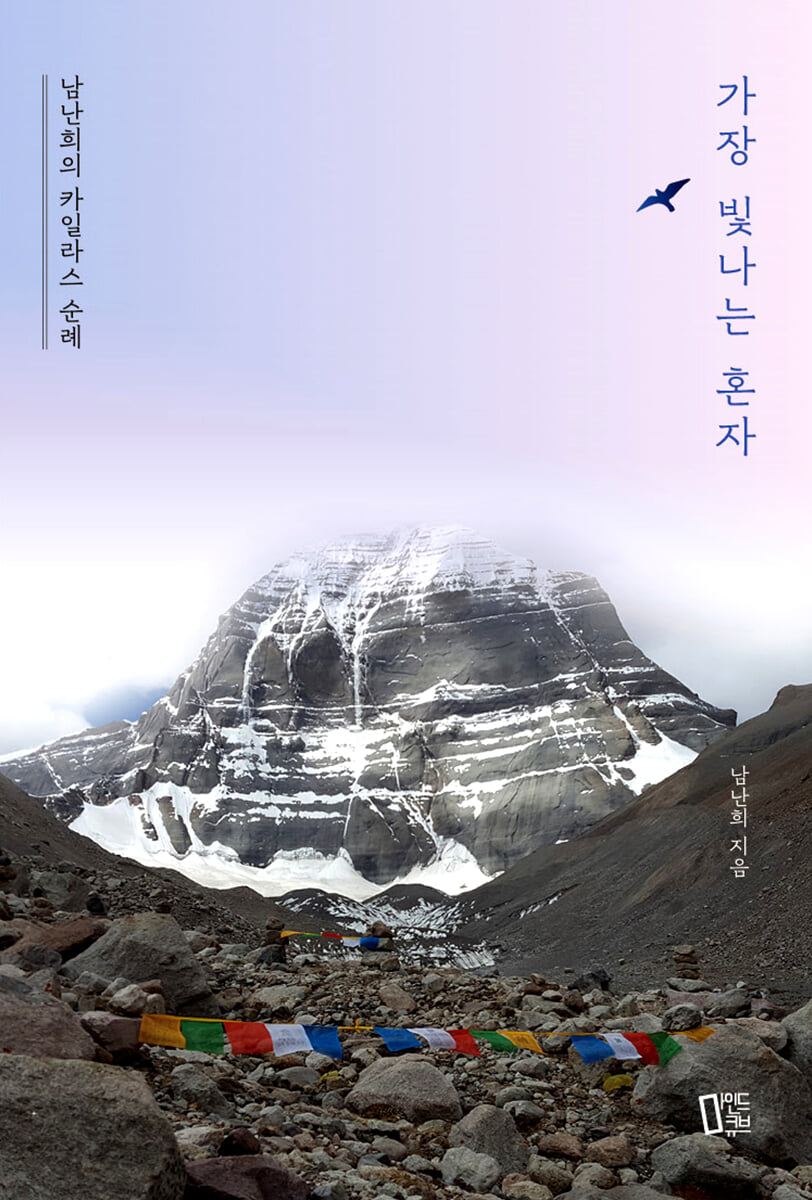
The most shining alone
 |
Description
Book Introduction
Kailash is a mountain in the southwestern part of the Tibetan Plateau, and is the English expression for the Sanskrit word 'Kailasha'.
Some people say that this mountain is the Mount Sumeru mentioned in Buddhism.
Tibetans call this mountain 'Gangrinpoche'.
There is also a freshwater lake nearby called Manasarovar, which is as wide as the sea.
This is the lake that the Tibetans call 'Mapham Yumtso'.
This book tells the story of the author's pilgrimage to Mount Kailash and Lake Manasarovar in 2016.
Some people say that this mountain is the Mount Sumeru mentioned in Buddhism.
Tibetans call this mountain 'Gangrinpoche'.
There is also a freshwater lake nearby called Manasarovar, which is as wide as the sea.
This is the lake that the Tibetans call 'Mapham Yumtso'.
This book tells the story of the author's pilgrimage to Mount Kailash and Lake Manasarovar in 2016.
- You can preview some of the book's contents.
Preview
index
Preface · 5
First Encounter · 14
Manasarovar Pilgrimage, Day 1 · 23
Manasarovar Pilgrimage, Day 2 · 40
Manasarovar Pilgrimage, Day 3 · 55
Manasarovar Pilgrimage, Final Day · 68
Kailash Pilgrimage, Day Before Departure · 90
Kailash Pilgrimage, Day 1 · 115
Kailash Pilgrimage, Day 2 · 136
Behind the Scenes · 198
First Encounter · 14
Manasarovar Pilgrimage, Day 1 · 23
Manasarovar Pilgrimage, Day 2 · 40
Manasarovar Pilgrimage, Day 3 · 55
Manasarovar Pilgrimage, Final Day · 68
Kailash Pilgrimage, Day Before Departure · 90
Kailash Pilgrimage, Day 1 · 115
Kailash Pilgrimage, Day 2 · 136
Behind the Scenes · 198
Into the book
Kailash is said to be the axis of the universe.
Kailash is said to be the center of the universe.
Kailash is said to be the navel of the universe.
Kailash is said to be a sanctuary of the soul, a realm of the divine, and a symbol of enlightenment.
Kailash is said to be the most mysterious place on Earth.
Kailash is the source of four major rivers in Asia and is also a holy site for four major religions in Asia.
The four major religions of Asia are Buddhism, Hinduism, Jainism, and Bon, the native religion of Tibet.
In Tibetan Buddhism, it is said that there are three thousand great worlds on the summit of Kailash, and in Hinduism, their powerful god Shiva resides on the summit of the mountain.
In Jainism, it is said that this is the place where the leader Mahavir attained enlightenment, and in Bonism, it is said that the leader came down this mountain and ascended again when the time was right.
The four major rivers of Asia are the Yarlung Tsangpo, the Sutrej, the Karnak, and the Indus.
The Yarlung Tsangpo River originates from the eastern side of this mountain, and its name changes to the Brahmaputra River as it passes through the Himalayas.
It is a river that flows parallel to the Himalayas from west to east across the Tibetan Plateau, then turns sharply to the southwest, passing through the Assam region of India and the Bangladesh delta before emptying into the Bay of Bengal.
The total length is 2,900 kilometers.
The Sutrej River originates in the west, passes through the Guge Kingdom, and crosses the Himalayas to join the Indus River.
The water that comes from the south is the Karnali River.
It crosses the Himalayas, passes through Nepal, and joins the Ganges River in India.
It is the source of the Ganges.
The water that flows from the north is the Indus River.
The river originates from the north face of Kailash and flows northwest parallel to the Himalayas, passing through northern Kashmir and the Ladakh Mountains.
It then turns southwest and flows through Pakistan into the Arabian Sea southeast of Karachi.
The length of this river is said to be 2,900 kilometers.
Tibetans also gave mythological interpretations of these rivers as coming from the mouths of animals.
That is, Yarlung Tsangpo was considered the mouth of a horse, Sutrej the mouth of an elephant, Karnak the mouth of a peacock, and Indus the mouth of a lion.
These animals are said to be related to Buddhism.
The horse symbolizes wisdom, the elephant symbolizes the power of compassion, the peacock symbolizes inspiration through the Dharma, and the lion symbolizes fearless practical steps toward truth.
According to Master Im Hyeon-dam's 『Gangrinpoche』, the horse is the animal that Gautama Siddhartha rode when he left everything to become a monk to become a Buddha, and the elephant is the animal that appeared in the dream of Siddhartha's mother, Lady Maya.
It is said that the peacock helped Siddhartha in his practice by eating cobras, snakes, and other vermin around him, and the lion symbolized Siddhartha's return after he attained enlightenment and restored order to the world.
The four sides of Mount Kailash are sometimes compared to jewels.
The entire mountain was interpreted as crystal, with the east as glass, the west as ruby, the south as sapphire, and the north as gold.
Meanwhile, Manasarovar is a highland lake at 4,582 meters above sea level, where water from Kailash gathers.
It is the highest freshwater lake in the world, with a circumference of over 100 kilometers.
This lake is also revered as a holy site by the four major religions.
It is especially an absolute holy place for Hindus.
Because it is the source of the Ganges River, the river they revere.
According to legend, Brahma's seven sons came down from Kailash after practicing asceticism, and when their bodies became hot from their asceticism, they had nowhere to bathe, so Brahma created a huge lake out of his own free will.
For this reason, Hindus believe that bathing in this water or simply touching it will allow them to enter Brahma's heaven, and drinking this water will cleanse them of all their sins and allow them to enter the house of Shiva.
As befits the most revered and sacred place for Hindus, they enter the water, drink, praise, shout, pray and rejoice in happiness.
The Buddhist story goes that the Buddha's mother, Queen Maya, conceived him after bathing in Manasarovar.
It is said that some of the ashes of Mahatma Gandhi, a Jain Indian saint, were scattered in the lake in accordance with his will to have his ashes scattered in Manasarovar.
* * *
I went on a pilgrimage to Kailash and Manasarovar in May 2016.
I came back and organized the manuscript, but I couldn't finish it and just kept putting it off.
In my opinion, whether it's a travelogue or a pilgrimage, if you organize it too quickly after returning, it will be fresh, but it will be too raw and lack depth of flavor, so I thought it would be better to let it age a bit before publishing it.
But for one reason or another, too many days have passed.
Actually, I had to finish it, but I couldn't do it because I had to tell Kibeom the story.
I didn't want to talk about Kibeom.
Because talking about him still makes my heart ache.
Maybe it will be like this until my last breath.
But at that time, the purpose of finding Kailash was largely to dedicate him there, and I actually performed that ritual and returned.
Even though I had made that kind of confession, I couldn't be completely free from it and just wanted to avoid it.
I couldn't write because I tried to avoid it like that.
Because it wouldn't be a pilgrimage without his story.
And one more thing.
I wanted to meet Kailash and Manasarovar once more.
I promised myself that I would definitely come back, but I really wanted to go back.
Before the Chinese government 'develops' it any further, before the Chinese government ruins it any further.
Looking back, there are many things I regret.
If only I knew then what I know now.
More than anything, I wanted to feel that energy again.
I wanted to feel that powerful energy again under the north face of Kailash, and walk that thrilling path again.
If I go back, I will walk very slowly.
I won't hold back my tears.
I will also do more prostrations.
I will visit the bosom of Manasarovar, my mother's womb, more often.
I will leave food for the cliff cave practitioners down at the bottom of the cave.
I will go to the nomads' house and live with them for just a few days.
I will definitely spend at least one night under the north face of Kailash.
I will once again enjoy the most shining time alone… … .
These feelings continued to build up.
Even though I made up my mind like that, I couldn't go back.
The biggest reason is that I started hiking the Pacific Crest Trail (PCT), a long-distance trail in the United States, in 2018.
Because of that, the plan to go to Kailash was postponed.
But I will definitely go back someday.
Go see, feel, walk and be thankful.
For those reasons, it was a manuscript that almost got left unfinished, but after receiving an offer from a publisher, I felt I couldn't put it off any longer.
I have compiled some notes and memories from my pilgrimage and am sending them out to the world.
For me, this book is a greeting to Mount Kailash.
I would like to express my gratitude to Mind Cube editor Kim In-su, who helped me see the light of day with this book, even though it was lacking.
Nam Nan-hee, July 2022
---From the author's preface
As I opened the car door and stepped out onto the ground, without even looking around, a white, triangular peak in the distance immediately caught my eye.
Kailash, the mountain I had only seen in pictures, was that very mountain.
Ah! He was there.
Thud, without me knowing it, my whole body collapsed towards him.
It was a spontaneous prostration.
Fine dust and a slightly musty smell entered my nose.
Once, twice, three times… … I don’t know how many times, but my heart ached and tears began to fall.
I was so embarrassed that I tried to sniffle my nose to get the tears back, but it was no use.
The tears eventually turned into sobs, whimpers, wailing, and wailing.
The crying was uncontrollable and poured out through my entire body, as if it were not my own, a crying that was beyond my control.
--- p.15
Of course, any mountain is the same weight to me.
Every mountain is precious to me.
The mountain is god to me.
So, we serve the mountain as if we were serving God.
The mountains are my religion.
Whether it's Baekdudaegan, the Himalayas, Jirisan, or Bul-il Falls, which I visit every day, I always encounter mountains with that kind of heart and revere them.
Of course, Kailash felt very different to me than other mountains.
It couldn't be helped, because up until now, mountains were mountains that you had to climb and come down, but Kailash is not a mountain you can climb and come down, but a mountain you have to look up at and climb.
It is a mountain that you must make a pilgrimage to by looking up at it.
It is a mountain that you walk with your whole heart praying and giving thanks, with the mountain over your shoulder.
This is the object of pilgrimage that I saw with my own eyes, not through a photo.
Is this the person I've been wanting to see or meet for so long?
--- p.18
The colorful pieces of cloth, inscribed with countless inscriptions, were piled up in layers, fluttering in the wind or falling to the ground.
Many of the letters were so faded that they were illegible.
Has the scriptures finally been fully conveyed? The colors of the pieces of scripture, weathered by time and wind, become more vivid the further out they are.
It was put up very recently, maybe just today.
Today's Tarcho, vividly preserved in its five colors, will remain there for a while, sending out sacred words on the wind.
The scenery is also bound to be spectacular.
What more needs to be said when a sacred, jewel-like mountain stands tall, and a lake like a sea decorates the scenery in purple next to it?
--- p.20
Because we were in a high altitude area, we were told to drink a lot of water to acclimatize to the altitude. We drank like carp and had to urinate several times a night. We had no choice as the accommodation did not have a bathroom.
After enduring it for as long as I could, I passed the hall to go out, and the locals glared at me with blatant glances. When I went outside to do some business, dogs that had only spoken knew and came up to me stealthily.
To me, the thought of a beast I didn't particularly like and was even afraid of approaching me in this dark, unfamiliar land, doing its business, was almost terrifying.
Oh my, I'm scared. I ran into the room like I was on a leash and never wanted to leave again, so I covered a trash can with plastic and made a makeshift urinal.
--- p.24
The lake seen up close was truly enormous.
It was so much like a sea rather than a lake.
It was surprising that such a huge lake existed at an altitude of 4,582 meters.
It is said to be the highest freshwater lake on Earth.
It is said to be a lake with a circumference of about 110 kilometers, which is hard to imagine, but because it is so wide, the view is bound to be refreshing.
I think it's a blessing in itself to be able to walk around a lake like that.
--- p.25
Now there was a road completely around the lake.
I don't know when it started.
None of the materials I've seen so far have mentioned that there's a road around Manasarovar.
Maybe it was recently created.
Now, the Chinese government seems intent on building a road around this sacred lake to attract tourists so they can comfortably tour the area from their cars.
It is truly horrifying to see a holy site being turned into a tourist attraction.
--- p.27
Perhaps they came to the lake to drink water. A herd of wild yaks were grazing and drinking water around the lake.
I also become relaxed with their endless leisure, so I put down my backpack, sit down, and spend time looking at them.
Such a large body with such gentle eyes.
What sustains their stamina in this high place, where even grass and leaves are precious? Where does that dignified and resolute presence come from? It's a marvel, a leisurely presence, devoid of any trace of impatience.
Spend some time with them.
--- p.33
At some point, I finally met a pilgrim who was making a pilgrimage to Manasarovar with prostrations.
The road was next to the lake, so I had no choice but to walk along it, and that's when I met him.
He was covered in dust all over his body.
All I could see from him was the color of dust.
The head, face, clothes, hands and feet are all the same dust color.
The badge on his forehead is a slightly darker dust color, a callus formed by contact with dirt.
Only the eyes sparkle with life.
No, there's something else that's not dust colored.
The teeth are shining white.
He said that he would go around Manasarovar and Kailash with all his might.
It seemed like the lake had been circling with five prostrations for two days already.
--- pp.44~45
Looking back, I realize that I was either too relaxed, too desperate, or too intense.
Of course, even so, I did my best during that time, and I enjoyed that time.
Even after that, depending on the time, that time was the best and that person was the best.
It's the same now.
I am here now, and the time I spend here is the best time of my life.
The path you are walking now is the best path.
Of course, yesterday was the best day of the year.
Also, tomorrow will be the best day to walk.
I am living the best time every moment of every day and walking the best path.
Where can you find a blessing greater than this?
Kailash is said to be the center of the universe.
Kailash is said to be the navel of the universe.
Kailash is said to be a sanctuary of the soul, a realm of the divine, and a symbol of enlightenment.
Kailash is said to be the most mysterious place on Earth.
Kailash is the source of four major rivers in Asia and is also a holy site for four major religions in Asia.
The four major religions of Asia are Buddhism, Hinduism, Jainism, and Bon, the native religion of Tibet.
In Tibetan Buddhism, it is said that there are three thousand great worlds on the summit of Kailash, and in Hinduism, their powerful god Shiva resides on the summit of the mountain.
In Jainism, it is said that this is the place where the leader Mahavir attained enlightenment, and in Bonism, it is said that the leader came down this mountain and ascended again when the time was right.
The four major rivers of Asia are the Yarlung Tsangpo, the Sutrej, the Karnak, and the Indus.
The Yarlung Tsangpo River originates from the eastern side of this mountain, and its name changes to the Brahmaputra River as it passes through the Himalayas.
It is a river that flows parallel to the Himalayas from west to east across the Tibetan Plateau, then turns sharply to the southwest, passing through the Assam region of India and the Bangladesh delta before emptying into the Bay of Bengal.
The total length is 2,900 kilometers.
The Sutrej River originates in the west, passes through the Guge Kingdom, and crosses the Himalayas to join the Indus River.
The water that comes from the south is the Karnali River.
It crosses the Himalayas, passes through Nepal, and joins the Ganges River in India.
It is the source of the Ganges.
The water that flows from the north is the Indus River.
The river originates from the north face of Kailash and flows northwest parallel to the Himalayas, passing through northern Kashmir and the Ladakh Mountains.
It then turns southwest and flows through Pakistan into the Arabian Sea southeast of Karachi.
The length of this river is said to be 2,900 kilometers.
Tibetans also gave mythological interpretations of these rivers as coming from the mouths of animals.
That is, Yarlung Tsangpo was considered the mouth of a horse, Sutrej the mouth of an elephant, Karnak the mouth of a peacock, and Indus the mouth of a lion.
These animals are said to be related to Buddhism.
The horse symbolizes wisdom, the elephant symbolizes the power of compassion, the peacock symbolizes inspiration through the Dharma, and the lion symbolizes fearless practical steps toward truth.
According to Master Im Hyeon-dam's 『Gangrinpoche』, the horse is the animal that Gautama Siddhartha rode when he left everything to become a monk to become a Buddha, and the elephant is the animal that appeared in the dream of Siddhartha's mother, Lady Maya.
It is said that the peacock helped Siddhartha in his practice by eating cobras, snakes, and other vermin around him, and the lion symbolized Siddhartha's return after he attained enlightenment and restored order to the world.
The four sides of Mount Kailash are sometimes compared to jewels.
The entire mountain was interpreted as crystal, with the east as glass, the west as ruby, the south as sapphire, and the north as gold.
Meanwhile, Manasarovar is a highland lake at 4,582 meters above sea level, where water from Kailash gathers.
It is the highest freshwater lake in the world, with a circumference of over 100 kilometers.
This lake is also revered as a holy site by the four major religions.
It is especially an absolute holy place for Hindus.
Because it is the source of the Ganges River, the river they revere.
According to legend, Brahma's seven sons came down from Kailash after practicing asceticism, and when their bodies became hot from their asceticism, they had nowhere to bathe, so Brahma created a huge lake out of his own free will.
For this reason, Hindus believe that bathing in this water or simply touching it will allow them to enter Brahma's heaven, and drinking this water will cleanse them of all their sins and allow them to enter the house of Shiva.
As befits the most revered and sacred place for Hindus, they enter the water, drink, praise, shout, pray and rejoice in happiness.
The Buddhist story goes that the Buddha's mother, Queen Maya, conceived him after bathing in Manasarovar.
It is said that some of the ashes of Mahatma Gandhi, a Jain Indian saint, were scattered in the lake in accordance with his will to have his ashes scattered in Manasarovar.
* * *
I went on a pilgrimage to Kailash and Manasarovar in May 2016.
I came back and organized the manuscript, but I couldn't finish it and just kept putting it off.
In my opinion, whether it's a travelogue or a pilgrimage, if you organize it too quickly after returning, it will be fresh, but it will be too raw and lack depth of flavor, so I thought it would be better to let it age a bit before publishing it.
But for one reason or another, too many days have passed.
Actually, I had to finish it, but I couldn't do it because I had to tell Kibeom the story.
I didn't want to talk about Kibeom.
Because talking about him still makes my heart ache.
Maybe it will be like this until my last breath.
But at that time, the purpose of finding Kailash was largely to dedicate him there, and I actually performed that ritual and returned.
Even though I had made that kind of confession, I couldn't be completely free from it and just wanted to avoid it.
I couldn't write because I tried to avoid it like that.
Because it wouldn't be a pilgrimage without his story.
And one more thing.
I wanted to meet Kailash and Manasarovar once more.
I promised myself that I would definitely come back, but I really wanted to go back.
Before the Chinese government 'develops' it any further, before the Chinese government ruins it any further.
Looking back, there are many things I regret.
If only I knew then what I know now.
More than anything, I wanted to feel that energy again.
I wanted to feel that powerful energy again under the north face of Kailash, and walk that thrilling path again.
If I go back, I will walk very slowly.
I won't hold back my tears.
I will also do more prostrations.
I will visit the bosom of Manasarovar, my mother's womb, more often.
I will leave food for the cliff cave practitioners down at the bottom of the cave.
I will go to the nomads' house and live with them for just a few days.
I will definitely spend at least one night under the north face of Kailash.
I will once again enjoy the most shining time alone… … .
These feelings continued to build up.
Even though I made up my mind like that, I couldn't go back.
The biggest reason is that I started hiking the Pacific Crest Trail (PCT), a long-distance trail in the United States, in 2018.
Because of that, the plan to go to Kailash was postponed.
But I will definitely go back someday.
Go see, feel, walk and be thankful.
For those reasons, it was a manuscript that almost got left unfinished, but after receiving an offer from a publisher, I felt I couldn't put it off any longer.
I have compiled some notes and memories from my pilgrimage and am sending them out to the world.
For me, this book is a greeting to Mount Kailash.
I would like to express my gratitude to Mind Cube editor Kim In-su, who helped me see the light of day with this book, even though it was lacking.
Nam Nan-hee, July 2022
---From the author's preface
As I opened the car door and stepped out onto the ground, without even looking around, a white, triangular peak in the distance immediately caught my eye.
Kailash, the mountain I had only seen in pictures, was that very mountain.
Ah! He was there.
Thud, without me knowing it, my whole body collapsed towards him.
It was a spontaneous prostration.
Fine dust and a slightly musty smell entered my nose.
Once, twice, three times… … I don’t know how many times, but my heart ached and tears began to fall.
I was so embarrassed that I tried to sniffle my nose to get the tears back, but it was no use.
The tears eventually turned into sobs, whimpers, wailing, and wailing.
The crying was uncontrollable and poured out through my entire body, as if it were not my own, a crying that was beyond my control.
--- p.15
Of course, any mountain is the same weight to me.
Every mountain is precious to me.
The mountain is god to me.
So, we serve the mountain as if we were serving God.
The mountains are my religion.
Whether it's Baekdudaegan, the Himalayas, Jirisan, or Bul-il Falls, which I visit every day, I always encounter mountains with that kind of heart and revere them.
Of course, Kailash felt very different to me than other mountains.
It couldn't be helped, because up until now, mountains were mountains that you had to climb and come down, but Kailash is not a mountain you can climb and come down, but a mountain you have to look up at and climb.
It is a mountain that you must make a pilgrimage to by looking up at it.
It is a mountain that you walk with your whole heart praying and giving thanks, with the mountain over your shoulder.
This is the object of pilgrimage that I saw with my own eyes, not through a photo.
Is this the person I've been wanting to see or meet for so long?
--- p.18
The colorful pieces of cloth, inscribed with countless inscriptions, were piled up in layers, fluttering in the wind or falling to the ground.
Many of the letters were so faded that they were illegible.
Has the scriptures finally been fully conveyed? The colors of the pieces of scripture, weathered by time and wind, become more vivid the further out they are.
It was put up very recently, maybe just today.
Today's Tarcho, vividly preserved in its five colors, will remain there for a while, sending out sacred words on the wind.
The scenery is also bound to be spectacular.
What more needs to be said when a sacred, jewel-like mountain stands tall, and a lake like a sea decorates the scenery in purple next to it?
--- p.20
Because we were in a high altitude area, we were told to drink a lot of water to acclimatize to the altitude. We drank like carp and had to urinate several times a night. We had no choice as the accommodation did not have a bathroom.
After enduring it for as long as I could, I passed the hall to go out, and the locals glared at me with blatant glances. When I went outside to do some business, dogs that had only spoken knew and came up to me stealthily.
To me, the thought of a beast I didn't particularly like and was even afraid of approaching me in this dark, unfamiliar land, doing its business, was almost terrifying.
Oh my, I'm scared. I ran into the room like I was on a leash and never wanted to leave again, so I covered a trash can with plastic and made a makeshift urinal.
--- p.24
The lake seen up close was truly enormous.
It was so much like a sea rather than a lake.
It was surprising that such a huge lake existed at an altitude of 4,582 meters.
It is said to be the highest freshwater lake on Earth.
It is said to be a lake with a circumference of about 110 kilometers, which is hard to imagine, but because it is so wide, the view is bound to be refreshing.
I think it's a blessing in itself to be able to walk around a lake like that.
--- p.25
Now there was a road completely around the lake.
I don't know when it started.
None of the materials I've seen so far have mentioned that there's a road around Manasarovar.
Maybe it was recently created.
Now, the Chinese government seems intent on building a road around this sacred lake to attract tourists so they can comfortably tour the area from their cars.
It is truly horrifying to see a holy site being turned into a tourist attraction.
--- p.27
Perhaps they came to the lake to drink water. A herd of wild yaks were grazing and drinking water around the lake.
I also become relaxed with their endless leisure, so I put down my backpack, sit down, and spend time looking at them.
Such a large body with such gentle eyes.
What sustains their stamina in this high place, where even grass and leaves are precious? Where does that dignified and resolute presence come from? It's a marvel, a leisurely presence, devoid of any trace of impatience.
Spend some time with them.
--- p.33
At some point, I finally met a pilgrim who was making a pilgrimage to Manasarovar with prostrations.
The road was next to the lake, so I had no choice but to walk along it, and that's when I met him.
He was covered in dust all over his body.
All I could see from him was the color of dust.
The head, face, clothes, hands and feet are all the same dust color.
The badge on his forehead is a slightly darker dust color, a callus formed by contact with dirt.
Only the eyes sparkle with life.
No, there's something else that's not dust colored.
The teeth are shining white.
He said that he would go around Manasarovar and Kailash with all his might.
It seemed like the lake had been circling with five prostrations for two days already.
--- pp.44~45
Looking back, I realize that I was either too relaxed, too desperate, or too intense.
Of course, even so, I did my best during that time, and I enjoyed that time.
Even after that, depending on the time, that time was the best and that person was the best.
It's the same now.
I am here now, and the time I spend here is the best time of my life.
The path you are walking now is the best path.
Of course, yesterday was the best day of the year.
Also, tomorrow will be the best day to walk.
I am living the best time every moment of every day and walking the best path.
Where can you find a blessing greater than this?
--- pp.58~59
Publisher's Review
The Sacred Mountain and the Pilgrim's Inner Self
Kailash is a mountain in the southwestern part of the Tibetan Plateau, and is the English expression for the Sanskrit word 'Kailasha'.
Some people say that this mountain is the Mount Sumeru mentioned in Buddhism.
Tibetans call this mountain 'Gangrinpoche'.
There is also a freshwater lake nearby called Manasarovar, which is as wide as the sea.
This is the lake that Tibetans call 'Mapham Yumtso'.
This book tells the story of the author's pilgrimage to Mount Kailash and Lake Manasarovar in 2016.
The author introduces Mount Kailash as follows:
“Kailas is said to be the axis of the universe.
Kailash is said to be the center of the universe.
Kailash is said to be the navel of the universe.
Kailash is said to be a sanctuary of the soul, a realm of the divine, and a symbol of enlightenment.
Kailash is said to be the most mysterious place on Earth.
Kailash is the source of four major rivers in Asia and is also a holy site for four major religions in Asia.
The four major religions of Asia are Buddhism, Hinduism, Jainism, and Bon, the native religion of Tibet.
In Tibetan Buddhism, it is said that there are three thousand great worlds on the summit of Kailash, and in Hinduism, their powerful god Shiva resides on the summit of the mountain.
In Jainism, it is said that this is the place where the leader Mahavir attained enlightenment, and in Bonism, it is said that the leader came down this mountain and ascended again when the time was right.”
The author first encountered Kailash (Kang Rinpoche) through a photograph over a dozen years ago.
The author said he felt a thrill just by looking at the photos.
A mountain made entirely of black rock, when covered with white snow, it shines white alone even when the snow on other mountains has melted.
From then on, the author always kept that mountain, which gave him thrills and excitement, in his heart.
Then, in 2013, the author faced a great ordeal.
In August, his closest junior passed away from cancer, and to make matters worse, in November, his most precious son left him.
The author's whole life was paralyzed.
I barely managed to breathe.
I lived in anger, resentment, and self-harm.
I spent more than two years like that.
Then, when his mind finally began to calm down, the author began to think that he had to 'send off' the two people well.
In his own way, he decided to 'return' the two people.
That is precisely why the author went on a pilgrimage to Kailash and Manasarovar in May 2016.
This book fully captures the author's feelings.
As you know, Tibet is currently under China's control.
Naturally, the Chinese government controls the areas around Kailash and Manasarovar.
As a result, roads and accommodations are being built indiscriminately.
The author's lamentations, criticisms, and concerns about the Chinese government's reckless development and destruction are expressed throughout the book.
While reading the author's pilgrimage, readers will encounter the mystical mountain Kailash (Kang Rinpoche) and the sacred lake Manasarovar (Mapham Yumtso) around it, and will feel as if they are on a pilgrimage with the author.
The story of the 'Kuge Kingdom', which the author visited on his way back home, can be obtained as a bonus.
Kailash is a mountain in the southwestern part of the Tibetan Plateau, and is the English expression for the Sanskrit word 'Kailasha'.
Some people say that this mountain is the Mount Sumeru mentioned in Buddhism.
Tibetans call this mountain 'Gangrinpoche'.
There is also a freshwater lake nearby called Manasarovar, which is as wide as the sea.
This is the lake that Tibetans call 'Mapham Yumtso'.
This book tells the story of the author's pilgrimage to Mount Kailash and Lake Manasarovar in 2016.
The author introduces Mount Kailash as follows:
“Kailas is said to be the axis of the universe.
Kailash is said to be the center of the universe.
Kailash is said to be the navel of the universe.
Kailash is said to be a sanctuary of the soul, a realm of the divine, and a symbol of enlightenment.
Kailash is said to be the most mysterious place on Earth.
Kailash is the source of four major rivers in Asia and is also a holy site for four major religions in Asia.
The four major religions of Asia are Buddhism, Hinduism, Jainism, and Bon, the native religion of Tibet.
In Tibetan Buddhism, it is said that there are three thousand great worlds on the summit of Kailash, and in Hinduism, their powerful god Shiva resides on the summit of the mountain.
In Jainism, it is said that this is the place where the leader Mahavir attained enlightenment, and in Bonism, it is said that the leader came down this mountain and ascended again when the time was right.”
The author first encountered Kailash (Kang Rinpoche) through a photograph over a dozen years ago.
The author said he felt a thrill just by looking at the photos.
A mountain made entirely of black rock, when covered with white snow, it shines white alone even when the snow on other mountains has melted.
From then on, the author always kept that mountain, which gave him thrills and excitement, in his heart.
Then, in 2013, the author faced a great ordeal.
In August, his closest junior passed away from cancer, and to make matters worse, in November, his most precious son left him.
The author's whole life was paralyzed.
I barely managed to breathe.
I lived in anger, resentment, and self-harm.
I spent more than two years like that.
Then, when his mind finally began to calm down, the author began to think that he had to 'send off' the two people well.
In his own way, he decided to 'return' the two people.
That is precisely why the author went on a pilgrimage to Kailash and Manasarovar in May 2016.
This book fully captures the author's feelings.
As you know, Tibet is currently under China's control.
Naturally, the Chinese government controls the areas around Kailash and Manasarovar.
As a result, roads and accommodations are being built indiscriminately.
The author's lamentations, criticisms, and concerns about the Chinese government's reckless development and destruction are expressed throughout the book.
While reading the author's pilgrimage, readers will encounter the mystical mountain Kailash (Kang Rinpoche) and the sacred lake Manasarovar (Mapham Yumtso) around it, and will feel as if they are on a pilgrimage with the author.
The story of the 'Kuge Kingdom', which the author visited on his way back home, can be obtained as a bonus.
GOODS SPECIFICS
- Publication date: August 29, 2022
- Page count, weight, size: 236 pages | 300g | 128*188*20mm
- ISBN13: 9791188434633
- ISBN10: 1188434632
You may also like
카테고리
korean


korean

![GQ KOREA Mark (Monthly): December [2025]](http://librairie.coreenne.fr/cdn/shop/files/8ef265dbbfbf186523ed75ba7319009d.jpg?v=1765340328&width=3840)


