

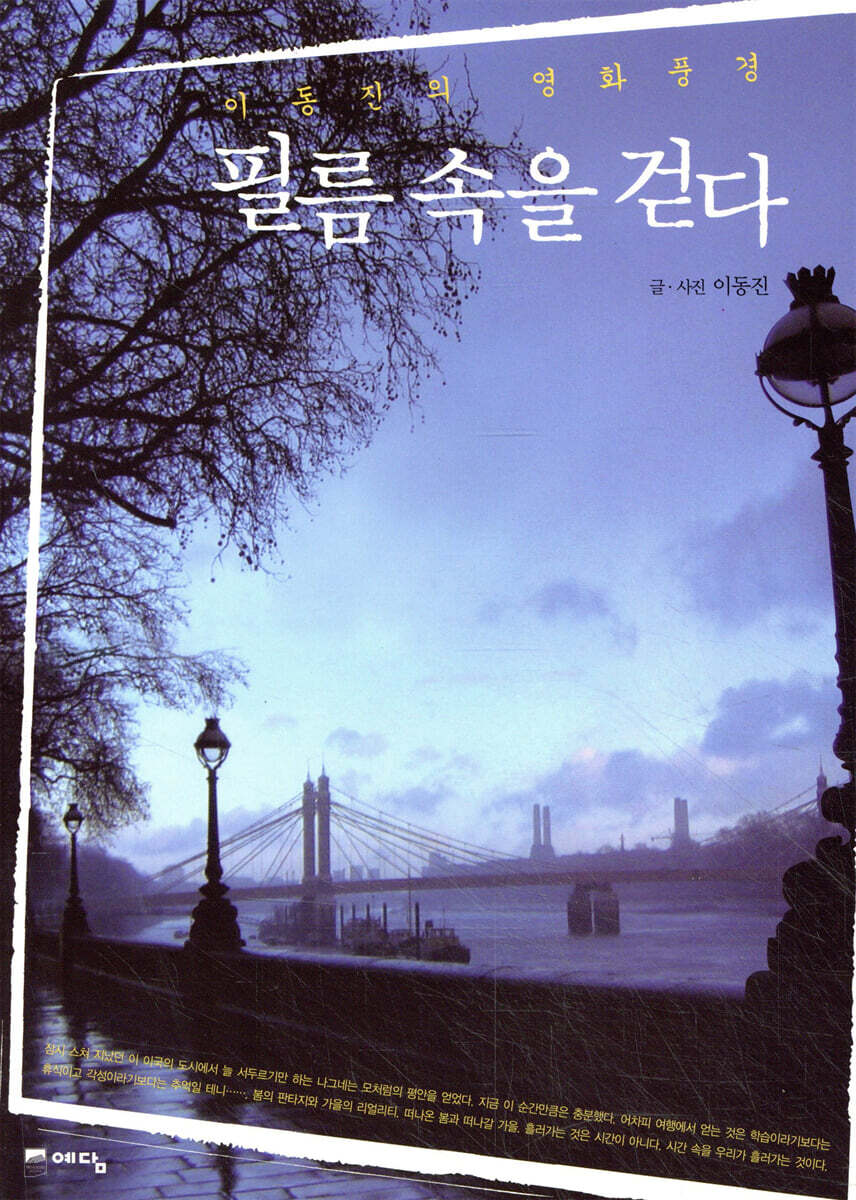
Walking through the film
 |
Description
Book Introduction
A travel essay by film critic Lee Dong-jin, popular for his delicate and lucid film reviews.
"Walking Through Film" is a travel essay collection that takes you to the landscapes where various films such as "Love Letter," "Before Sunset," and "Love Actually" were created.
You can experience scenes from the movie in a new way through the eyes of a critic.
What will the impressive scenes that seemed fleeting on screen be like today? This book, which naturally captures the changing landscapes encountered in the film, takes us on a journey through various locations, including Otaru, Japan, Cuba, and Venice.
This book is a revised and significantly expanded version of the author's previously published series in the Chosun Ilbo, titled "Lee Dong-jin's World Cinema Journey." Through "Walking Through Film," the author's love of film and curiosity as a traveler are palpable.
It is filled with beautifully captured photos of the locations that served as the backdrop for the movie.
"Walking Through Film" is a travel essay collection that takes you to the landscapes where various films such as "Love Letter," "Before Sunset," and "Love Actually" were created.
You can experience scenes from the movie in a new way through the eyes of a critic.
What will the impressive scenes that seemed fleeting on screen be like today? This book, which naturally captures the changing landscapes encountered in the film, takes us on a journey through various locations, including Otaru, Japan, Cuba, and Venice.
This book is a revised and significantly expanded version of the author's previously published series in the Chosun Ilbo, titled "Lee Dong-jin's World Cinema Journey." Through "Walking Through Film," the author's love of film and curiosity as a traveler are palpable.
It is filled with beautifully captured photos of the locations that served as the backdrop for the movie.
- You can preview some of the book's contents.
Preview
index
#01 Finding traces
Time to Go Out into the World - Love Letter, Otaru
The flowers that make up the forest wither - Before Sunset, Paris
Love dies of indigestion - My Best Friend's Wedding, Chicago
All that has endured time - Eternal Sunshine of the Spotless Mind, Montauk
If you talk about love, you will love - Love Actually, London
#02 Finding Reality
The Guilt of the Carbonated Bubbling in Your Mouth - In the Mood for Love, Cambodia
What is it? Where is it? Just again - Picnic at Hanging Rock, Australia
The Overconsumption Revolution - Buena Vista Social Club, Cuba
Went to the Winter Sea - Josee, the Tiger and the Fish, Chiba
The Right to Be Lazy - The Chronicles of Narnia, New Zealand
#03 Finding Time
Sealed Time - Gloomy Sunday, Budapest
I wish you were here - Schindler's List, Poland
In this cold corner of the star—Seven Years in Tibet, Tibet
Some people are simply born with sadness - Remembering Leslie Cheung, Hong Kong
The deeper the island, the lonelier it becomes - Death in Venice, Venice
Time to Go Out into the World - Love Letter, Otaru
The flowers that make up the forest wither - Before Sunset, Paris
Love dies of indigestion - My Best Friend's Wedding, Chicago
All that has endured time - Eternal Sunshine of the Spotless Mind, Montauk
If you talk about love, you will love - Love Actually, London
#02 Finding Reality
The Guilt of the Carbonated Bubbling in Your Mouth - In the Mood for Love, Cambodia
What is it? Where is it? Just again - Picnic at Hanging Rock, Australia
The Overconsumption Revolution - Buena Vista Social Club, Cuba
Went to the Winter Sea - Josee, the Tiger and the Fish, Chiba
The Right to Be Lazy - The Chronicles of Narnia, New Zealand
#03 Finding Time
Sealed Time - Gloomy Sunday, Budapest
I wish you were here - Schindler's List, Poland
In this cold corner of the star—Seven Years in Tibet, Tibet
Some people are simply born with sadness - Remembering Leslie Cheung, Hong Kong
The deeper the island, the lonelier it becomes - Death in Venice, Venice
Into the book
Le Pur Cafe, which the two reached after wandering through the alleyways, was located near the Charonne station in the 11th arrondissement, which is emerging as a new center of art in Paris.
I sat at the two-person table where Celine and Jesse were sitting and ordered coffee like them.
A man sitting at the bar in the middle, drinking wine, whistled skillfully as a soft chanson flowed from the speakers.
As soon as Jessie sits down here, she blurts out, "Why aren't there cafes like this in America?"
The quiet and leisurely cafes and back alleys were a perfect example of what Parisians' Paris is like.
The two people, sitting in a cafe and starting to talk in earnest, realize how powerful nine years can be.
In Vienna, Celine and Jesse, who had never clashed over any topic of conversation, witnessed the miserable reality of the Third World, and their worldviews changed as time went by: one became a pessimist who believed that humanity had no vision, and the other an optimist who believed that hope still existed.
On the napkin on the table, behind the words 'Le Pur Cafe', there were three dots printed like ellipses.
What were the words that the two people who sat across from each other at this table and had a wide-ranging conversation about life, philosophy, religion, and society, as if it were that day long ago, ended up unable to express and ended up condensing?
What ultimately determines the longevity of love is not the romance spoken, but the compassion swallowed by the heart.
After leaving the cafe, the two continued their conversation and went to the Promenade Plantée, a promenade near the Gare de Lyon.
As I walked along the path that used to be a railroad track and was now a park, listening to the sound of bamboo leaves swaying in the wind, I noticed a man and a woman walking with only their pinkies linked.
Lovers are people who recklessly promise their feelings in the face of time, which changes everything.
--- pp.33~35
I climbed the rock that stood tall at the top.
I felt like I was going to fall down in the strong wind.
Where Albert found one of the missing girls.
A small village came into view in the distance.
Villages were scattered sparsely across the plains.
But the silence seemed to swallow even the screams.
As if swallowing Albert's cries for rescue.
All those events and the secrets of world affairs.
Silence was the only thing possible there.
I met many people at the bottom of the mountain.
But there was no one at the top.
The weather was gloomy.
The rock was cold.
When I lay on the rock, my skin breathed instead of my lungs.
In the mountains, touch dominated sight.
And my hearing became sharper.
Sometimes a bird flew.
When the wind blew, the small forest shook violently.
But the stone remained silent the whole time.
The stone was indifferent.
I unpacked my bag from a small hole between the rocks.
I ate scones and drank juice.
I took out a book and looked through it here and there.
I quickly ran out of things to do.
The picnic is over.
But there was no way down.
But do I really have to go down?
As time went by, it became like that.
It was as if I myself were a part of nature.
We do not dream, we are dreamed.
Every exit is an entrance to somewhere else.
The temptation of evaporation was tough.
I want to scatter my life, which I have shared and shared again, into the air.
First, I no longer thought about the girls who had disappeared.
The mystery of life.
The mystery of nothingness.
What could it be?
Where is it?
just.
also.
--- pp.147~148
Now I had to go there.
How could this journey end without stopping at the Mandarin Oriental Hotel, where he jumped from the 24th floor? In "A Fei Zheng Zhuan," Leslie Cheung speaks to Andy Lau as he dies on the train.
"I've always wondered what I see when I die.
"I'm going to die with my eyes open." What did he, who suffered from acrophobia, see when he threw himself from the 24th floor to the ground?
The hotel, which forms one of the skyscrapers in Central, Hong Kong's busiest district, was coincidentally closed for renovations, with all entrances blocked.
The construction netting surrounding the building looked like a suicide prevention device.
This building was built in 1960.
Coincidentally, the hotel was undergoing a complete renovation after 46 years, the exact same number of years that Leslie Cheung had been here.
From Madame Tussauds Wax Museum to the Mandarin Oriental Hotel, many places associated with Leslie Cheung were strangely under construction.
As if trying to shake off the tragic relationship with a certain unfortunate person.
(Omitted) Damn it.
Three years was a long enough time.
The world has already forgotten the man who ended his futile life at the age of forty-six.
Unable to find a place to fly in this claustrophobic, cramped and crowded city, he eventually resorted to jumping.
Even after his death, his scent still lingered like a ghost, unable to leave the world he lived in, but people had already sent him away long ago.
I was about to leave the square when I looked at my watch and stood there blankly for another five minutes before I started walking towards the sea.
6:41.
Just as the day was about to end.
That was the moment Leslie Cheung left this crowded stage.
I sat at the two-person table where Celine and Jesse were sitting and ordered coffee like them.
A man sitting at the bar in the middle, drinking wine, whistled skillfully as a soft chanson flowed from the speakers.
As soon as Jessie sits down here, she blurts out, "Why aren't there cafes like this in America?"
The quiet and leisurely cafes and back alleys were a perfect example of what Parisians' Paris is like.
The two people, sitting in a cafe and starting to talk in earnest, realize how powerful nine years can be.
In Vienna, Celine and Jesse, who had never clashed over any topic of conversation, witnessed the miserable reality of the Third World, and their worldviews changed as time went by: one became a pessimist who believed that humanity had no vision, and the other an optimist who believed that hope still existed.
On the napkin on the table, behind the words 'Le Pur Cafe', there were three dots printed like ellipses.
What were the words that the two people who sat across from each other at this table and had a wide-ranging conversation about life, philosophy, religion, and society, as if it were that day long ago, ended up unable to express and ended up condensing?
What ultimately determines the longevity of love is not the romance spoken, but the compassion swallowed by the heart.
After leaving the cafe, the two continued their conversation and went to the Promenade Plantée, a promenade near the Gare de Lyon.
As I walked along the path that used to be a railroad track and was now a park, listening to the sound of bamboo leaves swaying in the wind, I noticed a man and a woman walking with only their pinkies linked.
Lovers are people who recklessly promise their feelings in the face of time, which changes everything.
--- pp.33~35
I climbed the rock that stood tall at the top.
I felt like I was going to fall down in the strong wind.
Where Albert found one of the missing girls.
A small village came into view in the distance.
Villages were scattered sparsely across the plains.
But the silence seemed to swallow even the screams.
As if swallowing Albert's cries for rescue.
All those events and the secrets of world affairs.
Silence was the only thing possible there.
I met many people at the bottom of the mountain.
But there was no one at the top.
The weather was gloomy.
The rock was cold.
When I lay on the rock, my skin breathed instead of my lungs.
In the mountains, touch dominated sight.
And my hearing became sharper.
Sometimes a bird flew.
When the wind blew, the small forest shook violently.
But the stone remained silent the whole time.
The stone was indifferent.
I unpacked my bag from a small hole between the rocks.
I ate scones and drank juice.
I took out a book and looked through it here and there.
I quickly ran out of things to do.
The picnic is over.
But there was no way down.
But do I really have to go down?
As time went by, it became like that.
It was as if I myself were a part of nature.
We do not dream, we are dreamed.
Every exit is an entrance to somewhere else.
The temptation of evaporation was tough.
I want to scatter my life, which I have shared and shared again, into the air.
First, I no longer thought about the girls who had disappeared.
The mystery of life.
The mystery of nothingness.
What could it be?
Where is it?
just.
also.
--- pp.147~148
Now I had to go there.
How could this journey end without stopping at the Mandarin Oriental Hotel, where he jumped from the 24th floor? In "A Fei Zheng Zhuan," Leslie Cheung speaks to Andy Lau as he dies on the train.
"I've always wondered what I see when I die.
"I'm going to die with my eyes open." What did he, who suffered from acrophobia, see when he threw himself from the 24th floor to the ground?
The hotel, which forms one of the skyscrapers in Central, Hong Kong's busiest district, was coincidentally closed for renovations, with all entrances blocked.
The construction netting surrounding the building looked like a suicide prevention device.
This building was built in 1960.
Coincidentally, the hotel was undergoing a complete renovation after 46 years, the exact same number of years that Leslie Cheung had been here.
From Madame Tussauds Wax Museum to the Mandarin Oriental Hotel, many places associated with Leslie Cheung were strangely under construction.
As if trying to shake off the tragic relationship with a certain unfortunate person.
(Omitted) Damn it.
Three years was a long enough time.
The world has already forgotten the man who ended his futile life at the age of forty-six.
Unable to find a place to fly in this claustrophobic, cramped and crowded city, he eventually resorted to jumping.
Even after his death, his scent still lingered like a ghost, unable to leave the world he lived in, but people had already sent him away long ago.
I was about to leave the square when I looked at my watch and stood there blankly for another five minutes before I started walking towards the sea.
6:41.
Just as the day was about to end.
That was the moment Leslie Cheung left this crowded stage.
--- pp.282~285
Publisher's Review
A romantic meeting of movies and travel!
Flowing through time and into film, in search of memories and traces of love, reality and fantasy, the fleeting and the eternal… …
From Otaru, Japan, the hometown of my hazy first love, to Venice, where a lonely musician died alone.
A journey to discover the landscape where movies were born
Movies and travel have something in common: they are like dreams that are slightly removed from reality.
So how romantic would it be to have these two together?
For those who find it difficult to take action, film journalist Lee Dong-jin has stepped forward as a friendly guide.
“Walking Through Film,” recently published by Yedam, is a travel essay that takes you to the landscapes where various films were created, such as “Love Letter,” “Before Sunset,” “Love Actually,” and “In the Mood for Love.”
Reporter Lee Dong-jin's visit to 'that place' in the movie was not simply to recreate and confirm the movie's scenes.
I wanted to naturally find traces of the impressive scenes that passed by in a fleeting moment on the screen, in what form and time they remain in reality, and how they have changed over time.
"Walking Through Film" is a book that helps readers experience the romantic experience of walking down alleyways and strolling along the beach with the main characters in movies, traveling to various places such as Otaru, Japan, Cuba, and Venice, through soft and delicate sentences and photos that capture scenery more dramatic than a movie.
Walk into the film in search of memories and traces of love, reality and fantasy, the fleeting and the eternal.
Reporter Lee Dong-jin, author of "Walking Through Film," is known for his delicate perspective and sensitive writing style, and for having a loyal fan base, which is rare for a reporter.
This book is full of such characteristics, and its charm is enhanced by a love of film and a traveler's slow, curious pace and gaze.
For example, reporter Lee Dong-jin, who visited the middle school attended by the main characters of “Love Letter,” sits in the back of the classroom where the filming took place and seriously thinks about the young boys and girls’ love, and also visits the place that appeared as the female protagonist’s home.
Although you are forced to turn back in front of an empty house after encountering a heavy snowfall, you will encounter a landscape that will remind you of the scene from the play at a glance.
The journey of this book largely brings to mind the lonely and solitary figures of its protagonists. The beaches of Montauk, USA, which served as the setting for "Eternal Sunshine of the Spotless Mind," and the beaches of Kyushu-ri, Chiba Prefecture, Japan, which served as the setting for "Josee, the Tiger and the Fish," overlap as places of secret rituals for those who visit alone, and they bring to mind the future of unrequited love. As in "Love Actually," London, visited on Christmas, was a lonely place to confirm the love that is everywhere, and the Polish winter of "Schindler's List," which contains the dark memories of the Holocaust, was heavy.
In addition, the scenery of Hong Kong, where I went to find the traces of Leslie Cheung, who was “just born with sadness,” and Venice, where I followed the lonely path of an old musician who died (“Death in Venice”), are even more impressive than the film itself.
In particular, the article introducing the Australian film "Picnic at Hanging Rock," which has been enthusiastically supported by a small number of fans even though it has not been officially released or introduced in Korea, received a great response even at the time of serialization because it conveys the mysterious atmosphere of the film even without having seen it.
Flowing through time and into film, in search of memories and traces of love, reality and fantasy, the fleeting and the eternal… …
From Otaru, Japan, the hometown of my hazy first love, to Venice, where a lonely musician died alone.
A journey to discover the landscape where movies were born
Movies and travel have something in common: they are like dreams that are slightly removed from reality.
So how romantic would it be to have these two together?
For those who find it difficult to take action, film journalist Lee Dong-jin has stepped forward as a friendly guide.
“Walking Through Film,” recently published by Yedam, is a travel essay that takes you to the landscapes where various films were created, such as “Love Letter,” “Before Sunset,” “Love Actually,” and “In the Mood for Love.”
Reporter Lee Dong-jin's visit to 'that place' in the movie was not simply to recreate and confirm the movie's scenes.
I wanted to naturally find traces of the impressive scenes that passed by in a fleeting moment on the screen, in what form and time they remain in reality, and how they have changed over time.
"Walking Through Film" is a book that helps readers experience the romantic experience of walking down alleyways and strolling along the beach with the main characters in movies, traveling to various places such as Otaru, Japan, Cuba, and Venice, through soft and delicate sentences and photos that capture scenery more dramatic than a movie.
Walk into the film in search of memories and traces of love, reality and fantasy, the fleeting and the eternal.
Reporter Lee Dong-jin, author of "Walking Through Film," is known for his delicate perspective and sensitive writing style, and for having a loyal fan base, which is rare for a reporter.
This book is full of such characteristics, and its charm is enhanced by a love of film and a traveler's slow, curious pace and gaze.
For example, reporter Lee Dong-jin, who visited the middle school attended by the main characters of “Love Letter,” sits in the back of the classroom where the filming took place and seriously thinks about the young boys and girls’ love, and also visits the place that appeared as the female protagonist’s home.
Although you are forced to turn back in front of an empty house after encountering a heavy snowfall, you will encounter a landscape that will remind you of the scene from the play at a glance.
The journey of this book largely brings to mind the lonely and solitary figures of its protagonists. The beaches of Montauk, USA, which served as the setting for "Eternal Sunshine of the Spotless Mind," and the beaches of Kyushu-ri, Chiba Prefecture, Japan, which served as the setting for "Josee, the Tiger and the Fish," overlap as places of secret rituals for those who visit alone, and they bring to mind the future of unrequited love. As in "Love Actually," London, visited on Christmas, was a lonely place to confirm the love that is everywhere, and the Polish winter of "Schindler's List," which contains the dark memories of the Holocaust, was heavy.
In addition, the scenery of Hong Kong, where I went to find the traces of Leslie Cheung, who was “just born with sadness,” and Venice, where I followed the lonely path of an old musician who died (“Death in Venice”), are even more impressive than the film itself.
In particular, the article introducing the Australian film "Picnic at Hanging Rock," which has been enthusiastically supported by a small number of fans even though it has not been officially released or introduced in Korea, received a great response even at the time of serialization because it conveys the mysterious atmosphere of the film even without having seen it.
GOODS SPECIFICS
- Date of issue: October 15, 2007
- Page count, weight, size: 301 pages | 578g | 153*224*30mm
- ISBN13: 9788959132645
- ISBN10: 8959132640
You may also like
카테고리
korean


korean

![GQ KOREA Mark (Monthly): December [2025]](http://librairie.coreenne.fr/cdn/shop/files/8ef265dbbfbf186523ed75ba7319009d.jpg?v=1765340328&width=3840)


