

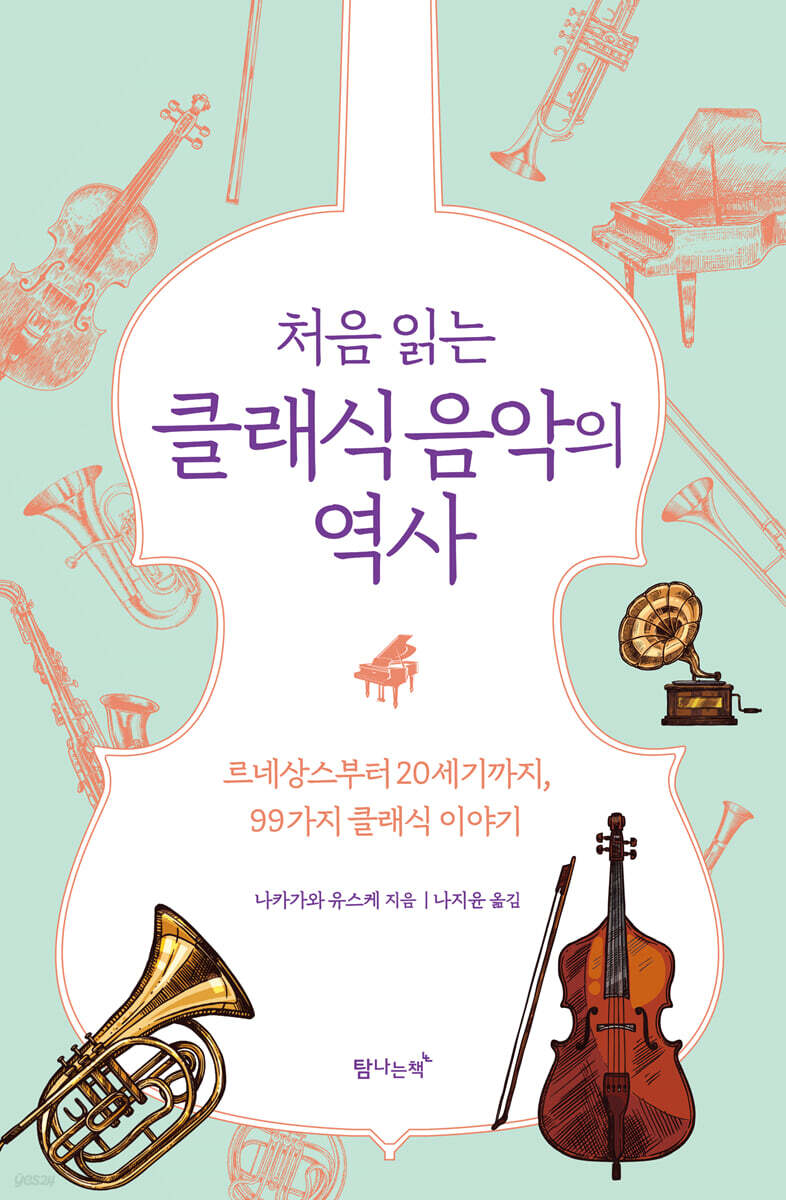
A History of Classical Music for the First Time
 |
Description
Book Introduction
Classic history in one volume
99 Classical Musical Instruments, Playing 400 Years of Musical History
“If you know Western music history, you will be able to enjoy classical music!”
This book covers a wide range of classical music, from the Renaissance to the most recent.
The reason this book is titled 'A History of Classical Music for Beginners' is simple.
This is because it covers all the music found in the classical music section of large record stores in one volume.
Music from the Renaissance period after Gregorian chant, as well as Baroque, Classical, Early and Late Romantic, and 20th-century contemporary music all fall into the category of classical music.
According to these classifications, this book covers each music history in six chapters.
This will allow you to explore the history of classical music in just a few hours.
The book progresses chronologically, and the story is divided into 99 topics, including characters, events, concepts, and technical terms.
Each item is independent, but it is organized in a series of short stories so that reading them sequentially allows for an understanding of the flow of music history.
You can read only the interesting parts, start from the first chapter, or work your way back from the last chapter.
99 Classical Musical Instruments, Playing 400 Years of Musical History
“If you know Western music history, you will be able to enjoy classical music!”
This book covers a wide range of classical music, from the Renaissance to the most recent.
The reason this book is titled 'A History of Classical Music for Beginners' is simple.
This is because it covers all the music found in the classical music section of large record stores in one volume.
Music from the Renaissance period after Gregorian chant, as well as Baroque, Classical, Early and Late Romantic, and 20th-century contemporary music all fall into the category of classical music.
According to these classifications, this book covers each music history in six chapters.
This will allow you to explore the history of classical music in just a few hours.
The book progresses chronologically, and the story is divided into 99 topics, including characters, events, concepts, and technical terms.
Each item is independent, but it is organized in a series of short stories so that reading them sequentially allows for an understanding of the flow of music history.
You can read only the interesting parts, start from the first chapter, or work your way back from the last chapter.
- You can preview some of the book's contents.
Preview
index
Introduction
Chapter 1: Antiquity-Renaissance
01 Ancestor of Human Music
02 The oldest classical music
03 Sheet Music
04 Renaissance Music
Chapter 2 Baroque
05 Baroque Music
06 Opera
07 Monteverdi
08 Lully
09 Vivaldi
10 The Four Seasons
11 Stradivarius
12 The first opera house and the first concert
13 Pachelbel's Canon and Albinoni's Adagio
14 Telemann
15 Handel
16 Bach
17 Symphony
18 Sonata
19 The first symphony ever
Chapter 3 Classical
20 Classical Music
21 Vienna, the city of music
22 Haydn
The Secret of the Symphony Title
24 Mozart
25 The Mystery of Mozart's Death
26 Unfinished Songs
27 Beethoven
28 〈Hero〉 〈Fate〉 〈Pastoral〉
29 Tribute Songs
30 Orchestras and Conductors
31 Schubert
32 Unfinished Symphony
33 Rossini
Chapter 4: The Romantics
34 Romantic
35 piano
36 Title Music and Absolute Music
37 〈Four Seasons〉 〈Revolution〉 〈Bi-Chang〉
38 Paganini
39 French music
40 Berlioz
41 Mendelssohn
42 Schumann
43 Clara Schumann
44 Chopin
45 Etudes
Chapter 5: The Late Romantics
46 Late Romantic
List 47
48 Symphonic Poems
49 Romantic Operas
50 Wagner
51 The Ring of the Nibelung
52 The Birth of a Conductor
53 Music Festival
54 Bizet
55 Verdi
56 Puccini
57 Musicalization of Literary Works
58 National Music School
59 Grieg
60 Sibelius
61 Smetana
62 Dvorak
63 Russian Five
64 Mussorgsky
65 Tchaikovsky
66 〈Bichang〉
67 Brahms
68 Bruckner
69 Mahler
70 song titles
71 Impressionism in Music
72 Debussy
73 labels
74 Sati
Chapter 6 The 20th Century
75 20th Century Music
76 Strauss
77 Schoenberg
78 Rachmaninoff
79 Bartok
80 Prokofiev
81 Stravinsky
82 Popular Music
83 Gershwin
84 Elgar
85 gramophone
86 Soviet Music
87 Shostakovich
88 Britain
89 Messiaen
90 Piazzolla
91 Contemporary Music
92 cages
93 Colors
94 Gould
95 Karajan
96 Early Music
97 Bernstein
98 Musical
99 Film Music
Conclusion
Chapter 1: Antiquity-Renaissance
01 Ancestor of Human Music
02 The oldest classical music
03 Sheet Music
04 Renaissance Music
Chapter 2 Baroque
05 Baroque Music
06 Opera
07 Monteverdi
08 Lully
09 Vivaldi
10 The Four Seasons
11 Stradivarius
12 The first opera house and the first concert
13 Pachelbel's Canon and Albinoni's Adagio
14 Telemann
15 Handel
16 Bach
17 Symphony
18 Sonata
19 The first symphony ever
Chapter 3 Classical
20 Classical Music
21 Vienna, the city of music
22 Haydn
The Secret of the Symphony Title
24 Mozart
25 The Mystery of Mozart's Death
26 Unfinished Songs
27 Beethoven
28 〈Hero〉 〈Fate〉 〈Pastoral〉
29 Tribute Songs
30 Orchestras and Conductors
31 Schubert
32 Unfinished Symphony
33 Rossini
Chapter 4: The Romantics
34 Romantic
35 piano
36 Title Music and Absolute Music
37 〈Four Seasons〉 〈Revolution〉 〈Bi-Chang〉
38 Paganini
39 French music
40 Berlioz
41 Mendelssohn
42 Schumann
43 Clara Schumann
44 Chopin
45 Etudes
Chapter 5: The Late Romantics
46 Late Romantic
List 47
48 Symphonic Poems
49 Romantic Operas
50 Wagner
51 The Ring of the Nibelung
52 The Birth of a Conductor
53 Music Festival
54 Bizet
55 Verdi
56 Puccini
57 Musicalization of Literary Works
58 National Music School
59 Grieg
60 Sibelius
61 Smetana
62 Dvorak
63 Russian Five
64 Mussorgsky
65 Tchaikovsky
66 〈Bichang〉
67 Brahms
68 Bruckner
69 Mahler
70 song titles
71 Impressionism in Music
72 Debussy
73 labels
74 Sati
Chapter 6 The 20th Century
75 20th Century Music
76 Strauss
77 Schoenberg
78 Rachmaninoff
79 Bartok
80 Prokofiev
81 Stravinsky
82 Popular Music
83 Gershwin
84 Elgar
85 gramophone
86 Soviet Music
87 Shostakovich
88 Britain
89 Messiaen
90 Piazzolla
91 Contemporary Music
92 cages
93 Colors
94 Gould
95 Karajan
96 Early Music
97 Bernstein
98 Musical
99 Film Music
Conclusion
Detailed image

Into the book
Naturally, Renaissance musicians could not earn income through concerts, CDs, or internet broadcasts.
Earning income from publishing sheet music was still a distant dream.
They were employed by the church or the palace.
In today's terms, he would be considered a company employee.
Musicians employed by churches created music for religious ceremonies, while musicians employed by courts created music for ceremonies (ceremonies, state events) or for the entertainment of kings and nobles.
The idea of composing music to pursue one's artistic desires was a dream come true.
If I were to put it in modern terms, I would say he is a 'soulless office worker'.
But that doesn't mean we can blame them.
Because that was the norm in society at the time.
It was an era when music itself was not an art but existed for practical purposes.
At that time, religious music consisted solely of songs, but from the Renaissance period onwards, instruments began to be used as accompaniment.
Afterwards, as musical instruments continued to develop technically, it became an opportunity to open the Baroque era.
---From "Renaissance Music"
Why can't anyone surpass the tone of a Stradivarius?
Usually, the outside of the violin body is varnished on the front.
It is to protect the wood and make the appearance look good, but the sound is also greatly affected depending on the varnish ingredients.
The secret to Stradivarius' unique tone lies in the combination of varnishes.
If we knew this combination, we could make a violin that would produce a similar sound, but unfortunately, the secret recipe has not been passed down, so it is impossible.
It has been over 200 years since the Stradivarius was created.
Some argue that the tone is caused by acoustic changes in the wood over time (slow changes over a long period of time).
Some people jokingly say that when you listen to a piece of music while thinking it's a good instrument, you get a good tone.
---From "Stradivarius"
Symphonies composed during the Haydn and Mozart era were later called 'absolute music', meaning that they were not music that depicted any specific content.
At that time, the main role in concerts was played by soloists or soloists, and symphonies were merely supporting roles.
Symphony music began to emerge as a mainstay of concert programs in the 1780s.
Haydn established the form of the four-movement symphony, but the music was not meant to express or describe anything.
The symphonies of Haydn and Mozart were 'music itself' that kings and nobles enjoyed comfortably as entertainment.
It was with the emergence of Beethoven, an unprecedented genius in the history of music, that symphonies were elevated from mere entertainment to art, with musicians pouring their heart and soul into composing after serious thought, with profound messages embedded in the music, and with audiences feeling thrilled and moved.
---From "The First Symphony in History"
Mozart spent a third of his life traveling, composing and performing along the way.
I also like entertainment, so I go to parties, gamble, date… … .
In reality, he was not the type of person who would shut himself away in his study and remain secluded.
I wonder if he died from overwork because he lived a busy life that made him feel like he needed ten bodies.
Anyway, there are still various theories surrounding his cause of death.
The fact that the body was buried in a mass grave and no further details could be confirmed adds to the secrecy.
The most popular theory of his death is that he was poisoned by his business partner Salieri (1750-1825).
This is because, 30 years after Mozart's death, a rumor circulated that Salieri, just before he died, confessed, "I killed Mozart."
Although this rumor did circulate in Vienna, the Salieri poisoning theory is losing credibility today.
Yet another question remains.
Why did such a rumor spread?
Salieri suffered from mental disorder in his later years, and the thought of 'I hate Mozart' that had been lodged in his subconscious.
There is an opinion that the thought of 'I want to kill Mozart' came out of his mouth.
---From "The Mystery of Mozart's Death"
Paganini was labeled all his life as having "sold his soul to the devil," and this was not just a metaphor.
People at the time really thought so.
The rumors were spread because of his unrivaled technique and bizarre appearance.
It is said that he was born with a weak constitution, had a very thin body, dark skin, and abnormally long hands and fingers like a spider.
Because of this, some people claim that Paganini suffered from Marfan syndrome.
This condition is characterized by excessive elongation of the fingers and softening of the joints.
It is said that superhuman and demonic skills originated from this disease.
As such, his appearance was enough to remind one of the devil.
There is no definitive evidence that he actually had Marfan syndrome.
People at the time had no knowledge of this disease, so they simply believed with all their heart that he had made a deal with the devil.
That's why it is said that many people made the sign of the cross while watching Paganini's performance at a concert.
Like a scary but still-watchable horror movie, his concerts were always packed.
People were amazed by his technique and cheered and applauded enthusiastically, but they also whispered among themselves:
“He is definitely a devil!”
---From "Paganini"
Berlioz created music to express the pain of unrequited love.
However, it would be a mistake to think of it as a one-dimensional song like 'Harriet, I Love You'.
The contents of the Symphonie Fantastique are as follows.
A young artist with an overly sensitive sensibility and a rich imagination attempts suicide by taking opium due to the pain of love, but fails to take enough and falls into a deep sleep.
He has bizarre dreams, in which sensations, emotions and memories are transformed into musical ideas and images in his diseased mind.
The image of the lover also becomes a fixed melody that floats endlessly.
Of course, the 'young artist' referred to here is Berlioz himself.
It is not known whether he actually attempted suicide by taking opium, but it may have been a similar state of mental confusion.
This song, completed with the passion of youth, is the masterpiece that opened the curtain on Romantic music, the Symphonie Fantastique.
This work consists of five movements, each with a title.
These are 'Dreams and Passions', 'Ball', 'Field Scenes', 'March to the Guillotine', and 'Dream of the Witches' Night Feast'.
---From "Berlioz"
Professional conductors emerged after the 19th century.
Until then, the composer conducted himself.
Since it was a song he composed himself, there was no need to interpret it; he could just play it the way he wanted.
The reason why professional conductors emerged was because in the 19th century, they began to perform the works of deceased composers.
Until the time of Mozart, composers conducted their own music, and no one played or listened to the music of composers who had already passed away.
But this atmosphere changed after Beethoven.
Even after Beethoven's death, his famous pieces continued to be performed, but since he was no longer alive, someone else had to conduct them.
This makes the conductor's role important.
By the way, Wagner was a conductor of Beethoven's music, acknowledged by everyone.
Thanks to that, No. 9, which had been considered a failure until then, was reborn as a masterpiece.
---From "The Birth of a Conductor"
Mozart's last symphony, No. 41, is called the Jupiter Symphony.
But this song is not about the god Jupiter.
It is a nickname given to it, meaning that it is the greatest masterpiece of symphony, like Jupiter, the supreme god of Greece.
The Prague Symphony is also not a piece that depicts the scenery of Prague.
It is called that way only because Mozart composed it while he was in Prague.
Beethoven's last piano concerto, No. 5, "Emperor", means that the work is as excellent as an emperor, but this was not given to him by Beethoven.
In this way, nicknames given to symphonies and sonatas are often given by third parties with the strategic intention of appealing to the public.
Certainly, if you have a nickname, it's easier to remember than a dry number like a standard number, and you'll want to hear it once.
However, it often leads to misunderstandings, so caution is advised.
Dvořák's Symphony No. 8 is called "England" or "London" not because it depicts scenes from London, but because it was published by a London publisher.
The music itself is a work with a strong Czech national flavor and has nothing to do with London or England.
---From "Song Title"
What is the crucial difference between a musical and an opera?
It's dance.
There are dancing scenes in operas, but only when necessary for the story.
Like a ballroom scene, for example.
But musicals express everything through dance.
There is no need to dance in the play, but the characters dance and talk, and that is how the drama progresses.
The pronunciation method is also different.
The vocalization in musicals is basically the same as in pop songs.
So, there is no great sense of incongruity in making a musical into a movie.
However, when opera is made into a film, the characteristically excessive vocalizations become disjointed from the realistic images, creating a sense of incongruity.
This is why opera films rarely do well at the box office.
The point is that the vocalization of opera is not suitable for the film format.
Earning income from publishing sheet music was still a distant dream.
They were employed by the church or the palace.
In today's terms, he would be considered a company employee.
Musicians employed by churches created music for religious ceremonies, while musicians employed by courts created music for ceremonies (ceremonies, state events) or for the entertainment of kings and nobles.
The idea of composing music to pursue one's artistic desires was a dream come true.
If I were to put it in modern terms, I would say he is a 'soulless office worker'.
But that doesn't mean we can blame them.
Because that was the norm in society at the time.
It was an era when music itself was not an art but existed for practical purposes.
At that time, religious music consisted solely of songs, but from the Renaissance period onwards, instruments began to be used as accompaniment.
Afterwards, as musical instruments continued to develop technically, it became an opportunity to open the Baroque era.
---From "Renaissance Music"
Why can't anyone surpass the tone of a Stradivarius?
Usually, the outside of the violin body is varnished on the front.
It is to protect the wood and make the appearance look good, but the sound is also greatly affected depending on the varnish ingredients.
The secret to Stradivarius' unique tone lies in the combination of varnishes.
If we knew this combination, we could make a violin that would produce a similar sound, but unfortunately, the secret recipe has not been passed down, so it is impossible.
It has been over 200 years since the Stradivarius was created.
Some argue that the tone is caused by acoustic changes in the wood over time (slow changes over a long period of time).
Some people jokingly say that when you listen to a piece of music while thinking it's a good instrument, you get a good tone.
---From "Stradivarius"
Symphonies composed during the Haydn and Mozart era were later called 'absolute music', meaning that they were not music that depicted any specific content.
At that time, the main role in concerts was played by soloists or soloists, and symphonies were merely supporting roles.
Symphony music began to emerge as a mainstay of concert programs in the 1780s.
Haydn established the form of the four-movement symphony, but the music was not meant to express or describe anything.
The symphonies of Haydn and Mozart were 'music itself' that kings and nobles enjoyed comfortably as entertainment.
It was with the emergence of Beethoven, an unprecedented genius in the history of music, that symphonies were elevated from mere entertainment to art, with musicians pouring their heart and soul into composing after serious thought, with profound messages embedded in the music, and with audiences feeling thrilled and moved.
---From "The First Symphony in History"
Mozart spent a third of his life traveling, composing and performing along the way.
I also like entertainment, so I go to parties, gamble, date… … .
In reality, he was not the type of person who would shut himself away in his study and remain secluded.
I wonder if he died from overwork because he lived a busy life that made him feel like he needed ten bodies.
Anyway, there are still various theories surrounding his cause of death.
The fact that the body was buried in a mass grave and no further details could be confirmed adds to the secrecy.
The most popular theory of his death is that he was poisoned by his business partner Salieri (1750-1825).
This is because, 30 years after Mozart's death, a rumor circulated that Salieri, just before he died, confessed, "I killed Mozart."
Although this rumor did circulate in Vienna, the Salieri poisoning theory is losing credibility today.
Yet another question remains.
Why did such a rumor spread?
Salieri suffered from mental disorder in his later years, and the thought of 'I hate Mozart' that had been lodged in his subconscious.
There is an opinion that the thought of 'I want to kill Mozart' came out of his mouth.
---From "The Mystery of Mozart's Death"
Paganini was labeled all his life as having "sold his soul to the devil," and this was not just a metaphor.
People at the time really thought so.
The rumors were spread because of his unrivaled technique and bizarre appearance.
It is said that he was born with a weak constitution, had a very thin body, dark skin, and abnormally long hands and fingers like a spider.
Because of this, some people claim that Paganini suffered from Marfan syndrome.
This condition is characterized by excessive elongation of the fingers and softening of the joints.
It is said that superhuman and demonic skills originated from this disease.
As such, his appearance was enough to remind one of the devil.
There is no definitive evidence that he actually had Marfan syndrome.
People at the time had no knowledge of this disease, so they simply believed with all their heart that he had made a deal with the devil.
That's why it is said that many people made the sign of the cross while watching Paganini's performance at a concert.
Like a scary but still-watchable horror movie, his concerts were always packed.
People were amazed by his technique and cheered and applauded enthusiastically, but they also whispered among themselves:
“He is definitely a devil!”
---From "Paganini"
Berlioz created music to express the pain of unrequited love.
However, it would be a mistake to think of it as a one-dimensional song like 'Harriet, I Love You'.
The contents of the Symphonie Fantastique are as follows.
A young artist with an overly sensitive sensibility and a rich imagination attempts suicide by taking opium due to the pain of love, but fails to take enough and falls into a deep sleep.
He has bizarre dreams, in which sensations, emotions and memories are transformed into musical ideas and images in his diseased mind.
The image of the lover also becomes a fixed melody that floats endlessly.
Of course, the 'young artist' referred to here is Berlioz himself.
It is not known whether he actually attempted suicide by taking opium, but it may have been a similar state of mental confusion.
This song, completed with the passion of youth, is the masterpiece that opened the curtain on Romantic music, the Symphonie Fantastique.
This work consists of five movements, each with a title.
These are 'Dreams and Passions', 'Ball', 'Field Scenes', 'March to the Guillotine', and 'Dream of the Witches' Night Feast'.
---From "Berlioz"
Professional conductors emerged after the 19th century.
Until then, the composer conducted himself.
Since it was a song he composed himself, there was no need to interpret it; he could just play it the way he wanted.
The reason why professional conductors emerged was because in the 19th century, they began to perform the works of deceased composers.
Until the time of Mozart, composers conducted their own music, and no one played or listened to the music of composers who had already passed away.
But this atmosphere changed after Beethoven.
Even after Beethoven's death, his famous pieces continued to be performed, but since he was no longer alive, someone else had to conduct them.
This makes the conductor's role important.
By the way, Wagner was a conductor of Beethoven's music, acknowledged by everyone.
Thanks to that, No. 9, which had been considered a failure until then, was reborn as a masterpiece.
---From "The Birth of a Conductor"
Mozart's last symphony, No. 41, is called the Jupiter Symphony.
But this song is not about the god Jupiter.
It is a nickname given to it, meaning that it is the greatest masterpiece of symphony, like Jupiter, the supreme god of Greece.
The Prague Symphony is also not a piece that depicts the scenery of Prague.
It is called that way only because Mozart composed it while he was in Prague.
Beethoven's last piano concerto, No. 5, "Emperor", means that the work is as excellent as an emperor, but this was not given to him by Beethoven.
In this way, nicknames given to symphonies and sonatas are often given by third parties with the strategic intention of appealing to the public.
Certainly, if you have a nickname, it's easier to remember than a dry number like a standard number, and you'll want to hear it once.
However, it often leads to misunderstandings, so caution is advised.
Dvořák's Symphony No. 8 is called "England" or "London" not because it depicts scenes from London, but because it was published by a London publisher.
The music itself is a work with a strong Czech national flavor and has nothing to do with London or England.
---From "Song Title"
What is the crucial difference between a musical and an opera?
It's dance.
There are dancing scenes in operas, but only when necessary for the story.
Like a ballroom scene, for example.
But musicals express everything through dance.
There is no need to dance in the play, but the characters dance and talk, and that is how the drama progresses.
The pronunciation method is also different.
The vocalization in musicals is basically the same as in pop songs.
So, there is no great sense of incongruity in making a musical into a movie.
However, when opera is made into a film, the characteristically excessive vocalizations become disjointed from the realistic images, creating a sense of incongruity.
This is why opera films rarely do well at the box office.
The point is that the vocalization of opera is not suitable for the film format.
---From "Musical"
Publisher's Review
This book is a history book that focuses on classical music in world history. It provides a clear overview of the history of classical music spanning over 400 years, from Gregorian chant to Renaissance music and 20th-century musicals and film music, in 6 chapters and 99 stories.
Chapter 1 opens the ancient-Renaissance era and reveals the origins of human music, the oldest classical music, and the origins of musical notation.
Chapter 2 moves into the Baroque era, introducing the origins of opera, the first opera houses, the first concerts, the first symphonies, and Vivaldi, Handel, and Bach.
Chapter 3 turns its attention to classical music, focusing on the genius musicians Mozart, Beethoven, and Schubert.
Chapter 4 deals with the early Romantic period, following the activities of Paganini, the Schumanns, and Chopin in the midst of program music, absolute music, and the innovative development of the piano.
Chapter 5 continues the late Romantic period, exploring the trends of the time, including Romantic opera, the birth of the true conductor, the musicalization of literary works, and Impressionism in music, and visiting musicians such as Wagner, Verdi, Puccini, and Tchaikovsky.
Chapter 6 moves into the 20th century and explores the emergence of popular music, film music, and musicals, the rise of the American music industry, and the pivotal figures of this era, including Gershwin, Elgar, Piazzolla, Callas, and Karajan.
Of the 99 subheadings in this book, 51, or about half, are names of musicians.
In short, this book has strong elements of a biographical dictionary.
In other words, it is a fun read, a 'biography of geniuses' that explains in an easy-to-understand way the social and economic structures within which these genius musicians created music, and how music progressed amidst social upheavals such as the French and Russian Revolutions.
If you're interested in classical music but aren't sure how to approach it, this book is a good place to start, as it covers musicians, background events, classical music concepts, and some technical terminology.
Now is the time to appreciate classical music.
Let's add a beautiful and leisurely note to our dull and busy daily lives with 99 classic stories that will make you want to listen to them the more you watch them.
Chapter 1 opens the ancient-Renaissance era and reveals the origins of human music, the oldest classical music, and the origins of musical notation.
Chapter 2 moves into the Baroque era, introducing the origins of opera, the first opera houses, the first concerts, the first symphonies, and Vivaldi, Handel, and Bach.
Chapter 3 turns its attention to classical music, focusing on the genius musicians Mozart, Beethoven, and Schubert.
Chapter 4 deals with the early Romantic period, following the activities of Paganini, the Schumanns, and Chopin in the midst of program music, absolute music, and the innovative development of the piano.
Chapter 5 continues the late Romantic period, exploring the trends of the time, including Romantic opera, the birth of the true conductor, the musicalization of literary works, and Impressionism in music, and visiting musicians such as Wagner, Verdi, Puccini, and Tchaikovsky.
Chapter 6 moves into the 20th century and explores the emergence of popular music, film music, and musicals, the rise of the American music industry, and the pivotal figures of this era, including Gershwin, Elgar, Piazzolla, Callas, and Karajan.
Of the 99 subheadings in this book, 51, or about half, are names of musicians.
In short, this book has strong elements of a biographical dictionary.
In other words, it is a fun read, a 'biography of geniuses' that explains in an easy-to-understand way the social and economic structures within which these genius musicians created music, and how music progressed amidst social upheavals such as the French and Russian Revolutions.
If you're interested in classical music but aren't sure how to approach it, this book is a good place to start, as it covers musicians, background events, classical music concepts, and some technical terminology.
Now is the time to appreciate classical music.
Let's add a beautiful and leisurely note to our dull and busy daily lives with 99 classic stories that will make you want to listen to them the more you watch them.
GOODS SPECIFICS
- Publication date: November 28, 2022
- Page count, weight, size: 336 pages | 520g | 140*214*22mm
- ISBN13: 9791189550813
- ISBN10: 1189550814
You may also like
카테고리
korean


korean

![GQ KOREA Mark (Monthly): December [2025]](http://librairie.coreenne.fr/cdn/shop/files/8ef265dbbfbf186523ed75ba7319009d.jpg?v=1765340328&width=3840)


