

Imjin War 1592
 |
Description
Book Introduction
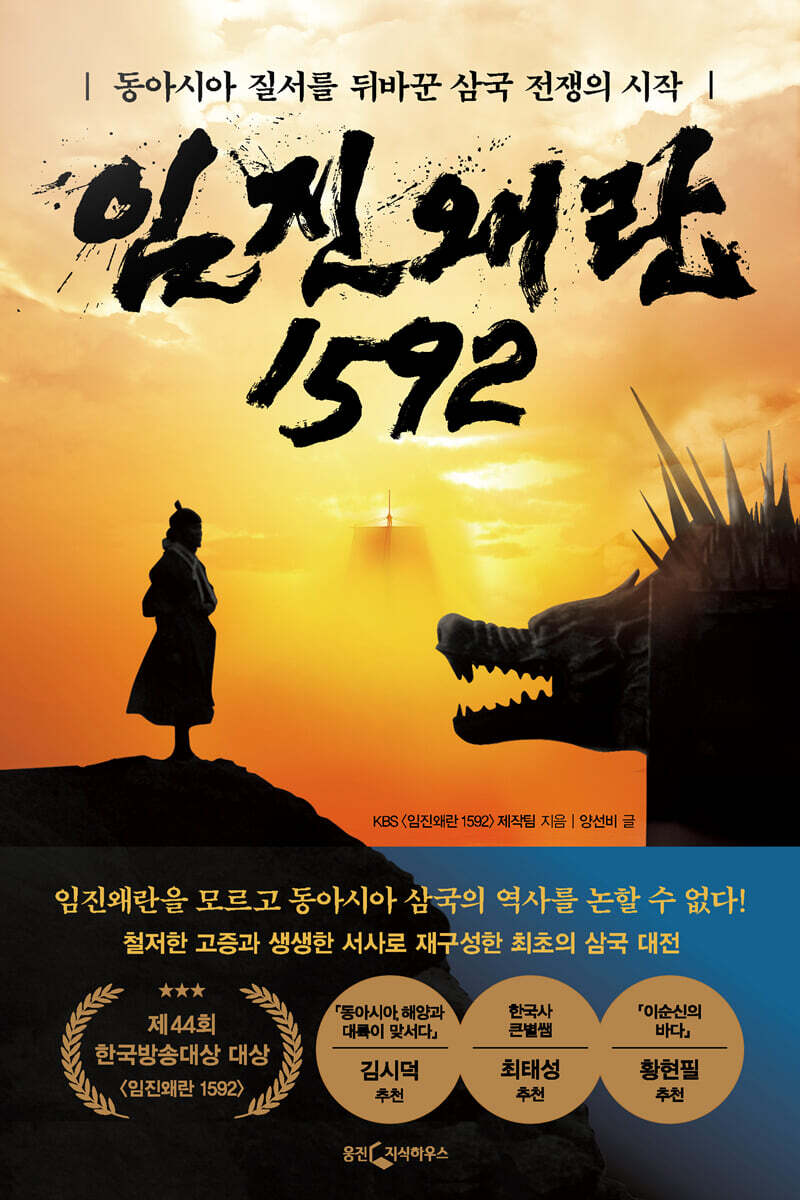
You cannot discuss the history of the three East Asian countries without knowing about the Imjin War! The first Three Kingdoms War reconstructed with thorough research and vivid narrative “I feel like the book I wanted to write has been stolen. “A textbook on the Imjin War that I confidently recommend!” - Hwang Hyeon-pil (author of "The Sea of Yi Sun-sin") - Winner of the 44th Korea Broadcasting Awards! Discover the hit KBS program "Imjin War 1592" in book form. Recommended by Kim Si-deok, "East Asia: Ocean and Continent Confrontation," Choi Tae-seong, "Big Star Teacher of Korean History," and Hwang Hyeon-pil, "The Sea of Yi Sun-sin." - Includes over 70 famous scenes, allowing you to enjoy the history of the Imjin War like a drama. The first domestic factual drama, KBS's "Imjin War 1592," which created a box office hit and was praised as "a well-made historical drama that proved the value of subscription fees," is now being published as a book. “Imjin War 1592,” which stands out for its thorough historical research, solid storytelling, and spectacular directing, received the Grand Prize at the 44th Korea Broadcasting Awards, the Special Jury Prize at the Houston International Film Festival, and the Gold Prize and Best Cinematography at the New York TV & Film Festival, garnering worldwide attention. 『Imjin War 1592』, a re-edited book based on the broadcast, shows the beginning and end of the Imjin War at a glance, focusing on 21 key events. From the East Asian political situation in the 16th century, to the desperate battle between Admiral Yi Sun-sin and the Joseon navy, to the Battle of Pyongyang Castle where Joseon, Japan, and the Ming Dynasty clashed head-on, to the peace talks filled with lies, to the resumption and conclusion of the war, the long and short history of the Imjin War unfolds like a drama with over 70 famous scenes. The Imjin War was the first international war in East Asia, in which the regular armies of Joseon, Japan, and the Ming Dynasty fought each other. This is also why this book deals with figures from not only Joseon but also Japan and the Ming Dynasty. This book brings together the hidden stories of those who have been treated as supporting characters in the history of the Imjin War, such as Toyotomi Hideyoshi, who rose from a lowly needle merchant to become the most powerful person in Japan; Konishi Yukinaga and Kato Kiyomasa, long-time rivals and two vanguards of the Japanese army; and Chen Lin, the Ming navy admiral who shared a special friendship with Yi Sun-sin. 『Imjin War 1592』 is a history textbook that contains the stories of numerous events and people that influenced the Imjin War. As we follow the fierce and heated battles between the three East Asian nations depicted in this book, our perspective on history and the world will broaden. |
- You can preview some of the book's contents.
Preview
index
Introduction: Why We Need to Reread the Imjin War Now
Part 1: The Spark of War
#Photo Intro Here, there is a war called by three names.
01 Conflicting reports from Joseon Tongsinsa a year before the outbreak of war
[History Between the Lines] The First Envoy in 111 Years: Diverging Dreams Between Joseon and Japan
02 Joseon, the land of scholars, faces a dilemma.
03 The Balance of Power Shakes: The 16th-Century East Asian International Order
[History Between the Lines] Emperor Yongle and Zheng He's Expeditions
04 The Birth of an Invader, Toyotomi Hideyoshi
[History Between the Lines] What to Do with the Cuckoo That Doesn't Sing: Oda Nobunaga, Toyotomi Hideyoshi, and Tokugawa Ieyasu
Part 2: The Beginning of War
#Photo Intro: Imjin Year, Japanese troops invade Joseon
01 Japanese troops landed in Busan and advanced rapidly.
[History Between the Lines] Changes in Joseon's Wartime Defense System: The Jin-gwan System and the Je-seung-bang-ryak System
02 Defeat in the Battle of Tangeumdae and King Seonjo's retreat
[History Between the Lines] Two Vanguards of the Imjin War: Konishi Yukinaga and Kato Kiyomasa
03 He was in the sea of Joseon
04 Surround the Enemy with the Wings of a Crane: The Battle of Hansando
05 Why Joseon scholars held swords instead of brushes
[History Between the Lines] Toegye's Two Disciples, Ryu Seong-ryong and Kim Seong-il
Part 3: The Three Kingdoms War, Pyongyang Castle
#Photo Intro The Battle of Pyongyang Castle, the first international battle in East Asia in the 16th century.
01 Fierce battles surrounding the granary area
02 Why did the Ming Dynasty hesitate to participate in the war?
03 Who will become the master of Pyongyang Castle?
[History Between the Lines] The Japanese Army's Abrasives, the Ming Army's Abrasives: The Tyranny of the Japanese and Ming Armies Against Joseon
04 Gangwha Conference and the Battle of Haengju
[History Between the Lines] Japanese Forces Build Fortresses in Joseon and Hold Out: Japanese Castles along the Southern Coast
Part 4: The Imjin War and the End of the War
#Photo Intro: The disorganized talks on reinforcement, and the resumption of war.
01 The deceptive and deceptive reinforcement talks
02 The outbreak of the Imjin War and the Miracle of Myeongnyang
03 Counterattack by the Joseon-Ming allied forces
[History Between the Lines] Koreans Following Japan, Japanese Following Korea: On Pursuing and Resisting Japan
04 Two Giants of War Fall
[History Between the Lines] Yi Sun-sin and Jin Lin: The Launch of the Joint Joseon-Ming Fleet
Part 5: The Wave of Change
#Photo Intro The End of the Seven Years' War, Three Changes
01 Scars of War and Waves of Change
[History Between the Lines] Reestablishing Diplomatic Relations 11 Years After the War: The Treaty of Giyu and the Repatriation of Korean POWs
02 The Dethronement of King Gwanghae and the Kingdom of Taoism: Changes in Joseon
[History Between the Lines] The Light and Shadow of the Imjin War on King Gwanghaegun
03 The Era of the Tokugawa Family Begins: Japan's Transformation
[History Between the Lines] Who Will Seize Japanese Hegemony: The Battle of Sekigahara
04 The Emergence of a New Hegemon in East Asia: The Transformation of the Ming Dynasty
References
Part 1: The Spark of War
#Photo Intro Here, there is a war called by three names.
01 Conflicting reports from Joseon Tongsinsa a year before the outbreak of war
[History Between the Lines] The First Envoy in 111 Years: Diverging Dreams Between Joseon and Japan
02 Joseon, the land of scholars, faces a dilemma.
03 The Balance of Power Shakes: The 16th-Century East Asian International Order
[History Between the Lines] Emperor Yongle and Zheng He's Expeditions
04 The Birth of an Invader, Toyotomi Hideyoshi
[History Between the Lines] What to Do with the Cuckoo That Doesn't Sing: Oda Nobunaga, Toyotomi Hideyoshi, and Tokugawa Ieyasu
Part 2: The Beginning of War
#Photo Intro: Imjin Year, Japanese troops invade Joseon
01 Japanese troops landed in Busan and advanced rapidly.
[History Between the Lines] Changes in Joseon's Wartime Defense System: The Jin-gwan System and the Je-seung-bang-ryak System
02 Defeat in the Battle of Tangeumdae and King Seonjo's retreat
[History Between the Lines] Two Vanguards of the Imjin War: Konishi Yukinaga and Kato Kiyomasa
03 He was in the sea of Joseon
04 Surround the Enemy with the Wings of a Crane: The Battle of Hansando
05 Why Joseon scholars held swords instead of brushes
[History Between the Lines] Toegye's Two Disciples, Ryu Seong-ryong and Kim Seong-il
Part 3: The Three Kingdoms War, Pyongyang Castle
#Photo Intro The Battle of Pyongyang Castle, the first international battle in East Asia in the 16th century.
01 Fierce battles surrounding the granary area
02 Why did the Ming Dynasty hesitate to participate in the war?
03 Who will become the master of Pyongyang Castle?
[History Between the Lines] The Japanese Army's Abrasives, the Ming Army's Abrasives: The Tyranny of the Japanese and Ming Armies Against Joseon
04 Gangwha Conference and the Battle of Haengju
[History Between the Lines] Japanese Forces Build Fortresses in Joseon and Hold Out: Japanese Castles along the Southern Coast
Part 4: The Imjin War and the End of the War
#Photo Intro: The disorganized talks on reinforcement, and the resumption of war.
01 The deceptive and deceptive reinforcement talks
02 The outbreak of the Imjin War and the Miracle of Myeongnyang
03 Counterattack by the Joseon-Ming allied forces
[History Between the Lines] Koreans Following Japan, Japanese Following Korea: On Pursuing and Resisting Japan
04 Two Giants of War Fall
[History Between the Lines] Yi Sun-sin and Jin Lin: The Launch of the Joint Joseon-Ming Fleet
Part 5: The Wave of Change
#Photo Intro The End of the Seven Years' War, Three Changes
01 Scars of War and Waves of Change
[History Between the Lines] Reestablishing Diplomatic Relations 11 Years After the War: The Treaty of Giyu and the Repatriation of Korean POWs
02 The Dethronement of King Gwanghae and the Kingdom of Taoism: Changes in Joseon
[History Between the Lines] The Light and Shadow of the Imjin War on King Gwanghaegun
03 The Era of the Tokugawa Family Begins: Japan's Transformation
[History Between the Lines] Who Will Seize Japanese Hegemony: The Battle of Sekigahara
04 The Emergence of a New Hegemon in East Asia: The Transformation of the Ming Dynasty
References
Detailed image

Into the book
Revisiting the Imjin War, which occurred approximately 400 years ago, clearly required something new, and I decided to try to give this war a fresh perspective as a means of doing so.
As revealed in the section titled 'The Birth of the Invader, Toyotomi Hideyoshi' in [Imjin War 1592], it is about looking at the Imjin War from a new perspective, not only from the perspective of the invaded, but also from the perspective of the invaders.
And the reason why these attempts were possible is because the Imjin War was not a bilateral war limited to Joseon and Japan.
The Imjin War was the first international war in East Asia, with regular armies from three countries, Joseon, Japan, and the Ming Dynasty, facing off.
[Imjin War 1592] follows the perspectives of three different countries and seeks to discover something new about the Imjin War that we did not know about.
And this is directly connected to the reason why we must read the Imjin War now.
---「Entering.
From “Why We Need to Reread the Imjin War Now”
The huge difference in perception between Joseon and Japan surrounding the news agency stemmed from a kind of fraud perpetrated by a fugitive from Tsushima Island who traveled between the two countries.
(……) The moment Toyotomi Hideyoshi's demand to abandon the Ming Dynasty and submit to Japan was delivered to Joseon, it was clear that the advantage of the intermediate trade that Tsushima Island had enjoyed between the two countries would disappear immediately.
In the end, So Yoshitoshi, who was caught in a trap, deceived both Joseon and Japan and led Joseon to dispatch a diplomatic envoy.
It was said that Joseon's King Seonjo sent an official delegation for peace and cultural exchange, and that Toyotomi Hideyoshi sent a tribute envoy after the Joseon king surrendered.
---From "The First Communications Mission in 111 Years: The Diverging Dreams of Joseon and Japan"
The Japanese pirates are a symbol of the fact that the East Asian international order, while centering on the Ming Dynasty, still harbored subtle tensions and room for change.
(……) While the Japanese pirates were a nuisance to the Ming and Joseon governments, inflicting violence and plunder, for Japan, which was a geopolitically peripheral country, the Japanese pirates were also a means of trade that allowed them to accept new civilization.
This is why some compare the Japanese pirates to the mafia and view them as a deformed group of merchants who led smuggling.
The fact that the Japanese pirates and their economic activities persisted despite their violence suggests that the Ming Dynasty's ideological and justified Chinese order was not perfect, and that there was no formal order in the real world that could replace the Japanese pirates' economic activities.
---「03.
From “The Balance of Power Shakes: The International Order in 16th-Century East Asia”
In its trade with Japan, Joseon mainly exported cotton and rice and received gold and silver from Japan. With the gold and silver purchased in this way, it imported silk, porcelain, books, and medicinal herbs from the Ming Dynasty.
Cotton was a particularly important item to Japan, but at the time, Japan was unable to produce its own cotton, so it depended on plunder or imports through Japanese pirates.
In fact, the amount of cotton exported from Joseon to Japan in 1486 alone reached 500,000 rolls.
This East Asian international trade system gave rise to a desire for a new trade system within Japan.
---「03.
From “The Balance of Power Shakes: The International Order in 16th-Century East Asia”
There are three people who are the most important figures in Japanese history and most closely related to the Imjin War.
Oda Nobunaga, the main character who laid the foundation for the unification of the country and Hideyoshi's lord; Toyotomi Hideyoshi, who unified Japan and started the Imjin War; and Tokugawa Ieyasu, who usurped Hideyoshi's position after the Imjin War.
Although the trio was closely intertwined with each other, focusing on the unification of Japan and the Imjin War, their personalities were different.
There is a famous idiom that illustrates this well: the story of the cuckoo that never cries.
Oda Nobunaga: Lord Tokugawa, what would you do if there were a cuckoo that didn't sing? Of course, a bird that doesn't sing should be killed.
Tokugawa Ieyasu: We have to wait.
You have to wait until the bird sings.
Toyotomi Hideyoshi: My lord, I must make you cry somehow.
They lure you with delicious food and threaten you with threats.
---From "What to Do with the Cuckoo That Doesn't Cry: Oda Nobunaga, Toyotomi Hideyoshi, and Tokugawa Ieyasu"
Toyotomi Hideyoshi's plan seemed to be successful, as the Japanese army captured Hanyang in just 20 days.
However, three major variables stood in the way of the Japanese army.
The first variable is that King Seonjo of Joseon did not defend the capital city or commit suicide, but fled too quickly.
The second variable was that Admiral Yi Sun-sin and the Joseon navy were guarding the sea, and the last variable was that numerous volunteer armies were rising up in various places behind the Japanese army.
---「02.
From "The Defeat of the Battle of Tangeumdae and the Dream of King Seonjo"
Yi Sun-sin's second expedition holds special significance in the history of Yi Sun-sin and the naval battles of the Imjin War.
One is that Yi Sun-sin was wounded in battle for the first time, and the other is that the turtle ship, or Gwiseon (龜船), was put into actual combat for the first time and displayed its might.
The Guiseon, which overwhelmed the Japanese army with its mere presence thanks to its powerful mobility and firepower, was a symbol of the great victory of the Joseon navy during the Imjin War and a guardian deity that protected the seas of Joseon.
What is even more surprising is that the ship was completed just one day before the outbreak of the Imjin War.
The dramatic birth of the Guiseon, which stood at the forefront of the naval battle that changed the course of the great war known as the Imjin War, was in itself a foreshadowing of how the war would unfold in the future.
---「03.
From "He Was in the Sea of Joseon"
The Joseon navy, which had already established itself near Hansando Island, deployed a crane-wing formation, surrounded the Wakizaka fleet, and then poured out a barrage of guns.
Of the 73 Japanese ships, 59 were destroyed and the Japanese navy suffered a crushing defeat without even being able to put up a proper fight.
Yasuharu Wakizaka was shot by an arrow and fell from the ship. He survived on a deserted island for about ten days, eating seaweed before barely managing to escape.
Since the commander who led the fleet was like this, the damage suffered by the Japanese troops under his command was needless to say.
On the other hand, the losses suffered by the Joseon navy in the Battle of Hansando were limited to 3 killed and 10 wounded.
July 8, 1592, was the moment when the Joseon navy achieved a great victory in the Battle of Hansando.
---「04.
Surround the enemy with the wings of a crane: From the Battle of Hansando
In October 1592, after a fierce battle, the Joseon army achieved a great victory despite being outnumbered by only one-tenth of the Japanese army.
Japanese casualties reached a whopping 10,000.
With the victory in the Battle of Jinju, Joseon was able to protect not only Jinju but also the granary region of Honam located behind it.
On the other hand, the Japanese army, which had suffered a crushing defeat in battle, sharpened its sword of revenge.
In particular, regarding Jinju pastor Kim Si-min, who led the battle, the saying “Beware of Mokuso (木?)” was circulated, making Kim Si-min an object of fear to the Japanese military as much as Yi Sun-sin.
'Mokuso' is the Japanese pronunciation of Kim Si-min's title, pastor. The Japanese military's fear and humiliation of him were so great that a character with the same name was created in the traditional Japanese play Kabuki.
---「01.
Among the fierce battles surrounding the granary area
The Ming Dynasty watched as Joseon suffered under a large-scale attack from Japan, but it simply watched the situation unfold.
They did not easily put aside their suspicious gaze toward Joseon, and they could not easily accept the situation in which the capital was handed over to the Japanese army just 20 days after the outbreak of war and the king fled.
(……) The Ming Dynasty’s suspicion was solely intended to identify elements that threatened its own security.
Ultimately, the reason why the Ming Dynasty sent reinforcements to Joseon was not only the justification for the tributary system, but also a pragmatic choice to promote stability and order in the country.
---「02.
From "Why did the Ming Dynasty hesitate to participate in the war?"
The Battle of Pyongyang Castle, especially the Fourth Battle of Pyongyang Castle in January 1593, was a typical international war in which the regular armies of the three East Asian countries clashed head-on.
This clash between the three kingdoms was not limited to battles.
The Ming Dynasty and Japan attempted to end the war through a diplomatic agreement called peace, but Joseon, which had suffered the greatest damage from the war, was excluded from the process, creating an ironic situation.
The war dragged on endlessly, and Joseon's suffering grew day by day amid a tragedy reminiscent of the proxy war between the Ming Dynasty and Japan.
---「03.
From "Who Will Be the Master of Pyongyang Castle"
The most famous Japanese castle related to the Imjin War is Ulsan Japanese Castle.
Ulsan Castle was where Kato Kiyomasa, the vanguard of the Japanese army during the Imjin War, held a siege until the end of the war.
(……) He responded to the large-scale attacks by the Joseon-Ming allied forces twice in January and October of 1598 with a tenacious siege. When the water in the well inside the castle ran low, he defended Ulsan Japanese Castle by drinking horse blood and urine.
After the Imjin War, Kato Kiyomasa returned to Japan and built Kumamoto Castle. It is said that he built over 120 wells in Kumamoto Castle, perhaps because of his experience with the fierce siege at Ulsan Castle.
In Kumamoto, there is a village called 'Ulsan Village' that has been passed down to this day.
This place contains not only Kato Kiyomasa's memories of Ulsan, but also the sad history of the Korean prisoners he forcibly took away as he retreated.
---From "Japanese Army Builds Castles in Joseon and Holds Out: Japanese Castles along the Southern Coast"
Konishi Yukinaga, who had a quick mind and good judgment, planned a withdrawal to Japan when the Japanese army's defeat seemed certain, and approached Chen Lin, the Ming navy admiral, for this purpose.
Jinrin accepts several bribes from Konishi Yukinaga and promises to open a path for the Japanese army to retreat.
Yi Sun-sin never condoned Jin Rin's actions.
Unlike Jin Lin, who was fighting in a foreign land, Yi Sun-sin, who had lost his son during the war, and the Joseon navy, which had shed countless tears of blood, could not allow the Japanese army to return safely.
Despite Jin Lin's persuasion, Yi Sun-sin strongly requested dispatch of troops.
In this way, the combined Joseon-Ming fleet led by Yi Sun-sin and Jin Lin attacked the Japanese fleet in the sea of Noryang.
---From "Yi Sun-sin and Jin Lin, the Launch of the Joseon-Ming Combined Fleet"
With the signing of the Treaty of Giyu in 1609, formal diplomatic and trade relations were restored between Joseon and Japan.
It was 11 years after the end of the Imjin War.
The biggest issue in the process of resuming diplomatic relations was the repatriation of Korean prisoners of war.
The repatriation of prisoners of war provided economic incentives to the Joseon government in that it secured a population that would serve as the foundation of national administration, but it was also a politically urgent matter.
Because a government that did not care for its people taken to foreign countries could have its existence threatened.
---From "Resumption of diplomatic relations after 11 years of war: The Treaty of Giyu and the repatriation of Korean prisoners of war"
Nevertheless, the Imjin War was not a war in which Japan devoted all its efforts, and although it retreated without much success, it did not suffer damage that was close to annihilation.
There were many powerful daimyo who did not participate in the war, such as Tokugawa Ieyasu, who became the most powerful person in Japan after Toyotomi Hideyoshi's death.
Even if they did participate in the war, the damage would only fall on each daimyo.
In short, Joseon and Ming, the victors of the Imjin War, achieved a victory that was nothing but a wound, while Japan, the defeated nation, suffered a mild defeat without any major damage to its national foundation.
---「03.
From "The Era of the Tokugawa Family Begins: Changes in Japan"
The fall of the Ming Dynasty and the rise of the Qing Dynasty can be seen as a repetition of the history of conquest by northern nomadic peoples that continued long ago through the Liao Dynasty (Khitan), the Jin Dynasty (Jurchen), and the Yuan Dynasty (Mongol).
(……) It is an undeniable fact that one of the main driving forces that made the wheel of history turn again was the wind caused by the Imjin War.
The new era that arrived after the Imjin War and the transition between the Ming and Qing Dynasties laid the foundation for the East Asian order for 300 years and wrote a new history.
As revealed in the section titled 'The Birth of the Invader, Toyotomi Hideyoshi' in [Imjin War 1592], it is about looking at the Imjin War from a new perspective, not only from the perspective of the invaded, but also from the perspective of the invaders.
And the reason why these attempts were possible is because the Imjin War was not a bilateral war limited to Joseon and Japan.
The Imjin War was the first international war in East Asia, with regular armies from three countries, Joseon, Japan, and the Ming Dynasty, facing off.
[Imjin War 1592] follows the perspectives of three different countries and seeks to discover something new about the Imjin War that we did not know about.
And this is directly connected to the reason why we must read the Imjin War now.
---「Entering.
From “Why We Need to Reread the Imjin War Now”
The huge difference in perception between Joseon and Japan surrounding the news agency stemmed from a kind of fraud perpetrated by a fugitive from Tsushima Island who traveled between the two countries.
(……) The moment Toyotomi Hideyoshi's demand to abandon the Ming Dynasty and submit to Japan was delivered to Joseon, it was clear that the advantage of the intermediate trade that Tsushima Island had enjoyed between the two countries would disappear immediately.
In the end, So Yoshitoshi, who was caught in a trap, deceived both Joseon and Japan and led Joseon to dispatch a diplomatic envoy.
It was said that Joseon's King Seonjo sent an official delegation for peace and cultural exchange, and that Toyotomi Hideyoshi sent a tribute envoy after the Joseon king surrendered.
---From "The First Communications Mission in 111 Years: The Diverging Dreams of Joseon and Japan"
The Japanese pirates are a symbol of the fact that the East Asian international order, while centering on the Ming Dynasty, still harbored subtle tensions and room for change.
(……) While the Japanese pirates were a nuisance to the Ming and Joseon governments, inflicting violence and plunder, for Japan, which was a geopolitically peripheral country, the Japanese pirates were also a means of trade that allowed them to accept new civilization.
This is why some compare the Japanese pirates to the mafia and view them as a deformed group of merchants who led smuggling.
The fact that the Japanese pirates and their economic activities persisted despite their violence suggests that the Ming Dynasty's ideological and justified Chinese order was not perfect, and that there was no formal order in the real world that could replace the Japanese pirates' economic activities.
---「03.
From “The Balance of Power Shakes: The International Order in 16th-Century East Asia”
In its trade with Japan, Joseon mainly exported cotton and rice and received gold and silver from Japan. With the gold and silver purchased in this way, it imported silk, porcelain, books, and medicinal herbs from the Ming Dynasty.
Cotton was a particularly important item to Japan, but at the time, Japan was unable to produce its own cotton, so it depended on plunder or imports through Japanese pirates.
In fact, the amount of cotton exported from Joseon to Japan in 1486 alone reached 500,000 rolls.
This East Asian international trade system gave rise to a desire for a new trade system within Japan.
---「03.
From “The Balance of Power Shakes: The International Order in 16th-Century East Asia”
There are three people who are the most important figures in Japanese history and most closely related to the Imjin War.
Oda Nobunaga, the main character who laid the foundation for the unification of the country and Hideyoshi's lord; Toyotomi Hideyoshi, who unified Japan and started the Imjin War; and Tokugawa Ieyasu, who usurped Hideyoshi's position after the Imjin War.
Although the trio was closely intertwined with each other, focusing on the unification of Japan and the Imjin War, their personalities were different.
There is a famous idiom that illustrates this well: the story of the cuckoo that never cries.
Oda Nobunaga: Lord Tokugawa, what would you do if there were a cuckoo that didn't sing? Of course, a bird that doesn't sing should be killed.
Tokugawa Ieyasu: We have to wait.
You have to wait until the bird sings.
Toyotomi Hideyoshi: My lord, I must make you cry somehow.
They lure you with delicious food and threaten you with threats.
---From "What to Do with the Cuckoo That Doesn't Cry: Oda Nobunaga, Toyotomi Hideyoshi, and Tokugawa Ieyasu"
Toyotomi Hideyoshi's plan seemed to be successful, as the Japanese army captured Hanyang in just 20 days.
However, three major variables stood in the way of the Japanese army.
The first variable is that King Seonjo of Joseon did not defend the capital city or commit suicide, but fled too quickly.
The second variable was that Admiral Yi Sun-sin and the Joseon navy were guarding the sea, and the last variable was that numerous volunteer armies were rising up in various places behind the Japanese army.
---「02.
From "The Defeat of the Battle of Tangeumdae and the Dream of King Seonjo"
Yi Sun-sin's second expedition holds special significance in the history of Yi Sun-sin and the naval battles of the Imjin War.
One is that Yi Sun-sin was wounded in battle for the first time, and the other is that the turtle ship, or Gwiseon (龜船), was put into actual combat for the first time and displayed its might.
The Guiseon, which overwhelmed the Japanese army with its mere presence thanks to its powerful mobility and firepower, was a symbol of the great victory of the Joseon navy during the Imjin War and a guardian deity that protected the seas of Joseon.
What is even more surprising is that the ship was completed just one day before the outbreak of the Imjin War.
The dramatic birth of the Guiseon, which stood at the forefront of the naval battle that changed the course of the great war known as the Imjin War, was in itself a foreshadowing of how the war would unfold in the future.
---「03.
From "He Was in the Sea of Joseon"
The Joseon navy, which had already established itself near Hansando Island, deployed a crane-wing formation, surrounded the Wakizaka fleet, and then poured out a barrage of guns.
Of the 73 Japanese ships, 59 were destroyed and the Japanese navy suffered a crushing defeat without even being able to put up a proper fight.
Yasuharu Wakizaka was shot by an arrow and fell from the ship. He survived on a deserted island for about ten days, eating seaweed before barely managing to escape.
Since the commander who led the fleet was like this, the damage suffered by the Japanese troops under his command was needless to say.
On the other hand, the losses suffered by the Joseon navy in the Battle of Hansando were limited to 3 killed and 10 wounded.
July 8, 1592, was the moment when the Joseon navy achieved a great victory in the Battle of Hansando.
---「04.
Surround the enemy with the wings of a crane: From the Battle of Hansando
In October 1592, after a fierce battle, the Joseon army achieved a great victory despite being outnumbered by only one-tenth of the Japanese army.
Japanese casualties reached a whopping 10,000.
With the victory in the Battle of Jinju, Joseon was able to protect not only Jinju but also the granary region of Honam located behind it.
On the other hand, the Japanese army, which had suffered a crushing defeat in battle, sharpened its sword of revenge.
In particular, regarding Jinju pastor Kim Si-min, who led the battle, the saying “Beware of Mokuso (木?)” was circulated, making Kim Si-min an object of fear to the Japanese military as much as Yi Sun-sin.
'Mokuso' is the Japanese pronunciation of Kim Si-min's title, pastor. The Japanese military's fear and humiliation of him were so great that a character with the same name was created in the traditional Japanese play Kabuki.
---「01.
Among the fierce battles surrounding the granary area
The Ming Dynasty watched as Joseon suffered under a large-scale attack from Japan, but it simply watched the situation unfold.
They did not easily put aside their suspicious gaze toward Joseon, and they could not easily accept the situation in which the capital was handed over to the Japanese army just 20 days after the outbreak of war and the king fled.
(……) The Ming Dynasty’s suspicion was solely intended to identify elements that threatened its own security.
Ultimately, the reason why the Ming Dynasty sent reinforcements to Joseon was not only the justification for the tributary system, but also a pragmatic choice to promote stability and order in the country.
---「02.
From "Why did the Ming Dynasty hesitate to participate in the war?"
The Battle of Pyongyang Castle, especially the Fourth Battle of Pyongyang Castle in January 1593, was a typical international war in which the regular armies of the three East Asian countries clashed head-on.
This clash between the three kingdoms was not limited to battles.
The Ming Dynasty and Japan attempted to end the war through a diplomatic agreement called peace, but Joseon, which had suffered the greatest damage from the war, was excluded from the process, creating an ironic situation.
The war dragged on endlessly, and Joseon's suffering grew day by day amid a tragedy reminiscent of the proxy war between the Ming Dynasty and Japan.
---「03.
From "Who Will Be the Master of Pyongyang Castle"
The most famous Japanese castle related to the Imjin War is Ulsan Japanese Castle.
Ulsan Castle was where Kato Kiyomasa, the vanguard of the Japanese army during the Imjin War, held a siege until the end of the war.
(……) He responded to the large-scale attacks by the Joseon-Ming allied forces twice in January and October of 1598 with a tenacious siege. When the water in the well inside the castle ran low, he defended Ulsan Japanese Castle by drinking horse blood and urine.
After the Imjin War, Kato Kiyomasa returned to Japan and built Kumamoto Castle. It is said that he built over 120 wells in Kumamoto Castle, perhaps because of his experience with the fierce siege at Ulsan Castle.
In Kumamoto, there is a village called 'Ulsan Village' that has been passed down to this day.
This place contains not only Kato Kiyomasa's memories of Ulsan, but also the sad history of the Korean prisoners he forcibly took away as he retreated.
---From "Japanese Army Builds Castles in Joseon and Holds Out: Japanese Castles along the Southern Coast"
Konishi Yukinaga, who had a quick mind and good judgment, planned a withdrawal to Japan when the Japanese army's defeat seemed certain, and approached Chen Lin, the Ming navy admiral, for this purpose.
Jinrin accepts several bribes from Konishi Yukinaga and promises to open a path for the Japanese army to retreat.
Yi Sun-sin never condoned Jin Rin's actions.
Unlike Jin Lin, who was fighting in a foreign land, Yi Sun-sin, who had lost his son during the war, and the Joseon navy, which had shed countless tears of blood, could not allow the Japanese army to return safely.
Despite Jin Lin's persuasion, Yi Sun-sin strongly requested dispatch of troops.
In this way, the combined Joseon-Ming fleet led by Yi Sun-sin and Jin Lin attacked the Japanese fleet in the sea of Noryang.
---From "Yi Sun-sin and Jin Lin, the Launch of the Joseon-Ming Combined Fleet"
With the signing of the Treaty of Giyu in 1609, formal diplomatic and trade relations were restored between Joseon and Japan.
It was 11 years after the end of the Imjin War.
The biggest issue in the process of resuming diplomatic relations was the repatriation of Korean prisoners of war.
The repatriation of prisoners of war provided economic incentives to the Joseon government in that it secured a population that would serve as the foundation of national administration, but it was also a politically urgent matter.
Because a government that did not care for its people taken to foreign countries could have its existence threatened.
---From "Resumption of diplomatic relations after 11 years of war: The Treaty of Giyu and the repatriation of Korean prisoners of war"
Nevertheless, the Imjin War was not a war in which Japan devoted all its efforts, and although it retreated without much success, it did not suffer damage that was close to annihilation.
There were many powerful daimyo who did not participate in the war, such as Tokugawa Ieyasu, who became the most powerful person in Japan after Toyotomi Hideyoshi's death.
Even if they did participate in the war, the damage would only fall on each daimyo.
In short, Joseon and Ming, the victors of the Imjin War, achieved a victory that was nothing but a wound, while Japan, the defeated nation, suffered a mild defeat without any major damage to its national foundation.
---「03.
From "The Era of the Tokugawa Family Begins: Changes in Japan"
The fall of the Ming Dynasty and the rise of the Qing Dynasty can be seen as a repetition of the history of conquest by northern nomadic peoples that continued long ago through the Liao Dynasty (Khitan), the Jin Dynasty (Jurchen), and the Yuan Dynasty (Mongol).
(……) It is an undeniable fact that one of the main driving forces that made the wheel of history turn again was the wind caused by the Imjin War.
The new era that arrived after the Imjin War and the transition between the Ming and Qing Dynasties laid the foundation for the East Asian order for 300 years and wrote a new history.
---「04.
From "The Emergence of a New Hegemon in East Asia: The Transformation of the Ming Dynasty"
From "The Emergence of a New Hegemon in East Asia: The Transformation of the Ming Dynasty"
Publisher's Review
How did the Seven Years' War change 300 years of East Asian history?
From the 'Japanese Riots of the Imjin Year' to the 'First Three Kingdoms War in East Asia'
“The Three Kingdoms of the Imjin War” written from a new perspective
This year marks the 430th anniversary of the outbreak of the Imjin War.
There is no one who does not know about the Imjin War, but the way this war is remembered is similar now as it was then.
"The vicious Japanese invaders attacked Joseon, and the Joseon king was desperate to escape, but the famous general Yi Sun-sin defended the country with the turtle ship at the forefront." Was the Imjin War simply a "Japanese rebellion in the year of Imjin (1592)"? Was it simply a war between Joseon and Japan?
This book, which reconstructs the KBS factual drama [Imjin War 1592] into a single volume, illuminates the Imjin War as an 'international war between the three East Asian countries' and reveals the other side of the war that we have overlooked.
The Imjin War was not a war that suddenly broke out due to Japan's military provocation.
The conflict between the conflicting interests of the Ming Dynasty, which reigned as the hegemon of East Asia; Joseon, which had established itself as the Ming Dynasty's top tributary state; and Japan, which was alienated from the Ming Dynasty-centered order, fueled the flames of war that burned for 200 years.
The Imjin War was the first international war in East Asia, as it was the first time that the regular armies of three countries clashed, and it led to the reorganization of the East Asian order in the 16th century.
After the war, the king of Joseon changed through a coup, the Edo shogunate was established in Japan, and the Ming Dynasty was destroyed and the Qing Dynasty took its place.
This is why, unlike other books about the Imjin War, 『Imjin War 1592』 focuses heavily on figures from Japan and the Ming Dynasty.
From Toyotomi Hideyoshi, who rose from a lowly needle merchant to become the most powerful man in Japan; Konishi Yukinaga and Kato Kiyomasa, long-time rivals and two leaders of the Japanese army; the Wanli Emperor, who was revered as the emperor who saved the country in Joseon but was condemned as a tyrant who brought down the country in the Ming Dynasty; to Chen Lin, the Ming navy admiral who accepted bribes from enemy generals but ultimately led the Battle of Noryang alongside Yi Sun-sin.
The hidden stories of those who have been treated as supporting actors on the historical stage of the Imjin War are colorfully revealed.
The Imjin War, an unprecedented event that shook the East Asian order in the 16th century.
This book will be established as the so-called “Romance of the Three Kingdoms of the Imjin War,” vividly depicting the fierce and heated battles between the three East Asian countries.
* New things to see when approaching the Imjin War as an 'international war between the three East Asian countries'
· One war, three names
This war that took place in 1592 is called the Imjin War (壬辰倭亂; the rebellion caused by the Japanese in the Imjin Year) in Korea, the Bunroku-Keicho War (文祿慶長の役; the conquests carried out during the Bunroku and Keicho eras) in Japan, and the Wanli-Joseon War (萬曆朝鮮戰爭; the war that took place in Joseon during the reign of Emperor Wanli) in China.
This is a passage that reveals the three countries' different perspectives on war.
· Toyotomi Hideyoshi's Golden Fan (page 73)
This fan, which contains maps of the three countries of the Ming Dynasty, Joseon, and Japan, depicts the Japanese archipelago as being more than twice the size of the Korean Peninsula and as large as the Chinese mainland.
We can get a glimpse of Toyotomi Hideyoshi's ambition to conquer the Ming Dynasty through Joseon and advance to India.
· The Battle of Pyongyang Castle, the first head-on clash between the regular armies of the three countries (page 191)
In January 1593, a fierce battle unfolded between the Joseon-Ming allied forces and the Japanese army surrounding Pyongyang Castle.
This battle was the first international war in East Asia and the largest modern gunpowder war, pitting the regular armies of Joseon, Japan, and the Ming Dynasty against each other.
· Peace talks involving only the Ming Dynasty and Japan, excluding Joseon (pp. 209-211, 234-235)
The peace talks, which began in 1593, lasted about four years.
The main parties of the talks were the Ming Dynasty and Japan.
Even though four of the seven conditions Japan put forward for negotiations were related to Korea, Korea failed to attend the peace talks.
"A masterpiece that made me realize the value of my subscription fee." - From a viewer review
A hot topic program that received numerous compliments immediately after airing
Korea's first factual drama, KBS's [Imjin War 1592], now available as a book.
“God still has twelve ships left.” This is a famous line from the movie [Roaring Currents], which captivated over 10 million viewers.
Watching Yi Sun-sin win a battle that seemed almost impossible, I was intoxicated with immense pride, but at the same time, I thought, 'It's a movie, so it must be possible.'
However, if we look at the actual history of the Imjin War, we see a series of incredibly dramatic events that occurred one after another.
A year before the Imjin War broke out, Yi Sun-sin was appointed as the Left Naval Commander of Jeolla Province.
The turtle ship, the ultimate weapon of the Joseon navy, was completed the day before the outbreak of war.
(There is a difference in the numbers compared to the movie) In the Battle of Myeongnyang, Yi Sun-sin and the Joseon navy defeated the Japanese army with 133 warships with only 13 panokseon ships.
“Sometimes historical facts are more dramatic than dramas.” The KBS five-part factual drama [Imjin War 1592], the original work of this book, took this point into account.
It is evaluated as a masterpiece that realistically and dramatically portrays the Imjin War based on thorough historical research, to the point that the script was revised 228 times with expert advice.
“A masterpiece that made me realize the value of the license fee”, “I couldn’t help but shed tears at the end after holding it in for so long!”, “It’s a shame that this kind of program only has five episodes”, etc. After its airing, it received enthusiastic praise from viewers, and in 2017, it won the Grand Prize at the 44th Korea Broadcasting Awards.
Following this, it received the Houston International Film Festival Special Jury Prize and the New York TV & Film Festival Gold Prize and Cinematography Award, garnering worldwide attention.
This book is a history textbook based on the broadcast [Imjin War 1592].
While the original focused on solid storytelling and dazzling visuals, this book adds historical context and organizes the history of the Imjin War into an easily understandable narrative centered around 21 key events.
From the East Asian political situation in the 16th century, the desperate battle between Admiral Yi Sun-sin and the Joseon navy, the Battle of Pyongyang Castle where Joseon, Japan, and the Ming Dynasty clashed head-on, the peace talks filled with lies, and the resumption and conclusion of the war, the major events of the Imjin War are carefully traced.
When was the turtle ship, the ultimate weapon of the Joseon navy, put into actual combat?
The tragic words of a Japanese general who was completely defeated in the Battle of Hansando…
The story of how the hero of the Battle of Jinju appeared as a monster in a Kabuki play…
[Photo Intro] Featuring over 70 famous scenes, showing the flow of war at a glance.
Enjoy the history of the Imjin War like a drama
As it covers the beginning and end of the Imjin War, the true charm of 『Imjin War 1592』 lies in the tense and fierce battle story.
This book covers the three major battles of the Imjin War: the Battle of Hansando, the Battle of Jinju, and the Battle of Haengju; the Battle of Tangeumdae, which forced King Seonjo of Joseon to flee; the Battle of Okpo, where Yi Sun-sin's fleet achieved its first victory; the Battle of Sacheon, where the turtle ships were first used in combat; and the Battle of Byeokjegwan, where the once-proud Ming army lost its will to fight.
In particular, the anecdotes that Japanese general Wakizaka Yasuharu survived by eating seaweed on an uninhabited island after being defeated by Yi Sun-sin's fleet at Hansando (page 137 of the text) and that the Japanese soldiers who were defeated at the Battle of Jinju called Jinju governor Kim Si-min "Mokuso (木?)" and feared him, which later led to the creation of a character with the same name in a Kabuki play (page 176 of the text) remind us of the might of the Joseon army, which achieved victory on land and sea despite being outnumbered.
We also gathered together in-depth topics that could not be shown in the original broadcast [Imjin War 1592] due to time constraints.
The dispatch of a diplomatic envoy after 111 years caused by the fraud of fleeing to Tsushima Island (pp. 41-43), the connection between the three heroes of Japan during the Warring States period and the Imjin War (pp. 75-81), the strange friendship between Yi Sun-sin, the commander of Joseon's three naval provinces, and Ming admiral Chen Lin (pp. 269-277), and the story of Joseon's reestablishment of diplomatic relations with Japan 11 years after the end of the war (pp. 295-299) are introduced in the separate corner [History Between the Lines].
Please get rid of the prejudice that a book on war history is rigid and difficult.
The book includes over 70 famous scenes from the broadcast [Imjin War 1592], allowing you to savor the original work's splendid visuals and deep aftertaste.
In addition, the [Chronology] and [Photo Intro] placed at the introduction of each section serve as milestones guiding readers through the long yet short history of the Imjin War.
From the 'Japanese Riots of the Imjin Year' to the 'First Three Kingdoms War in East Asia'
“The Three Kingdoms of the Imjin War” written from a new perspective
This year marks the 430th anniversary of the outbreak of the Imjin War.
There is no one who does not know about the Imjin War, but the way this war is remembered is similar now as it was then.
"The vicious Japanese invaders attacked Joseon, and the Joseon king was desperate to escape, but the famous general Yi Sun-sin defended the country with the turtle ship at the forefront." Was the Imjin War simply a "Japanese rebellion in the year of Imjin (1592)"? Was it simply a war between Joseon and Japan?
This book, which reconstructs the KBS factual drama [Imjin War 1592] into a single volume, illuminates the Imjin War as an 'international war between the three East Asian countries' and reveals the other side of the war that we have overlooked.
The Imjin War was not a war that suddenly broke out due to Japan's military provocation.
The conflict between the conflicting interests of the Ming Dynasty, which reigned as the hegemon of East Asia; Joseon, which had established itself as the Ming Dynasty's top tributary state; and Japan, which was alienated from the Ming Dynasty-centered order, fueled the flames of war that burned for 200 years.
The Imjin War was the first international war in East Asia, as it was the first time that the regular armies of three countries clashed, and it led to the reorganization of the East Asian order in the 16th century.
After the war, the king of Joseon changed through a coup, the Edo shogunate was established in Japan, and the Ming Dynasty was destroyed and the Qing Dynasty took its place.
This is why, unlike other books about the Imjin War, 『Imjin War 1592』 focuses heavily on figures from Japan and the Ming Dynasty.
From Toyotomi Hideyoshi, who rose from a lowly needle merchant to become the most powerful man in Japan; Konishi Yukinaga and Kato Kiyomasa, long-time rivals and two leaders of the Japanese army; the Wanli Emperor, who was revered as the emperor who saved the country in Joseon but was condemned as a tyrant who brought down the country in the Ming Dynasty; to Chen Lin, the Ming navy admiral who accepted bribes from enemy generals but ultimately led the Battle of Noryang alongside Yi Sun-sin.
The hidden stories of those who have been treated as supporting actors on the historical stage of the Imjin War are colorfully revealed.
The Imjin War, an unprecedented event that shook the East Asian order in the 16th century.
This book will be established as the so-called “Romance of the Three Kingdoms of the Imjin War,” vividly depicting the fierce and heated battles between the three East Asian countries.
* New things to see when approaching the Imjin War as an 'international war between the three East Asian countries'
· One war, three names
This war that took place in 1592 is called the Imjin War (壬辰倭亂; the rebellion caused by the Japanese in the Imjin Year) in Korea, the Bunroku-Keicho War (文祿慶長の役; the conquests carried out during the Bunroku and Keicho eras) in Japan, and the Wanli-Joseon War (萬曆朝鮮戰爭; the war that took place in Joseon during the reign of Emperor Wanli) in China.
This is a passage that reveals the three countries' different perspectives on war.
· Toyotomi Hideyoshi's Golden Fan (page 73)
This fan, which contains maps of the three countries of the Ming Dynasty, Joseon, and Japan, depicts the Japanese archipelago as being more than twice the size of the Korean Peninsula and as large as the Chinese mainland.
We can get a glimpse of Toyotomi Hideyoshi's ambition to conquer the Ming Dynasty through Joseon and advance to India.
· The Battle of Pyongyang Castle, the first head-on clash between the regular armies of the three countries (page 191)
In January 1593, a fierce battle unfolded between the Joseon-Ming allied forces and the Japanese army surrounding Pyongyang Castle.
This battle was the first international war in East Asia and the largest modern gunpowder war, pitting the regular armies of Joseon, Japan, and the Ming Dynasty against each other.
· Peace talks involving only the Ming Dynasty and Japan, excluding Joseon (pp. 209-211, 234-235)
The peace talks, which began in 1593, lasted about four years.
The main parties of the talks were the Ming Dynasty and Japan.
Even though four of the seven conditions Japan put forward for negotiations were related to Korea, Korea failed to attend the peace talks.
"A masterpiece that made me realize the value of my subscription fee." - From a viewer review
A hot topic program that received numerous compliments immediately after airing
Korea's first factual drama, KBS's [Imjin War 1592], now available as a book.
“God still has twelve ships left.” This is a famous line from the movie [Roaring Currents], which captivated over 10 million viewers.
Watching Yi Sun-sin win a battle that seemed almost impossible, I was intoxicated with immense pride, but at the same time, I thought, 'It's a movie, so it must be possible.'
However, if we look at the actual history of the Imjin War, we see a series of incredibly dramatic events that occurred one after another.
A year before the Imjin War broke out, Yi Sun-sin was appointed as the Left Naval Commander of Jeolla Province.
The turtle ship, the ultimate weapon of the Joseon navy, was completed the day before the outbreak of war.
(There is a difference in the numbers compared to the movie) In the Battle of Myeongnyang, Yi Sun-sin and the Joseon navy defeated the Japanese army with 133 warships with only 13 panokseon ships.
“Sometimes historical facts are more dramatic than dramas.” The KBS five-part factual drama [Imjin War 1592], the original work of this book, took this point into account.
It is evaluated as a masterpiece that realistically and dramatically portrays the Imjin War based on thorough historical research, to the point that the script was revised 228 times with expert advice.
“A masterpiece that made me realize the value of the license fee”, “I couldn’t help but shed tears at the end after holding it in for so long!”, “It’s a shame that this kind of program only has five episodes”, etc. After its airing, it received enthusiastic praise from viewers, and in 2017, it won the Grand Prize at the 44th Korea Broadcasting Awards.
Following this, it received the Houston International Film Festival Special Jury Prize and the New York TV & Film Festival Gold Prize and Cinematography Award, garnering worldwide attention.
This book is a history textbook based on the broadcast [Imjin War 1592].
While the original focused on solid storytelling and dazzling visuals, this book adds historical context and organizes the history of the Imjin War into an easily understandable narrative centered around 21 key events.
From the East Asian political situation in the 16th century, the desperate battle between Admiral Yi Sun-sin and the Joseon navy, the Battle of Pyongyang Castle where Joseon, Japan, and the Ming Dynasty clashed head-on, the peace talks filled with lies, and the resumption and conclusion of the war, the major events of the Imjin War are carefully traced.
When was the turtle ship, the ultimate weapon of the Joseon navy, put into actual combat?
The tragic words of a Japanese general who was completely defeated in the Battle of Hansando…
The story of how the hero of the Battle of Jinju appeared as a monster in a Kabuki play…
[Photo Intro] Featuring over 70 famous scenes, showing the flow of war at a glance.
Enjoy the history of the Imjin War like a drama
As it covers the beginning and end of the Imjin War, the true charm of 『Imjin War 1592』 lies in the tense and fierce battle story.
This book covers the three major battles of the Imjin War: the Battle of Hansando, the Battle of Jinju, and the Battle of Haengju; the Battle of Tangeumdae, which forced King Seonjo of Joseon to flee; the Battle of Okpo, where Yi Sun-sin's fleet achieved its first victory; the Battle of Sacheon, where the turtle ships were first used in combat; and the Battle of Byeokjegwan, where the once-proud Ming army lost its will to fight.
In particular, the anecdotes that Japanese general Wakizaka Yasuharu survived by eating seaweed on an uninhabited island after being defeated by Yi Sun-sin's fleet at Hansando (page 137 of the text) and that the Japanese soldiers who were defeated at the Battle of Jinju called Jinju governor Kim Si-min "Mokuso (木?)" and feared him, which later led to the creation of a character with the same name in a Kabuki play (page 176 of the text) remind us of the might of the Joseon army, which achieved victory on land and sea despite being outnumbered.
We also gathered together in-depth topics that could not be shown in the original broadcast [Imjin War 1592] due to time constraints.
The dispatch of a diplomatic envoy after 111 years caused by the fraud of fleeing to Tsushima Island (pp. 41-43), the connection between the three heroes of Japan during the Warring States period and the Imjin War (pp. 75-81), the strange friendship between Yi Sun-sin, the commander of Joseon's three naval provinces, and Ming admiral Chen Lin (pp. 269-277), and the story of Joseon's reestablishment of diplomatic relations with Japan 11 years after the end of the war (pp. 295-299) are introduced in the separate corner [History Between the Lines].
Please get rid of the prejudice that a book on war history is rigid and difficult.
The book includes over 70 famous scenes from the broadcast [Imjin War 1592], allowing you to savor the original work's splendid visuals and deep aftertaste.
In addition, the [Chronology] and [Photo Intro] placed at the introduction of each section serve as milestones guiding readers through the long yet short history of the Imjin War.
GOODS SPECIFICS
- Publication date: July 19, 2022
- Format: Paperback book binding method guide
- Page count, weight, size: 344 pages | 550g | 140*210*22mm
- ISBN13: 9788901262819
- ISBN10: 8901262819
You may also like
카테고리
korean


korean

![GQ KOREA Mark (Monthly): December [2025]](http://librairie.coreenne.fr/cdn/shop/files/8ef265dbbfbf186523ed75ba7319009d.jpg?v=1765340328&width=3840)


