

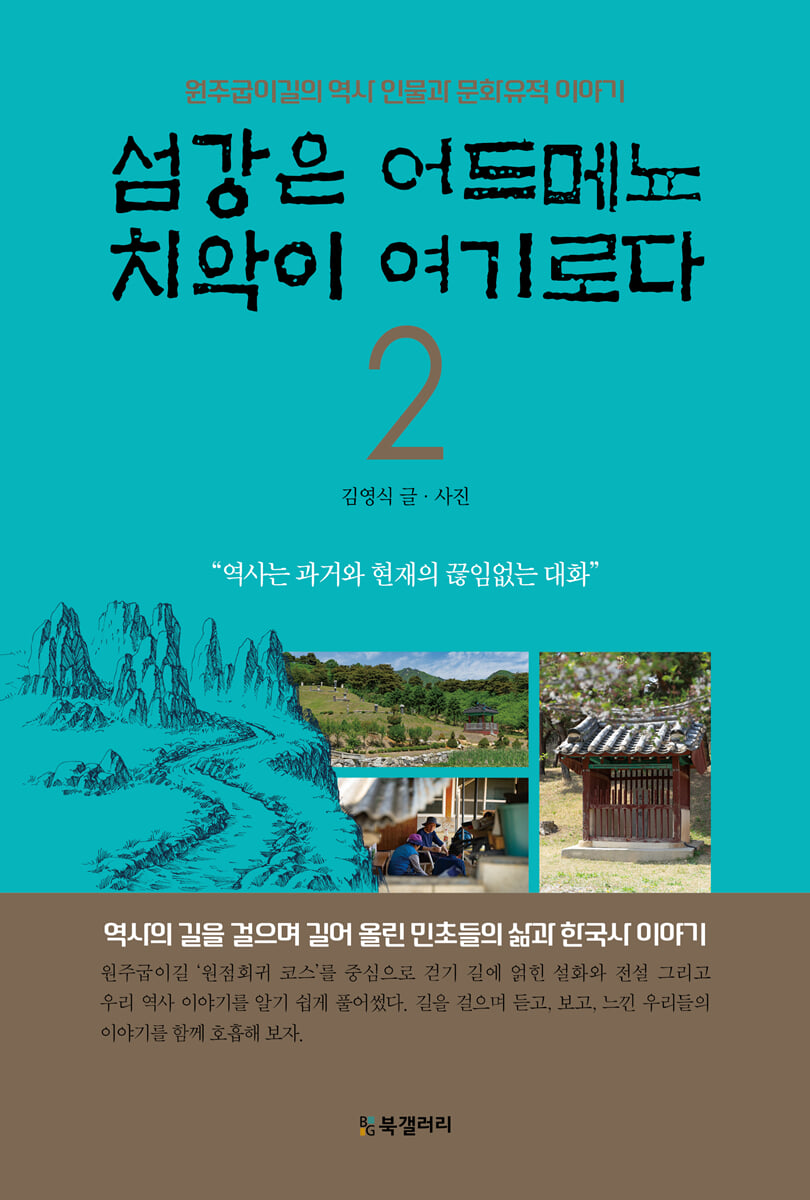
The island is here, Chiak is here 2
 |
Description
Book Introduction
The second book on 'Historical Figures and Cultural Heritage of Wonju Gubi-gil'!
This is the second story about 'Historical figures and cultural heritage of Wonju Gubi-gil.'
『Seomgang is here, Chiak is here 2』 is a book that explains in an easy-to-understand way the tales, legends, and stories of our history related to the walking path centered around the Wonju Gubi-gil ‘origin return course.’
This is the second story about 'Historical figures and cultural heritage of Wonju Gubi-gil.'
『Seomgang is here, Chiak is here 2』 is a book that explains in an easy-to-understand way the tales, legends, and stories of our history related to the walking path centered around the Wonju Gubi-gil ‘origin return course.’
index
Recommendation
Introduction
Chapter 1: The Cursed Text
Hwang Hyo-ja-gil (Old Origin Return Course 6) / Which comes first, loyalty or filial piety?
Bangye-ri Ginkgo Tree Road (formerly Course 7, now Course 18) / Jjokseom Island and Autumn Sonata
Dongwha Village Jindallae Road (formerly Course 4 of the original return route, now Course 17) / When the head monk cut down a paulownia tree
Azalea Road in Dongwha Village [Appendix] / The Story of Lady Eom, the Lady Beloved by Emperor Gojong
Chapter 2: Industry and the Board of Directors
Heungup Campus Romantic Road (Formerly 8-course roundabout, now 14-course) / You are buried in Heungup, and I am living there.
Baekunsan Natural Recreation Forest Trail (former origin return course 3, current course 15) / If you put a silk bag in Yongso
Baekunsan Natural Recreation Forest Trail [Appendix] / Between Martyrdom and Apostasy (Focusing on Lee Byeok, Lee Seung-hun, and Lee Ga-hwan)
Chapter 3: Wonju City
Bukwon History Trail (1) (Old Origin Return Course 12, Current Course 10) / Whose fault is this, O Heaven! Oh, Heaven!
Bukwon History Trail (2) (Old Origin Return 12 Courses, Current 10 Courses) / If War Breaks Out, It Will Only Bukwon History Trail (3) / Im Yun-ji-dang Finding the Way in Academics
100 Pass Road (Old Origin Return Course 1) / Find Yukpanbawi Rock
Musil Orchard Road (Formerly Course 13, Current Course 12) / Amazing! Magic Happens
100 Mountain Roads [Appendix] / How Did Pro-Japanese Collaborators Survive? (Focusing on the US Military Government and the Special Committee on Anti-National Activities)
Chapter 4 Designation and Supplementary Discussion
Ganhyeonbonggil (1) (Old Origin Return Course 5) / The poisonous Jeongcheol killed my virtuous subject.
Ganhyeonbonggil (2) (Old Origin Return Course 5) / Heo Gyun's ancestral grave was in Norim-ri, Wonju.
Corporate City Perimeter Road (Former Origin Return Course 10, Current Course 17) / What is 'Latte'?
Chapter 5: Hojeo, Gwirae, and Shillim
Guseulmoe-gil (old origin return course 9) / An epidemic spreads greatly throughout the eight provinces
Daduninbeolgil (Old Origin Return Course 11) / Even a four-year-old child smoked?
Guhaksan Mountain Forest Trail (Former Origin Return Course 2, Current Course 13) / Nine cranes fly up
Key References
Introduction
Chapter 1: The Cursed Text
Hwang Hyo-ja-gil (Old Origin Return Course 6) / Which comes first, loyalty or filial piety?
Bangye-ri Ginkgo Tree Road (formerly Course 7, now Course 18) / Jjokseom Island and Autumn Sonata
Dongwha Village Jindallae Road (formerly Course 4 of the original return route, now Course 17) / When the head monk cut down a paulownia tree
Azalea Road in Dongwha Village [Appendix] / The Story of Lady Eom, the Lady Beloved by Emperor Gojong
Chapter 2: Industry and the Board of Directors
Heungup Campus Romantic Road (Formerly 8-course roundabout, now 14-course) / You are buried in Heungup, and I am living there.
Baekunsan Natural Recreation Forest Trail (former origin return course 3, current course 15) / If you put a silk bag in Yongso
Baekunsan Natural Recreation Forest Trail [Appendix] / Between Martyrdom and Apostasy (Focusing on Lee Byeok, Lee Seung-hun, and Lee Ga-hwan)
Chapter 3: Wonju City
Bukwon History Trail (1) (Old Origin Return Course 12, Current Course 10) / Whose fault is this, O Heaven! Oh, Heaven!
Bukwon History Trail (2) (Old Origin Return 12 Courses, Current 10 Courses) / If War Breaks Out, It Will Only Bukwon History Trail (3) / Im Yun-ji-dang Finding the Way in Academics
100 Pass Road (Old Origin Return Course 1) / Find Yukpanbawi Rock
Musil Orchard Road (Formerly Course 13, Current Course 12) / Amazing! Magic Happens
100 Mountain Roads [Appendix] / How Did Pro-Japanese Collaborators Survive? (Focusing on the US Military Government and the Special Committee on Anti-National Activities)
Chapter 4 Designation and Supplementary Discussion
Ganhyeonbonggil (1) (Old Origin Return Course 5) / The poisonous Jeongcheol killed my virtuous subject.
Ganhyeonbonggil (2) (Old Origin Return Course 5) / Heo Gyun's ancestral grave was in Norim-ri, Wonju.
Corporate City Perimeter Road (Former Origin Return Course 10, Current Course 17) / What is 'Latte'?
Chapter 5: Hojeo, Gwirae, and Shillim
Guseulmoe-gil (old origin return course 9) / An epidemic spreads greatly throughout the eight provinces
Daduninbeolgil (Old Origin Return Course 11) / Even a four-year-old child smoked?
Guhaksan Mountain Forest Trail (Former Origin Return Course 2, Current Course 13) / Nine cranes fly up
Key References
Detailed image

Into the book
Every old road bears the traces of those who have gone before.
Traces are history, and history is the sum total of records, legends, and cultural heritage.
On the road, countless figures appeared and disappeared like stars in the night sky.
For the past four years, I have walked the path of Wonju following in their footsteps.
Sometimes I walked alone, and sometimes I walked with others.
Some walked quickly and far ahead, while others listened intently to stories, thirsting for the history of the road.
The scene of history has always been difficult, breathless, and overwhelming.
--- p.6 From “Introductory Remarks”
Loyalty is the duty of a subject, and filial piety is the duty of a son.
In Joseon, loyalty and filial piety were the core values of Neo-Confucianism.
What did the nobles do when loyalty and filial piety clashed? Don't be surprised.
They chose filial piety without hesitation.
When the general heard the news that his parents had died during the war, he handed over his baton and returned to his hometown.
--- p.15 From “Chapter 1, The Cursive Text”
“A lone wolf has no future.
“A political party is a group, and it has a future only when it has the attitude of living together.” These are the words of President Kim Young-sam to the next presidential candidate of the New Korea Party, known as the Nine Dragons, in August 1996.
It's a story from over 30 years ago, but it's still ongoing.
Not only politicians, but also trees.
Trees that live in groups live long, but trees that live alone have a short lifespan.
There are exceptions.
This is a ginkgo tree that has survived for 150 million years.
The flower language is also 'longevity'.
--- p.31 From “Chapter 1, The Cursive Text”
Heavy rain and heat waves continued.
The mud flowed down and the stream water rose rapidly.
Plan A.
B. I hesitated over C.
Every armband in this world stands at a crossroads of choice at every moment.
The decision was quick and decisive.
We decided to proceed as originally planned.
No matter what choice you make, there is an opportunity cost.
Living with an armband is not easy.
We headed to Munmak Fairy Tale Village Arboretum.
--- p.47 From “Chapter 1, The Cursive Text”
In February 1897, Emperor Gojong returned to Gyeongungung (Deoksugung Palace) from the Russian embassy and changed the national title to the Korean Empire and declared independence from the Qing Dynasty.
It was no longer a vassal state of the Qing Dynasty, but a proper empire.
From this time on, the king became emperor, the queen became empress, and the crown prince became crown prince.
When Crown Prince Yi Cheok (later Emperor Sunjong), born to Queen Min, had no heir, King Gojong appointed Yi Eun (Prince Yeong, 1897-1970), born to Lady Eom, as the successor to Emperor Sunjong, instead of Yi Gang (Prince Ui, 1877-1955), born to Lady Jang.
--- p.59 From “Chapter 1, The Cursive Text”
Industry is a young land.
Although it is a cotton producing area, it is full of energy and youth as it has three universities and Yukmin High School.
Heungeop-myeon is the former Geummulsan-myeon (currently Daean-ri).
Magi.
Heungeop-ri) and Saje-myeon (currently Bangye-ri, Munmak-eup).
Pathology.
It was the area of Donghwari, Heungeop-myeon, Sajeri.
When Saje-myeon was abolished in 1914, Saje-ri was incorporated into Geummulsan-myeon, and Geummulsan-myeon became Heungeop-myeon in 1917.
Geumulsan (今勿山) originated from Geomusan, located to the north of Daean-ri and Sulmi Village.
--- p.85 From “Chapter 2, Industry and Commerce”
In the early morning, dark clouds and strong winds came.
Heavy rain poured down all night.
The Korea Meteorological Administration said that 150mm of rain is expected.
There is a man who drives a car from far away and gives the robber a ride.
It's not once or twice, it's always like that.
This is something that cannot be done without some conviction or philosophy.
People in the world call such people 'fools'.
Poet Cheon Sang-byeong, the 'noble' poet, was a fool, Cardinal Kim Su-hwan was a fool, and Jesus was a fool.
--- p.98 From “Chapter 2, Industry and Commerce”
On June 28, 1800, King Jeongjo died.
Six days later, when the eleven-year-old Sunjo ascended the throne, the Grand Queen Dowager (Queen Jeongsun) began to rule as regent.
He was fifty-six years old.
After becoming the second wife of King Yeongjo, who was 66 years old at the age of 15, she seized power without brakes for 41 years.
There were many people who needed to be taken care of, but I had no choice but to endure it because it was during the funeral of the former king.
Taking advantage of the opportunity, the Catholic scholars came and went freely, lighting their lanterns.
I was so close to bumping shoulders with Sungkyunkwan students on their way home.
--- p.112 From “Chapter 2, Industry and Commerce”
In the courtyard of the Wonju History Museum, a stone pagoda, a seated stone Buddha, a stone man, and a stone Bodhisattva statue are lined up.
The stone statue of Bodhisattva was found at the site of Cheonwangsa Temple.
Cheonwangsa Temple was founded in the late Silla and early Goryeo periods, but was closed during the reign of King Seongjong of Joseon.
There is a stone post near the Bongsan-dong roundabout, which was the entrance to the temple, and the temple site is believed to be the land encompassing Wonju Elementary School and Wonju Police Station.
Next to the museum is the birthplace of Choi Kyu-hah, the 10th President of the Republic of Korea.
--- p.145 From “Chapter 3, Wonju City”
During the Goryeo Dynasty, Wonju was part of Gyojudo.
In the 4th year of King Taejo of Joseon (1395), Gangneung-do and Gyoju-do were combined to form Gangwon-do, taking the characters ‘Gang’ from Gangneung and ‘Won’ from Wonju.
Wonju was the capital city (provincial office) where the Gangwon Provincial Office was located for 500 years during the Joseon Dynasty, but it lost its function in 1895 when the Gabo Reform changed the country's eight provinces into 23 bu (metropolitan cities). The following year, it was reverted back to 13 provinces and Chuncheon became the provincial office.
--- p.174 From “Chapter 3, Wonju City”
Near the Bongsan-dong Dangganjiju, there remains the site of the house where Im Yunjidang (1721-1793), the first female Neo-Confucian scholar of Joseon, lived.
She married into the Pyeongsan Shin clan (her husband Shin Gwang-yu) at the age of nineteen and lived there for 54 years. She was a pioneer who challenged the male-only domain of Neo-Confucianism and showed that women could study as well as men.
Joseon did not teach women to read and write, and even when they did, it was limited to children's books or women's books that taught women's codes of conduct.
--- p.197 From “Chapter 3, Wonju City”
Bongsan-dong, where the 100-mile mountain road begins, was formerly Illi, the headquarters of Wonju-gun.
It became Hwacheon-ri in 1914 and Bongsan-dong in 1946.
Bongsan-dong was the famous neighborhood of Wonju during the Joseon Dynasty.
Hangjae Jeong Jong-yeong (his grandfather was Jeong Yun-gyeom, his father was Jeong Suk, and his maternal aunt was Jeong Nan-jeong, the concubine of Yun Won-hyeong), who served as the governor of four provinces (Gangwon, Gyeongsang, Jeolla, and Pyeongan) and the minister of six ministries during the reign of King Seonjo.
Jeong Yun-gyeom's tomb is located at 49-1, Oksan-ri, Hojeo-myeon, where he was born, and Im Yun-ji-dang, the first female Confucian scholar of Joseon, got married at the age of 19 and lived there for 54 years.
--- p.214 From “Chapter 3, Wonju City”
The location of Wonju City Hall is ‘Mandaegol’.
It is also called Mande-dong (萬垈洞) using the character 'man' for day, 'dae' for earth, and Mande-dong (晩垈洞) using the character 'man' for evening.
The character 'man' in 'ilman' means 'the land is wide and many houses live together', and the character 'man' in 'jeomul' means 'the sun sets early because there are Bonghwasan and Gambaksan to the west'.
Around the city hall, there are many signs named after Mandae, such as Mandae Intersection, Mandae Elementary School, Mandae Reservoir, and Mandae Meat Restaurant.
--- p.225 From “Chapter 3, Wonju City”
The liquidation of pro-Japanese collaborators has crossed a bridge of no return.
The Special Committee on Anti-National Activities disappeared into history when the bill to abolish it was passed in the National Assembly on August 22, 1949.
The surviving pro-Japanese collaborators prospered, while the independence activists who had sacrificed themselves for the liberation of their country, enduring hardships and hardships in a foreign land, defected to North Korea, were assassinated, or executed amidst the struggle for leadership between the left and right wings and the vortex of the Korean War. Those who survived lived in silence until they were gradually forgotten.
--- p.266 From “Chapter 3, Wonju City”
“Jeong Cheol was a loyal and upright man, and many people throughout the country admired his demeanor (appearance and attitude), but he liked to drink and lost his dignity when drunk, so people considered this a weakness.” This is a record from February 1, 1580, the 13th year of the reign of King Seonjo.
King Seonjo praised Jeong Cheol, who was 45 years old, as “a subject with the integrity of a tiger and an eagle” and sent him to be the governor of Gangwon Province.
Jeong Cheol left Gyeongbokgung Palace and headed to Wonju, where the Gangwon Provincial Office was located.
--- p.271 From “Chapter 4 Designation and Supplementary Discussion”
The Seomgang River, which passes Anchangri, passes Munmak Waterway Ferry and Buron Norimri, and heads towards Heungwonchang (Eunseompo).
Since it's a long walk, let's go along the Seomgang River to Heungwonchang.
Rather than just walking along the set path and going fast, if you occasionally deviate from your path and take a different path, you will open your eyes to a different perspective.
Didn't author Han Bi-ya, who walked around the world three and a half times, say, "March off the map"?
--- p.289 From “Chapter 4 Designation and Supplementary Discussion”
This is the corporate city observatory.
The city view is visible at a glance.
It is egg-shaped with a long oval shape surrounded by layers.
It feels real that Gagok-ri has become a wall of ruins.
Coming down from the observatory, we came across the site of a temple called Yeounsa on the east side of Mt. Ttandongguri.
Ttandongguri Mountain is a mountain located west of the current Medical Device Comprehensive Support Center.
It stood alone in the field and was called ‘Tandonguri Mountain.’
As the corporate city was established, the ‘Tandonguri Small Park’ was built.
--- p.313 From “Chapter 4 Designation and Supplementary Discussion”
Hojeo is a city of water with the Seom River on its side.
Because of its abundance of water and suitable climate, it has long been an ideal location for cultivating mulberry trees, the raw material for Korean paper.
The name Hojeo was also created by combining the first letters of Jeojeon-dong, meaning a field of mulberry trees, and Homaegokmyeon, meaning a village in a valley with flowing water.
Some people say there is nothing to see in Hoger, but if you look closely, it is a treasure trove of historical figures and cultural relics.
--- p.317 From “Chapter 5 Hojeo, Gwirae, and Shillim”
Guirae (貴來) literally means a place where a noble guest has visited.
Who is our honored guest? He is King Gyeongsun, the last king of Silla.
In Gwirae, traces of King Gyeongsun remain everywhere.
There is also the site of Haksu Temple (Hwangsansa Temple) on Mt. Mireuk where King Gyeongsun is said to have stayed; Baejae where he climbed the peak every morning and bowed toward Seorabeol, the capital of Silla, to console his sorrow for the fall of the nation; and Gyeongcheonmyo (presumed to be the site of Gojaam Temple) where former officials held a memorial service for the portrait of King Gyeongsun.
There is also Jidunsa Temple where King Gwanghaegun's father-in-law Kim Hee-cheol and maternal uncle Kim Ye-jik are buried, Gwirae-ri Samil Park where the Gimi Independence Movement took place, and Hwahyangdae where a gisaeng named Hwahyang is said to have fallen to her death.
--- pp.337-338 From “Chapter 5 Hojeo, Guirae, and Shillim”
Deokdaegol in Banghak-dong is close.
It is said that during the Joseon Dynasty, if a family member contracted smallpox and showed no signs of recovery, they would load the family member onto a raft and abandon them in a deep, uninhabited valley.
Not only in Deokdaegol, but also in every valley of Joseon's eight provinces, the blood and tears of the common people who, despite their pain, withered like wild flowers without ever receiving treatment, are permeated.
Traces are history, and history is the sum total of records, legends, and cultural heritage.
On the road, countless figures appeared and disappeared like stars in the night sky.
For the past four years, I have walked the path of Wonju following in their footsteps.
Sometimes I walked alone, and sometimes I walked with others.
Some walked quickly and far ahead, while others listened intently to stories, thirsting for the history of the road.
The scene of history has always been difficult, breathless, and overwhelming.
--- p.6 From “Introductory Remarks”
Loyalty is the duty of a subject, and filial piety is the duty of a son.
In Joseon, loyalty and filial piety were the core values of Neo-Confucianism.
What did the nobles do when loyalty and filial piety clashed? Don't be surprised.
They chose filial piety without hesitation.
When the general heard the news that his parents had died during the war, he handed over his baton and returned to his hometown.
--- p.15 From “Chapter 1, The Cursive Text”
“A lone wolf has no future.
“A political party is a group, and it has a future only when it has the attitude of living together.” These are the words of President Kim Young-sam to the next presidential candidate of the New Korea Party, known as the Nine Dragons, in August 1996.
It's a story from over 30 years ago, but it's still ongoing.
Not only politicians, but also trees.
Trees that live in groups live long, but trees that live alone have a short lifespan.
There are exceptions.
This is a ginkgo tree that has survived for 150 million years.
The flower language is also 'longevity'.
--- p.31 From “Chapter 1, The Cursive Text”
Heavy rain and heat waves continued.
The mud flowed down and the stream water rose rapidly.
Plan A.
B. I hesitated over C.
Every armband in this world stands at a crossroads of choice at every moment.
The decision was quick and decisive.
We decided to proceed as originally planned.
No matter what choice you make, there is an opportunity cost.
Living with an armband is not easy.
We headed to Munmak Fairy Tale Village Arboretum.
--- p.47 From “Chapter 1, The Cursive Text”
In February 1897, Emperor Gojong returned to Gyeongungung (Deoksugung Palace) from the Russian embassy and changed the national title to the Korean Empire and declared independence from the Qing Dynasty.
It was no longer a vassal state of the Qing Dynasty, but a proper empire.
From this time on, the king became emperor, the queen became empress, and the crown prince became crown prince.
When Crown Prince Yi Cheok (later Emperor Sunjong), born to Queen Min, had no heir, King Gojong appointed Yi Eun (Prince Yeong, 1897-1970), born to Lady Eom, as the successor to Emperor Sunjong, instead of Yi Gang (Prince Ui, 1877-1955), born to Lady Jang.
--- p.59 From “Chapter 1, The Cursive Text”
Industry is a young land.
Although it is a cotton producing area, it is full of energy and youth as it has three universities and Yukmin High School.
Heungeop-myeon is the former Geummulsan-myeon (currently Daean-ri).
Magi.
Heungeop-ri) and Saje-myeon (currently Bangye-ri, Munmak-eup).
Pathology.
It was the area of Donghwari, Heungeop-myeon, Sajeri.
When Saje-myeon was abolished in 1914, Saje-ri was incorporated into Geummulsan-myeon, and Geummulsan-myeon became Heungeop-myeon in 1917.
Geumulsan (今勿山) originated from Geomusan, located to the north of Daean-ri and Sulmi Village.
--- p.85 From “Chapter 2, Industry and Commerce”
In the early morning, dark clouds and strong winds came.
Heavy rain poured down all night.
The Korea Meteorological Administration said that 150mm of rain is expected.
There is a man who drives a car from far away and gives the robber a ride.
It's not once or twice, it's always like that.
This is something that cannot be done without some conviction or philosophy.
People in the world call such people 'fools'.
Poet Cheon Sang-byeong, the 'noble' poet, was a fool, Cardinal Kim Su-hwan was a fool, and Jesus was a fool.
--- p.98 From “Chapter 2, Industry and Commerce”
On June 28, 1800, King Jeongjo died.
Six days later, when the eleven-year-old Sunjo ascended the throne, the Grand Queen Dowager (Queen Jeongsun) began to rule as regent.
He was fifty-six years old.
After becoming the second wife of King Yeongjo, who was 66 years old at the age of 15, she seized power without brakes for 41 years.
There were many people who needed to be taken care of, but I had no choice but to endure it because it was during the funeral of the former king.
Taking advantage of the opportunity, the Catholic scholars came and went freely, lighting their lanterns.
I was so close to bumping shoulders with Sungkyunkwan students on their way home.
--- p.112 From “Chapter 2, Industry and Commerce”
In the courtyard of the Wonju History Museum, a stone pagoda, a seated stone Buddha, a stone man, and a stone Bodhisattva statue are lined up.
The stone statue of Bodhisattva was found at the site of Cheonwangsa Temple.
Cheonwangsa Temple was founded in the late Silla and early Goryeo periods, but was closed during the reign of King Seongjong of Joseon.
There is a stone post near the Bongsan-dong roundabout, which was the entrance to the temple, and the temple site is believed to be the land encompassing Wonju Elementary School and Wonju Police Station.
Next to the museum is the birthplace of Choi Kyu-hah, the 10th President of the Republic of Korea.
--- p.145 From “Chapter 3, Wonju City”
During the Goryeo Dynasty, Wonju was part of Gyojudo.
In the 4th year of King Taejo of Joseon (1395), Gangneung-do and Gyoju-do were combined to form Gangwon-do, taking the characters ‘Gang’ from Gangneung and ‘Won’ from Wonju.
Wonju was the capital city (provincial office) where the Gangwon Provincial Office was located for 500 years during the Joseon Dynasty, but it lost its function in 1895 when the Gabo Reform changed the country's eight provinces into 23 bu (metropolitan cities). The following year, it was reverted back to 13 provinces and Chuncheon became the provincial office.
--- p.174 From “Chapter 3, Wonju City”
Near the Bongsan-dong Dangganjiju, there remains the site of the house where Im Yunjidang (1721-1793), the first female Neo-Confucian scholar of Joseon, lived.
She married into the Pyeongsan Shin clan (her husband Shin Gwang-yu) at the age of nineteen and lived there for 54 years. She was a pioneer who challenged the male-only domain of Neo-Confucianism and showed that women could study as well as men.
Joseon did not teach women to read and write, and even when they did, it was limited to children's books or women's books that taught women's codes of conduct.
--- p.197 From “Chapter 3, Wonju City”
Bongsan-dong, where the 100-mile mountain road begins, was formerly Illi, the headquarters of Wonju-gun.
It became Hwacheon-ri in 1914 and Bongsan-dong in 1946.
Bongsan-dong was the famous neighborhood of Wonju during the Joseon Dynasty.
Hangjae Jeong Jong-yeong (his grandfather was Jeong Yun-gyeom, his father was Jeong Suk, and his maternal aunt was Jeong Nan-jeong, the concubine of Yun Won-hyeong), who served as the governor of four provinces (Gangwon, Gyeongsang, Jeolla, and Pyeongan) and the minister of six ministries during the reign of King Seonjo.
Jeong Yun-gyeom's tomb is located at 49-1, Oksan-ri, Hojeo-myeon, where he was born, and Im Yun-ji-dang, the first female Confucian scholar of Joseon, got married at the age of 19 and lived there for 54 years.
--- p.214 From “Chapter 3, Wonju City”
The location of Wonju City Hall is ‘Mandaegol’.
It is also called Mande-dong (萬垈洞) using the character 'man' for day, 'dae' for earth, and Mande-dong (晩垈洞) using the character 'man' for evening.
The character 'man' in 'ilman' means 'the land is wide and many houses live together', and the character 'man' in 'jeomul' means 'the sun sets early because there are Bonghwasan and Gambaksan to the west'.
Around the city hall, there are many signs named after Mandae, such as Mandae Intersection, Mandae Elementary School, Mandae Reservoir, and Mandae Meat Restaurant.
--- p.225 From “Chapter 3, Wonju City”
The liquidation of pro-Japanese collaborators has crossed a bridge of no return.
The Special Committee on Anti-National Activities disappeared into history when the bill to abolish it was passed in the National Assembly on August 22, 1949.
The surviving pro-Japanese collaborators prospered, while the independence activists who had sacrificed themselves for the liberation of their country, enduring hardships and hardships in a foreign land, defected to North Korea, were assassinated, or executed amidst the struggle for leadership between the left and right wings and the vortex of the Korean War. Those who survived lived in silence until they were gradually forgotten.
--- p.266 From “Chapter 3, Wonju City”
“Jeong Cheol was a loyal and upright man, and many people throughout the country admired his demeanor (appearance and attitude), but he liked to drink and lost his dignity when drunk, so people considered this a weakness.” This is a record from February 1, 1580, the 13th year of the reign of King Seonjo.
King Seonjo praised Jeong Cheol, who was 45 years old, as “a subject with the integrity of a tiger and an eagle” and sent him to be the governor of Gangwon Province.
Jeong Cheol left Gyeongbokgung Palace and headed to Wonju, where the Gangwon Provincial Office was located.
--- p.271 From “Chapter 4 Designation and Supplementary Discussion”
The Seomgang River, which passes Anchangri, passes Munmak Waterway Ferry and Buron Norimri, and heads towards Heungwonchang (Eunseompo).
Since it's a long walk, let's go along the Seomgang River to Heungwonchang.
Rather than just walking along the set path and going fast, if you occasionally deviate from your path and take a different path, you will open your eyes to a different perspective.
Didn't author Han Bi-ya, who walked around the world three and a half times, say, "March off the map"?
--- p.289 From “Chapter 4 Designation and Supplementary Discussion”
This is the corporate city observatory.
The city view is visible at a glance.
It is egg-shaped with a long oval shape surrounded by layers.
It feels real that Gagok-ri has become a wall of ruins.
Coming down from the observatory, we came across the site of a temple called Yeounsa on the east side of Mt. Ttandongguri.
Ttandongguri Mountain is a mountain located west of the current Medical Device Comprehensive Support Center.
It stood alone in the field and was called ‘Tandonguri Mountain.’
As the corporate city was established, the ‘Tandonguri Small Park’ was built.
--- p.313 From “Chapter 4 Designation and Supplementary Discussion”
Hojeo is a city of water with the Seom River on its side.
Because of its abundance of water and suitable climate, it has long been an ideal location for cultivating mulberry trees, the raw material for Korean paper.
The name Hojeo was also created by combining the first letters of Jeojeon-dong, meaning a field of mulberry trees, and Homaegokmyeon, meaning a village in a valley with flowing water.
Some people say there is nothing to see in Hoger, but if you look closely, it is a treasure trove of historical figures and cultural relics.
--- p.317 From “Chapter 5 Hojeo, Gwirae, and Shillim”
Guirae (貴來) literally means a place where a noble guest has visited.
Who is our honored guest? He is King Gyeongsun, the last king of Silla.
In Gwirae, traces of King Gyeongsun remain everywhere.
There is also the site of Haksu Temple (Hwangsansa Temple) on Mt. Mireuk where King Gyeongsun is said to have stayed; Baejae where he climbed the peak every morning and bowed toward Seorabeol, the capital of Silla, to console his sorrow for the fall of the nation; and Gyeongcheonmyo (presumed to be the site of Gojaam Temple) where former officials held a memorial service for the portrait of King Gyeongsun.
There is also Jidunsa Temple where King Gwanghaegun's father-in-law Kim Hee-cheol and maternal uncle Kim Ye-jik are buried, Gwirae-ri Samil Park where the Gimi Independence Movement took place, and Hwahyangdae where a gisaeng named Hwahyang is said to have fallen to her death.
--- pp.337-338 From “Chapter 5 Hojeo, Guirae, and Shillim”
Deokdaegol in Banghak-dong is close.
It is said that during the Joseon Dynasty, if a family member contracted smallpox and showed no signs of recovery, they would load the family member onto a raft and abandon them in a deep, uninhabited valley.
Not only in Deokdaegol, but also in every valley of Joseon's eight provinces, the blood and tears of the common people who, despite their pain, withered like wild flowers without ever receiving treatment, are permeated.
--- p.358 From “Chapter 5 Hojeo, Guirae, and Shillim”
Publisher's Review
Walking the path our ancestors walked, we tell the stories contained in every corner.
This book, the second to be published following the publication of the first volume in 2021, was written by 'Road Storytelling Writer (Kim Young-sik)' who systematically classified and organized the stories contained in various parts of the road by walking the same paths as our ancestors, searching through old documents in university libraries, and meeting local residents while conducting field trips.
The author said, “For the past two years, I have been working hard, searching through old documents in the university library, visiting sites with members of the Wonju Wednesday Walking Association and the Non-designated Cultural Heritage Investigation Team, and meeting local residents to hear their stories, in order to capture the footsteps of our ancestors that permeate every corner of the road.”
He divided the Wonju Gubi-gil into towns and townships and, based on the Annals of the Joseon Dynasty, the Wonju Place Name Collection, unofficial history, and testimonies of local residents, combined the local history of the time with Korean history to create an easy-to-read and informative story.
《Seomgang is here, Chiak is here 2》 contains the story of Jjokseom Island, which was called purple island before the Munmak Industrial Complex was built, the story of Joseon's noblemen who had conflicts over loyalty and filial piety, the story of Bamdeul Camp, which was a refugee camp during the Korean War, the story of Namsan Chuwoldae, which is being redeveloped, the story of Norim-ri, which was Heo Gyun's ancestral grave, the story of Ji Seok-yeong, who liberated Joseon from the fear of smallpox, the attempted poisoning of King Gojong's coffee, and the story of the gisaengs of Gangwon Provincial Office who were selected as Heungcheong and Uncheong during the reign of King Yeonsangun and left their names in history.
In addition, special appendices include the story of Lady Eom, a concubine, related to the Seunghamaseok in Munmak Gungchon-ri, the Yongsu-gol Huri Temple public prosecution and the early history of Catholic persecution, and the story of pro-Japanese collaborators who survived through transformations from immediately after liberation to the dissolution of the Special Committee on Anti-National Activities, adding to the interest.
It consists of five chapters, including 'A Walking Trail with an Interesting Story'.
This book is divided by region, regardless of the order, based on the old origin return courses (13) before 2024, and is composed of five chapters, including 'Walking trails with interesting stories.'
First, 'Chapter 1, Munmak-pyeon' contains the Hwang Hyo-ja Road, the Ginkgo Tree Road in Bangye-ri, the Azalea Road in Dongwha Village, and as an appendix related to the region, 'The Story of Lady Eom, the Lady Loved by Emperor Gojong'.
Chapter 2, Heungup and Panbu, includes the Heungup Campus Romantic Road, the Baekunsan Natural Recreation Forest Road, and an appendix related to the region, titled “Between Martyrdom and Apostasy (Focusing on Lee Byeok, Lee Seung-hun, and Lee Ga-hwan),” which details the history of persecution of the Catholic Church.
Chapter 3, Wonju City, includes Bukwon History Road 1, 2, and 3, Musil Orchard Road, and an appendix related to the relevant local government, titled “How Did Pro-Japanese Collaborators Survive? (Focusing on the US Military Government and the Special Committee on Anti-National Activities).”
In Chapter 4, Designation and Discussion, the story of Songgang Jeong Cheol and Heo Gyun of The Story of Hong Gildong, who were involved with Wonju, is told through Ganhyeonbonggil 1 and 2 and the Corporate City Perimeter Road.
'Chapter 5 Hojeo, Gwirae, and Sillim' tells the story of Ji Seok-yeong, who liberated Joseon from the fear of smallpox on Guseulmoe-gil, the tobacco etiquette incident that shook Joseon on Daduninbeol-gil, and the legend of nine cranes flying around the Guhaksan Mountain Forest Trail, which gave rise to nine place names with the character 'hak'.
“The rich history of Wonju, the capital city of the Joseon Dynasty for 500 years,
“I hope that we can show the true face of Wonju through the ‘Story Tour’.”
Park Seong-yong, director of the Wonju Local Culture Research Institute, said, “Coming into contact with history and culture through walking is a special experience that connects the past and present of the region.” He added, “The author walked the streets of Wonju for a long time, visiting historical sites in detail and meeting people wherever he went.
“Reading this book will reveal hidden gems of roads and stories we never knew existed, and you will realize that Wonju is not just a place name, but a stage for rich history and culture,” he said.
The author emphasized, “I hope to upgrade Wonju’s road from a ‘stamp tour’ to a ‘story tour’ based on the rich historical story of Wonju, which was the capital city of the Joseon Dynasty for 500 years, so that we can show the true face of Wonju to the whole country.”
If you read “Stories of Historical Figures and Cultural Heritage on the Road” and walk the road yourself to see, hear, and feel “Seomgang is here, Chiak is here 2,” you will be able to understand, even if only a little, the fierce life of our winding history.
This book, the second to be published following the publication of the first volume in 2021, was written by 'Road Storytelling Writer (Kim Young-sik)' who systematically classified and organized the stories contained in various parts of the road by walking the same paths as our ancestors, searching through old documents in university libraries, and meeting local residents while conducting field trips.
The author said, “For the past two years, I have been working hard, searching through old documents in the university library, visiting sites with members of the Wonju Wednesday Walking Association and the Non-designated Cultural Heritage Investigation Team, and meeting local residents to hear their stories, in order to capture the footsteps of our ancestors that permeate every corner of the road.”
He divided the Wonju Gubi-gil into towns and townships and, based on the Annals of the Joseon Dynasty, the Wonju Place Name Collection, unofficial history, and testimonies of local residents, combined the local history of the time with Korean history to create an easy-to-read and informative story.
《Seomgang is here, Chiak is here 2》 contains the story of Jjokseom Island, which was called purple island before the Munmak Industrial Complex was built, the story of Joseon's noblemen who had conflicts over loyalty and filial piety, the story of Bamdeul Camp, which was a refugee camp during the Korean War, the story of Namsan Chuwoldae, which is being redeveloped, the story of Norim-ri, which was Heo Gyun's ancestral grave, the story of Ji Seok-yeong, who liberated Joseon from the fear of smallpox, the attempted poisoning of King Gojong's coffee, and the story of the gisaengs of Gangwon Provincial Office who were selected as Heungcheong and Uncheong during the reign of King Yeonsangun and left their names in history.
In addition, special appendices include the story of Lady Eom, a concubine, related to the Seunghamaseok in Munmak Gungchon-ri, the Yongsu-gol Huri Temple public prosecution and the early history of Catholic persecution, and the story of pro-Japanese collaborators who survived through transformations from immediately after liberation to the dissolution of the Special Committee on Anti-National Activities, adding to the interest.
It consists of five chapters, including 'A Walking Trail with an Interesting Story'.
This book is divided by region, regardless of the order, based on the old origin return courses (13) before 2024, and is composed of five chapters, including 'Walking trails with interesting stories.'
First, 'Chapter 1, Munmak-pyeon' contains the Hwang Hyo-ja Road, the Ginkgo Tree Road in Bangye-ri, the Azalea Road in Dongwha Village, and as an appendix related to the region, 'The Story of Lady Eom, the Lady Loved by Emperor Gojong'.
Chapter 2, Heungup and Panbu, includes the Heungup Campus Romantic Road, the Baekunsan Natural Recreation Forest Road, and an appendix related to the region, titled “Between Martyrdom and Apostasy (Focusing on Lee Byeok, Lee Seung-hun, and Lee Ga-hwan),” which details the history of persecution of the Catholic Church.
Chapter 3, Wonju City, includes Bukwon History Road 1, 2, and 3, Musil Orchard Road, and an appendix related to the relevant local government, titled “How Did Pro-Japanese Collaborators Survive? (Focusing on the US Military Government and the Special Committee on Anti-National Activities).”
In Chapter 4, Designation and Discussion, the story of Songgang Jeong Cheol and Heo Gyun of The Story of Hong Gildong, who were involved with Wonju, is told through Ganhyeonbonggil 1 and 2 and the Corporate City Perimeter Road.
'Chapter 5 Hojeo, Gwirae, and Sillim' tells the story of Ji Seok-yeong, who liberated Joseon from the fear of smallpox on Guseulmoe-gil, the tobacco etiquette incident that shook Joseon on Daduninbeol-gil, and the legend of nine cranes flying around the Guhaksan Mountain Forest Trail, which gave rise to nine place names with the character 'hak'.
“The rich history of Wonju, the capital city of the Joseon Dynasty for 500 years,
“I hope that we can show the true face of Wonju through the ‘Story Tour’.”
Park Seong-yong, director of the Wonju Local Culture Research Institute, said, “Coming into contact with history and culture through walking is a special experience that connects the past and present of the region.” He added, “The author walked the streets of Wonju for a long time, visiting historical sites in detail and meeting people wherever he went.
“Reading this book will reveal hidden gems of roads and stories we never knew existed, and you will realize that Wonju is not just a place name, but a stage for rich history and culture,” he said.
The author emphasized, “I hope to upgrade Wonju’s road from a ‘stamp tour’ to a ‘story tour’ based on the rich historical story of Wonju, which was the capital city of the Joseon Dynasty for 500 years, so that we can show the true face of Wonju to the whole country.”
If you read “Stories of Historical Figures and Cultural Heritage on the Road” and walk the road yourself to see, hear, and feel “Seomgang is here, Chiak is here 2,” you will be able to understand, even if only a little, the fierce life of our winding history.
GOODS SPECIFICS
- Date of issue: October 31, 2024
- Page count, weight, size: 365 pages | 153*224*30mm
- ISBN13: 9788964953075
- ISBN10: 896495307X
You may also like
카테고리
korean


korean

![ELLE 엘르 스페셜 에디션 A형 : 12월 [2025]](http://librairie.coreenne.fr/cdn/shop/files/b8e27a3de6c9538896439686c6b0e8fb.jpg?v=1766436872&width=3840)


