

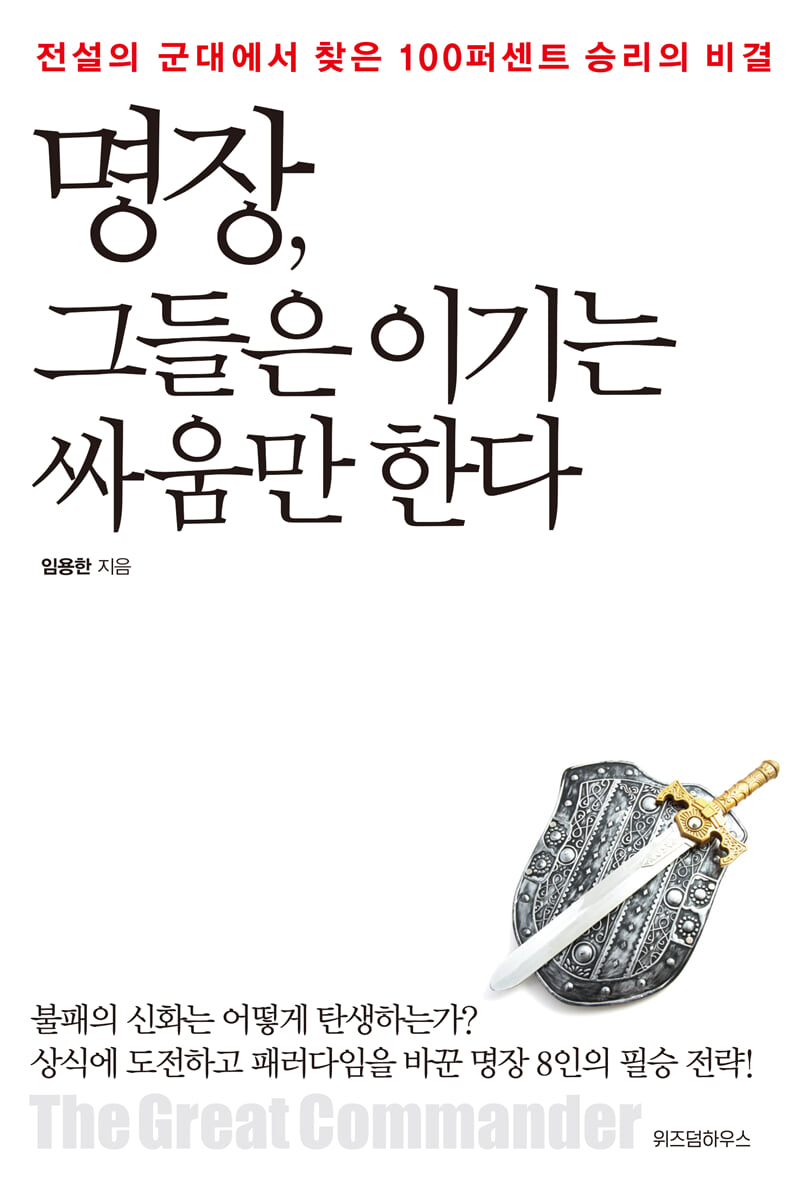
Masters, they only fight battles they can win.
 |
Description
Book Introduction
The winning strategies of eight famous generals who fought on the battlefield.
We are analyzing the secrets of the strategies and tactics that ensured their victory, along with the eight legendary generals who have become legends in the history of war.
It also offers detailed descriptions of the exciting battles of famous generals and their winning strategies and tactics, offering wisdom for self-management that can be applied to modern society.
From Epaminondas, the creator of the diagonal formation, to the meticulous strategist Rommel, readers will be able to discover new changes and creative alternatives through the strategies of famous generals who changed the rules of war, paradigms, and common sense.
The book features battlefield leaders you might have heard of, from Epaminondas, the commander-in-chief of the Greek army, to Rommel, who commanded the German army during World War II.
The author seeks the driving force behind the survival instinct, speed, and efficiency essential to an organization from the performance of those who achieved absolute victory.
Furthermore, it examines the secret behind their ability to maintain victory even in life-or-death crises, and how they created and applied diverse tactics on the ever-changing battlefield. By connecting corporate and real-life examples to the context of the time, it provides food for thought that modern people can apply to their own lives.
We are analyzing the secrets of the strategies and tactics that ensured their victory, along with the eight legendary generals who have become legends in the history of war.
It also offers detailed descriptions of the exciting battles of famous generals and their winning strategies and tactics, offering wisdom for self-management that can be applied to modern society.
From Epaminondas, the creator of the diagonal formation, to the meticulous strategist Rommel, readers will be able to discover new changes and creative alternatives through the strategies of famous generals who changed the rules of war, paradigms, and common sense.
The book features battlefield leaders you might have heard of, from Epaminondas, the commander-in-chief of the Greek army, to Rommel, who commanded the German army during World War II.
The author seeks the driving force behind the survival instinct, speed, and efficiency essential to an organization from the performance of those who achieved absolute victory.
Furthermore, it examines the secret behind their ability to maintain victory even in life-or-death crises, and how they created and applied diverse tactics on the ever-changing battlefield. By connecting corporate and real-life examples to the context of the time, it provides food for thought that modern people can apply to their own lives.
- You can preview some of the book's contents.
Preview
index
Introduction
1. The Beginning of the Reversal Tactic, the Creator of the Diagonal Formation: Epaminondas
The birth of camouflage tactics aimed at confusing the enemy│Changing traditional deployments to aim for a single blow│Using diverse units│Winning with four-dimensional tactics and diagonal formations│Pay attention to the principles and shifts in thinking hidden in phenomena.
2 A Master General Who Inspired All History of War: Alexander the Great
A fierce general with both brains and courage│Reform to survive│A great leader uses all methods appropriately│Charge into the center of the enemy camp│Even an unfavorable situation can be turned to your advantage│To become a winner, courage and confidence are necessary│Seize the opportunity as soon as you see it│He who guards the river is sure to lose│Assume the inevitable in an unexpected situation│Focus only on the possibility of victory
The Battle of the Century: Hannibal and Scipio, a Long-Range Strategy
Two leaders with unique tactics and vision│Challenge the imperative, not the possible│What matters in war is practice and timing│Conceive scenarios in advance and put them into action│God does not give humans two talents│Imitate good strategies│The incompetent hope for luck, the competent create luck│The difference in a critical mistake determines victory or defeat
4 Leaders who demonstrated the power of the eight-color bird: Belisarius
The General Who Solved the Byzantine Empire's Challenges│A Commander Who Doesn't Know His Role Is Dangerous│Turning Individual Skills into Multiplayer│The Tide of War Turns Depending on a Leader's Understanding
5. The King Who Overcame Limitations and Founded an Empire: Genghis Khan
Unleashing Mongolia's Potential│Escape the Trap of Adversity│Perfecting Tactics through Training and Practice│True Creativity is Unprecedented│Winning Through Mobility, Freedom, and Communication
6. The Tactical Wizard Who Saved the Ming Dynasty from Crisis: Qi Jiguang
The reality of not being able to respond to the invasion of the Japanese pirates│Sleep the Japanese sword with absurd weapons and tactics│Win by knowing how to utilize your strengths│Understand the behavioral patterns of your members│Consider rolling around in reality
7. A strategist who maximized turbulence and mobility: Rommel
The Struggle of the Killing Zone│Opportunity Always Demands Speed│Luck Comes to Those Who Take on Challenges│Execute Quickly, Thoroughly, and Boldly│Customs and Habits Are Effective When Used Rationally│All Efforts Must Be Preparation for Change│Win Through Mobility, Not Defense
References
1. The Beginning of the Reversal Tactic, the Creator of the Diagonal Formation: Epaminondas
The birth of camouflage tactics aimed at confusing the enemy│Changing traditional deployments to aim for a single blow│Using diverse units│Winning with four-dimensional tactics and diagonal formations│Pay attention to the principles and shifts in thinking hidden in phenomena.
2 A Master General Who Inspired All History of War: Alexander the Great
A fierce general with both brains and courage│Reform to survive│A great leader uses all methods appropriately│Charge into the center of the enemy camp│Even an unfavorable situation can be turned to your advantage│To become a winner, courage and confidence are necessary│Seize the opportunity as soon as you see it│He who guards the river is sure to lose│Assume the inevitable in an unexpected situation│Focus only on the possibility of victory
The Battle of the Century: Hannibal and Scipio, a Long-Range Strategy
Two leaders with unique tactics and vision│Challenge the imperative, not the possible│What matters in war is practice and timing│Conceive scenarios in advance and put them into action│God does not give humans two talents│Imitate good strategies│The incompetent hope for luck, the competent create luck│The difference in a critical mistake determines victory or defeat
4 Leaders who demonstrated the power of the eight-color bird: Belisarius
The General Who Solved the Byzantine Empire's Challenges│A Commander Who Doesn't Know His Role Is Dangerous│Turning Individual Skills into Multiplayer│The Tide of War Turns Depending on a Leader's Understanding
5. The King Who Overcame Limitations and Founded an Empire: Genghis Khan
Unleashing Mongolia's Potential│Escape the Trap of Adversity│Perfecting Tactics through Training and Practice│True Creativity is Unprecedented│Winning Through Mobility, Freedom, and Communication
6. The Tactical Wizard Who Saved the Ming Dynasty from Crisis: Qi Jiguang
The reality of not being able to respond to the invasion of the Japanese pirates│Sleep the Japanese sword with absurd weapons and tactics│Win by knowing how to utilize your strengths│Understand the behavioral patterns of your members│Consider rolling around in reality
7. A strategist who maximized turbulence and mobility: Rommel
The Struggle of the Killing Zone│Opportunity Always Demands Speed│Luck Comes to Those Who Take on Challenges│Execute Quickly, Thoroughly, and Boldly│Customs and Habits Are Effective When Used Rationally│All Efforts Must Be Preparation for Change│Win Through Mobility, Not Defense
References
Into the book
There is a more important and fundamental lesson in the diagonal formation.
If you want to create and innovate, you should not look at the phenomenon, but pay attention to the principles and changes in thinking hidden within it.
Many people search for products to benchmark, just as they search for blue oceans.
(Omitted) That is also necessary, but the more groundbreaking the success of a product is, the more likely it is that it contains a change in thinking, like the lesson of the diagonal formation, “divide time and space.”
Capturing this new principle could open up a whole new world.---「The Beginning of Reversal Tactics, Creator of the Diagonal Formation: Epaminondas」
There is a famous saying that sums up Alexander's character in one word.
“War is turbulent.” Generals facing war analyze the enemy’s tactics, strengths and weaknesses, and terrain, and formulate detailed plans.
The essence of tactics at this time is to attack the enemy's weaknesses.
(Omitted) No one establishes tactics with a momentary weakness that has not yet been revealed and may be revealed at any time as a target for attack and a decisive point of victory.
But Alexander was different.
He is extraordinary and groundbreaking in that he assumed this accidental or unexpected situation as an inevitable process and used it as a decisive battle point. ---「2 A Master General Who Inspired All History of War: Alexander the Great」
Timing is everything in war.
Too often, we lose battles we could have won or miss opportunities to destroy the enemy because we miss the moment to charge, the moment to send out our troops, the moment to turn back, etc.
However, looking at the history of war, cases of such timing being achieved are extremely rare.
(Omitted) It is difficult to communicate and exchange signals, and timing must be adjusted by taking into account all factors such as terrain, the time soldiers move, the changing battle situation in the meantime, the weather, and changes in the soldiers' psychology and morale.
In his ability to judge all these things and conduct battles with the art of war, Hannibal was unrivaled.
---「The Battle of the Century: Hannibal and Scipio, a Long-Range Strategy」
Belisarius revived the true traditions of Rome, finding ways to learn from and combine them with the barbarians.
His army became the most efficient and adaptable force in the world by applying a new organizational concept, multiplayer, that the world had never seen before.
In terms of speed, another criterion for an army that astonishes the world, Belisarius' army fails to display an explosive and impressive display.
But there is no efficiency without speed.
They were not cavalry that charged into battle, but they increased the speed of circulation within the Byzantine camp.
---「4 Leaders who have demonstrated the power of the Eight Colors: Belisarius」
Genghis Khan unified Mongolia, which was divided like grains of sand, both horizontally and vertically.
However, it was not a complete integration, an institutional integration.
Genghis Khan created a new and vast framework called the 'Mongol Ulus', but the Mongol tribes within it still existed in their old form.
However, Genghis Khan allowed them to perform their roles and functions to the fullest extent as part of the Mongol Ulus.
Over time, Europeans entered the Mongol Ulus, but despite being a union of thousands and tens of thousands of heterogeneous groups, the great wheel of the Mongol Ulus turned even more fiercely.
---「5 The King Who Overcame Limitations and Founded an Empire: Genghis Khan」
Qi Jiguang analyzed the process of battle and discovered a new quantitative increase in troops by deploying them in the process.
Simply put, close combat is a process of 'attacking the enemy, blocking, and attacking again' or 'blocking the enemy's attack and then attacking', and this process is usually carried out by one soldier.
However, Qi Jiguang analyzed this process and assigned two or more soldiers to each stage, and had ten people perform the entire process.
Additionally, by devising and providing weapons that can maximize each process, the efficiency of each process was maximized again.
---「6 The Tactical Wizard Who Saved the Ming Dynasty from Crisis: Qi Jiguang」
Rommel recaptured the outpost with a lightning-quick counterattack and redeployed the retreating troops.
If Rommel had forced them to make a noble sacrifice, even if this battle were won, the soldiers would still be timid and cowardly, lest they be chosen as victims themselves, while paying tribute to the victims.
The company will lose teamwork and every operation it sets up will go awry.
Rommel always demanded extraordinary courage in war, but never martyrdom.
If you want to create and innovate, you should not look at the phenomenon, but pay attention to the principles and changes in thinking hidden within it.
Many people search for products to benchmark, just as they search for blue oceans.
(Omitted) That is also necessary, but the more groundbreaking the success of a product is, the more likely it is that it contains a change in thinking, like the lesson of the diagonal formation, “divide time and space.”
Capturing this new principle could open up a whole new world.---「The Beginning of Reversal Tactics, Creator of the Diagonal Formation: Epaminondas」
There is a famous saying that sums up Alexander's character in one word.
“War is turbulent.” Generals facing war analyze the enemy’s tactics, strengths and weaknesses, and terrain, and formulate detailed plans.
The essence of tactics at this time is to attack the enemy's weaknesses.
(Omitted) No one establishes tactics with a momentary weakness that has not yet been revealed and may be revealed at any time as a target for attack and a decisive point of victory.
But Alexander was different.
He is extraordinary and groundbreaking in that he assumed this accidental or unexpected situation as an inevitable process and used it as a decisive battle point. ---「2 A Master General Who Inspired All History of War: Alexander the Great」
Timing is everything in war.
Too often, we lose battles we could have won or miss opportunities to destroy the enemy because we miss the moment to charge, the moment to send out our troops, the moment to turn back, etc.
However, looking at the history of war, cases of such timing being achieved are extremely rare.
(Omitted) It is difficult to communicate and exchange signals, and timing must be adjusted by taking into account all factors such as terrain, the time soldiers move, the changing battle situation in the meantime, the weather, and changes in the soldiers' psychology and morale.
In his ability to judge all these things and conduct battles with the art of war, Hannibal was unrivaled.
---「The Battle of the Century: Hannibal and Scipio, a Long-Range Strategy」
Belisarius revived the true traditions of Rome, finding ways to learn from and combine them with the barbarians.
His army became the most efficient and adaptable force in the world by applying a new organizational concept, multiplayer, that the world had never seen before.
In terms of speed, another criterion for an army that astonishes the world, Belisarius' army fails to display an explosive and impressive display.
But there is no efficiency without speed.
They were not cavalry that charged into battle, but they increased the speed of circulation within the Byzantine camp.
---「4 Leaders who have demonstrated the power of the Eight Colors: Belisarius」
Genghis Khan unified Mongolia, which was divided like grains of sand, both horizontally and vertically.
However, it was not a complete integration, an institutional integration.
Genghis Khan created a new and vast framework called the 'Mongol Ulus', but the Mongol tribes within it still existed in their old form.
However, Genghis Khan allowed them to perform their roles and functions to the fullest extent as part of the Mongol Ulus.
Over time, Europeans entered the Mongol Ulus, but despite being a union of thousands and tens of thousands of heterogeneous groups, the great wheel of the Mongol Ulus turned even more fiercely.
---「5 The King Who Overcame Limitations and Founded an Empire: Genghis Khan」
Qi Jiguang analyzed the process of battle and discovered a new quantitative increase in troops by deploying them in the process.
Simply put, close combat is a process of 'attacking the enemy, blocking, and attacking again' or 'blocking the enemy's attack and then attacking', and this process is usually carried out by one soldier.
However, Qi Jiguang analyzed this process and assigned two or more soldiers to each stage, and had ten people perform the entire process.
Additionally, by devising and providing weapons that can maximize each process, the efficiency of each process was maximized again.
---「6 The Tactical Wizard Who Saved the Ming Dynasty from Crisis: Qi Jiguang」
Rommel recaptured the outpost with a lightning-quick counterattack and redeployed the retreating troops.
If Rommel had forced them to make a noble sacrifice, even if this battle were won, the soldiers would still be timid and cowardly, lest they be chosen as victims themselves, while paying tribute to the victims.
The company will lose teamwork and every operation it sets up will go awry.
Rommel always demanded extraordinary courage in war, but never martyrdom.
---From "7 Strategists Who Utilized Turbulence and Mobility to the Fullest: Rommel"
Publisher's Review
Discover the secrets of a 100% winning strategy from the legendary generals who have become legends in the history of war!
The words most often heard by modern people, who cannot escape the era of endless competition, are probably change and creation.
But not everyone can lead change and creation.
Looking back at history, only those with special talents became creators who changed the times and brought about great transformations.
Especially the great commanders who demonstrated leadership in war were infinitely different from their contemporaries.
Their virtues and tactics have commonalities and connections.
They led the army with efficient organizational management, an understanding of the characteristics of various members, an aesthetic eye for determining victory or defeat, the courage and conviction to jump into actual combat, and confidence and potential in themselves, and successfully employed strategies and tactics appropriate to actual combat situations.
This book analyzes the secrets of the strategies and tactics that ensured their victory, along with the eight legendary generals who have become legends in the history of war.
Author Im Yong-han not only depicts the thrilling battles of famous generals, but also explains in detail their winning strategies and tactics, offering wisdom for self-management that can be applied to modern society.
From Epaminondas, the creator of the diagonal formation, to the meticulous strategist Rommel, readers will be able to discover new changes and creative alternatives through the strategies of famous generals who changed the rules of war, paradigms, and common sense.
Masters of strategy who overcame life-or-death crises and won, conquering the era!
Many companies strive to find blue oceans or their competitors' weaknesses and vulnerabilities.
But as we move into a hyper-competitive society, the vast wastelands waiting for their owners are gradually disappearing.
The development of innovative technologies and the transformation of the diversified global market are born and changed in an instant.
To capture these turbulent moments and build a system to respond, we must constantly devise new strategies and apply them to reality to prepare for change.
Even the great generals of history who stood tall as conquerors of the century had to predict and analyze the weather, terrain, troop deployment, enemy forces, and expected routes during battle.
The battles that are considered famous in the history of war were largely the result of the contributions of famous generals who exploited the strengths of their own forces and the weaknesses of the enemy.
This book features battlefield leaders you may have heard of, from Epaminondas, the commander-in-chief of the Greek army, to Rommel, who commanded the German army during World War II.
The author seeks the driving force behind the survival instinct, speed, and efficiency essential to an organization from the performance of those who achieved absolute victory.
Furthermore, it examines the secret behind their ability to maintain victory even in life-or-death crises, and how they created and applied diverse tactics on the ever-changing battlefield. By connecting corporate and real-life examples to the context of the time, it provides food for thought that modern people can apply to their own lives.
The winning strategies of eight famous generals who were active across the battlefield!
The masters appearing in this book can be broadly classified into three types.
First, there are commanders who won with a 'change in thinking', such as Epaminondas, who disrupted the traditional formation and created a diagonal formation that incorporated the concepts of time and space to confuse the enemy, and Qi Jiguang, who created a process whereby 12 soldiers could form a team and each person could fight up to 10 people.
Next are examples of maximizing the use of 'member management', such as Belisarius, who utilized multiplayer tactics by understanding the individual strengths of the Byzantine army, which was a mixture of various races, and Rommel, who fearlessly raised the morale and courage of his subordinates even when the enemy broke through.
Lastly, leaders who used 'organic tactics' include Hannibal and Scipio, who planned out expected scenarios and prepared for unexpected situations, and Genghis Khan, who brought about the golden age of Mongolia by forming and training units only with cavalry that communicated quickly.
The person who combined all these types was Alexander the Great.
The author believes that Alexander's strategy and tactics became a role model and lesson for all subsequent battlefields.
In fact, Alexander trained an excellent elite unit to increase mobility and change the deployment of his troops by predicting battlefield situations in advance to create a force strong in improvisation.
To keep the morale of the soldiers high, he never lost his sense of challenge, courage, and adventure, and he waged the war with only a focus on the possibility of victory.
A must-read for the next generation of leaders who will usher in a new era!
Masters are people who are respected for their methods of victory rather than the quantity of victory.
As the saying goes, “War is turbulence,” no matter how well-planned a strategy is, cracks are bound to appear in actual combat.
The gap that arises in a turbulent situation can also be a door that leads to victory.
Masters have always been scheming to find new core strategies to exploit these gaps, and they have quickly grasped unexpected emergencies.
He also diligently analyzed the situation he was in, including the surrounding political situation, geography, and weather, and was sensitive to speed.
He created a strategy that emphasized his own confidence and courage rather than precedent.
The history of war is the record of those who survived in the battlefield of survival where fierce battles took place.
Only a few of them are praised as great generals.
There is a saying that history goes round and round and progresses, but only a select few can lead a new history through change and creation.
Now the battlefield of the past has moved to the modern era.
In this era of fierce competition, countries, companies, small organizations, and even individuals around the world need their own strategies to survive.
Through this book, readers will be able to examine the tactics and secrets of victory of the famous generals who became heroes of their time, the conditions for a creator who can change the times, and how wisdom that shines even brighter in times of crisis is forged.
The words most often heard by modern people, who cannot escape the era of endless competition, are probably change and creation.
But not everyone can lead change and creation.
Looking back at history, only those with special talents became creators who changed the times and brought about great transformations.
Especially the great commanders who demonstrated leadership in war were infinitely different from their contemporaries.
Their virtues and tactics have commonalities and connections.
They led the army with efficient organizational management, an understanding of the characteristics of various members, an aesthetic eye for determining victory or defeat, the courage and conviction to jump into actual combat, and confidence and potential in themselves, and successfully employed strategies and tactics appropriate to actual combat situations.
This book analyzes the secrets of the strategies and tactics that ensured their victory, along with the eight legendary generals who have become legends in the history of war.
Author Im Yong-han not only depicts the thrilling battles of famous generals, but also explains in detail their winning strategies and tactics, offering wisdom for self-management that can be applied to modern society.
From Epaminondas, the creator of the diagonal formation, to the meticulous strategist Rommel, readers will be able to discover new changes and creative alternatives through the strategies of famous generals who changed the rules of war, paradigms, and common sense.
Masters of strategy who overcame life-or-death crises and won, conquering the era!
Many companies strive to find blue oceans or their competitors' weaknesses and vulnerabilities.
But as we move into a hyper-competitive society, the vast wastelands waiting for their owners are gradually disappearing.
The development of innovative technologies and the transformation of the diversified global market are born and changed in an instant.
To capture these turbulent moments and build a system to respond, we must constantly devise new strategies and apply them to reality to prepare for change.
Even the great generals of history who stood tall as conquerors of the century had to predict and analyze the weather, terrain, troop deployment, enemy forces, and expected routes during battle.
The battles that are considered famous in the history of war were largely the result of the contributions of famous generals who exploited the strengths of their own forces and the weaknesses of the enemy.
This book features battlefield leaders you may have heard of, from Epaminondas, the commander-in-chief of the Greek army, to Rommel, who commanded the German army during World War II.
The author seeks the driving force behind the survival instinct, speed, and efficiency essential to an organization from the performance of those who achieved absolute victory.
Furthermore, it examines the secret behind their ability to maintain victory even in life-or-death crises, and how they created and applied diverse tactics on the ever-changing battlefield. By connecting corporate and real-life examples to the context of the time, it provides food for thought that modern people can apply to their own lives.
The winning strategies of eight famous generals who were active across the battlefield!
The masters appearing in this book can be broadly classified into three types.
First, there are commanders who won with a 'change in thinking', such as Epaminondas, who disrupted the traditional formation and created a diagonal formation that incorporated the concepts of time and space to confuse the enemy, and Qi Jiguang, who created a process whereby 12 soldiers could form a team and each person could fight up to 10 people.
Next are examples of maximizing the use of 'member management', such as Belisarius, who utilized multiplayer tactics by understanding the individual strengths of the Byzantine army, which was a mixture of various races, and Rommel, who fearlessly raised the morale and courage of his subordinates even when the enemy broke through.
Lastly, leaders who used 'organic tactics' include Hannibal and Scipio, who planned out expected scenarios and prepared for unexpected situations, and Genghis Khan, who brought about the golden age of Mongolia by forming and training units only with cavalry that communicated quickly.
The person who combined all these types was Alexander the Great.
The author believes that Alexander's strategy and tactics became a role model and lesson for all subsequent battlefields.
In fact, Alexander trained an excellent elite unit to increase mobility and change the deployment of his troops by predicting battlefield situations in advance to create a force strong in improvisation.
To keep the morale of the soldiers high, he never lost his sense of challenge, courage, and adventure, and he waged the war with only a focus on the possibility of victory.
A must-read for the next generation of leaders who will usher in a new era!
Masters are people who are respected for their methods of victory rather than the quantity of victory.
As the saying goes, “War is turbulence,” no matter how well-planned a strategy is, cracks are bound to appear in actual combat.
The gap that arises in a turbulent situation can also be a door that leads to victory.
Masters have always been scheming to find new core strategies to exploit these gaps, and they have quickly grasped unexpected emergencies.
He also diligently analyzed the situation he was in, including the surrounding political situation, geography, and weather, and was sensitive to speed.
He created a strategy that emphasized his own confidence and courage rather than precedent.
The history of war is the record of those who survived in the battlefield of survival where fierce battles took place.
Only a few of them are praised as great generals.
There is a saying that history goes round and round and progresses, but only a select few can lead a new history through change and creation.
Now the battlefield of the past has moved to the modern era.
In this era of fierce competition, countries, companies, small organizations, and even individuals around the world need their own strategies to survive.
Through this book, readers will be able to examine the tactics and secrets of victory of the famous generals who became heroes of their time, the conditions for a creator who can change the times, and how wisdom that shines even brighter in times of crisis is forged.
GOODS SPECIFICS
- Date of issue: January 6, 2014
- Page count, weight, size: 312 pages | 412g | 152*225*30mm
- ISBN13: 9788960866423
- ISBN10: 8960866423
You may also like
카테고리
korean


korean

![GQ KOREA Mark (Monthly): December [2025]](http://librairie.coreenne.fr/cdn/shop/files/8ef265dbbfbf186523ed75ba7319009d.jpg?v=1765340328&width=3840)


