

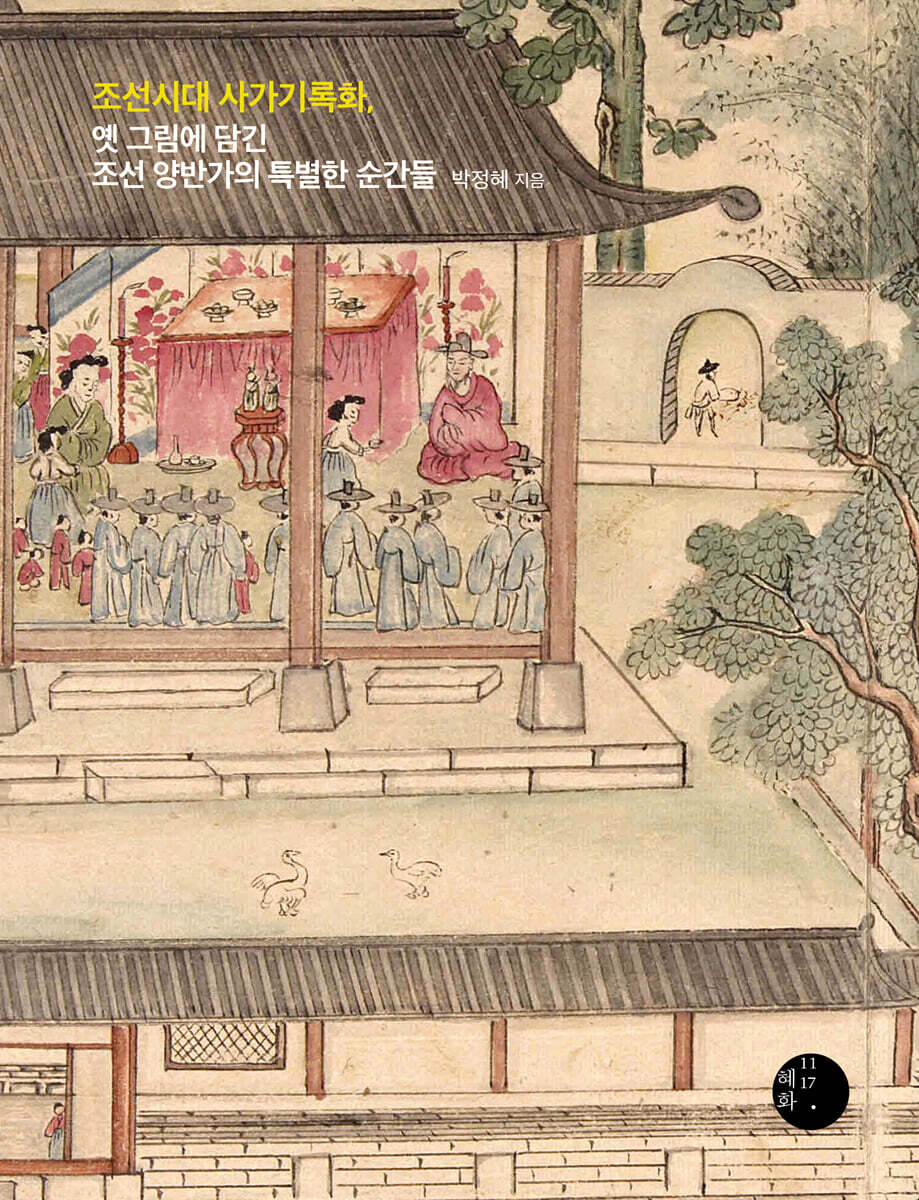
Joseon Dynasty Historical Records: Special Moments from Joseon's Noble Family Captured in Old Paintings
 |
Description
Book Introduction
- A word from MD
-
Joseon's daily life as seen through old paintings712 pages, approximately 2,500 sheets of manuscript paper, and approximately 450 illustrations.
It contains almost everything about Joseon Dynasty historical records.
A collection of previously unpublished paintings from private collections and those from major domestic and international institutions.
You can enjoy the scenery of Seoul and Pyongyang along with the daily life of Joseon.
June 7, 2022. History PD Son Min-gyu
The daily lives of Joseon nobles recorded in pictures,
It is, without a doubt, a new world of Korean art history that no one has ever seen before!
The emergence of an overwhelming achievement that guides us into that world!
We cannot leave out the name of art historian Park Jeong-hye when it comes to how we can now so familiarly recall Joseon Dynasty palaces and royal paintings.
Thanks to his steady and silent exploration of Joseon Dynasty documentary paintings, court paintings, and color paintings, which he took an interest in earlier than anyone else, the world of Korean art, which had been centered on literati paintings and ink paintings, expanded significantly, and before we knew it, the various documentary paintings and beautiful color paintings produced in palaces and government offices became an indispensable genre in our art history.
He once again unfolds before us the world of so-called private records left behind by the Joseon yangban.
For him, the study of royal court records has been an ongoing project for a long time, as he had already considered it as his next task when he was engrossed in the study of royal court records.
For over 30 years, he has been focusing on the fields of color painting and documentary painting, which were previously considered mere reference works among popular subjects in Korean art history. He has tirelessly and steadily pursued this path, and has finally presented to the world the results of his overwhelming achievements.
Through the path he paved step by step, a new and vast world of Korean painting history, never before seen, has finally unfolded before us in a grand and beautiful way.
It is, without a doubt, a new world of Korean art history that no one has ever seen before!
The emergence of an overwhelming achievement that guides us into that world!
We cannot leave out the name of art historian Park Jeong-hye when it comes to how we can now so familiarly recall Joseon Dynasty palaces and royal paintings.
Thanks to his steady and silent exploration of Joseon Dynasty documentary paintings, court paintings, and color paintings, which he took an interest in earlier than anyone else, the world of Korean art, which had been centered on literati paintings and ink paintings, expanded significantly, and before we knew it, the various documentary paintings and beautiful color paintings produced in palaces and government offices became an indispensable genre in our art history.
He once again unfolds before us the world of so-called private records left behind by the Joseon yangban.
For him, the study of royal court records has been an ongoing project for a long time, as he had already considered it as his next task when he was engrossed in the study of royal court records.
For over 30 years, he has been focusing on the fields of color painting and documentary painting, which were previously considered mere reference works among popular subjects in Korean art history. He has tirelessly and steadily pursued this path, and has finally presented to the world the results of his overwhelming achievements.
Through the path he paved step by step, a new and vast world of Korean painting history, never before seen, has finally unfolded before us in a grand and beautiful way.
- You can preview some of the book's contents.
Preview
index
ㆍ Publishing a book
Introduction | How to Read the Saga Records
Saga Record Painting, a commemorative painting of the noble class that transcended the walls of the palace and government offices | The most frequently depicted wish for longevity and health | Aspirations for lofty achievements and success | A wish for the well-being and prosperity of the family | The popularity of lifelong painting and Saga Record Painting | Saga Record Painting, where albums were preferred | Saga Record Painting led by the gentry of Yeongnam and the Gyeonghwa gentry of Hanyang | Painters who painted Saga Record Painting
Chapter 1 | Celebrating Parents' Longevity - Gyeongsuyeondo
Gyeongsuyeondo, painted even before the Imjin War | The painting has disappeared, but the scenery of Gyeongsuyeon can be guessed from writing | In the 17th century, the production of Gyeongsuyeon paintings began to increase | The oldest extant Suyeondo, 《Aeildanggugyeongcheop》 | Scenes of Gyeongsuyeon held six times, 《Gyeongsudocheop》 | Record of a banquet held by ten families of the prime ministers, 《Seonmyojojejaegyeongsuyeondo》 | Seven mothers who received longevity congratulations from the king, 《Chiltaebuin Gyeongsuyeondo》 | Brotherly brothers and sisters celebrating each other's longevity together, 《Damrakyeondo》
Chapter 2 | Receiving the Stone and Staff to Honor National Elders_Sagui Funeral Ceremony
A subject who asks to step down from his position is allowed to remain in office | From food to music, the king's grand ceremonies | The shape of the funeral procession changes with the times | The Hongseom Sagone Funeral Picture, which depicts the funeral procession before the Imjin War | The revival of the funeral procession after the Imjin War, the Lee Won-ik Sagone Funeral Picture Book | The Lee Gyeong-seok Sagone Funeral Picture Book, which is preserved in three copies
Chapter 3 | 60 Years of Marriage, Another Wedding_A Second Wedding
Joseon's Unique Customs, the Wedding Ceremony | Parents' Wedding Ceremony, a Country's Gratitude | Wedding Ceremony in Records | An Ordinary Man's Wedding Ceremony, "Yohwa Noin Hoegeundocheop" | 8-Painted Folding Screens Commemorating the Wedding Ceremony Following 19th-Century Fashion | The Beginning and End of the Wedding Ceremony Seen in Illustrated Pictures, "Hoehonryeidocheop"
Chapter 4 | Once a Motivation, Always a Motivation_Bang Hwe-do
A gathering of classmates who passed the state examination during the Joseon Dynasty, Banghoe | A gathering of classmates who passed the state examination on the 60th anniversary of passing the state examination, a banquet held with generals | Two 16th-century Banghoe paintings, 〈Yeonbangdongnyeonilsijosa Gyehoedo〉 and 〈Higyeongru Banghoedo〉 | Banghoe paintings together, separate Banghoe albums, 〈Gyeyusama Banghoedo〉 and 〈Sinchuksama Banghoedo〉 | 〈Se-nyeon Gyehoedo〉 and 〈Yeongye-dongnyeon Gyehoedo〉, left by sons who became classmates following their father | Sima Dongnyeon, who rose to the position of Samjeongseung, 〈Imosama Banghoedo〉 | Sima Dongnyeon, who met with difficulty while away from home, 〈Yongmansama Dongbangrok〉
Chapter 5 | Days Spent at a Local Post: Record of Appointment
The procession of the new governors and magistrates depicted in the procession map | A new trend in the folding screen of the town wall painting | The governor of all governors, the procession of the Pyeongan-do governor | The procession of the Hwanghae-do governor | The Jeolla-do governor commemorates his procession to the town wall | The Gyeonggi-do governor and his people depicted together in the folding screen | The river drawn in the town wall painting of Hwaseong, Ganghwa, and Geoje | The special mission of the Dongrae magistrate: welcoming the Japanese envoy | The privilege of elegance enjoyed only by the Pyeongan-do governor | The special hospitality of Pyeongyang for those who passed the provincial examination
Chapter 6 | Official History Recorded in Pictures_Hwanryeokdo
A record of Tamna Island's pilgrimage by a Jeju governor, "Tamna Sunryeokdo" | A lifelong pilgrimage by a Gyeonghwa Sajok, "Sukcheon Jeado" | A map depicting the history of foreign posts, "Hwanyu Cheop"
Chapter 7 | The Glory of a Family Receiving a Name from the State - Yeonsiryedo
The meaning of receiving a new name from the nation | The production of a commemorative painting of the rite of passage seen in records | Commemorating the rite of passage of an ancestor who passed away 26 years ago, 《Hyogan-gong Lee Jeong-yeong's rite of passage docheop》 | Another rite of passage docheop left by the descendants of Ik Ik-sang, Minister of Personnel, 《Munhui-gong Lee Ik-sang's rite of passage docheop》 | Performing a rite of passage at the tomb, 《Mungyeong-gong Munjang Gongyang Daeyeonsi-do》 | A rite of passage record that contains the entire rite of passage, although it does not contain any pictures
Chapter 8 | Ancestral Records Collected in the Family Name: Family Phone Book
Joseon Dynasty family painting albums created with similar yet different stories | Representative family painting album, 《Uiryeong Nam Clan Family Painting Album》 | Widely disseminated family painting albums through lithography, 《Daegu Seo Clan Painting Album》 | Family painting albums of the Andong Hyangban clan, 《Pungsan Kim Clan Family Painting Album》 · Key figures who brought glory to the Pungsan Kim clan · Compiler Kim Jung-hyu's family consciousness and the compilation of 《Pungsan Kim Clan Family Painting Album》 · Painting style and production of 《Pungsan Kim Clan Family Painting Album》 Painter | Family painting albums of the Oh family that settled in Chungcheong Province, 《Dongbok Oh Clan Family Painting Book》
Chapter 9 | The Comprehensive History of the Life-Spanning Do_The Life-Spanning Do
Life-Saving Paintings: The Aspirations of the Noble and Scholarly Class, Instead of Recording Facts | The Hidden Meanings of Paintings as Seen Through Masterpieces | Leaving Autobiographical Life-Saving Paintings That Capture the Entire Life | The Historical Record of Life-Saving Paintings: Their Changing Meanings Over Time
Chapter 10 | People Who Captured the Values and Ideals of the Yangban Scholars in Paintings: The Two Axis of the Production of Historical Records
People Who Recorded Their History in Illustrated Records | Illustrated Records of the Yeongnam Aristocrats: A Community of Scholarly Lineage and Blood | Illustrated Records of the Gyeonghwa Aristocrats, Hanyang's Prestigious Families
supplement
· Notes · Tables · Data · References · Index
Introduction | How to Read the Saga Records
Saga Record Painting, a commemorative painting of the noble class that transcended the walls of the palace and government offices | The most frequently depicted wish for longevity and health | Aspirations for lofty achievements and success | A wish for the well-being and prosperity of the family | The popularity of lifelong painting and Saga Record Painting | Saga Record Painting, where albums were preferred | Saga Record Painting led by the gentry of Yeongnam and the Gyeonghwa gentry of Hanyang | Painters who painted Saga Record Painting
Chapter 1 | Celebrating Parents' Longevity - Gyeongsuyeondo
Gyeongsuyeondo, painted even before the Imjin War | The painting has disappeared, but the scenery of Gyeongsuyeon can be guessed from writing | In the 17th century, the production of Gyeongsuyeon paintings began to increase | The oldest extant Suyeondo, 《Aeildanggugyeongcheop》 | Scenes of Gyeongsuyeon held six times, 《Gyeongsudocheop》 | Record of a banquet held by ten families of the prime ministers, 《Seonmyojojejaegyeongsuyeondo》 | Seven mothers who received longevity congratulations from the king, 《Chiltaebuin Gyeongsuyeondo》 | Brotherly brothers and sisters celebrating each other's longevity together, 《Damrakyeondo》
Chapter 2 | Receiving the Stone and Staff to Honor National Elders_Sagui Funeral Ceremony
A subject who asks to step down from his position is allowed to remain in office | From food to music, the king's grand ceremonies | The shape of the funeral procession changes with the times | The Hongseom Sagone Funeral Picture, which depicts the funeral procession before the Imjin War | The revival of the funeral procession after the Imjin War, the Lee Won-ik Sagone Funeral Picture Book | The Lee Gyeong-seok Sagone Funeral Picture Book, which is preserved in three copies
Chapter 3 | 60 Years of Marriage, Another Wedding_A Second Wedding
Joseon's Unique Customs, the Wedding Ceremony | Parents' Wedding Ceremony, a Country's Gratitude | Wedding Ceremony in Records | An Ordinary Man's Wedding Ceremony, "Yohwa Noin Hoegeundocheop" | 8-Painted Folding Screens Commemorating the Wedding Ceremony Following 19th-Century Fashion | The Beginning and End of the Wedding Ceremony Seen in Illustrated Pictures, "Hoehonryeidocheop"
Chapter 4 | Once a Motivation, Always a Motivation_Bang Hwe-do
A gathering of classmates who passed the state examination during the Joseon Dynasty, Banghoe | A gathering of classmates who passed the state examination on the 60th anniversary of passing the state examination, a banquet held with generals | Two 16th-century Banghoe paintings, 〈Yeonbangdongnyeonilsijosa Gyehoedo〉 and 〈Higyeongru Banghoedo〉 | Banghoe paintings together, separate Banghoe albums, 〈Gyeyusama Banghoedo〉 and 〈Sinchuksama Banghoedo〉 | 〈Se-nyeon Gyehoedo〉 and 〈Yeongye-dongnyeon Gyehoedo〉, left by sons who became classmates following their father | Sima Dongnyeon, who rose to the position of Samjeongseung, 〈Imosama Banghoedo〉 | Sima Dongnyeon, who met with difficulty while away from home, 〈Yongmansama Dongbangrok〉
Chapter 5 | Days Spent at a Local Post: Record of Appointment
The procession of the new governors and magistrates depicted in the procession map | A new trend in the folding screen of the town wall painting | The governor of all governors, the procession of the Pyeongan-do governor | The procession of the Hwanghae-do governor | The Jeolla-do governor commemorates his procession to the town wall | The Gyeonggi-do governor and his people depicted together in the folding screen | The river drawn in the town wall painting of Hwaseong, Ganghwa, and Geoje | The special mission of the Dongrae magistrate: welcoming the Japanese envoy | The privilege of elegance enjoyed only by the Pyeongan-do governor | The special hospitality of Pyeongyang for those who passed the provincial examination
Chapter 6 | Official History Recorded in Pictures_Hwanryeokdo
A record of Tamna Island's pilgrimage by a Jeju governor, "Tamna Sunryeokdo" | A lifelong pilgrimage by a Gyeonghwa Sajok, "Sukcheon Jeado" | A map depicting the history of foreign posts, "Hwanyu Cheop"
Chapter 7 | The Glory of a Family Receiving a Name from the State - Yeonsiryedo
The meaning of receiving a new name from the nation | The production of a commemorative painting of the rite of passage seen in records | Commemorating the rite of passage of an ancestor who passed away 26 years ago, 《Hyogan-gong Lee Jeong-yeong's rite of passage docheop》 | Another rite of passage docheop left by the descendants of Ik Ik-sang, Minister of Personnel, 《Munhui-gong Lee Ik-sang's rite of passage docheop》 | Performing a rite of passage at the tomb, 《Mungyeong-gong Munjang Gongyang Daeyeonsi-do》 | A rite of passage record that contains the entire rite of passage, although it does not contain any pictures
Chapter 8 | Ancestral Records Collected in the Family Name: Family Phone Book
Joseon Dynasty family painting albums created with similar yet different stories | Representative family painting album, 《Uiryeong Nam Clan Family Painting Album》 | Widely disseminated family painting albums through lithography, 《Daegu Seo Clan Painting Album》 | Family painting albums of the Andong Hyangban clan, 《Pungsan Kim Clan Family Painting Album》 · Key figures who brought glory to the Pungsan Kim clan · Compiler Kim Jung-hyu's family consciousness and the compilation of 《Pungsan Kim Clan Family Painting Album》 · Painting style and production of 《Pungsan Kim Clan Family Painting Album》 Painter | Family painting albums of the Oh family that settled in Chungcheong Province, 《Dongbok Oh Clan Family Painting Book》
Chapter 9 | The Comprehensive History of the Life-Spanning Do_The Life-Spanning Do
Life-Saving Paintings: The Aspirations of the Noble and Scholarly Class, Instead of Recording Facts | The Hidden Meanings of Paintings as Seen Through Masterpieces | Leaving Autobiographical Life-Saving Paintings That Capture the Entire Life | The Historical Record of Life-Saving Paintings: Their Changing Meanings Over Time
Chapter 10 | People Who Captured the Values and Ideals of the Yangban Scholars in Paintings: The Two Axis of the Production of Historical Records
People Who Recorded Their History in Illustrated Records | Illustrated Records of the Yeongnam Aristocrats: A Community of Scholarly Lineage and Blood | Illustrated Records of the Gyeonghwa Aristocrats, Hanyang's Prestigious Families
supplement
· Notes · Tables · Data · References · Index
Detailed image
Publisher's Review
A 60th birthday party, a wedding ceremony to celebrate 60 years of marriage, a reunion of classmates, a history of official positions held, all the glory of the family, the achievements of ancestors, the life of a nobleman recorded in a life map…
Special moments of the Joseon yangban family unfold in Joseon Dynasty paintings.
A saga record is literally a picture that visually records events or rituals related to an individual's family or life.
It was mainly created with the intention of commemorating the footsteps of the main character of the event, praising the achievements of ancestors, and further promoting the excellence of the family and raising its status.
Rather than being a public record produced with public funds after an official event at a palace or government office, they depict various events held in the homes of individuals or families, as well as special moments that they wish to keep privately.
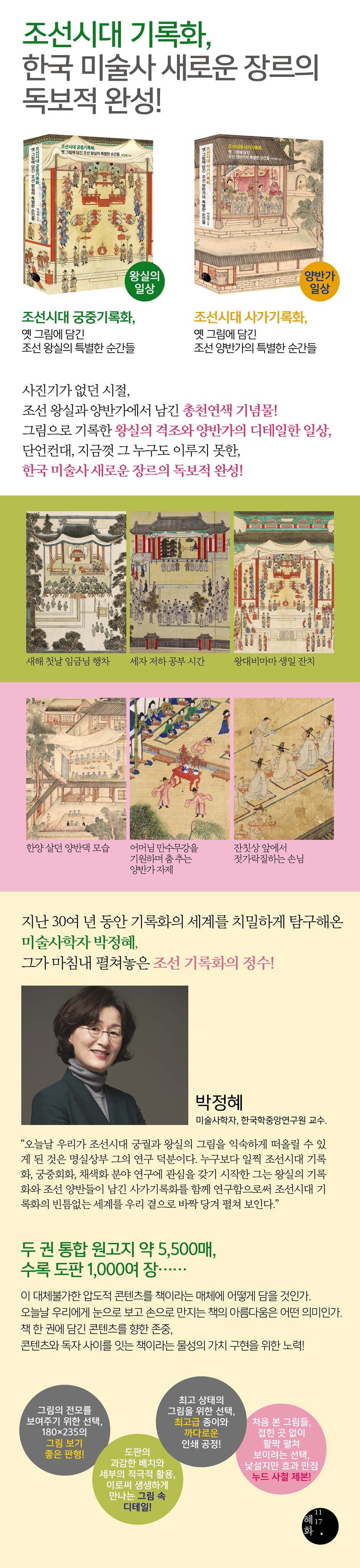
Here, there are various types, such as Gyeongsuyeondo (Chapter 1) to celebrate the longevity of parents, Sagwijangryedo (Chapter 2) to symbolize being treated as a national elder by the country, Hoehonryedo (Chapter 3) to commemorate the 60th anniversary of marriage, Banghoedo (Chapter 4) which is like a commemorative photo of a class reunion of past civil service examination passers-by, Record of Assignment Pictures containing memories of working at various local posts (Chapter 5), Hwanryeokdo (Chapter 6) which meticulously records the history of official posts through pictures, Yeonsiryedo (Chapter 7) to leave the honor of the family when a deceased ancestor received a name from the country, Gajeonhwacheop (Chapter 8) a kind of pictorial genealogy containing the great achievements of previous ancestors, and the life of a nobleman contained in a life-span picture (Chapter 9).
A colorful monument left behind by a noble family in Joseon in the days before cameras.
Who, why, and how were the Joseon Dynasty historical records drawn?
What does this picture mean to us?
In the Joseon Dynasty, before the advent of photography, historical records served as a record and memorial, much like today's full-color photographs.
Things that you want to remember for a long time, things you want to brag about to many people, and happy events that you want to pass down to future generations are realistically captured in the picture.
These paintings were sometimes painted as a single piece, or were made into albums by combining several pieces, and sometimes were made into folding screens.
It is also characteristic that the range of artists is wide, ranging from famous painters of the time to descendants of painters and unknown local painters, depending on the circumstances and situations of the individual and family.
Compared to court records or government records, these paintings by such diverse people were painted relatively freely, not confined to a single stereotype, although they followed the style of the time.
Saga records do not stop at simply reproducing facts.
It is difficult to find in official group commemorative paintings of royal courts or government offices, but each painting is deeply imbued with the individual efforts and history of each household, and the Confucian values and pride in the family of the Joseon yangban families are also fully imbued in each painting.
In other words, the painting reveals in detail how the yangban officials perceived the Confucian values that Joseon society demanded of them.
This means that today we can fully experience what they were aiming for through the visualization of special moments of individuals and families through the highly realistic medium of painting.
However, the intention to record important moments of one's family and personal life through drawings was not something that could be done by everyone, even if they had a lot of fame or wealth.
Someone in the household had to take responsibility for it and pay constant attention to keeping it in shape and in good condition.
To complete a painting, one must have the humanities to leave a record in the form of a painting, the connections to hire an artist and make it a reality, and the financial resources to support it.
And that's not all.
It didn't end with just one drawing.
In order to give meaning to the paintings drawn in this way by receiving texts from prestigious people, and to pass them down to descendants from generation to generation, it was necessary to prevent damage, loss, and theft as much as possible.
If a painting inherited from an ancestor was damaged or lost for any reason, it had to be copied and preserved in order to be passed down to future generations.
Therefore, the presence of many later copies is one of the important characteristics of historical records.
It is significant that each copy has its own story, and paradoxically, the more copies there are, the more weighty the historical value contained in the painting.
In addition, observing the traces of changes over time reflected in copying the same painting is another special pleasure encountered through the historical records.
From paintings that have been passed down in the vaults of noble families for generations,
A collection of all kinds of paintings hidden in art galleries and museums at home and abroad!
Even the picture that appeared just before the book's closing time and solved the final puzzle!
Since the Saga Record Paintings are paintings created by individuals and families, most of them are kept in the vaults of noble families that have been passed down through generations and are not often exposed to the public.
In addition, there are collections in national and public art galleries, museums, research institutes, university museums, and many museums and art galleries overseas, but they are rarely shown to the public.
Because of the nature of the paintings, most of the paintings included in this book have been studied individually by researchers, but their full picture has rarely been revealed.
This book covers all kinds of paintings from private collections that were not previously known, to those held by major domestic institutions, as well as art galleries and museums at home and abroad, including the Harvard-Yenching Institute, Yale University, the Asian Art Museum of San Francisco, the Portland Museum of Modern Art, the Peabody Essex Museum, the Guimet National Museum of Asian Art in France, the Leipzig-Grassi Folk Museum in Germany, and the Korean Central History Museum in Pyongyang.
This is hardly the first time that drawings that had previously been shared only among a select few have been compiled in such a comprehensive manner.
In addition, the illustrations that had been passed down as one-sided drawings (pages 84 and 90) before the publication of this book, raising curiosity about the rest of the book, appeared just before the book's deadline, and the world within the drawings that had been left unknown was included (pages 92-99), further increasing the significance of this book.
The household structure of a noble family in the Joseon Dynasty, the table setting for a banquet day that differs from house to house, the seating arrangements of the nobles, the nobles using chopsticks, the changing hairstyles and fashion styles of women over time, the groom's entrance and the reception of guests, guests who arrive late and in a hurry on a banquet day, food preparation, the scenery of a noble family on a banquet day, a boat ride on the Daedong River by the Pyeongan Governor, the welcoming ceremony for top-ranking civil service exam passers...
Vivid scenes of Joseon Dynasty life, never seen before, appearing one after another in countless numbers.
The greatest pleasure that general readers will enjoy through this book is, without a doubt, the pleasure of looking at the illustrations.
In this unique and even unfamiliar painting, which I have never seen before, the Joseon yangban dance, eat, smoke cigarettes hidden in the background, and converse.
The leisurely expressions of the noblemen who arrived early on the day of the feast, the sight of the palanquin bearers rushing over the hill, the unique customs of Joseon holding a wedding ceremony again after 60 years, every corner of a simple nobleman's house at the foot of Mt. Wau in Hanyang, the noblemen using chopsticks in front of one table per person, the servants helping with the feast, the sights of gisaeng and musicians dancing and playing instruments, records collected like a photo album of the scenery of the government offices and regions where they worked throughout their lives, the achievements of their predecessors compiled in a unique painting style, the scenery of various places in North Korea that are unfamiliar to us but were clearly the playgrounds of the noblemen of the Joseon Dynasty, and among them, the banquet at the famous Pyeongan Governor's site, the old appearance of Pyongyang seen through a boat ride on the Taedong River, etc. are interesting and vivid scenes that seem like they would have been captured by today's social media if it had existed in that era.
A world completely different from the literati paintings, landscape paintings, and ink paintings we have seen so far, and a world completely different from the familiar genre paintings that give us a glimpse into the daily lives of the Joseon Dynasty, the special moments of the Joseon Dynasty's noble families that we encounter through these paintings transcend time and space and come before us as if they were our neighbors.
How is the history of a single painting revealed to us?
Sometimes, like an exciting detective novel,
Sometimes, it brings to light the true nature of a scholar's meticulous research,
A compilation of 30 years of research by Professor Park Jeong-hye, the highest authority on Korean art history.
The Joseon Dynasty's noble culture recorded in pictures, and the cultural landscape that led to that culture!
A picture tells a lot, but it doesn't reveal everything.
When the Joseon yangban created a painting, they did not forget to leave a record related to the painting.
The background of the painting's creation, as well as the names of those invited to the event, their seating arrangements, and even the structure and procedures of the event, were sometimes written on the painting and sometimes separately and bound together in a picture album.
In addition, he did not forget to receive congratulatory poems from close and prominent people around him and to include them in his collection.
Author Park Jeong-hye examined countless prefaces, biographies, epitaphs, epitaphs, and elegies left behind by the noble families of the Joseon Dynasty to understand the circumstances surrounding the creation of the paintings and the meaning of the moments within them.
It's like tracing another world behind a picture.
Observing the process of his exploration, one sometimes feels the thrill of reading a detective novel, and at other times, one encounters the meticulous sincerity of a scholar who uncovers the evidence in a painting based solely on hard facts.
In the Joseon Dynasty, the process of preparing, executing, and recording events in writing and pictures was not limited to the work of just one family.
Sometimes, several families would unite to hold an event, produce several paintings to share, or actively reference other families' events.
The host of an event is sometimes invited as a guest at other events, and one person may appear in writing and by name at events of several families.
This means that examining the process of creating a saga record is equivalent to understanding the cultural landscape of the time.
The reason why Joseon's historical records were produced with a particular focus on the noble families of Yeongnam and Gyeonghwa in Hanyang can also be explained along these lines.
The result of the author's meticulous research over 30 years,
Approximately 2,500 pages of manuscript paper, approximately 450 illustrations, and approximately 960 entries in the index of names and works…
What does the beauty of books that we see with our eyes and touch with our hands mean to us today?
Respect for the content contained in a book,
Efforts to realize the physical value of books as a link between content and readers
What does the beauty of books that we see with our eyes and touch with our hands mean to us today?
How should the author's decades of intense research be honored through a book?
How should the authority of the overwhelming content—approximately 2,500 pages of manuscript paper and 450 illustrations—be realized in a single book?
In this age where dozens, even hundreds, of books are published every day, in this age where lighthearted and easy-to-read content is gaining traction, how can we properly and accurately convey this irreplaceable content through the medium of books?
The journey toward the book, which began about a year ago when I first encountered the true nature of the manuscript, began with that very concern.
We have long since abandoned the idea of setting a price range, format, and size to make it easy for readers to choose.
Also, the obsession with readability, that is, that it must be easy to read, is one of the things that was excluded during the work process.
The first premise of the editing process for this book was to create a book that suited its content.
The structure of a book is not all that is visible.
In order to effectively convey to readers the world of saga records, which are as new to them as the illustrations themselves, the author revised the overall structure of the book, explained unfamiliar concepts as much as possible within the text, and paid special attention to the organic flow of the illustrations and text.
To this end, the beginning and end of the book include separate sections that provide a comprehensive overview of the historical records and their meaning (Introduction, Chapter 10). The overall flow of the book is divided into three categories to make it easier for readers to understand: ‘Longevity and prosperity of descendants,’ ‘Passing the civil service examination and official life,’ and ‘Stability and prosperity of the family.’
This is an attempt to break away from the linear approach of compiling and organizing research results that is often adopted in research papers, allowing readers to access dense content in a much more accessible way.
The readers this book is intended for are not only lovers of Korean art.
One book is bound to serve as a stepping stone to another study.
This book, which will serve as an entryway into a new world of Korean art history, a true record of historical events, has a calling to fulfill its role for those who will continue to explore this field.
To this end, the author has not neglected to provide a context for existing research, making it much easier to enter this new world, in order to maximize the usefulness for future researchers in this field.
Another characteristic of this book is that, rather than the aforementioned obsession with easy readability, it focuses more on consideration for discerning readers who will appreciate the book's meaning.
To this end, the author has separately organized and arranged numerous tables to help readers understand the content in depth and breadth, and has included various materials to help them understand more deeply.
In line with these concerns, this book adopted a large format to show the true nature of the paintings, a bold layout of the plates and active use of details, a binding method to properly display the paintings that most readers will encounter for the first time in their lives, and selection of paper to ensure high-quality printing.
This book, which we first encounter with the number on page 712 and the regular price of 59,000 won, is filled with content that a single book can possess and an attitude of respect for its readers.
Special moments of the Joseon yangban family unfold in Joseon Dynasty paintings.
A saga record is literally a picture that visually records events or rituals related to an individual's family or life.
It was mainly created with the intention of commemorating the footsteps of the main character of the event, praising the achievements of ancestors, and further promoting the excellence of the family and raising its status.
Rather than being a public record produced with public funds after an official event at a palace or government office, they depict various events held in the homes of individuals or families, as well as special moments that they wish to keep privately.
Here, there are various types, such as Gyeongsuyeondo (Chapter 1) to celebrate the longevity of parents, Sagwijangryedo (Chapter 2) to symbolize being treated as a national elder by the country, Hoehonryedo (Chapter 3) to commemorate the 60th anniversary of marriage, Banghoedo (Chapter 4) which is like a commemorative photo of a class reunion of past civil service examination passers-by, Record of Assignment Pictures containing memories of working at various local posts (Chapter 5), Hwanryeokdo (Chapter 6) which meticulously records the history of official posts through pictures, Yeonsiryedo (Chapter 7) to leave the honor of the family when a deceased ancestor received a name from the country, Gajeonhwacheop (Chapter 8) a kind of pictorial genealogy containing the great achievements of previous ancestors, and the life of a nobleman contained in a life-span picture (Chapter 9).
A colorful monument left behind by a noble family in Joseon in the days before cameras.
Who, why, and how were the Joseon Dynasty historical records drawn?
What does this picture mean to us?
In the Joseon Dynasty, before the advent of photography, historical records served as a record and memorial, much like today's full-color photographs.
Things that you want to remember for a long time, things you want to brag about to many people, and happy events that you want to pass down to future generations are realistically captured in the picture.
These paintings were sometimes painted as a single piece, or were made into albums by combining several pieces, and sometimes were made into folding screens.
It is also characteristic that the range of artists is wide, ranging from famous painters of the time to descendants of painters and unknown local painters, depending on the circumstances and situations of the individual and family.
Compared to court records or government records, these paintings by such diverse people were painted relatively freely, not confined to a single stereotype, although they followed the style of the time.
Saga records do not stop at simply reproducing facts.
It is difficult to find in official group commemorative paintings of royal courts or government offices, but each painting is deeply imbued with the individual efforts and history of each household, and the Confucian values and pride in the family of the Joseon yangban families are also fully imbued in each painting.
In other words, the painting reveals in detail how the yangban officials perceived the Confucian values that Joseon society demanded of them.
This means that today we can fully experience what they were aiming for through the visualization of special moments of individuals and families through the highly realistic medium of painting.
However, the intention to record important moments of one's family and personal life through drawings was not something that could be done by everyone, even if they had a lot of fame or wealth.
Someone in the household had to take responsibility for it and pay constant attention to keeping it in shape and in good condition.
To complete a painting, one must have the humanities to leave a record in the form of a painting, the connections to hire an artist and make it a reality, and the financial resources to support it.
And that's not all.
It didn't end with just one drawing.
In order to give meaning to the paintings drawn in this way by receiving texts from prestigious people, and to pass them down to descendants from generation to generation, it was necessary to prevent damage, loss, and theft as much as possible.
If a painting inherited from an ancestor was damaged or lost for any reason, it had to be copied and preserved in order to be passed down to future generations.
Therefore, the presence of many later copies is one of the important characteristics of historical records.
It is significant that each copy has its own story, and paradoxically, the more copies there are, the more weighty the historical value contained in the painting.
In addition, observing the traces of changes over time reflected in copying the same painting is another special pleasure encountered through the historical records.
From paintings that have been passed down in the vaults of noble families for generations,
A collection of all kinds of paintings hidden in art galleries and museums at home and abroad!
Even the picture that appeared just before the book's closing time and solved the final puzzle!
Since the Saga Record Paintings are paintings created by individuals and families, most of them are kept in the vaults of noble families that have been passed down through generations and are not often exposed to the public.
In addition, there are collections in national and public art galleries, museums, research institutes, university museums, and many museums and art galleries overseas, but they are rarely shown to the public.
Because of the nature of the paintings, most of the paintings included in this book have been studied individually by researchers, but their full picture has rarely been revealed.
This book covers all kinds of paintings from private collections that were not previously known, to those held by major domestic institutions, as well as art galleries and museums at home and abroad, including the Harvard-Yenching Institute, Yale University, the Asian Art Museum of San Francisco, the Portland Museum of Modern Art, the Peabody Essex Museum, the Guimet National Museum of Asian Art in France, the Leipzig-Grassi Folk Museum in Germany, and the Korean Central History Museum in Pyongyang.
This is hardly the first time that drawings that had previously been shared only among a select few have been compiled in such a comprehensive manner.
In addition, the illustrations that had been passed down as one-sided drawings (pages 84 and 90) before the publication of this book, raising curiosity about the rest of the book, appeared just before the book's deadline, and the world within the drawings that had been left unknown was included (pages 92-99), further increasing the significance of this book.
The household structure of a noble family in the Joseon Dynasty, the table setting for a banquet day that differs from house to house, the seating arrangements of the nobles, the nobles using chopsticks, the changing hairstyles and fashion styles of women over time, the groom's entrance and the reception of guests, guests who arrive late and in a hurry on a banquet day, food preparation, the scenery of a noble family on a banquet day, a boat ride on the Daedong River by the Pyeongan Governor, the welcoming ceremony for top-ranking civil service exam passers...
Vivid scenes of Joseon Dynasty life, never seen before, appearing one after another in countless numbers.
The greatest pleasure that general readers will enjoy through this book is, without a doubt, the pleasure of looking at the illustrations.
In this unique and even unfamiliar painting, which I have never seen before, the Joseon yangban dance, eat, smoke cigarettes hidden in the background, and converse.
The leisurely expressions of the noblemen who arrived early on the day of the feast, the sight of the palanquin bearers rushing over the hill, the unique customs of Joseon holding a wedding ceremony again after 60 years, every corner of a simple nobleman's house at the foot of Mt. Wau in Hanyang, the noblemen using chopsticks in front of one table per person, the servants helping with the feast, the sights of gisaeng and musicians dancing and playing instruments, records collected like a photo album of the scenery of the government offices and regions where they worked throughout their lives, the achievements of their predecessors compiled in a unique painting style, the scenery of various places in North Korea that are unfamiliar to us but were clearly the playgrounds of the noblemen of the Joseon Dynasty, and among them, the banquet at the famous Pyeongan Governor's site, the old appearance of Pyongyang seen through a boat ride on the Taedong River, etc. are interesting and vivid scenes that seem like they would have been captured by today's social media if it had existed in that era.
A world completely different from the literati paintings, landscape paintings, and ink paintings we have seen so far, and a world completely different from the familiar genre paintings that give us a glimpse into the daily lives of the Joseon Dynasty, the special moments of the Joseon Dynasty's noble families that we encounter through these paintings transcend time and space and come before us as if they were our neighbors.
How is the history of a single painting revealed to us?
Sometimes, like an exciting detective novel,
Sometimes, it brings to light the true nature of a scholar's meticulous research,
A compilation of 30 years of research by Professor Park Jeong-hye, the highest authority on Korean art history.
The Joseon Dynasty's noble culture recorded in pictures, and the cultural landscape that led to that culture!
A picture tells a lot, but it doesn't reveal everything.
When the Joseon yangban created a painting, they did not forget to leave a record related to the painting.
The background of the painting's creation, as well as the names of those invited to the event, their seating arrangements, and even the structure and procedures of the event, were sometimes written on the painting and sometimes separately and bound together in a picture album.
In addition, he did not forget to receive congratulatory poems from close and prominent people around him and to include them in his collection.
Author Park Jeong-hye examined countless prefaces, biographies, epitaphs, epitaphs, and elegies left behind by the noble families of the Joseon Dynasty to understand the circumstances surrounding the creation of the paintings and the meaning of the moments within them.
It's like tracing another world behind a picture.
Observing the process of his exploration, one sometimes feels the thrill of reading a detective novel, and at other times, one encounters the meticulous sincerity of a scholar who uncovers the evidence in a painting based solely on hard facts.
In the Joseon Dynasty, the process of preparing, executing, and recording events in writing and pictures was not limited to the work of just one family.
Sometimes, several families would unite to hold an event, produce several paintings to share, or actively reference other families' events.
The host of an event is sometimes invited as a guest at other events, and one person may appear in writing and by name at events of several families.
This means that examining the process of creating a saga record is equivalent to understanding the cultural landscape of the time.
The reason why Joseon's historical records were produced with a particular focus on the noble families of Yeongnam and Gyeonghwa in Hanyang can also be explained along these lines.
The result of the author's meticulous research over 30 years,
Approximately 2,500 pages of manuscript paper, approximately 450 illustrations, and approximately 960 entries in the index of names and works…
What does the beauty of books that we see with our eyes and touch with our hands mean to us today?
Respect for the content contained in a book,
Efforts to realize the physical value of books as a link between content and readers
What does the beauty of books that we see with our eyes and touch with our hands mean to us today?
How should the author's decades of intense research be honored through a book?
How should the authority of the overwhelming content—approximately 2,500 pages of manuscript paper and 450 illustrations—be realized in a single book?
In this age where dozens, even hundreds, of books are published every day, in this age where lighthearted and easy-to-read content is gaining traction, how can we properly and accurately convey this irreplaceable content through the medium of books?
The journey toward the book, which began about a year ago when I first encountered the true nature of the manuscript, began with that very concern.
We have long since abandoned the idea of setting a price range, format, and size to make it easy for readers to choose.
Also, the obsession with readability, that is, that it must be easy to read, is one of the things that was excluded during the work process.
The first premise of the editing process for this book was to create a book that suited its content.
The structure of a book is not all that is visible.
In order to effectively convey to readers the world of saga records, which are as new to them as the illustrations themselves, the author revised the overall structure of the book, explained unfamiliar concepts as much as possible within the text, and paid special attention to the organic flow of the illustrations and text.
To this end, the beginning and end of the book include separate sections that provide a comprehensive overview of the historical records and their meaning (Introduction, Chapter 10). The overall flow of the book is divided into three categories to make it easier for readers to understand: ‘Longevity and prosperity of descendants,’ ‘Passing the civil service examination and official life,’ and ‘Stability and prosperity of the family.’
This is an attempt to break away from the linear approach of compiling and organizing research results that is often adopted in research papers, allowing readers to access dense content in a much more accessible way.
The readers this book is intended for are not only lovers of Korean art.
One book is bound to serve as a stepping stone to another study.
This book, which will serve as an entryway into a new world of Korean art history, a true record of historical events, has a calling to fulfill its role for those who will continue to explore this field.
To this end, the author has not neglected to provide a context for existing research, making it much easier to enter this new world, in order to maximize the usefulness for future researchers in this field.
Another characteristic of this book is that, rather than the aforementioned obsession with easy readability, it focuses more on consideration for discerning readers who will appreciate the book's meaning.
To this end, the author has separately organized and arranged numerous tables to help readers understand the content in depth and breadth, and has included various materials to help them understand more deeply.
In line with these concerns, this book adopted a large format to show the true nature of the paintings, a bold layout of the plates and active use of details, a binding method to properly display the paintings that most readers will encounter for the first time in their lives, and selection of paper to ensure high-quality printing.
This book, which we first encounter with the number on page 712 and the regular price of 59,000 won, is filled with content that a single book can possess and an attitude of respect for its readers.
GOODS SPECIFICS
- Publication date: May 30, 2022
- Format: Guide to book binding methods for four-sided binding
- Page count, weight, size: 712 pages | 1,542g | 180*235*40mm
- ISBN13: 9791191133066
- ISBN10: 1191133060
You may also like
카테고리
korean


korean

![GQ KOREA Mark (Monthly): December [2025]](http://librairie.coreenne.fr/cdn/shop/files/8ef265dbbfbf186523ed75ba7319009d.jpg?v=1765340328&width=3840)


