

LLM Design Patterns
 |
Description
Book Introduction
LLM Design Patterns is a practical guide for AI professionals, helping them leverage the power of design patterns to develop robust, scalable, and efficient large-scale language models (LLMs).
Written by a world-renowned AI expert and bestselling author who leads standards and innovation in generative AI, security, and strategy, this book covers the entire LLM development lifecycle, presenting reusable architectures and engineering solutions for challenges encountered during data processing, model training, evaluation, and deployment.
It covers everything from cleaning, augmenting, and annotating large-scale datasets to designing modular training pipelines, hyperparameter tuning, pruning, and model optimization through quantization.
Each chapter also explores advanced prompting techniques such as regularization, checkpointing, fine-tuning, and ReAct (reason and execution), and introduces how to implement reflection-based reasoning, multi-step reasoning, and tool utilization.
In addition, it focuses on search augmented generation (RAG), graph-based search, interpretability, fairness, and human feedback reinforcement learning (RLHF), ultimately leading to the construction of an agentic LLM system.
By the end of this book, readers will have the knowledge and tools to design and build next-generation LLMs that are adaptable, effective, secure, and aligned with human values.
Written by a world-renowned AI expert and bestselling author who leads standards and innovation in generative AI, security, and strategy, this book covers the entire LLM development lifecycle, presenting reusable architectures and engineering solutions for challenges encountered during data processing, model training, evaluation, and deployment.
It covers everything from cleaning, augmenting, and annotating large-scale datasets to designing modular training pipelines, hyperparameter tuning, pruning, and model optimization through quantization.
Each chapter also explores advanced prompting techniques such as regularization, checkpointing, fine-tuning, and ReAct (reason and execution), and introduces how to implement reflection-based reasoning, multi-step reasoning, and tool utilization.
In addition, it focuses on search augmented generation (RAG), graph-based search, interpretability, fairness, and human feedback reinforcement learning (RLHF), ultimately leading to the construction of an agentic LLM system.
By the end of this book, readers will have the knowledge and tools to design and build next-generation LLMs that are adaptable, effective, secure, and aligned with human values.
- You can preview some of the book's contents.
Preview
index
[Part 1] Introduction and Data Preparation
▣ Chapter 1: Introduction to LLM Design Patterns
1.1 Understanding LLM
__1.1.1 Evolution of Language Models
__1.1.2 Core Features of LLM
1.2 Understanding Design Patterns
__1.2.1 Origin and Evolution
__1.2.2 Core principles of design patterns
1.3 Design Patterns for LLM Development
__1.3.1 Benefits of the LLM Design Pattern
__1.3.2 Challenges in Applying Design Patterns to LLM
1.4 Summary
▣ Chapter 2: LLM Training Data Cleaning
2.1 The Importance of Data Cleaning
2.2 Data quality issues commonly encountered in language datasets
2.3 Text preprocessing techniques for LLM
2.4 Multilingual and mixed-sign data processing
2.5 Deduplication strategies for large-scale text corpora
__2.5.1 Exact Match Duplicate Removal
__2.5.2 Approximate Duplicate Detection
__2.5.3 Single Ring
__2.5.4 Locality-Sensitive Hashing (LSH)
2.6 Automating the Data Cleansing Pipeline
2.7 Data Verification and Quality Assurance
2.8 Summary
▣ Chapter 3: Data Augmentation
3.1 Text data augmentation techniques
__3.1.1 Synonym Replacement
__3.1.2 Back translation
__3.1.3 Text generation using T5
3.2 Data generation using existing LLM
3.3 Multilingual Data Augmentation Strategy
__3.3.1 Back-translation between languages
__3.3.2 Multilingual T5 Augmentation
3.4 Preserving meaning when augmenting text
__3.4.1 Using sentence embeddings
__3.4.2 Contextual word embeddings for synonym replacement
3.5 Balancing Augmentation and Data Quality
__3.5.1 Quality Filtering
__3.5.2 Human-in-the-Loop (HITL) Verification
3.6 Assessing the Impact of Data Augmentation
__3.6.1 Embarrassment
__3.6.2 Task-specific metrics
__3.6.3 Diversity Indicators
3.7 Summary
▣ Chapter 4: Processing Large-Scale Datasets for LLM Training
4.1 Challenges of Large Datasets
4.2 Data Sampling Techniques
4.3 Distributed Data Processing
4.4 Data Sharding and Parallelization Strategies
4.5 Efficient data storage format
4.6 Streaming Data Processing for Continuous LLM Training
4.7 Memory-Efficient Data Loading Techniques
4.8 Summary
▣ Chapter 5: Data Version Management
5.1 Understanding the Need for Data Versioning
5.2 Data Versioning Strategies for Large-Scale Language Datasets
5.3 Tools for Data Version Management
5.4 Integrating Data Versioning into Your Training Workflow
5.5 Versioning Text Corpora
5.6 Dataset Transformation and Experiment Management
5.7 Best Practices for Data Versioning
5.8 Summary
▣ Chapter 6: Dataset Annotation and Labeling
6.1 The Importance of High-Quality Annotations
6.2 Various task-specific annotation strategies
6.3 Tools and Platforms for Large-Scale Text Annotation
6.4 Annotation Quality Control
6.5 Pros and Cons of Crowdsourcing Annotations
6.6 Semi-automatic annotation techniques
6.7 Annotation Techniques for Large-Scale Language Datasets
6.8 Annotation Bias and Mitigation Strategies
6.9 Summary
[Part 2] Training and Optimizing Large-Scale Language Models
▣ Chapter 7: Training Pipeline
7.1 Components of the Training Pipeline
7.2 Data Entry and Preprocessing
7.3 LLM Architecture Design Considerations
7.4 Loss Functions and Optimization Strategies
7.5 Logging
7.6 Pipeline Modularity and Reusability
7.7 Extending the Training Pipeline for Larger Models
7.8 Summary
▣ Chapter 8: Hyperparameter Tuning
8.1 Understanding Hyperparameters
8.2 Manual and automatic tuning
__8.2.1 Manual Tuning
__8.2.2 Automatic tuning
8.3 Grid search and random search
8.4 Bayesian Optimization
8.5 Population-based methods
8.6 Multi-objective hyperparameter optimization
8.7 Challenges and Solutions for Large-Scale Hyperparameter Tuning
8.8 Summary
▣ Chapter 9: Normalization
9.1 L2 regularization (ridge regression)
9.2 Dropout
9.3 Layer-wise adaptive normalization
9.4 Gradient Clipping and Noise Injection
9.5 Regularization in Transfer Learning and Fine-Tuning Scenarios
9.6 New normalization techniques
__9.6.1 Stochastic Weighted Averaging (SWA)
__9.6.2 Sharpness-Aware Minimization (SAM)
__9.6.3 Differential Privacy-Based Normalization
__9.6.4 Fast Gradient Sign Method (FGSM)
__9.6.5 Look-Ahead Optimizer
9.7 Summary
▣ Chapter 10: Checkpointing and Recovery
10.1 Why is checkpointing important?
10.2 Checkpoint Frequency and Storage Strategy
10.3 Efficient checkpoint storage method
10.4 Recovering from Failure
10.5 Checkpointing in Distributed LLM Training
10.6 Versioning of LLM Checkpoints
10.7 Automated Checkpointing and Recovery System
10.8 Summary
▣ Chapter 11: Fine Tuning
11.1 Implementing Transfer Learning and Fine-Tuning
11.2 Freezing and thawing strategies for layers
11.3 Learning rate scheduling
11.4 Domain-Specific Fine-Tuning Techniques
11.5 Few-Shot/Zero-Shot Fine Tuning
11.6 Continuous Fine Tuning and Catastrophic Forgetting
11.7 Summary
▣ Chapter 12: Model Pruning
12.1 Size-based pruning
12.2 Structural and Unstructured Pruning
12.3 Iterative pruning technique
12.4 Pruning During and After Training
12.5 Balancing Pruning and Model Performance
12.6 Combining Pruning with Other Compression Techniques
__12.6.1 Pruning and Quantization
__12.6.2 Pruning and Knowledge Distillation
12.7 Summary
▣ Chapter 13: Quantization
13.1 Understanding Basic Concepts
__13.1.1 Post-Training Quantization (PTQ)
13.2 Mixed-precision quantization
13.3 Hardware Considerations
13.4 Comparison of Quantization Strategies
13.5 Combining Quantization with Other Optimization Techniques
__13.5.1 Pruning and Quantization
__13.5.2 Knowledge Distillation and Quantization
13.6 Summary
[Part 3] Evaluation and Interpretation of Large-Scale Language Models
▣ Chapter 14: Evaluation Indicators
14.1 NLU Benchmark
__14.1.1 MMLU
__14.1.2 SuperGLUE
__14.1.3 TruthfulQA
14.2 Reasoning and Problem Solving Indicators
__14.2.1 AI2 Reasoning Challenge
__14.2.2 GSM8K
14.3 Coding and Programming Assessment
14.4 Conversational Skills Assessment
14.5 Common Sense and General Knowledge Benchmark
14.6 Other Key Benchmarks
14.7 Developing Custom Metrics and Benchmarks
14.8 Interpretation and comparison of LLM evaluation results
14.9 Summary
▣ Chapter 15: Cross-Validation
15.1 Pretraining and Fine-Tuning Data Splitting
__15.1.1 Stratified Sampling for Pretraining Data
__15.1.2 Time-based segmentation for fine-tuning data
__15.1.3 Oversampling and Weighting Techniques for Data Balance
15.2 Few-shot and Zero-shot Evaluation Strategies
__15.2.1 Fewshot Evaluation
__15.2.2 Zero Shot Evaluation
15.3 Domain and Task Generalization
__15.3.1 Domain Adaptation Evaluation
__15.3.2 Task Generalization Assessment
15.4 Continuous Learning Assessment
15.5 Challenges and Best Practices of Cross-Validation
15.6 Summary
▣ Chapter 16: Interpretability
16.1 Attention Visualization Techniques
16.2 Probe method
16.3 Explaining LLM predictions using contribution analysis techniques
16.4 Interpretability of Transformer-Based LLM
16.5 Possibility of a mechanistic interpretation
16.6 Balance between interpretability and performance
16.7 Summary
▣ Chapter 17: Fairness and Bias Detection
17.1 Types of Bias
17.2 Fairness Indicators for LLM Text Generation and Comprehension
17.3 Bias Detection
17.4 Debiasing Strategies
17.5 Training with Fairness in Mind
17.6 Ethical Considerations
17.7 Summary
▣ Chapter 18: Adversarial Robustness
18.1 Types of Text Adversarial Attacks
18.2 Adversarial Training Techniques
18.3 Robustness Evaluation
18.4 Trade-offs in LLM's Adversarial Training
18.5 Real-World Implications
18.6 Summary
▣ Chapter 19: Reinforcement Learning with Human Feedback
19.1 Components of the RLHF System
__19.1.1 Compensation Model
__19.1.2 Policy Optimization
19.2 Extending RLHF
19.3 Limitations of RLHF in Language Modeling
19.4 RLHF Applications
19.5 Summary
[Part 4] Advanced Prompt Engineering Techniques
▣ Chapter 20: Chain of Thinking (CoT) Prompting
20.1 Designing Effective CoT Prompts
20.2 Using CoT Prompting for Troubleshooting
20.3 Combining CoT prompting with other techniques
20.4 Evaluating CoT Prompting Output
20.5 Limitations of CoT Prompting
20.6 Future Direction
20.7 Summary
▣ Chapter 21: Thinking Tree (ToT) Prompting
21.1 Designing ToT Prompts
21.2 Exploration Strategy
21.3 Pruning and Evaluation
21.4 Applying ToT to Solve Multi-Step Problems
21.5 Implementation Challenges
21.6 Future Direction
21.7 Summary
▣ Chapter 22: Reasoning and Execution (ReAct)
22.1 Implementing ReAct with LangChain
__22.1.1 ReAct Document Repository
22.2 Building a ReAct Agent with LCEL
__22.2.1 ReActSingleInputOutputParser Description
__22.2.2 Running an agent with AgentExecutor
22.3 Complete tasks and solve problems
22.4 Performance Evaluation of ReAct
22.5 Safety, Control, and Ethical Considerations
22.6 Limitations and Future Directions
22.7 Summary
▣ Chapter 23: ReWOO (Remote Observation Outcome)
23.1 Implementing ReWOO with LangGraph
23.2 Advantages of ReWOO
23.3 Quality Assessment and Ethical Considerations
23.4 Future Direction
23.5 Summary
▣ Chapter 24: Reflection Techniques
24.1 Designing Prompts for Self-Reflection
24.2 Implementing Iterative Improvements
24.3 Bug Fixes
24.4 Assessing the Impact of Reflection
24.5 Challenges of Implementing Effective Reflection
24.6 Future Direction
24.7 Summary
▣ Chapter 25: Automated Multi-Step Reasoning and Tool Use
25.1 Prompting Design for Complex Task Decomposition
25.2 Integrating External Tools
25.3 Implementing automatic tool selection and use
25.4 Complex Problem Solving
25.5 Multi-level reasoning and tool use assessment
25.6 Challenges and Future Directions
25.7 Summary
[Part 5] Search and Knowledge Integration in Large-Scale Language Models
▣ Chapter 26: Augmented Search Creation
26.1 Building a Simple RAG System
26.2 Embedding and Indexing Techniques for Search
__26.2.1 Embedding
__26.2.2 Index
__26.2.3 Example code demonstrating embedding, indexing, and searching
26.3 Search Query Writing Strategies
26.4 Integrating the retrieved information into LLM creation
26.5 RAG's Challenges and Development Direction
26.6 Summary
▣ Chapter 27: Graph-based RAG
27.1 Overview of Graph-Based Knowledge Representation
27.2 Graph-Based RAG Architecture Design
27.3 Improving Search Performance Using Graph Embeddings
27.4 Integrating query expansion and generation using graph structures
27.5 Graph RAG Use Cases
27.6 Challenges and Solutions of Graph-Based RAG
27.7 Summary
▣ Chapter 28: Advanced RAG
28.1 Multi-stage and iterative search techniques
28.2 Adaptive Search Based on Context and Task
28.3 Improving Search through Meta-Learning
28.4 Combining RAG with Other Prompting Techniques
28.5 Handling Ambiguity and Uncertainty in RAG
28.6 Large-scale expansion of RAG's knowledge base
28.7 Future Directions of RAG Research
28.8 Summary
▣ Chapter 29: RAG System Evaluation
29.1 Challenges in RAG System Evaluation
__29.1.1 Interaction between Search and Creation
__29.1.2 Context-Sensitive Evaluation
__29.1.3 Beyond factual accuracy
__29.1.4 Limitations of Automated Metrics
__29.1.5 Difficulties in Error Analysis
__29.1.6 The Need for Various Evaluation Scenarios
__29.1.7 Dynamic Knowledge and Evolving Information
__29.1.8 Computational Cost
29.2 Search Quality Evaluation Indicators
__29.2.1 Recall@k
__29.2.2 Precision@k
__29.2.3 Mean Reverse Rank (MRR)
__29.2.4 Normalized Discounted Cumulative Gain (NDCG@k)
29.3 Considerations Regarding Search Metrics
29.4 Assessing the relevance of retrieved information
__29.4.1 How to evaluate the relevance of retrieved information
__29.4.2 Challenges of RAG Relevance Assessment
29.5 Measuring the Impact of Search on Generation Performance
__29.5.1 Key Indicators for Search Impact Assessment
__29.5.2 Challenges in Measuring the Impact of Search
29.6 End-to-end evaluation of the RAG system
__29.6.1 Evaluation Strategy
__29.6.2 Challenges of End-to-End Evaluation
29.7 Human Evaluation Techniques for RAG
__29.7.1 Best Practices for Human Evaluation
__29.7.2 Challenges of Human Evaluation
29.8 Benchmarks and Datasets for RAG Evaluation
29.9 Summary
▣ Chapter 30: Agentic Patterns
30.1 Introduction to LLM-Based Agentic AI Systems
30.2 Goal Setting and Planning in LLM-Based Agents
30.3 Memory Implementation and State Management for LLM Agents
30.4 Decision-making and action selection in LLM-based agents
30.5 Learning and Adaptation in the Agentic LLM System
30.6 Ethical Considerations and Safety of LLM-Based Agentic AI
30.7 The Future of Agentic AI Using LLM
30.8 Summary
30.9 Future Directions and Development of the LLM Pattern
▣ Chapter 1: Introduction to LLM Design Patterns
1.1 Understanding LLM
__1.1.1 Evolution of Language Models
__1.1.2 Core Features of LLM
1.2 Understanding Design Patterns
__1.2.1 Origin and Evolution
__1.2.2 Core principles of design patterns
1.3 Design Patterns for LLM Development
__1.3.1 Benefits of the LLM Design Pattern
__1.3.2 Challenges in Applying Design Patterns to LLM
1.4 Summary
▣ Chapter 2: LLM Training Data Cleaning
2.1 The Importance of Data Cleaning
2.2 Data quality issues commonly encountered in language datasets
2.3 Text preprocessing techniques for LLM
2.4 Multilingual and mixed-sign data processing
2.5 Deduplication strategies for large-scale text corpora
__2.5.1 Exact Match Duplicate Removal
__2.5.2 Approximate Duplicate Detection
__2.5.3 Single Ring
__2.5.4 Locality-Sensitive Hashing (LSH)
2.6 Automating the Data Cleansing Pipeline
2.7 Data Verification and Quality Assurance
2.8 Summary
▣ Chapter 3: Data Augmentation
3.1 Text data augmentation techniques
__3.1.1 Synonym Replacement
__3.1.2 Back translation
__3.1.3 Text generation using T5
3.2 Data generation using existing LLM
3.3 Multilingual Data Augmentation Strategy
__3.3.1 Back-translation between languages
__3.3.2 Multilingual T5 Augmentation
3.4 Preserving meaning when augmenting text
__3.4.1 Using sentence embeddings
__3.4.2 Contextual word embeddings for synonym replacement
3.5 Balancing Augmentation and Data Quality
__3.5.1 Quality Filtering
__3.5.2 Human-in-the-Loop (HITL) Verification
3.6 Assessing the Impact of Data Augmentation
__3.6.1 Embarrassment
__3.6.2 Task-specific metrics
__3.6.3 Diversity Indicators
3.7 Summary
▣ Chapter 4: Processing Large-Scale Datasets for LLM Training
4.1 Challenges of Large Datasets
4.2 Data Sampling Techniques
4.3 Distributed Data Processing
4.4 Data Sharding and Parallelization Strategies
4.5 Efficient data storage format
4.6 Streaming Data Processing for Continuous LLM Training
4.7 Memory-Efficient Data Loading Techniques
4.8 Summary
▣ Chapter 5: Data Version Management
5.1 Understanding the Need for Data Versioning
5.2 Data Versioning Strategies for Large-Scale Language Datasets
5.3 Tools for Data Version Management
5.4 Integrating Data Versioning into Your Training Workflow
5.5 Versioning Text Corpora
5.6 Dataset Transformation and Experiment Management
5.7 Best Practices for Data Versioning
5.8 Summary
▣ Chapter 6: Dataset Annotation and Labeling
6.1 The Importance of High-Quality Annotations
6.2 Various task-specific annotation strategies
6.3 Tools and Platforms for Large-Scale Text Annotation
6.4 Annotation Quality Control
6.5 Pros and Cons of Crowdsourcing Annotations
6.6 Semi-automatic annotation techniques
6.7 Annotation Techniques for Large-Scale Language Datasets
6.8 Annotation Bias and Mitigation Strategies
6.9 Summary
[Part 2] Training and Optimizing Large-Scale Language Models
▣ Chapter 7: Training Pipeline
7.1 Components of the Training Pipeline
7.2 Data Entry and Preprocessing
7.3 LLM Architecture Design Considerations
7.4 Loss Functions and Optimization Strategies
7.5 Logging
7.6 Pipeline Modularity and Reusability
7.7 Extending the Training Pipeline for Larger Models
7.8 Summary
▣ Chapter 8: Hyperparameter Tuning
8.1 Understanding Hyperparameters
8.2 Manual and automatic tuning
__8.2.1 Manual Tuning
__8.2.2 Automatic tuning
8.3 Grid search and random search
8.4 Bayesian Optimization
8.5 Population-based methods
8.6 Multi-objective hyperparameter optimization
8.7 Challenges and Solutions for Large-Scale Hyperparameter Tuning
8.8 Summary
▣ Chapter 9: Normalization
9.1 L2 regularization (ridge regression)
9.2 Dropout
9.3 Layer-wise adaptive normalization
9.4 Gradient Clipping and Noise Injection
9.5 Regularization in Transfer Learning and Fine-Tuning Scenarios
9.6 New normalization techniques
__9.6.1 Stochastic Weighted Averaging (SWA)
__9.6.2 Sharpness-Aware Minimization (SAM)
__9.6.3 Differential Privacy-Based Normalization
__9.6.4 Fast Gradient Sign Method (FGSM)
__9.6.5 Look-Ahead Optimizer
9.7 Summary
▣ Chapter 10: Checkpointing and Recovery
10.1 Why is checkpointing important?
10.2 Checkpoint Frequency and Storage Strategy
10.3 Efficient checkpoint storage method
10.4 Recovering from Failure
10.5 Checkpointing in Distributed LLM Training
10.6 Versioning of LLM Checkpoints
10.7 Automated Checkpointing and Recovery System
10.8 Summary
▣ Chapter 11: Fine Tuning
11.1 Implementing Transfer Learning and Fine-Tuning
11.2 Freezing and thawing strategies for layers
11.3 Learning rate scheduling
11.4 Domain-Specific Fine-Tuning Techniques
11.5 Few-Shot/Zero-Shot Fine Tuning
11.6 Continuous Fine Tuning and Catastrophic Forgetting
11.7 Summary
▣ Chapter 12: Model Pruning
12.1 Size-based pruning
12.2 Structural and Unstructured Pruning
12.3 Iterative pruning technique
12.4 Pruning During and After Training
12.5 Balancing Pruning and Model Performance
12.6 Combining Pruning with Other Compression Techniques
__12.6.1 Pruning and Quantization
__12.6.2 Pruning and Knowledge Distillation
12.7 Summary
▣ Chapter 13: Quantization
13.1 Understanding Basic Concepts
__13.1.1 Post-Training Quantization (PTQ)
13.2 Mixed-precision quantization
13.3 Hardware Considerations
13.4 Comparison of Quantization Strategies
13.5 Combining Quantization with Other Optimization Techniques
__13.5.1 Pruning and Quantization
__13.5.2 Knowledge Distillation and Quantization
13.6 Summary
[Part 3] Evaluation and Interpretation of Large-Scale Language Models
▣ Chapter 14: Evaluation Indicators
14.1 NLU Benchmark
__14.1.1 MMLU
__14.1.2 SuperGLUE
__14.1.3 TruthfulQA
14.2 Reasoning and Problem Solving Indicators
__14.2.1 AI2 Reasoning Challenge
__14.2.2 GSM8K
14.3 Coding and Programming Assessment
14.4 Conversational Skills Assessment
14.5 Common Sense and General Knowledge Benchmark
14.6 Other Key Benchmarks
14.7 Developing Custom Metrics and Benchmarks
14.8 Interpretation and comparison of LLM evaluation results
14.9 Summary
▣ Chapter 15: Cross-Validation
15.1 Pretraining and Fine-Tuning Data Splitting
__15.1.1 Stratified Sampling for Pretraining Data
__15.1.2 Time-based segmentation for fine-tuning data
__15.1.3 Oversampling and Weighting Techniques for Data Balance
15.2 Few-shot and Zero-shot Evaluation Strategies
__15.2.1 Fewshot Evaluation
__15.2.2 Zero Shot Evaluation
15.3 Domain and Task Generalization
__15.3.1 Domain Adaptation Evaluation
__15.3.2 Task Generalization Assessment
15.4 Continuous Learning Assessment
15.5 Challenges and Best Practices of Cross-Validation
15.6 Summary
▣ Chapter 16: Interpretability
16.1 Attention Visualization Techniques
16.2 Probe method
16.3 Explaining LLM predictions using contribution analysis techniques
16.4 Interpretability of Transformer-Based LLM
16.5 Possibility of a mechanistic interpretation
16.6 Balance between interpretability and performance
16.7 Summary
▣ Chapter 17: Fairness and Bias Detection
17.1 Types of Bias
17.2 Fairness Indicators for LLM Text Generation and Comprehension
17.3 Bias Detection
17.4 Debiasing Strategies
17.5 Training with Fairness in Mind
17.6 Ethical Considerations
17.7 Summary
▣ Chapter 18: Adversarial Robustness
18.1 Types of Text Adversarial Attacks
18.2 Adversarial Training Techniques
18.3 Robustness Evaluation
18.4 Trade-offs in LLM's Adversarial Training
18.5 Real-World Implications
18.6 Summary
▣ Chapter 19: Reinforcement Learning with Human Feedback
19.1 Components of the RLHF System
__19.1.1 Compensation Model
__19.1.2 Policy Optimization
19.2 Extending RLHF
19.3 Limitations of RLHF in Language Modeling
19.4 RLHF Applications
19.5 Summary
[Part 4] Advanced Prompt Engineering Techniques
▣ Chapter 20: Chain of Thinking (CoT) Prompting
20.1 Designing Effective CoT Prompts
20.2 Using CoT Prompting for Troubleshooting
20.3 Combining CoT prompting with other techniques
20.4 Evaluating CoT Prompting Output
20.5 Limitations of CoT Prompting
20.6 Future Direction
20.7 Summary
▣ Chapter 21: Thinking Tree (ToT) Prompting
21.1 Designing ToT Prompts
21.2 Exploration Strategy
21.3 Pruning and Evaluation
21.4 Applying ToT to Solve Multi-Step Problems
21.5 Implementation Challenges
21.6 Future Direction
21.7 Summary
▣ Chapter 22: Reasoning and Execution (ReAct)
22.1 Implementing ReAct with LangChain
__22.1.1 ReAct Document Repository
22.2 Building a ReAct Agent with LCEL
__22.2.1 ReActSingleInputOutputParser Description
__22.2.2 Running an agent with AgentExecutor
22.3 Complete tasks and solve problems
22.4 Performance Evaluation of ReAct
22.5 Safety, Control, and Ethical Considerations
22.6 Limitations and Future Directions
22.7 Summary
▣ Chapter 23: ReWOO (Remote Observation Outcome)
23.1 Implementing ReWOO with LangGraph
23.2 Advantages of ReWOO
23.3 Quality Assessment and Ethical Considerations
23.4 Future Direction
23.5 Summary
▣ Chapter 24: Reflection Techniques
24.1 Designing Prompts for Self-Reflection
24.2 Implementing Iterative Improvements
24.3 Bug Fixes
24.4 Assessing the Impact of Reflection
24.5 Challenges of Implementing Effective Reflection
24.6 Future Direction
24.7 Summary
▣ Chapter 25: Automated Multi-Step Reasoning and Tool Use
25.1 Prompting Design for Complex Task Decomposition
25.2 Integrating External Tools
25.3 Implementing automatic tool selection and use
25.4 Complex Problem Solving
25.5 Multi-level reasoning and tool use assessment
25.6 Challenges and Future Directions
25.7 Summary
[Part 5] Search and Knowledge Integration in Large-Scale Language Models
▣ Chapter 26: Augmented Search Creation
26.1 Building a Simple RAG System
26.2 Embedding and Indexing Techniques for Search
__26.2.1 Embedding
__26.2.2 Index
__26.2.3 Example code demonstrating embedding, indexing, and searching
26.3 Search Query Writing Strategies
26.4 Integrating the retrieved information into LLM creation
26.5 RAG's Challenges and Development Direction
26.6 Summary
▣ Chapter 27: Graph-based RAG
27.1 Overview of Graph-Based Knowledge Representation
27.2 Graph-Based RAG Architecture Design
27.3 Improving Search Performance Using Graph Embeddings
27.4 Integrating query expansion and generation using graph structures
27.5 Graph RAG Use Cases
27.6 Challenges and Solutions of Graph-Based RAG
27.7 Summary
▣ Chapter 28: Advanced RAG
28.1 Multi-stage and iterative search techniques
28.2 Adaptive Search Based on Context and Task
28.3 Improving Search through Meta-Learning
28.4 Combining RAG with Other Prompting Techniques
28.5 Handling Ambiguity and Uncertainty in RAG
28.6 Large-scale expansion of RAG's knowledge base
28.7 Future Directions of RAG Research
28.8 Summary
▣ Chapter 29: RAG System Evaluation
29.1 Challenges in RAG System Evaluation
__29.1.1 Interaction between Search and Creation
__29.1.2 Context-Sensitive Evaluation
__29.1.3 Beyond factual accuracy
__29.1.4 Limitations of Automated Metrics
__29.1.5 Difficulties in Error Analysis
__29.1.6 The Need for Various Evaluation Scenarios
__29.1.7 Dynamic Knowledge and Evolving Information
__29.1.8 Computational Cost
29.2 Search Quality Evaluation Indicators
__29.2.1 Recall@k
__29.2.2 Precision@k
__29.2.3 Mean Reverse Rank (MRR)
__29.2.4 Normalized Discounted Cumulative Gain (NDCG@k)
29.3 Considerations Regarding Search Metrics
29.4 Assessing the relevance of retrieved information
__29.4.1 How to evaluate the relevance of retrieved information
__29.4.2 Challenges of RAG Relevance Assessment
29.5 Measuring the Impact of Search on Generation Performance
__29.5.1 Key Indicators for Search Impact Assessment
__29.5.2 Challenges in Measuring the Impact of Search
29.6 End-to-end evaluation of the RAG system
__29.6.1 Evaluation Strategy
__29.6.2 Challenges of End-to-End Evaluation
29.7 Human Evaluation Techniques for RAG
__29.7.1 Best Practices for Human Evaluation
__29.7.2 Challenges of Human Evaluation
29.8 Benchmarks and Datasets for RAG Evaluation
29.9 Summary
▣ Chapter 30: Agentic Patterns
30.1 Introduction to LLM-Based Agentic AI Systems
30.2 Goal Setting and Planning in LLM-Based Agents
30.3 Memory Implementation and State Management for LLM Agents
30.4 Decision-making and action selection in LLM-based agents
30.5 Learning and Adaptation in the Agentic LLM System
30.6 Ethical Considerations and Safety of LLM-Based Agentic AI
30.7 The Future of Agentic AI Using LLM
30.8 Summary
30.9 Future Directions and Development of the LLM Pattern
Detailed image
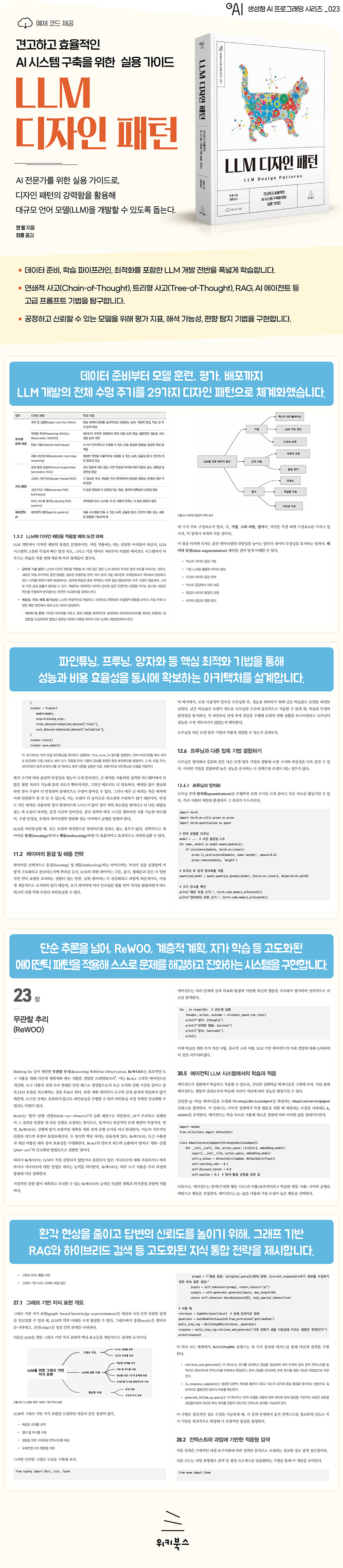
Publisher's Review
★ What this book covers ★
◎ Improving the efficiency of data preparation stages such as data purification and augmentation
◎ Design a scalable training pipeline using tuning, normalization, and checkpointing.
◎ LLM optimization through pruning, quantization, and fine-tuning
◎ Model evaluation through metrics, cross-validation, and interpretability
◎ Understand fairness and find bias in output
◎ Development of an RLHF strategy for building a safe agentic AI system.
◎ Improving the efficiency of data preparation stages such as data purification and augmentation
◎ Design a scalable training pipeline using tuning, normalization, and checkpointing.
◎ LLM optimization through pruning, quantization, and fine-tuning
◎ Model evaluation through metrics, cross-validation, and interpretability
◎ Understand fairness and find bias in output
◎ Development of an RLHF strategy for building a safe agentic AI system.
GOODS SPECIFICS
- Date of issue: November 25, 2025
- Page count, weight, size: 520 pages | 188*240*21mm
- ISBN13: 9791158396503
You may also like
카테고리
korean


korean

![GQ KOREA Mark (Monthly): December [2025]](http://librairie.coreenne.fr/cdn/shop/files/8ef265dbbfbf186523ed75ba7319009d.jpg?v=1765340328&width=3840)


