

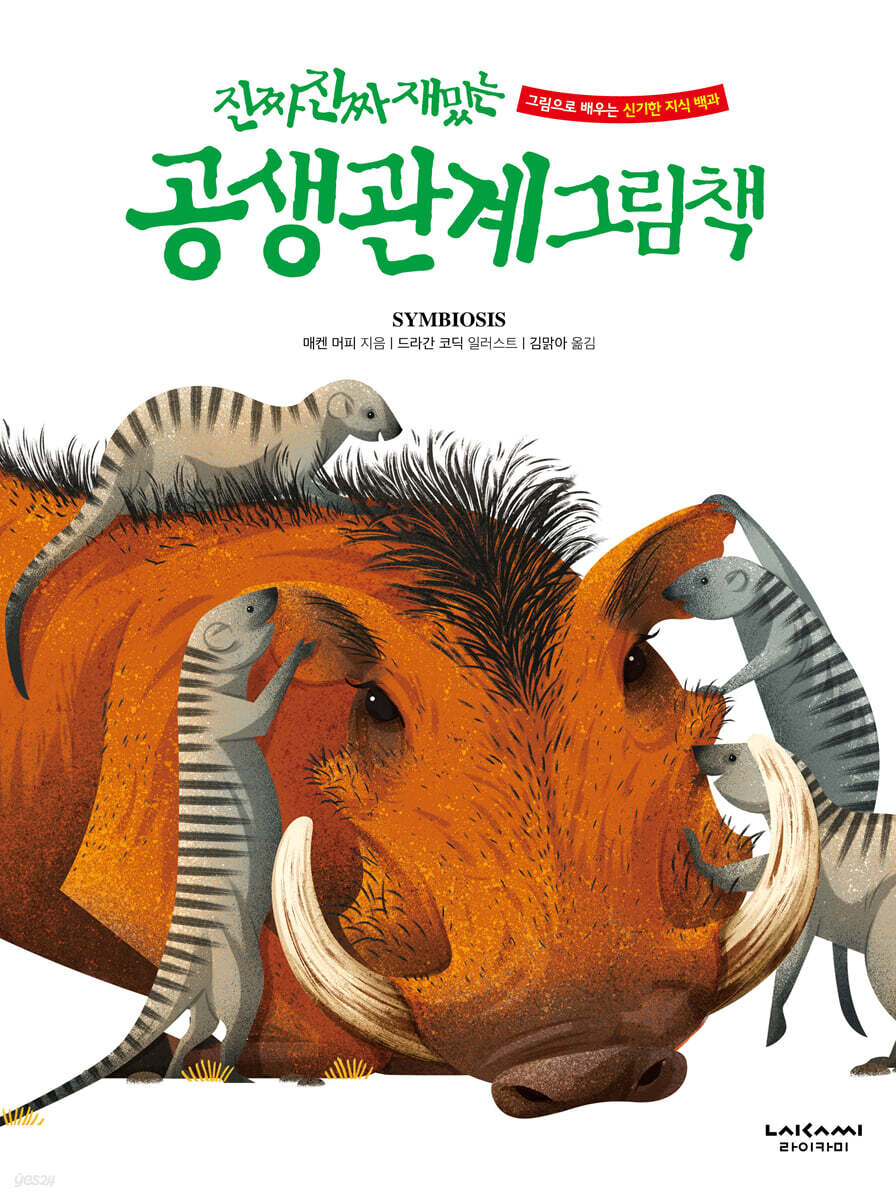
A really, really fun symbiotic relationship picture book
 |
Description
Book Introduction
The 25th book in the 'Real Real' series, a personalized knowledge encyclopedia for ages 4-9!
The amazing story of the 'symbiotic relationship' that creatures chose to survive better!
The "Really, Really Fun Picture Books" series, beloved for its large, vivid illustrations and engaging stories, is a leading children's encyclopedia! This book explores the "relationships" between different living beings living together.
Living things in nature usually live together with similar species.
But there are also special relationships we can't imagine.
Animals that were once known only as eaters sometimes help each other, and sometimes one side takes advantage of the other.
But there's one reason we stay together! It's to better survive in the harsh nature.
Discover the complex and fascinating symbiotic relationships within nature through 59 amazing stories!
The amazing story of the 'symbiotic relationship' that creatures chose to survive better!
The "Really, Really Fun Picture Books" series, beloved for its large, vivid illustrations and engaging stories, is a leading children's encyclopedia! This book explores the "relationships" between different living beings living together.
Living things in nature usually live together with similar species.
But there are also special relationships we can't imagine.
Animals that were once known only as eaters sometimes help each other, and sometimes one side takes advantage of the other.
But there's one reason we stay together! It's to better survive in the harsh nature.
Discover the complex and fascinating symbiotic relationships within nature through 59 amazing stories!
- You can preview some of the book's contents.
Preview
index
Introduction to this book
Tarantulas and frogs
Coyote and Badger
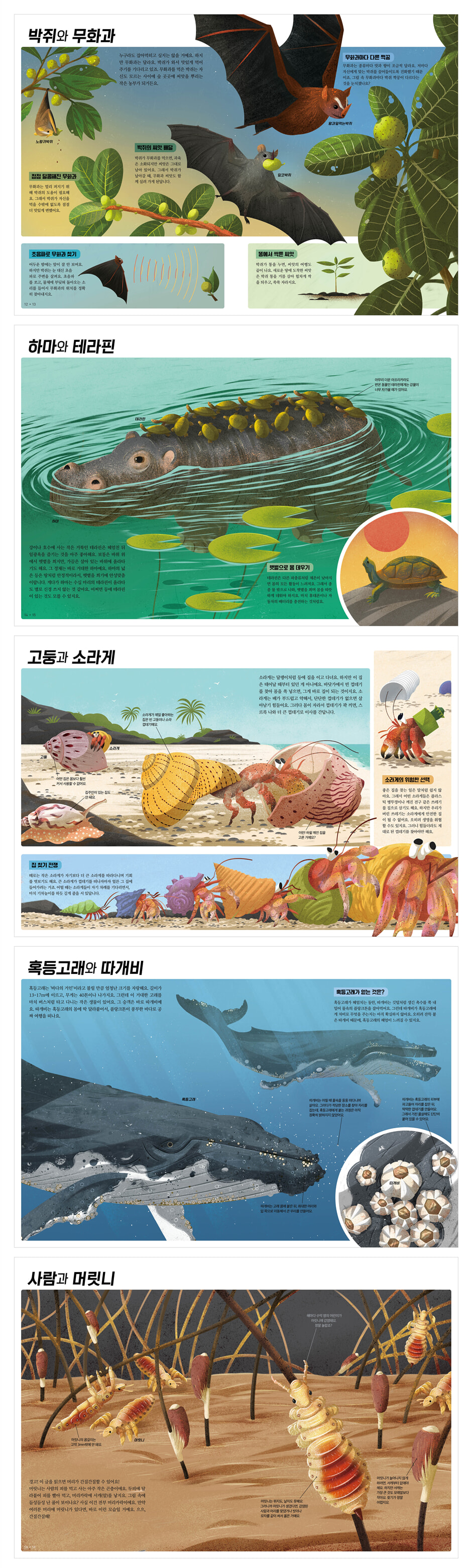
Bats and Figs
Hippopotamus and terrapin
Vampires and magpies
Tiger orchid and tree
Yellow ants and root aphids
zebra and ostrich
Chimpanzees and fruit trees
Cow and heron
Rhinoceros and oxpecker
beetles and spider mites
Skink and Mulungu tree
Clownfish and sea anemones
Black-faced Gull and Black-faced Gull
Snails and hermit crabs
bees and flowers
Honey Guide Bird and Man
Spider crabs and algae
Capybara and the Little Red-crowned Crane
Humpback whales and barnacles
Leafcutter ants and fungi
Crayfish and crayfish worms
Elephant shrew and pagoda lily
Liptia and bacteria
People and lice
Octopus and grouper
Hardwick's Woolly Bat and Bee-Catching Plant
Sea urchins and sea urchins
Zebra and wildebeest
Cuckoo and cuckoo
Hummingbird and flower
moray eel and cleaner wrasse
warthog and mongoose
The Going Moth and the Jodomandu Tree
vampire bats and pigs
Mosquitoes and Orchids
Manta rays and reef sharks
Birds and Trees
Spotted Blue Butterfly and Red Ant
The Wood Mouse and the Scorpion
Wolf and Hyena
Crab spider and flower
Dog and man
Ants and oxhorn acacia
Woodpecker and cactus
People and corn
Squirrel and Oak Tree
gopher tortoises and dung beetles
Sloths and green algae
Green chromate and orange chromate
Lemurs and Fan Palm
Lemon Ants and the Devil's Garden
Brown-headed Blackbird and Yellow-throated Warbler
Boxing crab and sea squirt
Swift parrot and Tasmanian blue gum
Great white shark and black rockfish
Windmill and Meerkat
Shooting shrimp and goby
Glossary of Terms
Tarantulas and frogs
Coyote and Badger
Bats and Figs
Hippopotamus and terrapin
Vampires and magpies
Tiger orchid and tree
Yellow ants and root aphids
zebra and ostrich
Chimpanzees and fruit trees
Cow and heron
Rhinoceros and oxpecker
beetles and spider mites
Skink and Mulungu tree
Clownfish and sea anemones
Black-faced Gull and Black-faced Gull
Snails and hermit crabs
bees and flowers
Honey Guide Bird and Man
Spider crabs and algae
Capybara and the Little Red-crowned Crane
Humpback whales and barnacles
Leafcutter ants and fungi
Crayfish and crayfish worms
Elephant shrew and pagoda lily
Liptia and bacteria
People and lice
Octopus and grouper
Hardwick's Woolly Bat and Bee-Catching Plant
Sea urchins and sea urchins
Zebra and wildebeest
Cuckoo and cuckoo
Hummingbird and flower
moray eel and cleaner wrasse
warthog and mongoose
The Going Moth and the Jodomandu Tree
vampire bats and pigs
Mosquitoes and Orchids
Manta rays and reef sharks
Birds and Trees
Spotted Blue Butterfly and Red Ant
The Wood Mouse and the Scorpion
Wolf and Hyena
Crab spider and flower
Dog and man
Ants and oxhorn acacia
Woodpecker and cactus
People and corn
Squirrel and Oak Tree
gopher tortoises and dung beetles
Sloths and green algae
Green chromate and orange chromate
Lemurs and Fan Palm
Lemon Ants and the Devil's Garden
Brown-headed Blackbird and Yellow-throated Warbler
Boxing crab and sea squirt
Swift parrot and Tasmanian blue gum
Great white shark and black rockfish
Windmill and Meerkat
Shooting shrimp and goby
Glossary of Terms
Detailed image
Publisher's Review
Friend or foe?
The complex and special relationships between creatures who help, deceive, and exploit each other!
In nature, creatures of the same type usually live together.
Just like ants live with other ants and bats live with other bats.
But there are also cases where two completely different creatures live together, such as hippos and turtles, whales and barnacles, or chimpanzees and trees.
Living in this way, influencing each other, is called 'symbiosis'.
『Really, Really Fun Symbiotic Relationship Picture Book』 is full of surprising symbiotic stories we never knew about.
When we think of symbiosis, we usually think of 'mutually helping each other,' but symbiosis in nature is much more diverse and complex than that.
Some creatures deceive others for their own benefit, and even eat them.
But is this special relationship limited to animals and plants? In fact, we humans also live in symbiotic relationships with countless other living creatures! Explore the mystical world of nature with these large, vivid illustrations!
▣ Features of this book
1.
Discover 59 amazing stories of symbiosis in nature.
This book is full of amazing and surprising stories we never knew about.
Tarantulas and frogs, who are usually prey, sometimes protect each other, and coyotes and badgers work together to hunt.
Also, sea urchins use sea urchins to protect themselves, and the wind crow saves the lives of other animals, but when it is hungry, it hits the back of their heads.
In this fun story, you will naturally encounter various types of symbiotic relationships such as mutualism, mutualism, mutualism, and parasitism that you will learn about in science class later!
2.
Observe the relationships between living things through cheerful and realistic illustrations.
The scientific concept of symbiosis is visualized in an easy-to-understand way, so that the characteristics and relationships of living things become clear just by looking at the picture.
This is why it is a science book, but reads as smoothly as a picture book.
3.
It contains an amazing story that only biologists know.
The author, a science educator and animal podcaster, has compiled some of his favorite symbiosis stories.
Some of these stories are familiar, but most are truly astonishing and only known to biologists.
There are many surprising facts even for children who frequently watch documentaries, so after reading it once, they will want to open it again.
4.
We impart knowledge at a level suitable for children.
We explain unfamiliar scientific concepts in an easy-to-understand way, and provide detailed explanations of essential terms on the 'Glossary' page.
It's a good length for children to read on their own, and the story is interesting, so it's perfect for children who are learning to read.
This is an encyclopedia that will foster scientific thinking and curiosity about nature in a fun way.
The complex and special relationships between creatures who help, deceive, and exploit each other!
In nature, creatures of the same type usually live together.
Just like ants live with other ants and bats live with other bats.
But there are also cases where two completely different creatures live together, such as hippos and turtles, whales and barnacles, or chimpanzees and trees.
Living in this way, influencing each other, is called 'symbiosis'.
『Really, Really Fun Symbiotic Relationship Picture Book』 is full of surprising symbiotic stories we never knew about.
When we think of symbiosis, we usually think of 'mutually helping each other,' but symbiosis in nature is much more diverse and complex than that.
Some creatures deceive others for their own benefit, and even eat them.
But is this special relationship limited to animals and plants? In fact, we humans also live in symbiotic relationships with countless other living creatures! Explore the mystical world of nature with these large, vivid illustrations!
▣ Features of this book
1.
Discover 59 amazing stories of symbiosis in nature.
This book is full of amazing and surprising stories we never knew about.
Tarantulas and frogs, who are usually prey, sometimes protect each other, and coyotes and badgers work together to hunt.
Also, sea urchins use sea urchins to protect themselves, and the wind crow saves the lives of other animals, but when it is hungry, it hits the back of their heads.
In this fun story, you will naturally encounter various types of symbiotic relationships such as mutualism, mutualism, mutualism, and parasitism that you will learn about in science class later!
2.
Observe the relationships between living things through cheerful and realistic illustrations.
The scientific concept of symbiosis is visualized in an easy-to-understand way, so that the characteristics and relationships of living things become clear just by looking at the picture.
This is why it is a science book, but reads as smoothly as a picture book.
3.
It contains an amazing story that only biologists know.
The author, a science educator and animal podcaster, has compiled some of his favorite symbiosis stories.
Some of these stories are familiar, but most are truly astonishing and only known to biologists.
There are many surprising facts even for children who frequently watch documentaries, so after reading it once, they will want to open it again.
4.
We impart knowledge at a level suitable for children.
We explain unfamiliar scientific concepts in an easy-to-understand way, and provide detailed explanations of essential terms on the 'Glossary' page.
It's a good length for children to read on their own, and the story is interesting, so it's perfect for children who are learning to read.
This is an encyclopedia that will foster scientific thinking and curiosity about nature in a fun way.
GOODS SPECIFICS
- Date of issue: May 23, 2025
- Format: Hardcover book binding method guide
- Page count, weight, size: 128 pages | Checking size
- ISBN13: 9791190808828
- ISBN10: 119080882X
- KC Certification: Certification Type: Conformity Confirmation
You may also like
카테고리
korean


korean

![GQ KOREA Mark (Monthly): December [2025]](http://librairie.coreenne.fr/cdn/shop/files/8ef265dbbfbf186523ed75ba7319009d.jpg?v=1765340328&width=3840)


