

One giant bookstore, Jinbocho
 |
Description
Book Introduction
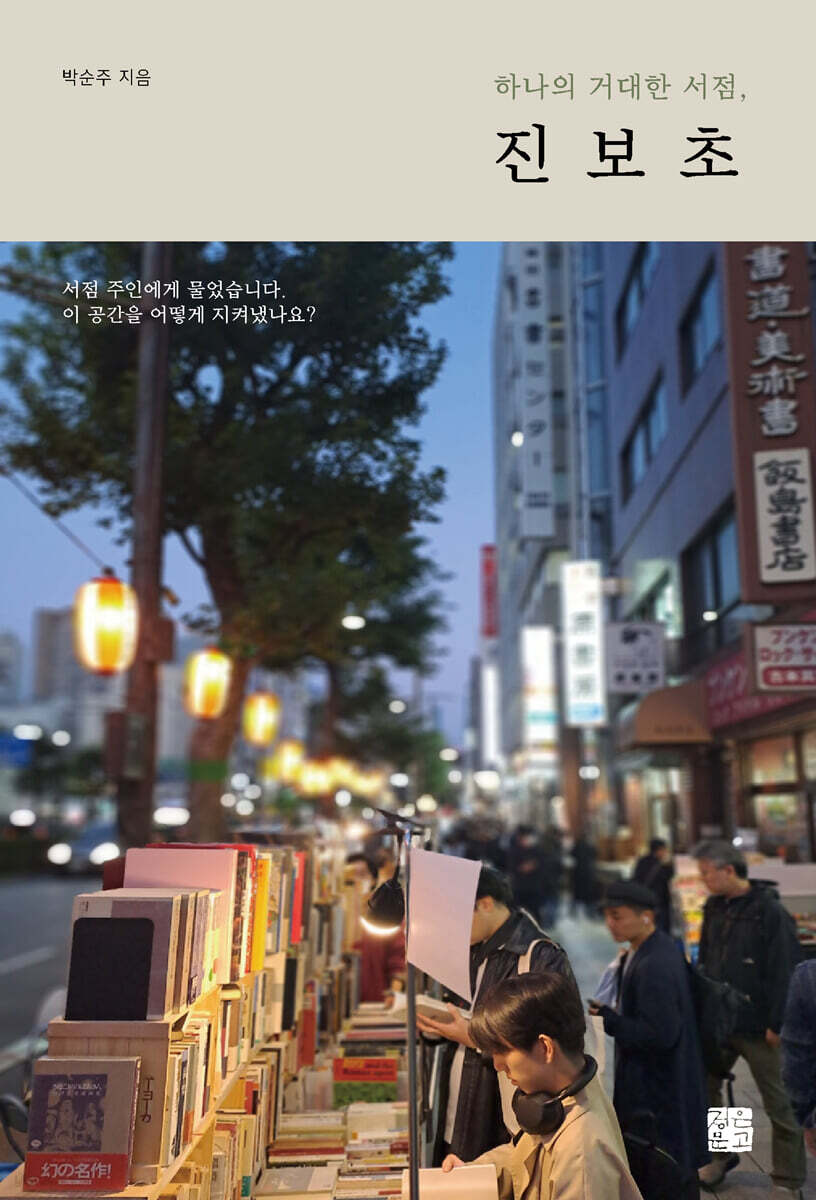
The entire street is one giant bookstore, Jinbocho
Jinbocho is the oldest book town in the world.
As the University of Tokyo was established in Meiji-cho and Jinbo-cho, and several other universities, including Senshu University and Meiji University, were established one after another, bookstores frequented by students naturally began to open one by one.
The first bookstore is said to have opened in 1877, so it has a history of 147 years.
If Marunouchi represented the political and economic center of Japan as it modernized, and Ginza represented the center of consumer culture, then Jinbocho could be said to be the center of knowledge distribution.
We visited 18 bookstores, including long-standing bookstores established in Jinbocho since Japan's modernization, as well as young bookstores that have undergone a new transformation, and recorded their history and secrets to sustainability.
Jinbocho is the oldest book town in the world.
As the University of Tokyo was established in Meiji-cho and Jinbo-cho, and several other universities, including Senshu University and Meiji University, were established one after another, bookstores frequented by students naturally began to open one by one.
The first bookstore is said to have opened in 1877, so it has a history of 147 years.
If Marunouchi represented the political and economic center of Japan as it modernized, and Ginza represented the center of consumer culture, then Jinbocho could be said to be the center of knowledge distribution.
We visited 18 bookstores, including long-standing bookstores established in Jinbocho since Japan's modernization, as well as young bookstores that have undergone a new transformation, and recorded their history and secrets to sustainability.
- You can preview some of the book's contents.
Preview
index
Each bookshelf has a different owner . Parsajoo by All Reviews
Tokyo Bookstore: A Town of Old Books, Filled with the Scent of New Books
Crazy combination distribution of original paintbrushes and stationery
A bookstore selling books the size of beans
Shinsendo Bookstore, satisfying all five senses with paper maps
Takayama Bookstore, the king of the old bookstore street
Doriumi Bookstore , a treasure trove full of nature
Miwa Seobang, a fairytale land filled with memories and dreams
The building itself is a drama set , Yaguchi Bookstore
Bookhouse Cafe, a world of childhood inviting you
20th Century Memory Devices, Subculture @Wonder
Meirinkan Bookstore, the only science and engineering specialty store in Jinbocho
Isseido Bookstore, with 120 years of history intact
Komiyama Bookstore, a space where past and present coexist
Yagi Bookstore, a literary mecca filled with language
A record company overflowing with nostalgic melodies
Okuno Karutaten: Reading Japan through Pictures and Play
Love of books, love of movies, love of cats Nekonohondana
Appendix: A Walk Through the Retro Architecture of Jinbocho
Commentary Big Progressive Elementary School, Small Progressive Elementary School
Tokyo Bookstore: A Town of Old Books, Filled with the Scent of New Books
Crazy combination distribution of original paintbrushes and stationery
A bookstore selling books the size of beans
Shinsendo Bookstore, satisfying all five senses with paper maps
Takayama Bookstore, the king of the old bookstore street
Doriumi Bookstore , a treasure trove full of nature
Miwa Seobang, a fairytale land filled with memories and dreams
The building itself is a drama set , Yaguchi Bookstore
Bookhouse Cafe, a world of childhood inviting you
20th Century Memory Devices, Subculture @Wonder
Meirinkan Bookstore, the only science and engineering specialty store in Jinbocho
Isseido Bookstore, with 120 years of history intact
Komiyama Bookstore, a space where past and present coexist
Yagi Bookstore, a literary mecca filled with language
A record company overflowing with nostalgic melodies
Okuno Karutaten: Reading Japan through Pictures and Play
Love of books, love of movies, love of cats Nekonohondana
Appendix: A Walk Through the Retro Architecture of Jinbocho
Commentary Big Progressive Elementary School, Small Progressive Elementary School
Detailed image

Into the book
Anyone who loves books has probably dreamed of owning a bookstore at least once! Passage by All Reviews is the place to make that dream come true.
It is a system where you rent a bookshelf, become the owner, stock books, manage inventory, promote through social media, and sell offline.
Each bookshelf has a QR code containing the bookstore owner's information, so you can scan it with your smartphone to get information about the book and its stock.
Moreover, in Japan, where cash transactions are still prevalent, it is surprising that books are purchased only with credit cards or mobile payment services like PayPay.
In Jinbocho, which remembers the old days, isn't this a revolutionary idea?
Additionally, the table located in the center next to the cash register changes weekly based on theme and owner, making the space, which might otherwise be boring with just books, more interesting and encouraging communication between customers and the owner.
--- pp.21-22
As I walk along the rows of shops, I come across an old building with a quaint atmosphere at the end of Suzuran Street.
I thought it was a bookstore, so I went closer and saw a cat with bright yellow eyes looking at me.
As soon as you step inside, your heart is instantly captivated and a world of colorful and cute sundries unfolds before your eyes.
I am in a state of ecstasy and wander around the stalls without a second thought.
The excitement doesn't subside easily because it's filled with cute dolls and vintage interior items.
Isn't this the scene where the first walker of Jinbo Elementary School encounters the distribution map?
If you're an animal lover, you'll probably find yourself craving all sorts of unique cat products.
"文房" (munbang) refers to the study or tools used in a writer's study. So, could we simply describe the distribution map as a stationery store, as its name suggests? No, it's not that simple. It's more famous as an art store, selling all kinds of art supplies, from general to professional.
He is a pioneer and living witness who has written the history of Japanese art supplies by domestically producing various art tools, including the first development of professional oil paints.
--- p.51
Mamehon, translated into Korean as 'Kongchaek', is like that.
Who would have ever imagined?
A short story can fit into a space measuring 2cm wide and 3cm high.
Not only are the letters densely packed on a small piece of paper no bigger than the palm of your hand, but there are also drawings and photographs.
It seems like it's just for decoration, but surprisingly the writing is easy to read.
In the West, from the 16th century, Bibles and guidebooks were made into miniatures for easy carrying, and in China, small books called sleeved books were made to be carried in the sleeve and read while traveling.
In Japan, it started in the late Edo period.
I made a small storybook for women and children to use as entertainment or to put in the drawer of the Hina dolls (dolls displayed during Hinamatsuri, a festival celebrating the growth of girls) that are displayed at home on March 3rd.
--- p.71
The history of Shinsendo Bookstore dates back to 1907.
After the Russo-Japanese War ended, the first representative came up to Tokyo and helped his older brother run a bookstore in front of Hongo University of Tokyo.
Although the area has lost its former glory and only a few secondhand bookstores remain, back then, Hongo Secondhand Bookstore Street was bustling with activity.
After that, he became independent and opened a used bookstore in Shibuya Dogenzaka in the early Showa period, but due to his lack of experience, he closed it after a few years.
After working at his brother's bookstore for about 10 years, he moved to Mita, Ginza, Uguisudani, and other places to continue running the bookstore, and in 1977, when he was the second generation, he settled in Jinbocho.
It was a store of about 15 pyeong on the 3rd floor of the Gandago Center.
Around that time, the third generation, Yuzuru Nagamori, quit his job and took full charge of the bookstore.
It mainly dealt with Oriental history, especially Edo period documents and old maps, and then moved to its current location three years later in 1980.
Currently, the company is run by the fourth generation, Shingo Nagamori, who took over from his father.
--- p.92
Because many of its regular customers from their school days later debuted as directors, Yaguchi Bookstore is also famous as a filming location for dramas, commercials, and movies.
There are countless works that feature Yaguchi Bookstore as a background, such as commercials featuring actor Takahashi Issei and the drama "Hey, Handsome!" featuring actress Sakuma Yui, whenever there is a scene featuring a publishing company or someone working at a bookstore.
Unfortunately, individuals are prohibited from taking photos inside.
These days, as the number of transactions of old books between individuals through online auction sites such as Auction increases, the prices and authenticity of books sold in old bookstores frequently drop.
--- p.165
“I once heard from my father that the writer Yukio Mishima often visited, but I was born after he died, so I actually didn’t know much about him.
Since my family ran a bookstore, I naturally became interested in literature, and when I got a little older, I read a novel by Yukio Mishima and was instantly hooked.
After that, I started collecting his work and related materials.
He collected everything he could get his hands on: first editions, signed copies, limited editions, photo books, movie posters, handwritten manuscripts, and even the colored paper he enjoyed writing on.
As an art major, the nude photos of Mishima in Eiko Hosoe's photo book were a fresh shock to me.
“As many artists worked on various projects based on Yukio Mishima, such as the painter Tadanori Yoko who drew pictures based on Eiko Hosoe’s photographs, we ended up collecting related works as well.”
--- p.250
Every year during the last week of October, two large festivals are held on the Jinbocho Bookstore Street.
The festival and the Jinbocho Book Festival are right around the corner.
Each street is divided into Yasukuni Street and Suzuran Street, and a true 'festival of books' unfolds.
Kandagoseo Festival神田古本まつり
It is hosted by the Gandago Bookstore Association and has a long history, with the 63rd event scheduled for 2023.
During the festival, a spectacular sight is created: carts and stalls line Yasukuni Street, and nearly a million used books are piled up like mountains.
Jinbocho North Festival
Hosted by bookstores and publishers located on Suzuran Street, it will be held for the 31st time in 2023.
Not only do university presses and local publishers participate to sell old and new books, but food corners are also located throughout, providing plenty of things to see and eat.
--- p.317
Following the founding of the University of Tokyo in 1877 on the site of the former Tokyo Kaisei School, many universities, including Meiji University, Chuo University, Hosei University, Nihon University, and Senshu University, gathered in Jinbocho.
A book street was formed when students bought and sold textbooks that professors used in class.
In 1923, the Great Kanto Earthquake destroyed most of the buildings and turned the area into a burnt-out wasteland, but it quickly recovered and disaster relief buildings and signboard buildings were erected.
Thanks to its escape from air raids during World War II, the Jinbocho Bookstore Street is now home to many stylish retro buildings.
People of all ages, including young people, come here to enjoy the retro atmosphere.
This is another charm of Jinbo Elementary School.
But these days, with the wind of redevelopment blowing, those buildings are being torn down one by one.
Even though I feel as if my flesh is being cut to pieces, all I can do is to engrave the existing buildings in my mind and leave a record.
Wanting to share that moment, we planned and surveyed a 'Jinbocho Retro Architecture Walk' along the route featured in the special article.
--- p.337
An American friend who studies the history and charm of Jinbocho said that when he first visited, he thought the entire neighborhood looked like one giant bookstore.
“Each bookstore is a huge bookshelf, and the alleys are passageways that lead from bookshelf to bookshelf.
A place to have a cup of coffee when you get tired of looking at books, a place with delicious food and drinks.
It's a dream town for book lovers.
It doesn't exist in the US or anywhere else in the world.
It's worth going once, and I recommend it to people whenever I go back to the US.
Of course, you can't see everything in just one time."
It is a system where you rent a bookshelf, become the owner, stock books, manage inventory, promote through social media, and sell offline.
Each bookshelf has a QR code containing the bookstore owner's information, so you can scan it with your smartphone to get information about the book and its stock.
Moreover, in Japan, where cash transactions are still prevalent, it is surprising that books are purchased only with credit cards or mobile payment services like PayPay.
In Jinbocho, which remembers the old days, isn't this a revolutionary idea?
Additionally, the table located in the center next to the cash register changes weekly based on theme and owner, making the space, which might otherwise be boring with just books, more interesting and encouraging communication between customers and the owner.
--- pp.21-22
As I walk along the rows of shops, I come across an old building with a quaint atmosphere at the end of Suzuran Street.
I thought it was a bookstore, so I went closer and saw a cat with bright yellow eyes looking at me.
As soon as you step inside, your heart is instantly captivated and a world of colorful and cute sundries unfolds before your eyes.
I am in a state of ecstasy and wander around the stalls without a second thought.
The excitement doesn't subside easily because it's filled with cute dolls and vintage interior items.
Isn't this the scene where the first walker of Jinbo Elementary School encounters the distribution map?
If you're an animal lover, you'll probably find yourself craving all sorts of unique cat products.
"文房" (munbang) refers to the study or tools used in a writer's study. So, could we simply describe the distribution map as a stationery store, as its name suggests? No, it's not that simple. It's more famous as an art store, selling all kinds of art supplies, from general to professional.
He is a pioneer and living witness who has written the history of Japanese art supplies by domestically producing various art tools, including the first development of professional oil paints.
--- p.51
Mamehon, translated into Korean as 'Kongchaek', is like that.
Who would have ever imagined?
A short story can fit into a space measuring 2cm wide and 3cm high.
Not only are the letters densely packed on a small piece of paper no bigger than the palm of your hand, but there are also drawings and photographs.
It seems like it's just for decoration, but surprisingly the writing is easy to read.
In the West, from the 16th century, Bibles and guidebooks were made into miniatures for easy carrying, and in China, small books called sleeved books were made to be carried in the sleeve and read while traveling.
In Japan, it started in the late Edo period.
I made a small storybook for women and children to use as entertainment or to put in the drawer of the Hina dolls (dolls displayed during Hinamatsuri, a festival celebrating the growth of girls) that are displayed at home on March 3rd.
--- p.71
The history of Shinsendo Bookstore dates back to 1907.
After the Russo-Japanese War ended, the first representative came up to Tokyo and helped his older brother run a bookstore in front of Hongo University of Tokyo.
Although the area has lost its former glory and only a few secondhand bookstores remain, back then, Hongo Secondhand Bookstore Street was bustling with activity.
After that, he became independent and opened a used bookstore in Shibuya Dogenzaka in the early Showa period, but due to his lack of experience, he closed it after a few years.
After working at his brother's bookstore for about 10 years, he moved to Mita, Ginza, Uguisudani, and other places to continue running the bookstore, and in 1977, when he was the second generation, he settled in Jinbocho.
It was a store of about 15 pyeong on the 3rd floor of the Gandago Center.
Around that time, the third generation, Yuzuru Nagamori, quit his job and took full charge of the bookstore.
It mainly dealt with Oriental history, especially Edo period documents and old maps, and then moved to its current location three years later in 1980.
Currently, the company is run by the fourth generation, Shingo Nagamori, who took over from his father.
--- p.92
Because many of its regular customers from their school days later debuted as directors, Yaguchi Bookstore is also famous as a filming location for dramas, commercials, and movies.
There are countless works that feature Yaguchi Bookstore as a background, such as commercials featuring actor Takahashi Issei and the drama "Hey, Handsome!" featuring actress Sakuma Yui, whenever there is a scene featuring a publishing company or someone working at a bookstore.
Unfortunately, individuals are prohibited from taking photos inside.
These days, as the number of transactions of old books between individuals through online auction sites such as Auction increases, the prices and authenticity of books sold in old bookstores frequently drop.
--- p.165
“I once heard from my father that the writer Yukio Mishima often visited, but I was born after he died, so I actually didn’t know much about him.
Since my family ran a bookstore, I naturally became interested in literature, and when I got a little older, I read a novel by Yukio Mishima and was instantly hooked.
After that, I started collecting his work and related materials.
He collected everything he could get his hands on: first editions, signed copies, limited editions, photo books, movie posters, handwritten manuscripts, and even the colored paper he enjoyed writing on.
As an art major, the nude photos of Mishima in Eiko Hosoe's photo book were a fresh shock to me.
“As many artists worked on various projects based on Yukio Mishima, such as the painter Tadanori Yoko who drew pictures based on Eiko Hosoe’s photographs, we ended up collecting related works as well.”
--- p.250
Every year during the last week of October, two large festivals are held on the Jinbocho Bookstore Street.
The festival and the Jinbocho Book Festival are right around the corner.
Each street is divided into Yasukuni Street and Suzuran Street, and a true 'festival of books' unfolds.
Kandagoseo Festival神田古本まつり
It is hosted by the Gandago Bookstore Association and has a long history, with the 63rd event scheduled for 2023.
During the festival, a spectacular sight is created: carts and stalls line Yasukuni Street, and nearly a million used books are piled up like mountains.
Jinbocho North Festival
Hosted by bookstores and publishers located on Suzuran Street, it will be held for the 31st time in 2023.
Not only do university presses and local publishers participate to sell old and new books, but food corners are also located throughout, providing plenty of things to see and eat.
--- p.317
Following the founding of the University of Tokyo in 1877 on the site of the former Tokyo Kaisei School, many universities, including Meiji University, Chuo University, Hosei University, Nihon University, and Senshu University, gathered in Jinbocho.
A book street was formed when students bought and sold textbooks that professors used in class.
In 1923, the Great Kanto Earthquake destroyed most of the buildings and turned the area into a burnt-out wasteland, but it quickly recovered and disaster relief buildings and signboard buildings were erected.
Thanks to its escape from air raids during World War II, the Jinbocho Bookstore Street is now home to many stylish retro buildings.
People of all ages, including young people, come here to enjoy the retro atmosphere.
This is another charm of Jinbo Elementary School.
But these days, with the wind of redevelopment blowing, those buildings are being torn down one by one.
Even though I feel as if my flesh is being cut to pieces, all I can do is to engrave the existing buildings in my mind and leave a record.
Wanting to share that moment, we planned and surveyed a 'Jinbocho Retro Architecture Walk' along the route featured in the special article.
--- p.337
An American friend who studies the history and charm of Jinbocho said that when he first visited, he thought the entire neighborhood looked like one giant bookstore.
“Each bookstore is a huge bookshelf, and the alleys are passageways that lead from bookshelf to bookshelf.
A place to have a cup of coffee when you get tired of looking at books, a place with delicious food and drinks.
It's a dream town for book lovers.
It doesn't exist in the US or anywhere else in the world.
It's worth going once, and I recommend it to people whenever I go back to the US.
Of course, you can't see everything in just one time."
--- p.353
Publisher's Review
The entire street is one giant bookstore, Jinbocho
Interview with the bookstore owner of Jinbocho, a knowledge distribution hub that has been in place for over 140 years.
Jinbocho is a huge 'book street' that is hard to find anywhere else in the world.
There are about 130 bookstores lined up, each dealing in specialized books of different genres.
Each bookstore acts like a bookshelf, making the entire town one large library.
Following the founding of the University of Tokyo in 1877, many universities, including Meiji University, Chuo University, Hosei University, Nihon University, and Senshu University, gathered in Jinbocho.
A bookstore street was formed as students bought and sold textbooks used in university classes.
If Marunouchi represented the political and economic center of Japan's modernization process and Ginza represented the center of consumer culture, then Jinbocho represented the center of knowledge distribution.
We visited 18 bookstores, including those with a long history spanning four or five generations, as well as young bookstores that have recently emerged with a new look, and recorded their history and the secrets to their consistent love.
A place where specialized bookstores and publishers in literature, humanities, science, and art gather together.
Jinbocho is full of bookstores that opened over 100 years ago.
Large bookstores that handle new books, such as Sanseido Main Store (1881) and Tokyo Bookstore (1890), are famous, but there are also many specialty stores, such as Kitazawa Bookstore (1902), which specializes in old European and American books, Uchiyama Bookstore (1917), which specializes in Asian books, especially Chinese books, Yaguchi Bookstore (1918), which handles films and plays, and Shinsendo Bookstore (1907), which specializes in old maps.
Readers visit bookstores based on their search criteria to obtain the books they want, and bookstore owners do not compete with each other as they each have their own areas of expertise.
Many bookstore staff have research-level knowledge in their fields, enough to provide detailed guidance on how to obtain better materials.
There are many third- and fourth-generation bookstore owners who are knowledgeable in their fields.
Jinbocho Bookstore Street, home to over 170 bookstores, 240 publishers, magazine companies, and printing houses, is a rare place in the world where the entire process of book creation, from production to distribution, is gathered together.
It is a hub of knowledge distribution maintained through cooperation between booksellers, publishers, and readers.
A street of old bookstores that preserves a reading culture unlike any other in the world.
When it comes to ancient books, many people may think of academic books on philosophy, literature, natural science, and art, or books with high historical value such as ukiyo-e.
The Jinbocho Bookstore Street is also full of books from other genres.
There are many specialty bookstores selling celebrity or idol photo books, pornographic novels, mystery novels, baduk, occult, cat books…
So, if you go to Jinbocho, I recommend you take a look at the store that has slightly vulgar books and colorful magazines on display.
Japanese publications are generally lax in regulation, resulting in a wide variety of publications and readers for each genre.
No matter which bookstore you enter, you will find people reading books in every corner of the store.
This is a place where a reading culture that cannot be found anywhere else in the world is alive.
Useful information to know when visiting Jinbocho
Jinbocho has many famous attractions besides books.
Unique retro buildings often appear in Japanese dramas and movies.
We've compiled a box of articles about hidden gems and attractions you can only find in Jinbocho, including restaurants, cafes, movie theaters, and book festivals.
Also, the editor-in-chief of the specialized magazine 『Osanbo Jinbocho』 has included a map of a retro architectural walking trail with a sense of long history.
The Jinbocho bookstore owner is said to be generally unfriendly, but we have included a variety of interesting information made with paper, such as how to visit, how to use it from beginner to advanced level for first-time visitors, the Jinbocho book festival, and the unique book cover designs of each bookstore.
To make it easier to read Jinbocho, which is full of Chinese character signs, a map in Korean was included at the beginning, and it was divided into three streets representing Jinbocho: Suzuran, Yasukuni, and Hakusan.
Interview with the bookstore owner of Jinbocho, a knowledge distribution hub that has been in place for over 140 years.
Jinbocho is a huge 'book street' that is hard to find anywhere else in the world.
There are about 130 bookstores lined up, each dealing in specialized books of different genres.
Each bookstore acts like a bookshelf, making the entire town one large library.
Following the founding of the University of Tokyo in 1877, many universities, including Meiji University, Chuo University, Hosei University, Nihon University, and Senshu University, gathered in Jinbocho.
A bookstore street was formed as students bought and sold textbooks used in university classes.
If Marunouchi represented the political and economic center of Japan's modernization process and Ginza represented the center of consumer culture, then Jinbocho represented the center of knowledge distribution.
We visited 18 bookstores, including those with a long history spanning four or five generations, as well as young bookstores that have recently emerged with a new look, and recorded their history and the secrets to their consistent love.
A place where specialized bookstores and publishers in literature, humanities, science, and art gather together.
Jinbocho is full of bookstores that opened over 100 years ago.
Large bookstores that handle new books, such as Sanseido Main Store (1881) and Tokyo Bookstore (1890), are famous, but there are also many specialty stores, such as Kitazawa Bookstore (1902), which specializes in old European and American books, Uchiyama Bookstore (1917), which specializes in Asian books, especially Chinese books, Yaguchi Bookstore (1918), which handles films and plays, and Shinsendo Bookstore (1907), which specializes in old maps.
Readers visit bookstores based on their search criteria to obtain the books they want, and bookstore owners do not compete with each other as they each have their own areas of expertise.
Many bookstore staff have research-level knowledge in their fields, enough to provide detailed guidance on how to obtain better materials.
There are many third- and fourth-generation bookstore owners who are knowledgeable in their fields.
Jinbocho Bookstore Street, home to over 170 bookstores, 240 publishers, magazine companies, and printing houses, is a rare place in the world where the entire process of book creation, from production to distribution, is gathered together.
It is a hub of knowledge distribution maintained through cooperation between booksellers, publishers, and readers.
A street of old bookstores that preserves a reading culture unlike any other in the world.
When it comes to ancient books, many people may think of academic books on philosophy, literature, natural science, and art, or books with high historical value such as ukiyo-e.
The Jinbocho Bookstore Street is also full of books from other genres.
There are many specialty bookstores selling celebrity or idol photo books, pornographic novels, mystery novels, baduk, occult, cat books…
So, if you go to Jinbocho, I recommend you take a look at the store that has slightly vulgar books and colorful magazines on display.
Japanese publications are generally lax in regulation, resulting in a wide variety of publications and readers for each genre.
No matter which bookstore you enter, you will find people reading books in every corner of the store.
This is a place where a reading culture that cannot be found anywhere else in the world is alive.
Useful information to know when visiting Jinbocho
Jinbocho has many famous attractions besides books.
Unique retro buildings often appear in Japanese dramas and movies.
We've compiled a box of articles about hidden gems and attractions you can only find in Jinbocho, including restaurants, cafes, movie theaters, and book festivals.
Also, the editor-in-chief of the specialized magazine 『Osanbo Jinbocho』 has included a map of a retro architectural walking trail with a sense of long history.
The Jinbocho bookstore owner is said to be generally unfriendly, but we have included a variety of interesting information made with paper, such as how to visit, how to use it from beginner to advanced level for first-time visitors, the Jinbocho book festival, and the unique book cover designs of each bookstore.
To make it easier to read Jinbocho, which is full of Chinese character signs, a map in Korean was included at the beginning, and it was divided into three streets representing Jinbocho: Suzuran, Yasukuni, and Hakusan.
GOODS SPECIFICS
- Date of issue: March 25, 2024
- Page count, weight, size: 370 pages | 404g | 128*188*25mm
- ISBN13: 9791185153636
- ISBN10: 1185153632
You may also like
카테고리
korean


korean

![GQ KOREA Mark (Monthly): December [2025]](http://librairie.coreenne.fr/cdn/shop/files/8ef265dbbfbf186523ed75ba7319009d.jpg?v=1765340328&width=3840)


