

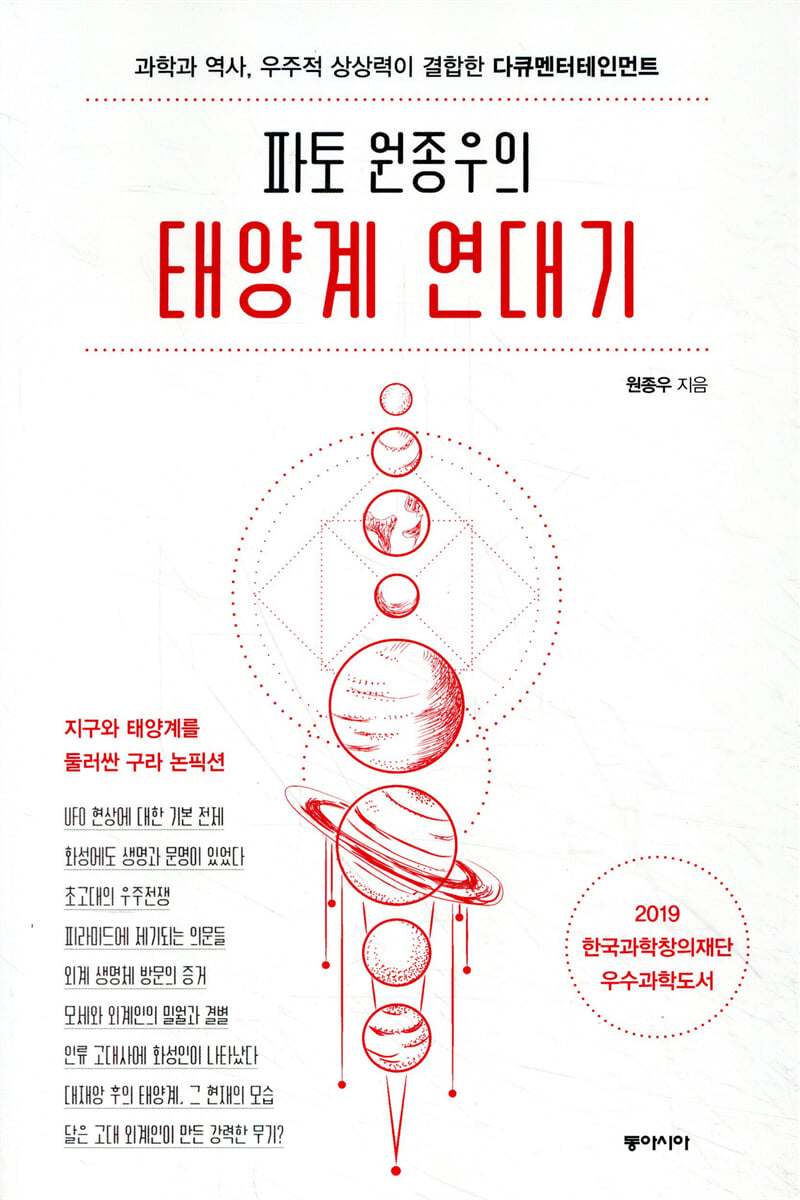
Pato Wonjong-woo's Solar System Chronicles
 |
Description
Book Introduction
A combination of science, history, and cosmic imagination
'Documentarytainment' is non-fiction!
There are many secrets in the world, big and small.
The forms and significance of these secrets vary greatly, from trivial personal details to the workings of the universe and even the names of God.
However, despite the remarkable advancements in scientific civilization over the past several hundred years, what we have discovered so far is not as much as we might think.
Some of them may remain unknown for many years to come, perhaps forever.
How was the Great Pyramid of Giza, impossible even with modern construction technology, built? What is the truth about the UFO phenomenon? What do the images of astronauts or aliens on ancient rock art mean? These questions are the starting point of "Pato Won Jong-woo's Solar System Chronicles."
Author Won Jong-woo (pen name "Pato"), who has studied archaeological artifacts, ancient history books, ancient literature, the Bible, and even modern astronomical research, has developed a hypothesis: that in the ancient world, before 15,000 BC, there existed a highly advanced civilization far more advanced than our own.
Not only civilization, but also the Earth, Mars, and a now-extinct planet (named 'Planet Z') in the solar system formed a huge space empire.
This book is a fantasy full of the author's imagination, which rationally deduces the existence of a solar system empire by tracing back the past and using hypotheses and scientific facts.
Because imagination is combined with science and history, the author named the genre of this book 'documentarytainment' (documentary + entertainment).
It has become a new 'science fiction textbook' by adding fun imagination to scientific facts.
In other words, it could be called 'fake nonfiction'.
The book's core premise is that long ago in the solar system, there was an empire of three planets, their history was magnificent and their civilization was great, but 12,000 years ago, a tragedy killed the once-life-filled planet Mars, and at that time, there was another planet between Mars and Jupiter, the remains of which now remain as an asteroid.
This story, which may seem like simple science fiction, has captured the attention of many because it has scientific basis.
'Documentarytainment' is non-fiction!
There are many secrets in the world, big and small.
The forms and significance of these secrets vary greatly, from trivial personal details to the workings of the universe and even the names of God.
However, despite the remarkable advancements in scientific civilization over the past several hundred years, what we have discovered so far is not as much as we might think.
Some of them may remain unknown for many years to come, perhaps forever.
How was the Great Pyramid of Giza, impossible even with modern construction technology, built? What is the truth about the UFO phenomenon? What do the images of astronauts or aliens on ancient rock art mean? These questions are the starting point of "Pato Won Jong-woo's Solar System Chronicles."
Author Won Jong-woo (pen name "Pato"), who has studied archaeological artifacts, ancient history books, ancient literature, the Bible, and even modern astronomical research, has developed a hypothesis: that in the ancient world, before 15,000 BC, there existed a highly advanced civilization far more advanced than our own.
Not only civilization, but also the Earth, Mars, and a now-extinct planet (named 'Planet Z') in the solar system formed a huge space empire.
This book is a fantasy full of the author's imagination, which rationally deduces the existence of a solar system empire by tracing back the past and using hypotheses and scientific facts.
Because imagination is combined with science and history, the author named the genre of this book 'documentarytainment' (documentary + entertainment).
It has become a new 'science fiction textbook' by adding fun imagination to scientific facts.
In other words, it could be called 'fake nonfiction'.
The book's core premise is that long ago in the solar system, there was an empire of three planets, their history was magnificent and their civilization was great, but 12,000 years ago, a tragedy killed the once-life-filled planet Mars, and at that time, there was another planet between Mars and Jupiter, the remains of which now remain as an asteroid.
This story, which may seem like simple science fiction, has captured the attention of many because it has scientific basis.
- You can preview some of the book's contents.
Preview
index
Recommendation_ This is the genesis of the Korean science fiction wave.
Preface_ Ancient Civilizations and Hermeticism
Revised and Expanded Edition_ Combining Scientific Facts and Entertainment
In the second revised and expanded edition
01 Aliens are near Earth
Alien life definitely exists
Basic assumptions about the UFO phenomenon
We need to approach it from a scientific perspective
Specific Problems of Interstellar Travel
Science Box_ The World's Exoplanet Search Telescope
02 What Happened on Mars?
There was life and civilization on Mars too.
Activities of unmanned probes
Science Box_ Mars Probes and Exploration Robots
03 Who Killed Mars, Once a Planet of Abundance?
A huge, long scar drawn horizontally
The great disaster of Gyeongcheon-dong
Were the creatures on Mars killed?
Science Box_ Scientific Facts about Mars
04 Another lost planet
Titius-Bode's law
What happened when the planet was destroyed
The Secret of Asteroid Eros
Science Box_ Understanding Asteroids
05 What Happened Between Mars and Planet Z?
The Secret of Iapetus
Was there interplanetary civilizational exchange?
Science Box_Exoplanet Probe Thermal
06 Reveal the identity of the moon
Mystery of the Moon
Could the Moon Be a Powerful Weapon Created by Ancient Aliens?
Were Earth and Planet Z allies?
The broken Death Star Iapetus
Science Box_The Apollo Program and Lunar Exploration
What happened on Earth in 15,000 BC?
The memory of the great flood is present in every civilization on earth.
An ancient, advanced civilization that remains only in myths and legends
The Ancient Space War
Iapetus, a space base on Mars, and the moon of Planet Z, a space base
Human civilization didn't suddenly appear 5,000 years ago.
Science Box_Catastrophes and Extinctions on Earth
Side Story: Evidence of Ancient Civilizations and Aliens
08 Pyramids and Aliens
The Great Pyramid of Giza, the greatest wonder of mankind
Questions Raised About the Pyramids
Ancient science and technology that is different from modern science
Even after the catastrophe, aliens visited Earth.
Evidence of extraterrestrial visitation found in rock art
Science Box_ Orion
09 In search of Moses' identity
Who is Moses
Why did Moses choose to carry out the Exodus?
The honeymoon and separation between Moses and the aliens
Moses was not a fool
Judaism, created with ancient ideas and technologies
Science Box_ Nuclear Power Story
10 Who will stand against the Martian worldview?
Martians appeared in ancient human history.
Planet Z and Jesus
Why Martians Have a Greater Influence on Earth
The Masonic Guild, a History of Freemasonry
Freemasonry developed the modern era.
Science Box_ The Difference Between Building with Rock and Concrete
11 Martians, Planet Z, and now us
They weren't aliens
The Glory and Wounds of the Solar Empire
The solar system after the cataclysm, what it looks like now
Science Box_ Neanderthals
Side Story_ Short Story "The Long Sunset: Z's Story"
Epilogue_ Cosmic Fantasy Entertainment
Preface_ Ancient Civilizations and Hermeticism
Revised and Expanded Edition_ Combining Scientific Facts and Entertainment
In the second revised and expanded edition
01 Aliens are near Earth
Alien life definitely exists
Basic assumptions about the UFO phenomenon
We need to approach it from a scientific perspective
Specific Problems of Interstellar Travel
Science Box_ The World's Exoplanet Search Telescope
02 What Happened on Mars?
There was life and civilization on Mars too.
Activities of unmanned probes
Science Box_ Mars Probes and Exploration Robots
03 Who Killed Mars, Once a Planet of Abundance?
A huge, long scar drawn horizontally
The great disaster of Gyeongcheon-dong
Were the creatures on Mars killed?
Science Box_ Scientific Facts about Mars
04 Another lost planet
Titius-Bode's law
What happened when the planet was destroyed
The Secret of Asteroid Eros
Science Box_ Understanding Asteroids
05 What Happened Between Mars and Planet Z?
The Secret of Iapetus
Was there interplanetary civilizational exchange?
Science Box_Exoplanet Probe Thermal
06 Reveal the identity of the moon
Mystery of the Moon
Could the Moon Be a Powerful Weapon Created by Ancient Aliens?
Were Earth and Planet Z allies?
The broken Death Star Iapetus
Science Box_The Apollo Program and Lunar Exploration
What happened on Earth in 15,000 BC?
The memory of the great flood is present in every civilization on earth.
An ancient, advanced civilization that remains only in myths and legends
The Ancient Space War
Iapetus, a space base on Mars, and the moon of Planet Z, a space base
Human civilization didn't suddenly appear 5,000 years ago.
Science Box_Catastrophes and Extinctions on Earth
Side Story: Evidence of Ancient Civilizations and Aliens
08 Pyramids and Aliens
The Great Pyramid of Giza, the greatest wonder of mankind
Questions Raised About the Pyramids
Ancient science and technology that is different from modern science
Even after the catastrophe, aliens visited Earth.
Evidence of extraterrestrial visitation found in rock art
Science Box_ Orion
09 In search of Moses' identity
Who is Moses
Why did Moses choose to carry out the Exodus?
The honeymoon and separation between Moses and the aliens
Moses was not a fool
Judaism, created with ancient ideas and technologies
Science Box_ Nuclear Power Story
10 Who will stand against the Martian worldview?
Martians appeared in ancient human history.
Planet Z and Jesus
Why Martians Have a Greater Influence on Earth
The Masonic Guild, a History of Freemasonry
Freemasonry developed the modern era.
Science Box_ The Difference Between Building with Rock and Concrete
11 Martians, Planet Z, and now us
They weren't aliens
The Glory and Wounds of the Solar Empire
The solar system after the cataclysm, what it looks like now
Science Box_ Neanderthals
Side Story_ Short Story "The Long Sunset: Z's Story"
Epilogue_ Cosmic Fantasy Entertainment
Detailed image

Into the book
Sightings of so-called "flying saucers," which began to be reported in earnest in the 1940s, have numbered in the hundreds of thousands over the past 70 years. These include cases where a large number of very clear photos were released, such as those of George Adamski in the United States and Billy Meier in Switzerland, as well as cases of people who claim to have met aliens in person, boarded their spaceships, and then passed on their teachings.
The Raelian Movement, a materialistic UFO group based in Canada, was a hot topic in the early 20th century due to its involvement in various issues such as human cloning.
(…) Numerous ancient paintings and petroglyphs from thousands and tens of thousands of years ago depict objects reminiscent of UFOs, which are no different in form from the modern UFOs we are familiar with through photographs and videos.
Some claim that it depicts stars or meteorological phenomena, but the mechanical devices are so obvious that such explanations feel illogical.
(…) UFOs are not a product of modern mechanical civilization’s imagination, as such objects have been continuously appearing in the skies of the Earth, not only now but also in the Middle Ages and even before that.
--- pp.27-28
The atmosphere of Mars, a red and scarred planet, is eerie and ominous.
This image has been commonly projected into the image of Mars in myths and cultures regardless of East or West.
Looking at this image, we can see that the surface is relatively smooth compared to the crater-strewn moon we are familiar with.
But I can't help but notice the huge scar drawn horizontally across the middle.
This massive valley, called the Grand Canyon of Mars or the Mariner's Canyon, is a staggering 3,000 kilometers long and 8 kilometers deep.
Considering that the Grand Canyon in Arizona, USA, the largest canyon on Earth, is only 450 kilometers long and 1.5 kilometers deep, you can get a sense of how massive this valley is.
Moreover, Mars' diameter is only half that of Earth.
So how on earth did this canyon come into being?
--- p.70
Let's think about it.
Of the nine planets in the solar system, Mars, the fourth, and Planet Z, the fifth, along with two neighboring planets, were completely destroyed.
While it is likely that these events share a common denominator, the destruction of one is unlikely to lead to the other being utterly destroyed, with the atmosphere and water vaporizing and the surface being horribly torn apart.
Because there's no way a huge celestial body could have come flying in from somewhere, smashed up Planet Z, bounced off, and then crashed back into Mars.
So what possibilities are left?
What is the 'one' incident that results in the destruction of 'two' worlds?
We are well aware of such examples.
It's war.
--- p.106
Photos 8-9 are the petroglyphs that appeared in Chapter 1 and were discovered in the Tassili-Najjer region of the Sahara Desert.
This era is the Stone Age, so there should not have been any writing, sophisticated modern artifacts, machines, or clothing.
However, the figure depicted here appears to be wearing some sort of helmet or helmet.
If you look closely, you can see that the neck area connecting the head and body is quite intricately sealed, and the helmet's appearance also shows a repeating pattern that is completely different from the shape of normal hair.
More importantly, the vertical folds on the chest area are not wrinkles that could be found in the fur or coarse fabrics worn at the time, but rather in a material that is finely woven with thin threads like silk or a fairly smooth material like vinyl.
Furthermore, the design of the clothing is similar to a modern spacesuit in that it is a kind of overall style, and from a comprehensive perspective, it does not match at all with the Stone Age people we know.
Meanwhile, on the upper right and left, a disc-shaped object appears as if it is flying in the sky.
If this had been drawn separately, it could be considered a primitive painting or a meaningless doodle, but thanks to the person in the middle, it naturally brings to mind a UFO.
Although it is not very visible, if you go to the left corner, you can see some of the figures of other people, but they are omitted compared to the central figure and are depicted only with simple lines, like a child's drawing.
If this picture represents them, wouldn't it be reasonable to assume that the central figure was specifically trying to portray some being quite different from themselves?
--- pp.186-188
Except for creationists, no one disputes the view that humans evolved from primates.
However, the fact that the process of evolution and the direction of mutations have flowed unnaturally quickly and in a beneficial direction is something that even mainstream academia is skeptical about.
There are also claims that some external force, perhaps aliens, intervened.
However, I do not favor the claim that aliens came from the Pleiades, Orion, or Sirius and genetically engineered humans.
There are no true aliens in this book, and the inhabitants of the three planets are actually Earthlings and their descendants.
So, I often wonder if, if it seems like human evolution has been too rapid, it might actually be because humans are an older species than we realize.
The Raelian Movement, a materialistic UFO group based in Canada, was a hot topic in the early 20th century due to its involvement in various issues such as human cloning.
(…) Numerous ancient paintings and petroglyphs from thousands and tens of thousands of years ago depict objects reminiscent of UFOs, which are no different in form from the modern UFOs we are familiar with through photographs and videos.
Some claim that it depicts stars or meteorological phenomena, but the mechanical devices are so obvious that such explanations feel illogical.
(…) UFOs are not a product of modern mechanical civilization’s imagination, as such objects have been continuously appearing in the skies of the Earth, not only now but also in the Middle Ages and even before that.
--- pp.27-28
The atmosphere of Mars, a red and scarred planet, is eerie and ominous.
This image has been commonly projected into the image of Mars in myths and cultures regardless of East or West.
Looking at this image, we can see that the surface is relatively smooth compared to the crater-strewn moon we are familiar with.
But I can't help but notice the huge scar drawn horizontally across the middle.
This massive valley, called the Grand Canyon of Mars or the Mariner's Canyon, is a staggering 3,000 kilometers long and 8 kilometers deep.
Considering that the Grand Canyon in Arizona, USA, the largest canyon on Earth, is only 450 kilometers long and 1.5 kilometers deep, you can get a sense of how massive this valley is.
Moreover, Mars' diameter is only half that of Earth.
So how on earth did this canyon come into being?
--- p.70
Let's think about it.
Of the nine planets in the solar system, Mars, the fourth, and Planet Z, the fifth, along with two neighboring planets, were completely destroyed.
While it is likely that these events share a common denominator, the destruction of one is unlikely to lead to the other being utterly destroyed, with the atmosphere and water vaporizing and the surface being horribly torn apart.
Because there's no way a huge celestial body could have come flying in from somewhere, smashed up Planet Z, bounced off, and then crashed back into Mars.
So what possibilities are left?
What is the 'one' incident that results in the destruction of 'two' worlds?
We are well aware of such examples.
It's war.
--- p.106
Photos 8-9 are the petroglyphs that appeared in Chapter 1 and were discovered in the Tassili-Najjer region of the Sahara Desert.
This era is the Stone Age, so there should not have been any writing, sophisticated modern artifacts, machines, or clothing.
However, the figure depicted here appears to be wearing some sort of helmet or helmet.
If you look closely, you can see that the neck area connecting the head and body is quite intricately sealed, and the helmet's appearance also shows a repeating pattern that is completely different from the shape of normal hair.
More importantly, the vertical folds on the chest area are not wrinkles that could be found in the fur or coarse fabrics worn at the time, but rather in a material that is finely woven with thin threads like silk or a fairly smooth material like vinyl.
Furthermore, the design of the clothing is similar to a modern spacesuit in that it is a kind of overall style, and from a comprehensive perspective, it does not match at all with the Stone Age people we know.
Meanwhile, on the upper right and left, a disc-shaped object appears as if it is flying in the sky.
If this had been drawn separately, it could be considered a primitive painting or a meaningless doodle, but thanks to the person in the middle, it naturally brings to mind a UFO.
Although it is not very visible, if you go to the left corner, you can see some of the figures of other people, but they are omitted compared to the central figure and are depicted only with simple lines, like a child's drawing.
If this picture represents them, wouldn't it be reasonable to assume that the central figure was specifically trying to portray some being quite different from themselves?
--- pp.186-188
Except for creationists, no one disputes the view that humans evolved from primates.
However, the fact that the process of evolution and the direction of mutations have flowed unnaturally quickly and in a beneficial direction is something that even mainstream academia is skeptical about.
There are also claims that some external force, perhaps aliens, intervened.
However, I do not favor the claim that aliens came from the Pleiades, Orion, or Sirius and genetically engineered humans.
There are no true aliens in this book, and the inhabitants of the three planets are actually Earthlings and their descendants.
So, I often wonder if, if it seems like human evolution has been too rapid, it might actually be because humans are an older species than we realize.
--- p.297
Publisher's Review
The Solar System Chronicles, now in its second revised edition
Will a new story unfold within the worldview of the book?
The series 'Alien Civilization and the Secret of Humanity', serialized in 16 parts in the Internet newspaper 'Ttangji Ilbo' from January to August 2010, was published as a book titled 'Alien Civilization and the Secret of Humanity' in 2011.
The reader response to the article published in the Ttangji Ilbo was explosive, and it became a hit, with a total of over 2 million views.
In the end, the long-running series that lasted eight months has come to fruition as a book.
The first revised edition was published in 2014 under the title "Solar System Chronology."
According to the author, after the publication of 『Alien Civilizations and the Secrets of Humanity』, people who want to create various types of science fiction works and scientists engaged in actual research showed interest in the book.
The author's thoughts were quite different from those of the author, who had assumed that if scientists reacted to the book's conspiracy-theoretic content, it would be met with ridicule.
Of course, they did not respond with the possibility in mind that the story this book tells might be true.
However, I liked the way the author made it clear that it was entertainment while using real, unmanipulated photos, theories, and their logical combinations to create a fictional history of the solar system.
In this first edition, we've refined both the entertainment and scientific aspects by reinforcing some of the story and clarifying some of the scientific facts.
I've added a significant amount of content, polished the sentences overall, and replaced many photos.
In February 2019, a second revised edition was published under the title “Pato Wonjong-woo’s Solar System Chronicle.”
A new cover design and some content revisions and additions have been added.
The author expects that a story featuring a variety of characters will be created based on the worldview of this book.
Author Won Jong-woo reveals that it is unclear whether he will do the work himself or whether another author will realize it through new media such as webtoons or movies.
However, the book's entertaining elements and exciting story are expected to fulfill the author's wish in the near future.
Science communicator Pato Won Jong-woo
A new genre created through free-spirited imagination
The author says that the meaning of the genre of this book, 'documentarytainment', is like the easiest example of professional wrestling.
Professional wrestling has a strong entertainment aspect in that it is scripted and the winner is determined.
But to achieve this, athletes build their bodies through massive amounts of exercise, risk serious injuries, and perform dangerous actions in the ring.
In that sense, although professional wrestling is entertainment, it should not be dismissed as just a show.
This is because the movements and actions of the players that take place in it are real, not special effects created by CG or wires.
Likewise, none of the numerous photos, data, or scientific theories appearing in 『Pato Wonjong-woo's Solar System Chronicle』 are synthetic or fabricated.
But the content that comes out of it is a kind of entertainment.
This is because leaps in logic, dangerous inferences, and extreme imaginations are used everywhere to make the story interesting.
Therefore, it is advisable to take this into account and approach it with an interest-oriented approach.
Author Won Jong-woo, better known by his pen name 'Pato', is dedicated to science-related work and has been hosting the podcast series 'Pato's Sitting and Doing Science' since 2013.
The podcast has been incredibly popular with listeners, reaching over 80 million downloads as of early 2019.
The author is active in many fields, including being in charge of the science corner of Kim Eo-jun's News Factory and appearing on various TV programs.
He is also currently serving as a director of the Korea Foundation for the Advancement of Science and Creativity.
The author, who has worked in a wide range of fields, including as a philosopher, rock musician, pop music activist, columnist, political and social commentator, conspiracy theory expert, documentary writer, and science communicator, boasts a vast knowledge encompassing history, science, and culture.
Therefore, the contents of the book 『Pato Won Jong-woo's Solar System Chronicle』, which faithfully shows the new genre he created, 'documentarytainment', sound more appealing than absurd.
Will a new story unfold within the worldview of the book?
The series 'Alien Civilization and the Secret of Humanity', serialized in 16 parts in the Internet newspaper 'Ttangji Ilbo' from January to August 2010, was published as a book titled 'Alien Civilization and the Secret of Humanity' in 2011.
The reader response to the article published in the Ttangji Ilbo was explosive, and it became a hit, with a total of over 2 million views.
In the end, the long-running series that lasted eight months has come to fruition as a book.
The first revised edition was published in 2014 under the title "Solar System Chronology."
According to the author, after the publication of 『Alien Civilizations and the Secrets of Humanity』, people who want to create various types of science fiction works and scientists engaged in actual research showed interest in the book.
The author's thoughts were quite different from those of the author, who had assumed that if scientists reacted to the book's conspiracy-theoretic content, it would be met with ridicule.
Of course, they did not respond with the possibility in mind that the story this book tells might be true.
However, I liked the way the author made it clear that it was entertainment while using real, unmanipulated photos, theories, and their logical combinations to create a fictional history of the solar system.
In this first edition, we've refined both the entertainment and scientific aspects by reinforcing some of the story and clarifying some of the scientific facts.
I've added a significant amount of content, polished the sentences overall, and replaced many photos.
In February 2019, a second revised edition was published under the title “Pato Wonjong-woo’s Solar System Chronicle.”
A new cover design and some content revisions and additions have been added.
The author expects that a story featuring a variety of characters will be created based on the worldview of this book.
Author Won Jong-woo reveals that it is unclear whether he will do the work himself or whether another author will realize it through new media such as webtoons or movies.
However, the book's entertaining elements and exciting story are expected to fulfill the author's wish in the near future.
Science communicator Pato Won Jong-woo
A new genre created through free-spirited imagination
The author says that the meaning of the genre of this book, 'documentarytainment', is like the easiest example of professional wrestling.
Professional wrestling has a strong entertainment aspect in that it is scripted and the winner is determined.
But to achieve this, athletes build their bodies through massive amounts of exercise, risk serious injuries, and perform dangerous actions in the ring.
In that sense, although professional wrestling is entertainment, it should not be dismissed as just a show.
This is because the movements and actions of the players that take place in it are real, not special effects created by CG or wires.
Likewise, none of the numerous photos, data, or scientific theories appearing in 『Pato Wonjong-woo's Solar System Chronicle』 are synthetic or fabricated.
But the content that comes out of it is a kind of entertainment.
This is because leaps in logic, dangerous inferences, and extreme imaginations are used everywhere to make the story interesting.
Therefore, it is advisable to take this into account and approach it with an interest-oriented approach.
Author Won Jong-woo, better known by his pen name 'Pato', is dedicated to science-related work and has been hosting the podcast series 'Pato's Sitting and Doing Science' since 2013.
The podcast has been incredibly popular with listeners, reaching over 80 million downloads as of early 2019.
The author is active in many fields, including being in charge of the science corner of Kim Eo-jun's News Factory and appearing on various TV programs.
He is also currently serving as a director of the Korea Foundation for the Advancement of Science and Creativity.
The author, who has worked in a wide range of fields, including as a philosopher, rock musician, pop music activist, columnist, political and social commentator, conspiracy theory expert, documentary writer, and science communicator, boasts a vast knowledge encompassing history, science, and culture.
Therefore, the contents of the book 『Pato Won Jong-woo's Solar System Chronicle』, which faithfully shows the new genre he created, 'documentarytainment', sound more appealing than absurd.
GOODS SPECIFICS
- Date of publication: February 27, 2019
- Page count, weight, size: 304 pages | 515g | 145*215*18mm
- ISBN13: 9788962622676
- ISBN10: 896262267X
You may also like
카테고리
korean


korean

![GQ KOREA Mark (Monthly): December [2025]](http://librairie.coreenne.fr/cdn/shop/files/8ef265dbbfbf186523ed75ba7319009d.jpg?v=1765340328&width=3840)


