

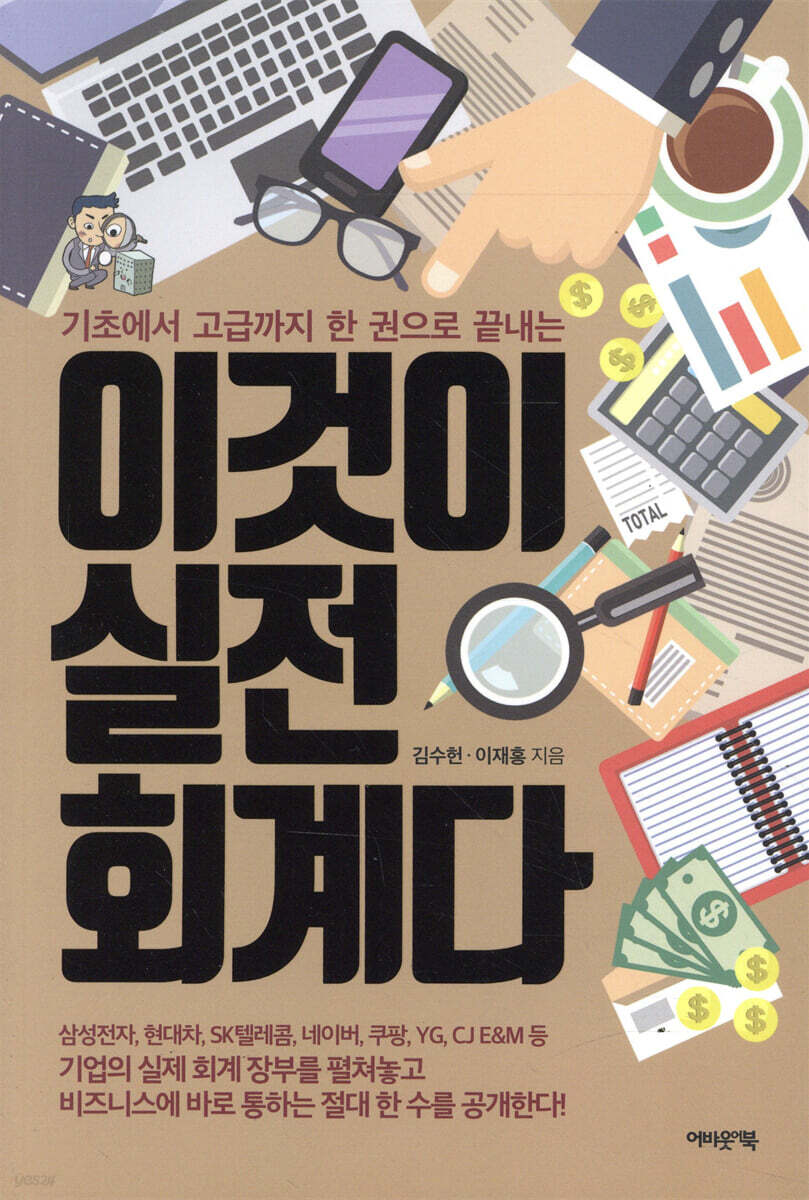
This is real accounting
 |
Description
Book Introduction
Spread out the company's actual accounting books
We're revealing the absolute best strategy for business!
Accounting is 'survival knowledge' for surviving in the business battlefield.
Involving the accounting department from the product design stage is not a unique management style unique to Apple.
Many companies require accounting-based decision-making across all areas of business, including planning, marketing, sales, management, production, and research.
Investing without analyzing a company's financial statements is like opening yourself up to strategic investors.
Accounting is present in everything related to management, investing, starting a business, promotion, and money.
"This is Practical Accounting" draws a clear line between itself and existing introductory accounting books.
It explains accounting thoroughly, using case studies and actual company accounting books.
The authors collected over 100 case studies from businesses such as Samsung Electronics, Hyundai Motors, SK Telecom, Naver, Coupang, YG, and CJ E&M, and they are truly "real-world" examples.
How much revenue would be generated if 100 won was credited to the purchase of a 10,000 won book? How would prepaid tuition be counted as revenue? How would the development costs of Ottogi's Jinjjamppong be accounted for? How would an entertainment agency account for the training fees of its entertainers and trainees? How would the massive warranty repair costs and inventory losses from Samsung Electronics' recall and suspension of sales of the Galaxy Note 7 be reflected in its financial statements? How did Daewoo Shipbuilding & Marine Engineering engage in 5.7 trillion won in fraudulent accounting? This book uses vivid examples, ranging from everyday cases to accounting issues that shook South Korea, to maximize financial statement analysis skills.
We're revealing the absolute best strategy for business!
Accounting is 'survival knowledge' for surviving in the business battlefield.
Involving the accounting department from the product design stage is not a unique management style unique to Apple.
Many companies require accounting-based decision-making across all areas of business, including planning, marketing, sales, management, production, and research.
Investing without analyzing a company's financial statements is like opening yourself up to strategic investors.
Accounting is present in everything related to management, investing, starting a business, promotion, and money.
"This is Practical Accounting" draws a clear line between itself and existing introductory accounting books.
It explains accounting thoroughly, using case studies and actual company accounting books.
The authors collected over 100 case studies from businesses such as Samsung Electronics, Hyundai Motors, SK Telecom, Naver, Coupang, YG, and CJ E&M, and they are truly "real-world" examples.
How much revenue would be generated if 100 won was credited to the purchase of a 10,000 won book? How would prepaid tuition be counted as revenue? How would the development costs of Ottogi's Jinjjamppong be accounted for? How would an entertainment agency account for the training fees of its entertainers and trainees? How would the massive warranty repair costs and inventory losses from Samsung Electronics' recall and suspension of sales of the Galaxy Note 7 be reflected in its financial statements? How did Daewoo Shipbuilding & Marine Engineering engage in 5.7 trillion won in fraudulent accounting? This book uses vivid examples, ranging from everyday cases to accounting issues that shook South Korea, to maximize financial statement analysis skills.
- You can preview some of the book's contents.
Preview
index
This is real-world accounting.
Prologue | Close any accounting books that just explain concepts!
Chapter 1.
Understanding the essence of operating profit, the starting point of profit and loss
Part 1.
Holey P&L
[Brunch Accounting] Where Should Asset Revaluation Gains Be Reported? - Income Statement and Comprehensive Income Statement
Part 2.
Department Store Products: "My Child" and "Someone Else's Child" - Total and Net Sales at Lotte, Shinsegae, and Hyundai Department Stores
[Brunch Accounting] The income statement that blows away when you close the books, and the balance sheet that carries the closing figures.
Part 3.
How did Coupang achieve such a staggering increase in sales?
[Brunch Accounting] Listed Companies' Obligations: Four Settlements and Four Financial Statements
Part 4.
Various operating profits
[Brunch Accounting] Even Baker King Park Easily Calculate Cost of Sales, Cost of Manufacturing, and Gross Profit
Chapter 2.
Why Accounting Feels Difficult: Deferred Revenue and Deferred Expenses
Part 5.
Debt Ratio 3000%, We're Not Insolvent! - Accounting for Down Payments and Advance Payments
Part 6.
How are prepaid tuition fees recognized as revenue? - Accounting for prepaid revenue and prepaid expenses.
[Brunch Accounting] When Should Revenue Be Recognized? - Accrual vs.
Cash basis accounting
Part 7.
Accounting for Technology Exports Varies According to Contract Terms - Hanmi Pharmaceutical Technology Contract Fee Allocation Accounting
[Brunch Accounting] Distinguishing Between Accounts Receivable and Revenue Receivable
Chapter 3.
Depreciation and impairment losses
Part 8.
When, how, and why is depreciation done?
Part 9.
The Disaster Caused by Bold Investments in Facilities: Interflex and E-Mart
Part 10.
The Power of Management, Tangible Assets
[Brunch Accounting] The Essence of Manufacturing: A Race Against Time
Part 11.
Mother-in-law and daughter-in-law who became enemies because of octopus - trademarks are assets too!
[Brunch Accounting] Can Customer Transaction Information Become an Intangible Asset?
Part 12.
Samsung SDI's 700 billion won deficit: Impairment loss accounting
Chapter 4.
If you're good at analyzing accounts receivable, you won't get hit in the back of the head.
Part 13.
Bad debt reserves are a pain! - Accounts receivable valuation and expense processing? LS Networks, POSCO Daewoo
Part 14.
Transfer of Accounts Receivable: Is it a sale or a borrowing transaction?
Part 15.
Moneuel's accounting fraud using accounts receivable transfer transactions
[Brunch Accounting] "We've Accumulated Debt Since We're IPOing" - Accounting Standards and Hyosung's Short-Term Debt
Chapter 5.
Cash-generating assets, inventory
Part 16.
Inventory Asset Valuation Loss: How to Measure and Reflect It
Part 17.
Finding Hidden Inventory Losses in the Income Statement
[Brunch Accounting] Calculating Turnover Ratio and Turnover Period, Useful for Financial Statement Analysis
Chapter 6.
Accounting for financial assets
Part 18.
Cuckoo Electronics is more excited about Samsung Life Insurance's stock price rising than Woongjin's! - Financial assets recognized in profit or loss
[Brunch Accounting] Classification of Capital Composition Items Different for Each Company
Part 19.
Recognize profit or loss when disposed of! - Available-for-sale financial assets
Part 20.
Muhak Co., Ltd.'s performance faltered due to ELS
[Brunch Accounting] Stocks whose book value remains unchanged, no matter how good their performance.
Chapter 7.
Understanding the Equity Method in 1 Hour
Part 21.
How does a parent company account for changes in its subsidiary's net assets? - Basic Principles of Equity Method Accounting
Part 22. Why is KFC's equity method loss so large?
Part 23.
Equity method accounting when there are ‘internal transactions’ and ‘dividends’
Part 24.
Korean Air, which was devastated by Hanjin Shipping - equity method losses and impairment losses piled up.
[Brunch Accounting] Three Financial Accounting Standards Applicable to Korean Companies
Chapter 8.
The World of Intangible Assets
Part 25.
How will the development costs of Jinjjambbong and Genesis be accounted for?
Part 26. LG Electronics: 6%, Celltrion: 80% - The Wide Variation in R&D Expenditure Capitalization Ratios 234
[Brunch Accounting] R&D Expenses: Expenses or Assets? - I Got Caught Evading Development Expenses! 242
Part 27.
Basic Principles of Accounting for Goodwill in Mergers and Acquisitions 248
Part 28. CJ E&M significantly revises drama production cost accounting.
[Brunch Accounting] How to Handle Asset Impairment and Recoveries? 260
Part 29.
The unique accounting practices of entertainment agencies that make a living from celebrities
[Brunch Accounting] Can a Recruitment Bonus Become a Company's Intangible Asset?
Chapter 9.
Accounting for reserve liabilities and capital increases and decreases with or without compensation
Part 30.
Liabilities and reserves with uncertain timing and amount of expenditure - Hyundai Motor Company, Asiana Airlines, Hyundai Wia, Kia Motors, Samsung SDI
[Brunch Accounting] Reserves and Liabilities: Similar, But Their Meanings Are Worlds Apart 283
Part 31.
New Capital Securities: Equity or Debt? - Doosan Infracore 285
Part 32.
Sources of Assets, Capital, and Liabilities 293
Part 33.
Capital Changes Due to Corporate Growth and Decline - Capital Increases, Capital Reductions, and Capital Impairment 298
Part 34.
Are Paid Potatoes and Potato Cars a Broken Fortune? - The Return of Investments from the Singapore Investment Authority and Private Equity Funds
Part 35.
Accounting for Buying and Selling Treasury Stock - Hwainvest, Samchully
Chapter 10.
Lease transactions and sale-and-leaseback
Part 36.
Borrowing the same asset, sometimes mine, sometimes someone else's - financial lease and operating lease
[Brunch Accounting] Lease Accounting for Airlines
Part 37.
Is it a lease or a loan? - The Real World of Leases
Part 38.
Sale & Leaseback to Break Through the Money Vein - Homeplus
[Brunch Accounting] Financial Statement Analysis for Sale-and-Leaseback Transactions
Chapter 11.
Various revenues and expenses - customer points, stock options, exchange rate fluctuations
Part 39.
Sales and customer points temporarily postponed
Part 40.
Accounting for stock options, a representative form of stock-based compensation
[Brunch Accounting] Even if a major shareholder gives stock to employees, it costs the company money - A special case of stock compensation at KOSDAQ company TSE.
Part 41.
Exchange rate fluctuations are sometimes more frightening than the compatibility issue - Kia Motors, CJ, Korean Air
Chapter 12.
Anatomy of Progress-Based Accounting in the Order-Based Industry
Part 42.
The Core of Accounting in the Construction and Shipbuilding Industries
[Brunch Accounting] Why is it easy to cheat on progress criteria?
Part 43.
"Oh, construction costs have increased dramatically." - How to recognize losses in the contract industry and turnaround.
[Brunch Accounting] Can't bill for construction work? - Unbilled and overbilled construction
Chapter 13.
What the Cash Flow Statement Tells You
Part 44.
Learn Cash Flow in One Place
Part 45.
Signals from the Cash Flow Statement
[Brunch Accounting] Regarding the Misconception That Cash Flow Statements and Income Statements Are Completely Different
Chapter 14.
A leap forward in advanced accounting, consolidated financial statements
Part 46.
Connecting the financial statements
Part 47.
Connecting the Income Statement
Part 48.
Understanding equity method income and controlling and non-controlling interests
Part 49.
What are the differences between consolidated, separate, and individual financial statements? - Samsung Electronics, POSCO, Kwanglim, and Ssangbangwool
[Brunch Accounting] What if subsidiaries with less than a 50% stake become equity-method stocks? - LG Electronics, LG Innotek, SK, Hyundai Rotem
Prologue | Close any accounting books that just explain concepts!
Chapter 1.
Understanding the essence of operating profit, the starting point of profit and loss
Part 1.
Holey P&L
[Brunch Accounting] Where Should Asset Revaluation Gains Be Reported? - Income Statement and Comprehensive Income Statement
Part 2.
Department Store Products: "My Child" and "Someone Else's Child" - Total and Net Sales at Lotte, Shinsegae, and Hyundai Department Stores
[Brunch Accounting] The income statement that blows away when you close the books, and the balance sheet that carries the closing figures.
Part 3.
How did Coupang achieve such a staggering increase in sales?
[Brunch Accounting] Listed Companies' Obligations: Four Settlements and Four Financial Statements
Part 4.
Various operating profits
[Brunch Accounting] Even Baker King Park Easily Calculate Cost of Sales, Cost of Manufacturing, and Gross Profit
Chapter 2.
Why Accounting Feels Difficult: Deferred Revenue and Deferred Expenses
Part 5.
Debt Ratio 3000%, We're Not Insolvent! - Accounting for Down Payments and Advance Payments
Part 6.
How are prepaid tuition fees recognized as revenue? - Accounting for prepaid revenue and prepaid expenses.
[Brunch Accounting] When Should Revenue Be Recognized? - Accrual vs.
Cash basis accounting
Part 7.
Accounting for Technology Exports Varies According to Contract Terms - Hanmi Pharmaceutical Technology Contract Fee Allocation Accounting
[Brunch Accounting] Distinguishing Between Accounts Receivable and Revenue Receivable
Chapter 3.
Depreciation and impairment losses
Part 8.
When, how, and why is depreciation done?
Part 9.
The Disaster Caused by Bold Investments in Facilities: Interflex and E-Mart
Part 10.
The Power of Management, Tangible Assets
[Brunch Accounting] The Essence of Manufacturing: A Race Against Time
Part 11.
Mother-in-law and daughter-in-law who became enemies because of octopus - trademarks are assets too!
[Brunch Accounting] Can Customer Transaction Information Become an Intangible Asset?
Part 12.
Samsung SDI's 700 billion won deficit: Impairment loss accounting
Chapter 4.
If you're good at analyzing accounts receivable, you won't get hit in the back of the head.
Part 13.
Bad debt reserves are a pain! - Accounts receivable valuation and expense processing? LS Networks, POSCO Daewoo
Part 14.
Transfer of Accounts Receivable: Is it a sale or a borrowing transaction?
Part 15.
Moneuel's accounting fraud using accounts receivable transfer transactions
[Brunch Accounting] "We've Accumulated Debt Since We're IPOing" - Accounting Standards and Hyosung's Short-Term Debt
Chapter 5.
Cash-generating assets, inventory
Part 16.
Inventory Asset Valuation Loss: How to Measure and Reflect It
Part 17.
Finding Hidden Inventory Losses in the Income Statement
[Brunch Accounting] Calculating Turnover Ratio and Turnover Period, Useful for Financial Statement Analysis
Chapter 6.
Accounting for financial assets
Part 18.
Cuckoo Electronics is more excited about Samsung Life Insurance's stock price rising than Woongjin's! - Financial assets recognized in profit or loss
[Brunch Accounting] Classification of Capital Composition Items Different for Each Company
Part 19.
Recognize profit or loss when disposed of! - Available-for-sale financial assets
Part 20.
Muhak Co., Ltd.'s performance faltered due to ELS
[Brunch Accounting] Stocks whose book value remains unchanged, no matter how good their performance.
Chapter 7.
Understanding the Equity Method in 1 Hour
Part 21.
How does a parent company account for changes in its subsidiary's net assets? - Basic Principles of Equity Method Accounting
Part 22. Why is KFC's equity method loss so large?
Part 23.
Equity method accounting when there are ‘internal transactions’ and ‘dividends’
Part 24.
Korean Air, which was devastated by Hanjin Shipping - equity method losses and impairment losses piled up.
[Brunch Accounting] Three Financial Accounting Standards Applicable to Korean Companies
Chapter 8.
The World of Intangible Assets
Part 25.
How will the development costs of Jinjjambbong and Genesis be accounted for?
Part 26. LG Electronics: 6%, Celltrion: 80% - The Wide Variation in R&D Expenditure Capitalization Ratios 234
[Brunch Accounting] R&D Expenses: Expenses or Assets? - I Got Caught Evading Development Expenses! 242
Part 27.
Basic Principles of Accounting for Goodwill in Mergers and Acquisitions 248
Part 28. CJ E&M significantly revises drama production cost accounting.
[Brunch Accounting] How to Handle Asset Impairment and Recoveries? 260
Part 29.
The unique accounting practices of entertainment agencies that make a living from celebrities
[Brunch Accounting] Can a Recruitment Bonus Become a Company's Intangible Asset?
Chapter 9.
Accounting for reserve liabilities and capital increases and decreases with or without compensation
Part 30.
Liabilities and reserves with uncertain timing and amount of expenditure - Hyundai Motor Company, Asiana Airlines, Hyundai Wia, Kia Motors, Samsung SDI
[Brunch Accounting] Reserves and Liabilities: Similar, But Their Meanings Are Worlds Apart 283
Part 31.
New Capital Securities: Equity or Debt? - Doosan Infracore 285
Part 32.
Sources of Assets, Capital, and Liabilities 293
Part 33.
Capital Changes Due to Corporate Growth and Decline - Capital Increases, Capital Reductions, and Capital Impairment 298
Part 34.
Are Paid Potatoes and Potato Cars a Broken Fortune? - The Return of Investments from the Singapore Investment Authority and Private Equity Funds
Part 35.
Accounting for Buying and Selling Treasury Stock - Hwainvest, Samchully
Chapter 10.
Lease transactions and sale-and-leaseback
Part 36.
Borrowing the same asset, sometimes mine, sometimes someone else's - financial lease and operating lease
[Brunch Accounting] Lease Accounting for Airlines
Part 37.
Is it a lease or a loan? - The Real World of Leases
Part 38.
Sale & Leaseback to Break Through the Money Vein - Homeplus
[Brunch Accounting] Financial Statement Analysis for Sale-and-Leaseback Transactions
Chapter 11.
Various revenues and expenses - customer points, stock options, exchange rate fluctuations
Part 39.
Sales and customer points temporarily postponed
Part 40.
Accounting for stock options, a representative form of stock-based compensation
[Brunch Accounting] Even if a major shareholder gives stock to employees, it costs the company money - A special case of stock compensation at KOSDAQ company TSE.
Part 41.
Exchange rate fluctuations are sometimes more frightening than the compatibility issue - Kia Motors, CJ, Korean Air
Chapter 12.
Anatomy of Progress-Based Accounting in the Order-Based Industry
Part 42.
The Core of Accounting in the Construction and Shipbuilding Industries
[Brunch Accounting] Why is it easy to cheat on progress criteria?
Part 43.
"Oh, construction costs have increased dramatically." - How to recognize losses in the contract industry and turnaround.
[Brunch Accounting] Can't bill for construction work? - Unbilled and overbilled construction
Chapter 13.
What the Cash Flow Statement Tells You
Part 44.
Learn Cash Flow in One Place
Part 45.
Signals from the Cash Flow Statement
[Brunch Accounting] Regarding the Misconception That Cash Flow Statements and Income Statements Are Completely Different
Chapter 14.
A leap forward in advanced accounting, consolidated financial statements
Part 46.
Connecting the financial statements
Part 47.
Connecting the Income Statement
Part 48.
Understanding equity method income and controlling and non-controlling interests
Part 49.
What are the differences between consolidated, separate, and individual financial statements? - Samsung Electronics, POSCO, Kwanglim, and Ssangbangwool
[Brunch Accounting] What if subsidiaries with less than a 50% stake become equity-method stocks? - LG Electronics, LG Innotek, SK, Hyundai Rotem
Detailed image
.jpg)
Publisher's Review
This is real-world accounting.
Close any accounting books that just explain concepts right now!
Accounting is 'survival knowledge' for surviving in the business battlefield.
Involving the accounting department from the product design stage is not a unique management style unique to Apple.
Many companies require accounting-based decision-making across all areas of business, including planning, marketing, sales, management, production, and research.
Investing without analyzing a company's financial statements is like opening yourself up to strategic investors.
Accounting is present in everything related to management, investing, starting a business, promotion, and money.
The concept of learning accounting by reading it like a novel or explaining accounting without using financial statements lowers the barrier to entry for studying accounting.
But that's it.
Books with a concept like 'Dang-ui-jeong (糖衣錠)' have the sweetness on the surface melt away before you even swallow them, revealing the bitter taste of accounting.
In the end, your skills do not improve, you remain stagnant, and a vicious cycle of looking for a new accounting book repeats itself.
"This is Practical Accounting" draws a clear line between itself and existing introductory accounting books.
It explains accounting thoroughly, using case studies and actual company accounting books.
This is because a company's financial statements are the most vivid 'site' where you can maximize your understanding and analytical skills in accounting.
This book clearly explains corporate accounting processes and accounting principles through financial statements and business reports of over 100 companies, including Samsung Electronics, Hyundai Motor Company, SK Telecom, Naver, Coupang, YG, and CJ E&M.
Striking Case Studies from the Business World
This book is a collaborative effort between an economics expert who has long analyzed corporations and securities, and an accountant who has worked at an accounting firm and provides management, accounting, and tax consulting services to corporations.
Author Kim Su-heon has deep accounting knowledge, so much so that he is known as the "accounting teacher" of economic reporters.
He taught himself accounting by grappling with corporate financial statements, financial disclosures, and various financial analysis reports from securities analysts and credit rating agencies to write accurate articles.
His accounting knowledge, gained through studying accounting while working in the business field, is truly practical.
Additionally, by closely examining figures or decisions that are difficult to understand through reporting, we analyze financial statements in a more three-dimensional manner.
The author, Jaehong Lee, is an accountant with 10 years of experience.
In the consulting field, he met many companies that suffered losses due to lack of accounting knowledge.
But unfortunately, the managers and members of these companies considered accounting to be a specialist field and distanced themselves from it.
As part of his work to break down the barriers to accounting, the author is working on Daum Brunch and the media to explain accounting in an easy and fun way, using the latest economic issues as material.
The best accounting textbook these two authors, a journalist and an accountant, have found is a company's actual financial statements.
If you study accounting by using specific examples of various situations for the sake of explanation, your ability to apply it will inevitably be reduced.
There is no better textbook for explaining the various mechanisms of accounting processing than real-world examples.
If you give 100 won in credit for the purchase of a 10,000 won book, how much will the sales be? (Page 347) How will prepaid tuition be considered sales? (Page 60) How will the development cost of Ottogi Jinjjamppong be accounted for? (Page 226) How will entertainment agencies account for the training costs of their entertainers and trainees? (Page 267) How will Hyundai Motor Company show free repair costs in its accounting books? (Page 274) How will the enormous warranty repair costs and inventory losses of Samsung Electronics, which recalled all Galaxy Note 7s and stopped selling them, be reflected in its financial statements? (Page 272) The authors explain accounting in an easy and clear way through vivid examples, from familiar cases related to everyday life to accounting issues that shook Korea.
A practical accounting class that will help you understand the flow of business and the pulse of investment!
Another virtue of this book is that it explains accounting in a way that suits the characteristics of industries such as distribution, construction, pharmaceuticals, and entertainment agencies, allowing for a more accurate understanding of accounting.
Social commerce company Coupang's sales in 2015 increased by 2,300% compared to 2013.
To accurately analyze how Coupang's explosive sales growth was possible, we need to understand sales recognition based on transaction types in the distribution industry.
Without this understanding, it is impossible to make accurate value judgments about business performance (p. 34).
In 2016, a financial information company provided the media with data indicating that “Samsung Heavy Industries’ Nigerian shipyard was in financial danger, with a debt ratio exceeding 3,000%.”
Samsung Heavy Industries immediately released a rebuttal stating, “It is true that the debt ratio is 3000%, but it is not insolvent at all.”
At first glance, it seems like a strange logic that doesn't make sense.
To accept Samsung Heavy Industries' claims, an understanding of down payment, advance payment, and accounting treatment during the order-taking process must be a prerequisite (page 52).
This book covers intermediate to advanced accounting topics not found in existing introductory books, including equity method, leases, exchange rates, financial assets, and consolidated financial statements.
Leasing is widely used in everything from automobiles to aircraft, and Korean companies, which have a large proportion of imports and exports, cannot be free from exchange rate fluctuations.
In a corporate environment where most companies have subsidiaries and complex investment relationships, it is impossible to fully understand financial statements without discussing the equity method and consolidated financial statements.
This book is a moderately introductory book, and serves as a stepping stone for those whose accounting skills are stagnant to advance to intermediate and advanced accounting.
Daewoo Shipbuilding & Marine Engineering (page 395), which committed 5.7 trillion won in fraudulent accounting; Moneual (page 134), which received 3 trillion won in fraudulent loans using accounts receivable; and Hanjin Shipping, which caused a logistics crisis (page 210).
Kia Motors is in a 1 trillion won wage lawsuit with its employees (page 282).
These are all issues that cannot be fully understood without accounting knowledge.
This book provides a detailed analysis of the latest accounting issues, imparting not only accounting knowledge but also business literacy.
Close any accounting books that just explain concepts right now!
Accounting is 'survival knowledge' for surviving in the business battlefield.
Involving the accounting department from the product design stage is not a unique management style unique to Apple.
Many companies require accounting-based decision-making across all areas of business, including planning, marketing, sales, management, production, and research.
Investing without analyzing a company's financial statements is like opening yourself up to strategic investors.
Accounting is present in everything related to management, investing, starting a business, promotion, and money.
The concept of learning accounting by reading it like a novel or explaining accounting without using financial statements lowers the barrier to entry for studying accounting.
But that's it.
Books with a concept like 'Dang-ui-jeong (糖衣錠)' have the sweetness on the surface melt away before you even swallow them, revealing the bitter taste of accounting.
In the end, your skills do not improve, you remain stagnant, and a vicious cycle of looking for a new accounting book repeats itself.
"This is Practical Accounting" draws a clear line between itself and existing introductory accounting books.
It explains accounting thoroughly, using case studies and actual company accounting books.
This is because a company's financial statements are the most vivid 'site' where you can maximize your understanding and analytical skills in accounting.
This book clearly explains corporate accounting processes and accounting principles through financial statements and business reports of over 100 companies, including Samsung Electronics, Hyundai Motor Company, SK Telecom, Naver, Coupang, YG, and CJ E&M.
Striking Case Studies from the Business World
This book is a collaborative effort between an economics expert who has long analyzed corporations and securities, and an accountant who has worked at an accounting firm and provides management, accounting, and tax consulting services to corporations.
Author Kim Su-heon has deep accounting knowledge, so much so that he is known as the "accounting teacher" of economic reporters.
He taught himself accounting by grappling with corporate financial statements, financial disclosures, and various financial analysis reports from securities analysts and credit rating agencies to write accurate articles.
His accounting knowledge, gained through studying accounting while working in the business field, is truly practical.
Additionally, by closely examining figures or decisions that are difficult to understand through reporting, we analyze financial statements in a more three-dimensional manner.
The author, Jaehong Lee, is an accountant with 10 years of experience.
In the consulting field, he met many companies that suffered losses due to lack of accounting knowledge.
But unfortunately, the managers and members of these companies considered accounting to be a specialist field and distanced themselves from it.
As part of his work to break down the barriers to accounting, the author is working on Daum Brunch and the media to explain accounting in an easy and fun way, using the latest economic issues as material.
The best accounting textbook these two authors, a journalist and an accountant, have found is a company's actual financial statements.
If you study accounting by using specific examples of various situations for the sake of explanation, your ability to apply it will inevitably be reduced.
There is no better textbook for explaining the various mechanisms of accounting processing than real-world examples.
If you give 100 won in credit for the purchase of a 10,000 won book, how much will the sales be? (Page 347) How will prepaid tuition be considered sales? (Page 60) How will the development cost of Ottogi Jinjjamppong be accounted for? (Page 226) How will entertainment agencies account for the training costs of their entertainers and trainees? (Page 267) How will Hyundai Motor Company show free repair costs in its accounting books? (Page 274) How will the enormous warranty repair costs and inventory losses of Samsung Electronics, which recalled all Galaxy Note 7s and stopped selling them, be reflected in its financial statements? (Page 272) The authors explain accounting in an easy and clear way through vivid examples, from familiar cases related to everyday life to accounting issues that shook Korea.
A practical accounting class that will help you understand the flow of business and the pulse of investment!
Another virtue of this book is that it explains accounting in a way that suits the characteristics of industries such as distribution, construction, pharmaceuticals, and entertainment agencies, allowing for a more accurate understanding of accounting.
Social commerce company Coupang's sales in 2015 increased by 2,300% compared to 2013.
To accurately analyze how Coupang's explosive sales growth was possible, we need to understand sales recognition based on transaction types in the distribution industry.
Without this understanding, it is impossible to make accurate value judgments about business performance (p. 34).
In 2016, a financial information company provided the media with data indicating that “Samsung Heavy Industries’ Nigerian shipyard was in financial danger, with a debt ratio exceeding 3,000%.”
Samsung Heavy Industries immediately released a rebuttal stating, “It is true that the debt ratio is 3000%, but it is not insolvent at all.”
At first glance, it seems like a strange logic that doesn't make sense.
To accept Samsung Heavy Industries' claims, an understanding of down payment, advance payment, and accounting treatment during the order-taking process must be a prerequisite (page 52).
This book covers intermediate to advanced accounting topics not found in existing introductory books, including equity method, leases, exchange rates, financial assets, and consolidated financial statements.
Leasing is widely used in everything from automobiles to aircraft, and Korean companies, which have a large proportion of imports and exports, cannot be free from exchange rate fluctuations.
In a corporate environment where most companies have subsidiaries and complex investment relationships, it is impossible to fully understand financial statements without discussing the equity method and consolidated financial statements.
This book is a moderately introductory book, and serves as a stepping stone for those whose accounting skills are stagnant to advance to intermediate and advanced accounting.
Daewoo Shipbuilding & Marine Engineering (page 395), which committed 5.7 trillion won in fraudulent accounting; Moneual (page 134), which received 3 trillion won in fraudulent loans using accounts receivable; and Hanjin Shipping, which caused a logistics crisis (page 210).
Kia Motors is in a 1 trillion won wage lawsuit with its employees (page 282).
These are all issues that cannot be fully understood without accounting knowledge.
This book provides a detailed analysis of the latest accounting issues, imparting not only accounting knowledge but also business literacy.
GOODS SPECIFICS
- Date of publication: December 23, 2016
- Page count, weight, size: 475 pages | 818g | 155*225*25mm
- ISBN13: 9791187150152
- ISBN10: 1187150150
You may also like
카테고리
korean


korean

![ELLE 엘르 스페셜 에디션 A형 : 12월 [2025]](http://librairie.coreenne.fr/cdn/shop/files/b8e27a3de6c9538896439686c6b0e8fb.jpg?v=1766436872&width=3840)


