

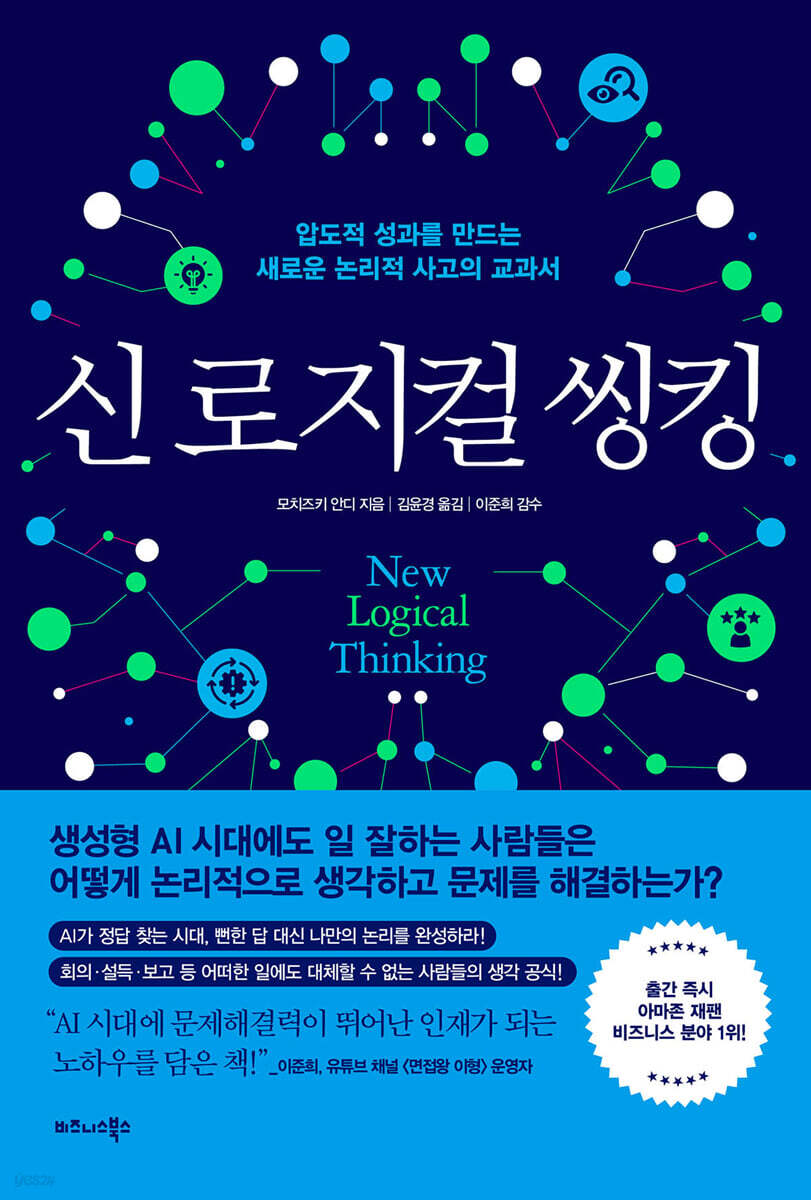
New Logical Thinking
 |
Description
Book Introduction
A top director selected by Deloitte Consulting for four consecutive years tells us
The top 1% logical thinking framework that AI cannot replace!
In business, speaking and writing logically are essential skills for everyone, from new graduates to leaders.
Accordingly, many companies, including McKinsey & Company, the world's leading knowledge merchant, have been emphasizing logical thinking in employee training and leader development.
But now, we live in an era where generative AI delivers answers in an instant. Despite AI's obvious answers and plausible misinformation, people choose the convenience AI offers, eschewing complex thought processes and settling for formulaic results.
Amidst these changes, "New Logical Thinking" raised the question of "We must regain the power to think for ourselves," and had a huge impact in Japanese society, where generative AI is rapidly spreading.
The same holds true for Korean society. Now, with AI-incapable capabilities becoming more crucial than ever, how can we achieve outstanding results through differentiated thinking?
Author Andi Mochizuki is a logical thinking expert who has been selected as the best employee for four consecutive years by one of the world's top four consulting firms.
Drawing on his extensive experience, he updates logical thinking and, through this book, introduces specific methods for solving problems creatively while maintaining logic.
Above all, he generously shares his know-how in demonstrating logical thinking in a variety of business situations, including meetings, reports, planning, and sales.
New logical thinking doesn't require innate talent.
From those who say they "still lack logic" to those who say they are "logical but mediocre and weakly persuasive," this book will help you build the fundamentals of logical thinking and creative thinking, enabling you to thrive in the AI era.
The top 1% logical thinking framework that AI cannot replace!
In business, speaking and writing logically are essential skills for everyone, from new graduates to leaders.
Accordingly, many companies, including McKinsey & Company, the world's leading knowledge merchant, have been emphasizing logical thinking in employee training and leader development.
But now, we live in an era where generative AI delivers answers in an instant. Despite AI's obvious answers and plausible misinformation, people choose the convenience AI offers, eschewing complex thought processes and settling for formulaic results.
Amidst these changes, "New Logical Thinking" raised the question of "We must regain the power to think for ourselves," and had a huge impact in Japanese society, where generative AI is rapidly spreading.
The same holds true for Korean society. Now, with AI-incapable capabilities becoming more crucial than ever, how can we achieve outstanding results through differentiated thinking?
Author Andi Mochizuki is a logical thinking expert who has been selected as the best employee for four consecutive years by one of the world's top four consulting firms.
Drawing on his extensive experience, he updates logical thinking and, through this book, introduces specific methods for solving problems creatively while maintaining logic.
Above all, he generously shares his know-how in demonstrating logical thinking in a variety of business situations, including meetings, reports, planning, and sales.
New logical thinking doesn't require innate talent.
From those who say they "still lack logic" to those who say they are "logical but mediocre and weakly persuasive," this book will help you build the fundamentals of logical thinking and creative thinking, enabling you to thrive in the AI era.
- You can preview some of the book's contents.
Preview
index
Review: Relearning the Power of Thinking in the AI Era
Introduction: Why We Need to Update Our Logical Thinking Now
Part 1: Structure Your Thoughts with a Positive Argument
Chapter 1: What it Means to Think Logically
[Case] Is the result more important or the process?
Extracting 'unknown information' from 'given information'
Strategic thinking that creates value through information differentiation
Argumentation is needed to persuade with information that is not given.
Argumentation is a fight over 'reason'
Argument is not about defeating your opponent, but about moving together.
Argument using the structure of 'because' and 'therefore'
'Sufficient elements' and 'expected order' to support logic
Argumentation principles that will capture the hearts of your opponents, summary
Provide a basis for both you and the other person to nod their heads.
The intersection of logic and organization, emological
From IQ to EQ: What's Needed in the Age of Generative AI
[Case Study] Think in AND, Not OR
Increase the resolution of your thinking with conditional arguments.
Do you have the courage to take risks?
The End of Logical Thinking: Standardization
The Backlash of Standardization: The Trap of Commodity Thinking
Chapter 2: Deriving Current Affairs Through Deductive Thinking
[Case Study] Analyzing Amazon's Strategy Story
The most basic brain function, association
Add logic to association and you have a story.
Aristotle and Descartes' deductive method
Proving, evaluating, predicting, and judging using deductive reasoning
A story born from a 'chain reaction of meaning'
Break free from commodity thinking with deductive thinking.
Tell an original story with your own perspective.
Deductive Thinking: How to Use It in Real-World Situations
Three Key Points for Deductive Thinking
The mind of a person who knows ten by hearing one
Deductive story, from linear logic to circular logic
The world of orthodox templates vs.
A world of logical surprises
So what's new?
Antifragility Thinking for Navigating an Age of Uncertainty
Draw a strategic story with comprehensive thinking.
Six Story Patterns That Create Logical Unexpectation
[Case Study] Building a Competitive Advantage by Engaging Customers
Chapter 3: Drawing Conclusions Through Inductive Thinking
[Case] DX at Work: Which Solution Should I Choose?
The principle of thinking that distinguishes between the same and the different
The flow of thought changes depending on the grouping
Accumulate your own classification perspective
Once you master grouping, you can also do induction.
As experience accumulates, logic becomes stronger.
Inductive thinking is about organizing things into one essence.
Don't collect and then organize, organize and then collect.
Focus on implications rather than facts! The difference between look and see
An inductive question that gets to the heart of the matter, So what?
Capture objects in three dimensions through the framework's lens.
Leverage your experience to derive 'laws'
Black Swan: Let Go of Your Stubbornness and Open Up to New Possibilities
How to Use Inductive Thinking in Real-World Situations
Structure it into a multi-step inductive thinking process.
Move beyond sub-messages to the main message.
[Case Study] Information as a Weapon, Consideration as a Shield
Deliberately destroy the structure depending on the opponent.
A good point involves a leap of logic.
A sense of balance between logical accuracy and leaps of logic
My perspective to draw my own insights
Part 2: Expand Your Thinking with Counter-Discovery
Chapter 4: Creating Hypotheses and Differentiating Thinking
[Case] How to increase sales in the landline phone business?
When the limit is crossed, good turns into evil.
Shatter the Myth of Consultant Structure
Thinking between argument and discovery
Discovery as a source of value
Develop your sense of discovery with brain exercises
Deductive reasoning to generate hypotheses about the unknown
The question that drives the thinking of the abductive method: What if?
Expand the options of your initial hypothesis.
Four criteria for prioritizing hypotheses
The usefulness of a hypothesis is more important than its source.
The trap of rationality that smart people fail to see
How to Use the Inductive Method in Real-Life Situations
1 percent inspiration is 99 percent perspiration.
The ultimate fruit of logical thinking: intuition
After doing all you can, wait for Heaven's will.
Four Mindsets That Promote Discovery
Negativity Resilience: Enduring Uncertain Times
[Case Study] What if we targeted seniors and business customers?
If you can't verbalize it, you can't imitate it.
Training your senses to turn intuition into skill
Safety and consideration that encourages discovery
Chapter 5: Developing Depth of Thinking by Enhancing Questioning Skills
[Case] How to capture the essence of a question?
The quality of your questions determines the quality of your thinking.
The power of questioning: the key to fully leveraging generative AI.
If you are anxious and afraid to ask questions,
The mind alone cannot think of anything.
Decide on an angle to delve into the problem.
When the necessary information comes to mind automatically
To think is to keep tension
Don't come up with 'thoughts', ask 'questions'.
A sense of setting questions, divergence and convergence
The difference between problems, challenges, and solutions
Question scope to get a full picture of the question
Three Characteristics of Good and Bad Questions
Before you run as fast as you can, stop once.
Question matrix for prioritizing problem solving
Questions that others can't solve, but I can.
The basics of question setting are creating 'interrogative sentences'.
The 'question-and-answer method' that elicits thoughts through questions
Developing the 'questioning power' of setting questions
A sense of ignorance heightens the power of inquiry.
Finite and temporaryize the problem domain.
6W2H: The Power of Thinking with a Framework
The final step of the framework: asking yourself questions.
The key to breaking through is the core question.
[Case Study] Draw a 'Question Structure Diagram' that's easy to see at a glance.
Asking questions makes you intellectually independent.
Personality changes depending on the questions you ask.
Part 3: Complete Your Thoughts with Synthesis and Logical Thinking
Chapter 6: A New Framework for Logical Thinking: The QADI Cycle
[Case] How to revitalize stagnant zoo management?
What is the 'framework of thought' for?
Strengths and Weaknesses of Deduction, Induction, and Hypothetical Reasoning
Leverage your strengths and compensate for your weaknesses by integrating your thinking.
The QADI Cycle: A New Logical Thinking Framework
From email to interview, execute the QADI cycle.
Restoring a sense of balance between discovery and argument
The order of explanation and the order of thought are different.
[Case Study] Transforming a Zoo into an Innovation Platform to Restore Sales
How to Survive in the Age of Uncertainty
Hypothetical Evolution or 'Strong New Game'
Going back and forth between the whole and the part through the 'circle of thought'
Welcome the 'illegal invasion' of thought
The future of organizations and societies unfolding through open minds
Chapter 7: How to Create Your Own Framework for Thinking
[Case] How should I respond to someone who is concerned about improving their thinking skills?
The meaning of the word 'smart'
The Five Powers of Thinking and the Maturity Model of Thinking
Maturity Diagnosis 1.
The power of setting questions
Maturity Diagnosis 2.
The power to generate hypotheses
Maturity Diagnosis 3.
The power to draw out implications
Maturity Diagnosis 4.
The power to draw conclusions
Maturity Diagnosis 5.
The power to explore new knowledge
Setting the Current and Future Thinking Levels with the Maturity Model
Overcome psychological blind spots to increase intelligence.
Deliberately look at yourself critically.
The attitude of 'private tutoring', which involves only selecting and following the good points
Methodological beliefs deepen and broaden learning.
Learn, break, and escape the 'frame'
Quantity breeds quality change, quality phone
Value the sense of logic over the form of logic.
Thinking with all your heart
The ultimate goal of thought: truth, goodness, and beauty
[Case Study] Self-Coaching Begins with the EARN Process
Minerva's owl spreads its wings at dusk.
The article that comes out: Why should we cultivate the power of thinking?
Acknowledgements
Introduction: Why We Need to Update Our Logical Thinking Now
Part 1: Structure Your Thoughts with a Positive Argument
Chapter 1: What it Means to Think Logically
[Case] Is the result more important or the process?
Extracting 'unknown information' from 'given information'
Strategic thinking that creates value through information differentiation
Argumentation is needed to persuade with information that is not given.
Argumentation is a fight over 'reason'
Argument is not about defeating your opponent, but about moving together.
Argument using the structure of 'because' and 'therefore'
'Sufficient elements' and 'expected order' to support logic
Argumentation principles that will capture the hearts of your opponents, summary
Provide a basis for both you and the other person to nod their heads.
The intersection of logic and organization, emological
From IQ to EQ: What's Needed in the Age of Generative AI
[Case Study] Think in AND, Not OR
Increase the resolution of your thinking with conditional arguments.
Do you have the courage to take risks?
The End of Logical Thinking: Standardization
The Backlash of Standardization: The Trap of Commodity Thinking
Chapter 2: Deriving Current Affairs Through Deductive Thinking
[Case Study] Analyzing Amazon's Strategy Story
The most basic brain function, association
Add logic to association and you have a story.
Aristotle and Descartes' deductive method
Proving, evaluating, predicting, and judging using deductive reasoning
A story born from a 'chain reaction of meaning'
Break free from commodity thinking with deductive thinking.
Tell an original story with your own perspective.
Deductive Thinking: How to Use It in Real-World Situations
Three Key Points for Deductive Thinking
The mind of a person who knows ten by hearing one
Deductive story, from linear logic to circular logic
The world of orthodox templates vs.
A world of logical surprises
So what's new?
Antifragility Thinking for Navigating an Age of Uncertainty
Draw a strategic story with comprehensive thinking.
Six Story Patterns That Create Logical Unexpectation
[Case Study] Building a Competitive Advantage by Engaging Customers
Chapter 3: Drawing Conclusions Through Inductive Thinking
[Case] DX at Work: Which Solution Should I Choose?
The principle of thinking that distinguishes between the same and the different
The flow of thought changes depending on the grouping
Accumulate your own classification perspective
Once you master grouping, you can also do induction.
As experience accumulates, logic becomes stronger.
Inductive thinking is about organizing things into one essence.
Don't collect and then organize, organize and then collect.
Focus on implications rather than facts! The difference between look and see
An inductive question that gets to the heart of the matter, So what?
Capture objects in three dimensions through the framework's lens.
Leverage your experience to derive 'laws'
Black Swan: Let Go of Your Stubbornness and Open Up to New Possibilities
How to Use Inductive Thinking in Real-World Situations
Structure it into a multi-step inductive thinking process.
Move beyond sub-messages to the main message.
[Case Study] Information as a Weapon, Consideration as a Shield
Deliberately destroy the structure depending on the opponent.
A good point involves a leap of logic.
A sense of balance between logical accuracy and leaps of logic
My perspective to draw my own insights
Part 2: Expand Your Thinking with Counter-Discovery
Chapter 4: Creating Hypotheses and Differentiating Thinking
[Case] How to increase sales in the landline phone business?
When the limit is crossed, good turns into evil.
Shatter the Myth of Consultant Structure
Thinking between argument and discovery
Discovery as a source of value
Develop your sense of discovery with brain exercises
Deductive reasoning to generate hypotheses about the unknown
The question that drives the thinking of the abductive method: What if?
Expand the options of your initial hypothesis.
Four criteria for prioritizing hypotheses
The usefulness of a hypothesis is more important than its source.
The trap of rationality that smart people fail to see
How to Use the Inductive Method in Real-Life Situations
1 percent inspiration is 99 percent perspiration.
The ultimate fruit of logical thinking: intuition
After doing all you can, wait for Heaven's will.
Four Mindsets That Promote Discovery
Negativity Resilience: Enduring Uncertain Times
[Case Study] What if we targeted seniors and business customers?
If you can't verbalize it, you can't imitate it.
Training your senses to turn intuition into skill
Safety and consideration that encourages discovery
Chapter 5: Developing Depth of Thinking by Enhancing Questioning Skills
[Case] How to capture the essence of a question?
The quality of your questions determines the quality of your thinking.
The power of questioning: the key to fully leveraging generative AI.
If you are anxious and afraid to ask questions,
The mind alone cannot think of anything.
Decide on an angle to delve into the problem.
When the necessary information comes to mind automatically
To think is to keep tension
Don't come up with 'thoughts', ask 'questions'.
A sense of setting questions, divergence and convergence
The difference between problems, challenges, and solutions
Question scope to get a full picture of the question
Three Characteristics of Good and Bad Questions
Before you run as fast as you can, stop once.
Question matrix for prioritizing problem solving
Questions that others can't solve, but I can.
The basics of question setting are creating 'interrogative sentences'.
The 'question-and-answer method' that elicits thoughts through questions
Developing the 'questioning power' of setting questions
A sense of ignorance heightens the power of inquiry.
Finite and temporaryize the problem domain.
6W2H: The Power of Thinking with a Framework
The final step of the framework: asking yourself questions.
The key to breaking through is the core question.
[Case Study] Draw a 'Question Structure Diagram' that's easy to see at a glance.
Asking questions makes you intellectually independent.
Personality changes depending on the questions you ask.
Part 3: Complete Your Thoughts with Synthesis and Logical Thinking
Chapter 6: A New Framework for Logical Thinking: The QADI Cycle
[Case] How to revitalize stagnant zoo management?
What is the 'framework of thought' for?
Strengths and Weaknesses of Deduction, Induction, and Hypothetical Reasoning
Leverage your strengths and compensate for your weaknesses by integrating your thinking.
The QADI Cycle: A New Logical Thinking Framework
From email to interview, execute the QADI cycle.
Restoring a sense of balance between discovery and argument
The order of explanation and the order of thought are different.
[Case Study] Transforming a Zoo into an Innovation Platform to Restore Sales
How to Survive in the Age of Uncertainty
Hypothetical Evolution or 'Strong New Game'
Going back and forth between the whole and the part through the 'circle of thought'
Welcome the 'illegal invasion' of thought
The future of organizations and societies unfolding through open minds
Chapter 7: How to Create Your Own Framework for Thinking
[Case] How should I respond to someone who is concerned about improving their thinking skills?
The meaning of the word 'smart'
The Five Powers of Thinking and the Maturity Model of Thinking
Maturity Diagnosis 1.
The power of setting questions
Maturity Diagnosis 2.
The power to generate hypotheses
Maturity Diagnosis 3.
The power to draw out implications
Maturity Diagnosis 4.
The power to draw conclusions
Maturity Diagnosis 5.
The power to explore new knowledge
Setting the Current and Future Thinking Levels with the Maturity Model
Overcome psychological blind spots to increase intelligence.
Deliberately look at yourself critically.
The attitude of 'private tutoring', which involves only selecting and following the good points
Methodological beliefs deepen and broaden learning.
Learn, break, and escape the 'frame'
Quantity breeds quality change, quality phone
Value the sense of logic over the form of logic.
Thinking with all your heart
The ultimate goal of thought: truth, goodness, and beauty
[Case Study] Self-Coaching Begins with the EARN Process
Minerva's owl spreads its wings at dusk.
The article that comes out: Why should we cultivate the power of thinking?
Acknowledgements
Detailed image

Into the book
"Why is argument necessary? It's to gain sympathy for the value of information that hasn't been given.
When the facts are right in front of you, there is no need for argument.
The fact that the sky is cloudy is something that anyone can know by looking up at the sky.
On the other hand, information that is not given is not placed before our eyes.
I can't tell right away if that's really true.
Therefore, information that is not given needs to be argued to make it truly believable.
If you simply say, “You should take an umbrella with you today,” without mentioning the weather, they’ll ask, “Why?”
Unless you present evidence to support your claim, people will not only disbelieve information they are not given, but they will also not act in a new way.
As a result, the original value of the information that was not given is also buried.
Therefore, argumentation is absolutely necessary to derive information that is not given from the given information and to gain the sympathy of the other party and realize value.”
--- From Chapter 1, “The Meaning of Thinking Logically”
“Inductive thinking is a bottom-up concept that builds up from facts.
A trap that is easy to fall into at this time is the idea that 'we collect information and then organize it.'
Working this way means either spending too much time collecting unnecessary information or being buried in a sea of information and spending too much time organizing it, failing to find any insights as a result of intellectual production.
It's just a waste of time.
Correct posture is the opposite.
You should organize and then collect, not collect and then organize.
Before collecting information, you must design a structure that can contain the information, that is, an overall framework, to greatly improve intellectual productivity later on.
“It is better to collect information by inserting the necessary information into a pre-made frame.”
--- From Chapter 3, “Reaching a Conclusion Through Inductive Thinking”
“In an office building, people were complaining about the long wait times for elevators.
However, to solve this problem, it was difficult to increase the number of elevators or the number of operations due to cost and structural constraints.
So the office building manager thought of a different approach.
He shifted his focus from the question, "How can we get more people on the elevator faster?" to the question, "How can we alleviate the frustration of people waiting for the elevator?"
And then I came up with the idea of installing mirrors in the elevator hall so that people could check their appearance while waiting for the elevator.
As a result, people became more interested in checking their hairstyles and clothes while waiting, which greatly reduced complaints.
What's remarkable about this story is that rather than racking their brains over finding a solution, they shifted their focus to the question, "How can people alleviate their discontent?" and thus found a solution.
"
--- From Chapter 5, “Increasing Questioning Ability to Create Depth of Thinking”
“These three thinking methods—deduction, induction, and abduction—each complement each other’s weaknesses and enhance each other’s strengths.
When these are combined, the flow of thought is as follows:
"The starting point for developing logic is to create a hypothesis using the abductive method, then use the deductive method to extract the potential of that hypothesis as an implication, and then use inductive reasoning to verify the hypothesis's error based on facts and draw a conclusion." This process is the trinity of hypothetical reasoning, deductive reasoning, and inductive reasoning.
These three ways of thinking are powerful on their own, but when combined,
If you do this, a synergy effect will be created that complements each other's weaknesses and enhances each other's strengths, allowing them to demonstrate their true value even further.
In other words, the three methods of abduction, deduction, and induction are more effective when combined to form a comprehensive method of thinking than when each method exists independently.
When we combine these three ways of thinking, their strengths complement each other's weaknesses, and a complete method of reasoning emerges.
Only through this integrated way of thinking can we achieve the ideal balance of thought necessary for correct thinking.”
When the facts are right in front of you, there is no need for argument.
The fact that the sky is cloudy is something that anyone can know by looking up at the sky.
On the other hand, information that is not given is not placed before our eyes.
I can't tell right away if that's really true.
Therefore, information that is not given needs to be argued to make it truly believable.
If you simply say, “You should take an umbrella with you today,” without mentioning the weather, they’ll ask, “Why?”
Unless you present evidence to support your claim, people will not only disbelieve information they are not given, but they will also not act in a new way.
As a result, the original value of the information that was not given is also buried.
Therefore, argumentation is absolutely necessary to derive information that is not given from the given information and to gain the sympathy of the other party and realize value.”
--- From Chapter 1, “The Meaning of Thinking Logically”
“Inductive thinking is a bottom-up concept that builds up from facts.
A trap that is easy to fall into at this time is the idea that 'we collect information and then organize it.'
Working this way means either spending too much time collecting unnecessary information or being buried in a sea of information and spending too much time organizing it, failing to find any insights as a result of intellectual production.
It's just a waste of time.
Correct posture is the opposite.
You should organize and then collect, not collect and then organize.
Before collecting information, you must design a structure that can contain the information, that is, an overall framework, to greatly improve intellectual productivity later on.
“It is better to collect information by inserting the necessary information into a pre-made frame.”
--- From Chapter 3, “Reaching a Conclusion Through Inductive Thinking”
“In an office building, people were complaining about the long wait times for elevators.
However, to solve this problem, it was difficult to increase the number of elevators or the number of operations due to cost and structural constraints.
So the office building manager thought of a different approach.
He shifted his focus from the question, "How can we get more people on the elevator faster?" to the question, "How can we alleviate the frustration of people waiting for the elevator?"
And then I came up with the idea of installing mirrors in the elevator hall so that people could check their appearance while waiting for the elevator.
As a result, people became more interested in checking their hairstyles and clothes while waiting, which greatly reduced complaints.
What's remarkable about this story is that rather than racking their brains over finding a solution, they shifted their focus to the question, "How can people alleviate their discontent?" and thus found a solution.
"
--- From Chapter 5, “Increasing Questioning Ability to Create Depth of Thinking”
“These three thinking methods—deduction, induction, and abduction—each complement each other’s weaknesses and enhance each other’s strengths.
When these are combined, the flow of thought is as follows:
"The starting point for developing logic is to create a hypothesis using the abductive method, then use the deductive method to extract the potential of that hypothesis as an implication, and then use inductive reasoning to verify the hypothesis's error based on facts and draw a conclusion." This process is the trinity of hypothetical reasoning, deductive reasoning, and inductive reasoning.
These three ways of thinking are powerful on their own, but when combined,
If you do this, a synergy effect will be created that complements each other's weaknesses and enhances each other's strengths, allowing them to demonstrate their true value even further.
In other words, the three methods of abduction, deduction, and induction are more effective when combined to form a comprehensive method of thinking than when each method exists independently.
When we combine these three ways of thinking, their strengths complement each other's weaknesses, and a complete method of reasoning emerges.
Only through this integrated way of thinking can we achieve the ideal balance of thought necessary for correct thinking.”
--- From Chapter 6, “A New Framework for Logical Thinking, the QADI Cycle”
Publisher's Review
Even in the AI era, logical thinking remains an essential business skill!
From reporting to planning, meetings, and sales, take the lead with your own logic!
In an era where AI writes reports and makes proposals, simple information analysis or logical sentences are no longer enough to compete in business.
What's truly needed in business isn't the ability to come up with answers, but the ability to think critically to see through complex problems and find solutions.
Whether it's defining a new product concept, identifying the cause of sluggish sales, or responding to a customer's needs, problem-solving is at the heart of everything we do.
《New Logical Thinking》 focuses on this very point.
Having solved countless complex problems at a global consulting firm, the author has upgraded traditional logical thinking from a simple method of reasoning to a logical and creative problem-solving technique.
From basic thinking methods like deduction, induction, and grouping, to transforming intuition into logical thinking skills and a new method that takes only the best aspects of various methods, we present field-oriented methodologies that can deliver overwhelming results even in rapidly changing times.
Lee Jun-hee, CEO of Alive Community and a leading HR consultant in Korea, also reviewed and recommended the book, saying, “What is needed in actual business settings is not logic itself, but the ability to solve problems, and ‘New Logical Thinking’ is a book that focuses on this problem-solving ability.”
New logical thinking applies across fields.
Learn and practice the new logical thinking techniques contained in this book.
Planners will be able to steer ideas, marketers will be able to make strategies more persuasive, salespeople will be able to figure out how to meet customer needs, and managers will be able to grasp the core of complex problems at a glance.
You can think from problem discovery to solution in one breath!
Rich case studies and solutions for the AI era!
Would you believe that Howard Schultz of Starbucks and Henry Ford of Ford Motor Company also used logical thinking techniques? How did they come up with mind-boggling ideas and become leaders in the top 1%? Starbucks founder Howard Schultz is a prime example of deductive thinking, discussed in Chapter 2 of this book.
Deductive reasoning is a way of thinking that draws specific conclusions based on universal facts.
Schultz combined the universal premise that "in a world without a place to rest, we need a place to restore our humanity" with the reality that "the world today is stifling and lacks space to breathe," and concluded that "the world today needs a third place."
As a result, Starbucks' core concept of 'a third place that is neither home nor work' was conceived.
Since then, Starbucks has designed a unique experience that is unique to Starbucks, including friendly customer service from baristas, comfortable space design, and customized beverage creation, and has expanded the deductive thinking that started from the initial premise into an actual business strategy.
The case of Henry Ford of Ford Motor Company is also noteworthy.
At a time when everyone was contemplating faster carriages, he asked, "What if we lived in a world where everyone could travel conveniently and quickly?"
To bridge the gap between reality and ideals, we continually question ourselves and drive industrial innovation.
Cases like Ford's can be examined in detail through the problem-solving process using hypothetical reasoning, which is covered in Chapter 5 of this book.
In this way, "New Logical Thinking" contains a process of leaping from existing logical thinking to new logical thinking over a total of three parts, and is a textbook on new logical thinking that presents abundant examples and specific methods in each of the seven chapters.
From routine tasks like drafting business plans, concise reports, sales recovery, and new business strategies to major projects, this book will help you tackle any situation without hesitation.
From reporting to planning, meetings, and sales, take the lead with your own logic!
In an era where AI writes reports and makes proposals, simple information analysis or logical sentences are no longer enough to compete in business.
What's truly needed in business isn't the ability to come up with answers, but the ability to think critically to see through complex problems and find solutions.
Whether it's defining a new product concept, identifying the cause of sluggish sales, or responding to a customer's needs, problem-solving is at the heart of everything we do.
《New Logical Thinking》 focuses on this very point.
Having solved countless complex problems at a global consulting firm, the author has upgraded traditional logical thinking from a simple method of reasoning to a logical and creative problem-solving technique.
From basic thinking methods like deduction, induction, and grouping, to transforming intuition into logical thinking skills and a new method that takes only the best aspects of various methods, we present field-oriented methodologies that can deliver overwhelming results even in rapidly changing times.
Lee Jun-hee, CEO of Alive Community and a leading HR consultant in Korea, also reviewed and recommended the book, saying, “What is needed in actual business settings is not logic itself, but the ability to solve problems, and ‘New Logical Thinking’ is a book that focuses on this problem-solving ability.”
New logical thinking applies across fields.
Learn and practice the new logical thinking techniques contained in this book.
Planners will be able to steer ideas, marketers will be able to make strategies more persuasive, salespeople will be able to figure out how to meet customer needs, and managers will be able to grasp the core of complex problems at a glance.
You can think from problem discovery to solution in one breath!
Rich case studies and solutions for the AI era!
Would you believe that Howard Schultz of Starbucks and Henry Ford of Ford Motor Company also used logical thinking techniques? How did they come up with mind-boggling ideas and become leaders in the top 1%? Starbucks founder Howard Schultz is a prime example of deductive thinking, discussed in Chapter 2 of this book.
Deductive reasoning is a way of thinking that draws specific conclusions based on universal facts.
Schultz combined the universal premise that "in a world without a place to rest, we need a place to restore our humanity" with the reality that "the world today is stifling and lacks space to breathe," and concluded that "the world today needs a third place."
As a result, Starbucks' core concept of 'a third place that is neither home nor work' was conceived.
Since then, Starbucks has designed a unique experience that is unique to Starbucks, including friendly customer service from baristas, comfortable space design, and customized beverage creation, and has expanded the deductive thinking that started from the initial premise into an actual business strategy.
The case of Henry Ford of Ford Motor Company is also noteworthy.
At a time when everyone was contemplating faster carriages, he asked, "What if we lived in a world where everyone could travel conveniently and quickly?"
To bridge the gap between reality and ideals, we continually question ourselves and drive industrial innovation.
Cases like Ford's can be examined in detail through the problem-solving process using hypothetical reasoning, which is covered in Chapter 5 of this book.
In this way, "New Logical Thinking" contains a process of leaping from existing logical thinking to new logical thinking over a total of three parts, and is a textbook on new logical thinking that presents abundant examples and specific methods in each of the seven chapters.
From routine tasks like drafting business plans, concise reports, sales recovery, and new business strategies to major projects, this book will help you tackle any situation without hesitation.
GOODS SPECIFICS
- Date of issue: November 24, 2025
- Page count, weight, size: 360 pages | 630g | 153*224*21mm
- ISBN13: 9791162544464
- ISBN10: 1162544465
You may also like
카테고리
korean


korean

![GQ KOREA Mark (Monthly): December [2025]](http://librairie.coreenne.fr/cdn/shop/files/8ef265dbbfbf186523ed75ba7319009d.jpg?v=1765340328&width=3840)


