

A Private Guidebook: Second Spain, Valencia
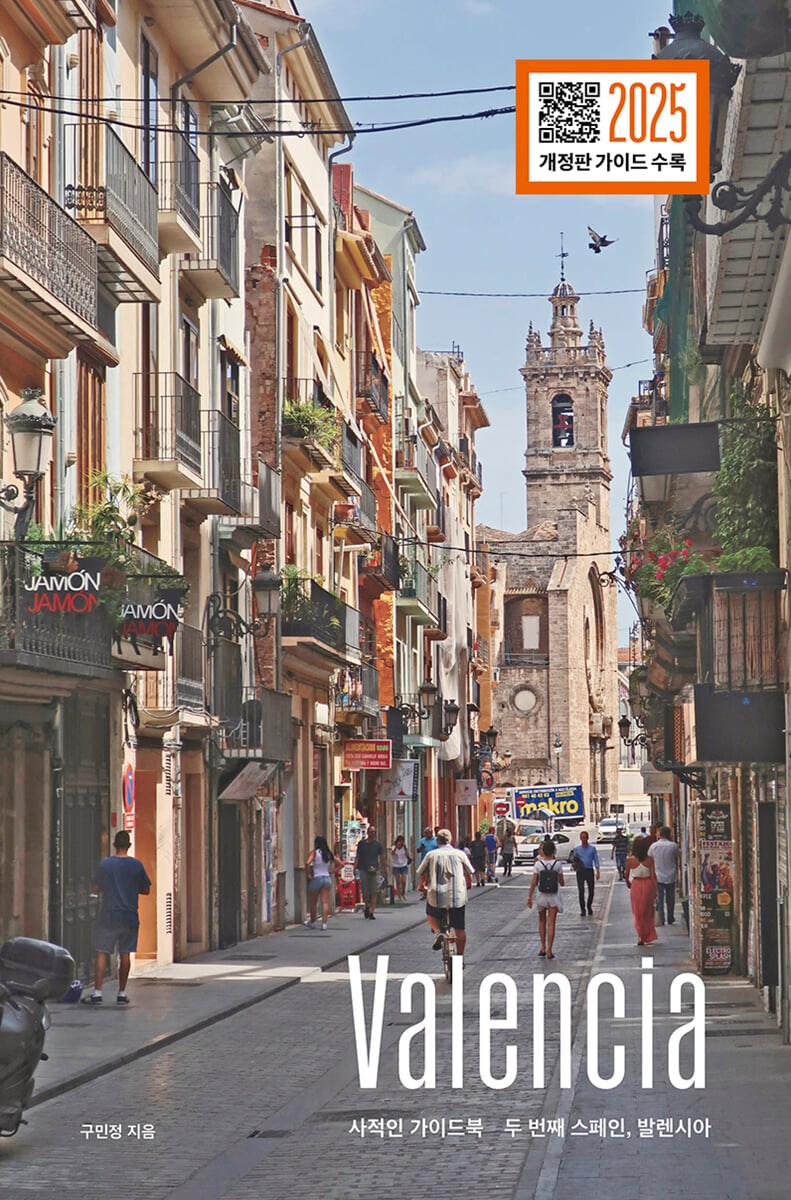 |
Description
Book Introduction
We are introducing Spain's jewel-like city of Valencia to Korea for the first time.
The author, who happened to encounter Valencia and fell in love with it, meticulously shares information on its history, traditions, festivals, attractions, local hot spots, and lifestyle, which he has accumulated through numerous stays and visits.
This guide has been carefully structured to help you explore Valencia based on three guide themes, and it also includes information and directions on 13 nearby cities that are great to visit.
In particular, it stands out with the latest information on over 200 accommodations, restaurants, bars, cafes, various shops, dance academies, movie theaters, and chain stores as of December 2018.
It also includes useful life tips for living in Valencia, language exchange meetings, a list of simple Spanish words and phrases, detailed maps of each district, subway and bus routes, and QR codes for each item.
Sensational photos that seem to capture the air and sounds of the place at that time, and vivid interviews with local owners, chefs, and graffiti artists add to the enjoyment of reading.
The author, who happened to encounter Valencia and fell in love with it, meticulously shares information on its history, traditions, festivals, attractions, local hot spots, and lifestyle, which he has accumulated through numerous stays and visits.
This guide has been carefully structured to help you explore Valencia based on three guide themes, and it also includes information and directions on 13 nearby cities that are great to visit.
In particular, it stands out with the latest information on over 200 accommodations, restaurants, bars, cafes, various shops, dance academies, movie theaters, and chain stores as of December 2018.
It also includes useful life tips for living in Valencia, language exchange meetings, a list of simple Spanish words and phrases, detailed maps of each district, subway and bus routes, and QR codes for each item.
Sensational photos that seem to capture the air and sounds of the place at that time, and vivid interviews with local owners, chefs, and graffiti artists add to the enjoyment of reading.
- You can preview some of the book's contents.
Preview
index
Recommendation
prolog
10 Reasons You'll Love Valencia
Recommended PICKS
Chapter 1.
A place called Valencia
Geography and History
symbol
traffic
Traditional food
Traditional houses and famous buildings
A Look Inside - Valencia's Architecture
festivities
A Taste of Spanish Life #01… Five Meals a Day & Ciesta 80
Chapter 2.
City Guides by Theme
Guide #01 Traveling along the Turia Gardens: El Pla del Real District
Guide #02 Time Travel in the Old City: Ciutat Vella District
A Taste of Spanish Life #02 … Tapas Bar Menu, a Very Personal Recommendation List
Guide #03 Trendy Spots, Enjoy Your Trip Like a Local: Eixample District
: Poblats Martims District
: Benimaclet District
A Taste of Spanish Life #03 … Nightlife
Chapter 3.
Suburban cities for vacation
1.
Manises
2.
Cullera
3.
Port SaPlaya
4.
Albufera
5.
Xativa, Jativa
6.
Peniscola
7.
Costa Blanca region
#01.
Denia
#02.
Xabia, Javea
#03.
Calpe
#04.
Altea
#05.
Benidorm
8.
Utiel-Raquena
9.
Morella
A Taste of Spanish Life #04: Interviews with Three Valencia's Leading Graffiti Artists
Chapter 4.
Living Information
Various chains and brands in Spain
Recommended accommodations by budget
Long-term stay, finding a home
Language exchange group
cinema
Korean Food Purchasing Information
Useful Spanish Vocabulary & Phrases to Know
Recommended: 2-Day Valencia Itinerary
Epilogue
supplement.
Valencia Metro Map
prolog
10 Reasons You'll Love Valencia
Recommended PICKS
Chapter 1.
A place called Valencia
Geography and History
symbol
traffic
Traditional food
Traditional houses and famous buildings
A Look Inside - Valencia's Architecture
festivities
A Taste of Spanish Life #01… Five Meals a Day & Ciesta 80
Chapter 2.
City Guides by Theme
Guide #01 Traveling along the Turia Gardens: El Pla del Real District
Guide #02 Time Travel in the Old City: Ciutat Vella District
A Taste of Spanish Life #02 … Tapas Bar Menu, a Very Personal Recommendation List
Guide #03 Trendy Spots, Enjoy Your Trip Like a Local: Eixample District
: Poblats Martims District
: Benimaclet District
A Taste of Spanish Life #03 … Nightlife
Chapter 3.
Suburban cities for vacation
1.
Manises
2.
Cullera
3.
Port SaPlaya
4.
Albufera
5.
Xativa, Jativa
6.
Peniscola
7.
Costa Blanca region
#01.
Denia
#02.
Xabia, Javea
#03.
Calpe
#04.
Altea
#05.
Benidorm
8.
Utiel-Raquena
9.
Morella
A Taste of Spanish Life #04: Interviews with Three Valencia's Leading Graffiti Artists
Chapter 4.
Living Information
Various chains and brands in Spain
Recommended accommodations by budget
Long-term stay, finding a home
Language exchange group
cinema
Korean Food Purchasing Information
Useful Spanish Vocabulary & Phrases to Know
Recommended: 2-Day Valencia Itinerary
Epilogue
supplement.
Valencia Metro Map
Detailed image

Into the book
While staying here, I mainly visited places where the locals live, eat, and enjoy themselves.
As I became immersed in their daily lives, meeting people, browsing through shops, and laughing and having fun with friends who became my neighbors, I too became a part of Valencia.
It was a free and comfortable time.
The air was clear and people's laughter was as fresh as the breeze on a sunny day.
Valencia, a place you can't help but love more and more as time goes by, and a place that shines more and more the more you see it.
Short orange trees line the road, and palm trees facing the Mediterranean sway in the emerald sea breeze.
The expressions of people as leisurely as the quiet streets blend in with the unique atmosphere of the place, and they overflow throughout the streets.
Even if you get lost in the middle of the city, each building has a story to tell, naturally serving as a landmark.
When I walk around the neighborhood and turn around to see what I think is a ruin, the graffiti covering the scarred surface is so intense that I lose myself in the act and press the camera shutter.
A delicious city where you can enjoy traditional Spanish paella while sitting in a restaurant decorated with ceramic tiles overlooking the Mediterranean Sea just 20 minutes by bus from the city center.
Valencia is such a warm and wonderful city.
--- Prologue
Valencia's signature dish is, of course, paella.
Paella is the Valencian word for 'pan', a shallow, round frying pan with handles on both sides.
The Valencia region is also the main producer of rice, the main ingredient in cooking.
There are many different types of paella depending on what is added, such as vegetables, meat, or seafood.
In the Valencia region, the most popular dish is paella Valenciana, a traditional dish made with beans, green vegetables, rabbit, snails, and chicken.
Just as we say that home-made kimchi is the most delicious, Spaniards also say that home-cooked paella is the most delicious.
--- 10 Reasons to Love Valencia, the Home of Paella
Oranges are Valencia's main export.
This sweet and sour fruit, which came from the African continent during the Taifa period when the Iberian Peninsula was under Islamic rule, became a specialty thanks to the warm climate of the Mediterranean.
From the early 19th century, it became popular throughout Europe, being exported to countries such as France and England.
Valencia has a Mediterranean subtropical climate where temperatures do not drop below 5 degrees Celsius even in winter.
So orange trees grow all year round.
Oranges sold in Valencia are marked 'DO' for the purpose of guaranteeing the place of production and quality.
Label it 'Valencia'.
You can enjoy freshly squeezed Valencian orange juice at any downtown cafe or bar.
Agua de Valencia (meaning 'Water of Valencia'), a signature Valencian cocktail made with orange juice, is also a must-try.
In Valencia's outdoor terrace cafes, oranges are placed on napkins and used as a paperweight.
--- A city filled with the scent of oranges
The artistic and hip neighborhoods of Russafa and El Cabanalla, nicknamed "post-Russafa," are packed with cute restaurants, bars, and cafes, making them bustling from Friday evenings through the weekend.
There are also cultural events held weekly, such as workshops and small concerts hosted by cafes and bars, so it's a good idea to follow their Facebook or Instagram pages for information.
El Cabana is right next to Malvarrosa Beach, so the atmosphere is a bit more relaxed.
This place, an old seaside village, was once designated as a historical and cultural heritage site, but was not properly preserved due to development logic.
Among the buildings that were forcibly demolished and collapsed, the unique old architectural elements that remain here and there delight the eyes of the walker.
--- A hot city full of personality
The Valencia region has been famous for its ceramic production for over 700 years, since the 14th century.
Especially from the 15th century, the golden age of Valencian ceramics, tiles and ceramics made in nearby Manises spread throughout the world and became popular.
In the 17th and 18th centuries, potters immigrated and the related business flourished further.
Thanks to this, we can still feel ceramic culture in many places in our daily lives.
You can also see a variety of works at the National Ceramic Museum and the Manises Ceramic Museum.
Manises' workshop also offers hands-on classes on making things.
Another nearby town, Alboraya, is home to the workshop of the world-renowned ceramics brand, Ladro.
--- City of traditional ceramics
Las Fallas, a traditional festival held annually from March 15 to 19, commemorates the feast day of Saint Joseph, the patron saint of the Valencian region (March 19).
Fallas is a medieval Valencian word derived from the classical Latin 'fax', meaning 'highly placed torch'.
Today, it refers to commemorative works made for festivals and celebrations.
The citizens of Valencia raise funds for this festival, and spend a year designing and building Ninot dolls that fill the streets during the festival.
The event concludes with the contest where only the winning piece is preserved in the Payas Museum, while the rest are burned on the last day of the festival.
Originally, this festival began as a custom of burning old furniture and dolls in a bonfire to get rid of them for spring cleaning.
Then, starting in the 18th century, the local community of Paya, home to Casal Payero, developed into its current form by bringing together expert carpenters and art and architecture experts to make ninot.
Las Fallas was inscribed on UNESCO's Intangible Cultural Heritage List on November 30, 2016.
--- Las Fallas, the City of Fire
After the 2002 World Cup, most Koreans became soccer fans.
Perhaps that is why Koreans who visit Spain usually watch soccer games or visit soccer stadiums in each city.
Valencia also has a famous football club.
Founded in 1919, Valencia CF has the third-largest supporters in Spain after Real Madrid CF and FC Barcelona, and is considered one of the biggest clubs in Europe.
They are a strong team that has won the Spanish league La Liga and Copa del Rey as well as several European leagues, so they also have quite a few Korean fans.
In particular, starting in 2001, promising Korean player Lee Kang-in received training at the Valencia CF Academy and prepared for his professional debut.
How about cheering on our players together with the locals at Campo de Mestalla Valencia CF, Valencia's home stadium?
At their home stadium, Mestalla, tour programs are run every morning and afternoon at one and a half hour intervals.
Even if you can't watch the match, you can still take a guided tour of the stadium, the Valencia CF history exhibition, and the players' locker room.
--- City of Soccer
As I became immersed in their daily lives, meeting people, browsing through shops, and laughing and having fun with friends who became my neighbors, I too became a part of Valencia.
It was a free and comfortable time.
The air was clear and people's laughter was as fresh as the breeze on a sunny day.
Valencia, a place you can't help but love more and more as time goes by, and a place that shines more and more the more you see it.
Short orange trees line the road, and palm trees facing the Mediterranean sway in the emerald sea breeze.
The expressions of people as leisurely as the quiet streets blend in with the unique atmosphere of the place, and they overflow throughout the streets.
Even if you get lost in the middle of the city, each building has a story to tell, naturally serving as a landmark.
When I walk around the neighborhood and turn around to see what I think is a ruin, the graffiti covering the scarred surface is so intense that I lose myself in the act and press the camera shutter.
A delicious city where you can enjoy traditional Spanish paella while sitting in a restaurant decorated with ceramic tiles overlooking the Mediterranean Sea just 20 minutes by bus from the city center.
Valencia is such a warm and wonderful city.
--- Prologue
Valencia's signature dish is, of course, paella.
Paella is the Valencian word for 'pan', a shallow, round frying pan with handles on both sides.
The Valencia region is also the main producer of rice, the main ingredient in cooking.
There are many different types of paella depending on what is added, such as vegetables, meat, or seafood.
In the Valencia region, the most popular dish is paella Valenciana, a traditional dish made with beans, green vegetables, rabbit, snails, and chicken.
Just as we say that home-made kimchi is the most delicious, Spaniards also say that home-cooked paella is the most delicious.
--- 10 Reasons to Love Valencia, the Home of Paella
Oranges are Valencia's main export.
This sweet and sour fruit, which came from the African continent during the Taifa period when the Iberian Peninsula was under Islamic rule, became a specialty thanks to the warm climate of the Mediterranean.
From the early 19th century, it became popular throughout Europe, being exported to countries such as France and England.
Valencia has a Mediterranean subtropical climate where temperatures do not drop below 5 degrees Celsius even in winter.
So orange trees grow all year round.
Oranges sold in Valencia are marked 'DO' for the purpose of guaranteeing the place of production and quality.
Label it 'Valencia'.
You can enjoy freshly squeezed Valencian orange juice at any downtown cafe or bar.
Agua de Valencia (meaning 'Water of Valencia'), a signature Valencian cocktail made with orange juice, is also a must-try.
In Valencia's outdoor terrace cafes, oranges are placed on napkins and used as a paperweight.
--- A city filled with the scent of oranges
The artistic and hip neighborhoods of Russafa and El Cabanalla, nicknamed "post-Russafa," are packed with cute restaurants, bars, and cafes, making them bustling from Friday evenings through the weekend.
There are also cultural events held weekly, such as workshops and small concerts hosted by cafes and bars, so it's a good idea to follow their Facebook or Instagram pages for information.
El Cabana is right next to Malvarrosa Beach, so the atmosphere is a bit more relaxed.
This place, an old seaside village, was once designated as a historical and cultural heritage site, but was not properly preserved due to development logic.
Among the buildings that were forcibly demolished and collapsed, the unique old architectural elements that remain here and there delight the eyes of the walker.
--- A hot city full of personality
The Valencia region has been famous for its ceramic production for over 700 years, since the 14th century.
Especially from the 15th century, the golden age of Valencian ceramics, tiles and ceramics made in nearby Manises spread throughout the world and became popular.
In the 17th and 18th centuries, potters immigrated and the related business flourished further.
Thanks to this, we can still feel ceramic culture in many places in our daily lives.
You can also see a variety of works at the National Ceramic Museum and the Manises Ceramic Museum.
Manises' workshop also offers hands-on classes on making things.
Another nearby town, Alboraya, is home to the workshop of the world-renowned ceramics brand, Ladro.
--- City of traditional ceramics
Las Fallas, a traditional festival held annually from March 15 to 19, commemorates the feast day of Saint Joseph, the patron saint of the Valencian region (March 19).
Fallas is a medieval Valencian word derived from the classical Latin 'fax', meaning 'highly placed torch'.
Today, it refers to commemorative works made for festivals and celebrations.
The citizens of Valencia raise funds for this festival, and spend a year designing and building Ninot dolls that fill the streets during the festival.
The event concludes with the contest where only the winning piece is preserved in the Payas Museum, while the rest are burned on the last day of the festival.
Originally, this festival began as a custom of burning old furniture and dolls in a bonfire to get rid of them for spring cleaning.
Then, starting in the 18th century, the local community of Paya, home to Casal Payero, developed into its current form by bringing together expert carpenters and art and architecture experts to make ninot.
Las Fallas was inscribed on UNESCO's Intangible Cultural Heritage List on November 30, 2016.
--- Las Fallas, the City of Fire
After the 2002 World Cup, most Koreans became soccer fans.
Perhaps that is why Koreans who visit Spain usually watch soccer games or visit soccer stadiums in each city.
Valencia also has a famous football club.
Founded in 1919, Valencia CF has the third-largest supporters in Spain after Real Madrid CF and FC Barcelona, and is considered one of the biggest clubs in Europe.
They are a strong team that has won the Spanish league La Liga and Copa del Rey as well as several European leagues, so they also have quite a few Korean fans.
In particular, starting in 2001, promising Korean player Lee Kang-in received training at the Valencia CF Academy and prepared for his professional debut.
How about cheering on our players together with the locals at Campo de Mestalla Valencia CF, Valencia's home stadium?
At their home stadium, Mestalla, tour programs are run every morning and afternoon at one and a half hour intervals.
Even if you can't watch the match, you can still take a guided tour of the stadium, the Valencia CF history exhibition, and the players' locker room.
--- City of Soccer
--- From the text
Publisher's Review
Along the avenue of low orange trees
Valencia, a city you want to walk together
A story about a kind person and a fragrant place, introduced for the first time in Korea.
This book is the first Valencia travel guidebook published in Korea.
Valencia is known as the birthplace of paella, the home of the soccer team Valencia CF, and a place where oranges grow in abundance.
But for the author, who happened to come across this place and fell in love with it, Valencia is a place like a sparkling jewel.
The author, while worried that this beautiful light might be overshadowed by the spotlight, dreams of exploring and walking side by side with others, and gradually gathers together the city's history, traditions, festivals, landmarks, local hot spots, and stories of its people.
『Private Guidebook: The Second Spain, Valencia』 showcases the unique charm of Valencia with rich images.
Following the prologue and the introduction, “10 Reasons to Love Valencia,” which includes a full-page pictorial, Chapter 1 introduces the geography, history, transportation, festivals, traditional food, and memorable architecture of the Valencia region.
Chapter 2 is designed to help you tour the city of Valencia and enjoy its famous attractions and local hot spots, based on three guide themes.
In particular, it is packed with up-to-date information on over 200 places, including accommodations, restaurants, bars, cafes, various shops, dance schools, and movie theaters, as of December 2018.
Part 3 introduces 13 nearby towns (Manises, Cullera, Port Saplaya, Albufera, Xativa, Peniscola, Denia, Javier, Calpe, Altea, Benidorm, Utiel-Lacena, and Moreya), explains how to get there, and highlights the charm of each place.
The final part, Part 4, contains useful life tips for living in Valencia, language exchange meetings, and a list of simple Spanish words and phrases.
We've also included detailed maps of each area, subway and bus routes, and QR codes for each detailed item for easy reference.
Sensational photos that seem to capture the air and sounds of the place at that time, as well as vivid interviews with local owners, chefs, and graffiti artists, add to the enjoyment of reading.
Valencia, a city you want to walk together
A story about a kind person and a fragrant place, introduced for the first time in Korea.
This book is the first Valencia travel guidebook published in Korea.
Valencia is known as the birthplace of paella, the home of the soccer team Valencia CF, and a place where oranges grow in abundance.
But for the author, who happened to come across this place and fell in love with it, Valencia is a place like a sparkling jewel.
The author, while worried that this beautiful light might be overshadowed by the spotlight, dreams of exploring and walking side by side with others, and gradually gathers together the city's history, traditions, festivals, landmarks, local hot spots, and stories of its people.
『Private Guidebook: The Second Spain, Valencia』 showcases the unique charm of Valencia with rich images.
Following the prologue and the introduction, “10 Reasons to Love Valencia,” which includes a full-page pictorial, Chapter 1 introduces the geography, history, transportation, festivals, traditional food, and memorable architecture of the Valencia region.
Chapter 2 is designed to help you tour the city of Valencia and enjoy its famous attractions and local hot spots, based on three guide themes.
In particular, it is packed with up-to-date information on over 200 places, including accommodations, restaurants, bars, cafes, various shops, dance schools, and movie theaters, as of December 2018.
Part 3 introduces 13 nearby towns (Manises, Cullera, Port Saplaya, Albufera, Xativa, Peniscola, Denia, Javier, Calpe, Altea, Benidorm, Utiel-Lacena, and Moreya), explains how to get there, and highlights the charm of each place.
The final part, Part 4, contains useful life tips for living in Valencia, language exchange meetings, and a list of simple Spanish words and phrases.
We've also included detailed maps of each area, subway and bus routes, and QR codes for each detailed item for easy reference.
Sensational photos that seem to capture the air and sounds of the place at that time, as well as vivid interviews with local owners, chefs, and graffiti artists, add to the enjoyment of reading.
GOODS SPECIFICS
- Date of issue: January 20, 2019
- Page count, weight, size: 304 pages | 512g | 145*220*30mm
- ISBN13: 9788997732050
- ISBN10: 8997732056
You may also like
카테고리
korean


korean

![GQ KOREA Mark (Monthly): December [2025]](http://librairie.coreenne.fr/cdn/shop/files/8ef265dbbfbf186523ed75ba7319009d.jpg?v=1765340328&width=3840)


