

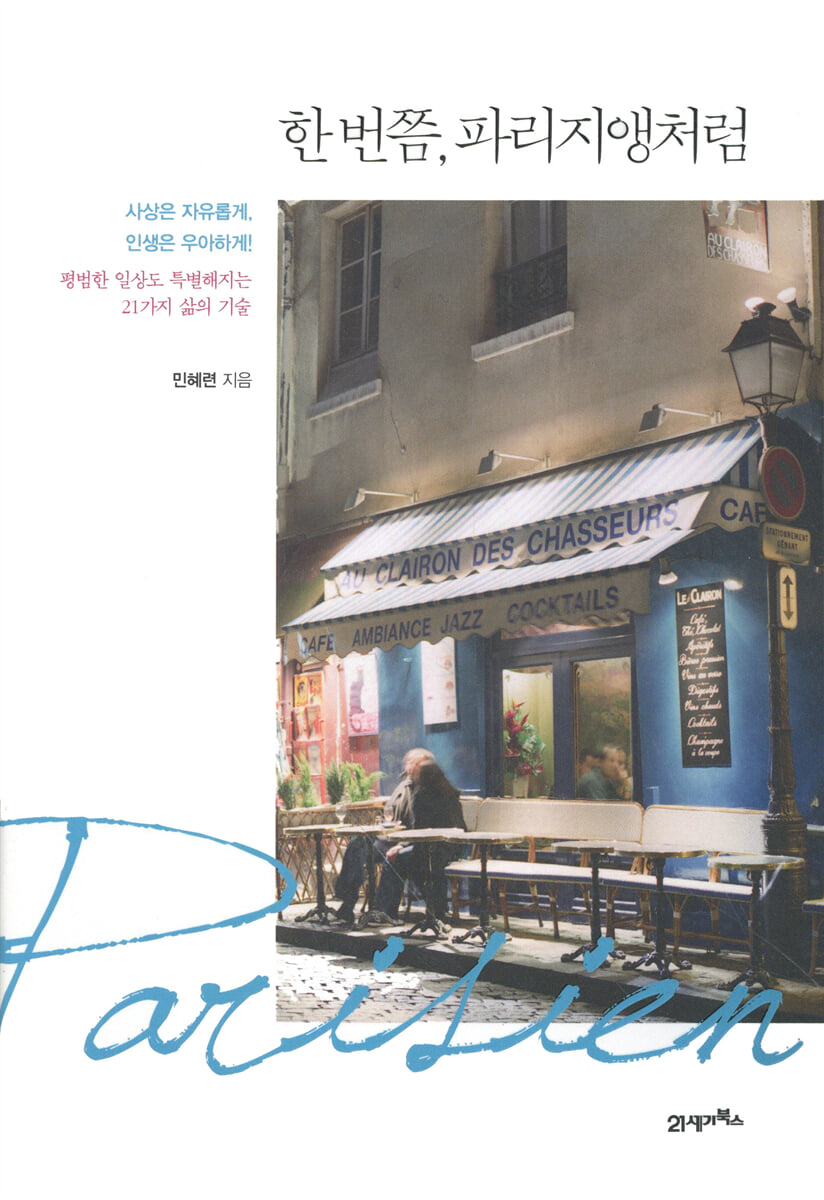
Once in a while, like a Parisian
 |
Description
Book Introduction
Think freely, live gracefully!
Everything Parisians Who Turn Everyday Life into Art
Paris is visited by countless travelers, and it is also admired by those who are sensitive to fashion and trends.
French cuisine has been recognized as a world cultural heritage, and its status is still evident, and in many famous art museums in Paris, the works of immortal artists still live on, transcending time and space.
Paris is a city that leads cutting-edge trends, but at the same time preserves centuries of cultural heritage.
And the Parisians who live there have a philosophy of life that is free in thought and knows how to live elegantly.
This is why Paris and Parisians are so fascinating.
This is because it has a cultural and spiritual depth that turns even ordinary daily life into ‘art.’
So many people dream of living the Parisian life 'at least once'.
This book is a travel essay that explores the elegant philosophy of life pursued by Parisians through 21 themes.
By examining the origins of the unique and fascinating ideas of Parisians through various humanistic foundations and finding ways to apply them to our own lives, this book offers readers a free and relaxed approach to life.
The author, a self-proclaimed expert on French culture, lived as a Parisian for over ten years while studying abroad in France, deeply embracing the French people's free-thinking and refined philosophy of life.
And by capturing the lifestyles they experienced there in this book, we are able to share with you ways to make our lives special and wonderful.
Everything Parisians Who Turn Everyday Life into Art
Paris is visited by countless travelers, and it is also admired by those who are sensitive to fashion and trends.
French cuisine has been recognized as a world cultural heritage, and its status is still evident, and in many famous art museums in Paris, the works of immortal artists still live on, transcending time and space.
Paris is a city that leads cutting-edge trends, but at the same time preserves centuries of cultural heritage.
And the Parisians who live there have a philosophy of life that is free in thought and knows how to live elegantly.
This is why Paris and Parisians are so fascinating.
This is because it has a cultural and spiritual depth that turns even ordinary daily life into ‘art.’
So many people dream of living the Parisian life 'at least once'.
This book is a travel essay that explores the elegant philosophy of life pursued by Parisians through 21 themes.
By examining the origins of the unique and fascinating ideas of Parisians through various humanistic foundations and finding ways to apply them to our own lives, this book offers readers a free and relaxed approach to life.
The author, a self-proclaimed expert on French culture, lived as a Parisian for over ten years while studying abroad in France, deeply embracing the French people's free-thinking and refined philosophy of life.
And by capturing the lifestyles they experienced there in this book, we are able to share with you ways to make our lives special and wonderful.
- You can preview some of the book's contents.
Preview
index
Author's Preface: Like the Parisian life where freedom and dignity coexist
Part 1: People Who Turn Everyday Life into Art
How Parisians Live_ Art de Vivre: The Art of Living
I'm comfortable in my shell_ Bien dans Sa Peau Accepting your body
More sexy because it is unreachable_ Trouver la Bonne Distance The aesthetic distance between beings
Speaking of the quality of life_ Culture
People who led change and innovation_ Gauche Left
At the pinnacle of art and literature, in the middle of it all_ Cafe Cafe
For everything you eat and enjoy_ Amuse-Bouche Mouthful Pleasure
Part 2: Think sexy, live freely
Recognize and respect differences_ Bourgeois
The Greatest Adventure of My Life_ Amour Love
The Power of Education to Create a Trustworthy Society_Education
The completion or end of love_ Mariage
Salon, a cradle of sophisticated expression and passionate discussion
Persona of Pretense and Mystery_ Etiquette
The idea of creating cultural depth_ Tolerance
Part 3: Another Name for Fascination: Paris and the Parisians
Ultimate naturalness_ Chic
There is no fashion in Paris_ Mode Fashion
Why subtle seduction is more appealing_ Femme Fatale
A country where everyone has their own scent_ Parfum
The carefree beauty of the cosmetics powerhouse_ Toilette makeup
The back of luxury_ Luxe luxury
Why Conform_ Liberte
Part 1: People Who Turn Everyday Life into Art
How Parisians Live_ Art de Vivre: The Art of Living
I'm comfortable in my shell_ Bien dans Sa Peau Accepting your body
More sexy because it is unreachable_ Trouver la Bonne Distance The aesthetic distance between beings
Speaking of the quality of life_ Culture
People who led change and innovation_ Gauche Left
At the pinnacle of art and literature, in the middle of it all_ Cafe Cafe
For everything you eat and enjoy_ Amuse-Bouche Mouthful Pleasure
Part 2: Think sexy, live freely
Recognize and respect differences_ Bourgeois
The Greatest Adventure of My Life_ Amour Love
The Power of Education to Create a Trustworthy Society_Education
The completion or end of love_ Mariage
Salon, a cradle of sophisticated expression and passionate discussion
Persona of Pretense and Mystery_ Etiquette
The idea of creating cultural depth_ Tolerance
Part 3: Another Name for Fascination: Paris and the Parisians
Ultimate naturalness_ Chic
There is no fashion in Paris_ Mode Fashion
Why subtle seduction is more appealing_ Femme Fatale
A country where everyone has their own scent_ Parfum
The carefree beauty of the cosmetics powerhouse_ Toilette makeup
The back of luxury_ Luxe luxury
Why Conform_ Liberte
Detailed image
Into the book
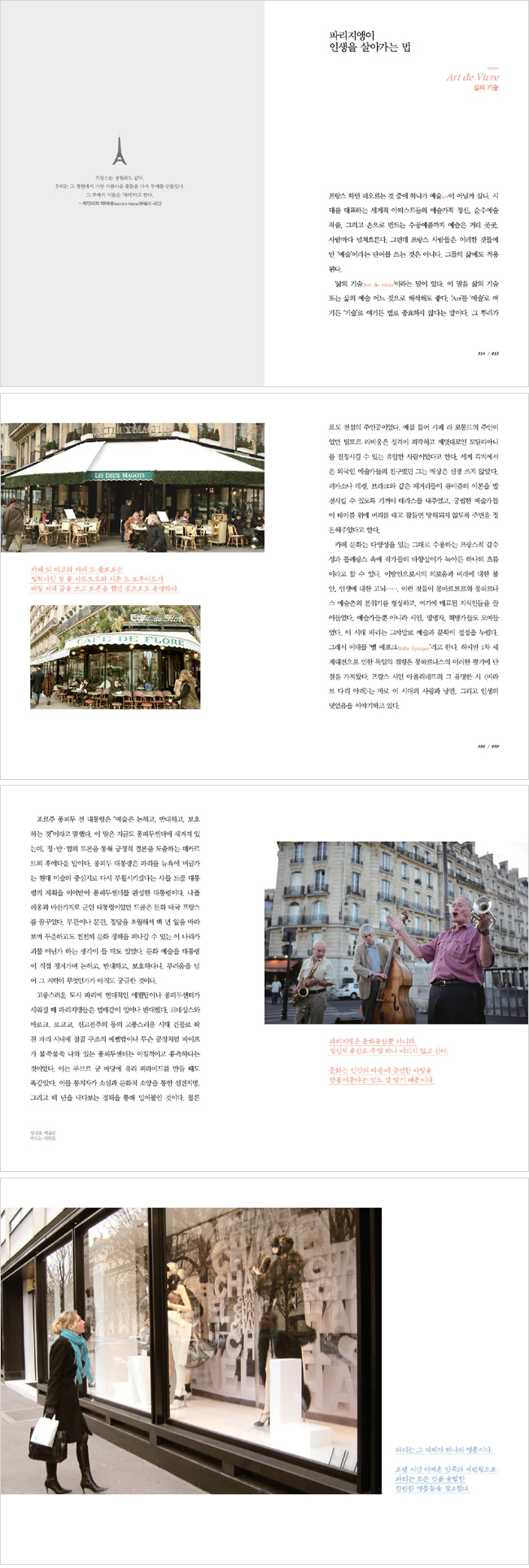
“To discover the world, you must break with your existing, familiar ways of receiving things,” said the French modern philosopher Maurice Merleau-Ponty.
I don't think there are any words that condense Paris into this.
Familiarity is comfort, but lacks passion.
Paris has been able to accumulate cultural power over such splendid centuries because it has always been willing to abandon the familiar and embrace adventure.
So, when anyone comes here, they discover another side of themselves that they had suppressed, and they become artists.
This city leaves no room for human imagination.
(5~6p)
Compared to American culture, which values results and is materialistic but also obsessed with visible moral frameworks, French culture values process over results, and while no one dislikes material things, it values spiritual values more highly.
Also, it values the private sphere before considering the morality revealed in visible actions.
So even if the president committed adultery, the first thing to consider is whether he is excellent at his duties as president, rather than the fact that he committed adultery.
I think that since adultery is a private matter, we cannot criticize it outright.
(18~19p)
There is a saying in French, 'bien dans sa peau'.
In Korean, it means 'fitting well into one's own shell', and when you see this expression, you can see why French is the most accurate language in the world and has been in the spotlight as a diplomatic language for a long time.
Simply put, this expression, which means 'a comfortable impression', expresses oneself as someone who has digested all of one's own pride and inferiority complex and lives comfortably in this reality, speaking indirectly yet very elegantly to the essence.
(37p)
France is truly rich in cultural heritage inherited from its ancestors, but it also preserves its spiritual heritage without discarding any of it.
And the entire nation and people come forward to protect and study it.
All policies are slow and far-sighted, like a stone bridge that has to be tapped before proceeding.
Cultural policy is even more so.
Because we know that culture and education, like the economy, are not something that emerges overnight, but rather that they shine brighter over time and as generations change.
It is also because we know that, unlike the easily shaken economy, culture provides a solid foundation for the human mind.
The French know all too well that they are now reaping the benefits of a cultural policy that began in the 17th century.
(57p)
If I were to interpret the stages of French sociological and psychological development from a Freudian perspective, I would say that France is a 'oral miracle' culture.
No, Paris itself is like one giant mouth.
French culture was created by pleasing the mouth of Paris.
The splendid aristocratic culture of the 17th and 18th centuries, and the common people's desires for the past century that erupted with the revolution, gave birth to France's cultural gluttony in the 19th and 20th centuries.
20th century Paris was truly the height of the nineties.
The 'bouche' called Paris has welcomed artists and writers hungry for diversity from all over the world.
I ate it all at once, savoring the taste.
(102p)
I 100% understand and sympathize with why former President Charles de Gaulle, who dreamed of the best France ever, said, “I love France, but I hate the French.”
It is because of the French people's debate culture.
The French people insist on their opinions to the end.
I can never win an argument with the French.
I love their culture, but when it comes to debating a topic, I don't think I can win against someone who is not accustomed to debate culture like me and comes from a culture that learns to go with the flow by saying that good things are good.
No, there is no room to even interfere, let alone win.
So, our way of being polite to others through silence and just enduring things that don't suit us often doesn't have much meaning in French society.
(p. 177~178)
France's modern history has been achieved under the slogan of 'liberty and equality.'
Perhaps no one embodied the spirit of tolerance better than Voltaire, the great thinker of our time.
“I don’t agree with what you’re saying, but I’ll fight to make sure you have the right to say it.” Because this country was artificially built on this kind of thinking, the idea that if your own thoughts are valuable, then others’ thoughts are also valuable has taken hold, despite the various different opinions among the members of society.
The tolerance at that time was one that was achieved under the proud sense of superiority of a great France, the world's greatest cultural power.
(200p)
As France emerged from the heavy burden of the Middle Ages, the roles of women, such as queens, concubines, and noblewomen, were emphasized.
Moreover, the tradition of salon culture, where women managed and influenced the intellectual men of the capital, remains intact.
An intellectual people who like to talk and discuss are, above all, fascinated by the pleasure of 'conversation'.
The focus is on the coquetry of language and the allure of wordplay.
As a result, to speak well, you need to know a lot, and if you don't have charm, you can't have a long conversation.
French chic naturally incorporates the image of a 'tea girl' with intellect.
Although some people are naturally reserved, the French enjoy intellectual entertainment.
And the essence of French chic is that if you can't share that intellectual play, it soon loses interest.
(p. 220-221)
The French femme fatale is a different type from the voluptuous and sassy blonde beauty.
French women are generally elegant.
Even though it is sensual, it does not lose its elegance.
That was Brigitte Bardot's youth.
There is something invisible that cannot be simply said to be seductive.
There is something mysterious and inexplicable in the seemingly indifferent gestures and attitudes, something that the French call 'Je ne sais quoi'.
Femininity may not come from what is visible and tangible, but rather from the invisible.
I think femininity comes from naturalness.
Confidence, a sense of humor, determination and a sense of adventure—these are the fundamental building blocks that make up the jeunessequoia that so many women yearn for.
Even if you go to the most expensive store, buy the most expensive clothes, and have the most gorgeous manicure, if you don't have the confidence to wear them, no matter how good they are, they lose their value.
(p. 248~249)
I don't think there are any words that condense Paris into this.
Familiarity is comfort, but lacks passion.
Paris has been able to accumulate cultural power over such splendid centuries because it has always been willing to abandon the familiar and embrace adventure.
So, when anyone comes here, they discover another side of themselves that they had suppressed, and they become artists.
This city leaves no room for human imagination.
(5~6p)
Compared to American culture, which values results and is materialistic but also obsessed with visible moral frameworks, French culture values process over results, and while no one dislikes material things, it values spiritual values more highly.
Also, it values the private sphere before considering the morality revealed in visible actions.
So even if the president committed adultery, the first thing to consider is whether he is excellent at his duties as president, rather than the fact that he committed adultery.
I think that since adultery is a private matter, we cannot criticize it outright.
(18~19p)
There is a saying in French, 'bien dans sa peau'.
In Korean, it means 'fitting well into one's own shell', and when you see this expression, you can see why French is the most accurate language in the world and has been in the spotlight as a diplomatic language for a long time.
Simply put, this expression, which means 'a comfortable impression', expresses oneself as someone who has digested all of one's own pride and inferiority complex and lives comfortably in this reality, speaking indirectly yet very elegantly to the essence.
(37p)
France is truly rich in cultural heritage inherited from its ancestors, but it also preserves its spiritual heritage without discarding any of it.
And the entire nation and people come forward to protect and study it.
All policies are slow and far-sighted, like a stone bridge that has to be tapped before proceeding.
Cultural policy is even more so.
Because we know that culture and education, like the economy, are not something that emerges overnight, but rather that they shine brighter over time and as generations change.
It is also because we know that, unlike the easily shaken economy, culture provides a solid foundation for the human mind.
The French know all too well that they are now reaping the benefits of a cultural policy that began in the 17th century.
(57p)
If I were to interpret the stages of French sociological and psychological development from a Freudian perspective, I would say that France is a 'oral miracle' culture.
No, Paris itself is like one giant mouth.
French culture was created by pleasing the mouth of Paris.
The splendid aristocratic culture of the 17th and 18th centuries, and the common people's desires for the past century that erupted with the revolution, gave birth to France's cultural gluttony in the 19th and 20th centuries.
20th century Paris was truly the height of the nineties.
The 'bouche' called Paris has welcomed artists and writers hungry for diversity from all over the world.
I ate it all at once, savoring the taste.
(102p)
I 100% understand and sympathize with why former President Charles de Gaulle, who dreamed of the best France ever, said, “I love France, but I hate the French.”
It is because of the French people's debate culture.
The French people insist on their opinions to the end.
I can never win an argument with the French.
I love their culture, but when it comes to debating a topic, I don't think I can win against someone who is not accustomed to debate culture like me and comes from a culture that learns to go with the flow by saying that good things are good.
No, there is no room to even interfere, let alone win.
So, our way of being polite to others through silence and just enduring things that don't suit us often doesn't have much meaning in French society.
(p. 177~178)
France's modern history has been achieved under the slogan of 'liberty and equality.'
Perhaps no one embodied the spirit of tolerance better than Voltaire, the great thinker of our time.
“I don’t agree with what you’re saying, but I’ll fight to make sure you have the right to say it.” Because this country was artificially built on this kind of thinking, the idea that if your own thoughts are valuable, then others’ thoughts are also valuable has taken hold, despite the various different opinions among the members of society.
The tolerance at that time was one that was achieved under the proud sense of superiority of a great France, the world's greatest cultural power.
(200p)
As France emerged from the heavy burden of the Middle Ages, the roles of women, such as queens, concubines, and noblewomen, were emphasized.
Moreover, the tradition of salon culture, where women managed and influenced the intellectual men of the capital, remains intact.
An intellectual people who like to talk and discuss are, above all, fascinated by the pleasure of 'conversation'.
The focus is on the coquetry of language and the allure of wordplay.
As a result, to speak well, you need to know a lot, and if you don't have charm, you can't have a long conversation.
French chic naturally incorporates the image of a 'tea girl' with intellect.
Although some people are naturally reserved, the French enjoy intellectual entertainment.
And the essence of French chic is that if you can't share that intellectual play, it soon loses interest.
(p. 220-221)
The French femme fatale is a different type from the voluptuous and sassy blonde beauty.
French women are generally elegant.
Even though it is sensual, it does not lose its elegance.
That was Brigitte Bardot's youth.
There is something invisible that cannot be simply said to be seductive.
There is something mysterious and inexplicable in the seemingly indifferent gestures and attitudes, something that the French call 'Je ne sais quoi'.
Femininity may not come from what is visible and tangible, but rather from the invisible.
I think femininity comes from naturalness.
Confidence, a sense of humor, determination and a sense of adventure—these are the fundamental building blocks that make up the jeunessequoia that so many women yearn for.
Even if you go to the most expensive store, buy the most expensive clothes, and have the most gorgeous manicure, if you don't have the confidence to wear them, no matter how good they are, they lose their value.
(p. 248~249)
---text
Publisher's Review
A peek into 21 'words of life' chosen by Parisians.
A cheeky stroll through Paris, alive with culture and art!
This book explains the philosophy of elegant life pursued by Parisians in 21 words.
Through themes representing France and Parisians, such as Art de Vivre, Amuse-Bouche, Tolerance, Chic, and Femme Fatale, the author portrays French culture and thought, which he personally experienced and studied, with humanistic depth.
This book will also instantly satisfy your longing and desire for Paris through its many photographs that capture the charm of Paris.
Part 1, "People Who Turn Everyday Life into Art," introduces the ways Parisians live their lives beautifully, including the French life skills that create valuable daily lives, the aesthetics of relationships with oneself and others, the values that coexist with the quality and pleasure of life, and enjoying cafes that become Parisian oases in the midst of art and literature.
Part 2, "Thoughts Sexy, Life Free," explores the background that allowed the French to develop a mature consciousness from a historical perspective, including the spirit of "tolerance" armed with diversity and tolerance, the story of love, which is the greatest adventure in life and an indispensable thing for the French, the secret of thought that creates cultural depth, and the power of education that created a trustworthy society.
In Part 3, 'Another Name for Fascination, Paris and Parisians', you can learn about the charm and power of Parisians who created present-day France, such as the 'chic' of Parisians who are not interested in trends and luxury goods but know how to express their own individuality most naturally, the femme fatale appearance of French women who are synonymous with cold but subtle seduction, the reason why cosmetics and perfume were worshipped at the Court of Versailles, and the fierce history of the French people until they seized freedom and equality.
Now, readers will be able to experience the life of Parisians vividly and deeply through this book, and through the valuable daily life and mature values they demonstrate, they will be able to create a life where freedom and leisure coexist.
A cheeky stroll through Paris, alive with culture and art!
This book explains the philosophy of elegant life pursued by Parisians in 21 words.
Through themes representing France and Parisians, such as Art de Vivre, Amuse-Bouche, Tolerance, Chic, and Femme Fatale, the author portrays French culture and thought, which he personally experienced and studied, with humanistic depth.
This book will also instantly satisfy your longing and desire for Paris through its many photographs that capture the charm of Paris.
Part 1, "People Who Turn Everyday Life into Art," introduces the ways Parisians live their lives beautifully, including the French life skills that create valuable daily lives, the aesthetics of relationships with oneself and others, the values that coexist with the quality and pleasure of life, and enjoying cafes that become Parisian oases in the midst of art and literature.
Part 2, "Thoughts Sexy, Life Free," explores the background that allowed the French to develop a mature consciousness from a historical perspective, including the spirit of "tolerance" armed with diversity and tolerance, the story of love, which is the greatest adventure in life and an indispensable thing for the French, the secret of thought that creates cultural depth, and the power of education that created a trustworthy society.
In Part 3, 'Another Name for Fascination, Paris and Parisians', you can learn about the charm and power of Parisians who created present-day France, such as the 'chic' of Parisians who are not interested in trends and luxury goods but know how to express their own individuality most naturally, the femme fatale appearance of French women who are synonymous with cold but subtle seduction, the reason why cosmetics and perfume were worshipped at the Court of Versailles, and the fierce history of the French people until they seized freedom and equality.
Now, readers will be able to experience the life of Parisians vividly and deeply through this book, and through the valuable daily life and mature values they demonstrate, they will be able to create a life where freedom and leisure coexist.
GOODS SPECIFICS
- Date of issue: June 9, 2014
- Page count, weight, size: 304 pages | 486g | 140*205*19mm
- ISBN13: 9788950956073
- ISBN10: 8950956071
You may also like
카테고리
korean


korean

![GQ KOREA Mark (Monthly): December [2025]](http://librairie.coreenne.fr/cdn/shop/files/8ef265dbbfbf186523ed75ba7319009d.jpg?v=1765340328&width=3840)


