

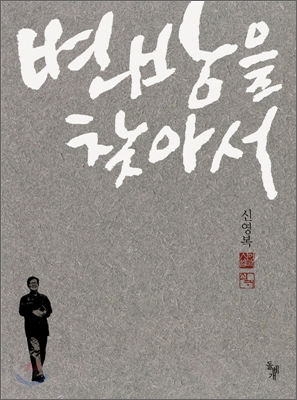
In search of the frontier
 |
Description
Book Introduction
|
A journey to discover a new creative space, the "frontier."
Waiting for the birth of the reader Mr. Shin Young-bok personally visited the places where his own writings were found and compiled a collection of writings that explain the origins of the writings, their meanings, and various stories related to the writings. We visited eight places in total, starting with the Seojeong Branch School in Haenam’s Land’s End Village, the Heo Gyun and Heo Nanseolheon Memorial Hall in Gangneung, Bakdaljae in Jecheon, North Chungcheong Province, the Hong Myeong-hui Literature Monument and Birthplace in Goesan, North Chungcheong Province, Sangwonsa Temple in Odaesan, the Jeonju Lee Se-jong Memorial Monument and General Kim Gae-nam Memorial Monument, the Seoul Mayor’s Office where the work “Seoul” hangs, and Bongha Village in South Gyeongsang Province where a small monument to the late President Roh Moo-hyun stands. Since most of the teacher's writing was in the outskirts, the title of the book naturally became 'In Search of the Outskirts'. The 'periphery' referred to here is geographically far from the center, and its character is not a space dominated by mainstream discourse. However, the border should not be read as simply meaning the periphery. Because the periphery is a space of creation and a passionate center that will usher in a new history. The 'frontier' discussed in the book does not refer to the region that stands at the opposite end of the Republic of Seoul. The remoteness found in the Seoul Metropolitan Government's office, in the heart of Seoul, speaks volumes. It is also true that the center and the periphery are not divided by the dichotomous thinking of conservative and progressive, left and right. The 'frontier' referred to in this book is a truly creative space without complexes. The dichotomous thinking of conservative and progressive, left and right, may be a complex that we cannot shake off. The baseless sense of superiority toward Southeast Asian migrant workers and the inferiority complex toward white people and the English they use are complexes we cannot shake off. In this book, Professor Shin Young-bok speaks of how we can shake off these complexes and become a true "frontier" that will create a new history. * index In search of the frontier, at the beginning of the book
Dreams are something you keep in your heart. Haenam Songji Elementary School, Seojeong Branch The Heo Gyun and Heo Nanseolheon Memorial Hall in Gangneung, a Code We Must Continue to Call to Our Times The tragic pathos of the sorrow of Tong-an Park Dal-jae Reading Im Kkeokjeong through a Postmodern Reading Method: Hong Myeong-hui's Literary Monument and Birthplace Wisdom, Discord with the Times, Sangwonsa Temple, Odaesan Mountain In front of the deaths that became the flowers of history, the Jeonju Lee Se-jong Memorial Monument and General Kim Gae-nam Memorial Monument The Joys and Sorrows of the People: "Seoul" from the Office of Mayor Han Kang-soo of Seoul Metropolitan City The grave of the late President Roh Moo-hyun in Bongha Village, a creative space resolving to begin anew. Detailed image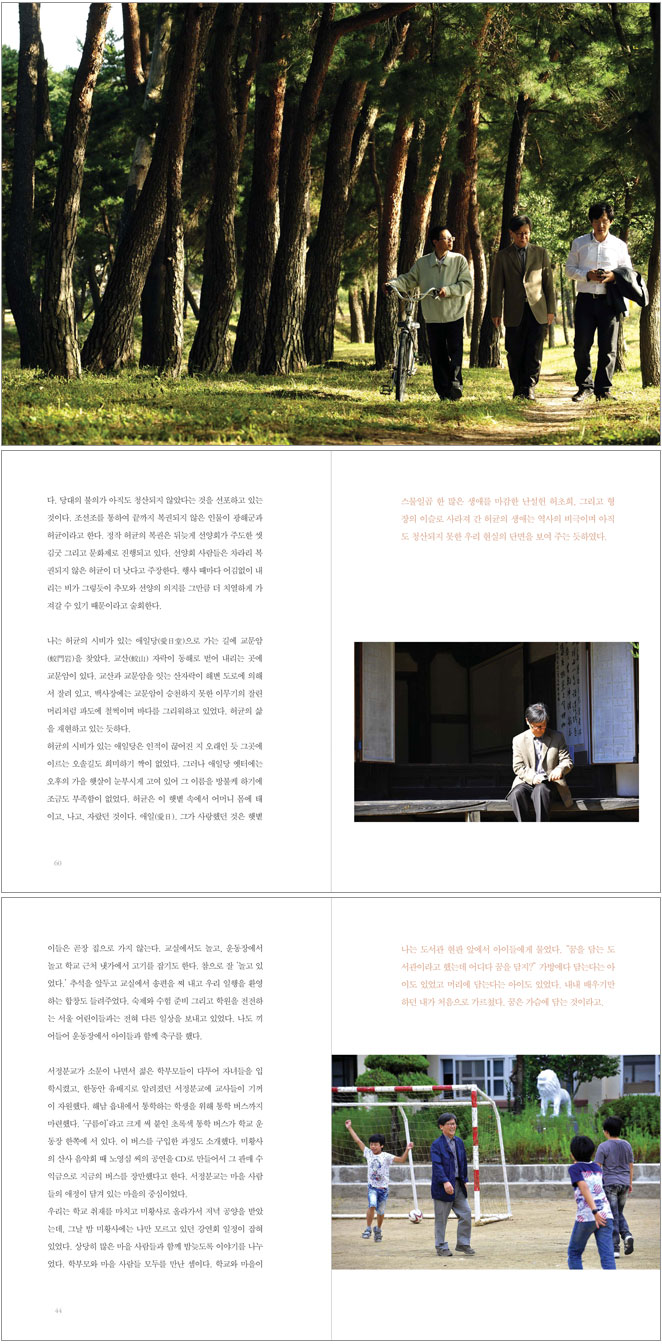 Publisher's Review A journey to discover a new creative space, the "frontier."
Waiting for the birth of the reader This book is a collection of writings written by Shin Young-bok, who personally visited the places where his own writings were found, and explained the origins of the writings, their meanings, and various stories related to them. We visited eight places in total, starting with the Seojeong Branch School in Haenam’s Land’s End Village, the Heo Gyun and Heo Nanseolheon Memorial Hall in Gangneung, Bakdaljae in Jecheon, North Chungcheong Province, the Hong Myeong-hui Literature Monument and Birthplace in Goesan, North Chungcheong Province, Sangwonsa Temple in Odaesan, the Jeonju Lee Se-jong Memorial Monument and General Kim Gae-nam Memorial Monument, the Seoul Mayor’s Office where the work “Seoul” hangs, and Bongha Village in South Gyeongsang Province where a small monument to the late President Roh Moo-hyun stands. Since most of the teacher's writing was in the outskirts, the title of the book naturally became 'In Search of the Outskirts'. The 'periphery' referred to here is geographically far from the center, and its character is not a space dominated by mainstream discourse. However, the border should not be read as simply meaning the periphery. Because the periphery is a space of creation and a passionate center that will usher in a new history. To advance to the center of the next era and the next civilization, thorough frontierism is required. We will explore this possibility in the eight 'frontiers' introduced in this book. And through eight short pieces, we await the birth of new readers who can break away from the context. Human history begins in the 'periphery' Throughout the history of human civilization, the periphery has always become the center of new history. From Greece and Rome on the periphery of the Orient, to the Habsburgs and Byzantines on the periphery of Greece and Rome, to the Netherlands and Britain, which marked the beginning of modern history, and even to the British colony of the United States, the history of human civilization is one in which its center has constantly moved from one periphery to another. People who have become historical figures also lived lives on the outskirts. Such was the life of Mahatma Gandhi, such was the life of Confucius. Joseon's Yi Seong-gye was also a frontiersman. Countless figures have moved from the periphery to the center of history. The importance of 'frontier' lies here. The driving force and potential to change and develop society lies right here on the periphery. A vibrant frontier is the focal point that can transform a society into a better one, into a more advanced history. New history always begins in the ‘periphery.’ The 'frontier' is change and communication, and change and communication are the forces that sustain life. The 'periphery' referred to here is not simply a spatial concept. The frontier should be understood in the sense of ‘frontierness’ and ‘frontier consciousness.’ That is, marginalizing oneself. Even though I am currently located at the center of a certain market, I need to internalize a sense of periphery. The core of 'Frontier' is change and communication. Only through reflection through the consciousness of the frontier and through constant change and communication can we exist as living beings. That is, life does not lose its vitality only while it observes and reflects on itself, that is, only while it is being renewed. A living tree blooms, bears fruit, and continues to change. A tree that does not change is a dead tree. This is true for individual living beings, as well as for groups, nations, and civilizations. Stagnant and dogmatic groups, nations, and civilizations cannot advance toward a new history or a new civilization. This has been proven throughout the history of human civilization. Joseon harbored a persistent complex about China, and as a result, it solidified a system of lesser China that was more Sinocentric than mainland China. During the imperialist era, Joseon was unable to think of a wider world beyond China, and was forced to become a frog in a well, completely exposed to imperialist invasion. In addition, the dogmatic Neo-Confucianism of the Sarim (士林) was unable to accept new ideas, and Neo-Confucianism has now become a dead discipline with only a name remaining. That is, without a consciousness of the frontier, there can be no further change or communication, and life cannot be sustained. Stand on the periphery, stand in the minority's shoes! In the vast universe, the status of humans can only be that of a small, marginal being, no matter when or where. For an individual or group, a small entity on the periphery, to have vitality and develop, they must possess a periphery-like nature and periphery consciousness that can communicate with change. The act of breaking out of the confined frame and constantly moving in search of new territory is the very essence of the frontier. If it is said that only constant change can sustain life, then in order to achieve this change, I must first place myself on the periphery. You have to stand in the position of the minority. The 'periphery' that the author talks about in this book does not refer to the region that stands at the opposite end of the Seoul Republic. The remoteness found in the Seoul Metropolitan Government's office, in the heart of Seoul, speaks volumes. It is also true that the center and the periphery are not divided by the dichotomous thinking of conservative and progressive, left and right. The 'frontier' referred to in this book is a truly creative space without complexes. The dichotomous thinking of conservative and progressive, left and right, may be a complex that we cannot shake off. The baseless sense of superiority toward Southeast Asian migrant workers and the inferiority complex toward white people and the English they use are complexes we cannot shake off. In this book, Professor Shin Young-bok speaks of how we can shake off these complexes and become a true "frontier" that will create a new history. A journey to discover the frontier First destination: Songji Elementary School, Seojeong Branch, Haenam Land's End Village A sign reading “Library of Dreams” hangs in the library of Songji Elementary School’s Seojeong Branch, a village at the southernmost tip of Korea. The author said that he wrote the signboard while imagining a picture of children huddled together and reading books in a small library in the outskirts. I went there thinking it was a rural branch school in a backward rural area, but surprisingly, it was a lively place where children ran around to their hearts' content under the bright sunlight. This rural branch school, which was on the verge of closure, is now considered a successful example of a branch school, with young parents competing to enroll their children there, thanks to the efforts of parents and residents. The author believes that Seongjeong Branch School, which demonstrates the potential of rural branch schools, may be the very dream of children in Seoul. Second destination: Heo Gyun and Heo Nanseolheon Memorial Hall in Gangneung The Heo Gyun and Heo Nanseolheon Memorial Hall is located in Chodang-dong, the lowest point in the Yeongdong region east of Daegwallyeong. This memorial hall has a plaque engraved with bamboo on a flat surface that reads, “Heo Gyun? Heo Nanseolheon Memorial Hall.” Heo Gyun, the author of “The Story of Hong Gildong,” was executed for treason, just like Hong Gildong, a hero of the people who failed to become part of the mainstream of his time. Also, his older sister, Heo Nanseolheon, was born with outstanding literary talent, but she regretted being born a woman and died young at the age of twenty-seven. The caste system of discrimination against illegitimate children, as Heo Gyun showed in “The Story of Hong Gildong,” has now disappeared, but its place has been replaced by various modern difficulties such as regional discrimination, polarization, the problem of foreign workers, and multicultural families. While the relics of Yulgok Yi I and Shin Saimdang at Ojukheon in Gangneung have been turned into sacred sites, Heo Gyun and Heo Nanseolheon are still in the outskirts. However, Heo Gyun's theory of serving the people and Heo Nanseolheon's spirit of freedom are still valid in this day and age. Third destination: Bakdaljae At Bakdaljae in Jecheon, North Chungcheong Province, there are two gates with signs reading “Bakdaljae.” Bakdaljae Pass is the place where the sad love story of Geumbong and Bakdal is told as a legend. Bakdal, who failed the civil service exam, is too ashamed to return, and Geumbong, who is tired of waiting, commits suicide by throwing herself off a cliff. And Bakdal, who returned late, also falls off a cliff and dies while chasing Geumbong. In modern society, it is difficult to find a passionate love like the one in the story of Bakdal and Geumbong. In this miserable reality where slang like 'Itaebaek' and 'Saohjeong' are rampant, millions of irregular workers are being created, and 42 people commit suicide every day, we are armed with cold emotions. Modern people are unable to properly experience pain. Although it is now a pass with few visitors due to the tunnel, the author hopes that many people will visit this Bakdaljae Pass and honestly face their pain. Fourth destination: Byeokcho Hong Myeong-hee's literary monument and birthplace The Hong Myeong-hee Literature Monument stands shabbily at the edge of the pension parking lot. It seems to show the image of Byeokcho, which has not been properly illuminated in the midst of the stubborn anti-communist logic of Korean society. However, there is no room for argument about the novel 『Im Kkeok-jeong』. Therefore, Byeokcho's 'literary monument' transcends all criticism about him. It is a common opinion in the literary world that there is no historical novel that surpasses the novel 『Im Kkeok-jeong』, and as engraved on the epitaph, 『Im Kkeok-jeong』 is ‘a work that is consistent with the sentiments of Joseon.’ The illegal and violent images of the socially disadvantaged, including Im Kkeok-jeong, are sometimes interpreted as aspects of the 'strong'. While the mainstream ideology that creates such an image is true, we must not be indifferent to the response methods that the socially disadvantaged have no choice but to choose in order to maintain a minimum standard of living. We must not forget that the socially weak use hypocrisy as their main weapon, while the socially strong use hypocrisy as their main weapon. The noise at the protest site and the silence in the courtroom are also examples of this. Cheongseokgol, the stronghold of the seven leaders including Im Kkeok-jeong, is a refuge for the socially disadvantaged, but at the same time, it is a space of freedom and creativity. Fifth destination: Sangwonsa Temple, Odaesan Mountain At the entrance to Sangwonsa Temple in Odaesan, there is a stone tablet written by the author, and a signboard reading “Munjujeon” hangs in the main hall, Munjujeon. The author is said to have pondered for more than a month over how to write the text for the Manjusri Hall, which houses Manjusri Bodhisattva, the Bodhisattva of Wisdom. After much thought, he connected the three characters and wrote them together. It is said that this represents the world of 'Won-Yong' (圓融) where all principles of law are gathered into one, rather than 'Bun' (分) and 'Seok' (析). The theory of dependent origination (緣起論) in Buddhism and the theory of relationships (關係論) that the author talks about are probably exactly like this. Finding meaning in the periphery was difficult in a temple of the Jogye Order, the largest Buddhist order in Korea. How can we weave ‘frontier’ into ‘wisdom’, the world of enlightenment? The author says that these concerns naturally disappeared in the field. The Buddhists who had come to the mountain temple with their old people soon resembled the mountain itself, and their eyes were all fixed on their own inner selves. It was a look that was not found in Seoul. In modern society, where you cannot survive without becoming a commodity, 'wisdom' and 'non-possession' paradoxically survive without becoming a commodity, revealing the illusion of the commodity. The author says that this is the wisdom of the frontier. The author was forced to reconsider the concept of the frontier during his trip to visit Sangwonsa Temple in Odaesan Mountain. The frontier is not a concept of space, but rather human life itself is a frontier existence, and the frontier is self-reflection. Sixth destination: Jeonju Lee Se-jong Memorial and General Kim Gae-nam Memorial The places where the author's handwriting is most abundant are probably the tombstones of democratic martyrs and memorial stones at universities. There are many tombstones in Seoul that the author has written, but the reason I went all the way to Jeonju is because of the earnest voices contained in the tombstones of Martyr Lee Se-jong and General Kim Gae-nam. Human voices can be heard at the memorial to martyr Lee Se-jong, who said, “I want to live again and see the sky,” and at the tombstone of General Kim Gae-nam, who said, “Gaenam-ah, Gaenam-ah, Kim Gae-nam-ah.” Historical figures become historical education itself, completely eliminating the joys and sorrows of individual lives and highlighting only historical causes. But can a cause that has been stripped of human sorrow truly convey human emotion? The author emphasizes that all education must be human education. The memorial to Martyr Lee Se-jong and General Kim Gae-nam is a living educational site steeped in human joys and sorrows. Seventh Destination: "Seoul" at the Seoul Metropolitan Government Mayor's Office The most unlikely travel destination for a trip to the outskirts might be the Seoul Metropolitan Government's mayor's office. The author's work "Seoul" hangs here. This work expresses ‘Seo’ and ‘Ul’ as Bukaksan Mountain and the Han River respectively, and interprets the phrase “Bukak Musim Ocheonnyeon (北岳無心五千年) and Hansu Yujeong Chilbaekri (漢水有情七百里)” in a classical Korean script. Bukak symbolizes the dynasty's power, and Hansu symbolizes the joys and sorrows of the common people. If the mayor's office, which houses the heads of 10 million Seoul citizens, is called a remote area, it could be perceived as a sign of demotion. However, Seoul Mayor Park Won-soon readily accepts this meaning of 'periphery'. He also confesses that he is from the periphery and that history is a process in which the periphery moves into the center. And the city of Seoul also expressed its intention to actively introduce the experience of the civic movement, a frontier space, into its administration. The author believes that Seoul City Hall should be a periphery of our time, like the Han River, rather than a center of power, a river that flows and embraces the lives of its citizens. Eighth destination: Bongha Village, the grave of the late President Roh Moo-hyun The final destination of the journey to the frontier is Bongha Village, Bonsan-ri, Jinyeong-eup, Gimhae-si, Gyeongsangnam-do, where the grave of the late President Roh Moo-hyun is located. It is a perfect remote area, a five-hour drive from Seoul without stopping. This remote and small rural village now attracts over a million visitors annually. This is a site that vividly demonstrates the creativity of the frontier. Here, the author's writing is engraved on the steel plate supporting the tombstone. “The last bastion of democracy is the organized power of an awakened citizenry.” In our modern history, Gwangju and Roh Moo-hyun are icons that divide the era. Just as no one is free from the tragedy of Gwangju, no one is free from the death of Roh Moo-hyun. What the 5 million mourners showed was regret for not being able to protect them, and an awakening to the realization of what good politics really is. Bongha Cemetery is a place where the living and the dead meet and a place of leap forward to become a creative space in the frontier. The periphery and the center are never spatial terms. A sober awakening to the old and a bold break from it are the core of frontierism. GOODS SPECIFICS
- Date of publication: May 21, 2012
- Page count, weight, size: 148 pages | 246g | 153*224*20mm
- ISBN13: 9788971994863
- ISBN10: 897199486X
|
You may also like
카테고리
korean


korean

![GQ KOREA Mark (Monthly): December [2025]](http://librairie.coreenne.fr/cdn/shop/files/8ef265dbbfbf186523ed75ba7319009d.jpg?v=1765340328&width=3840)


