

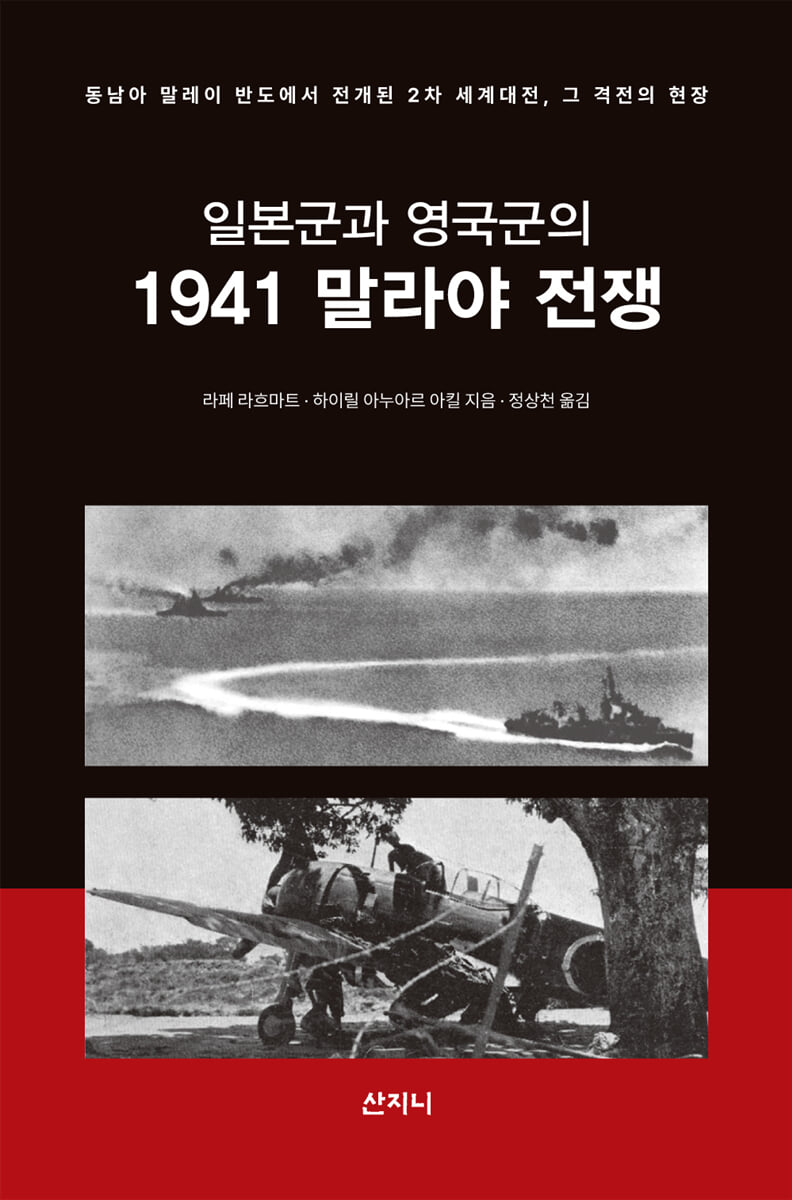
The 1941 Malayan War between Japanese and British forces
 |
Description
Book Introduction
Everything about the military power and tactics that determined the outcome of the war in the Malay Peninsula in 1941.
In 1940, during the height of World War II, Japan launched an invasion of Southeast Asia to gain access to the oil-rich islands of Borneo, Sumatra, and Java.
Since the Malayan region, which comprised the Malay Peninsula and Singapore, was under British rule at the time, Japan's advance into Malaya meant immediate war with the British.
From late 1941 to early 1942, Japan occupied Malaya, and fierce fighting ensued.
However, there are not many records that detail the situation during this period.
『The 1941 Malayan War Between the Japanese and British Forces』 is a book that vividly recreates the clash between the two empires that took place on the Malay Peninsula during World War II.
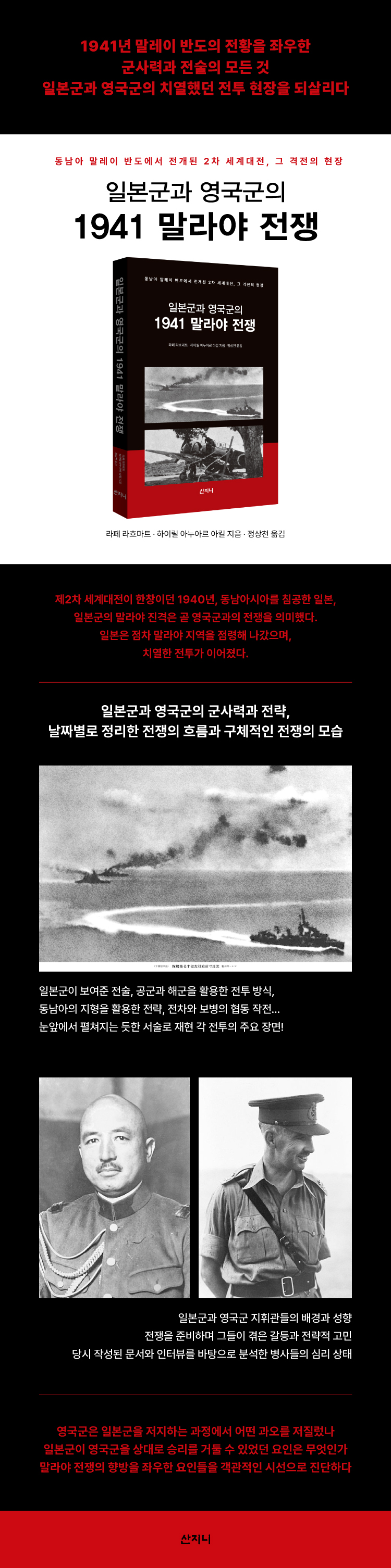
The two authors, who have studied military history for a long time, analyze the military power and strategies of the Japanese and British armies at the time and organize the flow of the war by date to provide readers with a more detailed picture of the situation.
It explores the defensive strategies employed by the British to halt the Japanese advance, the mistakes made in the process, and the factors that enabled the Japanese to achieve victory over the British.
This book will help both military experts and general readers easily understand the factors that influenced the course of the war in Malaya.
In 1940, during the height of World War II, Japan launched an invasion of Southeast Asia to gain access to the oil-rich islands of Borneo, Sumatra, and Java.
Since the Malayan region, which comprised the Malay Peninsula and Singapore, was under British rule at the time, Japan's advance into Malaya meant immediate war with the British.
From late 1941 to early 1942, Japan occupied Malaya, and fierce fighting ensued.
However, there are not many records that detail the situation during this period.
『The 1941 Malayan War Between the Japanese and British Forces』 is a book that vividly recreates the clash between the two empires that took place on the Malay Peninsula during World War II.
The two authors, who have studied military history for a long time, analyze the military power and strategies of the Japanese and British armies at the time and organize the flow of the war by date to provide readers with a more detailed picture of the situation.
It explores the defensive strategies employed by the British to halt the Japanese advance, the mistakes made in the process, and the factors that enabled the Japanese to achieve victory over the British.
This book will help both military experts and general readers easily understand the factors that influenced the course of the war in Malaya.
- You can preview some of the book's contents.
Preview
index
introduction
01 British Army Overview
02 The Meiji Restoration and the Birth of the Japanese Imperial Army
03 Japanese military commanders
04 British Commanders
Sinking of the Prince of Wales and Repulse of the Jet Fleet
Operation Matador 06
07 Crocol
08 Battle of Kota Bharu
09 Battle of Jitra
10 Battle of Kampar
11 Battle of Slim River
12 Battles of Gemas, Muar, and Parit Sulong
13 Battle of Endau
14 Planning flaws
15 Weapon Systems
Translation review
References
01 British Army Overview
02 The Meiji Restoration and the Birth of the Japanese Imperial Army
03 Japanese military commanders
04 British Commanders
Sinking of the Prince of Wales and Repulse of the Jet Fleet
Operation Matador 06
07 Crocol
08 Battle of Kota Bharu
09 Battle of Jitra
10 Battle of Kampar
11 Battle of Slim River
12 Battles of Gemas, Muar, and Parit Sulong
13 Battle of Endau
14 Planning flaws
15 Weapon Systems
Translation review
References
Detailed image
Into the book
Japan occupied French Indochina in 1940-1941, causing bloodshed among the Western powers.
The United States consulted with its allies to impose painful sanctions to prevent Japan from obtaining steel and oil.
The embargo forced Japan to choose between abandoning China and enduring unforgivable humiliation, or continuing its staunch resistance to Western arrogance.
They chose the latter and started a war in the Pacific.
--- p.9~10
Japanese intelligence agents were infiltrated throughout Malaya as dentists, fishermen, merchants, and photographers.
The spy ring's tight network even fooled the British into hiring one of their agents as the official photographer for the Singapore naval base.
(…) Based on his information, the geographical features of Malaya were revealed, and the Japanese were able to plan an attack from the rural areas of Songkhla to the British heartland in Singapore.
The plan was perfect for infantry units with vehicles, and was perfect for dismantling the British public's falsehood that Singapore was invincible.
--- p.33~34
The jet fleet was destroyed by the fierce Japanese attack.
They received no information or air cover from 453 Squadron RAF, which was responsible for providing support.
At 11:58 a.m., in the midst of the battle, 453 Squadron RAF took off from Sembawang Air Base in response to Repulse's distress signal, but it was too late.
Buffalo fighters arrived at 1:18 p.m., only to witness the sinking of the Prince of Wales.
Even more insulting was the fact that the Japanese reconnaissance aircraft evaded detection by the British Air Force.
--- p.77
The Japanese first tied the prisoners to wire and made them walk a short distance across the main road between Muar and Yongfeng, where another bridge was manned by a machine gun unit.
Their story ended there.
Some survived the brutality of automatic weapons, but their hopes for survival were ultimately dashed as the Japanese soldiers doused them with gasoline confiscated from Allied stockpiles and burned them alive.
The corpses of prisoners were piled up and trucks ran over them as if they were doing sports.
Local residents remembered scenes where several prisoners were tied to a bridge.
Some fell down with a bullet in their head, while others fell into the river and died.
--- p.149~150
In September 1940, British Prime Minister Winston Churchill was working hard to protect the Atlantic sea lanes of communication.
War broke out in North Africa, especially in Egypt.
Under pressure, Churchill was forced to support the Soviet Union against Germany.
And now Britain faced Japan in Indochina, with Japanese forces moving closer and closer to Malaya and Singapore.
However, Churchill underestimated this and did not support Malaysia and Singapore.
This was because Japan had not yet taken a threatening stance.
The United States consulted with its allies to impose painful sanctions to prevent Japan from obtaining steel and oil.
The embargo forced Japan to choose between abandoning China and enduring unforgivable humiliation, or continuing its staunch resistance to Western arrogance.
They chose the latter and started a war in the Pacific.
--- p.9~10
Japanese intelligence agents were infiltrated throughout Malaya as dentists, fishermen, merchants, and photographers.
The spy ring's tight network even fooled the British into hiring one of their agents as the official photographer for the Singapore naval base.
(…) Based on his information, the geographical features of Malaya were revealed, and the Japanese were able to plan an attack from the rural areas of Songkhla to the British heartland in Singapore.
The plan was perfect for infantry units with vehicles, and was perfect for dismantling the British public's falsehood that Singapore was invincible.
--- p.33~34
The jet fleet was destroyed by the fierce Japanese attack.
They received no information or air cover from 453 Squadron RAF, which was responsible for providing support.
At 11:58 a.m., in the midst of the battle, 453 Squadron RAF took off from Sembawang Air Base in response to Repulse's distress signal, but it was too late.
Buffalo fighters arrived at 1:18 p.m., only to witness the sinking of the Prince of Wales.
Even more insulting was the fact that the Japanese reconnaissance aircraft evaded detection by the British Air Force.
--- p.77
The Japanese first tied the prisoners to wire and made them walk a short distance across the main road between Muar and Yongfeng, where another bridge was manned by a machine gun unit.
Their story ended there.
Some survived the brutality of automatic weapons, but their hopes for survival were ultimately dashed as the Japanese soldiers doused them with gasoline confiscated from Allied stockpiles and burned them alive.
The corpses of prisoners were piled up and trucks ran over them as if they were doing sports.
Local residents remembered scenes where several prisoners were tied to a bridge.
Some fell down with a bullet in their head, while others fell into the river and died.
--- p.149~150
In September 1940, British Prime Minister Winston Churchill was working hard to protect the Atlantic sea lanes of communication.
War broke out in North Africa, especially in Egypt.
Under pressure, Churchill was forced to support the Soviet Union against Germany.
And now Britain faced Japan in Indochina, with Japanese forces moving closer and closer to Malaya and Singapore.
However, Churchill underestimated this and did not support Malaysia and Singapore.
This was because Japan had not yet taken a threatening stance.
--- p.190
Publisher's Review
Reliving the fierce battle between Japanese and British forces
The book focuses on the major battles fought by Japan before it conquered Malaya.
On December 8, 1941, Japanese forces began their invasion by landing in Kota Bharu, Malaysia.
In just a few days, Japanese forces quickly took control of the Malay Peninsula.
During this process, decisive battles such as the Battle of Kota Bharu, the Battle of Jitra, the Battle of Kampar, the Battle of Slim River, and the Battle of Endau were fought.
The author details the tactics the Japanese army employed in each battle, the combat methods they employed with their air force and navy, the strategies they employed in the jungle terrain of Southeast Asia, and the process of breaking down the Allied defenses through the cooperative operations of tanks and infantry.
The defense efforts of the British, Indian, and Australian forces are also covered in depth, along with Japanese military strategies.
Key scenes from each battle are recreated in a narrative that makes it seem as if they were unfolding before your eyes, from the Indian Army's defensive operations at the Battle of Kampar, to the British Army's humiliating defeat at the Battle of Slim River, to the brutal massacre of British troops by the Japanese during their retreat at Parit Sulong.
The victory or defeat of war and its causes as diagnosed from an objective perspective
How was Japan able to occupy the Malay Peninsula in such a short period of time? The author attributes this to the British military's lack of preparation and the Japanese military's meticulous planning.
Malaya was too far from Britain, and during World War II, Britain prioritized the security of its homeland.
The British government lacked the will to fight in Malaya and did not take war seriously.
It was a strategic mistake to underestimate the capabilities of the Japanese military.
Japan, on the other hand, had a thorough plan to collapse Britain.
The Japanese army received special training to adapt to tropical climates and gathered intelligence directly from the local population of Southeast Asia.
Preparations for tropical diseases and hygiene problems were also thoroughly carried out.
Even the underwater coral reefs that could be a nuisance when landing on the Malay Peninsula were not missed.
The author provides readers with a broad perspective on the Southeast Asian theater of World War II by comparing and analyzing not only the military power of Britain and Japan but also the policy decisions of both countries during the war.
Key figures who led the war and the weapon systems used
Another unique feature of this book is its in-depth analysis of the flow of battle as well as the roles of key Japanese and British commanders and soldiers.
The author introduces the backgrounds and inclinations of the commanders on both sides and examines the conflicts and strategic concerns they faced as they prepared for war.
Additionally, based on documents and interviews written at the time, we analyze the strategies used by soldiers on the actual battlefield and their psychological states during combat.
The weapons used in battle are also covered in detail.
Japan built its fighters with a focus on aerial maneuverability, which allowed it to achieve air superiority.
In contrast, the British military chose the aging Brewster F2A Buffalo as their fighter for the war.
In this way, an analysis of the weapon systems and specifications used during the Malayan War helps readers gain a deeper understanding of the battle.
The book focuses on the major battles fought by Japan before it conquered Malaya.
On December 8, 1941, Japanese forces began their invasion by landing in Kota Bharu, Malaysia.
In just a few days, Japanese forces quickly took control of the Malay Peninsula.
During this process, decisive battles such as the Battle of Kota Bharu, the Battle of Jitra, the Battle of Kampar, the Battle of Slim River, and the Battle of Endau were fought.
The author details the tactics the Japanese army employed in each battle, the combat methods they employed with their air force and navy, the strategies they employed in the jungle terrain of Southeast Asia, and the process of breaking down the Allied defenses through the cooperative operations of tanks and infantry.
The defense efforts of the British, Indian, and Australian forces are also covered in depth, along with Japanese military strategies.
Key scenes from each battle are recreated in a narrative that makes it seem as if they were unfolding before your eyes, from the Indian Army's defensive operations at the Battle of Kampar, to the British Army's humiliating defeat at the Battle of Slim River, to the brutal massacre of British troops by the Japanese during their retreat at Parit Sulong.
The victory or defeat of war and its causes as diagnosed from an objective perspective
How was Japan able to occupy the Malay Peninsula in such a short period of time? The author attributes this to the British military's lack of preparation and the Japanese military's meticulous planning.
Malaya was too far from Britain, and during World War II, Britain prioritized the security of its homeland.
The British government lacked the will to fight in Malaya and did not take war seriously.
It was a strategic mistake to underestimate the capabilities of the Japanese military.
Japan, on the other hand, had a thorough plan to collapse Britain.
The Japanese army received special training to adapt to tropical climates and gathered intelligence directly from the local population of Southeast Asia.
Preparations for tropical diseases and hygiene problems were also thoroughly carried out.
Even the underwater coral reefs that could be a nuisance when landing on the Malay Peninsula were not missed.
The author provides readers with a broad perspective on the Southeast Asian theater of World War II by comparing and analyzing not only the military power of Britain and Japan but also the policy decisions of both countries during the war.
Key figures who led the war and the weapon systems used
Another unique feature of this book is its in-depth analysis of the flow of battle as well as the roles of key Japanese and British commanders and soldiers.
The author introduces the backgrounds and inclinations of the commanders on both sides and examines the conflicts and strategic concerns they faced as they prepared for war.
Additionally, based on documents and interviews written at the time, we analyze the strategies used by soldiers on the actual battlefield and their psychological states during combat.
The weapons used in battle are also covered in detail.
Japan built its fighters with a focus on aerial maneuverability, which allowed it to achieve air superiority.
In contrast, the British military chose the aging Brewster F2A Buffalo as their fighter for the war.
In this way, an analysis of the weapon systems and specifications used during the Malayan War helps readers gain a deeper understanding of the battle.
GOODS SPECIFICS
- Date of issue: April 10, 2025
- Page count, weight, size: 232 pages | 140*212*15mm
- ISBN13: 9791168614574
You may also like
카테고리
korean


korean

![GQ KOREA Mark (Monthly): December [2025]](http://librairie.coreenne.fr/cdn/shop/files/8ef265dbbfbf186523ed75ba7319009d.jpg?v=1765340328&width=3840)


