

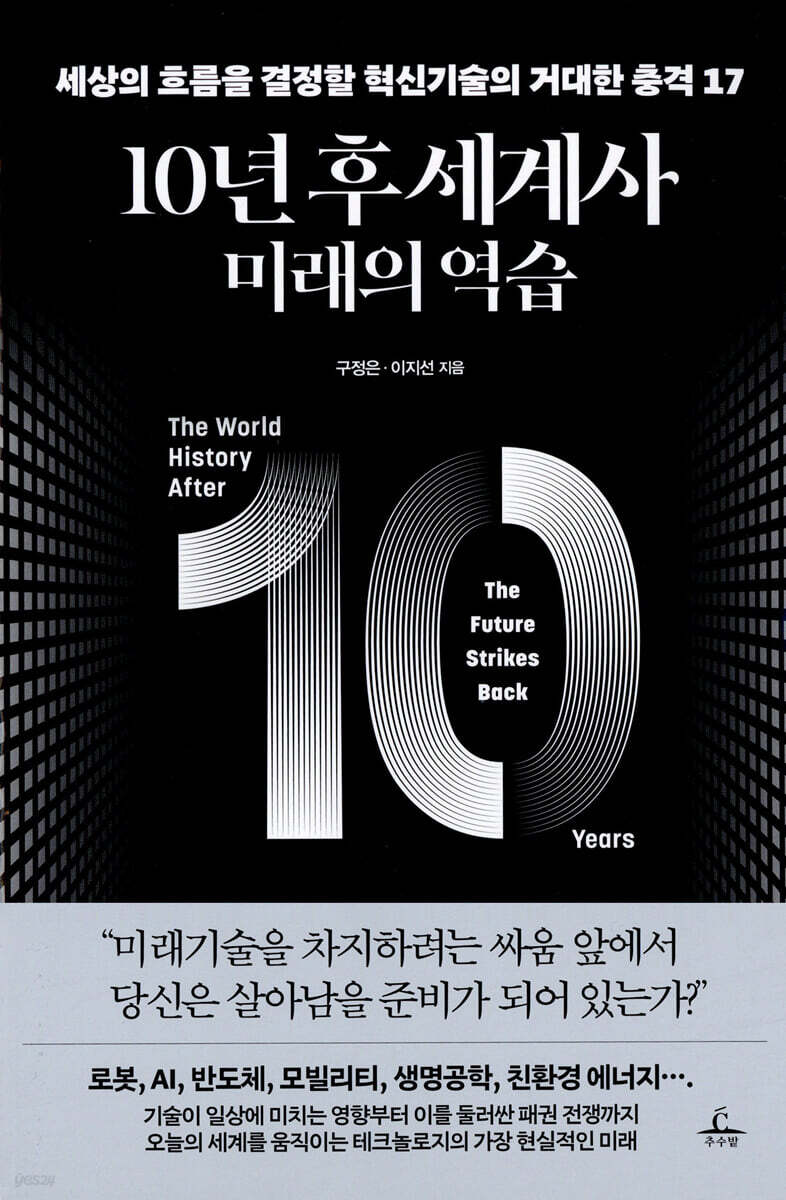
World History 10 Years Later: The Future Strikes Back
 |
Description
Book Introduction
The "World History 10 Years Later" series, which has been highlighting important issues of future society with a sharp perspective since 2015, has returned with its third volume.
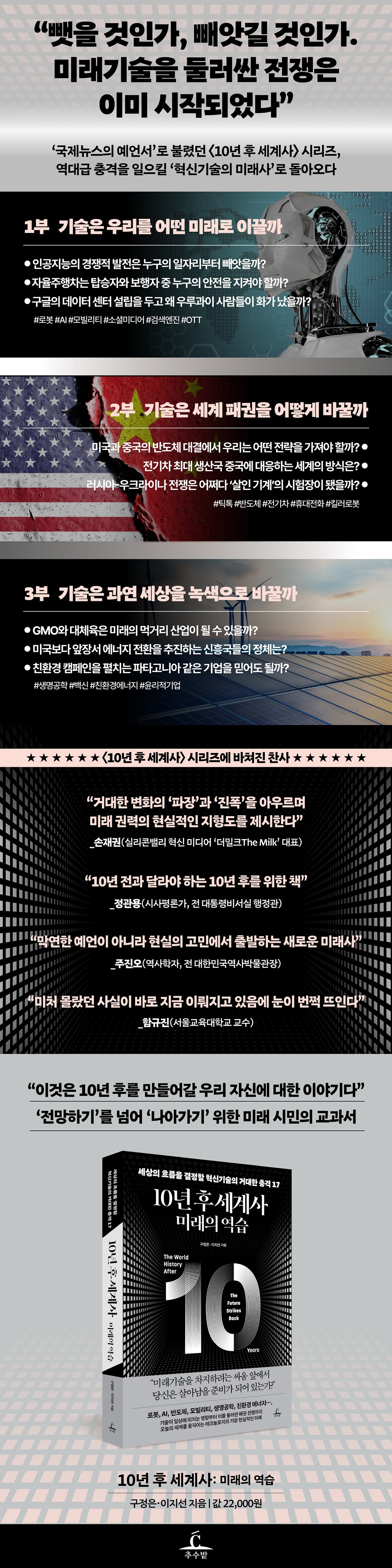
In this book, which showcases the unprecedented impact of innovative technologies such as robotics, AI, semiconductors, and mobility, the authors analyze the latest technological advancements and their multifaceted impact on international affairs, politics, economy, society, and culture, and offer a broad perspective on how global hegemony will evolve in the future.
Part 1 introduces the impact of cutting-edge technologies such as robots and artificial intelligence on our daily lives and the corresponding regulatory measures. Part 2 shows the US-China hegemony competition and the Third World's desire to take the lead in innovative technologies.
Part 3 examines how technology is shaping the way countries address environmental challenges, including climate change.
Each of the 17 chapters is supplemented with smaller issues that supplement each topic, guiding readers toward a more vivid future.
In this book, which showcases the unprecedented impact of innovative technologies such as robotics, AI, semiconductors, and mobility, the authors analyze the latest technological advancements and their multifaceted impact on international affairs, politics, economy, society, and culture, and offer a broad perspective on how global hegemony will evolve in the future.
Part 1 introduces the impact of cutting-edge technologies such as robots and artificial intelligence on our daily lives and the corresponding regulatory measures. Part 2 shows the US-China hegemony competition and the Third World's desire to take the lead in innovative technologies.
Part 3 examines how technology is shaping the way countries address environmental challenges, including climate change.
Each of the 17 chapters is supplemented with smaller issues that supplement each topic, guiding readers toward a more vivid future.
- You can preview some of the book's contents.
Preview
index
Introduction: Questions that examine our "anxiety" between optimism and pessimism about the future.
Part 1: What Future Will Technology Lead Us To?
Chapter 1: Will the American Robot Understand My Heart?
A smiling robot with a silicone face | The 'fairness' debate surrounding prosthetic sprinters | Optimus, the laundry-folding machine | Japan leads the way, China is catching up | Disappearing jobs and people | Should robots pay taxes, too?
Chapter 2: Why did the cruise stop after three months?
The Automotive Industry? Now It's 'Mobility' | How Far Have Robotaxis Come | The Challenges Advanced Mobility Must Overcome
Will +EVs save the city?
+21st Century Ghost Ships? The Future of Unmanned Ships
Chapter 3: Will AI be fair to everyone?
Does AI Lie? | Should We Slow AI Development? | AI Reproduces Prejudice | IU Songs That IU Didn't Sing? | How to Avoid Becoming a 'Gray Rhinoceros'
+ Is the UN's 'Artificial Intelligence Agency' emerging?
+Smart Home and the Internet of Things: A Home Connected to the World
Chapter 4: Why Facebook Abandoned Facial Recognition
The power of "likes" that move the world | The business that feeds on my attention | A world where users become commodities | Is life without social media possible?
+The Net of Heaven and 'Chinese 1984'
Chapter 5: Big Tech Knows Me Better Than I Know Myself
"Google God Knows" | If My Clicks Were Their Money | The First Antitrust Lawsuit in 22 Years | Can Search Change My 'Mind'? | 1 Billion Liters of Water
Chapter 6: What if Netflix and Coupang fight?
Video rental stores become a global cultural phenomenon | From Bong Joon-ho to Alfonso Cuarón | Giants dream of securing intellectual property | Global content platforms: a boon or a bane for cultural diversity?
Will 'subscriptions' be the future of the economy?
Part 2: How Technology Will Change World Hegemony
Chapter 7: How TikTok Shaked Up America
Are Chinese apps dangerous? | The trade war fueled by Trump | The US has beaten Japan, but can it also beat China? | A world on the brink of collapse amidst a whale fight
Chapter 8: Will the "Chip 4 Alliance" Be Solid?
A country wielding a "silicon shield" | The US aims to create a semiconductor quartet | Whose "weapon" will TSMC become?
+China's Counter-Fight: Rare Earths
Chapter 9: Why the World Will Fight China
What's the Super 301? | BYD Becomes Bigger Than Tesla | "Politically Unsustainable" | The 'World's Chimneys' Becoming Time Bombs
+Bricks, are you my friend?
Chapter 10: India's Struggling 'Semiconductor Dream'
India, a dog chasing a chicken | Why an IT powerhouse can't make semiconductors | Can Modi's dream come true? | Where will the "next China" be?
+Who will be the next to go into space?
Chapter 11: Africa's Dream of a Quantum Jump
Africa's Leap Forward to Advanced Industries | The 'Silicon Savannah' | Finding Hope in Trash | Startups That Are Changing Lives
+Why is Africa siding with Huawei?
Chapter 12: If Killer Robots Go to War
Gaza is an 'Israeli robot testing ground' | From landmines to ghost fleets, the growing number of killer robots | The CIA and drones: the 'military-intelligence complex' | Are 'ethical' killer robots possible? | 'The Oppenheimer Moment'
+Ukraine and DJI
Will Part 3 Technology Really Turn the World Green?
Chapter 13: When cutting-edge technology comes to the table
No "Frankenfoods"? | The Repeated Failure of "Golden Rice" | Soybeans in the US, Beef in China | Syngenta and ChemChina | Engineering Agriculture, Chemical Food
+Danong and Nongfu, Whose Water Is It?
+Meat that is not from animals
Chapter 14: Could BioNTech Be Found in Korea?
A wedding ceremony that ended with a brief shedding of lab coats and a marriage registration | Spotlight on fringe vaccine research | Viruses have no borders.
Can the world agree on a 'pandemic agreement'?
Chapter 15: Will Sunlight Parks and Wind Farms Save the Planet?
Solar panels and sheep coexist | 'Sun Park' in the Indian desert | Germany jumps into the hydrogen pipeline | What's our energy mix?
+A submarine cable is laid across the Pacific Ocean.
Chapter 16: The Gulf Desert as an Eco-Friendly Base?
Oil and Solar: The UAE's Two Paths | Decarbonization is the Trend, and Oil-Producing Countries Are No Exception | Gulf States Compete and Cooperate in the 'Energy Transition'
Chapter 17: Can We Trust Corporate Environmental Campaigns?
"Don't Buy Our Clothes" | The Age of Consuming Philosophy | The Power of "Don't Buy" | Sustainable Fashion and Greenwashing | "It's Time to Look Inside Your Closet"
+Can good capitalists save the world?
annotation
Part 1: What Future Will Technology Lead Us To?
Chapter 1: Will the American Robot Understand My Heart?
A smiling robot with a silicone face | The 'fairness' debate surrounding prosthetic sprinters | Optimus, the laundry-folding machine | Japan leads the way, China is catching up | Disappearing jobs and people | Should robots pay taxes, too?
Chapter 2: Why did the cruise stop after three months?
The Automotive Industry? Now It's 'Mobility' | How Far Have Robotaxis Come | The Challenges Advanced Mobility Must Overcome
Will +EVs save the city?
+21st Century Ghost Ships? The Future of Unmanned Ships
Chapter 3: Will AI be fair to everyone?
Does AI Lie? | Should We Slow AI Development? | AI Reproduces Prejudice | IU Songs That IU Didn't Sing? | How to Avoid Becoming a 'Gray Rhinoceros'
+ Is the UN's 'Artificial Intelligence Agency' emerging?
+Smart Home and the Internet of Things: A Home Connected to the World
Chapter 4: Why Facebook Abandoned Facial Recognition
The power of "likes" that move the world | The business that feeds on my attention | A world where users become commodities | Is life without social media possible?
+The Net of Heaven and 'Chinese 1984'
Chapter 5: Big Tech Knows Me Better Than I Know Myself
"Google God Knows" | If My Clicks Were Their Money | The First Antitrust Lawsuit in 22 Years | Can Search Change My 'Mind'? | 1 Billion Liters of Water
Chapter 6: What if Netflix and Coupang fight?
Video rental stores become a global cultural phenomenon | From Bong Joon-ho to Alfonso Cuarón | Giants dream of securing intellectual property | Global content platforms: a boon or a bane for cultural diversity?
Will 'subscriptions' be the future of the economy?
Part 2: How Technology Will Change World Hegemony
Chapter 7: How TikTok Shaked Up America
Are Chinese apps dangerous? | The trade war fueled by Trump | The US has beaten Japan, but can it also beat China? | A world on the brink of collapse amidst a whale fight
Chapter 8: Will the "Chip 4 Alliance" Be Solid?
A country wielding a "silicon shield" | The US aims to create a semiconductor quartet | Whose "weapon" will TSMC become?
+China's Counter-Fight: Rare Earths
Chapter 9: Why the World Will Fight China
What's the Super 301? | BYD Becomes Bigger Than Tesla | "Politically Unsustainable" | The 'World's Chimneys' Becoming Time Bombs
+Bricks, are you my friend?
Chapter 10: India's Struggling 'Semiconductor Dream'
India, a dog chasing a chicken | Why an IT powerhouse can't make semiconductors | Can Modi's dream come true? | Where will the "next China" be?
+Who will be the next to go into space?
Chapter 11: Africa's Dream of a Quantum Jump
Africa's Leap Forward to Advanced Industries | The 'Silicon Savannah' | Finding Hope in Trash | Startups That Are Changing Lives
+Why is Africa siding with Huawei?
Chapter 12: If Killer Robots Go to War
Gaza is an 'Israeli robot testing ground' | From landmines to ghost fleets, the growing number of killer robots | The CIA and drones: the 'military-intelligence complex' | Are 'ethical' killer robots possible? | 'The Oppenheimer Moment'
+Ukraine and DJI
Will Part 3 Technology Really Turn the World Green?
Chapter 13: When cutting-edge technology comes to the table
No "Frankenfoods"? | The Repeated Failure of "Golden Rice" | Soybeans in the US, Beef in China | Syngenta and ChemChina | Engineering Agriculture, Chemical Food
+Danong and Nongfu, Whose Water Is It?
+Meat that is not from animals
Chapter 14: Could BioNTech Be Found in Korea?
A wedding ceremony that ended with a brief shedding of lab coats and a marriage registration | Spotlight on fringe vaccine research | Viruses have no borders.
Can the world agree on a 'pandemic agreement'?
Chapter 15: Will Sunlight Parks and Wind Farms Save the Planet?
Solar panels and sheep coexist | 'Sun Park' in the Indian desert | Germany jumps into the hydrogen pipeline | What's our energy mix?
+A submarine cable is laid across the Pacific Ocean.
Chapter 16: The Gulf Desert as an Eco-Friendly Base?
Oil and Solar: The UAE's Two Paths | Decarbonization is the Trend, and Oil-Producing Countries Are No Exception | Gulf States Compete and Cooperate in the 'Energy Transition'
Chapter 17: Can We Trust Corporate Environmental Campaigns?
"Don't Buy Our Clothes" | The Age of Consuming Philosophy | The Power of "Don't Buy" | Sustainable Fashion and Greenwashing | "It's Time to Look Inside Your Closet"
+Can good capitalists save the world?
annotation
Detailed image
Into the book
Everything is uncertain, but if you think about it, the future has always been uncertain.
That is the fundamental property of the 'future', that which has not yet arrived.
While some people are optimistic, others are fearful and anxious about anything labeled “cutting-edge” or “artificial.”
But you don't have to choose the right answer between the two.
The path to take must be one of ignorance, and there is no other way than to search for it in confusion.
Still, I hope that the questions we ask can contribute to creating a less uncertain future.
--- From the "Introductory Note"
The "realistic fakes" created by AI are another major risk factor that confuses people and undermines the transparency and accuracy of information, which are fundamental prerequisites of democracy.
Deepfakes, which are fake images and videos synthesized onto real images or videos, distort the truth.
Without going too far, voice phishing cases exploiting the artificial intelligence-generated "wife's scream" continued to appear in Korea in 2024.
There have even been instances where celebrities whose faces were used in deepfakes for investment advertisements have urged the government to take action.
An example of malicious use of politics is US President Donald Trump.
The 2024 Republican presidential candidate posted a fake image on social media that made it appear as if pop star Taylor Swift had endorsed him.
Beyond criticism of Trump personally, the incident highlighted the need to regulate the misuse of artificial intelligence.
Ironically, the social media platform Trump posted the image on was his own creation, called "Truth Social."
Trump, who was at the forefront of spreading fake news, won the election and returned to the White House as the 74th President of the United States.
In a slightly different context, China's artificial intelligence DeepSeek has reportedly been evasive when asked about the political situation in China in Chinese.
While this may have been a major technological achievement for China, it carries with it a warning that repressive state surveillance could impact the functionality of AI.
--- From "Chapter 3: Will Artificial Intelligence Be Fair to Everyone?"
The amount of water used to train AI is increasing exponentially.
As the protests in Uruguay demonstrate, with climate change exacerbating water shortages, the question of where to build "water-drinking hippos" data centers could spark even more serious conflicts in the future.
In Uruguay, as well as in Spain and Chile, protests against the construction of data centers over water issues have erupted, and in Korea, data centers have been virtually labeled as abhorrent facilities, sparking controversy as local residents have opposed them.
If you can't avoid sending emails or searching, you have no choice but to resolve the conflict while minimizing the negative impact on your data center.
(…) The controversies surrounding data centers and the dangers behind the supposed convenience of Big Tech make us realize what costs and trade-offs we are paying for the convenience we gain.
Artificial intelligence technology will continue to advance rapidly, and we will continue to be able to send emails, search, and upload videos with a single click.
It is time to consider whether this is okay and the complex ramifications that everyday actions can bring.
--- From "Chapter 5: Big Tech: Knowing Me Better Than I Know Myself"
There are concerns about the current semiconductor landscape, which relies on specific countries and companies.
It is a natural logic of a market economy that demand is concentrated in capable companies, but when production is concentrated in a specific country or a small number of companies, it is difficult to respond when an emergency occurs.
Given the nature of semiconductors, which require significant capital and time to establish a production base, Taiwan's location, intertwined with China, is a factor that increases the instability of the security environment beyond the supply of semiconductors.
This is because semiconductors could be weaponized in the event of a sudden change in diplomatic security.
Warren Buffett, the American investor known as the 'Oracle of Omaha' and chairman of Berkshire Hathaway, said that he took into account the geopolitical crisis surrounding TSMC, which is escalating tensions between Taiwan and China, when selling his shares in TSMC.
The United States, which envisioned the Chip 4 alliance, ultimately intends to increase its domestic manufacturing capacity while embracing Taiwan, as the semiconductor industry is also greatly influenced by geopolitics.
--- From "Chapter 8: Will the 'Chip 4 Alliance' Be Strong?"
Flowers bloom even in graves.
There are people who have turned electronic waste itself into a business opportunity.
Appcyclers, a startup founded by three young Ghanaians, is using "upcycling" as its business model, going beyond recycling electronic waste to add value.
He started by making an egg incubator out of a discarded refrigerator, and later created an online platform where people could buy and sell recyclable parts collected from waste.
“We chose upcycling because it reduces environmental damage and allows us to do business,” said co-founder and CEO Agudor Agabas. “Our long-term goal is to create a more environmentally friendly and safe recycling environment for all of Ghana.”
Going a step further, they are also developing an AI model to identify recyclable materials in e-waste.
In Tanzania, Buni Hub, a startup space where people come together to create products using digital technologies and equipment, has successfully created a 3D printer from electronic waste.
The project leader said, “We have succeeded in creating new 3D objects using things like metal rods from broken printers, motors from electronic devices, and computer cables,” and “We are planning to use 3D printers to create things like medical prosthetics.”
--- From "Chapter 11: The Quantum Jump Africa Dreams of"
There's good reason why the United States is wary of Switzerland's "bio-cooperation" with China.
Syngenta is a large agricultural life sciences company headquartered in Basel, Switzerland.
(…) The company sells a variety of seeds along with pesticides and herbicides.
One thing this company sells a lot of in the United States is GM corn seeds.
American farmers who buy the seeds and grow them sell the corn they harvest to China.
This complex transaction also led to a large-scale lawsuit.
(…) What’s interesting is that while the lawsuit was going on, Syngenta became a ‘Chinese company.’
Syngenta acquired a series of corn and soybean seed companies in North America in 2004.
It was Monsanto that first coveted Syngenta, which held many patents.
In 2014, Monsanto attempted to acquire Syngenta for $40 billion, but was rejected.
Then, in 2017, Syngenta was acquired by ChemChina, a Chinese state-owned enterprise.
ChemChina's proposed acquisition was $43 billion, and unlike Monsanto, it offered the money in cash.
It was the largest acquisition by a Chinese company of a foreign company to date.
--- From "Chapter 13: When Cutting-Edge Technology Comes to the Table"
“Without the Earth, there is no business,” so the fashion industry is also thinking about and researching sustainable fashion.
"Upcycling," which creates products using recycled materials like waste plastic to increase their value, is one such effort. The suits BTS wore to address the UN General Assembly in 2022 were also made from deadstock clothing.
A new word, 'Confashion', has also emerged, combining the English word 'conscious' with 'fashion'.
The 'slow fashion' culture, which focuses on making clothes that can be worn for a long time rather than following trends and reducing clothing purchases, is also gradually spreading.
Founded in 1993 by Swiss designer brothers, FREITAG handcrafts bags from materials like tarpaulins, car seat belts, and bicycle inner tubes.
This company's bags have some worn parts and each product has different colors and patterns.
However, Freitag has been loved by consumers for 30 years without any special marketing.
Not only is there the advantage of being able to own a one-of-a-kind bag, but the company's pursuit of value is highly regarded.
The Freitag manufacturing plant in Zurich gets half of its electricity from renewable energy and uses rainwater to clean its tarpaulins.
The company's flagship store in the city is made from stacked abandoned shipping containers.
The very fact that we stubbornly practice this philosophy not only in materials but also in the production process and stores is marketing in itself.
That is the fundamental property of the 'future', that which has not yet arrived.
While some people are optimistic, others are fearful and anxious about anything labeled “cutting-edge” or “artificial.”
But you don't have to choose the right answer between the two.
The path to take must be one of ignorance, and there is no other way than to search for it in confusion.
Still, I hope that the questions we ask can contribute to creating a less uncertain future.
--- From the "Introductory Note"
The "realistic fakes" created by AI are another major risk factor that confuses people and undermines the transparency and accuracy of information, which are fundamental prerequisites of democracy.
Deepfakes, which are fake images and videos synthesized onto real images or videos, distort the truth.
Without going too far, voice phishing cases exploiting the artificial intelligence-generated "wife's scream" continued to appear in Korea in 2024.
There have even been instances where celebrities whose faces were used in deepfakes for investment advertisements have urged the government to take action.
An example of malicious use of politics is US President Donald Trump.
The 2024 Republican presidential candidate posted a fake image on social media that made it appear as if pop star Taylor Swift had endorsed him.
Beyond criticism of Trump personally, the incident highlighted the need to regulate the misuse of artificial intelligence.
Ironically, the social media platform Trump posted the image on was his own creation, called "Truth Social."
Trump, who was at the forefront of spreading fake news, won the election and returned to the White House as the 74th President of the United States.
In a slightly different context, China's artificial intelligence DeepSeek has reportedly been evasive when asked about the political situation in China in Chinese.
While this may have been a major technological achievement for China, it carries with it a warning that repressive state surveillance could impact the functionality of AI.
--- From "Chapter 3: Will Artificial Intelligence Be Fair to Everyone?"
The amount of water used to train AI is increasing exponentially.
As the protests in Uruguay demonstrate, with climate change exacerbating water shortages, the question of where to build "water-drinking hippos" data centers could spark even more serious conflicts in the future.
In Uruguay, as well as in Spain and Chile, protests against the construction of data centers over water issues have erupted, and in Korea, data centers have been virtually labeled as abhorrent facilities, sparking controversy as local residents have opposed them.
If you can't avoid sending emails or searching, you have no choice but to resolve the conflict while minimizing the negative impact on your data center.
(…) The controversies surrounding data centers and the dangers behind the supposed convenience of Big Tech make us realize what costs and trade-offs we are paying for the convenience we gain.
Artificial intelligence technology will continue to advance rapidly, and we will continue to be able to send emails, search, and upload videos with a single click.
It is time to consider whether this is okay and the complex ramifications that everyday actions can bring.
--- From "Chapter 5: Big Tech: Knowing Me Better Than I Know Myself"
There are concerns about the current semiconductor landscape, which relies on specific countries and companies.
It is a natural logic of a market economy that demand is concentrated in capable companies, but when production is concentrated in a specific country or a small number of companies, it is difficult to respond when an emergency occurs.
Given the nature of semiconductors, which require significant capital and time to establish a production base, Taiwan's location, intertwined with China, is a factor that increases the instability of the security environment beyond the supply of semiconductors.
This is because semiconductors could be weaponized in the event of a sudden change in diplomatic security.
Warren Buffett, the American investor known as the 'Oracle of Omaha' and chairman of Berkshire Hathaway, said that he took into account the geopolitical crisis surrounding TSMC, which is escalating tensions between Taiwan and China, when selling his shares in TSMC.
The United States, which envisioned the Chip 4 alliance, ultimately intends to increase its domestic manufacturing capacity while embracing Taiwan, as the semiconductor industry is also greatly influenced by geopolitics.
--- From "Chapter 8: Will the 'Chip 4 Alliance' Be Strong?"
Flowers bloom even in graves.
There are people who have turned electronic waste itself into a business opportunity.
Appcyclers, a startup founded by three young Ghanaians, is using "upcycling" as its business model, going beyond recycling electronic waste to add value.
He started by making an egg incubator out of a discarded refrigerator, and later created an online platform where people could buy and sell recyclable parts collected from waste.
“We chose upcycling because it reduces environmental damage and allows us to do business,” said co-founder and CEO Agudor Agabas. “Our long-term goal is to create a more environmentally friendly and safe recycling environment for all of Ghana.”
Going a step further, they are also developing an AI model to identify recyclable materials in e-waste.
In Tanzania, Buni Hub, a startup space where people come together to create products using digital technologies and equipment, has successfully created a 3D printer from electronic waste.
The project leader said, “We have succeeded in creating new 3D objects using things like metal rods from broken printers, motors from electronic devices, and computer cables,” and “We are planning to use 3D printers to create things like medical prosthetics.”
--- From "Chapter 11: The Quantum Jump Africa Dreams of"
There's good reason why the United States is wary of Switzerland's "bio-cooperation" with China.
Syngenta is a large agricultural life sciences company headquartered in Basel, Switzerland.
(…) The company sells a variety of seeds along with pesticides and herbicides.
One thing this company sells a lot of in the United States is GM corn seeds.
American farmers who buy the seeds and grow them sell the corn they harvest to China.
This complex transaction also led to a large-scale lawsuit.
(…) What’s interesting is that while the lawsuit was going on, Syngenta became a ‘Chinese company.’
Syngenta acquired a series of corn and soybean seed companies in North America in 2004.
It was Monsanto that first coveted Syngenta, which held many patents.
In 2014, Monsanto attempted to acquire Syngenta for $40 billion, but was rejected.
Then, in 2017, Syngenta was acquired by ChemChina, a Chinese state-owned enterprise.
ChemChina's proposed acquisition was $43 billion, and unlike Monsanto, it offered the money in cash.
It was the largest acquisition by a Chinese company of a foreign company to date.
--- From "Chapter 13: When Cutting-Edge Technology Comes to the Table"
“Without the Earth, there is no business,” so the fashion industry is also thinking about and researching sustainable fashion.
"Upcycling," which creates products using recycled materials like waste plastic to increase their value, is one such effort. The suits BTS wore to address the UN General Assembly in 2022 were also made from deadstock clothing.
A new word, 'Confashion', has also emerged, combining the English word 'conscious' with 'fashion'.
The 'slow fashion' culture, which focuses on making clothes that can be worn for a long time rather than following trends and reducing clothing purchases, is also gradually spreading.
Founded in 1993 by Swiss designer brothers, FREITAG handcrafts bags from materials like tarpaulins, car seat belts, and bicycle inner tubes.
This company's bags have some worn parts and each product has different colors and patterns.
However, Freitag has been loved by consumers for 30 years without any special marketing.
Not only is there the advantage of being able to own a one-of-a-kind bag, but the company's pursuit of value is highly regarded.
The Freitag manufacturing plant in Zurich gets half of its electricity from renewable energy and uses rainwater to clean its tarpaulins.
The company's flagship store in the city is made from stacked abandoned shipping containers.
The very fact that we stubbornly practice this philosophy not only in materials but also in the production process and stores is marketing in itself.
--- From "Chapter 17: Can We Trust Corporate Environmental Campaigns?"
Publisher's Review
“Technological advancements always go beyond predictions,
“Our future is not yet decided.”
17 Key Issues in Technological Society That Will Shape the New Decade
“Who will seize the key to future society, ‘technology’?”
The future of innovative technologies that will bring about "unprecedented impact" beyond "gradual change."
The "World History 10 Years Later" series, which has been highlighting important issues of future society with a sharp perspective since 2015, has returned with its third volume.
In this book, which showcases the unprecedented impact of innovative technologies such as robotics, AI, semiconductors, and mobility, the authors analyze the latest technological advancements and their multifaceted impact on international affairs, politics, economy, society, and culture, and offer a broad perspective on how global hegemony will evolve in the future.
Part 1 introduces the impact of cutting-edge technologies such as robots and artificial intelligence on our daily lives and the corresponding regulatory measures. Part 2 shows the US-China hegemony competition and the Third World's desire to take the lead in innovative technologies.
Part 3 examines how technology is shaping the way countries address environmental challenges, including climate change.
Each of the 17 chapters is supplemented with smaller issues that supplement each topic, guiding readers toward a more vivid future.
“How much have we lost in exchange for convenience?”
Robots, AI, mobility, social media, search engines, OTT, etc.
The unexpected impact of technology on our daily lives and society
How free is GM, which announced it would resume autonomous driving less than a year after its self-driving car, the Cruise, struck a pedestrian in October 2023? How should we view the phenomenon of AI, which is evolving so rapidly that no one can control it, not only spreading prejudice and racism, but also engaging in self-hallucinations and lying? What does the fact that DeepSec, boasting incredible speed and performance, is embroiled in a personal information leak controversy and can be used for sophisticated hacking operations, suggest to us?
Part 1 of this book examines the current state of technological advancement and the social challenges it presents through these questions.
Chapter 1 reveals that the competitive development of robots, which are becoming more human-like in not only physical structure but also emotional intelligence, is causing a decline in jobs for low-education and low-skilled workers and creating a new challenge: the introduction of a "robot tax."
Chapter 2 addresses the realistic challenges that the advanced mobility industry, encompassing autonomous driving, electric vehicles, and "flying cars," must address.
Chapter 3 illustrates the risks of AI that tells sophisticated lies and the various international efforts to regulate them.
Chapter 4 reveals that the 'facial recognition' technology that originated from Facebook is evolving beyond social media into China's massive surveillance system (Project Tianwang).
Chapter 5 exposes how search engine giant Google not only controls our thinking through biased algorithms, but also wastes over a billion liters of water annually to maintain its data centers.
Chapter 6 sheds light on the formation of the OTT market, the moves of large corporations to secure intellectual property rights, and the resulting serious marginalization of creators' rights.
“Power now comes from technology, not guns.”
TikTok, semiconductors, electric cars, cell phones, killer robots, etc.
The global struggle for hegemony over ownership and control of technology
Why is the United States, once considered a leader in free trade, now so intent on raising tariffs globally? How should semiconductor nations like South Korea and Taiwan respond to a global market divided between China and the United States? Will the BRICS (China, Brazil, Russia, India, and South Africa), known for their strong economic alliances, maintain their strong relationship? How did the Israel-Palestine conflict and the Russia-Ukraine war become testing grounds for "killing machines"? Part 2 explores the technological competition (or war) that underlies the geopolitical conflicts we often see in the news.
Chapter 7 introduces the US's efforts to regulate TikTok's market dominance and explains the "anti-China front" that both the Trump and Biden administrations have been pursuing.
Chapter 8 examines the strategy of the United States, which has formed a global semiconductor production alliance with South Korea, Japan, and Taiwan, and China, which seeks to acquire mines around the world containing natural resources such as rare earth elements.
Chapter 9 examines the global economic landscape, focusing on Europe and the BRICS countries, as it is intertwined with China, which has rapidly grown into the world's largest electric vehicle producer.
Chapters 10 and 11 examine the technological developments of emerging countries dreaming of becoming the "next China," focusing on India and Africa, which are driving the semiconductor and mobile industries, respectively.
Chapter 12 examines the dangers of the "killing machines" deployed in actual warfare today and discusses appropriate regulatory measures.
Can Good Capitalists Save the World?
Biotechnology, vaccines, green energy, ethical business, etc.
The Truth and Fiction of "Green Technology" That Claims to Protect the Earth
Can the long-standing debate over the safety of genetically modified organisms (GMOs) finally be resolved thanks to increasingly sophisticated biotechnology, such as gene editing? How far along are eco-friendly energy industries, including solar power and green hydrogen, in each country? How much faith should we have in the sincerity of developed countries and global corporations actively leading environmental campaigns? Part 3 explores the various ways in which the "alternative energy" and "green technology" required for a future that protects the planet and its people are being implemented in practice.
Chapter 13 presents an exciting look at the development of cutting-edge industries related to our food, from GMOs to alternative meats, and the fierce competition among companies surrounding them.
Chapter 14 examines the case of BioNTech, which successfully developed a COVID-19 vaccine, and highlights the remaining challenges of "vaccine inequality" and the "pandemic agreement."
Chapters 15 and 16 highlight how China, India, Germany, and the Gulf countries, leaders in the solar power industry, are achieving "unexpected successes" by shedding the stigma of "climate villains."
Chapter 17 fairly evaluates the self-correcting efforts of companies to address environmental issues such as fast fashion and the controversy surrounding 'greenwashing'.
"This is the story of ourselves, the people who will shape the future ten years from now."
A textbook for future citizens, moving beyond "prospecting" to "moving forward."
The authors, who are active journalists, say this book is not a 'future outlook'.
Beyond accurately predicting the pace of technological advancement, he emphasizes that he wrote this book to examine the "anxiety" we have about the future in a world divided into winners and losers.
In an increasingly uncertain and confusing world, perhaps what we need is the simple insight that a better future depends on us, not on anyone else.
Building on the insights consistently presented in the "World History 10 Years Later" series, this book depicts a "topography of technological power" encompassing the present and future of today's increasingly larger and broader world.
This book, which illustrates the conflict, clash, and cooperation between the three axes of "corporations, the state, and citizens" facing the fundamental question of "who will own and control technology and how?", will serve as a "textbook for future citizens" to prepare for the fierce technological war that will unfold in the coming society.
“Our future is not yet decided.”
17 Key Issues in Technological Society That Will Shape the New Decade
“Who will seize the key to future society, ‘technology’?”
The future of innovative technologies that will bring about "unprecedented impact" beyond "gradual change."
The "World History 10 Years Later" series, which has been highlighting important issues of future society with a sharp perspective since 2015, has returned with its third volume.
In this book, which showcases the unprecedented impact of innovative technologies such as robotics, AI, semiconductors, and mobility, the authors analyze the latest technological advancements and their multifaceted impact on international affairs, politics, economy, society, and culture, and offer a broad perspective on how global hegemony will evolve in the future.
Part 1 introduces the impact of cutting-edge technologies such as robots and artificial intelligence on our daily lives and the corresponding regulatory measures. Part 2 shows the US-China hegemony competition and the Third World's desire to take the lead in innovative technologies.
Part 3 examines how technology is shaping the way countries address environmental challenges, including climate change.
Each of the 17 chapters is supplemented with smaller issues that supplement each topic, guiding readers toward a more vivid future.
“How much have we lost in exchange for convenience?”
Robots, AI, mobility, social media, search engines, OTT, etc.
The unexpected impact of technology on our daily lives and society
How free is GM, which announced it would resume autonomous driving less than a year after its self-driving car, the Cruise, struck a pedestrian in October 2023? How should we view the phenomenon of AI, which is evolving so rapidly that no one can control it, not only spreading prejudice and racism, but also engaging in self-hallucinations and lying? What does the fact that DeepSec, boasting incredible speed and performance, is embroiled in a personal information leak controversy and can be used for sophisticated hacking operations, suggest to us?
Part 1 of this book examines the current state of technological advancement and the social challenges it presents through these questions.
Chapter 1 reveals that the competitive development of robots, which are becoming more human-like in not only physical structure but also emotional intelligence, is causing a decline in jobs for low-education and low-skilled workers and creating a new challenge: the introduction of a "robot tax."
Chapter 2 addresses the realistic challenges that the advanced mobility industry, encompassing autonomous driving, electric vehicles, and "flying cars," must address.
Chapter 3 illustrates the risks of AI that tells sophisticated lies and the various international efforts to regulate them.
Chapter 4 reveals that the 'facial recognition' technology that originated from Facebook is evolving beyond social media into China's massive surveillance system (Project Tianwang).
Chapter 5 exposes how search engine giant Google not only controls our thinking through biased algorithms, but also wastes over a billion liters of water annually to maintain its data centers.
Chapter 6 sheds light on the formation of the OTT market, the moves of large corporations to secure intellectual property rights, and the resulting serious marginalization of creators' rights.
“Power now comes from technology, not guns.”
TikTok, semiconductors, electric cars, cell phones, killer robots, etc.
The global struggle for hegemony over ownership and control of technology
Why is the United States, once considered a leader in free trade, now so intent on raising tariffs globally? How should semiconductor nations like South Korea and Taiwan respond to a global market divided between China and the United States? Will the BRICS (China, Brazil, Russia, India, and South Africa), known for their strong economic alliances, maintain their strong relationship? How did the Israel-Palestine conflict and the Russia-Ukraine war become testing grounds for "killing machines"? Part 2 explores the technological competition (or war) that underlies the geopolitical conflicts we often see in the news.
Chapter 7 introduces the US's efforts to regulate TikTok's market dominance and explains the "anti-China front" that both the Trump and Biden administrations have been pursuing.
Chapter 8 examines the strategy of the United States, which has formed a global semiconductor production alliance with South Korea, Japan, and Taiwan, and China, which seeks to acquire mines around the world containing natural resources such as rare earth elements.
Chapter 9 examines the global economic landscape, focusing on Europe and the BRICS countries, as it is intertwined with China, which has rapidly grown into the world's largest electric vehicle producer.
Chapters 10 and 11 examine the technological developments of emerging countries dreaming of becoming the "next China," focusing on India and Africa, which are driving the semiconductor and mobile industries, respectively.
Chapter 12 examines the dangers of the "killing machines" deployed in actual warfare today and discusses appropriate regulatory measures.
Can Good Capitalists Save the World?
Biotechnology, vaccines, green energy, ethical business, etc.
The Truth and Fiction of "Green Technology" That Claims to Protect the Earth
Can the long-standing debate over the safety of genetically modified organisms (GMOs) finally be resolved thanks to increasingly sophisticated biotechnology, such as gene editing? How far along are eco-friendly energy industries, including solar power and green hydrogen, in each country? How much faith should we have in the sincerity of developed countries and global corporations actively leading environmental campaigns? Part 3 explores the various ways in which the "alternative energy" and "green technology" required for a future that protects the planet and its people are being implemented in practice.
Chapter 13 presents an exciting look at the development of cutting-edge industries related to our food, from GMOs to alternative meats, and the fierce competition among companies surrounding them.
Chapter 14 examines the case of BioNTech, which successfully developed a COVID-19 vaccine, and highlights the remaining challenges of "vaccine inequality" and the "pandemic agreement."
Chapters 15 and 16 highlight how China, India, Germany, and the Gulf countries, leaders in the solar power industry, are achieving "unexpected successes" by shedding the stigma of "climate villains."
Chapter 17 fairly evaluates the self-correcting efforts of companies to address environmental issues such as fast fashion and the controversy surrounding 'greenwashing'.
"This is the story of ourselves, the people who will shape the future ten years from now."
A textbook for future citizens, moving beyond "prospecting" to "moving forward."
The authors, who are active journalists, say this book is not a 'future outlook'.
Beyond accurately predicting the pace of technological advancement, he emphasizes that he wrote this book to examine the "anxiety" we have about the future in a world divided into winners and losers.
In an increasingly uncertain and confusing world, perhaps what we need is the simple insight that a better future depends on us, not on anyone else.
Building on the insights consistently presented in the "World History 10 Years Later" series, this book depicts a "topography of technological power" encompassing the present and future of today's increasingly larger and broader world.
This book, which illustrates the conflict, clash, and cooperation between the three axes of "corporations, the state, and citizens" facing the fundamental question of "who will own and control technology and how?", will serve as a "textbook for future citizens" to prepare for the fierce technological war that will unfold in the coming society.
GOODS SPECIFICS
- Date of issue: March 26, 2025
- Page count, weight, size: 392 pages | 724g | 152*224*25mm
- ISBN13: 9791155402498
- ISBN10: 1155402499
You may also like
카테고리
korean


korean

![GQ KOREA Mark (Monthly): December [2025]](http://librairie.coreenne.fr/cdn/shop/files/8ef265dbbfbf186523ed75ba7319009d.jpg?v=1765340328&width=3840)


