

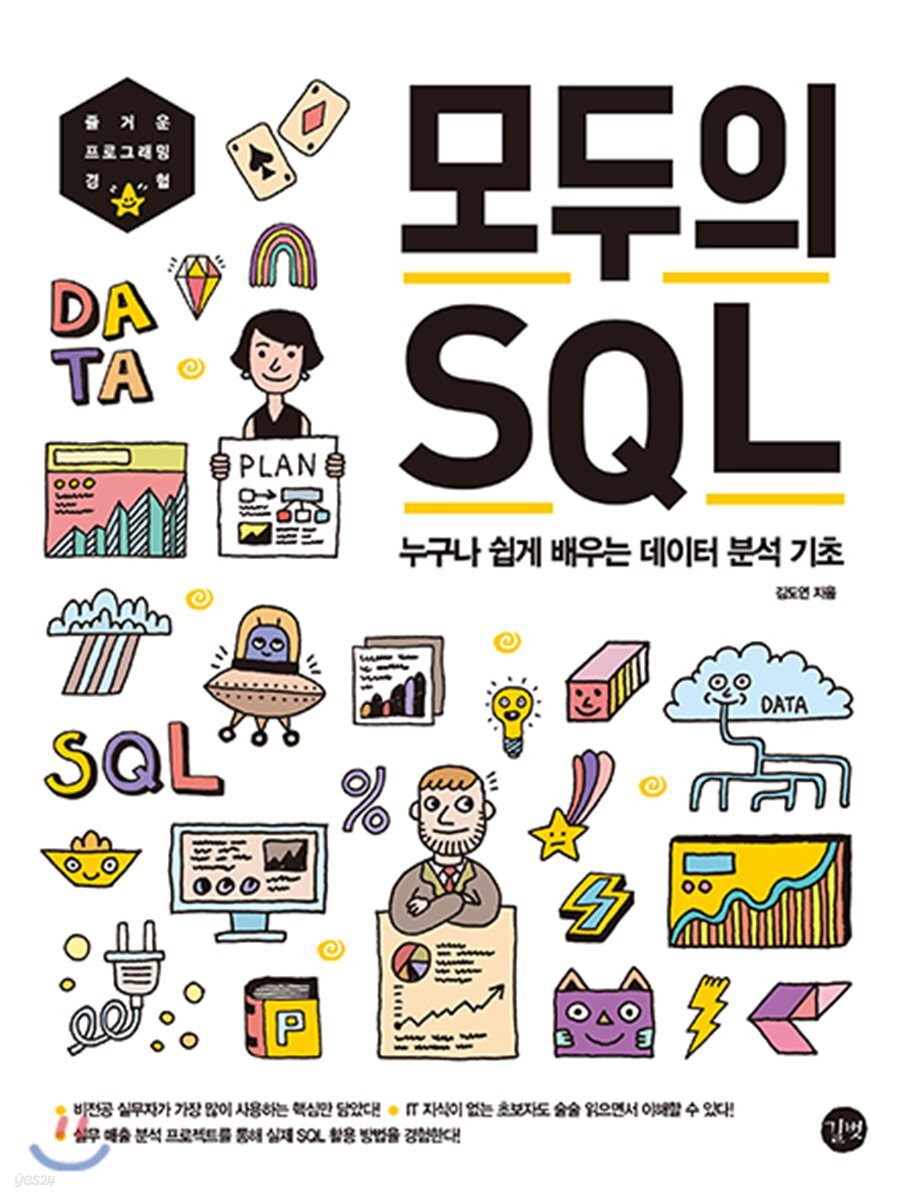
Everyone's SQL
 |
Description
Book Introduction
What if you need to analyze and process data with SQL for the first time?
The easiest SQL introduction for beginners and non-specialists.
With the development of the Internet and the rise of social media like Facebook, we have entered an era where everything is told through data.
But data is not a magic wand; it is raw material that must be processed to achieve the desired results.
[Everyone's SQL] is for people who need to analyze and process data with SQL for the first time.
It focuses on the core SQL content most frequently used by non-specialist practitioners, and the examples are also diverse and focused on frequently used content.
In particular, in the last chapter, you can experience how to use SQL in practice by carrying out a family restaurant sales analysis project in a hypothetical scenario.
Anyone can easily take their first step into data analysis with [Everyone's SQL].
The easiest SQL introduction for beginners and non-specialists.
With the development of the Internet and the rise of social media like Facebook, we have entered an era where everything is told through data.
But data is not a magic wand; it is raw material that must be processed to achieve the desired results.
[Everyone's SQL] is for people who need to analyze and process data with SQL for the first time.
It focuses on the core SQL content most frequently used by non-specialist practitioners, and the examples are also diverse and focused on frequently used content.
In particular, in the last chapter, you can experience how to use SQL in practice by carrying out a family restaurant sales analysis project in a hypothetical scenario.
Anyone can easily take their first step into data analysis with [Everyone's SQL].
- You can preview some of the book's contents.
Preview
index
Chapter 1 Relational Databases and SQL
01 Now is the era of data
02 Components and tables of a relational database
Chapter 2: Creating a Practice Environment
01 Installing Oracle Database Express
02 Installing Oracle SQL Developer
03 Basic Usage of Oracle SQL Developer
Chapter 3 SELECT: The Basics of Data Retrieval
01 Basic syntax of SELECT statement
02 Data retrieval using the WHERE condition clause.
Chapter 4: Functions: Easily Process Data with Functions
01 What is a function?
02 Single-row functions: Calculate and manipulate data values one by one
03 Group Functions: Summarizing by Group
Chapter 5 ERD: Database Object Design Diagram
01 Keys and Constraints: Object Property Notation
02 Relationship: Entity Relationship Notation
Chapter 6 Joins and Sets: Connecting Multiple Tables
01 What is Join?
02 Equi-join: Connecting identical data
03 Outer Join: Connecting All Data
04 Self-Join: Connecting to Your Own Data
05 Set Operators: Connecting with Sets
Chapter 7 Subqueries: SELECT statements within SELECT statements
01 What is a subquery?
02 Single-row subquery
03 Multi-row subquery
04 Multi-column subquery
05 FROM clause subquery: Inline view
Chapter 8 DML: Inserting/Updating/Deleting Data
01 What is DML?
02 INSERT: Inserting a row
03 UPDATE: Updating rows
04 DELETE: Delete a row
Chapter 9 Data Integrity and Transactions: Fundamental Rules for Database Operation
01 Data Integrity and Constraints 4
02 Transaction: Basic unit of work in data processing
Chapter 10 DDL: Manipulating Tables and Columns
01 What is DDL?
02 CREATE: Creating a table
03 ALTER: Modifying a table
04 TRUNCATE: Delete table contents
05 DROP: Delete a table
Chapter 11: Key Knowledge of Relational Databases
View 01: Virtual Table
02 Optimizer: Managing Performance Optimization
03 Index: Data address book for quick search
Chapter 12: Analyzing New Family Restaurant Sales with Manager Choi
01 Installing the practice data
02 Manager Choi's worries
03 Analyzing Sales
04 Analyzing demographics
05 Sales Data Analysis and Organization
01 Now is the era of data
02 Components and tables of a relational database
Chapter 2: Creating a Practice Environment
01 Installing Oracle Database Express
02 Installing Oracle SQL Developer
03 Basic Usage of Oracle SQL Developer
Chapter 3 SELECT: The Basics of Data Retrieval
01 Basic syntax of SELECT statement
02 Data retrieval using the WHERE condition clause.
Chapter 4: Functions: Easily Process Data with Functions
01 What is a function?
02 Single-row functions: Calculate and manipulate data values one by one
03 Group Functions: Summarizing by Group
Chapter 5 ERD: Database Object Design Diagram
01 Keys and Constraints: Object Property Notation
02 Relationship: Entity Relationship Notation
Chapter 6 Joins and Sets: Connecting Multiple Tables
01 What is Join?
02 Equi-join: Connecting identical data
03 Outer Join: Connecting All Data
04 Self-Join: Connecting to Your Own Data
05 Set Operators: Connecting with Sets
Chapter 7 Subqueries: SELECT statements within SELECT statements
01 What is a subquery?
02 Single-row subquery
03 Multi-row subquery
04 Multi-column subquery
05 FROM clause subquery: Inline view
Chapter 8 DML: Inserting/Updating/Deleting Data
01 What is DML?
02 INSERT: Inserting a row
03 UPDATE: Updating rows
04 DELETE: Delete a row
Chapter 9 Data Integrity and Transactions: Fundamental Rules for Database Operation
01 Data Integrity and Constraints 4
02 Transaction: Basic unit of work in data processing
Chapter 10 DDL: Manipulating Tables and Columns
01 What is DDL?
02 CREATE: Creating a table
03 ALTER: Modifying a table
04 TRUNCATE: Delete table contents
05 DROP: Delete a table
Chapter 11: Key Knowledge of Relational Databases
View 01: Virtual Table
02 Optimizer: Managing Performance Optimization
03 Index: Data address book for quick search
Chapter 12: Analyzing New Family Restaurant Sales with Manager Choi
01 Installing the practice data
02 Manager Choi's worries
03 Analyzing Sales
04 Analyzing demographics
05 Sales Data Analysis and Organization
Detailed image

Into the book
There have been many books explaining SQL grammar, but it has been difficult to find a book that explains how to use and apply it.
Readers who choose this book are likely to want to know what SQL is and how to use it.
The purpose of this book is clear.
'The vast field of SQL cannot be covered in one book.
Therefore, let's focus on delivering high-priority content that beginners and practitioners can best utilize in a practical environment!'
So, based on my experience, I have compiled the basics and important information you need to know into this book.
I also compiled this book by considering what beginners and practitioners are most curious about when using SQL and how to make it easier to understand.
If this book serves as a guide for readers in learning and utilizing SQL, I consider it to have achieved its purpose.
Many companies are trying to leverage databases and data.
But we discover that it is never easy.
Data is not a magic wand.
It is just a raw stone that needs to be worked upon to produce the desired result.
Some companies make the unfortunate choice of abandoning the value of raw materials and reverting to the past due to the difficulty of processing them.
When making choices that go against the grain, we must be very serious and careful, and someone must be held accountable.
Conversely, if companies overcome challenges, overcome existing ignorance, and discover meaningful results, they will advance to the next level. SQL is one of the essential tools for processing (manipulating and analyzing) data.
A craftsman's hands may produce a very fine piece of work, but they may not.
I hope this book will help you get a feel for the value and use of tools to achieve your intended results.
- From [Author's Note]
Readers who choose this book are likely to want to know what SQL is and how to use it.
The purpose of this book is clear.
'The vast field of SQL cannot be covered in one book.
Therefore, let's focus on delivering high-priority content that beginners and practitioners can best utilize in a practical environment!'
So, based on my experience, I have compiled the basics and important information you need to know into this book.
I also compiled this book by considering what beginners and practitioners are most curious about when using SQL and how to make it easier to understand.
If this book serves as a guide for readers in learning and utilizing SQL, I consider it to have achieved its purpose.
Many companies are trying to leverage databases and data.
But we discover that it is never easy.
Data is not a magic wand.
It is just a raw stone that needs to be worked upon to produce the desired result.
Some companies make the unfortunate choice of abandoning the value of raw materials and reverting to the past due to the difficulty of processing them.
When making choices that go against the grain, we must be very serious and careful, and someone must be held accountable.
Conversely, if companies overcome challenges, overcome existing ignorance, and discover meaningful results, they will advance to the next level. SQL is one of the essential tools for processing (manipulating and analyzing) data.
A craftsman's hands may produce a very fine piece of work, but they may not.
I hope this book will help you get a feel for the value and use of tools to achieve your intended results.
- From [Author's Note]
--- From the text
Publisher's Review
Anyone with SQL
You can analyze data!
Preparation | Prepare what you need to learn
Learn the concepts of what databases and SQL are and prepare Oracle for learning.
Basics | Learn Basic SQL
Learn about the basic syntax, functions, ERD, joins, and subqueries of the SELECT statement, a command for outputting data.
We will explain the most basic and frequently used core elements of SQL commands for manipulating and analyzing data.
Level Up and Leverage | In-Depth SQL Study and Experience Practical Projects
Go one step further and learn the core elements of DML and DDL to manipulate data directly.
Finally, we will proceed with a practical sales analysis project using the SQL grammar we have learned so far.
Explore how you can leverage SQL through your projects.
You can analyze data!
Preparation | Prepare what you need to learn
Learn the concepts of what databases and SQL are and prepare Oracle for learning.
Basics | Learn Basic SQL
Learn about the basic syntax, functions, ERD, joins, and subqueries of the SELECT statement, a command for outputting data.
We will explain the most basic and frequently used core elements of SQL commands for manipulating and analyzing data.
Level Up and Leverage | In-Depth SQL Study and Experience Practical Projects
Go one step further and learn the core elements of DML and DDL to manipulate data directly.
Finally, we will proceed with a practical sales analysis project using the SQL grammar we have learned so far.
Explore how you can leverage SQL through your projects.
GOODS SPECIFICS
- Date of publication: September 21, 2018
- Page count, weight, size: 296 pages | 683g | 183*235*16mm
- ISBN13: 9791160505771
You may also like
카테고리
korean


korean

![GQ KOREA Mark (Monthly): December [2025]](http://librairie.coreenne.fr/cdn/shop/files/8ef265dbbfbf186523ed75ba7319009d.jpg?v=1765340328&width=3840)


