

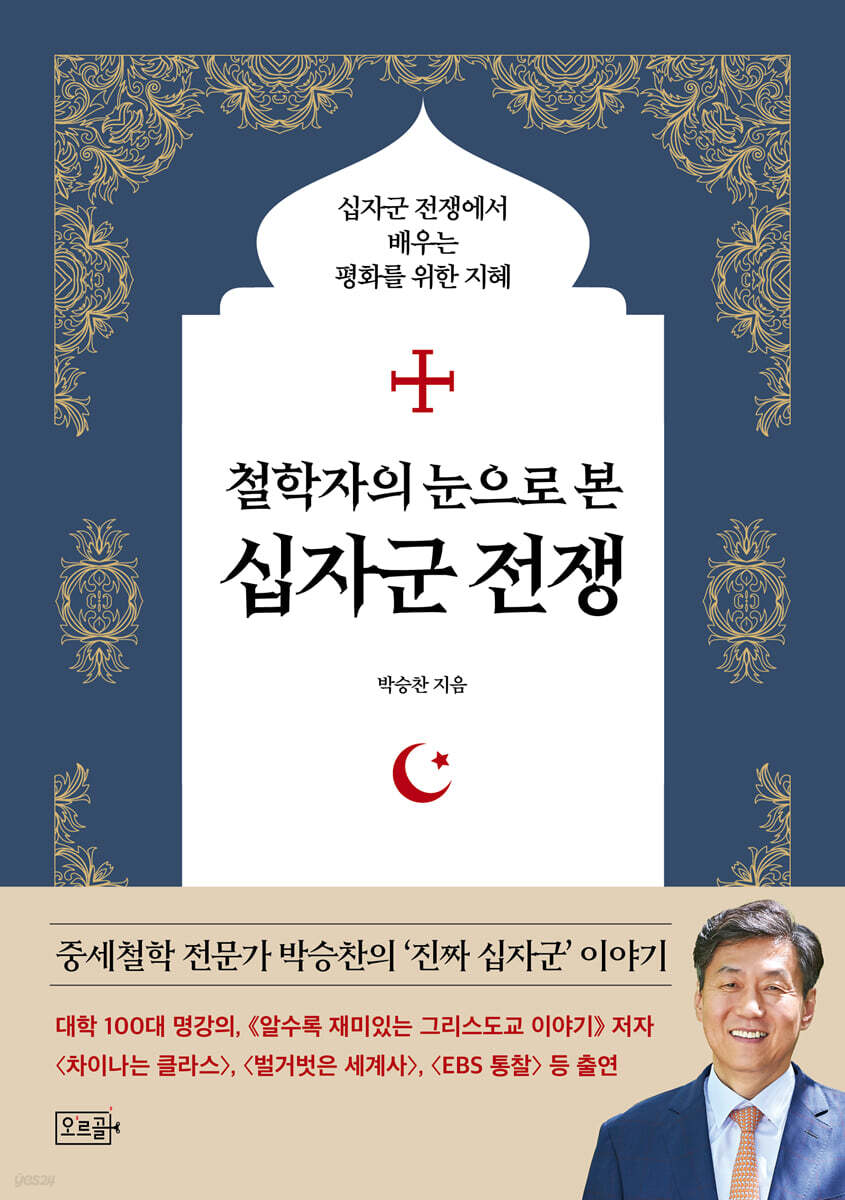
The Crusades Through the Eyes of a Philosopher
 |
Description
Book Introduction
- A word from MD
- The Crusades, a great event that changed world history.
Depending on where you look at the incident, whether it's Europe or the Middle East, the perspectives are completely different.
This book examines both perspectives and presents them in a balanced manner.
It helps us understand the Crusades with over 100 illustrations and a rich historical-philosophical discourse surrounding the war.
- Son Min-gyu, humanities PD
“The vast history of the Crusades meets the insights of a philosopher!”
The Story of the "Real Crusades" by Professor Seungchan Park, a medieval philosophy expert.
What would the Crusades look like through the eyes of a philosopher?
This book shows us the 'true face' of the Crusades, which we often mistakenly think we 'know'.
To this end, the author provides a balanced perspective on the 200-year Crusades, encompassing both Western and Islamic records.
Religious conflict, anger and hatred, human greed, lack of leadership, fake news… The Crusades, the longest-running war in human history, continue to resonate with us today in a different form.
A philosopher's deep reflections and suggestions to stop this!
This book is a 'medieval history book' that unfolds the Crusades like a panorama, and at the same time a 'humanities book' filled with philosophy, imparting wisdom that can help us correct historical errors and move in the right direction.
We examine the history of the Crusades, which began under the pretext of "God willed it" and were repeated eight times, from a historical-philosophical perspective, and reflect on the meaning the Crusades hold for us today.
Highly readable text and over 100 illustrations help readers immerse themselves, while footnotes with expert information and specially designed maps of the Crusades satisfy intellectual curiosity.
By faithfully including a chronology and index related to the Crusades, we have completed 'The Complete Guide to the Crusades in One Volume.'
Selected for the 2024 Small and Medium Publishing Company Leap Forward Production Support Project!
The Story of the "Real Crusades" by Professor Seungchan Park, a medieval philosophy expert.
What would the Crusades look like through the eyes of a philosopher?
This book shows us the 'true face' of the Crusades, which we often mistakenly think we 'know'.
To this end, the author provides a balanced perspective on the 200-year Crusades, encompassing both Western and Islamic records.
Religious conflict, anger and hatred, human greed, lack of leadership, fake news… The Crusades, the longest-running war in human history, continue to resonate with us today in a different form.
A philosopher's deep reflections and suggestions to stop this!
This book is a 'medieval history book' that unfolds the Crusades like a panorama, and at the same time a 'humanities book' filled with philosophy, imparting wisdom that can help us correct historical errors and move in the right direction.
We examine the history of the Crusades, which began under the pretext of "God willed it" and were repeated eight times, from a historical-philosophical perspective, and reflect on the meaning the Crusades hold for us today.
Highly readable text and over 100 illustrations help readers immerse themselves, while footnotes with expert information and specially designed maps of the Crusades satisfy intellectual curiosity.
By faithfully including a chronology and index related to the Crusades, we have completed 'The Complete Guide to the Crusades in One Volume.'
Selected for the 2024 Small and Medium Publishing Company Leap Forward Production Support Project!
- You can preview some of the book's contents.
Preview
index
preface
prolog
[Chapter 1] The Prelude to the Crusades, God Wills It
The occupation of Jerusalem by the emerging Islamic forces
The Pope's Cry That Created the Crusades
The social and political background of the Crusades
[Chapter 2] The First Crusade and the Capture of Jerusalem
The Reality of the People's Crusade
First Regular Crusade
Battle of Antioch, Faith or Madness
The Crusaders recapture Jerusalem
Changes in the political situation after the capture of Jerusalem
Introduction to the Knights Crusader
[Chapter 3] The Second Crusade Ends in Failure
The Islamic Counterattack and Nur al-Din
The Second Crusade advocated by Abbot Bernard
The Passion of the Second Crusade
The disastrous failure of the Crusades
The ongoing battle over Jerusalem
[Chapter 4] The Third Crusade: A War of Leadership
The Rise of Saladin, the Savior of Islam
Battle of Hattin and Saladin's recapture of Jerusalem
The Third Crusade to recapture Jerusalem
The Leadership of King Richard and Saladin
[Chapter 5] The End of the Ugly Expedition, the Fourth Crusade
The Fourth Crusade, engineered by Pope Innocent III
To Egypt, not Jerusalem
The Fourth Crusade's invasion of Constantinople
The Tragedy of the Children's Crusade
[Chapter 6] People Who Didn't Want a Senseless War
The Fifth Crusade, composed of local Christians
Saint Francis visits the Sultan
Frederick II and the Sixth Crusade
[Chapter 7] The Last Crusade and Aftermath
The Seventh Crusade and Louis IX
The Eighth Crusade and the Fall of the Crusader States
Why Most Crusades Failed
Changes in the world situation after the Crusades
[Chapter 8] Various Perspectives on the Crusades
The impact of the Crusades on Western Europe
Evaluation of the Crusades
[Chapter 9] The Rainbow Principle Learned from the Crusades
Principle 1.
Don't justify greed in the name of religion.
Principle 2.
Do not force justice.
Principle 3.
Avoid war with all your might
Principle 4.
Let go of harmful anger
Principle 5.
Show mercy to your enemies
Principle 6.
To avoid war, know one another.
Principle 7.
If you want peace, eliminate injustice.
Americas
Chronology of the Crusades
References
Image source
Search
prolog
[Chapter 1] The Prelude to the Crusades, God Wills It
The occupation of Jerusalem by the emerging Islamic forces
The Pope's Cry That Created the Crusades
The social and political background of the Crusades
[Chapter 2] The First Crusade and the Capture of Jerusalem
The Reality of the People's Crusade
First Regular Crusade
Battle of Antioch, Faith or Madness
The Crusaders recapture Jerusalem
Changes in the political situation after the capture of Jerusalem
Introduction to the Knights Crusader
[Chapter 3] The Second Crusade Ends in Failure
The Islamic Counterattack and Nur al-Din
The Second Crusade advocated by Abbot Bernard
The Passion of the Second Crusade
The disastrous failure of the Crusades
The ongoing battle over Jerusalem
[Chapter 4] The Third Crusade: A War of Leadership
The Rise of Saladin, the Savior of Islam
Battle of Hattin and Saladin's recapture of Jerusalem
The Third Crusade to recapture Jerusalem
The Leadership of King Richard and Saladin
[Chapter 5] The End of the Ugly Expedition, the Fourth Crusade
The Fourth Crusade, engineered by Pope Innocent III
To Egypt, not Jerusalem
The Fourth Crusade's invasion of Constantinople
The Tragedy of the Children's Crusade
[Chapter 6] People Who Didn't Want a Senseless War
The Fifth Crusade, composed of local Christians
Saint Francis visits the Sultan
Frederick II and the Sixth Crusade
[Chapter 7] The Last Crusade and Aftermath
The Seventh Crusade and Louis IX
The Eighth Crusade and the Fall of the Crusader States
Why Most Crusades Failed
Changes in the world situation after the Crusades
[Chapter 8] Various Perspectives on the Crusades
The impact of the Crusades on Western Europe
Evaluation of the Crusades
[Chapter 9] The Rainbow Principle Learned from the Crusades
Principle 1.
Don't justify greed in the name of religion.
Principle 2.
Do not force justice.
Principle 3.
Avoid war with all your might
Principle 4.
Let go of harmful anger
Principle 5.
Show mercy to your enemies
Principle 6.
To avoid war, know one another.
Principle 7.
If you want peace, eliminate injustice.
Americas
Chronology of the Crusades
References
Image source
Search
Detailed image
.jpg)
Into the book
What I particularly note is that 'anger' and 'hatred' toward other cultures or religions are not simple, temporary emotions, but are created by group ideology—whether it be political ideology, religious ideology, or the supremacy of money.
Moreover, I wanted to think about the fact that as this was taught and learned, it spread further and faster.
“Memories of hate have no expiration date,” says Caroline Emke, author of “The Hate Society.”
This means that even the hatred that occurred in the past can be repeated at any time if we do not properly reflect on it.
Thus, even in modern societies that pride themselves on being culturally advanced, ignorant and brutal events like the Crusades can easily repeat themselves.
--- From the "Preface"
In the Battle of Hattin, what determined victory or defeat was not the fighting ability of individual soldiers, but rather the fighting sense of the commander-in-chief who commanded the battlefield.
In fact, if we were to look at the fighting power of each individual soldier, the Knights Templar and the Knights Hospitaller, who were members of the Crusades and whose goal was to settle in the Middle East and defeat Muslims, would have been far superior.
But King Guy of Jerusalem was all talk and no experience in large-scale battles like this.
Moreover, the Hattin region was a place without water, so securing a 'water source' was essential, but they missed even this basic tactic.
--- p.172
Saladin advises his son about the reasons for his tolerance:
“Blood once shed never stops.
“Gain people’s trust with tolerance and affection.”
--- p.179
Even when looking at the same historical facts, fundamental differences emerge depending on each observer's way of understanding history and worldview.
In our country, the Crusades were introduced mainly from the perspective of Western historians, and world history education in schools was conducted in accordance with this.
--- p.330
The Crusaders believed themselves to be a chosen people, a new Hebrew people, a new Israelite people, subject to the commands and guidance of Yahweh (Jehovah).
Just as the Israelites marched across the Red Sea during their Exodus from Egypt, the Crusades were accompanied by many miracles and signs, including the Spear of Longinus, the apparitions of St. George, the discovery of materials for the siege tower in front of the city of Jerusalem, and the True Cross.
--- p.331
Contrary to Christians, in many Muslim regions the Crusades are perceived as sacrilege and a symbol of European aggression.
During the Crusades, Muslims considered the capture of Jerusalem by the Crusaders a disgrace and attributed it to internal divisions within Islam.
--- p.332
After World War II, the Crusades became widely recognized as a representative war that revealed the imperialistic nature of Europe.
In addition, the evaluation that it was an ugly war that forgot the essence of religion and was waged under the pretext of ‘God’s will’ was widely spread.
In March 2000, the Vatican officially recognized the Crusades as “a crime committed by the Church” in a document titled “Memory and Reconciliation: The Church and the Wrongdoings of the Past.”
Pope John Paul II then celebrated Mass in St. Peter's Basilica, formally asking for forgiveness for the Crusades, stating that they were the Church's fault.
--- p.336
The Crusades were not simply a war between two great religions, Christianity and Islam.
If we look more closely, there were also frequent cases of wars between Christians or Muslims.
--- p.337
Recently, there has been an increase in the number of 'military nerds' and 'game enthusiasts' who are showing interest in the Crusades simply out of curiosity.
They are very knowledgeable about the Crusades, down to the smallest detail.
But as a philosopher, I think the question of how history can be used to correct mistakes and move in the right direction is more important than a detailed description of individual histories.
--- p.341
Frederick II, Holy Roman Emperor, was a man who participated in the Sixth Crusade and even made a pilgrimage to Jerusalem, but was not properly evaluated in his time.
(…) At the time, Western Europeans, including the Pope, criticized the achievements as not being achieved through war, but from a modern perspective that prioritizes dialogue and compromise in resolving problems between nations, it deserves to be re-evaluated.
Moreover, I wanted to think about the fact that as this was taught and learned, it spread further and faster.
“Memories of hate have no expiration date,” says Caroline Emke, author of “The Hate Society.”
This means that even the hatred that occurred in the past can be repeated at any time if we do not properly reflect on it.
Thus, even in modern societies that pride themselves on being culturally advanced, ignorant and brutal events like the Crusades can easily repeat themselves.
--- From the "Preface"
In the Battle of Hattin, what determined victory or defeat was not the fighting ability of individual soldiers, but rather the fighting sense of the commander-in-chief who commanded the battlefield.
In fact, if we were to look at the fighting power of each individual soldier, the Knights Templar and the Knights Hospitaller, who were members of the Crusades and whose goal was to settle in the Middle East and defeat Muslims, would have been far superior.
But King Guy of Jerusalem was all talk and no experience in large-scale battles like this.
Moreover, the Hattin region was a place without water, so securing a 'water source' was essential, but they missed even this basic tactic.
--- p.172
Saladin advises his son about the reasons for his tolerance:
“Blood once shed never stops.
“Gain people’s trust with tolerance and affection.”
--- p.179
Even when looking at the same historical facts, fundamental differences emerge depending on each observer's way of understanding history and worldview.
In our country, the Crusades were introduced mainly from the perspective of Western historians, and world history education in schools was conducted in accordance with this.
--- p.330
The Crusaders believed themselves to be a chosen people, a new Hebrew people, a new Israelite people, subject to the commands and guidance of Yahweh (Jehovah).
Just as the Israelites marched across the Red Sea during their Exodus from Egypt, the Crusades were accompanied by many miracles and signs, including the Spear of Longinus, the apparitions of St. George, the discovery of materials for the siege tower in front of the city of Jerusalem, and the True Cross.
--- p.331
Contrary to Christians, in many Muslim regions the Crusades are perceived as sacrilege and a symbol of European aggression.
During the Crusades, Muslims considered the capture of Jerusalem by the Crusaders a disgrace and attributed it to internal divisions within Islam.
--- p.332
After World War II, the Crusades became widely recognized as a representative war that revealed the imperialistic nature of Europe.
In addition, the evaluation that it was an ugly war that forgot the essence of religion and was waged under the pretext of ‘God’s will’ was widely spread.
In March 2000, the Vatican officially recognized the Crusades as “a crime committed by the Church” in a document titled “Memory and Reconciliation: The Church and the Wrongdoings of the Past.”
Pope John Paul II then celebrated Mass in St. Peter's Basilica, formally asking for forgiveness for the Crusades, stating that they were the Church's fault.
--- p.336
The Crusades were not simply a war between two great religions, Christianity and Islam.
If we look more closely, there were also frequent cases of wars between Christians or Muslims.
--- p.337
Recently, there has been an increase in the number of 'military nerds' and 'game enthusiasts' who are showing interest in the Crusades simply out of curiosity.
They are very knowledgeable about the Crusades, down to the smallest detail.
But as a philosopher, I think the question of how history can be used to correct mistakes and move in the right direction is more important than a detailed description of individual histories.
--- p.341
Frederick II, Holy Roman Emperor, was a man who participated in the Sixth Crusade and even made a pilgrimage to Jerusalem, but was not properly evaluated in his time.
(…) At the time, Western Europeans, including the Pope, criticized the achievements as not being achieved through war, but from a modern perspective that prioritizes dialogue and compromise in resolving problems between nations, it deserves to be re-evaluated.
--- p.359~360
Publisher's Review
"A fascinating medieval history and a liberal arts textbook with a touch of philosophy."
A Panoramic View of the Crusades in One Volume
A balanced perspective encompassing the West and Islam
★ Selected for the 2024 Small and Medium Publishing Company Leap Forward Production Support Project ★
The story of the 'Real Crusade' by Professor Seungchan Park, an expert in medieval philosophy.
What would the Crusades look like through the eyes of a philosopher?
This book shows us the true face of the Crusades, which we often mistakenly think we 'know'.
To this end, the author provides a balanced perspective on the 200-year Crusades, encompassing both Western and Islamic records.
Religious conflict, anger and hatred, human greed, lack of leadership, fake news… The Crusades, the longest-running war in human history, continue to resonate with us today in a different form.
A philosopher's deep reflections and suggestions to stop this!
Most existing books and broadcasts dealing with the Crusades have focused on the sensational and brutal content, such as the First and Fourth Crusades, or viewed from either the Western or Islamic perspective.
In contrast, 『The Crusades Through the Eyes of a Philosopher』 made great efforts to explain the Crusades as objectively as possible, including introducing both Western and Islamic accounts of the same events.
* Recently, there has been an increase in the number of 'military nerds' and 'game enthusiasts' who are interested in the Crusades simply out of curiosity.
They are so well versed in the details of the Crusades.
But as a philosopher, I believe it's more important to understand how history can correct mistakes and move in the right direction. —Excerpt from p. 341
This book consists of nine chapters, the first half of which examines the aspects of each period of the Crusades, while the second half examines the meaning of the Crusades.
The author emphasizes that “even a brutal historical event like the Crusades can serve as a lesson, providing us with ‘wisdom for peace.’”
Chapter 1, “The Prelude to the Crusades, God Wills It,” and Chapter 2, “The First Crusade and the Occupation of Jerusalem,” cover atrocities committed in the name of religion, the harmful effects of “fake news,” and the history of the occupation that changes depending on one’s perspective.
Chapters 3 and 4 of the Second and Third Crusades respectively tell the backstory and activities of two heroes (Saladin and Richard the Lionheart) who stand out for their Islamic counterattack and leadership.
Chapter 5, “The End of the Ugly Expedition, the Fourth Crusade,” starkly shows human greed, and Chapter 6, “Those Who Did Not Want a Meaningless War,” deals with the Holy Roman Emperor Frederick II and Saint Francis, who came in search of a pilgrimage to Jerusalem.
Chapters 7 and 8 explore the changes in the world landscape brought about by the Crusades and the differences in perspective between the West and Islam.
"Even a brutal history, if properly reflected upon, reveals hope."
The story of the Crusades and the 'Rainbow Principle' that was not fully told on TV
The last 9 chapters of this book, “The Rainbow Principle: Lessons from the Crusades,” contain the author’s insights into the Crusades.
The author asks, “What wisdom for peace can we gain from the Crusades?” and presents the following seven “rainbow principles” as an answer.
① Do not justify greed in the name of religion.
② Do not force justice by force.
③ Avoid war with all your might.
④ Let go of harmful anger
⑤ Show mercy to your enemies
⑥ To avoid war, know one another.
⑦ If you want peace, eliminate injustice.
The title, “Rainbow Principle” (borrowed from the title of Father Cha Dong-yeop’s book), was given to convey the message that we should not give up hope despite the pain and darkness caused by war.
Professor Park Seung-chan, the author, is also renowned as a lecturer, having his lecture "Medieval Philosophy" selected as one of the "Top 100 University Lectures" by SBS and the Council for University Education. Through numerous broadcasts and lectures, including EBS's "Insight," JTBC's "Different Class," tvN's "Naked World History," and Catholic Peace Broadcasting, he has broadly introduced the largely uncharted territory of the medieval era and its culture to the public. His efforts are reflected in this book.
While introducing the Crusades by striking a balance between Christianity and Islam, it also provides readers with an easy-to-understand introduction to specialized content ranging from Plato's "Philosopher Politics" to Augustine's just war theory and Thomas Aquinas's "Summa Theologica."
As you follow the author's friendly explanations, the stories of the past Crusades will eventually lead to self-reflection.
I hope the author's deep insight into the history of the Crusades will help us stop the various "wars of hate" that are rampant around us, including the ongoing Crusades in another form today, the Israeli-Palestinian War.
A Panoramic View of the Crusades in One Volume
A balanced perspective encompassing the West and Islam
★ Selected for the 2024 Small and Medium Publishing Company Leap Forward Production Support Project ★
The story of the 'Real Crusade' by Professor Seungchan Park, an expert in medieval philosophy.
What would the Crusades look like through the eyes of a philosopher?
This book shows us the true face of the Crusades, which we often mistakenly think we 'know'.
To this end, the author provides a balanced perspective on the 200-year Crusades, encompassing both Western and Islamic records.
Religious conflict, anger and hatred, human greed, lack of leadership, fake news… The Crusades, the longest-running war in human history, continue to resonate with us today in a different form.
A philosopher's deep reflections and suggestions to stop this!
Most existing books and broadcasts dealing with the Crusades have focused on the sensational and brutal content, such as the First and Fourth Crusades, or viewed from either the Western or Islamic perspective.
In contrast, 『The Crusades Through the Eyes of a Philosopher』 made great efforts to explain the Crusades as objectively as possible, including introducing both Western and Islamic accounts of the same events.
* Recently, there has been an increase in the number of 'military nerds' and 'game enthusiasts' who are interested in the Crusades simply out of curiosity.
They are so well versed in the details of the Crusades.
But as a philosopher, I believe it's more important to understand how history can correct mistakes and move in the right direction. —Excerpt from p. 341
This book consists of nine chapters, the first half of which examines the aspects of each period of the Crusades, while the second half examines the meaning of the Crusades.
The author emphasizes that “even a brutal historical event like the Crusades can serve as a lesson, providing us with ‘wisdom for peace.’”
Chapter 1, “The Prelude to the Crusades, God Wills It,” and Chapter 2, “The First Crusade and the Occupation of Jerusalem,” cover atrocities committed in the name of religion, the harmful effects of “fake news,” and the history of the occupation that changes depending on one’s perspective.
Chapters 3 and 4 of the Second and Third Crusades respectively tell the backstory and activities of two heroes (Saladin and Richard the Lionheart) who stand out for their Islamic counterattack and leadership.
Chapter 5, “The End of the Ugly Expedition, the Fourth Crusade,” starkly shows human greed, and Chapter 6, “Those Who Did Not Want a Meaningless War,” deals with the Holy Roman Emperor Frederick II and Saint Francis, who came in search of a pilgrimage to Jerusalem.
Chapters 7 and 8 explore the changes in the world landscape brought about by the Crusades and the differences in perspective between the West and Islam.
"Even a brutal history, if properly reflected upon, reveals hope."
The story of the Crusades and the 'Rainbow Principle' that was not fully told on TV
The last 9 chapters of this book, “The Rainbow Principle: Lessons from the Crusades,” contain the author’s insights into the Crusades.
The author asks, “What wisdom for peace can we gain from the Crusades?” and presents the following seven “rainbow principles” as an answer.
① Do not justify greed in the name of religion.
② Do not force justice by force.
③ Avoid war with all your might.
④ Let go of harmful anger
⑤ Show mercy to your enemies
⑥ To avoid war, know one another.
⑦ If you want peace, eliminate injustice.
The title, “Rainbow Principle” (borrowed from the title of Father Cha Dong-yeop’s book), was given to convey the message that we should not give up hope despite the pain and darkness caused by war.
Professor Park Seung-chan, the author, is also renowned as a lecturer, having his lecture "Medieval Philosophy" selected as one of the "Top 100 University Lectures" by SBS and the Council for University Education. Through numerous broadcasts and lectures, including EBS's "Insight," JTBC's "Different Class," tvN's "Naked World History," and Catholic Peace Broadcasting, he has broadly introduced the largely uncharted territory of the medieval era and its culture to the public. His efforts are reflected in this book.
While introducing the Crusades by striking a balance between Christianity and Islam, it also provides readers with an easy-to-understand introduction to specialized content ranging from Plato's "Philosopher Politics" to Augustine's just war theory and Thomas Aquinas's "Summa Theologica."
As you follow the author's friendly explanations, the stories of the past Crusades will eventually lead to self-reflection.
I hope the author's deep insight into the history of the Crusades will help us stop the various "wars of hate" that are rampant around us, including the ongoing Crusades in another form today, the Israeli-Palestinian War.
GOODS SPECIFICS
- Date of issue: January 11, 2025
- Format: Paperback book binding method guide
- Page count, weight, size: 400 pages | 560g | 148*210*25mm
- ISBN13: 9791192642109
- ISBN10: 1192642104
You may also like
카테고리
korean


korean

![GQ KOREA Mark (Monthly): December [2025]](http://librairie.coreenne.fr/cdn/shop/files/8ef265dbbfbf186523ed75ba7319009d.jpg?v=1765340328&width=3840)


