

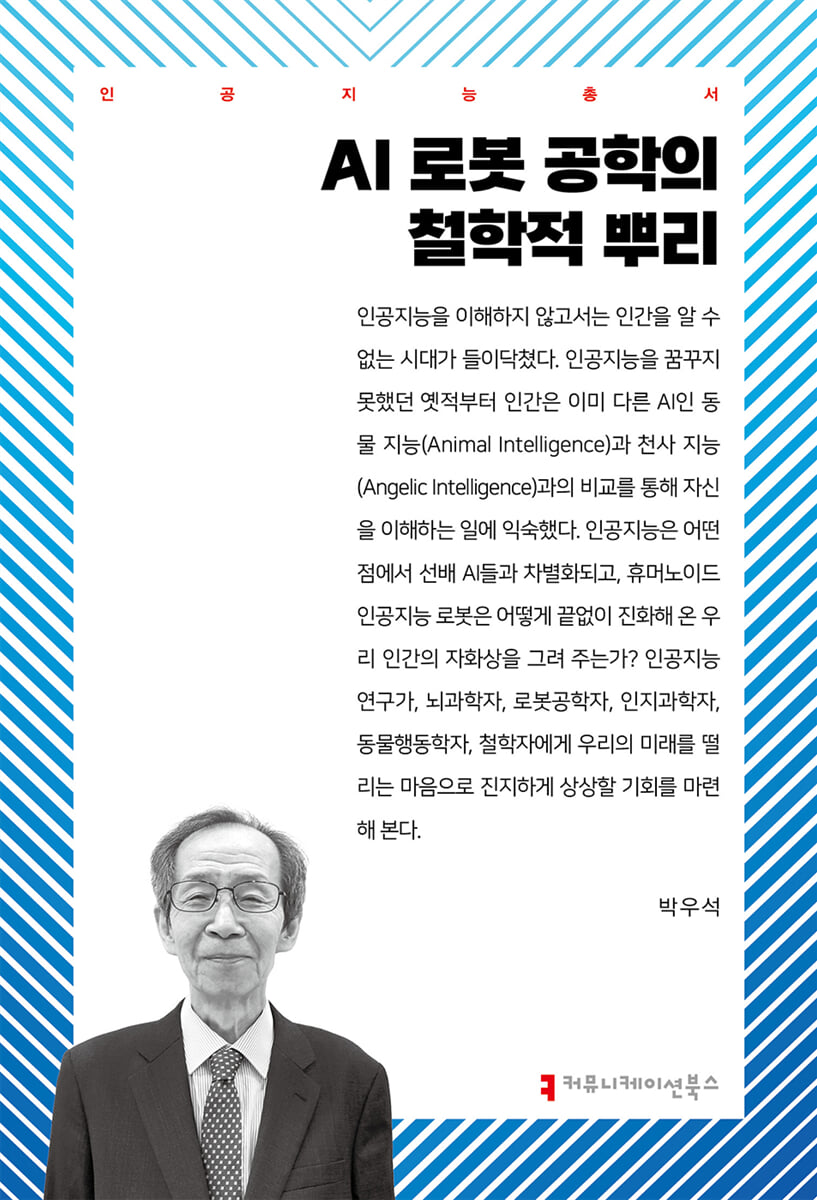
The Philosophical Roots of AI Robotics
 |
Description
Book Introduction
We explore AI robotics within the genealogy of philosophy, not technology.
Through the traditions of animal and angelic intelligence, we reflect on the nature of humans and robots, and reconstruct the issues of representation, autonomy, and existence in the language of thought.
It presents a new philosophical foundation for AI robotics within an intellectual lineage that connects ancient soulism, medieval angelology, modern machine philosophy, and contemporary cognitive science and brain science.
Artificial Intelligence Encyclopedia.
You can find the artificial intelligence knowledge you need at aiseries.oopy.io.
Through the traditions of animal and angelic intelligence, we reflect on the nature of humans and robots, and reconstruct the issues of representation, autonomy, and existence in the language of thought.
It presents a new philosophical foundation for AI robotics within an intellectual lineage that connects ancient soulism, medieval angelology, modern machine philosophy, and contemporary cognitive science and brain science.
Artificial Intelligence Encyclopedia.
You can find the artificial intelligence knowledge you need at aiseries.oopy.io.
- You can preview some of the book's contents.
Preview
index
Humanoid robots, three AIs, and humans
01 Building a Robot
02 Representation and misrepresentation
03 Animal Cognition
04 Language of Thought
05 The Beast-Machine Debate
06 Formal Ontology of Knowledge Representation
07 Natural species and robotic species
08 From the discovery of neurons to neural representation
09 Current Status of AI Robotics
10 Duality of Humanoid AI Robots
01 Building a Robot
02 Representation and misrepresentation
03 Animal Cognition
04 Language of Thought
05 The Beast-Machine Debate
06 Formal Ontology of Knowledge Representation
07 Natural species and robotic species
08 From the discovery of neurons to neural representation
09 Current Status of AI Robotics
10 Duality of Humanoid AI Robots
Into the book
Artificial intelligence and robotics have made tremendous strides over the past two decades, as evidenced by just a few success stories, such as self-driving cars and facial recognition systems.
Shouldn't we say that these devices or systems possess superior representational capabilities and intelligence? In other words, could Rodney Brooks still underestimate the robot's representational capabilities and intelligence? Now, the tables have turned, and wouldn't it be possible for Moravec, not Brooks, to ultimately claim that his beliefs and choices were correct? After all, aren't all modern robots AI robots possessing superior representational capabilities and intelligence?
At this point, we cannot help but ask, as Brooks did: What exactly is intelligence?
--- From 「01_“Building a Robot”」
In the larger context of the break between logic and psychology in the late 19th century, Peirce, like Gottlob Frege, the father of modern mathematical logic, criticized psychologism. However, in the atmosphere of the cognitive science revolution in the latter half of the 20th century, Peirce's ideas opened the door to a reunion of these two academic fields.
It is time to seriously consider Peirce's idea that if a newborn chick can easily select grains to eat, why should such a selective instinct not be allowed only to humans, who must select the correct one among countless scientific hypotheses?
--- From “03_“Animal Cognition””
According to Sowa, who shows an attitude of learning even from the ontology of Lao Tzu's "Tao Te Ching," categories are called domains in database theory, types in artificial intelligence research, and classes in object-oriented systems, but no matter what you call them, the choice of category determines everything that will be represented in computer applications.
And any imperfections, distortions, or limitations inherent in the categorical framework inevitably limit the flexibility and generality of programs and databases.
--- From “06_“Formal Ontology of Knowledge Representation””
It's safe to say that in just a few years, there's virtually no robotics research that doesn't put artificial intelligence and machine learning at the forefront.
(…) So, is it safe to conclude that AI has taken the lead within the research community of computer science, artificial intelligence, and robotics experts since the AlphaGo shock? Considering the innovations in AI that have been popularized in recent years, such as generative AI, LLM, and ChatGPT, there seems to be considerable basis for this assessment.
Shouldn't we say that these devices or systems possess superior representational capabilities and intelligence? In other words, could Rodney Brooks still underestimate the robot's representational capabilities and intelligence? Now, the tables have turned, and wouldn't it be possible for Moravec, not Brooks, to ultimately claim that his beliefs and choices were correct? After all, aren't all modern robots AI robots possessing superior representational capabilities and intelligence?
At this point, we cannot help but ask, as Brooks did: What exactly is intelligence?
--- From 「01_“Building a Robot”」
In the larger context of the break between logic and psychology in the late 19th century, Peirce, like Gottlob Frege, the father of modern mathematical logic, criticized psychologism. However, in the atmosphere of the cognitive science revolution in the latter half of the 20th century, Peirce's ideas opened the door to a reunion of these two academic fields.
It is time to seriously consider Peirce's idea that if a newborn chick can easily select grains to eat, why should such a selective instinct not be allowed only to humans, who must select the correct one among countless scientific hypotheses?
--- From “03_“Animal Cognition””
According to Sowa, who shows an attitude of learning even from the ontology of Lao Tzu's "Tao Te Ching," categories are called domains in database theory, types in artificial intelligence research, and classes in object-oriented systems, but no matter what you call them, the choice of category determines everything that will be represented in computer applications.
And any imperfections, distortions, or limitations inherent in the categorical framework inevitably limit the flexibility and generality of programs and databases.
--- From “06_“Formal Ontology of Knowledge Representation””
It's safe to say that in just a few years, there's virtually no robotics research that doesn't put artificial intelligence and machine learning at the forefront.
(…) So, is it safe to conclude that AI has taken the lead within the research community of computer science, artificial intelligence, and robotics experts since the AlphaGo shock? Considering the innovations in AI that have been popularized in recent years, such as generative AI, LLM, and ChatGPT, there seems to be considerable basis for this assessment.
--- From “09_“Current Status of AI Robotics””
Publisher's Review
Robots, a mirror of human philosophy
Artificial intelligence is seen as the key to understanding humanity, and its origins are extended to ‘senior AIs’ called Animal Intelligence and Angelic Intelligence.
Humans have long used these two intelligences as mirrors to reflect on themselves, and modern AI robotics is a continuation of that thinking.
The book dissects the thought processes of robotics, crossing ancient soulism, medieval angelology, the modern beast-machine debate, and contemporary cognitive science and brain science.
It directly addresses the philosophical questions raised by robots at the boundaries of representation and misrepresentation, consciousness and autonomy, existence and emotion, and asks why humans constantly seek to create 'machines that resemble themselves.'
This book, which reinterprets the genealogy of philosophy from Darwin to Descartes and Aquinas to Fodor in the language of AI robotics over ten chapters, presents a new attempt to explore robots through thought rather than technology.
Artificial intelligence is seen as the key to understanding humanity, and its origins are extended to ‘senior AIs’ called Animal Intelligence and Angelic Intelligence.
Humans have long used these two intelligences as mirrors to reflect on themselves, and modern AI robotics is a continuation of that thinking.
The book dissects the thought processes of robotics, crossing ancient soulism, medieval angelology, the modern beast-machine debate, and contemporary cognitive science and brain science.
It directly addresses the philosophical questions raised by robots at the boundaries of representation and misrepresentation, consciousness and autonomy, existence and emotion, and asks why humans constantly seek to create 'machines that resemble themselves.'
This book, which reinterprets the genealogy of philosophy from Darwin to Descartes and Aquinas to Fodor in the language of AI robotics over ten chapters, presents a new attempt to explore robots through thought rather than technology.
GOODS SPECIFICS
- Date of issue: November 7, 2025
- Page count, weight, size: 119 pages | 128*188*7mm
- ISBN13: 9791143012081
You may also like
카테고리
korean


korean

![GQ KOREA Mark (Monthly): December [2025]](http://librairie.coreenne.fr/cdn/shop/files/8ef265dbbfbf186523ed75ba7319009d.jpg?v=1765340328&width=3840)


