

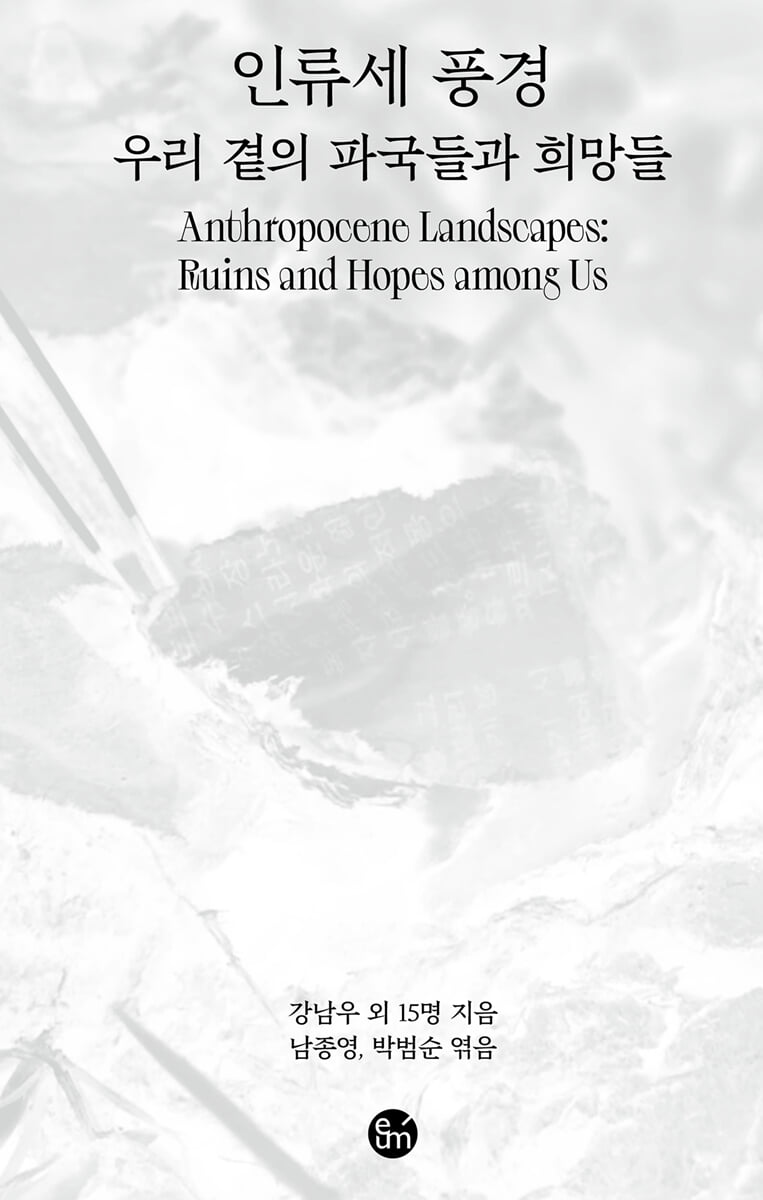
Anthropocene landscape
 |
Description
Book Introduction
Nam Jong-young, one of the most active environmental journalists of our time, and Professor Park Beom-soon, who led the Anthropocene Research Center for ten years and spearheaded academic discussions, have woven the landscape of the Anthropocene.
This book begins with a definition of the Anthropocene, examines the Anthropocene cases occurring around us in detail, and moves on to imagine the Anthropocene to come.
Each piece, intertwined with its own sense of catastrophe and hope, truthfully depicts what the Anthropocene is like at this very moment.
Look.
This is the landscape of the Anthropocene.
This book begins with a definition of the Anthropocene, examines the Anthropocene cases occurring around us in detail, and moves on to imagine the Anthropocene to come.
Each piece, intertwined with its own sense of catastrophe and hope, truthfully depicts what the Anthropocene is like at this very moment.
Look.
This is the landscape of the Anthropocene.
- You can preview some of the book's contents.
Preview
index
Entering
Concept: Climate Crisis and the Origins of the Anthropocene
The Difference Between the Anthropocene and Climate Change
The Anthropocene as a Practical Concept and the Role of Humans
Quaternary paleoenvironmental changes and the Anthropocene
The Language Politics of Carbon Neutrality
Sensing: Landscapes of History and Reality
The Origins of the Anthropocene and the Changing Concept of Nature
Going to Mississippi to See the End of the World: Anthropocene River Campus Review
Burned kangaroos, collapsed glaciers, and bullet-ridden orangutans
Humans and animals, two worlds in one
Exploration: Falling into the Human-Inhuman Web
Our Multispecies Relationships with Plants and Animals: Living with Bats, Ticks, and Viruses
Bird habitat, city: Will the egrets return to Daejeon next year?
Plants, the guardians of the quiet Earth
Airscape 2019
Imagine: Earth Beyond the Anthropocene?
Creating Ecological AI Connects Us
Designing Eco-Friendly Products with AI
What if you donated your data to help stop climate change?
The Horizon of the Anthropocene and Cosmology: Why the Anthropocene and Climate Change Are Not Just a Planetary Story
With dirt
Concept: Climate Crisis and the Origins of the Anthropocene
The Difference Between the Anthropocene and Climate Change
The Anthropocene as a Practical Concept and the Role of Humans
Quaternary paleoenvironmental changes and the Anthropocene
The Language Politics of Carbon Neutrality
Sensing: Landscapes of History and Reality
The Origins of the Anthropocene and the Changing Concept of Nature
Going to Mississippi to See the End of the World: Anthropocene River Campus Review
Burned kangaroos, collapsed glaciers, and bullet-ridden orangutans
Humans and animals, two worlds in one
Exploration: Falling into the Human-Inhuman Web
Our Multispecies Relationships with Plants and Animals: Living with Bats, Ticks, and Viruses
Bird habitat, city: Will the egrets return to Daejeon next year?
Plants, the guardians of the quiet Earth
Airscape 2019
Imagine: Earth Beyond the Anthropocene?
Creating Ecological AI Connects Us
Designing Eco-Friendly Products with AI
What if you donated your data to help stop climate change?
The Horizon of the Anthropocene and Cosmology: Why the Anthropocene and Climate Change Are Not Just a Planetary Story
With dirt
Detailed image

Into the book
This book is an effort to map out the two poles of optimism and pessimism in the Anthropocene era, and the vast gray area that lies between them.
Beginning with the suggestion that the Anthropocene is not a climate crisis in itself, and that the climate crisis must be understood within the holistic perspective of the Anthropocene, this paper explores the concept of the Anthropocene, the history of a new geological epoch, and practical strategies within the new relationships among humans, animals, artificial intelligence, and nature.
In short, it is a perspective and vision for living in the Anthropocene beyond anthropocentrism.
--- From "Entering"
It should not be overlooked that neologisms, especially those in administrative language, are carefully selected after competing with many concepts.
Does "carbon neutrality" adequately capture the problems we face in language? How pure and "neutral" are the language and numbers of carbon neutrality? For example, when the term "green growth" emerged as a social phenomenon during the Lee Myung-bak administration, researchers on the environmental side seriously pointed out the problems inherent in the concept.2 The value orientation of solving environmental problems ("green") with developmentalism ("growth") is surprisingly distinct and narrow, and thus remains a source of controversy.
--- From "The Language Politics of Carbon Neutrality"
One day, hundreds of thousands of years in the future, aliens visit Earth.
On Earth, humans have gone extinct, leaving only a few remaining forests and barren deserts.
Among them, a group of alien scientists discover a geological formation and conduct a geological survey.
“What is this?”
“There are small bones deposited.”
When I looked closer, I saw that they were particularly abundant in the strata of a certain era.
“Does it look like a bird bone?”
“It is said that these bones are often found in piles in other areas as well.
“It seems that a very large number of people lived on this planet at that time.”
--- From "Humans and Animals, From One World to Two"
Research shows that green is a calming color.
So plants generally get good marks from humans.
A forest-side apartment surrounded by trees, a walking path emitting phytoncide… … .
But the benefits green gives us are greater than we think.
So much so that the price cannot be calculated.
--- From "Plants, Guardians of the Quiet Earth"
To the ecologists and ecological researchers on the research team, the cranes were not just a source of ecological information, but also beautiful, sensitive, intelligent, and family-oriented creatures.
In actual ecological surveys, researchers made every effort to prevent cranes from stopping their feeding behavior and flying away due to their survey activities.
It was not only because ecological research becomes difficult when cranes fly away, but also because it seemed like a small ethical practice to 'respond' to the ecology and behavior of these sensitive animals.
Beginning with the suggestion that the Anthropocene is not a climate crisis in itself, and that the climate crisis must be understood within the holistic perspective of the Anthropocene, this paper explores the concept of the Anthropocene, the history of a new geological epoch, and practical strategies within the new relationships among humans, animals, artificial intelligence, and nature.
In short, it is a perspective and vision for living in the Anthropocene beyond anthropocentrism.
--- From "Entering"
It should not be overlooked that neologisms, especially those in administrative language, are carefully selected after competing with many concepts.
Does "carbon neutrality" adequately capture the problems we face in language? How pure and "neutral" are the language and numbers of carbon neutrality? For example, when the term "green growth" emerged as a social phenomenon during the Lee Myung-bak administration, researchers on the environmental side seriously pointed out the problems inherent in the concept.2 The value orientation of solving environmental problems ("green") with developmentalism ("growth") is surprisingly distinct and narrow, and thus remains a source of controversy.
--- From "The Language Politics of Carbon Neutrality"
One day, hundreds of thousands of years in the future, aliens visit Earth.
On Earth, humans have gone extinct, leaving only a few remaining forests and barren deserts.
Among them, a group of alien scientists discover a geological formation and conduct a geological survey.
“What is this?”
“There are small bones deposited.”
When I looked closer, I saw that they were particularly abundant in the strata of a certain era.
“Does it look like a bird bone?”
“It is said that these bones are often found in piles in other areas as well.
“It seems that a very large number of people lived on this planet at that time.”
--- From "Humans and Animals, From One World to Two"
Research shows that green is a calming color.
So plants generally get good marks from humans.
A forest-side apartment surrounded by trees, a walking path emitting phytoncide… … .
But the benefits green gives us are greater than we think.
So much so that the price cannot be calculated.
--- From "Plants, Guardians of the Quiet Earth"
To the ecologists and ecological researchers on the research team, the cranes were not just a source of ecological information, but also beautiful, sensitive, intelligent, and family-oriented creatures.
In actual ecological surveys, researchers made every effort to prevent cranes from stopping their feeding behavior and flying away due to their survey activities.
It was not only because ecological research becomes difficult when cranes fly away, but also because it seemed like a small ethical practice to 'respond' to the ecology and behavior of these sensitive animals.
--- From "Creating Ecological Artificial Intelligence Connected Us"
Publisher's Review
Is there hope at the end of the apocalypse?
The Anthropocene Landscape, Woven by Concept, Sensation, Exploration, and Imagination
Nam Jong-young, one of the most active environmental journalists of our time, and Professor Park Beom-soon, who led the Anthropocene Research Center for ten years and spearheaded academic discussions, have woven the landscape of the Anthropocene.
In addition to the articles in the 'Anthropocene' section of 『Epi』, we have added articles by Choi Pyeong-sun, an environmental and ecological expert PD, and Lee So-yo, who has been working on art on the theme of the Anthropocene, and grouped them into four parts: Concept, Sensation, Exploration, and Imagination.
Beginning with a definition of the Anthropocene, this book examines the Anthropocene-like instances occurring around us, and then moves on to imagine the Anthropocene to come. This book honestly depicts what the Anthropocene is like right now, at this very moment.
Current discussions about the Anthropocene can easily lead to extremes.
Optimism that we can overcome the Anthropocene with climate engineering solutions that capture carbon dioxide from the atmosphere and spray aerosols into the stratosphere to absorb solar energy.
Pessimism that speaks of a great disaster that will strike soon and humanity will become extinct within the current generation.
But as Nam Jong-young so pointed out, the two extremes only foster the mannerism that when scientists issue a 'warning,' the media translates it into 'fear,' and the public 'forgets.'
In fact, there is a vast gray area between them.
This book attempts to unfold those territories one by one.
It seeks to reveal the true landscape of the Anthropocene and the world after it, obscured by mannerism.
The writings each speak of their own destruction and hope.
Look.
This is the landscape of the Anthropocene.
Concept: Climate Crisis and the Origins of the Anthropocene
In 'Concept', we clear up the confusion surrounding the concept of the Anthropocene and present a more advanced discussion.
Historian Julia Adney Thomas warns against the public's view that the climate crisis and the Anthropocene are the same thing, saying that the Anthropocene is a symptom and phenomenon of human intervention in the Earth system, and that the climate crisis is just one of them.
At the same time, Park Seon-ah's article, which critically examines the concept of carbon neutrality, delves deeper into Julia Thomas's question.
Is a carbon-neutral future always a utopia? Carbon reductionism, which believes that simply reducing greenhouse gases will solve all of Earth's problems, places humanity's stakes on capital investment and technological innovation.
However, if we approach the Anthropocene through the flat lens of carbon neutrality, we cannot see the Anthropocene in its entirety.
In this respect, Park Beom-sun's article, which clearly introduces the process by which the Anthropocene has expanded into a practical concept, provides a rich intellectual experience.
The main culprits behind the new geological epoch are advanced Western nations and large corporations, but the term "Anthropocene," which seems to imply all of humanity, obscures the cause of the disease that the Earth is suffering from.
Here, we introduce the discussion of 'Capitalocene' as an alternative term, 'Toulouse' as a practical direction, and Latour's discussion criticizing the separation of science and politics since the modern era.
Finally, Kim Soo-hyun explores the Anthropocene from the perspective of paleoclimatology and paleoecology of the Quaternary period of the Cenozoic Era.
The position that the Anthropocene should be viewed as a "geological event" rather than a geological epoch, and the theory of early human intervention that places the starting point of change in the Neolithic Age, will help us understand why the draft submitted by the Anthropocene Working Group in 2024 was rejected by the geological community.
Sensing: Landscapes of History and Reality
In 'Detection', the history and reality of the Anthropocene are explored through the discourses of various scholars and the field in which the author has entered.
When did humanity begin to believe it could freely use and exploit nature? Park Beom-sun argues that a marked shift occurred in the European view of nature in the 16th and 17th centuries.
The scientific revolution occurred, the state emerged, and maritime trade expanded.
Terraforming and genocide occurred, erasing the ancient traditions and history of conquered lands.
Although the phenomenon of the Anthropocene can be seen since the mid-20th century, the social system changes that gave rise to it can be traced back hundreds of years.
Choi Myung-ae travels through the American South and New Orleans, following this historical extension, to show the chronology of the Anthropocene.
The kidnapping of black slaves to create large plantations, and the heavy chemical industrial complex built on their site, based on poor working conditions, resulted in the shameful figure of the highest cancer incidence rate.
New Orleans is devastated by Hurricane Katrina.
The author asks whether there is hope at the end.
Choi Pyeong-sun leads us to the end of the Great Acceleration disaster that began in the mid-20th century.
The Great Acceleration is an era that some geologists and Earth system scientists have identified as the beginning of the Anthropocene.
I visited Australia, where the worst wildfires in history were raging, a Himalayan mountain village where glacial floods are becoming more frequent, and a coal mine in Indonesia.
Finally, Nam Jong-young recalls the mink culling that occurred during the COVID-19 pandemic and the meat crisis in the United States.
As we revisit human history, focusing on our relationship with animals, we arrive at the Anthropocene of the 22nd century, where chicken bones are said to be important fossils of the Anthropocene.
Exploration: Falling into the Human-Inhuman Web
In 'Exploration', the author unfolds his thoughts and experiences on the network of relationships between humans and non-humans in order to navigate the Anthropocene.
The COVID-19 pandemic has taught us that microbes like viruses and bacteria, as well as tiny insects like mites, interact with humans through networks beyond our visual field.
Kim Dong-ju argues that, just as with the history of the Earth and the evolution of humanity, an awareness of multi-species relationships is necessary when analyzing phenomena.
In the age of zoonotic infectious diseases, attention to rats, bats, and ticks will become more important.
Seonghan Ah traces the history and present of Daejeon, a city with a population of 1.5 million and known as the city with the largest number of egrets in the country, revealing that humans and egrets have not existed separately from the past, but have existed intertwined.
Even river restoration projects intended to create leisure spaces for citizens have unintentionally benefited egrets.
Plants were so silent that we easily overlooked their inhuman nature.
However, plants use photosynthesis to convert solar energy into energy that other living things can use.
It spreads its roots, grows microorganisms, and stores carbon again.
Recently, plants like switchgrass, which grow quickly in a variety of climates, soils, and farming methods, have been recognized as important actors in overcoming the climate crisis.
Min Kyung-jin shows us plants, the quiet yet powerful guardians of the Earth.
Even inanimate non-humans influence and interact with humans.
The writings of Kim Seong-eun, Kim Hee-won, and Jeon Chi-hyeong, who trace the network of public behavior, corporate profit-seeking, scientific research, and national policy decisions centered around fine dust, and who perceive the landscape of fine dust as an air pocket of each individual's survival and breathing community, present a new perspective.
Imagine: Earth Beyond the Anthropocene?
'Imagination' is a chapter that unfolds imagination that gives new roles to the Earth as a planet and the dynamic actors on Earth.
When we view the Earth as a holistic system in which humans, non-human plants and animals, technology, and nature interact, we can see new ways to navigate the Anthropocene.
Choi Myung-ae documents the process of creating an AI ecologist by combining a human being, a social scientist, an engineer, a non-human animal called a crane, and an artificial intelligence that performs machine learning.
It is an interesting observation that shows various combinations.
In an era of data center explosion, where data centers consume 1.8 percent of the world's electricity and draw water equivalent to the water needs of a small city of 30,000 to 50,000 people, Dasom imagines data donation as a personal contribution.
In an age of information overload, isn't reducing data noise also a form of climate action? Kang Nam-woo also demonstrates how AI-powered product design can significantly reduce environmental impact by minimizing resource use and increasing energy efficiency.
Kim Dong-ju expands the horizon of the Anthropocene to the cosmos, marking a point for us to focus and think about.
With the emergence of the concept of the Anthropocene, Earth finally acquired the status of a planet.
Finally, Lee So-yo, who participated in the drilling work at a landfill site in Gyeonggi Province, offers artistic insights into the cycle of materials.
Since the Anthropocene, the Earth has been populated by a small number of substances selected by humans and artificial substances such as plastics.
The black plastic bags that are ubiquitous in our daily lives do not decompose, but accumulate, reminding us of potential disasters that threaten our lives in the future.
However, the black plastic bags collected from the dump decades ago were decomposed by some process.
The author asks while leaving the garbage dump layer as a work of art.
Can plastic become soil?
The Anthropocene Book and The Anthropocene Landscape
If 『The Anthropocene Book』 is a theoretical book, this book plays the role of a case study.
I hope that 『Anthropocene Landscape』 will quench the thirst for concrete examples felt while reading theoretical books.
The opposite is also true.
Those who complement each other are difficult to separate.
If you want to fully grasp the present of the Anthropocene, I recommend these two books together.
The Anthropocene Landscape, Woven by Concept, Sensation, Exploration, and Imagination
Nam Jong-young, one of the most active environmental journalists of our time, and Professor Park Beom-soon, who led the Anthropocene Research Center for ten years and spearheaded academic discussions, have woven the landscape of the Anthropocene.
In addition to the articles in the 'Anthropocene' section of 『Epi』, we have added articles by Choi Pyeong-sun, an environmental and ecological expert PD, and Lee So-yo, who has been working on art on the theme of the Anthropocene, and grouped them into four parts: Concept, Sensation, Exploration, and Imagination.
Beginning with a definition of the Anthropocene, this book examines the Anthropocene-like instances occurring around us, and then moves on to imagine the Anthropocene to come. This book honestly depicts what the Anthropocene is like right now, at this very moment.
Current discussions about the Anthropocene can easily lead to extremes.
Optimism that we can overcome the Anthropocene with climate engineering solutions that capture carbon dioxide from the atmosphere and spray aerosols into the stratosphere to absorb solar energy.
Pessimism that speaks of a great disaster that will strike soon and humanity will become extinct within the current generation.
But as Nam Jong-young so pointed out, the two extremes only foster the mannerism that when scientists issue a 'warning,' the media translates it into 'fear,' and the public 'forgets.'
In fact, there is a vast gray area between them.
This book attempts to unfold those territories one by one.
It seeks to reveal the true landscape of the Anthropocene and the world after it, obscured by mannerism.
The writings each speak of their own destruction and hope.
Look.
This is the landscape of the Anthropocene.
Concept: Climate Crisis and the Origins of the Anthropocene
In 'Concept', we clear up the confusion surrounding the concept of the Anthropocene and present a more advanced discussion.
Historian Julia Adney Thomas warns against the public's view that the climate crisis and the Anthropocene are the same thing, saying that the Anthropocene is a symptom and phenomenon of human intervention in the Earth system, and that the climate crisis is just one of them.
At the same time, Park Seon-ah's article, which critically examines the concept of carbon neutrality, delves deeper into Julia Thomas's question.
Is a carbon-neutral future always a utopia? Carbon reductionism, which believes that simply reducing greenhouse gases will solve all of Earth's problems, places humanity's stakes on capital investment and technological innovation.
However, if we approach the Anthropocene through the flat lens of carbon neutrality, we cannot see the Anthropocene in its entirety.
In this respect, Park Beom-sun's article, which clearly introduces the process by which the Anthropocene has expanded into a practical concept, provides a rich intellectual experience.
The main culprits behind the new geological epoch are advanced Western nations and large corporations, but the term "Anthropocene," which seems to imply all of humanity, obscures the cause of the disease that the Earth is suffering from.
Here, we introduce the discussion of 'Capitalocene' as an alternative term, 'Toulouse' as a practical direction, and Latour's discussion criticizing the separation of science and politics since the modern era.
Finally, Kim Soo-hyun explores the Anthropocene from the perspective of paleoclimatology and paleoecology of the Quaternary period of the Cenozoic Era.
The position that the Anthropocene should be viewed as a "geological event" rather than a geological epoch, and the theory of early human intervention that places the starting point of change in the Neolithic Age, will help us understand why the draft submitted by the Anthropocene Working Group in 2024 was rejected by the geological community.
Sensing: Landscapes of History and Reality
In 'Detection', the history and reality of the Anthropocene are explored through the discourses of various scholars and the field in which the author has entered.
When did humanity begin to believe it could freely use and exploit nature? Park Beom-sun argues that a marked shift occurred in the European view of nature in the 16th and 17th centuries.
The scientific revolution occurred, the state emerged, and maritime trade expanded.
Terraforming and genocide occurred, erasing the ancient traditions and history of conquered lands.
Although the phenomenon of the Anthropocene can be seen since the mid-20th century, the social system changes that gave rise to it can be traced back hundreds of years.
Choi Myung-ae travels through the American South and New Orleans, following this historical extension, to show the chronology of the Anthropocene.
The kidnapping of black slaves to create large plantations, and the heavy chemical industrial complex built on their site, based on poor working conditions, resulted in the shameful figure of the highest cancer incidence rate.
New Orleans is devastated by Hurricane Katrina.
The author asks whether there is hope at the end.
Choi Pyeong-sun leads us to the end of the Great Acceleration disaster that began in the mid-20th century.
The Great Acceleration is an era that some geologists and Earth system scientists have identified as the beginning of the Anthropocene.
I visited Australia, where the worst wildfires in history were raging, a Himalayan mountain village where glacial floods are becoming more frequent, and a coal mine in Indonesia.
Finally, Nam Jong-young recalls the mink culling that occurred during the COVID-19 pandemic and the meat crisis in the United States.
As we revisit human history, focusing on our relationship with animals, we arrive at the Anthropocene of the 22nd century, where chicken bones are said to be important fossils of the Anthropocene.
Exploration: Falling into the Human-Inhuman Web
In 'Exploration', the author unfolds his thoughts and experiences on the network of relationships between humans and non-humans in order to navigate the Anthropocene.
The COVID-19 pandemic has taught us that microbes like viruses and bacteria, as well as tiny insects like mites, interact with humans through networks beyond our visual field.
Kim Dong-ju argues that, just as with the history of the Earth and the evolution of humanity, an awareness of multi-species relationships is necessary when analyzing phenomena.
In the age of zoonotic infectious diseases, attention to rats, bats, and ticks will become more important.
Seonghan Ah traces the history and present of Daejeon, a city with a population of 1.5 million and known as the city with the largest number of egrets in the country, revealing that humans and egrets have not existed separately from the past, but have existed intertwined.
Even river restoration projects intended to create leisure spaces for citizens have unintentionally benefited egrets.
Plants were so silent that we easily overlooked their inhuman nature.
However, plants use photosynthesis to convert solar energy into energy that other living things can use.
It spreads its roots, grows microorganisms, and stores carbon again.
Recently, plants like switchgrass, which grow quickly in a variety of climates, soils, and farming methods, have been recognized as important actors in overcoming the climate crisis.
Min Kyung-jin shows us plants, the quiet yet powerful guardians of the Earth.
Even inanimate non-humans influence and interact with humans.
The writings of Kim Seong-eun, Kim Hee-won, and Jeon Chi-hyeong, who trace the network of public behavior, corporate profit-seeking, scientific research, and national policy decisions centered around fine dust, and who perceive the landscape of fine dust as an air pocket of each individual's survival and breathing community, present a new perspective.
Imagine: Earth Beyond the Anthropocene?
'Imagination' is a chapter that unfolds imagination that gives new roles to the Earth as a planet and the dynamic actors on Earth.
When we view the Earth as a holistic system in which humans, non-human plants and animals, technology, and nature interact, we can see new ways to navigate the Anthropocene.
Choi Myung-ae documents the process of creating an AI ecologist by combining a human being, a social scientist, an engineer, a non-human animal called a crane, and an artificial intelligence that performs machine learning.
It is an interesting observation that shows various combinations.
In an era of data center explosion, where data centers consume 1.8 percent of the world's electricity and draw water equivalent to the water needs of a small city of 30,000 to 50,000 people, Dasom imagines data donation as a personal contribution.
In an age of information overload, isn't reducing data noise also a form of climate action? Kang Nam-woo also demonstrates how AI-powered product design can significantly reduce environmental impact by minimizing resource use and increasing energy efficiency.
Kim Dong-ju expands the horizon of the Anthropocene to the cosmos, marking a point for us to focus and think about.
With the emergence of the concept of the Anthropocene, Earth finally acquired the status of a planet.
Finally, Lee So-yo, who participated in the drilling work at a landfill site in Gyeonggi Province, offers artistic insights into the cycle of materials.
Since the Anthropocene, the Earth has been populated by a small number of substances selected by humans and artificial substances such as plastics.
The black plastic bags that are ubiquitous in our daily lives do not decompose, but accumulate, reminding us of potential disasters that threaten our lives in the future.
However, the black plastic bags collected from the dump decades ago were decomposed by some process.
The author asks while leaving the garbage dump layer as a work of art.
Can plastic become soil?
The Anthropocene Book and The Anthropocene Landscape
If 『The Anthropocene Book』 is a theoretical book, this book plays the role of a case study.
I hope that 『Anthropocene Landscape』 will quench the thirst for concrete examples felt while reading theoretical books.
The opposite is also true.
Those who complement each other are difficult to separate.
If you want to fully grasp the present of the Anthropocene, I recommend these two books together.
GOODS SPECIFICS
- Date of issue: August 23, 2024
- Page count, weight, size: 296 pages | 432g | 140*220*17mm
- ISBN13: 9791194172031
- ISBN10: 1194172032
You may also like
카테고리
korean


korean

![GQ KOREA Mark (Monthly): December [2025]](http://librairie.coreenne.fr/cdn/shop/files/8ef265dbbfbf186523ed75ba7319009d.jpg?v=1765340328&width=3840)


