

AI service robots
 |
Description
Book Introduction
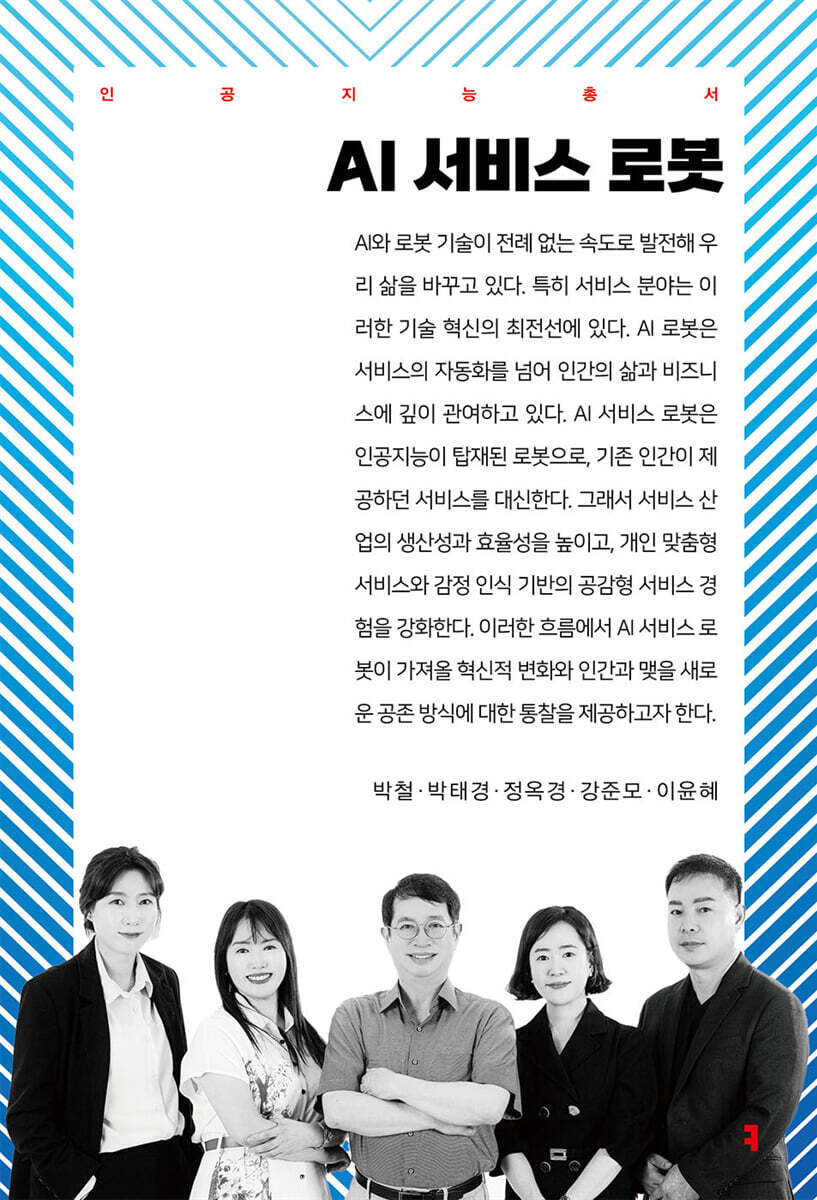
This article covers the process by which AI service robots are revolutionizing customer experiences by providing emotional recognition and personalized services in healthcare, education, distribution, and tourism.
It includes industry-specific cases, social issues, and future prospects.
This is a practical investment guide for individual investors.
Artificial Intelligence Encyclopedia.
You can find the artificial intelligence knowledge you need at aiseries.oopy.io.
It includes industry-specific cases, social issues, and future prospects.
This is a practical investment guide for individual investors.
Artificial Intelligence Encyclopedia.
You can find the artificial intelligence knowledge you need at aiseries.oopy.io.
- You can preview some of the book's contents.
Preview
index
A new era of human-machine collaboration
01 Service Innovation in the AI Robot Era
02 AI Robot Service Customer Experience
03 AI Robots and Emotion Recognition
04 AI Robots and Distribution
05 AI Robots and Entertainment
06 AI Robots and Education Services
07 AI Robots and Tourism and Hotel Services
08 AI Robots and Healthcare Services
09 AI Robots and Public Services
10 The Future of AI Service Robots
01 Service Innovation in the AI Robot Era
02 AI Robot Service Customer Experience
03 AI Robots and Emotion Recognition
04 AI Robots and Distribution
05 AI Robots and Entertainment
06 AI Robots and Education Services
07 AI Robots and Tourism and Hotel Services
08 AI Robots and Healthcare Services
09 AI Robots and Public Services
10 The Future of AI Service Robots
Into the book
AI service robots are providing guidance and service in various public places such as hotels, airports, museums, and shopping malls.
The guide robot provides visitors with multilingual support and real-time route guidance.
Serving robots replace serving staff in restaurants and cafes, saving manpower and maintaining service consistency.
They provide efficient service and increase customer satisfaction.
In the education sector, AI tutoring robots have opened up new horizons for personalized education. AI analyzes each student's learning style, strengths, and weaknesses to recommend optimal learning methods and content.
AI tutors handle repetitive problem-solving and concept explanations, while teachers enhance students' creative thinking and problem-solving skills. AI-based language learning robots help with pronunciation correction and conversation practice, maximizing the effectiveness of foreign language learning.
--- From "01_Service Innovation in the AI Robot Era"
One study found that 62% of older adults who interacted with an emotion-recognizing robot for more than three months reported that the robot “felt like a friend,” and some even treated the robot like a family member.
This emotional attachment can lead to higher repeat visit rates, likelihood to recommend (NPS), and brand loyalty, and emotional recognition ultimately functions as a factor that provides psychological stickiness.
Emotion recognition technology is a strategic turning point that humanizes AI and positions robots as key partners in customer experience design.
How companies design this technology and connect with customers can create a next-generation competitive edge built on emotional connection.
--- From "03_AI Robots and Emotion Recognition"
For robust and reliable human-centered AI systems to be applied in education, they must be able to understand learners' experiences, needs, emotions, and social contexts, adapt to complex learning environments, and interact appropriately with individuals (Li et al.
2021).
This is achieved through seamless communication between humans and AI, and the integration of human capabilities, knowledge, and personal perspectives into AI.
Furthermore, human-centered AI bridges the gap between the two by reflecting the learner's emotions and cognition, enabling AI to understand the learner's language, emotions, and behavior.
The ability of human-centered AI to understand individuals, adapt to situations, and interact appropriately is particularly important for educational advancement.
--- From "06_AI Robots and Education Services"
For example, shopping malls, airports, bars, restaurants, etc. are usually privately owned, but within them, people have relatively free choice of whom to meet and what to do.
In contrast, most outdoor public spaces, such as streets and parks, are publicly owned and managed by local governments or other legislative bodies.
In addition, gardens, some parks, and beach areas are also considered semi-public spaces with mixed public and private characteristics.
As the scope of robots expands and people increasingly value their everyday contributions, all entities managing public and semi-public spaces will need to consider more deeply the laws and regulations that can appropriately regulate the activities of robots.
Public safety must be a top priority, while careful consideration must also be given to how robots might change the atmosphere and experience of public spaces.
While managers can't completely control the "atmosphere" of a space, they can set the conditions under which robots are allowed in public spaces.
The guide robot provides visitors with multilingual support and real-time route guidance.
Serving robots replace serving staff in restaurants and cafes, saving manpower and maintaining service consistency.
They provide efficient service and increase customer satisfaction.
In the education sector, AI tutoring robots have opened up new horizons for personalized education. AI analyzes each student's learning style, strengths, and weaknesses to recommend optimal learning methods and content.
AI tutors handle repetitive problem-solving and concept explanations, while teachers enhance students' creative thinking and problem-solving skills. AI-based language learning robots help with pronunciation correction and conversation practice, maximizing the effectiveness of foreign language learning.
--- From "01_Service Innovation in the AI Robot Era"
One study found that 62% of older adults who interacted with an emotion-recognizing robot for more than three months reported that the robot “felt like a friend,” and some even treated the robot like a family member.
This emotional attachment can lead to higher repeat visit rates, likelihood to recommend (NPS), and brand loyalty, and emotional recognition ultimately functions as a factor that provides psychological stickiness.
Emotion recognition technology is a strategic turning point that humanizes AI and positions robots as key partners in customer experience design.
How companies design this technology and connect with customers can create a next-generation competitive edge built on emotional connection.
--- From "03_AI Robots and Emotion Recognition"
For robust and reliable human-centered AI systems to be applied in education, they must be able to understand learners' experiences, needs, emotions, and social contexts, adapt to complex learning environments, and interact appropriately with individuals (Li et al.
2021).
This is achieved through seamless communication between humans and AI, and the integration of human capabilities, knowledge, and personal perspectives into AI.
Furthermore, human-centered AI bridges the gap between the two by reflecting the learner's emotions and cognition, enabling AI to understand the learner's language, emotions, and behavior.
The ability of human-centered AI to understand individuals, adapt to situations, and interact appropriately is particularly important for educational advancement.
--- From "06_AI Robots and Education Services"
For example, shopping malls, airports, bars, restaurants, etc. are usually privately owned, but within them, people have relatively free choice of whom to meet and what to do.
In contrast, most outdoor public spaces, such as streets and parks, are publicly owned and managed by local governments or other legislative bodies.
In addition, gardens, some parks, and beach areas are also considered semi-public spaces with mixed public and private characteristics.
As the scope of robots expands and people increasingly value their everyday contributions, all entities managing public and semi-public spaces will need to consider more deeply the laws and regulations that can appropriately regulate the activities of robots.
Public safety must be a top priority, while careful consideration must also be given to how robots might change the atmosphere and experience of public spaces.
While managers can't completely control the "atmosphere" of a space, they can set the conditions under which robots are allowed in public spaces.
--- From "09_AI Robots and Public Services"
Publisher's Review
AI service robots: A new companion for humans and machines.
We explore the service innovations and new collaborative relationships between humans and machines that will be created by the combination of artificial intelligence and robotics technology.
We explore specific examples of how AI robots, which go beyond simple automation and provide empathetic services based on emotion recognition, are transforming customer experiences and work methods in various fields such as healthcare, education, distribution, tourism, entertainment, healthcare, and public services.
It covers technology that enables robots to analyze facial expressions, voice, language, and bio-signals to respond emotionally, building trust with customers, and the effects of introducing it in each industry.
It also presents a vision of a future where AI service robots will help humans focus on creativity and high-value-added work, along with social issues such as job changes, data protection, and ethical and regulatory issues.
It covers service innovation, customer experience, emotion recognition, industry-specific applications, and future prospects, providing insights for a symbiotic relationship between humans and robots.
We explore the service innovations and new collaborative relationships between humans and machines that will be created by the combination of artificial intelligence and robotics technology.
We explore specific examples of how AI robots, which go beyond simple automation and provide empathetic services based on emotion recognition, are transforming customer experiences and work methods in various fields such as healthcare, education, distribution, tourism, entertainment, healthcare, and public services.
It covers technology that enables robots to analyze facial expressions, voice, language, and bio-signals to respond emotionally, building trust with customers, and the effects of introducing it in each industry.
It also presents a vision of a future where AI service robots will help humans focus on creativity and high-value-added work, along with social issues such as job changes, data protection, and ethical and regulatory issues.
It covers service innovation, customer experience, emotion recognition, industry-specific applications, and future prospects, providing insights for a symbiotic relationship between humans and robots.
GOODS SPECIFICS
- Date of issue: August 25, 2025
- Page count, weight, size: 118 pages | 128*188*8mm
- ISBN13: 9791143008138
You may also like
카테고리
korean


korean

![GQ KOREA Mark (Monthly): December [2025]](http://librairie.coreenne.fr/cdn/shop/files/8ef265dbbfbf186523ed75ba7319009d.jpg?v=1765340328&width=3840)


