

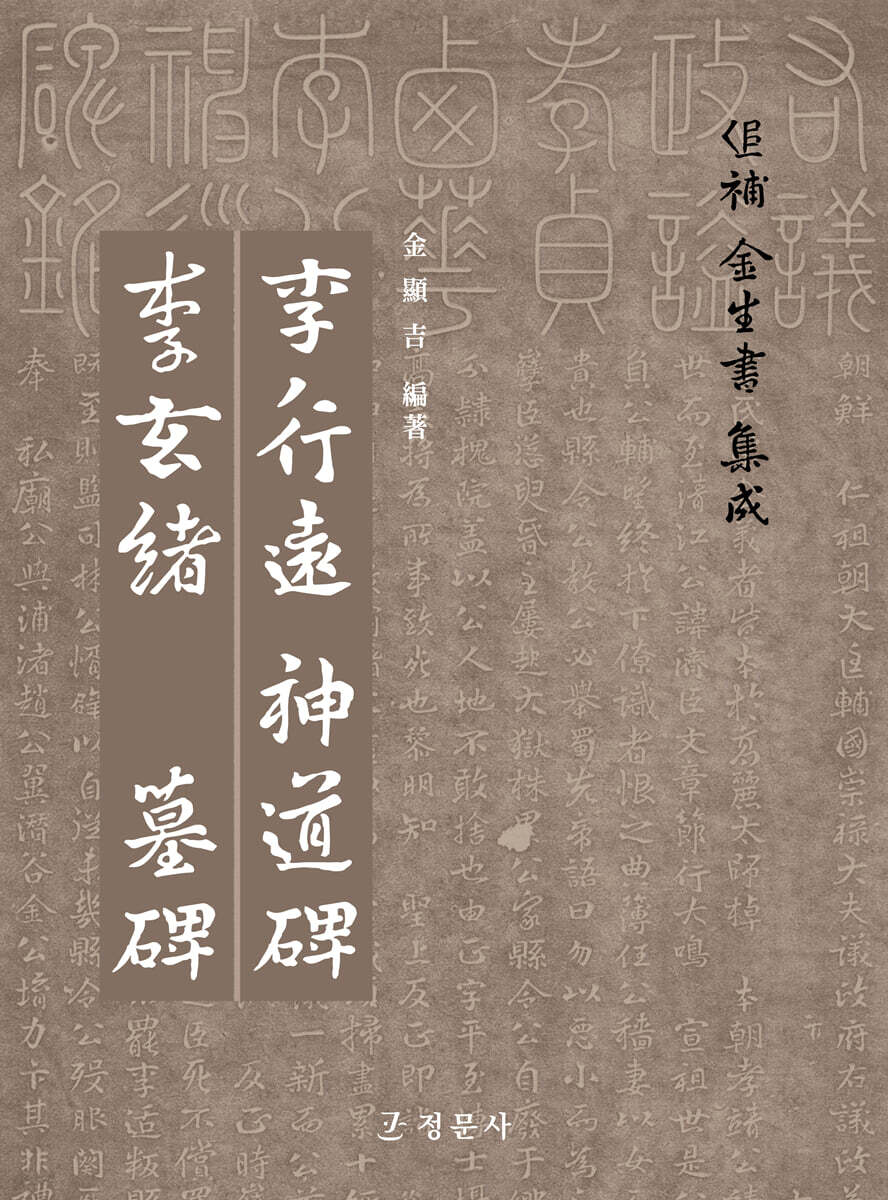
Collection of Chobo Kim Saeng-seo
 |
Description
index
Publishing a collection of supplements 3
Lee Hae-dong's Monument 9
Tomb of Lee Yeon-hyeon 65
譯文
Lee Hyeong-do’s Monument to God’s Way 128(19)
Tomb of Lee Jong-hyeon 119(28)
146(1)
Lee Hae-dong's Monument 9
Tomb of Lee Yeon-hyeon 65
譯文
Lee Hyeong-do’s Monument to God’s Way 128(19)
Tomb of Lee Jong-hyeon 119(28)
146(1)
Detailed image
Publisher's Review
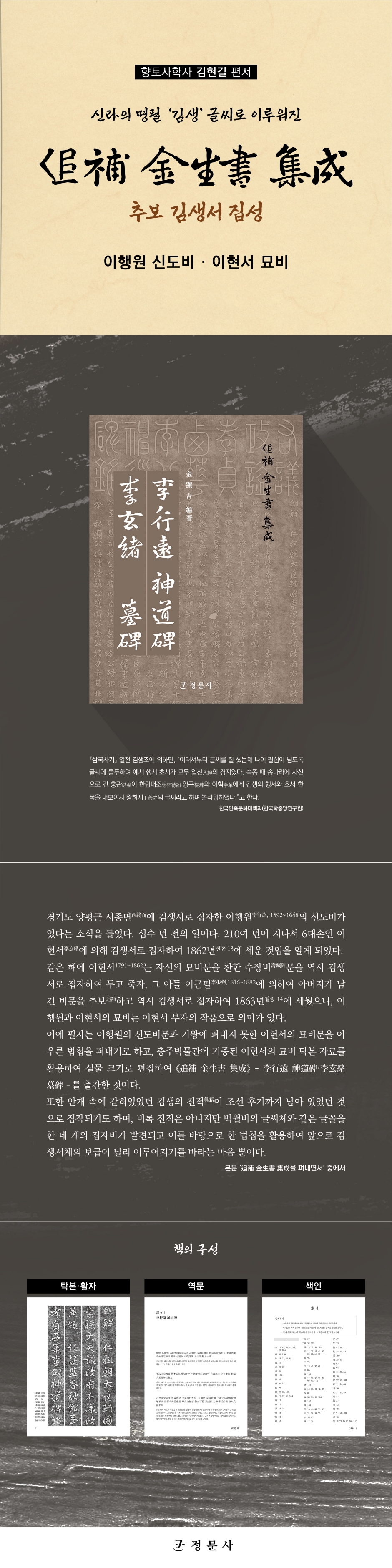
I heard that there is a memorial stele for Lee Haeng-won (1592-1648), who was also known as Kim Saeng-seo, in Seojong-myeon, Yangpyeong-gun, Gyeonggi-do.
It happened over a dozen years ago.
After about 210 years, it was discovered that it was established in 1862 (the 13th year of King Cheoljong's reign) by the 6th generation descendant, Lee Hyeon-seo, who took the name Kim Saeng-seo.
In the same year, Lee Hyeon-seo (1791-1862) died leaving behind an epitaph for his own tombstone, also written by Kim Saeng-seo. His son Lee Geun-pil (1816-1882) added an epitaph to his father's tombstone and also wrote it by Kim Saeng-seo, and erected it in 1863 (the 14th year of King Cheoljong's reign). Therefore, the tombstones of Lee Haeng-won and Lee Hyeon-seo are significant as the works of Lee Hyeon-seo and his son. Accordingly, the author decided to publish a book of laws that included Lee Haeng-won's epitaph and Lee Hyeon-seo's epitaph, which had not been published yet, and published it in full size by utilizing the rubbings of Lee Hyeon-seo's epitaph donated to the Chungju Museum, and published it as 《追補 金生書 集成》 - Lee Haeng-won's epitaph, Lee Hyeon-seo's tombstone - It is.
It is also presumed that Kim Saeng's real records, which had been trapped in the fog, remained until the late Joseon Dynasty. Although they are not real records, four steles with the same font as Baekwolbi's handwriting have been discovered, and it is hoped that the use of these as a legal document will lead to the widespread dissemination of Kim Saeng's calligraphy.
From ‘Publishing the Book of Kim Seong-seong’
It happened over a dozen years ago.
After about 210 years, it was discovered that it was established in 1862 (the 13th year of King Cheoljong's reign) by the 6th generation descendant, Lee Hyeon-seo, who took the name Kim Saeng-seo.
In the same year, Lee Hyeon-seo (1791-1862) died leaving behind an epitaph for his own tombstone, also written by Kim Saeng-seo. His son Lee Geun-pil (1816-1882) added an epitaph to his father's tombstone and also wrote it by Kim Saeng-seo, and erected it in 1863 (the 14th year of King Cheoljong's reign). Therefore, the tombstones of Lee Haeng-won and Lee Hyeon-seo are significant as the works of Lee Hyeon-seo and his son. Accordingly, the author decided to publish a book of laws that included Lee Haeng-won's epitaph and Lee Hyeon-seo's epitaph, which had not been published yet, and published it in full size by utilizing the rubbings of Lee Hyeon-seo's epitaph donated to the Chungju Museum, and published it as 《追補 金生書 集成》 - Lee Haeng-won's epitaph, Lee Hyeon-seo's tombstone - It is.
It is also presumed that Kim Saeng's real records, which had been trapped in the fog, remained until the late Joseon Dynasty. Although they are not real records, four steles with the same font as Baekwolbi's handwriting have been discovered, and it is hoped that the use of these as a legal document will lead to the widespread dissemination of Kim Saeng's calligraphy.
From ‘Publishing the Book of Kim Seong-seong’
GOODS SPECIFICS
- Date of issue: April 4, 2024
- Page count, weight, size: 148 pages | 552g | 220*297*10mm
- ISBN13: 9791193053089
- ISBN10: 1193053080
You may also like
카테고리
korean


korean

![GQ KOREA Mark (Monthly): December [2025]](http://librairie.coreenne.fr/cdn/shop/files/8ef265dbbfbf186523ed75ba7319009d.jpg?v=1765340328&width=3840)


