

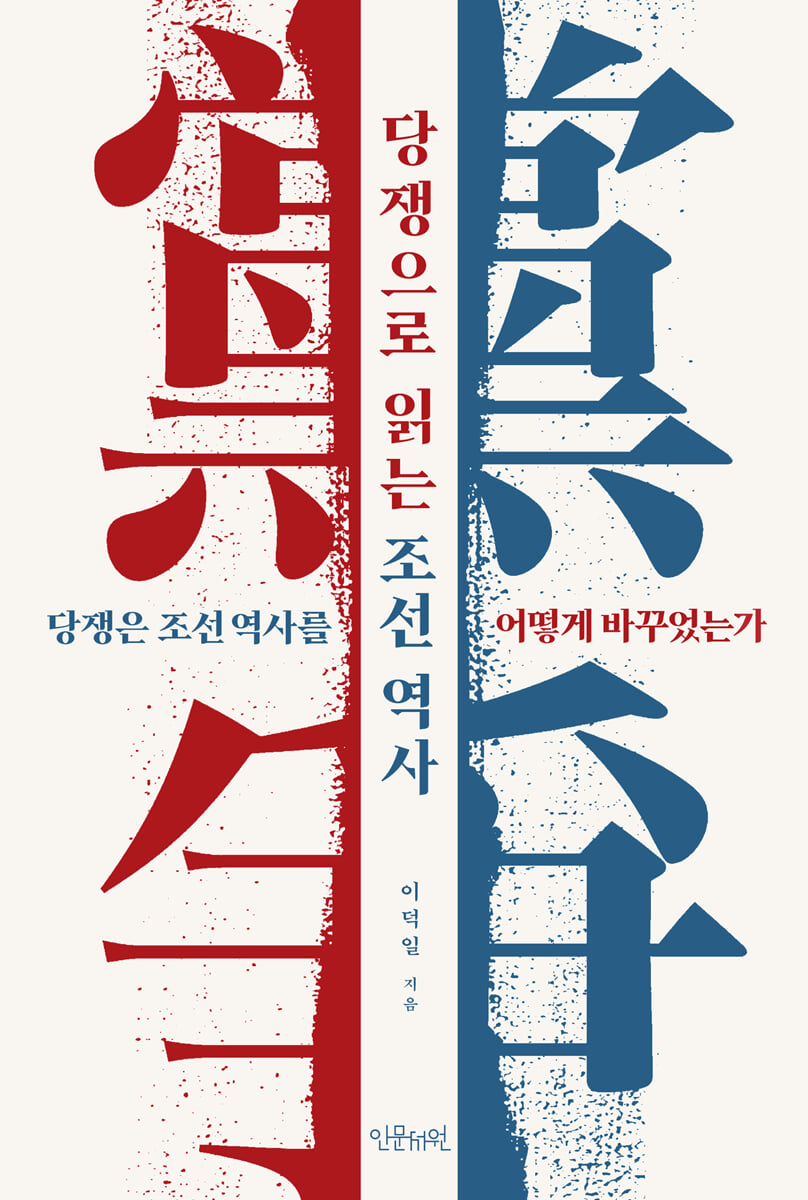
Joseon history read through factional strife
 |
Description
Book Introduction
From the emergence of the Sarim to the politics of the powerful, Rereading Joseon history through the power struggles of scholars "Reading Joseon History Through Party Strife" clearly organizes and interprets how Joseon scholars fought for political power, from the rise of the Sarim to the politics of the powerful factions, and how Joseon's history unfolded in the process. The beginning of factional strife, the true face of the Imjin War and the Byeongja War, the sudden death of Crown Prince Sohyeon, the conflict with the Seoin faction surrounding King Hyojong's northern expedition, the dispute over the legitimacy of the king through the first and second Yesong debates during the reign of King Hyeonjong, the reign of King Sukjong and the dramatic political upheaval, the assassination of Crown Prince Sado, and the confrontation between King Jeongjo and the Noron faction, all unfold in a breathless and exciting way, as if reading a historical novel. This book is a revised edition of 『Joseon History through Partisan Strife』(1997), and is a supplement to 『Joseon Scholars’ Partisan Strife History』, which was revised in 2018. Historian Lee Deok-il, based on primary sources such as the Annals of the Joseon Dynasty, Tangui Tongryak, Jeonggyobongpo, and Byeonbyeonsa Deungrok, shatters the stereotype that was forcibly instilled in Koreans during the Japanese colonial period that “Joseon was ruined by factional strife,” and reinterprets Joseon’s history from the perspective that “Joseon’s factional strife was party politics.” |
- You can preview some of the book's contents.
Preview
index
Leading text
Main characters
Chapter 1: The Sarim's Rise to Power and the Division of the East and West
The suppression of the Sarim by the Hun-gu faction and the purges
The ruling Sarim faction splits into the Easterners and the Westerners.
Lee Jun-kyung's factional prophecy
Lee's reasonable efforts and the 'two-sided theory'
People who impeached Lee Yi and were exiled
Differences between the Easterners and Westerners
Chapter 2: The Collapsing Framework of Coexistence
The downfall of the Seoin faction and the Jeong Yeo-rip incident
The Crown Prince's Rescue Problem and the Fall of the Seoin
The division of the ruling party and the approaching Imjin War
Why was the North Korean army helpless?
Jeong Cheol's release and the North Koreans' rise to power
Gwanghaegun, who ascended to the throne with difficulty
The Reign of King Gwanghaegun: A Prepared King's Prepared Innovation
A series of royal incidents
Successive Coups: The Gyehae Coup and Yi Gwal's Rebellion
The Byeongja Horan, brought about by the worship of Ming Confucianism
The unfortunate visionary, Prince Sohyeon
Chapter 3: The Daedong Law and the Military Service Debate
Joseon's tax laws and tribute
Farmers resisting heavy taxation
The great leaders of the Great East Law
If it weren't for the Great Harmony Law, how could we have overcome the Gyeongsin Famine?
How to solve the military service problem?
Chapter 4: From Coexistence to Exclusion
The movement to build a temple of Confucius, with Confucius on its back
The "Humanity and the Heart Debate": The Political Theory of the Aristocrats
The long road of a monk at the Munmyo Shrine
On the eve of the Gyehae Coup
During the reign of King Hyojong, there were differing views surrounding the Northern Expedition.
Three-Year Bok or One-Year Bok: The First Debate on Rites during King Hyeonjong's Reign
One-Year Bok or Nine-Month Bok: The Second Debate on Rites during King Hyeonjong's Reign
King Sukjong's reign, the Three Feudal Rebellions and Yun Hyu's rise to power
Queen Dowager Kim's cries echoed throughout the government office.
The Oil Tent Misuse Incident Brings Down the Nam In Regime
Chapter 5: The Vicious Cycle of Political Manipulation
Men being slaughtered
The Seoin faction split into the Noron and Soron factions.
Jang Hee-bin's mother's insult incident
Song Si-yeol receiving poison
Yi I and Seonghon were banished from the Confucian Shrine, and Queen Min was banished from the palace.
High and low stools
The Westerners' revenge and the downfall of Queen Jang
The prince our party supports must become the crown prince
During the reign of King Gyeongjong, a young king appointed his younger brother as his successor.
Soron seizes power
Chapter 6: Political strife over past history
The Yeongjo era begins amid rumors of King Gyeongjong's poisoning.
Lee In-jwa, rise up
Tangpyeong policy buried in the past
The backlash from the Soron hardliners and the Naju wall-writing incident
The truth behind the murder of Prince Sado
The Noron one-party system and the crown prince's crisis
Chapter 7 Towards a New Future
The beginning of the Jeongjo era, “I am the son of Crown Prince Sado!”
Attempted assassination of King Jeongjo
Multiparty system and ideological diversity
King Jeongjo dies amid rumors of poisoning
Chapter 8: The Collapse of Party Politics and the Politics of Factions
The widespread theory of Jeongjo's poisoning
The power of the maternal relatives that opened the door to nepotism
Daewongun's reformist politics emerged amidst shock
Emperor Gojong's family and the treason of the Noron faction
The new path of the Japanese aristocracy and the Soron and Namin factions
Outgoing post
supplement
Appendix 1: Major Political Diaries That Formed the Background of This Book
Appendix 2: Distribution of political parties by era
Appendix 3 Political Parties and Major Party Leaders of Each Joseon Dynasty
References
Main characters
Chapter 1: The Sarim's Rise to Power and the Division of the East and West
The suppression of the Sarim by the Hun-gu faction and the purges
The ruling Sarim faction splits into the Easterners and the Westerners.
Lee Jun-kyung's factional prophecy
Lee's reasonable efforts and the 'two-sided theory'
People who impeached Lee Yi and were exiled
Differences between the Easterners and Westerners
Chapter 2: The Collapsing Framework of Coexistence
The downfall of the Seoin faction and the Jeong Yeo-rip incident
The Crown Prince's Rescue Problem and the Fall of the Seoin
The division of the ruling party and the approaching Imjin War
Why was the North Korean army helpless?
Jeong Cheol's release and the North Koreans' rise to power
Gwanghaegun, who ascended to the throne with difficulty
The Reign of King Gwanghaegun: A Prepared King's Prepared Innovation
A series of royal incidents
Successive Coups: The Gyehae Coup and Yi Gwal's Rebellion
The Byeongja Horan, brought about by the worship of Ming Confucianism
The unfortunate visionary, Prince Sohyeon
Chapter 3: The Daedong Law and the Military Service Debate
Joseon's tax laws and tribute
Farmers resisting heavy taxation
The great leaders of the Great East Law
If it weren't for the Great Harmony Law, how could we have overcome the Gyeongsin Famine?
How to solve the military service problem?
Chapter 4: From Coexistence to Exclusion
The movement to build a temple of Confucius, with Confucius on its back
The "Humanity and the Heart Debate": The Political Theory of the Aristocrats
The long road of a monk at the Munmyo Shrine
On the eve of the Gyehae Coup
During the reign of King Hyojong, there were differing views surrounding the Northern Expedition.
Three-Year Bok or One-Year Bok: The First Debate on Rites during King Hyeonjong's Reign
One-Year Bok or Nine-Month Bok: The Second Debate on Rites during King Hyeonjong's Reign
King Sukjong's reign, the Three Feudal Rebellions and Yun Hyu's rise to power
Queen Dowager Kim's cries echoed throughout the government office.
The Oil Tent Misuse Incident Brings Down the Nam In Regime
Chapter 5: The Vicious Cycle of Political Manipulation
Men being slaughtered
The Seoin faction split into the Noron and Soron factions.
Jang Hee-bin's mother's insult incident
Song Si-yeol receiving poison
Yi I and Seonghon were banished from the Confucian Shrine, and Queen Min was banished from the palace.
High and low stools
The Westerners' revenge and the downfall of Queen Jang
The prince our party supports must become the crown prince
During the reign of King Gyeongjong, a young king appointed his younger brother as his successor.
Soron seizes power
Chapter 6: Political strife over past history
The Yeongjo era begins amid rumors of King Gyeongjong's poisoning.
Lee In-jwa, rise up
Tangpyeong policy buried in the past
The backlash from the Soron hardliners and the Naju wall-writing incident
The truth behind the murder of Prince Sado
The Noron one-party system and the crown prince's crisis
Chapter 7 Towards a New Future
The beginning of the Jeongjo era, “I am the son of Crown Prince Sado!”
Attempted assassination of King Jeongjo
Multiparty system and ideological diversity
King Jeongjo dies amid rumors of poisoning
Chapter 8: The Collapse of Party Politics and the Politics of Factions
The widespread theory of Jeongjo's poisoning
The power of the maternal relatives that opened the door to nepotism
Daewongun's reformist politics emerged amidst shock
Emperor Gojong's family and the treason of the Noron faction
The new path of the Japanese aristocracy and the Soron and Namin factions
Outgoing post
supplement
Appendix 1: Major Political Diaries That Formed the Background of This Book
Appendix 2: Distribution of political parties by era
Appendix 3 Political Parties and Major Party Leaders of Each Joseon Dynasty
References
Detailed image

Into the book
It is true that during the Joseon Dynasty, Song Si-yeol was respectfully called ‘Songja.’
However, the only ones who elevated him to the status of Song Ja were a certain political party within the ruling class.
The common people did not call him Songja.
Of course, political parties other than the one he belonged to did not call him Songja.
The only party that supported him as a son was the Noron faction.
Regionally, he was revered as Songja only in the Giho region, the stronghold of the Noron faction.
Among his opponents, the Namin (南人), he was nothing more than a 'dog name', let alone a 'sonja'.
It is not an exaggeration, but in fact, in the Yeongnam region, which was the stronghold of the Namins until recently, the name of the dog raised by one's family was called 'Siyeol-i'.
Even at this very moment, in some village in the Yeongnam region, some house may be calling its dog "Siyeol" just like it used to be, without even knowing why.
---From "The Leading Text"
After receiving the courtesy of a king and subject from King Injo, Emperor Taizong of the Qing returned to Shenyang, taking with him princes such as Crown Prince Sohyeon and Prince Bongrim, as well as Oh Dal-je and Yun Jip, the leaders of the expulsion theory, as hostages.
For the Joseon Dynasty, it was an indelible disgrace, and for the people, it was a case of suffering terribly under the hooves of a foreign enemy once again before they could even recover the farmland devastated by the Imjin War due to the ideological foreign policy of the coup regime.
But all history is a mixture of light and darkness.
A crisis can be an opportunity if used well.
Although Prince Sohyeon was taken to Shenyang in humiliation, this could have been a good opportunity to read the world situation and become an opportunity to actively respond to the rapidly changing world situation.
If only the ruling class of Joseon had the vision to turn crisis into opportunity and opportunity into reality.
---From "Chapter 2: The Collapsing Framework of Coexistence"
The first Yesong Debate ended in apparent victory for Song Si-yeol and the Seoin faction.
King Hyeonjong forbade the mention of the issue, saying, “If anyone ever slanders each other again with the same name, I will punish them severely,” but the royal authority had already suffered a serious blow.
The very fact that the subjects were fighting over the king's cloning was a sign of the decline of royal authority.
This was something that could not have happened in a country with such strong royal authority as China.
Through the first Yesong Controversy, suspicions grew that the Westerners did not recognize the Joseon royal family as a real royal family.
However, the first controversy over the annual mourning period ended with the wearing of mourning clothes according to international customs.
The second controversy over the rites of mourning, which took place 15 years later, was overturned by international law, which had been decided to be a one-year mourning period.
---From "Chapter 4: From Coexistence to Rejection"
This is called 'Mokhoryong's confession' or 'Iminoksa', and about 20 people were executed, 30 people were tortured to death, 10 people were strangled as accomplices, and over 100 people were exiled.
There were also nine women who took their own lives because they could not bear to see their families fall apart.
The root of this tragic incident lay in the Noron faction's attempt to remove the legitimately enthroned king and install a figure they supported as king.
In a dynastic state, the act of selecting a king by subjects, called 'Taekgun', was itself treason, but when the Noron faction took the path of 'Taekgun', the normal political system of the dynastic state collapsed and an extreme 'kill or be killed' political strife broke out over the throne.
---From "Chapter 5: The Vicious Cycle of Political Manipulation"
The theory of King Gyeongjong's poisoning was not something that could be resolved through the coexistence of the Noron and Soron factions.
This was not only a conflict between individuals and political parties, but also an expression of the limitations of Joseon's political system.
The fact that the throne itself became a target of political strife between factions meant that the basic framework of the dynastic state had collapsed.
This was also a clash between the political monopoly of a small number of aristocrats who were isolated from the people and the development situation at the bottom of society.
Although the Myeoncheon Law implemented by Seoae Ryu Seong-ryong during the Imjin War was abolished after Ryu Seong-ryong was overthrown, it caused the caste system itself to be rejected in the hearts of the people.
As agricultural productivity developed, some commoners and middle-class people who had become wealthy demanded political participation, which was evident in their participation in and provision of political funds for several reforms during the reign of King Sukjong.
In line with the demand for relaxation of the caste system, there was a demand for a change in the political system monopolized by the Yangban class.
The Neo-Confucian political ideology, which was based on the rule of the peasants by the aristocracy, could no longer lead society.
---From "Chapter 6: Political Strife in the Past"
The goal of the war of independence was not to revive a kingdom that had already fallen, but to establish a democratic republic based on the separation of powers.
The noblemen who gathered from all over the country no longer dreamed of a class society in which the noblemen ruled over the people.
It did not aim for a class-based society in which the king personally inspected all occasions by receiving a mandate from heaven.
They dreamed of sending away such a Neo-Confucian society along with the ruined country and creating a new society.
He dreamed of a society where all people were equal, where absolute individual freedom was guaranteed, and where people helped each other out.
That path was a new path, completely different from the path that Joseon's noblemen had walked until then.
---From "Chapter 8: The Collapse of Party Politics and Factional Politics"
The greatest tragedy in the history of Joseon politics lies in the fact that the Seoin (Noron) faction, which had been in power for nearly 300 years from the Gyehae Coup in 1623 until 1910, ultimately sold out the country.
Led by the last leader of the Noron faction, Yi Wan-yong, most of the Eulsa Five Traitors and Jeongmi Seven Traitors were Noron factions. Although they lost political power after the fall of the country, they maintained their social and economic power and dominated colonial society.
The descendants of the Noron faction, who failed to liquidate pro-Japanese elements after liberation, still cast a dark shadow over our society.
In particular, the anti-historical phenomenon of the Noron faction and pro-Japanese descendants continuing to dominate the academic world, including the field of history, continues.
The future of our society depends on how we correct this reality, where the most flawed group in Joseon's political history still wields influence.
However, the only ones who elevated him to the status of Song Ja were a certain political party within the ruling class.
The common people did not call him Songja.
Of course, political parties other than the one he belonged to did not call him Songja.
The only party that supported him as a son was the Noron faction.
Regionally, he was revered as Songja only in the Giho region, the stronghold of the Noron faction.
Among his opponents, the Namin (南人), he was nothing more than a 'dog name', let alone a 'sonja'.
It is not an exaggeration, but in fact, in the Yeongnam region, which was the stronghold of the Namins until recently, the name of the dog raised by one's family was called 'Siyeol-i'.
Even at this very moment, in some village in the Yeongnam region, some house may be calling its dog "Siyeol" just like it used to be, without even knowing why.
---From "The Leading Text"
After receiving the courtesy of a king and subject from King Injo, Emperor Taizong of the Qing returned to Shenyang, taking with him princes such as Crown Prince Sohyeon and Prince Bongrim, as well as Oh Dal-je and Yun Jip, the leaders of the expulsion theory, as hostages.
For the Joseon Dynasty, it was an indelible disgrace, and for the people, it was a case of suffering terribly under the hooves of a foreign enemy once again before they could even recover the farmland devastated by the Imjin War due to the ideological foreign policy of the coup regime.
But all history is a mixture of light and darkness.
A crisis can be an opportunity if used well.
Although Prince Sohyeon was taken to Shenyang in humiliation, this could have been a good opportunity to read the world situation and become an opportunity to actively respond to the rapidly changing world situation.
If only the ruling class of Joseon had the vision to turn crisis into opportunity and opportunity into reality.
---From "Chapter 2: The Collapsing Framework of Coexistence"
The first Yesong Debate ended in apparent victory for Song Si-yeol and the Seoin faction.
King Hyeonjong forbade the mention of the issue, saying, “If anyone ever slanders each other again with the same name, I will punish them severely,” but the royal authority had already suffered a serious blow.
The very fact that the subjects were fighting over the king's cloning was a sign of the decline of royal authority.
This was something that could not have happened in a country with such strong royal authority as China.
Through the first Yesong Controversy, suspicions grew that the Westerners did not recognize the Joseon royal family as a real royal family.
However, the first controversy over the annual mourning period ended with the wearing of mourning clothes according to international customs.
The second controversy over the rites of mourning, which took place 15 years later, was overturned by international law, which had been decided to be a one-year mourning period.
---From "Chapter 4: From Coexistence to Rejection"
This is called 'Mokhoryong's confession' or 'Iminoksa', and about 20 people were executed, 30 people were tortured to death, 10 people were strangled as accomplices, and over 100 people were exiled.
There were also nine women who took their own lives because they could not bear to see their families fall apart.
The root of this tragic incident lay in the Noron faction's attempt to remove the legitimately enthroned king and install a figure they supported as king.
In a dynastic state, the act of selecting a king by subjects, called 'Taekgun', was itself treason, but when the Noron faction took the path of 'Taekgun', the normal political system of the dynastic state collapsed and an extreme 'kill or be killed' political strife broke out over the throne.
---From "Chapter 5: The Vicious Cycle of Political Manipulation"
The theory of King Gyeongjong's poisoning was not something that could be resolved through the coexistence of the Noron and Soron factions.
This was not only a conflict between individuals and political parties, but also an expression of the limitations of Joseon's political system.
The fact that the throne itself became a target of political strife between factions meant that the basic framework of the dynastic state had collapsed.
This was also a clash between the political monopoly of a small number of aristocrats who were isolated from the people and the development situation at the bottom of society.
Although the Myeoncheon Law implemented by Seoae Ryu Seong-ryong during the Imjin War was abolished after Ryu Seong-ryong was overthrown, it caused the caste system itself to be rejected in the hearts of the people.
As agricultural productivity developed, some commoners and middle-class people who had become wealthy demanded political participation, which was evident in their participation in and provision of political funds for several reforms during the reign of King Sukjong.
In line with the demand for relaxation of the caste system, there was a demand for a change in the political system monopolized by the Yangban class.
The Neo-Confucian political ideology, which was based on the rule of the peasants by the aristocracy, could no longer lead society.
---From "Chapter 6: Political Strife in the Past"
The goal of the war of independence was not to revive a kingdom that had already fallen, but to establish a democratic republic based on the separation of powers.
The noblemen who gathered from all over the country no longer dreamed of a class society in which the noblemen ruled over the people.
It did not aim for a class-based society in which the king personally inspected all occasions by receiving a mandate from heaven.
They dreamed of sending away such a Neo-Confucian society along with the ruined country and creating a new society.
He dreamed of a society where all people were equal, where absolute individual freedom was guaranteed, and where people helped each other out.
That path was a new path, completely different from the path that Joseon's noblemen had walked until then.
---From "Chapter 8: The Collapse of Party Politics and Factional Politics"
The greatest tragedy in the history of Joseon politics lies in the fact that the Seoin (Noron) faction, which had been in power for nearly 300 years from the Gyehae Coup in 1623 until 1910, ultimately sold out the country.
Led by the last leader of the Noron faction, Yi Wan-yong, most of the Eulsa Five Traitors and Jeongmi Seven Traitors were Noron factions. Although they lost political power after the fall of the country, they maintained their social and economic power and dominated colonial society.
The descendants of the Noron faction, who failed to liquidate pro-Japanese elements after liberation, still cast a dark shadow over our society.
In particular, the anti-historical phenomenon of the Noron faction and pro-Japanese descendants continuing to dominate the academic world, including the field of history, continues.
The future of our society depends on how we correct this reality, where the most flawed group in Joseon's political history still wields influence.
---From "Outgoing Writing"
Publisher's Review
Joseon was torn apart by factional strife
What was gained and what was lost?
Dong-in, Seo-in, Nam-in, Buk-in, Noron, Soron… … .
When we think of the Joseon Dynasty, the first thing that comes to mind is the numerous political factions like this one.
Why did endless fighting continue throughout the Joseon Dynasty, and what consequences did it have on our history?
The Shinjin Sadaebu, the founding force of Joseon, was transformed into the Hun-gu faction after going through events such as the Gye-yu Jeongnan.
The new force that emerged in the court while criticizing this Hun-gu faction was the Sarim. Although they suffered losses from several purges, they eventually took control of the government and emerged at the center of power.
However, what awaited them was not stability in Joseon and the construction of an ideal society, but a division called the 'Four-Three Party'.
At first, the Dong-in and Seo-in factions were divided, then the Dong-in faction was divided into the Nam-in and Buk-in factions, and the Seo-in faction was divided into the Noron and Soron factions, which ended in the Noron faction's one-party dictatorship, factional politics, and the downfall of the nation.
In the 1930s, there was something called the Showa Restoration, which the Japanese imperialist military, or war machine, called for.
Young officers staged the Manchurian Incident in 1931 and several coups, including the February 26 Coup in 1936, creating an atmosphere of fear in society and portraying political strife itself as a bad thing.
They neutralized the parliament and neutralized the press.
The logic mainly used by the government-controlled media under their control was that ‘political strife is evil.’
But most political strife has a reason.
If there were no political strife, there would be no need for a multi-party system.
If you have a one-man dictatorship, there will be no political strife.
A multi-party system is a political system based on political strife, and it is the political system that mankind has agreed upon as the best after long historical experience.
The author argues that Joseon's party strife was also part of party politics, and argues that we should learn lessons from the party strife in Joseon's political history.
The author revisits Joseon history, focusing on factional strife, and explains how the "Joseon version of a multi-party system"—a system that could have been quite progressive—was distorted and what fate Joseon faced as a result, providing the necessary data and perspectives for 21st-century South Korea to learn the lessons of history.
Additionally, it helps readers understand numerous characters, events, and factions through introductions to key figures and appendices such as 'Major political diaries that formed the background of this book,' 'Distribution of political parties by era,' and 'Political parties and major party members in each era of Joseon.'
History is not a dead fossil, but a living organism.
Past experiences, whether bright or dark, can be beneficial to us.
The descendants of the Noron faction, who failed to liquidate pro-Japanese elements after liberation, still cast a dark shadow over our society.
In particular, the anti-historical phenomenon of the Noron faction and pro-Japanese descendants continuing to dominate the academic world, including the field of history, continues.
The future of our society depends on how we correct this reality, where the most flawed group in Joseon's political history still wields influence.
I hope that this book, which makes us think about 'what Joseon gained and lost through factional strife,' will serve as an opportunity for us to reflect on ourselves today and gain a correct understanding of history.
What was gained and what was lost?
Dong-in, Seo-in, Nam-in, Buk-in, Noron, Soron… … .
When we think of the Joseon Dynasty, the first thing that comes to mind is the numerous political factions like this one.
Why did endless fighting continue throughout the Joseon Dynasty, and what consequences did it have on our history?
The Shinjin Sadaebu, the founding force of Joseon, was transformed into the Hun-gu faction after going through events such as the Gye-yu Jeongnan.
The new force that emerged in the court while criticizing this Hun-gu faction was the Sarim. Although they suffered losses from several purges, they eventually took control of the government and emerged at the center of power.
However, what awaited them was not stability in Joseon and the construction of an ideal society, but a division called the 'Four-Three Party'.
At first, the Dong-in and Seo-in factions were divided, then the Dong-in faction was divided into the Nam-in and Buk-in factions, and the Seo-in faction was divided into the Noron and Soron factions, which ended in the Noron faction's one-party dictatorship, factional politics, and the downfall of the nation.
In the 1930s, there was something called the Showa Restoration, which the Japanese imperialist military, or war machine, called for.
Young officers staged the Manchurian Incident in 1931 and several coups, including the February 26 Coup in 1936, creating an atmosphere of fear in society and portraying political strife itself as a bad thing.
They neutralized the parliament and neutralized the press.
The logic mainly used by the government-controlled media under their control was that ‘political strife is evil.’
But most political strife has a reason.
If there were no political strife, there would be no need for a multi-party system.
If you have a one-man dictatorship, there will be no political strife.
A multi-party system is a political system based on political strife, and it is the political system that mankind has agreed upon as the best after long historical experience.
The author argues that Joseon's party strife was also part of party politics, and argues that we should learn lessons from the party strife in Joseon's political history.
The author revisits Joseon history, focusing on factional strife, and explains how the "Joseon version of a multi-party system"—a system that could have been quite progressive—was distorted and what fate Joseon faced as a result, providing the necessary data and perspectives for 21st-century South Korea to learn the lessons of history.
Additionally, it helps readers understand numerous characters, events, and factions through introductions to key figures and appendices such as 'Major political diaries that formed the background of this book,' 'Distribution of political parties by era,' and 'Political parties and major party members in each era of Joseon.'
History is not a dead fossil, but a living organism.
Past experiences, whether bright or dark, can be beneficial to us.
The descendants of the Noron faction, who failed to liquidate pro-Japanese elements after liberation, still cast a dark shadow over our society.
In particular, the anti-historical phenomenon of the Noron faction and pro-Japanese descendants continuing to dominate the academic world, including the field of history, continues.
The future of our society depends on how we correct this reality, where the most flawed group in Joseon's political history still wields influence.
I hope that this book, which makes us think about 'what Joseon gained and lost through factional strife,' will serve as an opportunity for us to reflect on ourselves today and gain a correct understanding of history.
GOODS SPECIFICS
- Date of issue: June 14, 2024
- Page count, weight, size: 480 pages | 822g | 152*224*30mm
- ISBN13: 9791186542675
- ISBN10: 1186542675
You may also like
카테고리
korean


korean

![GQ KOREA Mark (Monthly): December [2025]](http://librairie.coreenne.fr/cdn/shop/files/8ef265dbbfbf186523ed75ba7319009d.jpg?v=1765340328&width=3840)


