

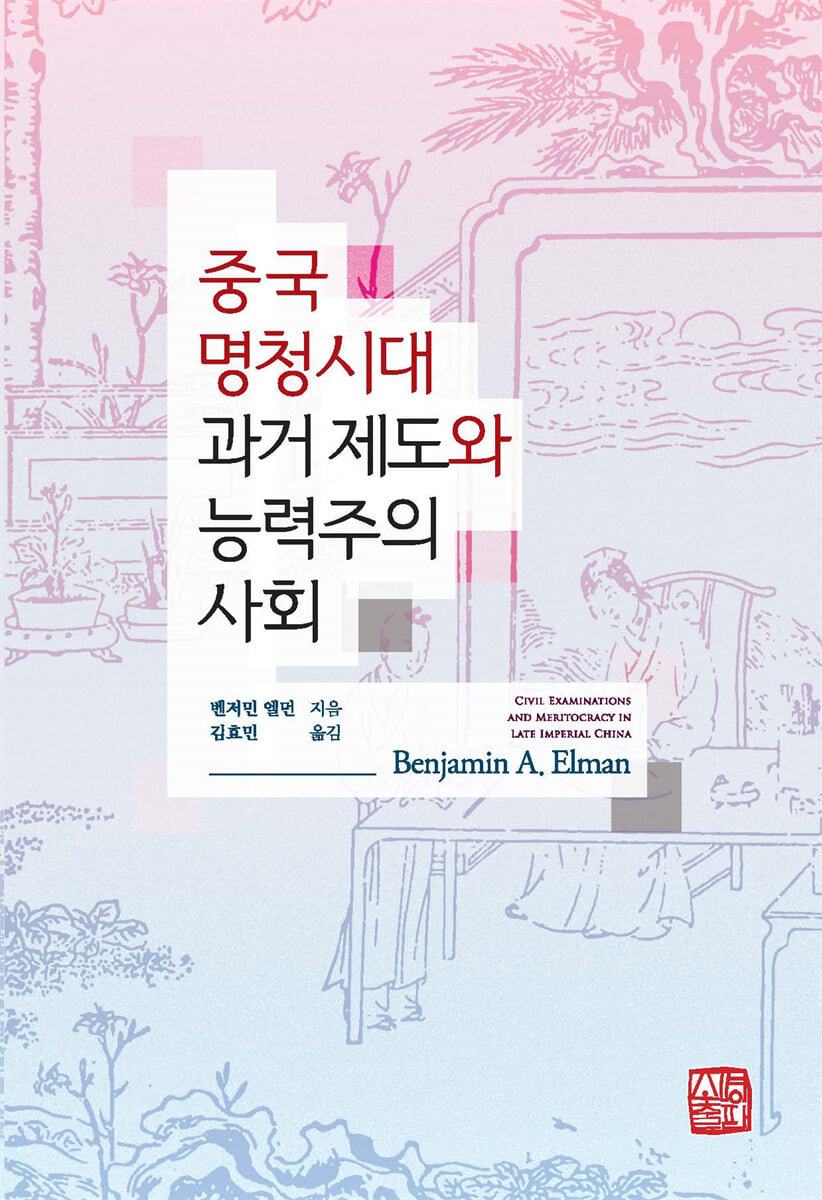
The civil service examination system and meritocratic society of the Ming and Qing Dynasties in China
 |
Description
Book Introduction
This book comprehensively covers Chinese politics, society, thought, academia, and education, focusing on the imperial examination system of the Ming and Qing Dynasties, and analyzes the influence and significance of the imperial examination system on Chinese society.
In particular, the author notes that the past system 'unintentionally' opened up various social avenues and alternative possibilities, and thus assessed that it did not hinder the construction of a modern Chinese nation.
This book has significant implications not only for understanding China's past systems, but also for the problems facing our society today.
In particular, the author notes that the past system 'unintentionally' opened up various social avenues and alternative possibilities, and thus assessed that it did not hinder the construction of a modern Chinese nation.
This book has significant implications not only for understanding China's past systems, but also for the problems facing our society today.
- You can preview some of the book's contents.
Preview
index
Note
Entering
Part 1: Becoming mainstream
Chapter 1: Power, Cultural Politics, and the Civil Service Examination System of the Ming Empire
Chapter 2 From the Ming Dynasty to the Qing Dynasty - The Standards of Daoism and the Eightfold Path
Part 2: Unintended Consequences of Past Exams
Chapter 3: The Circulation of the Elite in the Ming and Qing Dynasties
Chapter 4: Classical Literacy in Ming and Qing China
Chapter 5: Anxiety, Dreams, and Exam Preparation
Part 3: Reform of the Civil Service Examination to Adapt to Changing Times
Chapter 6: The Limits of Dynastic Power
Chapter 7: Books from the Ming to the Qing Dynasties
Chapter 8: Curriculum Reform: From the Qing Dynasty to the Taiping Heavenly Kingdom
supplement
Chinese chronology
Emperors of the Ming and Qing Dynasties
List of abbreviations
Acknowledgements
Translator's Note
annotation
Search
Entering
Part 1: Becoming mainstream
Chapter 1: Power, Cultural Politics, and the Civil Service Examination System of the Ming Empire
Chapter 2 From the Ming Dynasty to the Qing Dynasty - The Standards of Daoism and the Eightfold Path
Part 2: Unintended Consequences of Past Exams
Chapter 3: The Circulation of the Elite in the Ming and Qing Dynasties
Chapter 4: Classical Literacy in Ming and Qing China
Chapter 5: Anxiety, Dreams, and Exam Preparation
Part 3: Reform of the Civil Service Examination to Adapt to Changing Times
Chapter 6: The Limits of Dynastic Power
Chapter 7: Books from the Ming to the Qing Dynasties
Chapter 8: Curriculum Reform: From the Qing Dynasty to the Taiping Heavenly Kingdom
supplement
Chinese chronology
Emperors of the Ming and Qing Dynasties
List of abbreviations
Acknowledgements
Translator's Note
annotation
Search
Publisher's Review
A monumental work on the "cultural history of the past" of China's Ming and Qing dynasties
Author Benjamin Ellman is a specialist in the history of Chinese thought, culture, education, and science, particularly in the Ming and Qing dynasties. He is considered one of the leading Western historians of Chinese history, having achieved numerous outstanding research achievements.
He was the greatest scholar of the West at the time, especially in the past system.
His 『A Cultural History of Civil Examinations in Late Imperial China』(2000) is considered a monumental work following Miyazaki Ichisada's 『Gwa (科擧)』(1946), Chung-li Chang's 『The Chinese Gentry』(1955), and He Bing-ti Ho's 『The Ladder of Success in Imperial China』(1964).
If Ichisada's work focused on the historical aspects of past systems, especially the Qing Dynasty's institutional history, and He Bingdi and Zhang Zhongli's works took a social historical approach, Elman's work, which has a new cultural history tendency, is distinguished as a cultural history that examines past systems as a chapter encompassing all aspects surrounding them and as a central structure of Ming and Qing dynasties culture.
His works, which embody a wide range of multidisciplinary insights and are the product of meticulous research on over a thousand primary sources, are highly regarded academically, even surprising Sinologists.
This book is a specialized, general education book of an academic nature that has been condensed and revised from the author's extensive academic work, 『History of Past Cultures of the Ming and Qing Dynasties』.
It is also a 'social and cultural history of the Ming and Qing dynasties' reconstructed through the prism of past systems.
Through a comprehensive and multi-dimensional approach to the civil service examination system of the Ming and Qing dynasties, Elman reveals that it exerted a wide-ranging influence across intricately intertwined political, social, ideological, academic, educational, and cultural spheres, and that it was a key mechanism for reproducing power, class, ideology, knowledge, and faith.
This integrated perspective is presented more persuasively through a balanced approach that encompasses the diachronic context and synchronic specificities of Chinese history, centered on past institutions, and through appropriate comparisons with the West.
While emphasizing the long-term continuity and stable sustainability of the civil service examination system of the Ming and Qing dynasties, a close examination of the fierce internal debates, compromises, reforms, and changes that lay behind it, and their trajectories, is a representative aspect.
For example, it is a great achievement to have empirically revealed that the Ming and Qing imperial examinations were not confined to the framework of Taoism (Neo-Confucianism) as the official curriculum and ruling ideology, but that, as the times changed, Yangmingism, natural science, textual criticism (Chinese studies), history, and even Western studies (Western studies) also exerted academic and ideological influence.
Furthermore, another representative achievement of this book is that it approaches in detail the daily lives, customs, and inner world of the intellectuals and their families who have experienced tension, anxiety, and frustration in a “life of exam takers” filled with failure, while comparing the past examination hall to a “cultural prison” in which the intellectuals voluntarily wished to be locked up.
Focusing on the 'unintended' positive functions of past systems
On the other hand, the author puts forward the so-called 'meritocracy' as a keyword in this book, meaning ability-based society.
This term is a concept that was not emphasized in the original text of this book, 『Ming and Qing Dynasty Past Cultural History』.
This is a term that represents a more positive view of the civil service examination system than the author's original position, as it is the result of many years of additional research and discussion following the publication of 『History of Civil Service Examinations in the Ming and Qing Dynasties』.
Of course, the author clearly points out the limitations of the civil service examination system of the Ming and Qing dynasties, which excluded the absolute majority of the population from the beginning while demanding classical literacy and sufficient 'cultural capital' as basic prerequisites, and uses this concept in the context of a 'proper' social circulation centered on the elite.
However, they show a positive stance toward the fact that the past system 'unintentionally' produced a large number of literate individuals who opened up the possibility of increasingly diverse occupational and socio-cultural paths and alternatives, and that the 'openness' that created social mobility (albeit limited) by stably operating the world's most mature and efficient examination system is also positive.
Contrary to popular belief, the author also assesses that the past system did not, in general, hinder the construction of a modern Chinese state.
The author points out that although the Chinese imperial examination system eventually collapsed, it ironically became a precocious precedent for large-scale examination systems around the world in the modern era.
Even the modern Chinese Communist Party member selection exam is viewed as an extension of that.
Although the curriculum and test content are different, there are certainly many aspects of the past exams that are comparable to today's civil service exams, entrance exams, and other exams.
Furthermore, the limited social circulation within the elite class mentioned by the author is reminiscent of the deepening polarization and its inheritance phenomenon in our society.
It goes without saying that the sentiments of young people today, who are more sensitive than ever to fairness, are also intertwined with this issue.
The author's reconstruction of China's cultural past during the Ming and Qing Dynasties not only holds value and significance in itself, but also offers considerable implications for the sociocultural phenomena and problems facing our society today.
Author Benjamin Ellman is a specialist in the history of Chinese thought, culture, education, and science, particularly in the Ming and Qing dynasties. He is considered one of the leading Western historians of Chinese history, having achieved numerous outstanding research achievements.
He was the greatest scholar of the West at the time, especially in the past system.
His 『A Cultural History of Civil Examinations in Late Imperial China』(2000) is considered a monumental work following Miyazaki Ichisada's 『Gwa (科擧)』(1946), Chung-li Chang's 『The Chinese Gentry』(1955), and He Bing-ti Ho's 『The Ladder of Success in Imperial China』(1964).
If Ichisada's work focused on the historical aspects of past systems, especially the Qing Dynasty's institutional history, and He Bingdi and Zhang Zhongli's works took a social historical approach, Elman's work, which has a new cultural history tendency, is distinguished as a cultural history that examines past systems as a chapter encompassing all aspects surrounding them and as a central structure of Ming and Qing dynasties culture.
His works, which embody a wide range of multidisciplinary insights and are the product of meticulous research on over a thousand primary sources, are highly regarded academically, even surprising Sinologists.
This book is a specialized, general education book of an academic nature that has been condensed and revised from the author's extensive academic work, 『History of Past Cultures of the Ming and Qing Dynasties』.
It is also a 'social and cultural history of the Ming and Qing dynasties' reconstructed through the prism of past systems.
Through a comprehensive and multi-dimensional approach to the civil service examination system of the Ming and Qing dynasties, Elman reveals that it exerted a wide-ranging influence across intricately intertwined political, social, ideological, academic, educational, and cultural spheres, and that it was a key mechanism for reproducing power, class, ideology, knowledge, and faith.
This integrated perspective is presented more persuasively through a balanced approach that encompasses the diachronic context and synchronic specificities of Chinese history, centered on past institutions, and through appropriate comparisons with the West.
While emphasizing the long-term continuity and stable sustainability of the civil service examination system of the Ming and Qing dynasties, a close examination of the fierce internal debates, compromises, reforms, and changes that lay behind it, and their trajectories, is a representative aspect.
For example, it is a great achievement to have empirically revealed that the Ming and Qing imperial examinations were not confined to the framework of Taoism (Neo-Confucianism) as the official curriculum and ruling ideology, but that, as the times changed, Yangmingism, natural science, textual criticism (Chinese studies), history, and even Western studies (Western studies) also exerted academic and ideological influence.
Furthermore, another representative achievement of this book is that it approaches in detail the daily lives, customs, and inner world of the intellectuals and their families who have experienced tension, anxiety, and frustration in a “life of exam takers” filled with failure, while comparing the past examination hall to a “cultural prison” in which the intellectuals voluntarily wished to be locked up.
Focusing on the 'unintended' positive functions of past systems
On the other hand, the author puts forward the so-called 'meritocracy' as a keyword in this book, meaning ability-based society.
This term is a concept that was not emphasized in the original text of this book, 『Ming and Qing Dynasty Past Cultural History』.
This is a term that represents a more positive view of the civil service examination system than the author's original position, as it is the result of many years of additional research and discussion following the publication of 『History of Civil Service Examinations in the Ming and Qing Dynasties』.
Of course, the author clearly points out the limitations of the civil service examination system of the Ming and Qing dynasties, which excluded the absolute majority of the population from the beginning while demanding classical literacy and sufficient 'cultural capital' as basic prerequisites, and uses this concept in the context of a 'proper' social circulation centered on the elite.
However, they show a positive stance toward the fact that the past system 'unintentionally' produced a large number of literate individuals who opened up the possibility of increasingly diverse occupational and socio-cultural paths and alternatives, and that the 'openness' that created social mobility (albeit limited) by stably operating the world's most mature and efficient examination system is also positive.
Contrary to popular belief, the author also assesses that the past system did not, in general, hinder the construction of a modern Chinese state.
The author points out that although the Chinese imperial examination system eventually collapsed, it ironically became a precocious precedent for large-scale examination systems around the world in the modern era.
Even the modern Chinese Communist Party member selection exam is viewed as an extension of that.
Although the curriculum and test content are different, there are certainly many aspects of the past exams that are comparable to today's civil service exams, entrance exams, and other exams.
Furthermore, the limited social circulation within the elite class mentioned by the author is reminiscent of the deepening polarization and its inheritance phenomenon in our society.
It goes without saying that the sentiments of young people today, who are more sensitive than ever to fairness, are also intertwined with this issue.
The author's reconstruction of China's cultural past during the Ming and Qing Dynasties not only holds value and significance in itself, but also offers considerable implications for the sociocultural phenomena and problems facing our society today.
GOODS SPECIFICS
- Date of issue: April 10, 2024
- Page count, weight, size: 476 pages | 152*223*23mm
- ISBN13: 9791159058585
You may also like
카테고리
korean


korean

![GQ KOREA Mark (Monthly): December [2025]](http://librairie.coreenne.fr/cdn/shop/files/8ef265dbbfbf186523ed75ba7319009d.jpg?v=1765340328&width=3840)


