

Face-patterned water-proofing
 |
Description
Book Introduction
·The 'Silla Cultural Heritage Series', which explains 10 treasures of Silla selected by visitors to the Gyeongju National Museum.
A friendly guidebook that provides a clue to appreciating the face-patterned water lily, also known as the "Millennium Smile."
A guide that explains the long journey from the excavation site to the museum, including the production process and its meaning in an easy-to-understand and detailed manner.
The 'Silla Cultural Heritage Series' is a series planned by the Gyeongju National Museum to provide higher-quality and differentiated exhibition commentary.
The following are explained: the Cheonmachong gold crown, golden sword, earthenware-decorated jar, face-patterned water taps, Hwangryongsa chimi, King Seongdeok's new bell, Baekryulsa gilt-bronze Bhaisajyaguru Buddha statue, Gim Eunsa sarira reliquary, Jangchanggok stone Maitreya triad, and gilt-bronze scissors with a wick.
The ten treasures featured in this series were selected through direct voting by visitors to the National Gyeongju Museum.
In other words, it can be said to be the Silla cultural heritage most loved by Koreans.
The "Silla Cultural Heritage Series" was written by current and former curators and Korea's top researchers who are most familiar with and have extensive experience with the artifacts, all written in a way that is accessible to the general public.
It can be said to be a guidebook that combines reliability and popularity in its interpretation of relics.
It contains a wealth of photos of artifacts that cannot be found anywhere else, and difficult historical terms are explained separately to help with understanding.
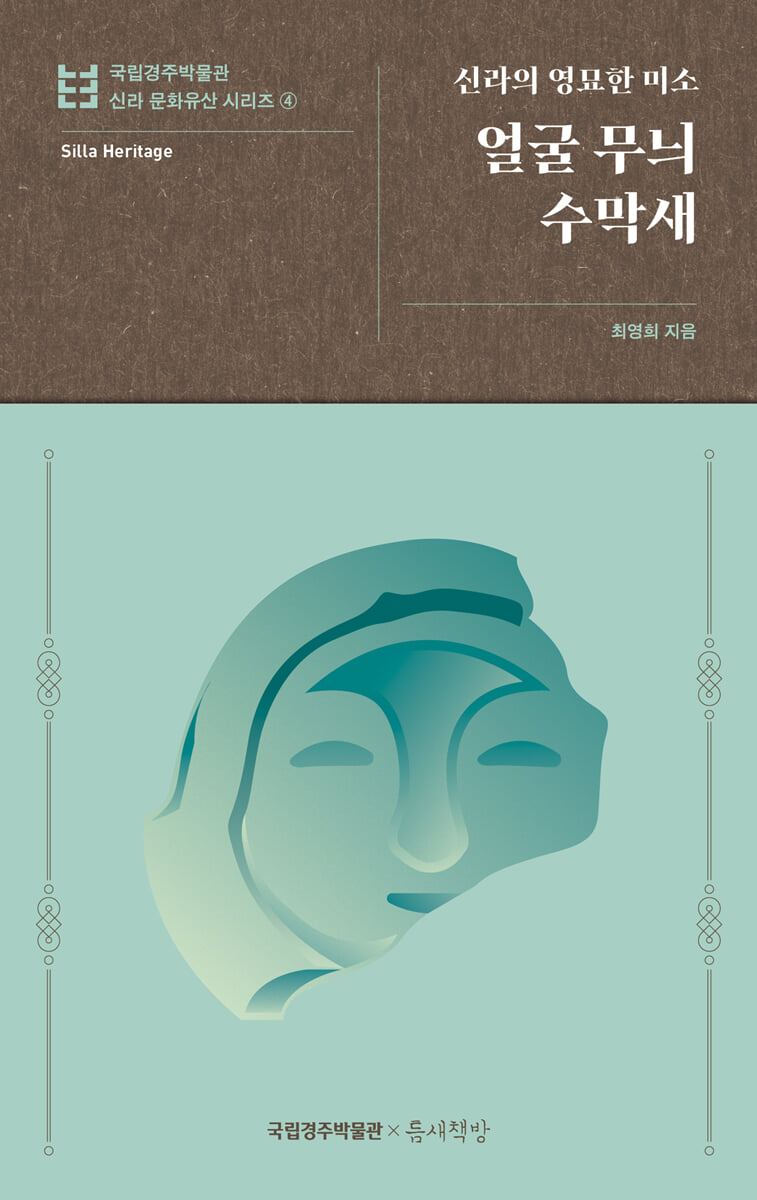
The fourth treasure in the ‘Silla Cultural Heritage Series’ is the face-patterned water-repellent tile.
The 'Face of Silla' face-patterned roof tiles that greet us with a mysterious smile as we enter Gyeongju are a unique relic whose identical pattern cannot be found even today.
It is also a cultural heritage that was discovered during the Japanese colonial period at Yeongmyosa Temple, which is full of anecdotes about Queen Seondeok, and then returned to its homeland after a long journey across the border.
It was the first tile to be designated as a national treasure.
《Face-patterned Sumaksae》 attempts to reveal the location and uniqueness of the face-patterned sumaksae produced in the first half of the 7th century through comparison with sumaksae from East Asia, including China and Japan, and through syntactic analysis.
It also stimulates the reader's historical imagination by presenting a process of tracing who became the model for the 'Millennium Smile'.
Reading “Face-patterned Roof Tiles” will allow you to imagine the feelings of the Silla potters, a thousand years later, as they created the face-patterned roof tiles and placed them on the roof.
A friendly guidebook that provides a clue to appreciating the face-patterned water lily, also known as the "Millennium Smile."
A guide that explains the long journey from the excavation site to the museum, including the production process and its meaning in an easy-to-understand and detailed manner.
The 'Silla Cultural Heritage Series' is a series planned by the Gyeongju National Museum to provide higher-quality and differentiated exhibition commentary.
The following are explained: the Cheonmachong gold crown, golden sword, earthenware-decorated jar, face-patterned water taps, Hwangryongsa chimi, King Seongdeok's new bell, Baekryulsa gilt-bronze Bhaisajyaguru Buddha statue, Gim Eunsa sarira reliquary, Jangchanggok stone Maitreya triad, and gilt-bronze scissors with a wick.
The ten treasures featured in this series were selected through direct voting by visitors to the National Gyeongju Museum.
In other words, it can be said to be the Silla cultural heritage most loved by Koreans.
The "Silla Cultural Heritage Series" was written by current and former curators and Korea's top researchers who are most familiar with and have extensive experience with the artifacts, all written in a way that is accessible to the general public.
It can be said to be a guidebook that combines reliability and popularity in its interpretation of relics.
It contains a wealth of photos of artifacts that cannot be found anywhere else, and difficult historical terms are explained separately to help with understanding.
The fourth treasure in the ‘Silla Cultural Heritage Series’ is the face-patterned water-repellent tile.
The 'Face of Silla' face-patterned roof tiles that greet us with a mysterious smile as we enter Gyeongju are a unique relic whose identical pattern cannot be found even today.
It is also a cultural heritage that was discovered during the Japanese colonial period at Yeongmyosa Temple, which is full of anecdotes about Queen Seondeok, and then returned to its homeland after a long journey across the border.
It was the first tile to be designated as a national treasure.
《Face-patterned Sumaksae》 attempts to reveal the location and uniqueness of the face-patterned sumaksae produced in the first half of the 7th century through comparison with sumaksae from East Asia, including China and Japan, and through syntactic analysis.
It also stimulates the reader's historical imagination by presenting a process of tracing who became the model for the 'Millennium Smile'.
Reading “Face-patterned Roof Tiles” will allow you to imagine the feelings of the Silla potters, a thousand years later, as they created the face-patterned roof tiles and placed them on the roof.
- You can preview some of the book's contents.
Preview
index
· Introductory remarks
Ⅰ.
The Journey of the Face-Patterned Water Lily
Ⅱ.
Uses of the face-patterned roof tiles, Yeongmyosa Temple
Ⅲ.
Making of face-patterned water-blocking tiles
Ⅳ.
Roof tiles with facial patterns
V.
Whose face is it?
· Outgoing words
· Glossary of Terms
· References
Ⅰ.
The Journey of the Face-Patterned Water Lily
Ⅱ.
Uses of the face-patterned roof tiles, Yeongmyosa Temple
Ⅲ.
Making of face-patterned water-blocking tiles
Ⅳ.
Roof tiles with facial patterns
V.
Whose face is it?
· Outgoing words
· Glossary of Terms
· References
Into the book
During the Unified Silla period, various motifs were added to the water curtains, such as two birds paired together, a lion with a mane, and a Garubinga, an imaginary bird with a human head and arms and wings and a tail.
In this flow, there is a unique pattern that particularly catches the eye, which is the face pattern (人面文) water curtain.
---From "Introductory Remarks"
It was Tanaka's most treasured and favorite artifact among his lifelong collection, so he wanted to keep it by his side.
According to the bereaved family, Tanaka kept the face-patterned water dropwort in his room and always admired it.
If you observe the actual face-patterned roof tiles, you can clearly feel the traces of love they have received over time, as they have been smoothed by human hands for a long time, unlike other roof tiles collected from historical sites.
---From "The Journey of the Face-Patterned Water Lily"
There are many stories about Yeongmyosa Temple that are as mysterious as its name.
One of them is the story of Queen Seondeok hearing the croaking of frogs in the middle of winter at the Okmunji Pond of Yeongmyosa Temple, realizing that the Baekje army was lying in ambush at Yeogeungok Valley, and annihilating them.
There is also a legend that a spirit who was in love with Queen Seondeok waited for her in front of Yeongmyosa Temple, and while she was asleep, he saw a gold bracelet left by the king and his love burned down the pagoda.
---From "The Clay Doll We Met Again"
The artifacts excavated from Gyerim-ro and Nodong-dong are the same long-necked jars, but their detailed designs are very different.
The Gyerim-ro wooden jar has a round body like a ball, but the Nodong-dong excavated jar has square shoulders and the center of the body is cut in half like a round ball.
---From "The Uses of Face-Patterned Water-Cutting Cloths, Yeongmyosa"
Until now, the prevailing opinion was that the face-patterned water-covered tiles were not made from clay, but were shaped by hand.
Compared to the lotus patterned water curtain, in which petals of the same shape and size are evenly spread out around the ovary, which is a round pedestal, the asymmetrical structure of the face pattern and the somewhat rough expression make it look like the result of handwork.
However, if you actually observe the face-patterned roof tiles, you can see the wood grain marks characteristic of wooden roof tiles all over the roof tiles.
---From "Making a Face-Patterned Water Lily"
Imagine a scene where face-patterned eaves made from tiles are placed side by side at the end of the eaves.
It gives a different impression from the appearance of the roof decorated with lotus flowers.
As it has been used as a pattern on roof tiles for a long time and over a wide area, the expression of facial features also appears in a variety of ways.
---From "Tiles with Face Patterns"
Our face-patterned water dropwort is a unique entity that has never been found with the same pattern.
In the current situation where there are no direct records or similar cases left, it is difficult to determine how the face-patterned watermark was made.
By carving a pattern on a wooden frame, stamping the frame into clay, attaching a sukiwa, and firing it in a kiln, the craftsman must have had someone in mind.
In this flow, there is a unique pattern that particularly catches the eye, which is the face pattern (人面文) water curtain.
---From "Introductory Remarks"
It was Tanaka's most treasured and favorite artifact among his lifelong collection, so he wanted to keep it by his side.
According to the bereaved family, Tanaka kept the face-patterned water dropwort in his room and always admired it.
If you observe the actual face-patterned roof tiles, you can clearly feel the traces of love they have received over time, as they have been smoothed by human hands for a long time, unlike other roof tiles collected from historical sites.
---From "The Journey of the Face-Patterned Water Lily"
There are many stories about Yeongmyosa Temple that are as mysterious as its name.
One of them is the story of Queen Seondeok hearing the croaking of frogs in the middle of winter at the Okmunji Pond of Yeongmyosa Temple, realizing that the Baekje army was lying in ambush at Yeogeungok Valley, and annihilating them.
There is also a legend that a spirit who was in love with Queen Seondeok waited for her in front of Yeongmyosa Temple, and while she was asleep, he saw a gold bracelet left by the king and his love burned down the pagoda.
---From "The Clay Doll We Met Again"
The artifacts excavated from Gyerim-ro and Nodong-dong are the same long-necked jars, but their detailed designs are very different.
The Gyerim-ro wooden jar has a round body like a ball, but the Nodong-dong excavated jar has square shoulders and the center of the body is cut in half like a round ball.
---From "The Uses of Face-Patterned Water-Cutting Cloths, Yeongmyosa"
Until now, the prevailing opinion was that the face-patterned water-covered tiles were not made from clay, but were shaped by hand.
Compared to the lotus patterned water curtain, in which petals of the same shape and size are evenly spread out around the ovary, which is a round pedestal, the asymmetrical structure of the face pattern and the somewhat rough expression make it look like the result of handwork.
However, if you actually observe the face-patterned roof tiles, you can see the wood grain marks characteristic of wooden roof tiles all over the roof tiles.
---From "Making a Face-Patterned Water Lily"
Imagine a scene where face-patterned eaves made from tiles are placed side by side at the end of the eaves.
It gives a different impression from the appearance of the roof decorated with lotus flowers.
As it has been used as a pattern on roof tiles for a long time and over a wide area, the expression of facial features also appears in a variety of ways.
---From "Tiles with Face Patterns"
Our face-patterned water dropwort is a unique entity that has never been found with the same pattern.
In the current situation where there are no direct records or similar cases left, it is difficult to determine how the face-patterned watermark was made.
By carving a pattern on a wooden frame, stamping the frame into clay, attaching a sukiwa, and firing it in a kiln, the craftsman must have had someone in mind.
---From "Outgoing Words"
Publisher's Review
·A story no one knew, contained in a familiar face-patterned water drop.
· Proposing a proactive historical experience rather than passive information acquisition
Gyeongju National Museum, Korea's representative museum where you can see Silla's history and culture at a glance, has released an in-depth guide to its artifacts.
Among the many exhibits, we have selected the 10 most popular artifacts among visitors to the National Gyeongju Museum.
From a curator's perspective, the exhibition follows a trend of change from the traditional exhibition method that focused on conveying information to the current process of allowing visitors to actively experience various histories.
The photos are as vivid as the splendid relics, making you feel awe and excitement.
A sad cultural heritage that had to embark on a long journey across borders
The path of the face-patterned water droplets to the National Gyeongju Museum was anything but ordinary.
It was discovered during the Japanese colonial period and was treasured by a Japanese collector, but was returned to its original place through the efforts of many people, leaving traces of human touch over a long period of time.
The place where it was discovered is also the site of Yeongmyosa Temple, which was known to have changed locations from Heungryunsa Temple for a long time.
Although the circumstances at the time of excavation are unknown, we can estimate the time and location of the creation of the facial patterned watermark based on what we know so far.
A masterpiece that embodies Silla's excellent tile-making technology.
The face-patterned roof tile was the first to be designated as a national treasure.
It is so unique in its shape that it is hard to find similar artifacts, so it is easy to think that it was shaped by hand.
By synthesizing the research results of various scholars up to this point, it is proven that the facial patterned roof tiles were also manufactured using wooden molds.
We will examine in detail the various techniques used to make sumaksae and learn about the time period and method by which face-patterned sumaksae were made.
Whose face is this?
People in the past put patterns on roof tiles to express their wishes.
They used lotus patterns, which symbolize Buddhism, or carved the faces of goblins or dragons to ward off bad luck.
So, what significance did the eaves hold for the face, with its gentle smile, neither menacing nor frightening? Whom might the Silla potter have in mind when he carved such a face into a wooden mold? This provides clues that can be felt and appreciated for oneself when visiting the museum and standing before the artifacts themselves.
Gyeongju National Museum Planning Series: A Complete Guidebook on 10 Popular Treasures Representing Silla's Millennium
Current and former curators at the National Museum of Korea and Korea's leading researchers will reveal stories never before told in the exhibition hall, from the excavation of artifacts to new findings from recent research.
Detailed photos, available only at museums, allow you to see the artifacts more clearly than in person.
It suggests a way to view and understand relics from a researcher's perspective, while also providing various perspectives on exhibits.
If you visit the National Gyeongju Museum after reading this book, you will feel that your perspective on artifacts has become much deeper and broader.
· Proposing a proactive historical experience rather than passive information acquisition
Gyeongju National Museum, Korea's representative museum where you can see Silla's history and culture at a glance, has released an in-depth guide to its artifacts.
Among the many exhibits, we have selected the 10 most popular artifacts among visitors to the National Gyeongju Museum.
From a curator's perspective, the exhibition follows a trend of change from the traditional exhibition method that focused on conveying information to the current process of allowing visitors to actively experience various histories.
The photos are as vivid as the splendid relics, making you feel awe and excitement.
A sad cultural heritage that had to embark on a long journey across borders
The path of the face-patterned water droplets to the National Gyeongju Museum was anything but ordinary.
It was discovered during the Japanese colonial period and was treasured by a Japanese collector, but was returned to its original place through the efforts of many people, leaving traces of human touch over a long period of time.
The place where it was discovered is also the site of Yeongmyosa Temple, which was known to have changed locations from Heungryunsa Temple for a long time.
Although the circumstances at the time of excavation are unknown, we can estimate the time and location of the creation of the facial patterned watermark based on what we know so far.
A masterpiece that embodies Silla's excellent tile-making technology.
The face-patterned roof tile was the first to be designated as a national treasure.
It is so unique in its shape that it is hard to find similar artifacts, so it is easy to think that it was shaped by hand.
By synthesizing the research results of various scholars up to this point, it is proven that the facial patterned roof tiles were also manufactured using wooden molds.
We will examine in detail the various techniques used to make sumaksae and learn about the time period and method by which face-patterned sumaksae were made.
Whose face is this?
People in the past put patterns on roof tiles to express their wishes.
They used lotus patterns, which symbolize Buddhism, or carved the faces of goblins or dragons to ward off bad luck.
So, what significance did the eaves hold for the face, with its gentle smile, neither menacing nor frightening? Whom might the Silla potter have in mind when he carved such a face into a wooden mold? This provides clues that can be felt and appreciated for oneself when visiting the museum and standing before the artifacts themselves.
Gyeongju National Museum Planning Series: A Complete Guidebook on 10 Popular Treasures Representing Silla's Millennium
Current and former curators at the National Museum of Korea and Korea's leading researchers will reveal stories never before told in the exhibition hall, from the excavation of artifacts to new findings from recent research.
Detailed photos, available only at museums, allow you to see the artifacts more clearly than in person.
It suggests a way to view and understand relics from a researcher's perspective, while also providing various perspectives on exhibits.
If you visit the National Gyeongju Museum after reading this book, you will feel that your perspective on artifacts has become much deeper and broader.
GOODS SPECIFICS
- Date of issue: December 15, 2023
- Page count, weight, size: 76 pages | 194g | 120*190*8mm
- ISBN13: 9791188949588
- ISBN10: 1188949586
You may also like
카테고리
korean


korean

![GQ KOREA Mark (Monthly): December [2025]](http://librairie.coreenne.fr/cdn/shop/files/8ef265dbbfbf186523ed75ba7319009d.jpg?v=1765340328&width=3840)


