

Reading method to get full marks
 |
Description
Book Introduction
The Perfect Korean Language Performance Assessment Success Strategy!!
A must-read for achieving a perfect score on performance assessments, packed with Gangnam academy district know-how.
In the age of textbook literacy, writing and expressive skills are now key.
Middle school students are exposed to Korean language performance assessments in the form of written work such as book reports, book reviews, and appreciations, as well as presentations and descriptive assessments. Most students tend to view these as opportunities to directly express their thoughts, either verbally or in writing.
However, they feel that the preparation process is long and burdensome, and they especially complain about difficulties in the process of deeply understanding the topic and refining their expressions when writing or presenting.
Additionally, students who lack regular reading habits tend to rush through books or rely on AI and search engines to reduce the burden of writing logically or expressing their thoughts.
However, they are unable to achieve satisfactory results and instead develop an aversion to the performance evaluation itself.
This will only lead to a vicious cycle where students will not be able to properly understand the curriculum and will not be able to properly take performance assessments as they advance in grade level.
Starting with reading comprehension and completing with confident writing.
"Performance Perfect Reading Method" is more than just reading a book; it is a practical study training book developed in line with middle and high school Korean language performance assessment methods and the latest perfect score strategies of Gangnam academies.
This book is designed to perfectly prepare students for the types of performance assessments they frequently encounter (book reviews, reading reports, topic research reports, etc.).
If students consistently practice with this book, they will be able to complete a virtuous cycle of self-directed learning: reading, thinking, and expressing themselves in writing.
Through short and effective training, you will be able to quickly improve your reading comprehension, vocabulary, and logical thinking and writing skills, which will lead to a perfect score on the Korean language proficiency test.
Therefore, this book is strongly recommended to students who have vague fears about the Korean language proficiency test before entering middle school, students who read diligently but have difficulty writing book reviews or reports, and parents who want to help their children not give up on studying by fostering the ability to think for themselves rather than simply memorizing.
I hope that by consistently studying with the "Perfect Performance Reading Method," you will escape the swamp of giving up on studying and lay the foundation for self-directed learning.
A must-read for achieving a perfect score on performance assessments, packed with Gangnam academy district know-how.
In the age of textbook literacy, writing and expressive skills are now key.
Middle school students are exposed to Korean language performance assessments in the form of written work such as book reports, book reviews, and appreciations, as well as presentations and descriptive assessments. Most students tend to view these as opportunities to directly express their thoughts, either verbally or in writing.
However, they feel that the preparation process is long and burdensome, and they especially complain about difficulties in the process of deeply understanding the topic and refining their expressions when writing or presenting.
Additionally, students who lack regular reading habits tend to rush through books or rely on AI and search engines to reduce the burden of writing logically or expressing their thoughts.
However, they are unable to achieve satisfactory results and instead develop an aversion to the performance evaluation itself.
This will only lead to a vicious cycle where students will not be able to properly understand the curriculum and will not be able to properly take performance assessments as they advance in grade level.
Starting with reading comprehension and completing with confident writing.
"Performance Perfect Reading Method" is more than just reading a book; it is a practical study training book developed in line with middle and high school Korean language performance assessment methods and the latest perfect score strategies of Gangnam academies.
This book is designed to perfectly prepare students for the types of performance assessments they frequently encounter (book reviews, reading reports, topic research reports, etc.).
If students consistently practice with this book, they will be able to complete a virtuous cycle of self-directed learning: reading, thinking, and expressing themselves in writing.
Through short and effective training, you will be able to quickly improve your reading comprehension, vocabulary, and logical thinking and writing skills, which will lead to a perfect score on the Korean language proficiency test.
Therefore, this book is strongly recommended to students who have vague fears about the Korean language proficiency test before entering middle school, students who read diligently but have difficulty writing book reviews or reports, and parents who want to help their children not give up on studying by fostering the ability to think for themselves rather than simply memorizing.
I hope that by consistently studying with the "Perfect Performance Reading Method," you will escape the swamp of giving up on studying and lay the foundation for self-directed learning.
- You can preview some of the book's contents.
Preview
index
prolog
How to use this book
Author classification
Curriculum-linked writing composition
Linking the 2022 Revised Curriculum's Achievement Standards for Each Secondary Korean Language Subject
PART 1 Poverty and Social Inequality
01 "The Poor" _ Victor Hugo
02 "The Necklace" _Guy de Maupassant
03 "The True Story of Ah Q" _Lu Xun
04 "The Chair Repairer" _Guy de Maupassant
PART 2 Power and Injustice
01 "Rain" _Grace A.
Ogot
02 "A Drink in the Hallway" _ Alan Payton
03 "The Overcoat" _Nikolai Gogol
04 "Chameleon" _Anton Chekhov
PART 3: QUESTIONS OF LIFE AND DEATH
01 "The Old Man and the Sea" _Ernest Hemingway
02 "Rashomon" _ Ryunosuke Akutagawa
03 "Three Questions" _ Leo Tolstoy
04 "The Death of Ivan Ilyich" _ Leo Tolstoy
PART 4 The Power of Right Choices and Community
01 "Reclaimed Conscience" _ O. Henry
02 "The Last Lesson" _Alphonse Daudet
03 "Twenty Years Later" _ O. Henry
04 "The Secret of Cornille's Inspiration" _Alphonse Daudet
PART 5 Anxiety and Conflict in the Heart
01 "Garden Party" _ Katherine Mansfield
02 "Butterfly" _Hermann Hesse
03 "The Lighthouse Keeper" _Henrik Sienkiewicz
04 "The Fat Gentleman" _Washington Irving
PART 6 Imagination Beyond Reality
01 "The Black Cat" _Edgar Allan Poe
02 "The Metamorphosis" _Franz Kafka
03 "The Monkey's Paw" _William Wymark Jacobs
04 "The Man with the Golden Brain" _Alphonse Daudet
Epilogue
How to use this book
Author classification
Curriculum-linked writing composition
Linking the 2022 Revised Curriculum's Achievement Standards for Each Secondary Korean Language Subject
PART 1 Poverty and Social Inequality
01 "The Poor" _ Victor Hugo
02 "The Necklace" _Guy de Maupassant
03 "The True Story of Ah Q" _Lu Xun
04 "The Chair Repairer" _Guy de Maupassant
PART 2 Power and Injustice
01 "Rain" _Grace A.
Ogot
02 "A Drink in the Hallway" _ Alan Payton
03 "The Overcoat" _Nikolai Gogol
04 "Chameleon" _Anton Chekhov
PART 3: QUESTIONS OF LIFE AND DEATH
01 "The Old Man and the Sea" _Ernest Hemingway
02 "Rashomon" _ Ryunosuke Akutagawa
03 "Three Questions" _ Leo Tolstoy
04 "The Death of Ivan Ilyich" _ Leo Tolstoy
PART 4 The Power of Right Choices and Community
01 "Reclaimed Conscience" _ O. Henry
02 "The Last Lesson" _Alphonse Daudet
03 "Twenty Years Later" _ O. Henry
04 "The Secret of Cornille's Inspiration" _Alphonse Daudet
PART 5 Anxiety and Conflict in the Heart
01 "Garden Party" _ Katherine Mansfield
02 "Butterfly" _Hermann Hesse
03 "The Lighthouse Keeper" _Henrik Sienkiewicz
04 "The Fat Gentleman" _Washington Irving
PART 6 Imagination Beyond Reality
01 "The Black Cat" _Edgar Allan Poe
02 "The Metamorphosis" _Franz Kafka
03 "The Monkey's Paw" _William Wymark Jacobs
04 "The Man with the Golden Brain" _Alphonse Daudet
Epilogue
Detailed image
.jpg)
Publisher's Review
“Literacy is basic, and expressive ability is competitiveness.
The only book that perfectly prepares you for performance assessments and college entrance essays.
“Establish a new standard for achieving a perfect score in Korean language proficiency with ‘Performance Perfect Reading Method.’”
The core of Korean language performance assessment is not memorization, but expressive and thinking skills.
"Performance Perfect Reading Method" is a self-directed Korean language study book that perfectly prepares students for the major types of middle school performance assessments and develops the ability to think independently and construct logical writing.
This book is composed mainly of 24 short stories from around the world selected by the authors, who are reading guidance experts.
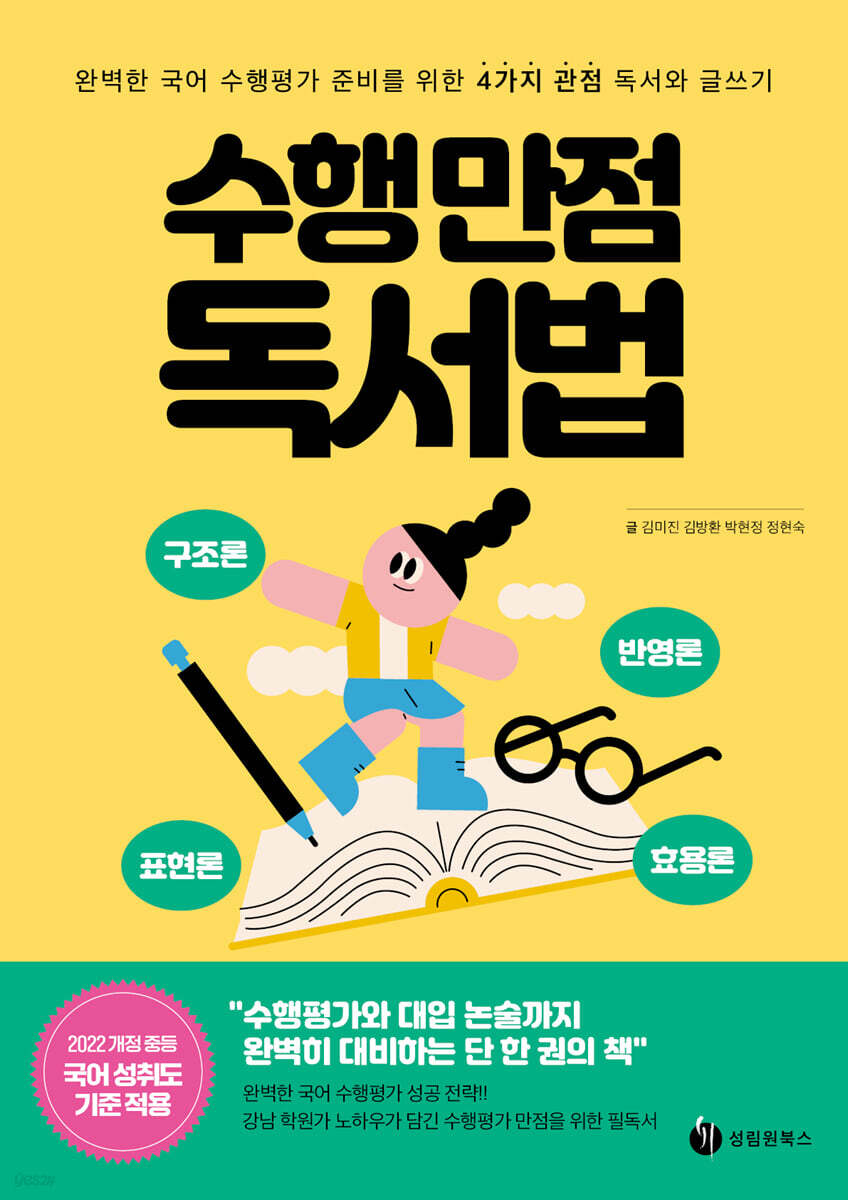
Rather than simply reading the work, we applied four perspectives for interpreting literature: structuralism, reflection, expressionism, and utility theory, allowing for two perspectives for analyzing and critically appreciating each work.
Through this, students will be able to develop not only reading comprehension but also critical thinking and creative writing skills.
Additionally, the book includes a variety of curriculum-related writing activities, such as writing interview scripts, book reports, argumentative essays, autobiographies, and discussion papers, allowing students to practice writing styles that frequently appear in performance assessments as if they were real-life situations.
In this process, students will naturally acquire vocabulary, sentence structure, and spelling skills, and will be able to develop the ability to express their thoughts clearly.
Above all, 『Performance Perfect Reading Method』 contains high-score strategies and study know-how proven in the Gangnam academy district.
Reflecting the latest educational trends and the direction of the 2028 college entrance exam reform, it has been designed to prepare students for Korean language proficiency tests and descriptive and essay-based assessments all at once.
Therefore, through this book, students will be able to train their literacy skills as well as logical and systematic writing skills without wasting time, and furthermore, they will be able to confirm their own growth process and improvement in skills.
Recently, the direction of education has changed from 'how much you memorize' to 'how deeply you think and express yourself.'
In particular, with the full implementation of the high school credit system, the importance of performance evaluations has increased, and integrated thinking and logical writing skills have emerged as crucial competitive factors in college entrance exams. Therefore, "Performance Perfect Reading Method" will be the optimal guidebook for developing the literacy, thinking, and expressive skills that students must possess in a balanced manner amidst these changing times.
The only book that perfectly prepares you for performance assessments and college entrance essays.
“Establish a new standard for achieving a perfect score in Korean language proficiency with ‘Performance Perfect Reading Method.’”
The core of Korean language performance assessment is not memorization, but expressive and thinking skills.
"Performance Perfect Reading Method" is a self-directed Korean language study book that perfectly prepares students for the major types of middle school performance assessments and develops the ability to think independently and construct logical writing.
This book is composed mainly of 24 short stories from around the world selected by the authors, who are reading guidance experts.
Rather than simply reading the work, we applied four perspectives for interpreting literature: structuralism, reflection, expressionism, and utility theory, allowing for two perspectives for analyzing and critically appreciating each work.
Through this, students will be able to develop not only reading comprehension but also critical thinking and creative writing skills.
Additionally, the book includes a variety of curriculum-related writing activities, such as writing interview scripts, book reports, argumentative essays, autobiographies, and discussion papers, allowing students to practice writing styles that frequently appear in performance assessments as if they were real-life situations.
In this process, students will naturally acquire vocabulary, sentence structure, and spelling skills, and will be able to develop the ability to express their thoughts clearly.
Above all, 『Performance Perfect Reading Method』 contains high-score strategies and study know-how proven in the Gangnam academy district.
Reflecting the latest educational trends and the direction of the 2028 college entrance exam reform, it has been designed to prepare students for Korean language proficiency tests and descriptive and essay-based assessments all at once.
Therefore, through this book, students will be able to train their literacy skills as well as logical and systematic writing skills without wasting time, and furthermore, they will be able to confirm their own growth process and improvement in skills.
Recently, the direction of education has changed from 'how much you memorize' to 'how deeply you think and express yourself.'
In particular, with the full implementation of the high school credit system, the importance of performance evaluations has increased, and integrated thinking and logical writing skills have emerged as crucial competitive factors in college entrance exams. Therefore, "Performance Perfect Reading Method" will be the optimal guidebook for developing the literacy, thinking, and expressive skills that students must possess in a balanced manner amidst these changing times.
[Author's Note]
Performance evaluation, this is how to do it perfectly.
Students who get perfect scores on performance assessments are those who read the key points accurately and clearly understand the requirements.
When reading a passage or book, try to highlight the author's arguments and key sentences.
If you can summarize the theme of the book in one sentence, you're already halfway there.
The starting point of evaluation is always ‘reading.’
1.
Check the evaluation criteria carefully
Many students often underestimate the importance of performance assessments compared to written exams.
The weight of the performance evaluation is so great that it is used to evaluate subject achievement based solely on the results of the performance evaluation.
Therefore, it is most important to accurately understand and prepare for the evaluation criteria.
Topic, volume, and format are the 'rules' of performance evaluation.
If you go beyond the requirements, you will lose points no matter how well you write.
It requires the ability to accurately describe the direction that fits the criteria.
2.
Answer the question with reason
When evaluating performance, it is important to accurately understand the intent of the question and provide supporting evidence to answer.
For example, if the question is, “What are the character’s emotions in this scene?”, you should make a judgment based on the expressions and actions in the text rather than interpreting the character’s emotions arbitrarily.
Personal opinions or vague speculations unrelated to the text will result in a deduction of points.
“Find the basis for the question in the text.” This is the basic principle of answering performance assessments.
3.
Expressing thoughts logically
Good writing has a clear structure and concrete ideas.
Even if it is a short text, keep the flow as follows: ① claim → ② evidence → ③ example or conclusion.
If the introduction, body, and conclusion are clear, the writing will be stable and will be clearly conveyed to the evaluator.
Also, don't stop at simply summarizing what you've read; clearly express 'my thoughts' within it.
The persuasiveness of an article increases when you present specific reasons and evidence rather than vague impressions.
4.
Consider your career path through various subject performance assessments.
The writing skills developed in the Korean language curriculum are the basis for all subject performance assessments.
In science, each subject evaluates both thinking and expressive skills, such as writing a lab report that organizes and analyzes the results of an experiment; in social studies, writing a persuasive or problem-solving essay on a social issue; and in English, writing a piece introducing a person you admire or your dream in English.
These performance assessments are not just about testing your knowledge; they are also a process of discovering your interests and strengths and exploring your career path.
5.
Practice in advance
Because the performance evaluation time is short, it is difficult to organize it logically if you write spontaneously.
Moreover, performance assessments for multiple subjects are often conducted simultaneously at similar times.
Once the evaluation topic is announced, try to practice briefly organizing your experiences and thoughts in advance.
Since the schedules for each subject overlap and you may have to prepare several assignments at once, it is a good idea to develop the habit of reading books and organizing your thoughts on a regular basis.
If you are prepared like this, it will be much easier to understand any topic naturally and express it logically.
Consistent practice will soon lead to confidence in performance evaluation.
The key to performance assessment is not the skill of writing well, but the ability to express thoughts clearly.
Students who grasp the main points of what they read, organize their thoughts logically, and express them in sentences will ultimately get high scores.
In other words, writing a performance evaluation is a process of developing the ability to ‘reconstruct what you have learned in your own words.’
Performance assessments become more important as students advance in grade level.
In middle school, students develop their thinking and expressive skills, and in high school, the results become a process that leads to career paths and college entrance exams.
As these experiences accumulate, they will solidify your thinking, and the process will soon become a study that will lead to your own growth.
《3 Questions and 3 Answers with the Author》
1.
What kind of book is "Perfect Reading Method for Performance"?
"Performance Perfect Reading Method" is a systematic reading training book that not only prepares for performance assessments, but also deeply understands literature and develops thinking and expressive skills.
By presenting four literary perspectives—structuralism, reflection, expression, and utility—centered on 24 short stories from around the world, this book fosters the ability to read and interpret a single work from various angles.
Additionally, you will learn how to organize your emotions and thoughts within the work, discover new perspectives, and express them in your own words.
It provides teachers with guidance on lesson design and parents with specific instructions to help their children learn.
2.
Why is the Korean language performance assessment important?
The core of performance assessment is the ability to reconstruct what has been learned in one's own words.
In this process, students develop thinking, critical, and expressive skills, which serve as the common foundation for all academic performance assessments.
The writing skills developed through the Korean language proficiency assessment go beyond academic achievement and serve as a starting point for career exploration and self-growth, empowering students to transform their thoughts into realistic competitiveness.
3.
What are your priority strategies and study methods for future college entrance exams?
Recently, the college entrance exam has shifted its focus to thinking, reading, and expressive skills, and the proportion of internal grades reflected in the exam is also gradually increasing.
In particular, the Korean language subject is placing increasing weight on performance assessment, and the scope of assessment is expanding to encompass reading, literature, speaking, and writing, requiring extensive preparation.
Accordingly, it is necessary to move beyond simple rote memorization and train oneself to understand the direction and criteria of evaluation and to logically organize one's thoughts.
"Performance-Perfect Reading Method" is the most practical preparation book to help students develop the ability to structure their thoughts and express them in a way that meets the evaluation criteria in a changing college entrance exam environment.
[Author's Note]
Performance evaluation, this is how to do it perfectly.
Students who get perfect scores on performance assessments are those who read the key points accurately and clearly understand the requirements.
When reading a passage or book, try to highlight the author's arguments and key sentences.
If you can summarize the theme of the book in one sentence, you're already halfway there.
The starting point of evaluation is always ‘reading.’
1.
Check the evaluation criteria carefully
Many students often underestimate the importance of performance assessments compared to written exams.
The weight of the performance evaluation is so great that it is used to evaluate subject achievement based solely on the results of the performance evaluation.
Therefore, it is most important to accurately understand and prepare for the evaluation criteria.
Topic, volume, and format are the 'rules' of performance evaluation.
If you go beyond the requirements, you will lose points no matter how well you write.
It requires the ability to accurately describe the direction that fits the criteria.
2.
Answer the question with reason
When evaluating performance, it is important to accurately understand the intent of the question and provide supporting evidence to answer.
For example, if the question is, “What are the character’s emotions in this scene?”, you should make a judgment based on the expressions and actions in the text rather than interpreting the character’s emotions arbitrarily.
Personal opinions or vague speculations unrelated to the text will result in a deduction of points.
“Find the basis for the question in the text.” This is the basic principle of answering performance assessments.
3.
Expressing thoughts logically
Good writing has a clear structure and concrete ideas.
Even if it is a short text, keep the flow as follows: ① claim → ② evidence → ③ example or conclusion.
If the introduction, body, and conclusion are clear, the writing will be stable and will be clearly conveyed to the evaluator.
Also, don't stop at simply summarizing what you've read; clearly express 'my thoughts' within it.
The persuasiveness of an article increases when you present specific reasons and evidence rather than vague impressions.
4.
Consider your career path through various subject performance assessments.
The writing skills developed in the Korean language curriculum are the basis for all subject performance assessments.
In science, each subject evaluates both thinking and expressive skills, such as writing a lab report that organizes and analyzes the results of an experiment; in social studies, writing a persuasive or problem-solving essay on a social issue; and in English, writing a piece introducing a person you admire or your dream in English.
These performance assessments are not just about testing your knowledge; they are also a process of discovering your interests and strengths and exploring your career path.
5.
Practice in advance
Because the performance evaluation time is short, it is difficult to organize it logically if you write spontaneously.
Moreover, performance assessments for multiple subjects are often conducted simultaneously at similar times.
Once the evaluation topic is announced, try to practice briefly organizing your experiences and thoughts in advance.
Since the schedules for each subject overlap and you may have to prepare several assignments at once, it is a good idea to develop the habit of reading books and organizing your thoughts on a regular basis.
If you are prepared like this, it will be much easier to understand any topic naturally and express it logically.
Consistent practice will soon lead to confidence in performance evaluation.
The key to performance assessment is not the skill of writing well, but the ability to express thoughts clearly.
Students who grasp the main points of what they read, organize their thoughts logically, and express them in sentences will ultimately get high scores.
In other words, writing a performance evaluation is a process of developing the ability to ‘reconstruct what you have learned in your own words.’
Performance assessments become more important as students advance in grade level.
In middle school, students develop their thinking and expressive skills, and in high school, the results become a process that leads to career paths and college entrance exams.
As these experiences accumulate, they will solidify your thinking, and the process will soon become a study that will lead to your own growth.
《3 Questions and 3 Answers with the Author》
1.
What kind of book is "Perfect Reading Method for Performance"?
"Performance Perfect Reading Method" is a systematic reading training book that not only prepares for performance assessments, but also deeply understands literature and develops thinking and expressive skills.
By presenting four literary perspectives—structuralism, reflection, expression, and utility—centered on 24 short stories from around the world, this book fosters the ability to read and interpret a single work from various angles.
Additionally, you will learn how to organize your emotions and thoughts within the work, discover new perspectives, and express them in your own words.
It provides teachers with guidance on lesson design and parents with specific instructions to help their children learn.
2.
Why is the Korean language performance assessment important?
The core of performance assessment is the ability to reconstruct what has been learned in one's own words.
In this process, students develop thinking, critical, and expressive skills, which serve as the common foundation for all academic performance assessments.
The writing skills developed through the Korean language proficiency assessment go beyond academic achievement and serve as a starting point for career exploration and self-growth, empowering students to transform their thoughts into realistic competitiveness.
3.
What are your priority strategies and study methods for future college entrance exams?
Recently, the college entrance exam has shifted its focus to thinking, reading, and expressive skills, and the proportion of internal grades reflected in the exam is also gradually increasing.
In particular, the Korean language subject is placing increasing weight on performance assessment, and the scope of assessment is expanding to encompass reading, literature, speaking, and writing, requiring extensive preparation.
Accordingly, it is necessary to move beyond simple rote memorization and train oneself to understand the direction and criteria of evaluation and to logically organize one's thoughts.
"Performance-Perfect Reading Method" is the most practical preparation book to help students develop the ability to structure their thoughts and express them in a way that meets the evaluation criteria in a changing college entrance exam environment.
Performance evaluation, this is how to do it perfectly.
Students who get perfect scores on performance assessments are those who read the key points accurately and clearly understand the requirements.
When reading a passage or book, try to highlight the author's arguments and key sentences.
If you can summarize the theme of the book in one sentence, you're already halfway there.
The starting point of evaluation is always ‘reading.’
1.
Check the evaluation criteria carefully
Many students often underestimate the importance of performance assessments compared to written exams.
The weight of the performance evaluation is so great that it is used to evaluate subject achievement based solely on the results of the performance evaluation.
Therefore, it is most important to accurately understand and prepare for the evaluation criteria.
Topic, volume, and format are the 'rules' of performance evaluation.
If you go beyond the requirements, you will lose points no matter how well you write.
It requires the ability to accurately describe the direction that fits the criteria.
2.
Answer the question with reason
When evaluating performance, it is important to accurately understand the intent of the question and provide supporting evidence to answer.
For example, if the question is, “What are the character’s emotions in this scene?”, you should make a judgment based on the expressions and actions in the text rather than interpreting the character’s emotions arbitrarily.
Personal opinions or vague speculations unrelated to the text will result in a deduction of points.
“Find the basis for the question in the text.” This is the basic principle of answering performance assessments.
3.
Expressing thoughts logically
Good writing has a clear structure and concrete ideas.
Even if it is a short text, keep the flow as follows: ① claim → ② evidence → ③ example or conclusion.
If the introduction, body, and conclusion are clear, the writing will be stable and will be clearly conveyed to the evaluator.
Also, don't stop at simply summarizing what you've read; clearly express 'my thoughts' within it.
The persuasiveness of an article increases when you present specific reasons and evidence rather than vague impressions.
4.
Consider your career path through various subject performance assessments.
The writing skills developed in the Korean language curriculum are the basis for all subject performance assessments.
In science, each subject evaluates both thinking and expressive skills, such as writing a lab report that organizes and analyzes the results of an experiment; in social studies, writing a persuasive or problem-solving essay on a social issue; and in English, writing a piece introducing a person you admire or your dream in English.
These performance assessments are not just about testing your knowledge; they are also a process of discovering your interests and strengths and exploring your career path.
5.
Practice in advance
Because the performance evaluation time is short, it is difficult to organize it logically if you write spontaneously.
Moreover, performance assessments for multiple subjects are often conducted simultaneously at similar times.
Once the evaluation topic is announced, try to practice briefly organizing your experiences and thoughts in advance.
Since the schedules for each subject overlap and you may have to prepare several assignments at once, it is a good idea to develop the habit of reading books and organizing your thoughts on a regular basis.
If you are prepared like this, it will be much easier to understand any topic naturally and express it logically.
Consistent practice will soon lead to confidence in performance evaluation.
The key to performance assessment is not the skill of writing well, but the ability to express thoughts clearly.
Students who grasp the main points of what they read, organize their thoughts logically, and express them in sentences will ultimately get high scores.
In other words, writing a performance evaluation is a process of developing the ability to ‘reconstruct what you have learned in your own words.’
Performance assessments become more important as students advance in grade level.
In middle school, students develop their thinking and expressive skills, and in high school, the results become a process that leads to career paths and college entrance exams.
As these experiences accumulate, they will solidify your thinking, and the process will soon become a study that will lead to your own growth.
《3 Questions and 3 Answers with the Author》
1.
What kind of book is "Perfect Reading Method for Performance"?
"Performance Perfect Reading Method" is a systematic reading training book that not only prepares for performance assessments, but also deeply understands literature and develops thinking and expressive skills.
By presenting four literary perspectives—structuralism, reflection, expression, and utility—centered on 24 short stories from around the world, this book fosters the ability to read and interpret a single work from various angles.
Additionally, you will learn how to organize your emotions and thoughts within the work, discover new perspectives, and express them in your own words.
It provides teachers with guidance on lesson design and parents with specific instructions to help their children learn.
2.
Why is the Korean language performance assessment important?
The core of performance assessment is the ability to reconstruct what has been learned in one's own words.
In this process, students develop thinking, critical, and expressive skills, which serve as the common foundation for all academic performance assessments.
The writing skills developed through the Korean language proficiency assessment go beyond academic achievement and serve as a starting point for career exploration and self-growth, empowering students to transform their thoughts into realistic competitiveness.
3.
What are your priority strategies and study methods for future college entrance exams?
Recently, the college entrance exam has shifted its focus to thinking, reading, and expressive skills, and the proportion of internal grades reflected in the exam is also gradually increasing.
In particular, the Korean language subject is placing increasing weight on performance assessment, and the scope of assessment is expanding to encompass reading, literature, speaking, and writing, requiring extensive preparation.
Accordingly, it is necessary to move beyond simple rote memorization and train oneself to understand the direction and criteria of evaluation and to logically organize one's thoughts.
"Performance-Perfect Reading Method" is the most practical preparation book to help students develop the ability to structure their thoughts and express them in a way that meets the evaluation criteria in a changing college entrance exam environment.
[Author's Note]
Performance evaluation, this is how to do it perfectly.
Students who get perfect scores on performance assessments are those who read the key points accurately and clearly understand the requirements.
When reading a passage or book, try to highlight the author's arguments and key sentences.
If you can summarize the theme of the book in one sentence, you're already halfway there.
The starting point of evaluation is always ‘reading.’
1.
Check the evaluation criteria carefully
Many students often underestimate the importance of performance assessments compared to written exams.
The weight of the performance evaluation is so great that it is used to evaluate subject achievement based solely on the results of the performance evaluation.
Therefore, it is most important to accurately understand and prepare for the evaluation criteria.
Topic, volume, and format are the 'rules' of performance evaluation.
If you go beyond the requirements, you will lose points no matter how well you write.
It requires the ability to accurately describe the direction that fits the criteria.
2.
Answer the question with reason
When evaluating performance, it is important to accurately understand the intent of the question and provide supporting evidence to answer.
For example, if the question is, “What are the character’s emotions in this scene?”, you should make a judgment based on the expressions and actions in the text rather than interpreting the character’s emotions arbitrarily.
Personal opinions or vague speculations unrelated to the text will result in a deduction of points.
“Find the basis for the question in the text.” This is the basic principle of answering performance assessments.
3.
Expressing thoughts logically
Good writing has a clear structure and concrete ideas.
Even if it is a short text, keep the flow as follows: ① claim → ② evidence → ③ example or conclusion.
If the introduction, body, and conclusion are clear, the writing will be stable and will be clearly conveyed to the evaluator.
Also, don't stop at simply summarizing what you've read; clearly express 'my thoughts' within it.
The persuasiveness of an article increases when you present specific reasons and evidence rather than vague impressions.
4.
Consider your career path through various subject performance assessments.
The writing skills developed in the Korean language curriculum are the basis for all subject performance assessments.
In science, each subject evaluates both thinking and expressive skills, such as writing a lab report that organizes and analyzes the results of an experiment; in social studies, writing a persuasive or problem-solving essay on a social issue; and in English, writing a piece introducing a person you admire or your dream in English.
These performance assessments are not just about testing your knowledge; they are also a process of discovering your interests and strengths and exploring your career path.
5.
Practice in advance
Because the performance evaluation time is short, it is difficult to organize it logically if you write spontaneously.
Moreover, performance assessments for multiple subjects are often conducted simultaneously at similar times.
Once the evaluation topic is announced, try to practice briefly organizing your experiences and thoughts in advance.
Since the schedules for each subject overlap and you may have to prepare several assignments at once, it is a good idea to develop the habit of reading books and organizing your thoughts on a regular basis.
If you are prepared like this, it will be much easier to understand any topic naturally and express it logically.
Consistent practice will soon lead to confidence in performance evaluation.
The key to performance assessment is not the skill of writing well, but the ability to express thoughts clearly.
Students who grasp the main points of what they read, organize their thoughts logically, and express them in sentences will ultimately get high scores.
In other words, writing a performance evaluation is a process of developing the ability to ‘reconstruct what you have learned in your own words.’
Performance assessments become more important as students advance in grade level.
In middle school, students develop their thinking and expressive skills, and in high school, the results become a process that leads to career paths and college entrance exams.
As these experiences accumulate, they will solidify your thinking, and the process will soon become a study that will lead to your own growth.
《3 Questions and 3 Answers with the Author》
1.
What kind of book is "Perfect Reading Method for Performance"?
"Performance Perfect Reading Method" is a systematic reading training book that not only prepares for performance assessments, but also deeply understands literature and develops thinking and expressive skills.
By presenting four literary perspectives—structuralism, reflection, expression, and utility—centered on 24 short stories from around the world, this book fosters the ability to read and interpret a single work from various angles.
Additionally, you will learn how to organize your emotions and thoughts within the work, discover new perspectives, and express them in your own words.
It provides teachers with guidance on lesson design and parents with specific instructions to help their children learn.
2.
Why is the Korean language performance assessment important?
The core of performance assessment is the ability to reconstruct what has been learned in one's own words.
In this process, students develop thinking, critical, and expressive skills, which serve as the common foundation for all academic performance assessments.
The writing skills developed through the Korean language proficiency assessment go beyond academic achievement and serve as a starting point for career exploration and self-growth, empowering students to transform their thoughts into realistic competitiveness.
3.
What are your priority strategies and study methods for future college entrance exams?
Recently, the college entrance exam has shifted its focus to thinking, reading, and expressive skills, and the proportion of internal grades reflected in the exam is also gradually increasing.
In particular, the Korean language subject is placing increasing weight on performance assessment, and the scope of assessment is expanding to encompass reading, literature, speaking, and writing, requiring extensive preparation.
Accordingly, it is necessary to move beyond simple rote memorization and train oneself to understand the direction and criteria of evaluation and to logically organize one's thoughts.
"Performance-Perfect Reading Method" is the most practical preparation book to help students develop the ability to structure their thoughts and express them in a way that meets the evaluation criteria in a changing college entrance exam environment.
GOODS SPECIFICS
- Date of issue: November 28, 2025
- Page count, weight, size: 304 pages | 548g | 152*215*30mm
- ISBN13: 9791124072042
- ISBN10: 1124072047
You may also like
카테고리
korean


korean

![GQ KOREA Mark (Monthly): December [2025]](http://librairie.coreenne.fr/cdn/shop/files/8ef265dbbfbf186523ed75ba7319009d.jpg?v=1765340328&width=3840)


