

The Origin of Species for Teens
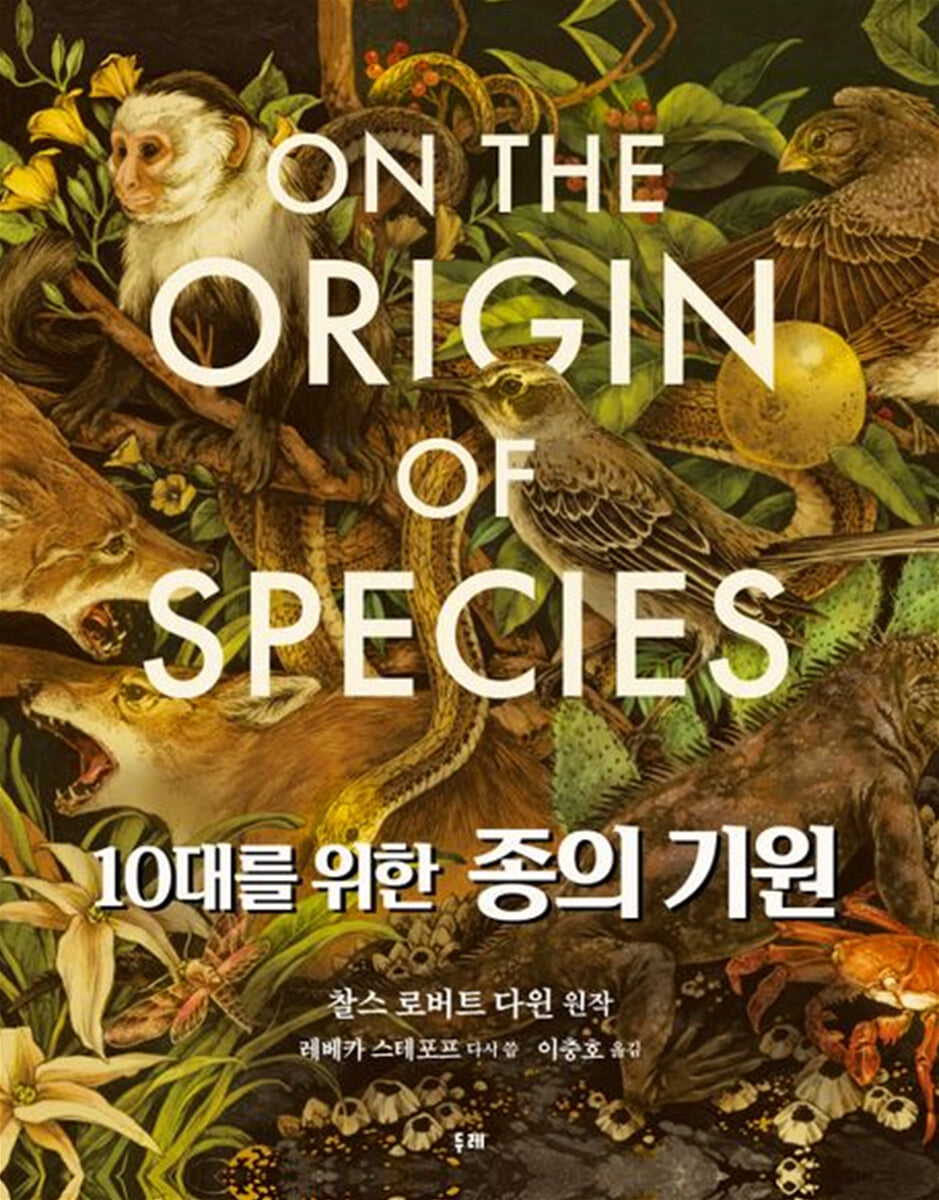 |
Description
Book Introduction
A revolutionary book that changed our thinking about all living things.
Selected by a group of experts comprised of British booksellers, librarians, publishers and academics.
The youth edition of the book that had the greatest influence on the world, 『On the Origin of Species』!
Along with Karl Marx's 'Das Kapital' and Sigmund Freud's 'The Interpretation of Dreams', Charles Darwin's 'The Origin of Species' is a book that played a revolutionary role in human history.
It is a classic book that we must read and cannot be left out as a must-read.
As times change, the theories of Marx and Freud gradually lose their power, while Darwin's theory becomes more and more persuasive.
The theory of evolution has had a decisive influence on almost all academic fields, including natural sciences such as geology and biology, as well as economics, sociology, psychology, anthropology, education, philosophy, and literature, and continues to evolve and develop today.
But as is often the case with classics, they make everyone, regardless of age or gender, go through a 'hardship'.
This is especially true for teenagers.
Most people get frustrated and give up when faced with the vast amount of content and difficult content.
『The Origin of Species for Teens』 is the perfect book to solve this difficult problem and quench your thirst for classics.
This book, a retelling of The Origin of Species for young readers, is intended to make Darwin's theory accessible to readers of all ages.
The author has carefully revised Darwin's original text for today's readers while respecting it.
The core content of the original was preserved, some outdated content was omitted, and difficult and complex content was summarized in a short and easy-to-understand manner.
To fill in the gaps in knowledge that Darwin did not know, such as genetics, some chapter titles and subtitles were rewritten, and explanations (boxed text and notes) and materials (photos and illustrations) not found in the original were added.
This book is a must-read for any reader with a curiosity and a desire to explore one of the most influential books of our time.
“We have condensed the content, added footnotes, updated the information, and added vivid photos and illustrations to bring this evolutionary bible to life.
Numerous footnotes and boxed texts elaborate on key concepts, add historical context, explain how later scientific discoveries have modified or supported Darwin's broader claims, and even carefully point out the author's errors.
“It is a book very close to the original” (Kirkus Reviews).
Selected by a group of experts comprised of British booksellers, librarians, publishers and academics.
The youth edition of the book that had the greatest influence on the world, 『On the Origin of Species』!
Along with Karl Marx's 'Das Kapital' and Sigmund Freud's 'The Interpretation of Dreams', Charles Darwin's 'The Origin of Species' is a book that played a revolutionary role in human history.
It is a classic book that we must read and cannot be left out as a must-read.
As times change, the theories of Marx and Freud gradually lose their power, while Darwin's theory becomes more and more persuasive.
The theory of evolution has had a decisive influence on almost all academic fields, including natural sciences such as geology and biology, as well as economics, sociology, psychology, anthropology, education, philosophy, and literature, and continues to evolve and develop today.
But as is often the case with classics, they make everyone, regardless of age or gender, go through a 'hardship'.
This is especially true for teenagers.
Most people get frustrated and give up when faced with the vast amount of content and difficult content.
『The Origin of Species for Teens』 is the perfect book to solve this difficult problem and quench your thirst for classics.
This book, a retelling of The Origin of Species for young readers, is intended to make Darwin's theory accessible to readers of all ages.
The author has carefully revised Darwin's original text for today's readers while respecting it.
The core content of the original was preserved, some outdated content was omitted, and difficult and complex content was summarized in a short and easy-to-understand manner.
To fill in the gaps in knowledge that Darwin did not know, such as genetics, some chapter titles and subtitles were rewritten, and explanations (boxed text and notes) and materials (photos and illustrations) not found in the original were added.
This book is a must-read for any reader with a curiosity and a desire to explore one of the most influential books of our time.
“We have condensed the content, added footnotes, updated the information, and added vivid photos and illustrations to bring this evolutionary bible to life.
Numerous footnotes and boxed texts elaborate on key concepts, add historical context, explain how later scientific discoveries have modified or supported Darwin's broader claims, and even carefully point out the author's errors.
“It is a book very close to the original” (Kirkus Reviews).
- You can preview some of the book's contents.
Preview
index
Preface: Darwin's Great Discoveries 7
Chapter 1: The Deformed Plant and the Blue Dove 21
Chapter 2: Classification of Species 35
Chapter 3: The Struggle for Survival 45
Chapter 4: Survival of the Fittest 57
Chapter 5: The Stripes of the Horse 71
Chapter 6: Difficult Problems in My Theory 85
Chapter 7: Instinct 99
Chapter 8 Rules and Mules 109
Chapter 9: What the Rocks Tell Us 121
Chapter 10: The Emergence and Extinction of Species 135
Chapter 11: Geography of Life 147
Chapter 11: Common Characteristics of Living Things 165
Chapter 13: This View of Life 177
Words of Gratitude 188
Glossary 189
Further Reading and Resources 192
Photo and illustration source 194
Search 199
Chapter 1: The Deformed Plant and the Blue Dove 21
Chapter 2: Classification of Species 35
Chapter 3: The Struggle for Survival 45
Chapter 4: Survival of the Fittest 57
Chapter 5: The Stripes of the Horse 71
Chapter 6: Difficult Problems in My Theory 85
Chapter 7: Instinct 99
Chapter 8 Rules and Mules 109
Chapter 9: What the Rocks Tell Us 121
Chapter 10: The Emergence and Extinction of Species 135
Chapter 11: Geography of Life 147
Chapter 11: Common Characteristics of Living Things 165
Chapter 13: This View of Life 177
Words of Gratitude 188
Glossary 189
Further Reading and Resources 192
Photo and illustration source 194
Search 199
Publisher's Review
Modern biology is a footnote and commentary on The Origin of Species!
Charles Darwin's famous theory of natural selection shook academia and society to its core by challenging orthodox beliefs about life that had persisted for thousands of years.
Darwin spent 20 years gathering information to support his theory of "evolution" or "inheritance with modification," and in 1859 he published a book that summarized all his findings, On the Origin of Species.
The first edition of this book sold out within days of its publication, and it sparked a great deal of controversy not only in the scientific community but also in other fields.
The arguments between those who supported and those who opposed Darwin's theory were sharp.
Many believers and clergy were appalled by the claim that life is governed by natural laws rather than divine law.
However, some clergymen openly supported Darwin, pointing out that evolution did not deny God, and even saying that “evolution is the discovery of God’s method of creation.”
The controversy surrounding this book continued until Darwin's death in 1882.
However, by the time Darwin died, many scientists had accepted his theory of evolution.
Although it took longer for natural selection to be accepted as a mechanism of evolution, the evidence supporting it continued to accumulate.
Today, evolution by natural selection is established as one of the fundamental knowledges of biology, ultimately changing our understanding of all living things.
The revolutionary book that changed the world, "The Origin of Species," is a detailed study of the interconnectedness of ecosystems, the complexity of life, and the reality of evolution. It is considered one of the greatest scientific achievements of the 19th century and one of the most influential books in human history.
It has been said that all Western philosophy is a footnote to Plato's philosophy.
If so, isn't modern biology a footnote and commentary on The Origin of Species?
The narrative style and structure of this book
『On the Origin of Species for Teenagers』 is based on the first edition of 『On the Origin of Species』 published in 1859.
In doing so, I rewrote the content in various ways, or changed the expressions.
Nevertheless, the wisdom and insight that Charles Darwin displayed in the original text of “The Origin of Species” will be fully conveyed.
First, I briefly summarized the original text of 『The Origin of Species』.
The original text of "The Origin of Species" is more than three times longer than the chapters presented in this book.
Some content that was out of date was even omitted.
For example, in Chapter 5, Darwin dealt with heredity, but this book leaves it out altogether.
The main concept is correct, but some of the details are now known to be incorrect.
Moreover, throughout The Origin of Species, Darwin presented a great deal of evidence to support his theory, as he believed that people would not readily accept his theory.
However, in order to save space, this book often introduces only one or two cases out of ten in the original.
Additionally, some content has been omitted or shortened in each chapter to make it easier for readers to read.
For example, Chapter 11 is a condensed version of what Darwin had written at length over two chapters.
The purpose of this rewrite is to preserve the essence of Darwin's argument while presenting difficult and complex content in a concise and easy-to-understand manner.
Second, in many places I have simplified Darwin's original expressions as much as possible.
Long sentences and clauses were cut and changed into shorter sentences.
Terms unfamiliar to readers have been replaced with more familiar terms (see glossary at the back).
Still, I have tried to preserve as much of Darwin's original expression as possible (especially many of the phrases that have become famous for their beauty and passion).
Third, some chapter titles and subtitles have been updated, and many short notes and boxed texts have been added next to the text to explain terms and assist readers.
The boxed articles are a total of 16, including 'What is a paper?', 'How did today's dogs come to be?', 'Integrationists and Subdivisionists', 'Classification systems and names of organisms', 'Natural selection in the 21st century', 'The missing piece', 'Reproductive isolation', 'Discovering Darwin's lost fossils!', 'Mass extinction', 'Moving continents', 'Darwin's famous finches', 'Legends and misunderstandings', and 'Evolution happening now'.
These helpful notes (footnotes and boxed text) were not in the original edition of The Origin of Species, but have been added specifically for this book.
Like the photographs and illustrations in this book, these texts will help bring the science of Darwin's era up to date, fill in the gaps in knowledge that Darwin didn't know, and show how the study of evolution itself has evolved since Darwin's time.
Most of the 'Glossary' at the end of the book is comprised of terms used by Darwin.
However, there are some modern terms that have been used in science since Darwin's time, such as 'genetics'.
What kind of book is “The Origin of Species”?
Darwin spent a long time trying to figure out how 'species' change over long periods of time.
And after writing a book called "On the Origin of Species" to prove this, he stated that the book was "one long argument" supporting the theory that "species" were not created individually, but descended from other species.
After solving the puzzle of 'how species arose,' Darwin emphasized that living things can and do change frequently over generations.
The changes may be very small, but over time they accumulate into larger and larger differences as they are passed down from parents to offspring, eventually resulting in a new species.
Darwin called this pattern of change "descent with modification."
To put it differently, we can call it 'evolution'.
The key to Darwin's theory was an explanation of 'how' such changes occurred.
Darwin thought that this happened through a process called 'natural selection'.
I spent 20 years gathering information to support this concept, and the culmination of all these findings is On the Origin of Species.
The Origin of Species presents a very carefully constructed model of scientific thinking that attempts to answer certain questions.
Scientists first collect research data that helps answer their questions.
Then we create a hypothesis (an answer that appears to explain the facts).
The next step is to test the hypothesis. There are two ways to do this: by conducting an experiment and by finding evidence that supports or refutes the hypothesis.
Darwin used both methods.
Finally, the scientist analyzes the results to see whether they support or refute the hypothesis.
The question Darwin sought to answer was, “How do species arise?”
The Origin of Species shows the steps to finding the answer.
First, let's start by discussing the well-known fact that people who breed plants or animals can create varieties with new characteristics or habits.
In Darwin's time, this fact was a part of everyday life for many people.
This is because there were many people who lived by raising plants and livestock.
The changes brought about by people who improve plant and animal breeds are the first step in Darwin's argument.
Then Darwin says that the same thing has happened in nature on a much larger scale and over a much longer period of time since life appeared.
Darwin's grand theory blossoms from the first chapter, which closely observes everyday creatures like pigeons and roses.
Who was Charles Robert Darwin?
Charles Darwin was born in Shrewsbury, England in 1809.
He entered medical school in Scotland with the intention of becoming a doctor like his father, but he was not interested in medical classes and transferred to Christ's College, Cambridge University to become a priest.
Darwin's favorite subjects were geology and biology, and he was also interested in natural history (the study of the natural world as a whole, including rocks and fossils, meteorology, geography, and all biological sciences).
After graduating from university in 1831, Darwin was able to board the British naval ship HMS Beagle on its circumnavigation of the world as a naturalist.
His job was to be a museum historian and a companion to the captain.
The Beagle voyage lasted about five years, and Darwin never set out on another dangerous journey after returning from it.
He did not even walk the path of a priest.
Thanks to inherited wealth and wise investments, I was able to make a living without having to work.
After completing the Beagle voyage, Darwin devoted himself to the study of natural history.
During his voyage on the Beagle, he edited five books on zoology and wrote three books on geology.
Darwin had been contemplating the concept of the 'species problem' since the voyage of the Beagle, and finally opened a new era in the 'species problem' by publishing 'The Origin of Species', which argued for the evolution of living things through natural selection.
After that, he continued to actively research and write until he passed away in 1882.
How did "The Origin of Species" come about?
Darwin's ship, the Beagle, sailed mainly along the coast of South America.
Darwin studied and collected insects, plants, and animals living in environments such as rainforests, deserts, grasslands, and coral reefs whenever he had the chance.
In particular, I spent a month in the Galapagos Islands, off the western coast of South America, marveling at the variety of species that inhabit these small volcanic islands and collecting a wide variety of specimens.
It also included important bird specimens collected from the Galapagos Islands.
The revolutionary theories Darwin later put forward were based on observations made during the Beagle voyage.
During the Beagle's voyage, he was 'shocked' by the diverse range of plant and animal species found scattered throughout South America.
Fossils have also been found that suggest a link between species that lived in South America and those that are extinct.
Darwin began to gather more facts that could help him solve the mystery of 'how species arose.'
By the end of 1838, Darwin had completed the framework of his theory.
He summarized and organized it in 1842, and two years later rewrote it into a longer version.
Then he wrote to his friend, botanist Joseph Hooker:
“(With the same feeling of confessing to murder) I am almost certain that paper is not an immutable entity… I think I have discovered a simple way that paper adapts exquisitely.”
Darwin also suffered from repeated bouts of illness or prolonged exhaustion that prevented him from working properly.
In 1848, his father died, and in 1851, his daughter died, leaving him grief-stricken and unable to make any progress in his studies.
But finally, in 1856, under the strong urging of botanist Joseph Hooker and geologist Charles Lyell, he began writing what he called "The Everlasting Species-Book."
Two years later, when I was more than halfway through writing the book, a shocking incident occurred.
A British naturalist named Alfred Russel Wallace sent a letter to Darwin from an island in Indonesia.
Wallace asked Darwin to read and comment on his paper on how new species arise.
After reading the paper, Darwin realized that Wallace had discovered a theory almost identical to the theory of natural selection that he had been studying and preparing for so long.
Darwin tried to be fair to Wallace, but he believed he had discovered the concept first.
After much deliberation, he sought advice from Lyell, who, after discussing it with Hooker, decided to present Wallace's paper alongside part of Darwin's 1844 summary at a meeting of scientists.
As a result, both men received credit for discovering the theory, but it was made clear to the public that Darwin had thought of it first.
Once his theory was made public, Darwin hastily completed the book he was writing, shortening it from what he had originally planned, and published it under the title The Origin of Species.
Charles Darwin's famous theory of natural selection shook academia and society to its core by challenging orthodox beliefs about life that had persisted for thousands of years.
Darwin spent 20 years gathering information to support his theory of "evolution" or "inheritance with modification," and in 1859 he published a book that summarized all his findings, On the Origin of Species.
The first edition of this book sold out within days of its publication, and it sparked a great deal of controversy not only in the scientific community but also in other fields.
The arguments between those who supported and those who opposed Darwin's theory were sharp.
Many believers and clergy were appalled by the claim that life is governed by natural laws rather than divine law.
However, some clergymen openly supported Darwin, pointing out that evolution did not deny God, and even saying that “evolution is the discovery of God’s method of creation.”
The controversy surrounding this book continued until Darwin's death in 1882.
However, by the time Darwin died, many scientists had accepted his theory of evolution.
Although it took longer for natural selection to be accepted as a mechanism of evolution, the evidence supporting it continued to accumulate.
Today, evolution by natural selection is established as one of the fundamental knowledges of biology, ultimately changing our understanding of all living things.
The revolutionary book that changed the world, "The Origin of Species," is a detailed study of the interconnectedness of ecosystems, the complexity of life, and the reality of evolution. It is considered one of the greatest scientific achievements of the 19th century and one of the most influential books in human history.
It has been said that all Western philosophy is a footnote to Plato's philosophy.
If so, isn't modern biology a footnote and commentary on The Origin of Species?
The narrative style and structure of this book
『On the Origin of Species for Teenagers』 is based on the first edition of 『On the Origin of Species』 published in 1859.
In doing so, I rewrote the content in various ways, or changed the expressions.
Nevertheless, the wisdom and insight that Charles Darwin displayed in the original text of “The Origin of Species” will be fully conveyed.
First, I briefly summarized the original text of 『The Origin of Species』.
The original text of "The Origin of Species" is more than three times longer than the chapters presented in this book.
Some content that was out of date was even omitted.
For example, in Chapter 5, Darwin dealt with heredity, but this book leaves it out altogether.
The main concept is correct, but some of the details are now known to be incorrect.
Moreover, throughout The Origin of Species, Darwin presented a great deal of evidence to support his theory, as he believed that people would not readily accept his theory.
However, in order to save space, this book often introduces only one or two cases out of ten in the original.
Additionally, some content has been omitted or shortened in each chapter to make it easier for readers to read.
For example, Chapter 11 is a condensed version of what Darwin had written at length over two chapters.
The purpose of this rewrite is to preserve the essence of Darwin's argument while presenting difficult and complex content in a concise and easy-to-understand manner.
Second, in many places I have simplified Darwin's original expressions as much as possible.
Long sentences and clauses were cut and changed into shorter sentences.
Terms unfamiliar to readers have been replaced with more familiar terms (see glossary at the back).
Still, I have tried to preserve as much of Darwin's original expression as possible (especially many of the phrases that have become famous for their beauty and passion).
Third, some chapter titles and subtitles have been updated, and many short notes and boxed texts have been added next to the text to explain terms and assist readers.
The boxed articles are a total of 16, including 'What is a paper?', 'How did today's dogs come to be?', 'Integrationists and Subdivisionists', 'Classification systems and names of organisms', 'Natural selection in the 21st century', 'The missing piece', 'Reproductive isolation', 'Discovering Darwin's lost fossils!', 'Mass extinction', 'Moving continents', 'Darwin's famous finches', 'Legends and misunderstandings', and 'Evolution happening now'.
These helpful notes (footnotes and boxed text) were not in the original edition of The Origin of Species, but have been added specifically for this book.
Like the photographs and illustrations in this book, these texts will help bring the science of Darwin's era up to date, fill in the gaps in knowledge that Darwin didn't know, and show how the study of evolution itself has evolved since Darwin's time.
Most of the 'Glossary' at the end of the book is comprised of terms used by Darwin.
However, there are some modern terms that have been used in science since Darwin's time, such as 'genetics'.
What kind of book is “The Origin of Species”?
Darwin spent a long time trying to figure out how 'species' change over long periods of time.
And after writing a book called "On the Origin of Species" to prove this, he stated that the book was "one long argument" supporting the theory that "species" were not created individually, but descended from other species.
After solving the puzzle of 'how species arose,' Darwin emphasized that living things can and do change frequently over generations.
The changes may be very small, but over time they accumulate into larger and larger differences as they are passed down from parents to offspring, eventually resulting in a new species.
Darwin called this pattern of change "descent with modification."
To put it differently, we can call it 'evolution'.
The key to Darwin's theory was an explanation of 'how' such changes occurred.
Darwin thought that this happened through a process called 'natural selection'.
I spent 20 years gathering information to support this concept, and the culmination of all these findings is On the Origin of Species.
The Origin of Species presents a very carefully constructed model of scientific thinking that attempts to answer certain questions.
Scientists first collect research data that helps answer their questions.
Then we create a hypothesis (an answer that appears to explain the facts).
The next step is to test the hypothesis. There are two ways to do this: by conducting an experiment and by finding evidence that supports or refutes the hypothesis.
Darwin used both methods.
Finally, the scientist analyzes the results to see whether they support or refute the hypothesis.
The question Darwin sought to answer was, “How do species arise?”
The Origin of Species shows the steps to finding the answer.
First, let's start by discussing the well-known fact that people who breed plants or animals can create varieties with new characteristics or habits.
In Darwin's time, this fact was a part of everyday life for many people.
This is because there were many people who lived by raising plants and livestock.
The changes brought about by people who improve plant and animal breeds are the first step in Darwin's argument.
Then Darwin says that the same thing has happened in nature on a much larger scale and over a much longer period of time since life appeared.
Darwin's grand theory blossoms from the first chapter, which closely observes everyday creatures like pigeons and roses.
Who was Charles Robert Darwin?
Charles Darwin was born in Shrewsbury, England in 1809.
He entered medical school in Scotland with the intention of becoming a doctor like his father, but he was not interested in medical classes and transferred to Christ's College, Cambridge University to become a priest.
Darwin's favorite subjects were geology and biology, and he was also interested in natural history (the study of the natural world as a whole, including rocks and fossils, meteorology, geography, and all biological sciences).
After graduating from university in 1831, Darwin was able to board the British naval ship HMS Beagle on its circumnavigation of the world as a naturalist.
His job was to be a museum historian and a companion to the captain.
The Beagle voyage lasted about five years, and Darwin never set out on another dangerous journey after returning from it.
He did not even walk the path of a priest.
Thanks to inherited wealth and wise investments, I was able to make a living without having to work.
After completing the Beagle voyage, Darwin devoted himself to the study of natural history.
During his voyage on the Beagle, he edited five books on zoology and wrote three books on geology.
Darwin had been contemplating the concept of the 'species problem' since the voyage of the Beagle, and finally opened a new era in the 'species problem' by publishing 'The Origin of Species', which argued for the evolution of living things through natural selection.
After that, he continued to actively research and write until he passed away in 1882.
How did "The Origin of Species" come about?
Darwin's ship, the Beagle, sailed mainly along the coast of South America.
Darwin studied and collected insects, plants, and animals living in environments such as rainforests, deserts, grasslands, and coral reefs whenever he had the chance.
In particular, I spent a month in the Galapagos Islands, off the western coast of South America, marveling at the variety of species that inhabit these small volcanic islands and collecting a wide variety of specimens.
It also included important bird specimens collected from the Galapagos Islands.
The revolutionary theories Darwin later put forward were based on observations made during the Beagle voyage.
During the Beagle's voyage, he was 'shocked' by the diverse range of plant and animal species found scattered throughout South America.
Fossils have also been found that suggest a link between species that lived in South America and those that are extinct.
Darwin began to gather more facts that could help him solve the mystery of 'how species arose.'
By the end of 1838, Darwin had completed the framework of his theory.
He summarized and organized it in 1842, and two years later rewrote it into a longer version.
Then he wrote to his friend, botanist Joseph Hooker:
“(With the same feeling of confessing to murder) I am almost certain that paper is not an immutable entity… I think I have discovered a simple way that paper adapts exquisitely.”
Darwin also suffered from repeated bouts of illness or prolonged exhaustion that prevented him from working properly.
In 1848, his father died, and in 1851, his daughter died, leaving him grief-stricken and unable to make any progress in his studies.
But finally, in 1856, under the strong urging of botanist Joseph Hooker and geologist Charles Lyell, he began writing what he called "The Everlasting Species-Book."
Two years later, when I was more than halfway through writing the book, a shocking incident occurred.
A British naturalist named Alfred Russel Wallace sent a letter to Darwin from an island in Indonesia.
Wallace asked Darwin to read and comment on his paper on how new species arise.
After reading the paper, Darwin realized that Wallace had discovered a theory almost identical to the theory of natural selection that he had been studying and preparing for so long.
Darwin tried to be fair to Wallace, but he believed he had discovered the concept first.
After much deliberation, he sought advice from Lyell, who, after discussing it with Hooker, decided to present Wallace's paper alongside part of Darwin's 1844 summary at a meeting of scientists.
As a result, both men received credit for discovering the theory, but it was made clear to the public that Darwin had thought of it first.
Once his theory was made public, Darwin hastily completed the book he was writing, shortening it from what he had originally planned, and published it under the title The Origin of Species.
GOODS SPECIFICS
- Date of issue: September 12, 2023
- Page count, weight, size: 208 pages | 530g | 188*240*12mm
- ISBN13: 9788974431594
- ISBN10: 8974431599
You may also like
카테고리
korean


korean

![GQ KOREA Mark (Monthly): December [2025]](http://librairie.coreenne.fr/cdn/shop/files/8ef265dbbfbf186523ed75ba7319009d.jpg?v=1765340328&width=3840)


