

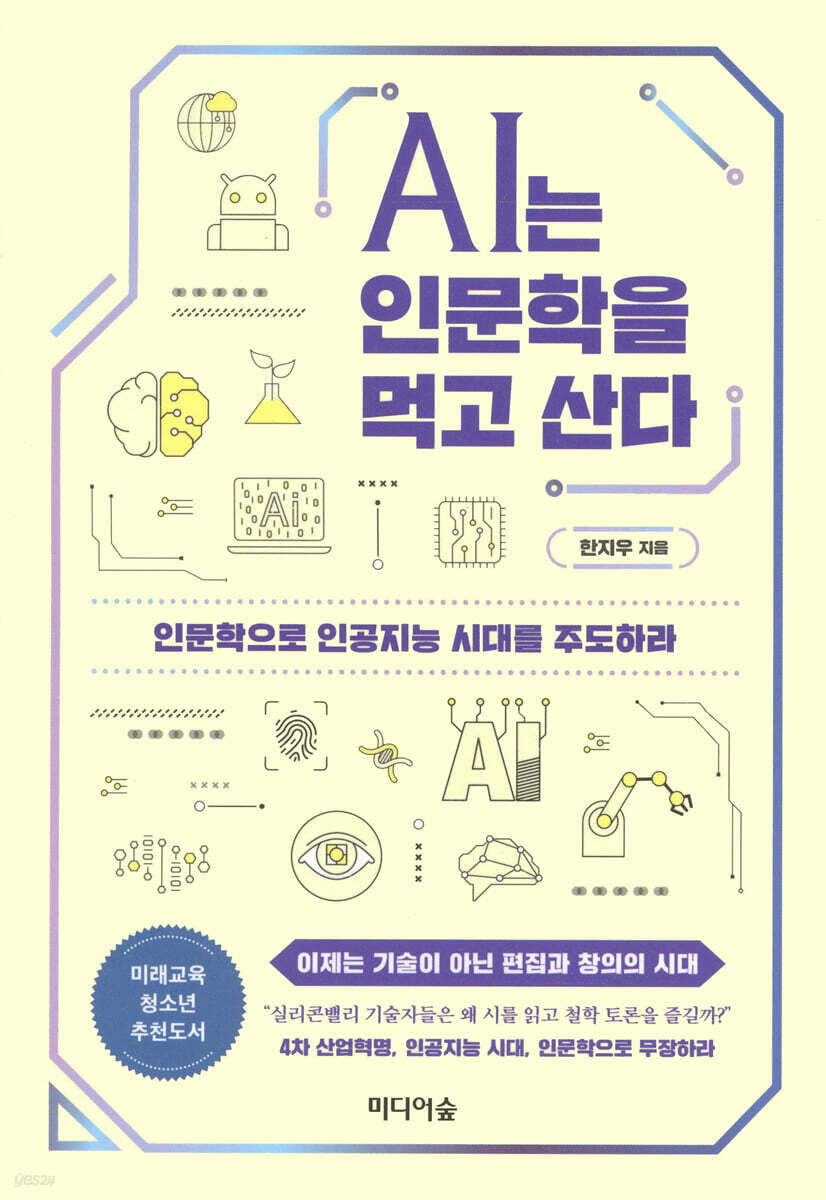
AI feeds on the humanities
 |
Description
Book Introduction
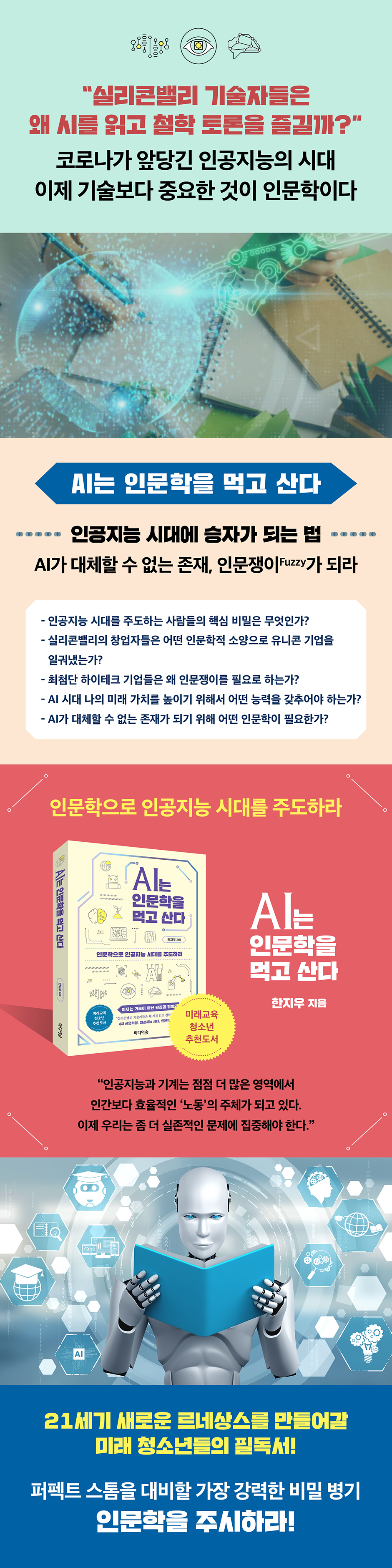
“Why do Silicon Valley techies read poetry and enjoy discussing philosophy?” Humanities are now more important than technology. How to Win in the Age of Artificial Intelligence In these times of unprecedented change and crisis, what we need is the acquisition of technology that will keep us abreast of trends, or the humanities that have steadfastly supported the axis of the universe for centuries? "AI Lives on the Humanities" reaches out to the humanities without hesitation. This is because all of Silicon Valley's renowned engineers, who are currently responsible for cutting-edge technologies around the world, are desperate to learn philosophical thinking and poetic sensibility. Why do they, working in the IT industry, feel a thirst for the humanities? Here's why. The most important reason why humanities knowledge is required in the era of the Fourth Industrial Revolution is that the barriers to entry into technology continue to lower. Skills acquired in one period may become completely useless a generation later. However, the humanities play a role in helping us gain insight into the essential aspects of humanity and society that permeate the times. Especially in the age of artificial intelligence, humanists with a liberal arts background have their own wise answers to questions like "What is humanity?" and "How are we different from artificial intelligence or machines?" Even in the current educational field, there is a trend toward integrating liberal arts and science. This is also because it is impossible to read the flow of the times by dichotomously dividing academics into science and humanities. Scholarship must now become an all-encompassing study, like in the Renaissance. AI with a humanistic mindset must dominate the era so that humanity can maintain a peaceful and safe life in an increasingly complex society that demands advanced technology. Leonardo da Vinci's ingenious imagination and Steve Jobs's pioneering spirit were both possible because they combined technological prowess with a deep understanding of the humanities. Having taught humanities in the field and dedicated himself to humanities education research for over a decade, the author has focused on the humanities-based skills of individuals who have achieved great success in the business world, including those who founded educational startups and worked at Multicampus, a leading education company. And by compiling numerous data and real-life examples, we created educational content on the secrets to their success and compiled them into a book. This is content that the author has already verified through lectures at many places, including universities and companies. The book raises questions that we should think about at least once. This book goes beyond simply emphasizing the importance of the humanities. It also tells us how the future society will unfold and how we should prepare for it. The book also explores concepts such as virtue ethics, posthumanism, high-touch, and high-concept, which are humanistic insights that will dominate the era of artificial intelligence, and how to cultivate these capabilities. By gaining insight into these differentiating contents and information, you will be able to become a leader one step ahead in the future world of artificial intelligence. |
- You can preview some of the book's contents.
Preview
index
Prologue: The Era of Artificial Intelligence Accelerated by COVID-19
Chapter 1: The World After Darkness
.
Two desperate men usher in a new era.
-The pandemic gave birth to great individuals.
.
Utopia vs. Dystopia
- A fierce debate among world-renowned scholars predicting the future of society.
.
The paradigm shift brought about by the pandemic
Green New Deal policy to restore the green Earth
Chapter 2: Renaissance Society
.
Turning Crisis into Opportunity: Welcome the Renaissance
-What the Black Death left behind in medieval Europe
A brilliant moment in human history following the Great Disaster
-The Renaissance that revived the humanities
.
The Second Renaissance Created by the Pandemic
-Changes in the post-corona era
The first keyword that will define the post-COVID era: Risk Society.
The second keyword that will define the post-COVID era: Green Society
The third keyword that will define the post-COVID era: Dream Society.
.
The New Humanity Created by the Pandemic: The Renaissance Man
-The spirit that created the Renaissance
.
Silicon Valley Blossoms a New Renaissance
Silicon Valley, the front line of artificial intelligence
-Hippies Create a Silicon Valley Empire
Stanford University, the root of Silicon Valley innovation
Chapter 3: The Fourth Industrial Revolution Accelerated by COVID-19
.
The Fourth Industrial Revolution: Humanity's Fourth Evolution
The old professor's declaration resonated throughout the Swiss resort.
-The everyday life of the industrial revolution
-Human progress achieved through the history of the Industrial Revolution
The Fourth Industrial Revolution Threatens Human Social Roles
.
The era of artificial intelligence is coming
A society where AI robots are part of everyday life
The unpredictable future society brought about by artificial intelligence
.
The Power of Artificial Intelligence: Will Humans Be Replaced?
The Battle of the Century: Artificial Intelligence and Humanity
-Heated debate about artificial intelligence
-The real threat posed by AI
-Philosophical Thoughts on Artificial Intelligence
Chapter 4: How to Avoid Being Replaced by Artificial Intelligence
.
In the age of artificial intelligence, those who sell dreams and stories will win.
-The era of content wars
The era of the Fourth Industrial Revolution is led by artists.
A society where everything is gamified
.
Fuzzy People: More Needed in the AI Era
-The Fuzzy and the Techie
-Silicon Valley's greatest humanist, Peter Thiel
-Renaissance man, Steve Jobs
Why the World's Richest People Study Humanities
.
Qualifications of talent that cannot be replaced by artificial intelligence
Why do cutting-edge high-tech companies need humanities professionals?
The influence of 'goodness'
The challenge of the post-COVID era: coexistence with nature.
Irreplaceability in the AI era
The power to create irreplaceability: humanities
Epilogue: Leading the AI Era with Humanities
Chapter 1: The World After Darkness
.
Two desperate men usher in a new era.
-The pandemic gave birth to great individuals.
.
Utopia vs. Dystopia
- A fierce debate among world-renowned scholars predicting the future of society.
.
The paradigm shift brought about by the pandemic
Green New Deal policy to restore the green Earth
Chapter 2: Renaissance Society
.
Turning Crisis into Opportunity: Welcome the Renaissance
-What the Black Death left behind in medieval Europe
A brilliant moment in human history following the Great Disaster
-The Renaissance that revived the humanities
.
The Second Renaissance Created by the Pandemic
-Changes in the post-corona era
The first keyword that will define the post-COVID era: Risk Society.
The second keyword that will define the post-COVID era: Green Society
The third keyword that will define the post-COVID era: Dream Society.
.
The New Humanity Created by the Pandemic: The Renaissance Man
-The spirit that created the Renaissance
.
Silicon Valley Blossoms a New Renaissance
Silicon Valley, the front line of artificial intelligence
-Hippies Create a Silicon Valley Empire
Stanford University, the root of Silicon Valley innovation
Chapter 3: The Fourth Industrial Revolution Accelerated by COVID-19
.
The Fourth Industrial Revolution: Humanity's Fourth Evolution
The old professor's declaration resonated throughout the Swiss resort.
-The everyday life of the industrial revolution
-Human progress achieved through the history of the Industrial Revolution
The Fourth Industrial Revolution Threatens Human Social Roles
.
The era of artificial intelligence is coming
A society where AI robots are part of everyday life
The unpredictable future society brought about by artificial intelligence
.
The Power of Artificial Intelligence: Will Humans Be Replaced?
The Battle of the Century: Artificial Intelligence and Humanity
-Heated debate about artificial intelligence
-The real threat posed by AI
-Philosophical Thoughts on Artificial Intelligence
Chapter 4: How to Avoid Being Replaced by Artificial Intelligence
.
In the age of artificial intelligence, those who sell dreams and stories will win.
-The era of content wars
The era of the Fourth Industrial Revolution is led by artists.
A society where everything is gamified
.
Fuzzy People: More Needed in the AI Era
-The Fuzzy and the Techie
-Silicon Valley's greatest humanist, Peter Thiel
-Renaissance man, Steve Jobs
Why the World's Richest People Study Humanities
.
Qualifications of talent that cannot be replaced by artificial intelligence
Why do cutting-edge high-tech companies need humanities professionals?
The influence of 'goodness'
The challenge of the post-COVID era: coexistence with nature.
Irreplaceability in the AI era
The power to create irreplaceability: humanities
Epilogue: Leading the AI Era with Humanities
Detailed image
Into the book
Futurist Rolf Jensen didn't predict a global pandemic, but he sensed a profound shift in the course of time long ago.
He said that just as the plague destroyed the social systems and leadership of 15th-century medieval Europe but also ushered in the Renaissance, a golden age of human history, the 21st century also shows many similar signs.
---------------------------------------------
The Renaissance was a period of revival after the plague.
At a historical turning point, a new idea emerges, causing great change throughout Europe.
As the existing social system, which was as solid as a rock, rapidly collapsed, people with new knowledge appeared explosively in various environments.
Through this, many scholars predict that even humanity, currently experiencing a global pandemic, can achieve a new Renaissance through effort.
In a time of global turmoil, we are looking forward to a civilizational transformation.
---------------------------------------------
Robotics researcher Hans Moravec says that the future rulers of the Earth will not be biological beings, but artificial intelligence beings that have inherited the human mental heritage.
This being is 'Robot Sapiens'.
He says that by around 2040, machines that can see, speak, and act like humans will emerge, surpassing human capabilities at an astonishing rate, and that by around 2050, robots may become the masters of the Earth.
---------------------------------------------
Stanford University offers a Symbolic Systems major that combines computer science with courses in philosophy, logic, and psychology.
Here, we learn science, math, and humanities together.
Many students who studied this major are now successful entrepreneurs in Silicon Valley.
LinkedIn founder Reid Hoffman and Instagram co-founder Mike Krieger are prime examples.
Facebook founder Mark Zuckerberg says this major has unearthed some of the world's most talented people.
---------------------------------------------
In the future, humanity will live in a society where artificial intelligence and robots take over physical labor.
In that era, machines can replace 99% of human labor, and artificial intelligence can replace more than 99% of human intellectual labor.
Now humans will use their muscles solely for pleasure and their brains to create stories that captivate people.
This trend is already underway in the cultural industry. The revitalization of cultural industries with storytelling, such as commercials, movies, games, animation, and individual content, is evidence of this.
---------------------------------------------
The most negative scenario is that strong AI is used as a weapon of war to wipe out humanity, as in the movie "Terminator."
But at the same time, a strong but benevolent AI could emerge.
If this happens, the future society could be a war between humans who favor strong but evil AI and humans who side with strong but good AI.
---------------------------------------------
Machines and artificial intelligence, which are rapidly expanding their capabilities, are now beginning to surpass human intelligence beyond the level of understanding human speech and responding appropriately.
We are both amazed by the advancement of machines and at the same time feel threatened by them.
Until now, tasks requiring sophisticated judgment were thought to be tasks that only humans could perform.
However, the emergence of AlphaGo confirmed that the development of artificial intelligence threatens even human jobs.
---------------------------------------------
There is a term called Moravec's paradox.
What is easy for computers is difficult for humans, and what is difficult for humans is easy for computers.
Hans Moravec, an American robotics expert, said, “It is relatively easy to build a computer that performs at an adult level on intelligence tests or chess, but it is difficult or impossible to build a computer that performs better than a one-year-old in perception or movement.”
---------------------------------------------
The talent that global companies want most these days is a humanities expert.
Santosh Jayaram, who developed the Google search engine, said, “It takes less than a year to get an intensive training in structured engineering.
The real challenge is making new products interesting and connecting with potential users.
“Anyone who has studied literature knows how to work the magic of making people imagine how this wonderful new product will improve their lives.”
---------------------------------------------
Global companies prefer humanities majors, especially anthropology.
Insights from anthropological research can help us better understand 'consumption' behavior and provide cultural factors to consider when developing and promoting products.
Because it helps predict an individual's reactions.
Because anthropology is the study of the behavior and psychology of individuals and groups, it can help us understand what psychology drives people to purchase products and services.
---------------------------------------------
The concept of 'virtue' has been a core philosophy for humans from ancient times to the Middle Ages.
However, since the modern era, discussions about ‘virtue’ have disappeared even in ethics.
But I can say with certainty that 'virtue' is a philosophy that guides human values in the right direction.
This is an element that must be revived, especially in this new normal era.
He said that just as the plague destroyed the social systems and leadership of 15th-century medieval Europe but also ushered in the Renaissance, a golden age of human history, the 21st century also shows many similar signs.
---------------------------------------------
The Renaissance was a period of revival after the plague.
At a historical turning point, a new idea emerges, causing great change throughout Europe.
As the existing social system, which was as solid as a rock, rapidly collapsed, people with new knowledge appeared explosively in various environments.
Through this, many scholars predict that even humanity, currently experiencing a global pandemic, can achieve a new Renaissance through effort.
In a time of global turmoil, we are looking forward to a civilizational transformation.
---------------------------------------------
Robotics researcher Hans Moravec says that the future rulers of the Earth will not be biological beings, but artificial intelligence beings that have inherited the human mental heritage.
This being is 'Robot Sapiens'.
He says that by around 2040, machines that can see, speak, and act like humans will emerge, surpassing human capabilities at an astonishing rate, and that by around 2050, robots may become the masters of the Earth.
---------------------------------------------
Stanford University offers a Symbolic Systems major that combines computer science with courses in philosophy, logic, and psychology.
Here, we learn science, math, and humanities together.
Many students who studied this major are now successful entrepreneurs in Silicon Valley.
LinkedIn founder Reid Hoffman and Instagram co-founder Mike Krieger are prime examples.
Facebook founder Mark Zuckerberg says this major has unearthed some of the world's most talented people.
---------------------------------------------
In the future, humanity will live in a society where artificial intelligence and robots take over physical labor.
In that era, machines can replace 99% of human labor, and artificial intelligence can replace more than 99% of human intellectual labor.
Now humans will use their muscles solely for pleasure and their brains to create stories that captivate people.
This trend is already underway in the cultural industry. The revitalization of cultural industries with storytelling, such as commercials, movies, games, animation, and individual content, is evidence of this.
---------------------------------------------
The most negative scenario is that strong AI is used as a weapon of war to wipe out humanity, as in the movie "Terminator."
But at the same time, a strong but benevolent AI could emerge.
If this happens, the future society could be a war between humans who favor strong but evil AI and humans who side with strong but good AI.
---------------------------------------------
Machines and artificial intelligence, which are rapidly expanding their capabilities, are now beginning to surpass human intelligence beyond the level of understanding human speech and responding appropriately.
We are both amazed by the advancement of machines and at the same time feel threatened by them.
Until now, tasks requiring sophisticated judgment were thought to be tasks that only humans could perform.
However, the emergence of AlphaGo confirmed that the development of artificial intelligence threatens even human jobs.
---------------------------------------------
There is a term called Moravec's paradox.
What is easy for computers is difficult for humans, and what is difficult for humans is easy for computers.
Hans Moravec, an American robotics expert, said, “It is relatively easy to build a computer that performs at an adult level on intelligence tests or chess, but it is difficult or impossible to build a computer that performs better than a one-year-old in perception or movement.”
---------------------------------------------
The talent that global companies want most these days is a humanities expert.
Santosh Jayaram, who developed the Google search engine, said, “It takes less than a year to get an intensive training in structured engineering.
The real challenge is making new products interesting and connecting with potential users.
“Anyone who has studied literature knows how to work the magic of making people imagine how this wonderful new product will improve their lives.”
---------------------------------------------
Global companies prefer humanities majors, especially anthropology.
Insights from anthropological research can help us better understand 'consumption' behavior and provide cultural factors to consider when developing and promoting products.
Because it helps predict an individual's reactions.
Because anthropology is the study of the behavior and psychology of individuals and groups, it can help us understand what psychology drives people to purchase products and services.
---------------------------------------------
The concept of 'virtue' has been a core philosophy for humans from ancient times to the Middle Ages.
However, since the modern era, discussions about ‘virtue’ have disappeared even in ethics.
But I can say with certainty that 'virtue' is a philosophy that guides human values in the right direction.
This is an element that must be revived, especially in this new normal era.
--- From the text
Publisher's Review
Creating a new Renaissance in the 21st century
A must-read for future youth!
The most powerful secret weapon to prepare for the perfect storm
Keep an eye on the humanities!
“Silicon Valley wants the humanities!”
The Secrets of Silicon Valley Leaders Leading the AI Era
Become a Fuzzy, the person AI cannot replace!
Peter Thiel, co-founder of PayPal, studied philosophy and law at Stanford University and constantly asked himself questions.
Then suddenly I realized.
The people who achieve great success are not those who compete fiercely in fields where they are already successful, but those who enter new fields and create something new.
The saying that came out was, 'Don't compete, monopolize.'
He emphasized that the most important thing in life is to 'find your own irreplaceable mission.'
Silicon Valley is desperately trying to find people with humanities backgrounds like Peter Thiel.
Silicon Valley, the cutting-edge base of the information revolution, is home to global corporations that are transforming not only the global economy and culture, but also the very way people live.
When hiring employees, they give the highest score to talents with a sense of the humanities.
Professor Bharat Anand of Harvard University emphasizes that the era of technological innovation is over and the era of editing and creativity has begun.
This is why the humanities are emphasized as technology advances.
Now that the 4th Industrial Revolution and the era of artificial intelligence are dawning, this is a time when we can clearly see what we need to prepare for.
This book covers historical events and the secrets of success of leading figures of the times, helping readers properly understand the trend of humanities being emphasized in the face of great change.
Furthermore, it provides information on how to develop humanities skills to secure competitiveness that cannot be replaced by artificial intelligence.
Millennials, who will lead the new normal era
Think about and understand the world through humanities!
During the period of information technology development, so-called STEM (Science, Technology, Engineering, Mathematics) majors were given preferential treatment.
On the other hand, in our country, it is a reality that liberal arts graduates were looked down upon to the point that the expression 'munsonghada' became popular.
However, when it came time to apply the developed information technology to people's lifestyles, things changed.
Even if a new technology that has never been seen before is developed, how to apply it to reality cannot be solved without a sense of the humanities.
In fact, many unicorn founders, including Facebook, Airbnb, Alibaba, and PayPal, majored in the humanities.
This book delves deeply into the secrets of success of those leading the AI era, encouraging us all to apply the humanities to our own lives, gaining insight into ourselves and the world.
As the author says, “In the age of artificial intelligence, the victors will be those who forge their own paths beyond what society demands—those who create human values that AI cannot replace.” Only those armed with the humanities will survive in the future society.
A must-read for future youth!
The most powerful secret weapon to prepare for the perfect storm
Keep an eye on the humanities!
“Silicon Valley wants the humanities!”
The Secrets of Silicon Valley Leaders Leading the AI Era
Become a Fuzzy, the person AI cannot replace!
Peter Thiel, co-founder of PayPal, studied philosophy and law at Stanford University and constantly asked himself questions.
Then suddenly I realized.
The people who achieve great success are not those who compete fiercely in fields where they are already successful, but those who enter new fields and create something new.
The saying that came out was, 'Don't compete, monopolize.'
He emphasized that the most important thing in life is to 'find your own irreplaceable mission.'
Silicon Valley is desperately trying to find people with humanities backgrounds like Peter Thiel.
Silicon Valley, the cutting-edge base of the information revolution, is home to global corporations that are transforming not only the global economy and culture, but also the very way people live.
When hiring employees, they give the highest score to talents with a sense of the humanities.
Professor Bharat Anand of Harvard University emphasizes that the era of technological innovation is over and the era of editing and creativity has begun.
This is why the humanities are emphasized as technology advances.
Now that the 4th Industrial Revolution and the era of artificial intelligence are dawning, this is a time when we can clearly see what we need to prepare for.
This book covers historical events and the secrets of success of leading figures of the times, helping readers properly understand the trend of humanities being emphasized in the face of great change.
Furthermore, it provides information on how to develop humanities skills to secure competitiveness that cannot be replaced by artificial intelligence.
Millennials, who will lead the new normal era
Think about and understand the world through humanities!
During the period of information technology development, so-called STEM (Science, Technology, Engineering, Mathematics) majors were given preferential treatment.
On the other hand, in our country, it is a reality that liberal arts graduates were looked down upon to the point that the expression 'munsonghada' became popular.
However, when it came time to apply the developed information technology to people's lifestyles, things changed.
Even if a new technology that has never been seen before is developed, how to apply it to reality cannot be solved without a sense of the humanities.
In fact, many unicorn founders, including Facebook, Airbnb, Alibaba, and PayPal, majored in the humanities.
This book delves deeply into the secrets of success of those leading the AI era, encouraging us all to apply the humanities to our own lives, gaining insight into ourselves and the world.
As the author says, “In the age of artificial intelligence, the victors will be those who forge their own paths beyond what society demands—those who create human values that AI cannot replace.” Only those armed with the humanities will survive in the future society.
GOODS SPECIFICS
- Publication date: November 20, 2021
- Page count, weight, size: 240 pages | 400g | 148*215*15mm
- ISBN13: 9791158741303
- ISBN10: 1158741308
You may also like
카테고리
korean


korean

![GQ KOREA Mark (Monthly): December [2025]](http://librairie.coreenne.fr/cdn/shop/files/8ef265dbbfbf186523ed75ba7319009d.jpg?v=1765340328&width=3840)


