

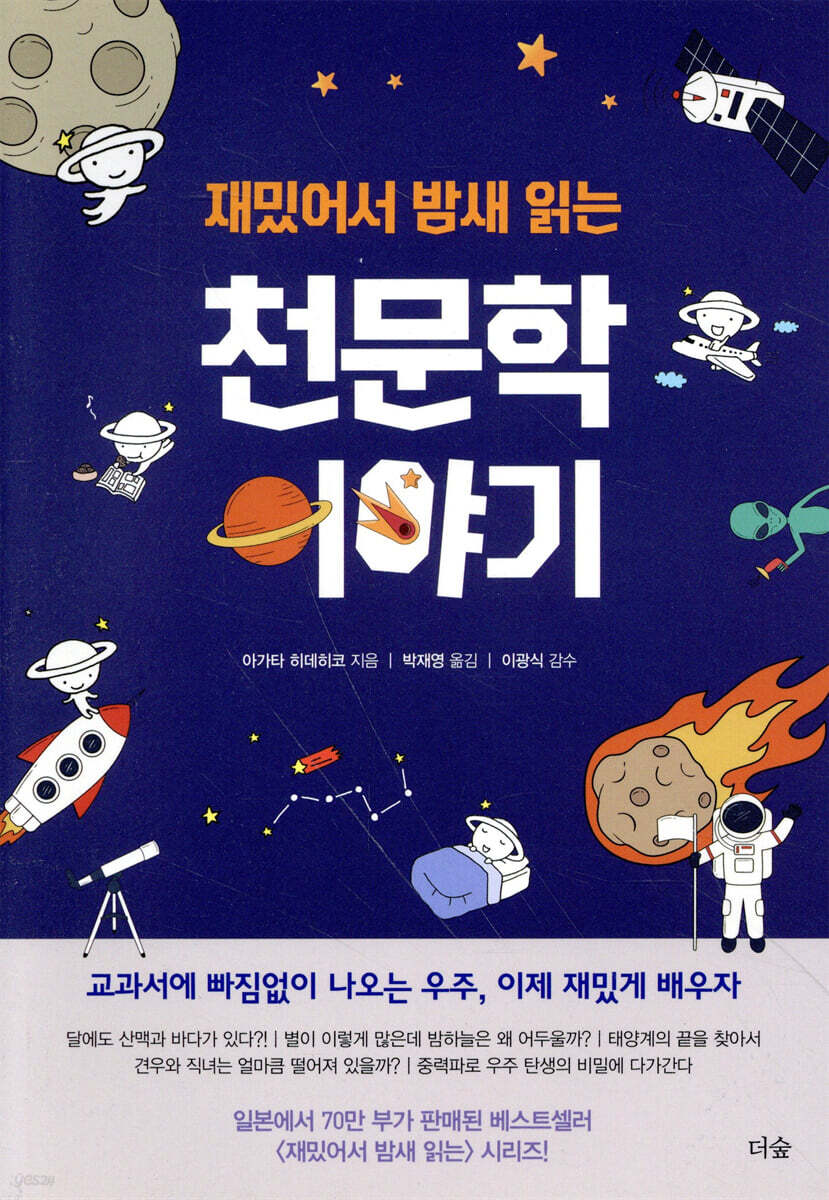
Astronomy stories that are so fun you'll read them all night
 |
Description
Book Introduction
The universe, which appears in every textbook, is now fun to learn about!
The "Astronomy" edition of the "Must-Read for Teens" series, "Fun and Easy to Read All Night," has been released.
The 'Astronomy' series, which is loved as a bestseller in the youth science field by being published in various scientific fields every year and selected as recommended books and excellent science books, has been published.
Moreover, with the Mars probe Insight landing on Mars (November 26, 2018) and the successful launch of the Nuri experimental launch vehicle (November 28, 2018), which was made with Korea's own technology, interest in astronomy and space exploration is higher than ever in Korea. This astronomy section will spark curiosity and imagination about space in students as well as science enthusiasts.
The author of this book is an astronomer currently affiliated with the National Astronomical Observatory of Japan's Astronomical Information Center, and is actively involved in lectures, TV, and radio appearances to introduce astronomy to the general public in a more accessible way.
The author, an astronomer with a background in education, wrote this book so that even students who find astronomy difficult can learn it easily and enjoyably.
Here, author Gwang-sik Lee, a leading Korean astronomy writer who has written 『Heart-pounding Astronomy』 and 『Astronomy Concert』, took on the role of reviewer, adding accuracy to suit the Korean situation.
With just this one book, you will be able to learn and acquire sufficient basic knowledge of astronomy.
Astronomy is a discipline that has been with humanity since ancient times, but it is one of those disciplines that feels unfamiliar to today's youth.
This book will serve as a guide for students to enjoy studying astronomy and further deepen their understanding by examining astronomy, a subject covered in textbooks, from various perspectives.
The "Astronomy" edition of the "Must-Read for Teens" series, "Fun and Easy to Read All Night," has been released.
The 'Astronomy' series, which is loved as a bestseller in the youth science field by being published in various scientific fields every year and selected as recommended books and excellent science books, has been published.
Moreover, with the Mars probe Insight landing on Mars (November 26, 2018) and the successful launch of the Nuri experimental launch vehicle (November 28, 2018), which was made with Korea's own technology, interest in astronomy and space exploration is higher than ever in Korea. This astronomy section will spark curiosity and imagination about space in students as well as science enthusiasts.
The author of this book is an astronomer currently affiliated with the National Astronomical Observatory of Japan's Astronomical Information Center, and is actively involved in lectures, TV, and radio appearances to introduce astronomy to the general public in a more accessible way.
The author, an astronomer with a background in education, wrote this book so that even students who find astronomy difficult can learn it easily and enjoyably.
Here, author Gwang-sik Lee, a leading Korean astronomy writer who has written 『Heart-pounding Astronomy』 and 『Astronomy Concert』, took on the role of reviewer, adding accuracy to suit the Korean situation.
With just this one book, you will be able to learn and acquire sufficient basic knowledge of astronomy.
Astronomy is a discipline that has been with humanity since ancient times, but it is one of those disciplines that feels unfamiliar to today's youth.
This book will serve as a guide for students to enjoy studying astronomy and further deepen their understanding by examining astronomy, a subject covered in textbooks, from various perspectives.
- You can preview some of the book's contents.
Preview
index
preface
Reviewer's note
PART 1 A Romantic Journey Through Space and Celestial Bodies
How to see a shooting star
Are there mountains and seas on the moon?
Why the North Star Changes Over Time
Why is the night sky dark even though there are countless stars?
The day the warrior Orion's right shoulder disappeared
A starry sky that can only be seen at tourist destinations
Is there life on Mars?
A journey of constellations that brings good luck and peace
When a celestial body collides with the Earth
PART 2: Hidden Secrets of the Night Sky
What are Saturn's rings made of?
Why the moon follows me
How many years will the sun live?
How to contact aliens?
The 'Alien Equation': Finding a Second Earth
When will the aurora be beautiful?
The calendar contains the history of astronomy.
The Cowherd and the Weaver Girl can't meet each other?
In search of the ends of the solar system
How to see the first star to rise
PART 3 The universe is full of mysteries
Discover the 'first star in the universe'
The Mystery of Dark Energy
How did galaxies come into being?
Star excluded from planet
Wasn't Galileo the first person to use a telescope?
Gravitational waves unlock the secrets of the universe's birth.
When and where were constellations created?
How to Weigh a Black Hole
Searching for the origin of life through comets
Cosmic time and human time
Conclusion
References
Reviewer's note
PART 1 A Romantic Journey Through Space and Celestial Bodies
How to see a shooting star
Are there mountains and seas on the moon?
Why the North Star Changes Over Time
Why is the night sky dark even though there are countless stars?
The day the warrior Orion's right shoulder disappeared
A starry sky that can only be seen at tourist destinations
Is there life on Mars?
A journey of constellations that brings good luck and peace
When a celestial body collides with the Earth
PART 2: Hidden Secrets of the Night Sky
What are Saturn's rings made of?
Why the moon follows me
How many years will the sun live?
How to contact aliens?
The 'Alien Equation': Finding a Second Earth
When will the aurora be beautiful?
The calendar contains the history of astronomy.
The Cowherd and the Weaver Girl can't meet each other?
In search of the ends of the solar system
How to see the first star to rise
PART 3 The universe is full of mysteries
Discover the 'first star in the universe'
The Mystery of Dark Energy
How did galaxies come into being?
Star excluded from planet
Wasn't Galileo the first person to use a telescope?
Gravitational waves unlock the secrets of the universe's birth.
When and where were constellations created?
How to Weigh a Black Hole
Searching for the origin of life through comets
Cosmic time and human time
Conclusion
References
Into the book
Astronomy has been said to be one of the oldest disciplines along with music and mathematics, and was a valuable communication tool for ancient people.
What if you had to decide on a place or time for an appointment in a world without clocks or telephones? In such situations, ancient people could communicate the season, time, and location by observing the phases of the moon and the positions of the stars.
In this way, astronomy was an essential tool for connecting people.
---From the "Preface"
The pyramids of Egypt were built precisely oriented north to south, even though there were no tools to accurately measure direction in an era when this was not possible.
This suggests that the direction was determined based on the stars.
So, was it the North Star that was used? In fact, around 2500 BCE, when the Great Pyramid of Giza (Khufu's tomb) was built in Egypt, Alpha Ursa Minor (α), the current North Star, was located nearly 20 degrees west of due north.
So, does that mean the North Star we see today has shifted slightly northward? Stars, including North Star, don't move across the sky on their own.
So why did latitude change? It wasn't because Polaris moved, but because the Earth wobbled on its axis.
This phenomenon is called 'precession'.
---From "Why the North Star Changes Over Time"
The light from Vega, which is 25 light years away, is light that reached Earth 25 years ago.
Meanwhile, the Altair star is 17 light years away from Earth, so the light is from 17 years ago.
The distance between the two stars is 15 light-years.
It is a distance of 9.5 trillion kilometers multiplied by 15.
When Chilseok approaches and the Weaver Girl contacts Cowherd, saying, “Mr. Cowherd, let’s meet at the Milky Way on July 7th,” the message reaches Cowherd 15 years later.
And even if the Altair planet immediately responds with “Okay,” it will take 30 years for the reply to reach the Weaver Girl planet.
Astronomically speaking, the Cowherd and the Weaver Girl cannot meet every year.
---From "Can't the Cowherd and the Weaver Girl Meet Each Other?"
To understand black holes, we need to stretch our imagination a little further.
Let's say you throw a ball far away from Earth.
The harder you throw the ball, the farther it will fly.
If a strong being like King Kong or Superman threw a ball with all his might, the ball might not hit the ground but instead start to orbit the Earth.
The speed at this time is 7.9 kilometers per second and is called the 'first space velocity (satellite speed)'.
This is the speed required to launch a satellite orbiting the Earth.
If you fire the ball again with all your might, this time it will escape Earth's gravity and begin to orbit the Sun.
This speed is about 11.2 kilometers per second and is called the 'second cosmic velocity (Escape velocity from Earth)'.
Second cosmic velocity is the speed required to launch probes flying around the solar system, such as Hayabusa 2 or Akatsuki.
What if you had to decide on a place or time for an appointment in a world without clocks or telephones? In such situations, ancient people could communicate the season, time, and location by observing the phases of the moon and the positions of the stars.
In this way, astronomy was an essential tool for connecting people.
---From the "Preface"
The pyramids of Egypt were built precisely oriented north to south, even though there were no tools to accurately measure direction in an era when this was not possible.
This suggests that the direction was determined based on the stars.
So, was it the North Star that was used? In fact, around 2500 BCE, when the Great Pyramid of Giza (Khufu's tomb) was built in Egypt, Alpha Ursa Minor (α), the current North Star, was located nearly 20 degrees west of due north.
So, does that mean the North Star we see today has shifted slightly northward? Stars, including North Star, don't move across the sky on their own.
So why did latitude change? It wasn't because Polaris moved, but because the Earth wobbled on its axis.
This phenomenon is called 'precession'.
---From "Why the North Star Changes Over Time"
The light from Vega, which is 25 light years away, is light that reached Earth 25 years ago.
Meanwhile, the Altair star is 17 light years away from Earth, so the light is from 17 years ago.
The distance between the two stars is 15 light-years.
It is a distance of 9.5 trillion kilometers multiplied by 15.
When Chilseok approaches and the Weaver Girl contacts Cowherd, saying, “Mr. Cowherd, let’s meet at the Milky Way on July 7th,” the message reaches Cowherd 15 years later.
And even if the Altair planet immediately responds with “Okay,” it will take 30 years for the reply to reach the Weaver Girl planet.
Astronomically speaking, the Cowherd and the Weaver Girl cannot meet every year.
---From "Can't the Cowherd and the Weaver Girl Meet Each Other?"
To understand black holes, we need to stretch our imagination a little further.
Let's say you throw a ball far away from Earth.
The harder you throw the ball, the farther it will fly.
If a strong being like King Kong or Superman threw a ball with all his might, the ball might not hit the ground but instead start to orbit the Earth.
The speed at this time is 7.9 kilometers per second and is called the 'first space velocity (satellite speed)'.
This is the speed required to launch a satellite orbiting the Earth.
If you fire the ball again with all your might, this time it will escape Earth's gravity and begin to orbit the Sun.
This speed is about 11.2 kilometers per second and is called the 'second cosmic velocity (Escape velocity from Earth)'.
Second cosmic velocity is the speed required to launch probes flying around the solar system, such as Hayabusa 2 or Akatsuki.
---From "How to Weigh a Black Hole"
Publisher's Review
An exciting plot that can be read in one sitting!
An engaging space story that will make studying science more enjoyable.
On December 3, 2018, SpaceX, a private space development company in the United States, set a new record in the history of space technology by launching one rocket three times.
In this way, humanity's steps toward space continue rapidly even at this moment.
This is why we must lay a solid foundation for our study of astronomy.
This book introduces various astronomical stories.
From romantic stories about the night sky, such as 'How to See a Shooting Star' and 'A Journey Through the Constellations That Bring Good Luck and Peace', to the hidden secrets of the night sky, such as 'Why Does the Moon Follow Me?' and 'Can't the Cowherd and the Weaver Girl Meet?', it also deals with the mysteries of the universe, such as 'Discover the First Star in the Universe' and 'Approaching the Secret of the Birth of the Universe with Gravitational Waves'.
The strength of this book is that it talks about astronomy in an engaging way, as if you were listening to a lecture right in front of you.
The author begins the story with familiar materials, such as the moon and stars.
Even professional stories are explained in a friendly way, such as through hands-on experience or visual observation, to stimulate readers' interest.
For example, he explains how to determine your latitude (north latitude) on Earth by the position of the North Star by making a fist.
Using the fact that the angle of a fist is about 10 degrees, you can easily figure out the latitude of your area.
So, although it covers a variety of stories with different heights, from Earth to gravitational waves, it can be read in one sitting from beginning to end without getting bored.
This will be a quick and easy-to-understand introductory book for those who wish to study astronomy for the first time.
From basic astronomy knowledge to in-depth, up-to-date information
An Introduction to Astronomy for Beginners
This book provides in-depth scientific knowledge and up-to-date information through small stories that will pique the readers' curiosity.
In the story of the mountains and seas of the moon, we can understand why Apollo 11 landed in the 'Sea of Tranquility' and the 'Giant Impact Theory' that led to the moon's origin.
Through Pluto, the unfortunate planet left out of 'Mercury, Venus, Earth, Fire, Mok, Tohsaka', we can learn about the Oort Cloud, the edge of the solar system, and the Kuiper Belt, a disk-shaped asteroid belt.
Also, if we look at why the night sky is always dark despite the many stars in the universe, we can learn about the birth and expansion of the universe, as well as the wavelength of light called 'red shift'.
It captures both the fun and depth of astronomy by looking into the big picture, from the birth of planets and the structure of the solar system to the origin of the universe.
The rich and engaging explanations that fill the gaps between textbooks will be helpful not only to students looking for an astronomy book to supplement their textbooks, but also to those who have never been interested in astronomy.
Meanwhile, for adult readers, it will offer a new kind of fun, different from the astronomy guides they read as children.
An engaging space story that will make studying science more enjoyable.
On December 3, 2018, SpaceX, a private space development company in the United States, set a new record in the history of space technology by launching one rocket three times.
In this way, humanity's steps toward space continue rapidly even at this moment.
This is why we must lay a solid foundation for our study of astronomy.
This book introduces various astronomical stories.
From romantic stories about the night sky, such as 'How to See a Shooting Star' and 'A Journey Through the Constellations That Bring Good Luck and Peace', to the hidden secrets of the night sky, such as 'Why Does the Moon Follow Me?' and 'Can't the Cowherd and the Weaver Girl Meet?', it also deals with the mysteries of the universe, such as 'Discover the First Star in the Universe' and 'Approaching the Secret of the Birth of the Universe with Gravitational Waves'.
The strength of this book is that it talks about astronomy in an engaging way, as if you were listening to a lecture right in front of you.
The author begins the story with familiar materials, such as the moon and stars.
Even professional stories are explained in a friendly way, such as through hands-on experience or visual observation, to stimulate readers' interest.
For example, he explains how to determine your latitude (north latitude) on Earth by the position of the North Star by making a fist.
Using the fact that the angle of a fist is about 10 degrees, you can easily figure out the latitude of your area.
So, although it covers a variety of stories with different heights, from Earth to gravitational waves, it can be read in one sitting from beginning to end without getting bored.
This will be a quick and easy-to-understand introductory book for those who wish to study astronomy for the first time.
From basic astronomy knowledge to in-depth, up-to-date information
An Introduction to Astronomy for Beginners
This book provides in-depth scientific knowledge and up-to-date information through small stories that will pique the readers' curiosity.
In the story of the mountains and seas of the moon, we can understand why Apollo 11 landed in the 'Sea of Tranquility' and the 'Giant Impact Theory' that led to the moon's origin.
Through Pluto, the unfortunate planet left out of 'Mercury, Venus, Earth, Fire, Mok, Tohsaka', we can learn about the Oort Cloud, the edge of the solar system, and the Kuiper Belt, a disk-shaped asteroid belt.
Also, if we look at why the night sky is always dark despite the many stars in the universe, we can learn about the birth and expansion of the universe, as well as the wavelength of light called 'red shift'.
It captures both the fun and depth of astronomy by looking into the big picture, from the birth of planets and the structure of the solar system to the origin of the universe.
The rich and engaging explanations that fill the gaps between textbooks will be helpful not only to students looking for an astronomy book to supplement their textbooks, but also to those who have never been interested in astronomy.
Meanwhile, for adult readers, it will offer a new kind of fun, different from the astronomy guides they read as children.
GOODS SPECIFICS
- Date of publication: December 10, 2018
- Page count, weight, size: 208 pages | 336g | 146*210*15mm
- ISBN13: 9791186900703
- ISBN10: 1186900709
You may also like
카테고리
korean


korean

![GQ KOREA Mark (Monthly): December [2025]](http://librairie.coreenne.fr/cdn/shop/files/8ef265dbbfbf186523ed75ba7319009d.jpg?v=1765340328&width=3840)


