

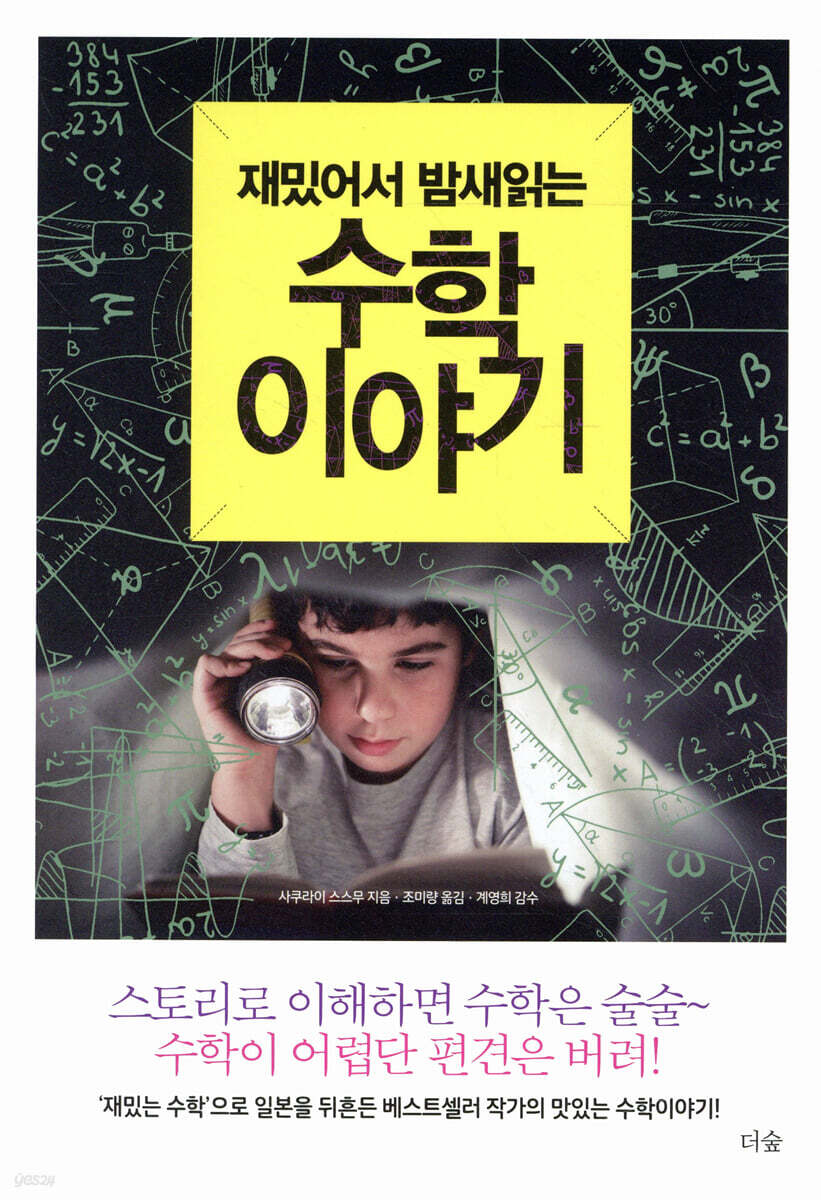
A math story that's so fun you'll read it all night
 |
Description
Book Introduction
2014 School Library Journal Recommended Books
This book is based on various materials encountered in everyday life, making mathematics more approachable and making studying mathematics fun and enjoyable.
The author of this book is a renowned lecturer and bestselling author known for his lectures on “Fun Math” and “Math that Conveys Wonder and Emotion.” He began making a name for himself as a lecturer who taught math and physics to young people in a fun and easy-to-understand way while still in college.
His live shows, which are very popular as lectures that can be enjoyed by everyone from elementary school students to grandfathers, are receiving favorable reviews for changing the worldview of the viewers.
"Math Stories That Are Fun and Will Keep You Reading All Night" is a book that contains the mathematical knowledge that the author has selected and organized while teaching mathematics in various activities and on the front lines. It is not the "dead mathematics" that can only be seen in textbooks, but rather the vivid, living, breathing landscapes of mathematics.
This book is based on various materials encountered in everyday life, making mathematics more approachable and making studying mathematics fun and enjoyable.
The author of this book is a renowned lecturer and bestselling author known for his lectures on “Fun Math” and “Math that Conveys Wonder and Emotion.” He began making a name for himself as a lecturer who taught math and physics to young people in a fun and easy-to-understand way while still in college.
His live shows, which are very popular as lectures that can be enjoyed by everyone from elementary school students to grandfathers, are receiving favorable reviews for changing the worldview of the viewers.
"Math Stories That Are Fun and Will Keep You Reading All Night" is a book that contains the mathematical knowledge that the author has selected and organized while teaching mathematics in various activities and on the front lines. It is not the "dead mathematics" that can only be seen in textbooks, but rather the vivid, living, breathing landscapes of mathematics.
- You can preview some of the book's contents.
Preview
index
An exciting math journey on the railroad called "Equals (=)"
A fun math guide for parents and children to read together
Chapter 1: Math That Will Make You Want to Stay Up All Night Reading
Mathematics is a beautiful harmony of numbers and letters / If you read a formula correctly, you can easily understand its meaning / Mathematicians express beauty / If you cut farts in half, will the smell of farts also decrease? / Factoring that protects our safety / The mathematical secrets hidden in credit card numbers / A super calculation method that easily calculates change / The number that stimulates curiosity, 11 / The story of the birth of the Fields Medal, the highest honor for mathematicians / The difficult problems in mathematics that have yet to be solved
Chapter 2: Finding Hidden Math in Everyday Life
Why should we study roots? / What mathematical relationships are hidden in copy paper? / If a manhole is a square. / We live thanks to 'transformation', and 'transformation' is possible thanks to mathematics. / The 'meter' was born during the French Revolution. / Navigation is full of mathematical and computer functions. / The music playing on the iPod is played by mathematics. / Mathematics is alive. / Baek Eun-bi, who breathes in a carpenter's tool. / Pythagoras, who discovered the beauty of sound in numbers. / Logarithms, a groundbreaking method for calculating astronomical numbers. / Equations, the elegant clothes the universe wears. / Euler, a mathematician who left behind a problem that even modern mathematics cannot solve. / Pi is an eternal never-ending story. / Is there a large or small in infinity?
Chapter 3: The Beautiful and Romantic World of Mathematics
Gauss's unique calculation method that gave birth to the arithmetic sequence / How to calculate the sum of 10 consecutive natural numbers in 1 second / Is 1+1=2 always the correct answer? / Are irrational numbers 'irrational numbers' that do not conform to a ratio? / The frequency of AM radio is made up of multiples of 9 / Ramanujan discovers the power of the mysterious number '12' / The world of numbers expanding from straight lines to planes and space / Infinity before infinity, infinite logarithms / How big is the giant number called 'Graham's number'?
Conclusion: The Joy of Mathematics Discovered in Chance
References
A fun math guide for parents and children to read together
Chapter 1: Math That Will Make You Want to Stay Up All Night Reading
Mathematics is a beautiful harmony of numbers and letters / If you read a formula correctly, you can easily understand its meaning / Mathematicians express beauty / If you cut farts in half, will the smell of farts also decrease? / Factoring that protects our safety / The mathematical secrets hidden in credit card numbers / A super calculation method that easily calculates change / The number that stimulates curiosity, 11 / The story of the birth of the Fields Medal, the highest honor for mathematicians / The difficult problems in mathematics that have yet to be solved
Chapter 2: Finding Hidden Math in Everyday Life
Why should we study roots? / What mathematical relationships are hidden in copy paper? / If a manhole is a square. / We live thanks to 'transformation', and 'transformation' is possible thanks to mathematics. / The 'meter' was born during the French Revolution. / Navigation is full of mathematical and computer functions. / The music playing on the iPod is played by mathematics. / Mathematics is alive. / Baek Eun-bi, who breathes in a carpenter's tool. / Pythagoras, who discovered the beauty of sound in numbers. / Logarithms, a groundbreaking method for calculating astronomical numbers. / Equations, the elegant clothes the universe wears. / Euler, a mathematician who left behind a problem that even modern mathematics cannot solve. / Pi is an eternal never-ending story. / Is there a large or small in infinity?
Chapter 3: The Beautiful and Romantic World of Mathematics
Gauss's unique calculation method that gave birth to the arithmetic sequence / How to calculate the sum of 10 consecutive natural numbers in 1 second / Is 1+1=2 always the correct answer? / Are irrational numbers 'irrational numbers' that do not conform to a ratio? / The frequency of AM radio is made up of multiples of 9 / Ramanujan discovers the power of the mysterious number '12' / The world of numbers expanding from straight lines to planes and space / Infinity before infinity, infinite logarithms / How big is the giant number called 'Graham's number'?
Conclusion: The Joy of Mathematics Discovered in Chance
References
Detailed image

Into the book
When you buy something and receive change, do you check to make sure the amount is correct? Most people probably don't.
Because subtraction is annoying.
But if you think about it a little, it's easy to calculate.
The secret is to not subtract.
Let's chant the spell 'add 9'.
The 'add 9' spell is to find all numbers except the last that add up to 9 and the last number that adds up to 10.
For example, if you pay 1,000 won and buy something worth 342 won, how do you calculate the change? In other words, in the case of '1000-342', the number that 'adds 9' to 3 in the hundreds place is 6, the number that 'adds 9' to 4 in the next tens place is 5, and the number that 'adds 10' to 2 in the last digit is 8.
If you put these three numbers side by side, it becomes '658', which means the change is '658 won'.
In fact, this is simply changing '1000-342' to '999-342+1'.
The job adds 1 to the end, so it becomes 'add 10'.
In other words, you can get the answer without having to do any subtraction.
This way you can easily calculate your change at the checkout counter.
We live by relying on our senses.
The five senses are sight, hearing, taste, smell, and touch, and there are actually certain laws to these.
First, let's consider the case of 'smell'.
Let's say you smell a foul odor like farts in a closed room and use an air freshener or air purifier to reduce it by half.
If it still smells, would you feel like it's only half-smelling? Probably not.
In cases like this, we usually think, 'It's almost the same,' or 'It smells, after all.'
To truly feel 'halfway', you need to remove 90% of the smell.
The same goes for 'sound'.
We can hear (feel) the sound of an insect and the volume of a concert equally.
This is quite interesting if you think about it.
If humans can perceive the absolute value of loudness, then the sound of an insect should be heard as soft because its volume is low, and the sound of a concert should be heard as loud.
But in reality, that's not the case.
We perceive small sounds as equally as loud ones.
This is because the way we feel (sensation) is the same regardless of the size of the sound.
For example, let's say there is a sound with energy 10.
How many times would we need to increase this sound volume before humans can perceive that the sound's loudness (sensation) has doubled? The common thought is, "Since it's doubled, wouldn't we just increase the amount of energy by 20?"
But human ears are not that sensitive.
To make it feel 'double', you actually have to make it ten times bigger.
The sound of '10' must become '100' to be felt as 'double'.
So, to make it feel like it has tripled, you need '10×10×10', which is actually 100 times the energy.
The boy Gauss pondered over how to solve the problem of adding numbers from 1 to 100.
If you draw '1+2+3+… … +98+99+100' as a bar graph, it looks like stairs.
Gauss easily recognized the shape of the figure hidden in this staircase.
It was so roughly piled up that no one would have guessed it was a shape.
Converting the addition of numbers into 'shapes'.
This was a very natural idea for Gauss, who later aimed to reach the pinnacle of number theory and geometry.
At this time, the size of the shape is not very relevant.
Whether it's 100 or 1000, the shape is the same.
The 'roughly stacked shape' mentioned above can be viewed as a trapezoid.
The way to find the area of a trapezoid is '(upper side length + lower side length) × height ÷ 2'.
If the upper side is '1', the lower side is '100', and the height is '100', then the answer '5050' comes out instantly by '(1+100)×100÷2'.
Even if 100 is changed to another number, you can easily find the answer using this method.
The sigma formula that we learn in high school math class can be explained in Gauss' way.
Had Gauss ever considered this formula before his teacher posed the problem? If so, he would have quickly figured out the answer, so this was probably the first time he had considered the problem.
Looking at it this way, it can be said that this formula was created because the problem was to add up to 100.
If the question was 'What is the sum of the natural numbers from 1 to 10?', this kind of thinking would not have been necessary.
Therefore, the teacher who chose 100 as the problem may have had some mathematical sense.
Because subtraction is annoying.
But if you think about it a little, it's easy to calculate.
The secret is to not subtract.
Let's chant the spell 'add 9'.
The 'add 9' spell is to find all numbers except the last that add up to 9 and the last number that adds up to 10.
For example, if you pay 1,000 won and buy something worth 342 won, how do you calculate the change? In other words, in the case of '1000-342', the number that 'adds 9' to 3 in the hundreds place is 6, the number that 'adds 9' to 4 in the next tens place is 5, and the number that 'adds 10' to 2 in the last digit is 8.
If you put these three numbers side by side, it becomes '658', which means the change is '658 won'.
In fact, this is simply changing '1000-342' to '999-342+1'.
The job adds 1 to the end, so it becomes 'add 10'.
In other words, you can get the answer without having to do any subtraction.
This way you can easily calculate your change at the checkout counter.
We live by relying on our senses.
The five senses are sight, hearing, taste, smell, and touch, and there are actually certain laws to these.
First, let's consider the case of 'smell'.
Let's say you smell a foul odor like farts in a closed room and use an air freshener or air purifier to reduce it by half.
If it still smells, would you feel like it's only half-smelling? Probably not.
In cases like this, we usually think, 'It's almost the same,' or 'It smells, after all.'
To truly feel 'halfway', you need to remove 90% of the smell.
The same goes for 'sound'.
We can hear (feel) the sound of an insect and the volume of a concert equally.
This is quite interesting if you think about it.
If humans can perceive the absolute value of loudness, then the sound of an insect should be heard as soft because its volume is low, and the sound of a concert should be heard as loud.
But in reality, that's not the case.
We perceive small sounds as equally as loud ones.
This is because the way we feel (sensation) is the same regardless of the size of the sound.
For example, let's say there is a sound with energy 10.
How many times would we need to increase this sound volume before humans can perceive that the sound's loudness (sensation) has doubled? The common thought is, "Since it's doubled, wouldn't we just increase the amount of energy by 20?"
But human ears are not that sensitive.
To make it feel 'double', you actually have to make it ten times bigger.
The sound of '10' must become '100' to be felt as 'double'.
So, to make it feel like it has tripled, you need '10×10×10', which is actually 100 times the energy.
The boy Gauss pondered over how to solve the problem of adding numbers from 1 to 100.
If you draw '1+2+3+… … +98+99+100' as a bar graph, it looks like stairs.
Gauss easily recognized the shape of the figure hidden in this staircase.
It was so roughly piled up that no one would have guessed it was a shape.
Converting the addition of numbers into 'shapes'.
This was a very natural idea for Gauss, who later aimed to reach the pinnacle of number theory and geometry.
At this time, the size of the shape is not very relevant.
Whether it's 100 or 1000, the shape is the same.
The 'roughly stacked shape' mentioned above can be viewed as a trapezoid.
The way to find the area of a trapezoid is '(upper side length + lower side length) × height ÷ 2'.
If the upper side is '1', the lower side is '100', and the height is '100', then the answer '5050' comes out instantly by '(1+100)×100÷2'.
Even if 100 is changed to another number, you can easily find the answer using this method.
The sigma formula that we learn in high school math class can be explained in Gauss' way.
Had Gauss ever considered this formula before his teacher posed the problem? If so, he would have quickly figured out the answer, so this was probably the first time he had considered the problem.
Looking at it this way, it can be said that this formula was created because the problem was to add up to 100.
If the question was 'What is the sum of the natural numbers from 1 to 10?', this kind of thinking would not have been necessary.
Therefore, the teacher who chose 100 as the problem may have had some mathematical sense.
---From the text
Publisher's Review
A delicious math story from the bestselling author who shook up Japan with "fun math"!
If you understand it through stories, math becomes easy~ Get rid of the prejudice that math is difficult!
Parents and math educators are showing increasing interest in the storytelling method that will be introduced in all elementary and middle school math textbooks starting in 2013 and continuing through 2015.
The purpose of introducing storytelling-style mathematics is to help our children, who often give up on mathematics early in their elementary school years, understand the purpose of studying mathematics, stimulate interest, and motivate them to study mathematics.
"Math Stories That Are Fun and Will Keep You Reading All Night" is a book published in line with this trend. It is a book that makes math more approachable and makes learning math fun and enjoyable based on various materials encountered in everyday life.
The author of this book is a renowned lecturer and bestselling author known for his lectures on “Fun Math” and “Math that Conveys Wonder and Emotion.” He began making a name for himself as a lecturer who taught math and physics to young people in a fun and easy-to-understand way while still in college.
His live shows, which are very popular as lectures that can be enjoyed by everyone from elementary school students to grandfathers, are receiving favorable reviews for changing the worldview of the viewers.
"Math Stories That Are Fun and Will Keep You Reading All Night" is a book that contains the mathematical knowledge that the author has selected and organized while teaching mathematics in various activities and on the front lines. It is not the "dead mathematics" that can only be seen in textbooks, but rather the vivid, living, breathing landscapes of mathematics.
This book explains various mathematical knowledge that can be found in textbooks, such as equations, factoring, logarithms, and irrational numbers, through interesting stories, and conveys to readers the fun of mathematics, why mathematics is necessary, and the beauty of mathematics.
As you follow the 'fun and lively math stories,' 'math that seemed difficult and unnecessary' will soon become an interesting world, and within it, you will discover the value and joy of math.
Once you start reading, you can't stop!
An exciting journey to discover the secrets of mathematics hidden in everyday life.
The door to mathematics, which had been firmly closed, is now open!
In the author's story, numerous formulas and symbols found in textbooks appear alongside our daily lives.
It easily explains the Internet security issues that were realized in the recent national issue of cyber terrorism through factoring, explains the principles of assigning credit card membership numbers, provides a fun calculation method to quickly check the change you received after buying something, explains the secrets behind the size of copy paper and the origin of the unit system, how navigation can find your current location and give you directions, and why manhole covers are round. It guides you into the mysterious world of mathematics that you never knew about in an easy and friendly way.
It also guides us into the fascinating world of mathematics through the history of mathematics, the challenges of mathematicians, and the lives of mathematicians who are devoted solely to mathematics.
The author, who has brought joy to people of all ages through enjoyable mathematics, teaches mathematics that leaves a warm impression, rather than mathematics consisting of rigid formulas, to young people who are growing tired of mathematics.
By comparing numbers to music, the author tells the story of how numbers create an elegant dance and the beautiful melody that flows to them will captivate you just once, emphasizing with his characteristically soft prose how beautiful and interesting mathematics is.
For parents, it is a tool for communication with their children through liberal arts mathematics.
The best introductory math book for children to learn math naturally!
This book is full of stories about mathematics that are good for children and parents to read together as a form of general knowledge.
Through stories about the Fields Medal, often called the Nobel Prize of mathematics, logarithms, equations, and roots, the 'meter' created during the French Revolution, and the fact that iPods play music based on mathematics, parents will be able to enjoy mathematics as a liberal art they could not have enjoyed in the past, and will have a tool for communicating with their children.
In addition to textbook-based mathematics, children will also naturally experience high-level mathematics, such as infinitesimal algebra and Graham's numbers, which are tailored to the level of young people, and representative unsolved problems in mathematics.
The author's new perspective that mathematics should be valued not only as numbers but also as letters and language fully reveals the author's deep affection for mathematics.
“Writing is the first step toward learning.
Through the act of writing, we enter a new world.
Mathematics, in particular, uses a significant number of letters.
Roman, Greek, Arabic, and Roman numerals, each in uppercase and lowercase, and in italics.
(…) This kind of cherishing of letters is the first step to making language your own.
Mathematics is also a language.
Therefore, the characters used in mathematics should also be cherished.”
Through the author's loving perspective on mathematics, teachers considering new directions in mathematics education will find hints for new teaching methods to teach children.
Additionally, teenagers who struggle with math or parents of children who struggle with math will find the perfect introductory math book to spark their interest in math.
If you understand it through stories, math becomes easy~ Get rid of the prejudice that math is difficult!
Parents and math educators are showing increasing interest in the storytelling method that will be introduced in all elementary and middle school math textbooks starting in 2013 and continuing through 2015.
The purpose of introducing storytelling-style mathematics is to help our children, who often give up on mathematics early in their elementary school years, understand the purpose of studying mathematics, stimulate interest, and motivate them to study mathematics.
"Math Stories That Are Fun and Will Keep You Reading All Night" is a book published in line with this trend. It is a book that makes math more approachable and makes learning math fun and enjoyable based on various materials encountered in everyday life.
The author of this book is a renowned lecturer and bestselling author known for his lectures on “Fun Math” and “Math that Conveys Wonder and Emotion.” He began making a name for himself as a lecturer who taught math and physics to young people in a fun and easy-to-understand way while still in college.
His live shows, which are very popular as lectures that can be enjoyed by everyone from elementary school students to grandfathers, are receiving favorable reviews for changing the worldview of the viewers.
"Math Stories That Are Fun and Will Keep You Reading All Night" is a book that contains the mathematical knowledge that the author has selected and organized while teaching mathematics in various activities and on the front lines. It is not the "dead mathematics" that can only be seen in textbooks, but rather the vivid, living, breathing landscapes of mathematics.
This book explains various mathematical knowledge that can be found in textbooks, such as equations, factoring, logarithms, and irrational numbers, through interesting stories, and conveys to readers the fun of mathematics, why mathematics is necessary, and the beauty of mathematics.
As you follow the 'fun and lively math stories,' 'math that seemed difficult and unnecessary' will soon become an interesting world, and within it, you will discover the value and joy of math.
Once you start reading, you can't stop!
An exciting journey to discover the secrets of mathematics hidden in everyday life.
The door to mathematics, which had been firmly closed, is now open!
In the author's story, numerous formulas and symbols found in textbooks appear alongside our daily lives.
It easily explains the Internet security issues that were realized in the recent national issue of cyber terrorism through factoring, explains the principles of assigning credit card membership numbers, provides a fun calculation method to quickly check the change you received after buying something, explains the secrets behind the size of copy paper and the origin of the unit system, how navigation can find your current location and give you directions, and why manhole covers are round. It guides you into the mysterious world of mathematics that you never knew about in an easy and friendly way.
It also guides us into the fascinating world of mathematics through the history of mathematics, the challenges of mathematicians, and the lives of mathematicians who are devoted solely to mathematics.
The author, who has brought joy to people of all ages through enjoyable mathematics, teaches mathematics that leaves a warm impression, rather than mathematics consisting of rigid formulas, to young people who are growing tired of mathematics.
By comparing numbers to music, the author tells the story of how numbers create an elegant dance and the beautiful melody that flows to them will captivate you just once, emphasizing with his characteristically soft prose how beautiful and interesting mathematics is.
For parents, it is a tool for communication with their children through liberal arts mathematics.
The best introductory math book for children to learn math naturally!
This book is full of stories about mathematics that are good for children and parents to read together as a form of general knowledge.
Through stories about the Fields Medal, often called the Nobel Prize of mathematics, logarithms, equations, and roots, the 'meter' created during the French Revolution, and the fact that iPods play music based on mathematics, parents will be able to enjoy mathematics as a liberal art they could not have enjoyed in the past, and will have a tool for communicating with their children.
In addition to textbook-based mathematics, children will also naturally experience high-level mathematics, such as infinitesimal algebra and Graham's numbers, which are tailored to the level of young people, and representative unsolved problems in mathematics.
The author's new perspective that mathematics should be valued not only as numbers but also as letters and language fully reveals the author's deep affection for mathematics.
“Writing is the first step toward learning.
Through the act of writing, we enter a new world.
Mathematics, in particular, uses a significant number of letters.
Roman, Greek, Arabic, and Roman numerals, each in uppercase and lowercase, and in italics.
(…) This kind of cherishing of letters is the first step to making language your own.
Mathematics is also a language.
Therefore, the characters used in mathematics should also be cherished.”
Through the author's loving perspective on mathematics, teachers considering new directions in mathematics education will find hints for new teaching methods to teach children.
Additionally, teenagers who struggle with math or parents of children who struggle with math will find the perfect introductory math book to spark their interest in math.
GOODS SPECIFICS
- Date of issue: April 5, 2013
- Page count, weight, size: 200 pages | 319g | 145*210*20mm
- ISBN13: 9788994418537
- ISBN10: 8994418539
You may also like
카테고리
korean


korean

![GQ KOREA Mark (Monthly): December [2025]](http://librairie.coreenne.fr/cdn/shop/files/8ef265dbbfbf186523ed75ba7319009d.jpg?v=1765340328&width=3840)


