

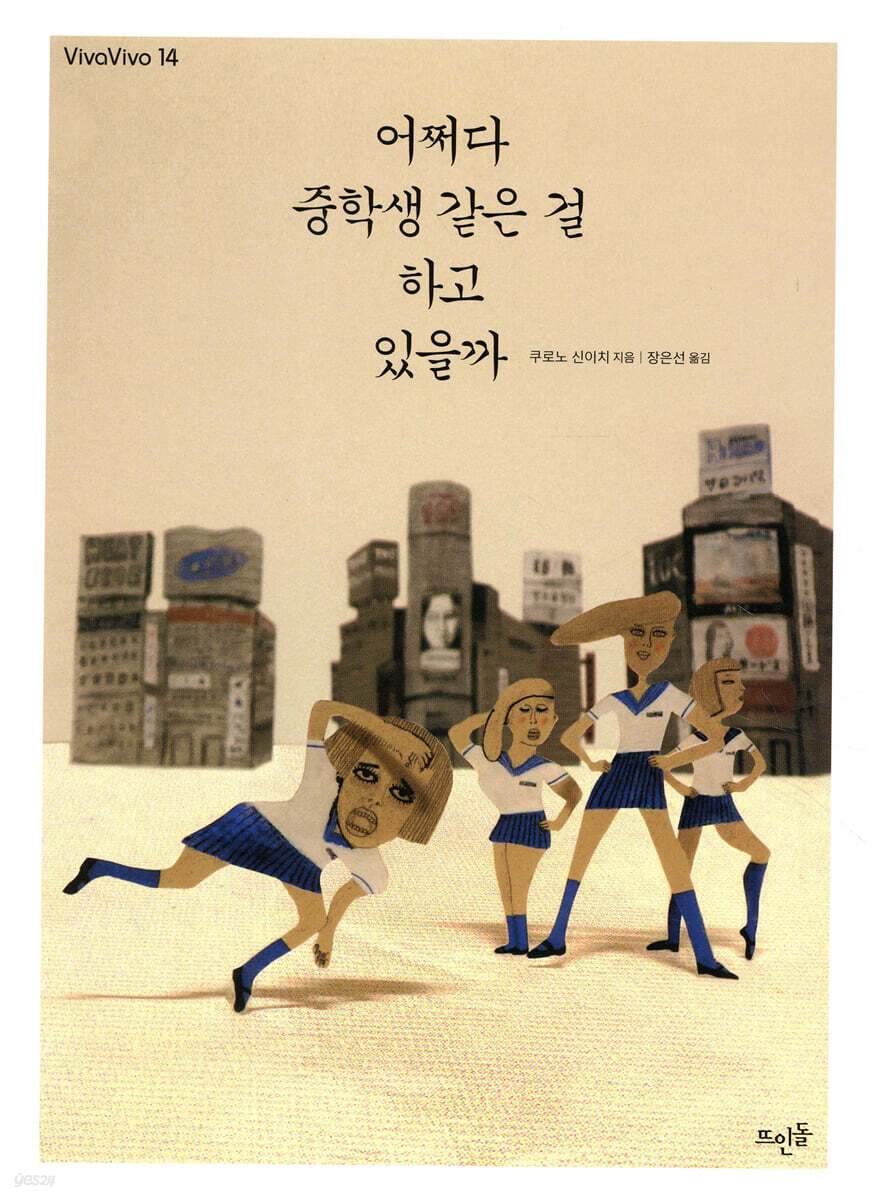
How come I'm doing something like a middle school student?
 |
Description
Book Introduction
The tumultuous growth story of a girl suffering from second-year middle school syndrome
"Why Am I Doing Middle School Things?" depicts the situations and inner thoughts of today's youth through the daily life of Sumire, who has just entered her second year of middle school.
The main character, Sumire, suffers from severe chuunibyou.
She may seem like a timid girl, but beyond reality, she dreams of becoming a hero, and dreams grandly of abolishing the middle school system by exposing the corruption of schools, families, and the privileged class in society—if only in her heart!
However, he just kept having delusions and drifted around like oil that couldn't mix with water, and eventually, he started the first semester of his second year of middle school without a single friend.
The protagonist of this novel, which consists of a nineteen-year-old reminiscing about the turbulent events he recorded in his second year of middle school, is very complex, boastful, and even fickle. However, if you follow his thoughts, you will find yourself unknowingly taking his side and rooting for him.
He is a character you can't hate, who gives you empathy, laughter, and emotion all at the same time.
Also, the people surrounding the main character and the events that occur every day are exciting, like watching a drama that makes you look forward to the next episode.
The story unfolds at a rapid pace, depicting the fiery power struggles that unfold in a middle school classroom, the war of nerves between teenage girls, and the emotional ups and downs of the protagonist, Sumire.
"Why Am I Doing Middle School Things?" depicts the situations and inner thoughts of today's youth through the daily life of Sumire, who has just entered her second year of middle school.
The main character, Sumire, suffers from severe chuunibyou.
She may seem like a timid girl, but beyond reality, she dreams of becoming a hero, and dreams grandly of abolishing the middle school system by exposing the corruption of schools, families, and the privileged class in society—if only in her heart!
However, he just kept having delusions and drifted around like oil that couldn't mix with water, and eventually, he started the first semester of his second year of middle school without a single friend.
The protagonist of this novel, which consists of a nineteen-year-old reminiscing about the turbulent events he recorded in his second year of middle school, is very complex, boastful, and even fickle. However, if you follow his thoughts, you will find yourself unknowingly taking his side and rooting for him.
He is a character you can't hate, who gives you empathy, laughter, and emotion all at the same time.
Also, the people surrounding the main character and the events that occur every day are exciting, like watching a drama that makes you look forward to the next episode.
The story unfolds at a rapid pace, depicting the fiery power struggles that unfold in a middle school classroom, the war of nerves between teenage girls, and the emotional ups and downs of the protagonist, Sumire.
- You can preview some of the book's contents.
Preview
Into the book
Middle school is completely different from elementary school.
Is this a given? There was little change between fifth and sixth grade, but the moment I transitioned from sixth grade to first year of middle school, it felt like I'd been thrust into a different dimension.
They're both just one year older.
School uniforms, strangely high horizontal bars, and teachers who change for each subject.
It's true that I wasted time getting used to things that didn't exist in elementary school.
But the biggest difference is the children in the class.
It's been two weeks since the new semester started.
The power structure in our class was becoming more and more clear.
Of course, I am almost a bystander and do not participate in the power struggle at all.
Is the term "power struggle" an exaggeration? Not at all.
In my opinion, school is similar to the Warring States period when all kinds of powers were running wild.
In it, I am just a bystander, like a modern person.
Why do kids who don't act like that at home suddenly change when they come to school? Is it a collective frenzy? No, I think it's more a matter of location.
Even men, who are masculine in and of themselves, are sulking in the subway, library, or department store.
So then, is the location called school the problem?
It's just as I said.
When you put children of the same age in one place, they become infected with the disease of obscenity.
So, middle schools should be abolished.
After you become an adult, let's either force you into one place or not.
Until then, everyone stay home and wait! That's all for now.
… But that won’t work, right?
I was annoyed at the two people who didn't even try to understand why their daughter was like this, and who only saw superficial things like theft and makeup.
I was angry at myself for struggling to change myself until now, only to be frustrated and left with no answer.
I also cursed the world that had created a middle school society that I felt I could never enter with my personality.
That's why I cried.
Of course, I know that this is a situation that requires reflection.
But I also want you to know that there are mountains of people who need to reflect on their actions, not just me.
As February came, the ignoring and harassment towards me became more severe.
Eventually, I entered a brain dead state.
Brain death refers to a state in which consciousness is completely blocked from the outside world, like a turtle putting its head inside its shell.
This way, you don't have to worry about what's going on around you.
I can't tell the difference between being happy, sad, or angry.
I can't feel anything, like a stone.
… So, I blocked out all information without speaking to anyone and just quietly waited for time to pass.
I didn't take any action to try to change the situation.
If you start thinking about it seriously, you'll probably really want to kill yourself.
But there was someone who spoke to me like this.
It's Jun.
The day my desk disappeared, if it weren't for Jun, I would have definitely exploded.
He might have lunged at Aoi with a cutter knife, or staggered up to the roof and thrown himself.
He represented my anger and acted as a cushion.
- Page 177
I will never forget who I was back then.
Because of those experiences, I am who I am today.
I want to pat my fourteen-year-old self on the head and say, 'Sumire, you really worked hard.'
Is this a given? There was little change between fifth and sixth grade, but the moment I transitioned from sixth grade to first year of middle school, it felt like I'd been thrust into a different dimension.
They're both just one year older.
School uniforms, strangely high horizontal bars, and teachers who change for each subject.
It's true that I wasted time getting used to things that didn't exist in elementary school.
But the biggest difference is the children in the class.
It's been two weeks since the new semester started.
The power structure in our class was becoming more and more clear.
Of course, I am almost a bystander and do not participate in the power struggle at all.
Is the term "power struggle" an exaggeration? Not at all.
In my opinion, school is similar to the Warring States period when all kinds of powers were running wild.
In it, I am just a bystander, like a modern person.
Why do kids who don't act like that at home suddenly change when they come to school? Is it a collective frenzy? No, I think it's more a matter of location.
Even men, who are masculine in and of themselves, are sulking in the subway, library, or department store.
So then, is the location called school the problem?
It's just as I said.
When you put children of the same age in one place, they become infected with the disease of obscenity.
So, middle schools should be abolished.
After you become an adult, let's either force you into one place or not.
Until then, everyone stay home and wait! That's all for now.
… But that won’t work, right?
I was annoyed at the two people who didn't even try to understand why their daughter was like this, and who only saw superficial things like theft and makeup.
I was angry at myself for struggling to change myself until now, only to be frustrated and left with no answer.
I also cursed the world that had created a middle school society that I felt I could never enter with my personality.
That's why I cried.
Of course, I know that this is a situation that requires reflection.
But I also want you to know that there are mountains of people who need to reflect on their actions, not just me.
As February came, the ignoring and harassment towards me became more severe.
Eventually, I entered a brain dead state.
Brain death refers to a state in which consciousness is completely blocked from the outside world, like a turtle putting its head inside its shell.
This way, you don't have to worry about what's going on around you.
I can't tell the difference between being happy, sad, or angry.
I can't feel anything, like a stone.
… So, I blocked out all information without speaking to anyone and just quietly waited for time to pass.
I didn't take any action to try to change the situation.
If you start thinking about it seriously, you'll probably really want to kill yourself.
But there was someone who spoke to me like this.
It's Jun.
The day my desk disappeared, if it weren't for Jun, I would have definitely exploded.
He might have lunged at Aoi with a cutter knife, or staggered up to the roof and thrown himself.
He represented my anger and acted as a cushion.
- Page 177
I will never forget who I was back then.
Because of those experiences, I am who I am today.
I want to pat my fourteen-year-old self on the head and say, 'Sumire, you really worked hard.'
--- From the text
Publisher's Review
The tumultuous growth story of a girl suffering from second-year middle school syndrome
"How did I end up doing something like a middle school student?"
“Their fierce psychological warfare in middle school classrooms,
The irony of laughter and tears coexisting amicably,
And the mind of a childish, lively, and cheeky teenage girl is revealed!”
Scanning the inner workings of the 21st century's most troubled race: youth.
Among the shocking incidents occurring these days, the ones that receive the most attention are those involving teenagers, especially middle school students.
School violence is progressing intellectually, with everything from bread shuttles, cigarette shuttles, and even Wi-Fi shuttles, and bullying and depression are rampant even in middle schools.
If you search for concerns about middle school life on portal sites, the most common concerns are about relationships with friends and parents and stress from studying.
Things that weren't that difficult in elementary school are so difficult in middle school.
Middle school life armed with unrealistic fears and a strange awkwardness.
A time when something inside you is stirring hotly, you get angry for no reason, and everyone else seems childish except you.
"Why Am I Doing Middle School Things?" depicts the situations and inner thoughts of today's youth through the daily life of Sumire, who has just entered her second year of middle school.
In a second-grade middle school classroom
Learn how to balance your life
One of the words that is popular among children these days is 'middle school syndrome'.
If we look at the symptoms,
-I think you can do anything if you put your mind to it.
-I think I am depressed and I am deeply hurt.
- Filling up your mini-homepage or blog with false statements.
-There are many times when I mutter to myself.
-I try to look at everything negatively.
-Everyone looks childish except me.
'Middle school syndrome' was selected as a hot keyword in 2011. It is a word that is passed around by many people to the point that the 'middle school syndrome test' has become popular.
The main character, Sumire, also suffers from severe chuunibyou.
She may seem like a timid girl, but beyond reality, she dreams of becoming a hero, and dreams grandly of abolishing the middle school system by exposing the corruption of schools, families, and the privileged classes in society (i.e., teachers, bullies, parents, and the government)—at least in her heart!
However, he just kept having delusions and drifted around like oil that couldn't mix with water, and eventually, he started the first semester of his second year of middle school without a single friend.
'The surrounding environment is wrong.
Just don't make friends and go your own way.
It's okay because it's not like I was bullied or ostracized and I'm walking around alone. It just happened naturally.'
I try to console myself like this, but does that mean I was naturally pushed out by the other kids in my class? Why? I may be a bit different from the others, but I'm not bad-tempered, not stubborn, and I'm perceptive.
Isn't that right? Are you oblivious? Is that why things turned out this way? I racked my brain desperately, but I couldn't figure it out.
- In the text
The protagonist realizes that he needs someone by his side, so he gives up his life as an outcast (or bystander, as the protagonist says) and desperately tries to fit into the best group in class.
After many twists and turns, he ends up hanging out with those kids, but an unexpected twist awaits him.
Many middle school students and teenagers are going through the worst time of their lives.
The same goes for our protagonist, Sumire.
However, through hardship, Sumire discovers the strength and perseverance that had been dormant within her, and learns to distance herself from the close and supportive relationships and to be more relaxed, thus enduring the period.
It's like learning to ride a bicycle, learning to balance life.
The protagonist, Sumire, who is now nineteen, concludes about her fourteenth year:
“Effort is important.
From that perspective, I deserve a round of applause for being a middle school student.
But when things don't work out no matter how hard you try, you shouldn't worry too much.
It's better to wait patiently for the storm to pass while enjoying your favorite snack or a warm cup of tea.
“The storm will pass soon.” - From the text
A story that unfolds as excitingly as watching a movie, with realistic character portrayals.
This book is about the protagonist listening back to and reminiscing about the events he recorded in his second year of middle school when he was nineteen years old.
The protagonist is very complex, boastful, and fickle.
But if you follow those thoughts, you will find yourself unknowingly taking the protagonist's side and rooting for him.
He is a character you can't hate, who gives you empathy, laughter, and emotion all at the same time.
Also, the people surrounding the main character and the events that occur every day are exciting, like watching a drama that makes you look forward to the next episode.
The story unfolds at a rapid pace, depicting the fiery power struggles that unfold in a middle school classroom, the war of nerves between teenage girls, and the emotional ups and downs of the protagonist, Sumire.
The characters in this book are so vivid that they seem to have jumped out of reality, and they all provide a witty and entertaining story.
Armed with the old-fashioned and double-crossing parents who constantly say "No!" to their children, the Aoi group, the most popular fashionistas in class, and the baseless belief that pretty kids are lenient towards ugly kids, the protagonist struggles to become one with these kids.
The Mykane Group, an unidentified religious group preparing for the destruction of the Earth and waiting for the next world; Takuji, a strangely attractive man infected with the disease of obscenity; and Jun, who always acts as a cushion by Sumire's side, quietly and silently.
Sumire learns to build relationships by both hurting and being hurt by the people around her.
As she learns to cover up the parts that are difficult to understand and to express gratitude, Sumire grows little by little without realizing it.
This book honestly and chicly shows the bare faces of youth, and writes about the hope and vitality of a new name.
Although his speech is rough, the protagonist eventually learns to love himself and others, and through his growth process, readers will be able to envision the 'tomorrow' of our youth.
"How did I end up doing something like a middle school student?"
“Their fierce psychological warfare in middle school classrooms,
The irony of laughter and tears coexisting amicably,
And the mind of a childish, lively, and cheeky teenage girl is revealed!”
Scanning the inner workings of the 21st century's most troubled race: youth.
Among the shocking incidents occurring these days, the ones that receive the most attention are those involving teenagers, especially middle school students.
School violence is progressing intellectually, with everything from bread shuttles, cigarette shuttles, and even Wi-Fi shuttles, and bullying and depression are rampant even in middle schools.
If you search for concerns about middle school life on portal sites, the most common concerns are about relationships with friends and parents and stress from studying.
Things that weren't that difficult in elementary school are so difficult in middle school.
Middle school life armed with unrealistic fears and a strange awkwardness.
A time when something inside you is stirring hotly, you get angry for no reason, and everyone else seems childish except you.
"Why Am I Doing Middle School Things?" depicts the situations and inner thoughts of today's youth through the daily life of Sumire, who has just entered her second year of middle school.
In a second-grade middle school classroom
Learn how to balance your life
One of the words that is popular among children these days is 'middle school syndrome'.
If we look at the symptoms,
-I think you can do anything if you put your mind to it.
-I think I am depressed and I am deeply hurt.
- Filling up your mini-homepage or blog with false statements.
-There are many times when I mutter to myself.
-I try to look at everything negatively.
-Everyone looks childish except me.
'Middle school syndrome' was selected as a hot keyword in 2011. It is a word that is passed around by many people to the point that the 'middle school syndrome test' has become popular.
The main character, Sumire, also suffers from severe chuunibyou.
She may seem like a timid girl, but beyond reality, she dreams of becoming a hero, and dreams grandly of abolishing the middle school system by exposing the corruption of schools, families, and the privileged classes in society (i.e., teachers, bullies, parents, and the government)—at least in her heart!
However, he just kept having delusions and drifted around like oil that couldn't mix with water, and eventually, he started the first semester of his second year of middle school without a single friend.
'The surrounding environment is wrong.
Just don't make friends and go your own way.
It's okay because it's not like I was bullied or ostracized and I'm walking around alone. It just happened naturally.'
I try to console myself like this, but does that mean I was naturally pushed out by the other kids in my class? Why? I may be a bit different from the others, but I'm not bad-tempered, not stubborn, and I'm perceptive.
Isn't that right? Are you oblivious? Is that why things turned out this way? I racked my brain desperately, but I couldn't figure it out.
- In the text
The protagonist realizes that he needs someone by his side, so he gives up his life as an outcast (or bystander, as the protagonist says) and desperately tries to fit into the best group in class.
After many twists and turns, he ends up hanging out with those kids, but an unexpected twist awaits him.
Many middle school students and teenagers are going through the worst time of their lives.
The same goes for our protagonist, Sumire.
However, through hardship, Sumire discovers the strength and perseverance that had been dormant within her, and learns to distance herself from the close and supportive relationships and to be more relaxed, thus enduring the period.
It's like learning to ride a bicycle, learning to balance life.
The protagonist, Sumire, who is now nineteen, concludes about her fourteenth year:
“Effort is important.
From that perspective, I deserve a round of applause for being a middle school student.
But when things don't work out no matter how hard you try, you shouldn't worry too much.
It's better to wait patiently for the storm to pass while enjoying your favorite snack or a warm cup of tea.
“The storm will pass soon.” - From the text
A story that unfolds as excitingly as watching a movie, with realistic character portrayals.
This book is about the protagonist listening back to and reminiscing about the events he recorded in his second year of middle school when he was nineteen years old.
The protagonist is very complex, boastful, and fickle.
But if you follow those thoughts, you will find yourself unknowingly taking the protagonist's side and rooting for him.
He is a character you can't hate, who gives you empathy, laughter, and emotion all at the same time.
Also, the people surrounding the main character and the events that occur every day are exciting, like watching a drama that makes you look forward to the next episode.
The story unfolds at a rapid pace, depicting the fiery power struggles that unfold in a middle school classroom, the war of nerves between teenage girls, and the emotional ups and downs of the protagonist, Sumire.
The characters in this book are so vivid that they seem to have jumped out of reality, and they all provide a witty and entertaining story.
Armed with the old-fashioned and double-crossing parents who constantly say "No!" to their children, the Aoi group, the most popular fashionistas in class, and the baseless belief that pretty kids are lenient towards ugly kids, the protagonist struggles to become one with these kids.
The Mykane Group, an unidentified religious group preparing for the destruction of the Earth and waiting for the next world; Takuji, a strangely attractive man infected with the disease of obscenity; and Jun, who always acts as a cushion by Sumire's side, quietly and silently.
Sumire learns to build relationships by both hurting and being hurt by the people around her.
As she learns to cover up the parts that are difficult to understand and to express gratitude, Sumire grows little by little without realizing it.
This book honestly and chicly shows the bare faces of youth, and writes about the hope and vitality of a new name.
Although his speech is rough, the protagonist eventually learns to love himself and others, and through his growth process, readers will be able to envision the 'tomorrow' of our youth.
GOODS SPECIFICS
- Date of publication: January 17, 2012
- Page count, weight, size: 191 pages | 336g | 152*210*20mm
- ISBN13: 9788958073642
- ISBN10: 8958073640
You may also like
카테고리
korean


korean

![GQ KOREA Mark (Monthly): December [2025]](http://librairie.coreenne.fr/cdn/shop/files/8ef265dbbfbf186523ed75ba7319009d.jpg?v=1765340328&width=3840)


