

Study medicine while you're at it
 |
Description
Book Introduction
“If you are a student who dreams of becoming a doctor, I recommend that you start studying anatomy with this book!”
_Highly recommended by Professor Namgung In, Department of Emergency Medicine!
From students aspiring to medical school to adults curious about the structure of the human body.
Amazing illustrations and one-point explanations that open up the wonderful world of anatomy.
A new book in the "Science with Pictures" series that catches the eye and is refreshingly easy to understand.
The new book in the "Science with Pictures" series, which has captivated everyone from middle school students to adults seeking to develop their scientific knowledge, has been released: "Study Medicine While You're at It."
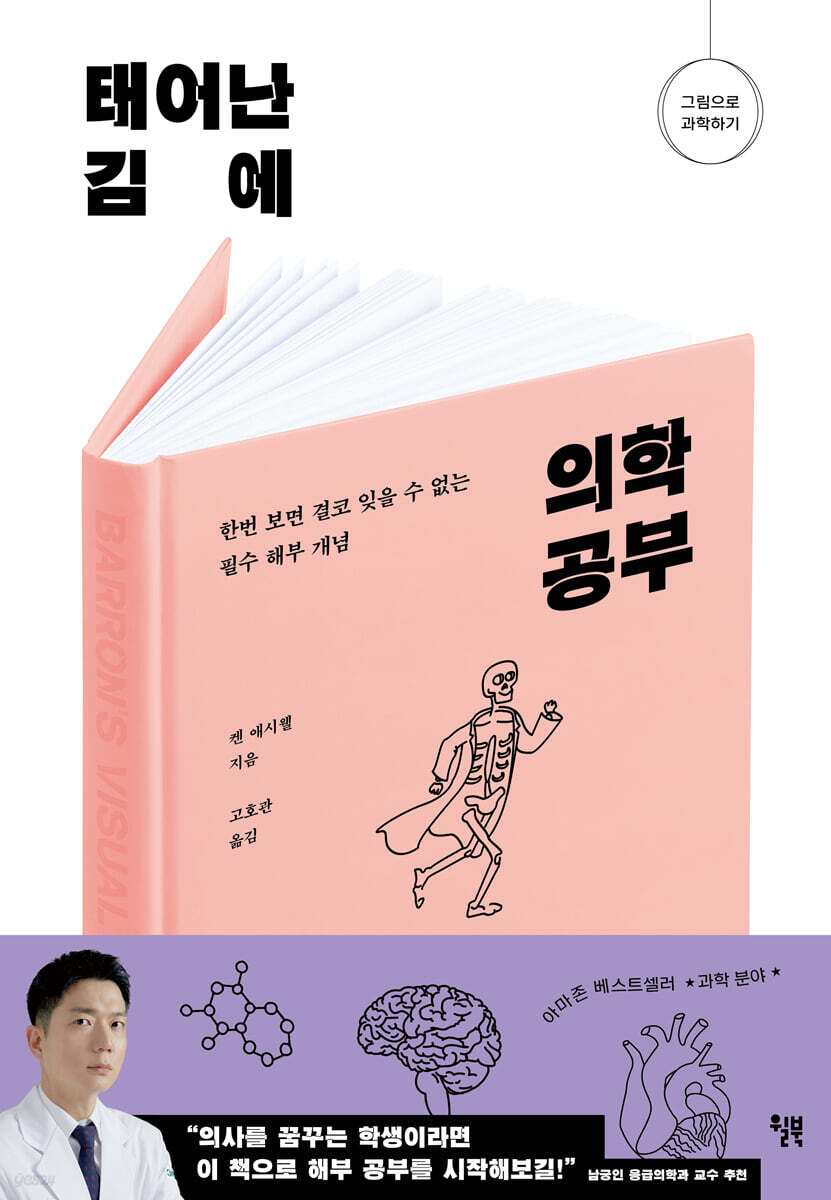
『Study Medicine While You're at It』 is a book that explains anatomy, the foundation of medicine, through illustrations.
This book provides an easy and friendly guide to studying anatomy for anyone, from children curious about the human body, students dreaming of pursuing a career in medicine, and adults interested in the structure of the human body for reasons such as drawing, exercise, or health.
By compressing numerous texts into a single image and providing simple and concise explanations of the essentials, you can quickly and easily memorize the human anatomy concepts you've always wanted to know without losing focus.
Organizing concepts into pictures not only allows you to understand them quickly and accurately, but also makes them less likely to be forgotten.
'Science with Pictures' is a series that emerged from a shift in approach to studying science through pictures rather than text.
More than half of the population is said to be a visual learner who learns through pictures rather than text, and science in particular is a subject that is effective when taught visually.
Anyone who has ever despaired of studying science by reading, listening, and solving problems, or who has despaired of becoming a science major, will discover a new world through this series.
It is also famous as a book that has helped people with adult ADHD and concentration problems.
High-quality infographics using vivid colors, layouts that guide the flow of the eye according to importance, and short, friendly, one-point explanations are designed to help users find the information they need without giving them time to lose focus.
If you're someone who can't stand not getting the information you want within 10 seconds of your attention, there's no better science book than this one.
Ken Ashwell, a world-renowned anatomy professor who has taught anatomy at universities for over 40 years, written anatomy textbooks, and published over 100 papers, has carefully selected and organized essential anatomy concepts from bones and joints to muscles, brain and nerves, cells, immune system, and endocrine system.
This book covers the core topics covered in high school life science, and if you want to delve deeper into life science, following "Study Biology While You're at It," this book will be a great guide.
Namgung In, author of “Body, the Universe Within Me” and professor of emergency medicine at Ewha Womans University Mokdong Hospital, said that this is the book he would give to his younger self who wanted to glimpse another world, and highly recommended it, saying, “Picture books have the charm of not being read once but being looked at again and again,” and that the details in picture books remain in the memory for a long time.
My interest in science begins with my body, and as I gain a structural understanding of my body, my perspective on the world changes.
Since we were born into a world that revolves around science, let's live as people who know science.
_Highly recommended by Professor Namgung In, Department of Emergency Medicine!
From students aspiring to medical school to adults curious about the structure of the human body.
Amazing illustrations and one-point explanations that open up the wonderful world of anatomy.
A new book in the "Science with Pictures" series that catches the eye and is refreshingly easy to understand.
The new book in the "Science with Pictures" series, which has captivated everyone from middle school students to adults seeking to develop their scientific knowledge, has been released: "Study Medicine While You're at It."
『Study Medicine While You're at It』 is a book that explains anatomy, the foundation of medicine, through illustrations.
This book provides an easy and friendly guide to studying anatomy for anyone, from children curious about the human body, students dreaming of pursuing a career in medicine, and adults interested in the structure of the human body for reasons such as drawing, exercise, or health.
By compressing numerous texts into a single image and providing simple and concise explanations of the essentials, you can quickly and easily memorize the human anatomy concepts you've always wanted to know without losing focus.
Organizing concepts into pictures not only allows you to understand them quickly and accurately, but also makes them less likely to be forgotten.
'Science with Pictures' is a series that emerged from a shift in approach to studying science through pictures rather than text.
More than half of the population is said to be a visual learner who learns through pictures rather than text, and science in particular is a subject that is effective when taught visually.
Anyone who has ever despaired of studying science by reading, listening, and solving problems, or who has despaired of becoming a science major, will discover a new world through this series.
It is also famous as a book that has helped people with adult ADHD and concentration problems.
High-quality infographics using vivid colors, layouts that guide the flow of the eye according to importance, and short, friendly, one-point explanations are designed to help users find the information they need without giving them time to lose focus.
If you're someone who can't stand not getting the information you want within 10 seconds of your attention, there's no better science book than this one.
Ken Ashwell, a world-renowned anatomy professor who has taught anatomy at universities for over 40 years, written anatomy textbooks, and published over 100 papers, has carefully selected and organized essential anatomy concepts from bones and joints to muscles, brain and nerves, cells, immune system, and endocrine system.
This book covers the core topics covered in high school life science, and if you want to delve deeper into life science, following "Study Biology While You're at It," this book will be a great guide.
Namgung In, author of “Body, the Universe Within Me” and professor of emergency medicine at Ewha Womans University Mokdong Hospital, said that this is the book he would give to his younger self who wanted to glimpse another world, and highly recommended it, saying, “Picture books have the charm of not being read once but being looked at again and again,” and that the details in picture books remain in the memory for a long time.
My interest in science begins with my body, and as I gain a structural understanding of my body, my perspective on the world changes.
Since we were born into a world that revolves around science, let's live as people who know science.
- You can preview some of the book's contents.
Preview
index
introduction
1. Look around your entire body
The foundation of our body │ Skeletal system │ Muscular system │ Nervous system and senses │ Circulatory system and blood │ Respiratory system │ Digestive system │ Urinary system │ Reproductive system │ Immune system │ Endocrine system
[Watch Again]
2 Cells and the Structure of Skin
Cells and the substances they produce │ Cell structure and organelles │ Cell division: mitosis and meiosis │ Anatomical positions and planes │ Skin, fingernails, and hair
[Watch Again]
3 Bones and Joints
Composition of the skeleton │ Joints and movement │ Structure of bones │ Bones of the trunk │ Bones of the upper limbs │ Bones of the lower limbs │ Joints
[Watch Again]
4 Muscular system
Tendons │ Muscles of the head and face │ Muscles of the neck and trunk │ Muscles of the upper limbs │ Muscles of the lower limbs
[Watch Again]
5 Nervous System and Senses
Structure of neurons │ Functional structure of the nervous system │ Structure and function of the brain │ Function of the cerebral cortex │ Brainstem and cerebellum │ Structure and function of the spinal cord │ Nerves of the head and neck │ Nerves of the shoulders and upper limbs │ Nerves of the buttocks and lower limbs │ Eyes and vision │ Ears and hearing │ Taste │ Smell
[Watch Again]
6 Cardiovascular system
Circulatory system │ Blood vessels of the circulatory system │ Heart structure and heart muscle │ Arteries and veins │ Capillaries │ Functions and components of blood
[Watch Again]
7 Immune and Lymphatic Systems
A Tour of the Lymphatic System │ Lymph Nodes and Lymphatic Channels │ Innate and Adaptive Immunity │ Thymus, Tonsils, and Spleen
[Watch Again]
8 Respiratory system
A Tour of the Respiratory System │ Nasal Cavity and Paranasal Cavity │ Larynx │ Trachea, Bronchi, and Lungs
[Watch Again]
9 Digestive System
Digestive tract │ Salivary glands │ Esophagus and stomach │ Small and large intestines │ Liver, gallbladder, exocrine pancreas
[Watch Again]
10 Urinary system
Urinary tract │ Kidneys │ Ureters, bladder, urethra
[Watch Again]
11 Reproductive System
Early germ cells │ Male reproductive system │ Female reproductive system
[Watch Again]
12 Endocrine System
Endocrine glands │ Anterior pituitary and hormones │ Posterior pituitary and hormones │ Thyroid and parathyroid glands │ Endocrine pancreas │ Adrenal cortex and medulla │ Gonads and reproductive hormones
[Watch Again]
1. Look around your entire body
The foundation of our body │ Skeletal system │ Muscular system │ Nervous system and senses │ Circulatory system and blood │ Respiratory system │ Digestive system │ Urinary system │ Reproductive system │ Immune system │ Endocrine system
[Watch Again]
2 Cells and the Structure of Skin
Cells and the substances they produce │ Cell structure and organelles │ Cell division: mitosis and meiosis │ Anatomical positions and planes │ Skin, fingernails, and hair
[Watch Again]
3 Bones and Joints
Composition of the skeleton │ Joints and movement │ Structure of bones │ Bones of the trunk │ Bones of the upper limbs │ Bones of the lower limbs │ Joints
[Watch Again]
4 Muscular system
Tendons │ Muscles of the head and face │ Muscles of the neck and trunk │ Muscles of the upper limbs │ Muscles of the lower limbs
[Watch Again]
5 Nervous System and Senses
Structure of neurons │ Functional structure of the nervous system │ Structure and function of the brain │ Function of the cerebral cortex │ Brainstem and cerebellum │ Structure and function of the spinal cord │ Nerves of the head and neck │ Nerves of the shoulders and upper limbs │ Nerves of the buttocks and lower limbs │ Eyes and vision │ Ears and hearing │ Taste │ Smell
[Watch Again]
6 Cardiovascular system
Circulatory system │ Blood vessels of the circulatory system │ Heart structure and heart muscle │ Arteries and veins │ Capillaries │ Functions and components of blood
[Watch Again]
7 Immune and Lymphatic Systems
A Tour of the Lymphatic System │ Lymph Nodes and Lymphatic Channels │ Innate and Adaptive Immunity │ Thymus, Tonsils, and Spleen
[Watch Again]
8 Respiratory system
A Tour of the Respiratory System │ Nasal Cavity and Paranasal Cavity │ Larynx │ Trachea, Bronchi, and Lungs
[Watch Again]
9 Digestive System
Digestive tract │ Salivary glands │ Esophagus and stomach │ Small and large intestines │ Liver, gallbladder, exocrine pancreas
[Watch Again]
10 Urinary system
Urinary tract │ Kidneys │ Ureters, bladder, urethra
[Watch Again]
11 Reproductive System
Early germ cells │ Male reproductive system │ Female reproductive system
[Watch Again]
12 Endocrine System
Endocrine glands │ Anterior pituitary and hormones │ Posterior pituitary and hormones │ Thyroid and parathyroid glands │ Endocrine pancreas │ Adrenal cortex and medulla │ Gonads and reproductive hormones
[Watch Again]
Detailed image

Into the book
Anatomy is the study of the internal structures of the human body.
Our bodies are made up of over 50 trillion tiny cells, and our organs perform the functions necessary for us to survive.
Explore the mysterious world of the human body through these stunning illustrations.
--- From the text
Anatomy is a visual science.
Therefore, this book also emphasizes the core elements of the human body structure with vivid colors and concise expressions.
This book is especially useful if you want to deepen your knowledge using easy-to-understand pictures and tables.
Don't just look at the shape of each body part, but also look at how it relates to other structures.
If you can grasp all the relationships on a two-dimensional plane, try thinking in higher dimensions through layered pictures.
At first, try to draw by looking at the picture, and later practice until you can draw it again just from memory.
A good scientist, like Vesalius, must observe with his own eyes.
Connect the illustrations in this book with your body.
Because there are many bones, muscles, blood vessels, and nerves just beneath the skin.
You can confirm the location by touching or observing.
Your body is your teacher, and this book is your guide.
Welcome to 『Study Medicine While You're at It』!
--- p.9
Bone is similar to reinforced concrete or fiberglass in that it is a synthetic material.
This means that organic fiber components (mainly type 1 collagen) and cellular components (bone cells) are sandwiched between calcium phosphate mineral crystals called hydroxyapatite.
The mineral components provide strength, and the organic fiber components provide elasticity to prevent breakage.
The ribs, once demineralized, are flexible enough to be tied together.
--- p.12
The prince of the endocrine system is the pituitary gland.
The pituitary gland is connected to the hypothalamus at the base of the brain by the pituitary stalk.
The brain can influence pituitary function either by secreting hormones from the hypothalamus (to the anterior pituitary) or through neural pathways (to the posterior pituitary).
Other endocrine glands are stressed
There is an adrenal cortex that regulates reactions and salt and water balance.
The adrenal gland regulates the secretion of epinephrine and norepinephrine in emergency situations.
--- p.29
The sternoclavicular joint is the axis around which the clavicle rotates when the shoulder moves.
The shoulder blade is a blade-shaped bone attached to the torso skeleton only by muscles and the clavicle.
On the upper side of the scapula is an oval-shaped articular surface (glenoid fossa) that articulates with the head of the humerus.
The joint between the humerus and ulna is a hinge joint.
--- p.54
Blood from the digestive system flows to the liver through the portal vein.
Almost all nutrients and all toxic substances from the entire digestive tract, including the liver and spleen, must pass through the liver and undergo a process of monitoring and processing.
The exception is large fat molecules that leave the digestive system via the lymph.
--- p.116
The thymus is a bilobed organ located in the upper chest.
It plays a role in maturing T lymphocytes that come from the bone marrow to the thymus.
The thymus gland has a connective tissue sac that extends internally and divides the tissue into two lobes.
Each leaf has an outer layer and a inner layer.
The cortex is composed of many T lymphocytes, dendritic cells, epithelial cells, and macrophages.
Dendritic cells help T cells mature, and epithelial cells provide a framework that can support up to 50 lymphocytes.
Most T cells die in the cortex.
So macrophages take care of the debris.
The surviving T cells enter the medulla.
--- p.134
Men have an X chromosome and a Y chromosome, but women have two X chromosomes.
Male development is initiated by the SRY (sex determining region) gene on the Y chromosome.
The male gonads (testicles) usually descend into the scrotum towards the end of pregnancy.
However, the female gonads (ovaries) only descend to the lateral pelvic wall.
During the first eight weeks of development in the womb, the external genital organs of males and females are similar.
From the 10th week onwards, the genital tubercle develops into the penis in males and the clitoris in females.
--- p.167
Humans are unique among primates in that they undergo a growth spurt during adolescence, when they reach sexual maturity.
During this growth spurt, height increases rapidly as the long bones of the limbs grow.
The hormones that stimulate growth are growth hormone, thyroid hormone, and sex hormone.
Other primates grow more slowly.
The unusual human growth spurt may be related to upright walking and the need to rapidly elongate limb bones.
Our bodies are made up of over 50 trillion tiny cells, and our organs perform the functions necessary for us to survive.
Explore the mysterious world of the human body through these stunning illustrations.
--- From the text
Anatomy is a visual science.
Therefore, this book also emphasizes the core elements of the human body structure with vivid colors and concise expressions.
This book is especially useful if you want to deepen your knowledge using easy-to-understand pictures and tables.
Don't just look at the shape of each body part, but also look at how it relates to other structures.
If you can grasp all the relationships on a two-dimensional plane, try thinking in higher dimensions through layered pictures.
At first, try to draw by looking at the picture, and later practice until you can draw it again just from memory.
A good scientist, like Vesalius, must observe with his own eyes.
Connect the illustrations in this book with your body.
Because there are many bones, muscles, blood vessels, and nerves just beneath the skin.
You can confirm the location by touching or observing.
Your body is your teacher, and this book is your guide.
Welcome to 『Study Medicine While You're at It』!
--- p.9
Bone is similar to reinforced concrete or fiberglass in that it is a synthetic material.
This means that organic fiber components (mainly type 1 collagen) and cellular components (bone cells) are sandwiched between calcium phosphate mineral crystals called hydroxyapatite.
The mineral components provide strength, and the organic fiber components provide elasticity to prevent breakage.
The ribs, once demineralized, are flexible enough to be tied together.
--- p.12
The prince of the endocrine system is the pituitary gland.
The pituitary gland is connected to the hypothalamus at the base of the brain by the pituitary stalk.
The brain can influence pituitary function either by secreting hormones from the hypothalamus (to the anterior pituitary) or through neural pathways (to the posterior pituitary).
Other endocrine glands are stressed
There is an adrenal cortex that regulates reactions and salt and water balance.
The adrenal gland regulates the secretion of epinephrine and norepinephrine in emergency situations.
--- p.29
The sternoclavicular joint is the axis around which the clavicle rotates when the shoulder moves.
The shoulder blade is a blade-shaped bone attached to the torso skeleton only by muscles and the clavicle.
On the upper side of the scapula is an oval-shaped articular surface (glenoid fossa) that articulates with the head of the humerus.
The joint between the humerus and ulna is a hinge joint.
--- p.54
Blood from the digestive system flows to the liver through the portal vein.
Almost all nutrients and all toxic substances from the entire digestive tract, including the liver and spleen, must pass through the liver and undergo a process of monitoring and processing.
The exception is large fat molecules that leave the digestive system via the lymph.
--- p.116
The thymus is a bilobed organ located in the upper chest.
It plays a role in maturing T lymphocytes that come from the bone marrow to the thymus.
The thymus gland has a connective tissue sac that extends internally and divides the tissue into two lobes.
Each leaf has an outer layer and a inner layer.
The cortex is composed of many T lymphocytes, dendritic cells, epithelial cells, and macrophages.
Dendritic cells help T cells mature, and epithelial cells provide a framework that can support up to 50 lymphocytes.
Most T cells die in the cortex.
So macrophages take care of the debris.
The surviving T cells enter the medulla.
--- p.134
Men have an X chromosome and a Y chromosome, but women have two X chromosomes.
Male development is initiated by the SRY (sex determining region) gene on the Y chromosome.
The male gonads (testicles) usually descend into the scrotum towards the end of pregnancy.
However, the female gonads (ovaries) only descend to the lateral pelvic wall.
During the first eight weeks of development in the womb, the external genital organs of males and females are similar.
From the 10th week onwards, the genital tubercle develops into the penis in males and the clitoris in females.
--- p.167
Humans are unique among primates in that they undergo a growth spurt during adolescence, when they reach sexual maturity.
During this growth spurt, height increases rapidly as the long bones of the limbs grow.
The hormones that stimulate growth are growth hormone, thyroid hormone, and sex hormone.
Other primates grow more slowly.
The unusual human growth spurt may be related to upright walking and the need to rapidly elongate limb bones.
--- p.186
Publisher's Review
Medicine begins with intellectual curiosity about one's own body.
The world's easiest medical study, accessible to everyone
If we look at the hottest social and economic issues, such as GLP-1-based metabolic disease treatments like Wegobina and Maunjaro, and fentanyl, which ignited the US-China tariff war, many of them are related to our bodies.
Just knowing your body and what happens inside it deepens your understanding of the world.
"Study Medicine While You're at It" is a book that explains everything about the human body, from the basics of anatomy to the core, for those interested in medicine and life sciences, and those who want to understand the human body but are unsure where to start.
If you've ever wanted to pursue medicine but been hesitant because of unfamiliar terminology and concepts that are difficult to understand, this book will be of great help.
Namgung In, a professor of emergency medicine, said, “Medical students take their first steps into medicine by learning anatomy, and that’s when they receive crucial protection from picture books,” and recommended that anyone who dreams of becoming a doctor start studying anatomy with this book.
Even when studying medicine, which is complex and difficult, you must first start with simplicity and clarity, and establish a solid 'skeleton' for your studies.
Because science must be studied through pictures!
Mind maps, flowcharts, and high-quality infographics
A brand new science book for visual learners
Do you ever organize your learning by taking notes or drawing pictures in your head? More than half of the population are visual learners, learning more effectively from visual aids like diagrams, pictures, and videos than from text or audio.
The 'Science with Pictures' series was developed by Barron's, a renowned American educational book company, to help 'visual learners' study science on their own.
It features refreshing pictures and clear explanations from a professor.
Just by focusing on pictures instead of text, learning efficiency is noticeably improved.
Because dozens of lines of text are compressed into a single image, understanding the concept becomes faster, and because the screen is stored in the mind like taking a screenshot, it is not easily forgotten.
This series is known to be particularly suitable for adults who have trouble concentrating, or for teenagers who have a good understanding but find it difficult to study seriously.
First of all, it contains only the most important scientific information among numerous scientific data, and it is designed to naturally draw attention to the core with refreshing infographics.
『Study Medicine While You're at It』 is a book in the 'Science Through Pictures' series that focuses on anatomy and explores the structure and function of the human body.
The author, a veteran anatomy instructor who has taught anatomy at universities for over 40 years and has also written anatomy textbooks, explains anatomy more simply and clearly than any other book for those who are just starting to take an interest in medicine and want to study anatomy.
The author encouraged readers to trace the illustrations in this book and imagine what was happening in their own bodies.
In addition, since it includes concepts that are essential for high school life science, such as cell division, hormones, and the circulatory system, following 『Study Biology While You're at It』, it will be of great help to those who need an easy and friendly way to study life science.
From elementary school students to adults,
So that everyone can enjoy science
"Study Medicine While You're at It" is a book for everyone, from children who dream of becoming doctors, middle and high school students who want to build a foundation in life sciences, to adults interested in the movement and structure of the human body.
To show that medicine is not the exclusive domain of a select few, but rather a field that anyone can explore with curiosity, we used colorful, vivid illustrations, simple, intuitive expressions, and everyday examples.
Starting from the basics of anatomy, it is systematically organized to cover cells, skeleton, muscle movement, brain and nerves, circulatory system, immune system, respiratory system, and digestive system.
No matter which page you open, the world of medicine unfolds in an exciting way.
At the end of each chapter, the content covered in that chapter is summarized in the form of a mind map.
It guides you to identify the relationships between individual concepts and terms and to draw the big picture of the 'human body'.
It's a good book to read from the beginning, but it's also a good book to keep on a corner of your desk and look up related topics whenever you watch medical dramas, documentaries, or health-related YouTube videos, or whenever news about new drugs comes out.
Just looking at the paintings without the burden of studying provides a sense of intellectual stimulation.
Let's travel the world of medicine through pictures with "Study Medicine While You're at It".
The world's easiest medical study, accessible to everyone
If we look at the hottest social and economic issues, such as GLP-1-based metabolic disease treatments like Wegobina and Maunjaro, and fentanyl, which ignited the US-China tariff war, many of them are related to our bodies.
Just knowing your body and what happens inside it deepens your understanding of the world.
"Study Medicine While You're at It" is a book that explains everything about the human body, from the basics of anatomy to the core, for those interested in medicine and life sciences, and those who want to understand the human body but are unsure where to start.
If you've ever wanted to pursue medicine but been hesitant because of unfamiliar terminology and concepts that are difficult to understand, this book will be of great help.
Namgung In, a professor of emergency medicine, said, “Medical students take their first steps into medicine by learning anatomy, and that’s when they receive crucial protection from picture books,” and recommended that anyone who dreams of becoming a doctor start studying anatomy with this book.
Even when studying medicine, which is complex and difficult, you must first start with simplicity and clarity, and establish a solid 'skeleton' for your studies.
Because science must be studied through pictures!
Mind maps, flowcharts, and high-quality infographics
A brand new science book for visual learners
Do you ever organize your learning by taking notes or drawing pictures in your head? More than half of the population are visual learners, learning more effectively from visual aids like diagrams, pictures, and videos than from text or audio.
The 'Science with Pictures' series was developed by Barron's, a renowned American educational book company, to help 'visual learners' study science on their own.
It features refreshing pictures and clear explanations from a professor.
Just by focusing on pictures instead of text, learning efficiency is noticeably improved.
Because dozens of lines of text are compressed into a single image, understanding the concept becomes faster, and because the screen is stored in the mind like taking a screenshot, it is not easily forgotten.
This series is known to be particularly suitable for adults who have trouble concentrating, or for teenagers who have a good understanding but find it difficult to study seriously.
First of all, it contains only the most important scientific information among numerous scientific data, and it is designed to naturally draw attention to the core with refreshing infographics.
『Study Medicine While You're at It』 is a book in the 'Science Through Pictures' series that focuses on anatomy and explores the structure and function of the human body.
The author, a veteran anatomy instructor who has taught anatomy at universities for over 40 years and has also written anatomy textbooks, explains anatomy more simply and clearly than any other book for those who are just starting to take an interest in medicine and want to study anatomy.
The author encouraged readers to trace the illustrations in this book and imagine what was happening in their own bodies.
In addition, since it includes concepts that are essential for high school life science, such as cell division, hormones, and the circulatory system, following 『Study Biology While You're at It』, it will be of great help to those who need an easy and friendly way to study life science.
From elementary school students to adults,
So that everyone can enjoy science
"Study Medicine While You're at It" is a book for everyone, from children who dream of becoming doctors, middle and high school students who want to build a foundation in life sciences, to adults interested in the movement and structure of the human body.
To show that medicine is not the exclusive domain of a select few, but rather a field that anyone can explore with curiosity, we used colorful, vivid illustrations, simple, intuitive expressions, and everyday examples.
Starting from the basics of anatomy, it is systematically organized to cover cells, skeleton, muscle movement, brain and nerves, circulatory system, immune system, respiratory system, and digestive system.
No matter which page you open, the world of medicine unfolds in an exciting way.
At the end of each chapter, the content covered in that chapter is summarized in the form of a mind map.
It guides you to identify the relationships between individual concepts and terms and to draw the big picture of the 'human body'.
It's a good book to read from the beginning, but it's also a good book to keep on a corner of your desk and look up related topics whenever you watch medical dramas, documentaries, or health-related YouTube videos, or whenever news about new drugs comes out.
Just looking at the paintings without the burden of studying provides a sense of intellectual stimulation.
Let's travel the world of medicine through pictures with "Study Medicine While You're at It".
GOODS SPECIFICS
- Date of issue: December 19, 2025
- Page count, weight, size: 192 pages | 572g | 178*257*14mm
- ISBN13: 9791155818664
- ISBN10: 1155818660
You may also like
카테고리
korean


korean

![GQ KOREA Mark (Monthly): December [2025]](http://librairie.coreenne.fr/cdn/shop/files/8ef265dbbfbf186523ed75ba7319009d.jpg?v=1765340328&width=3840)


