

Whose side is the law of the world on?
 |
Description
Book Introduction
Discrimination and inequality, it's time to stop!
A human rights story about changing the world with my own hands
Beyond the limitations of existing education, which lacks realistic examples and in-depth discussions, a new approach is needed that allows young people to directly experience and reflect on human rights issues.
In response to these social needs, a human rights knowledge book tailored to the youth's perspective, "Whose side is the law on?", was published.
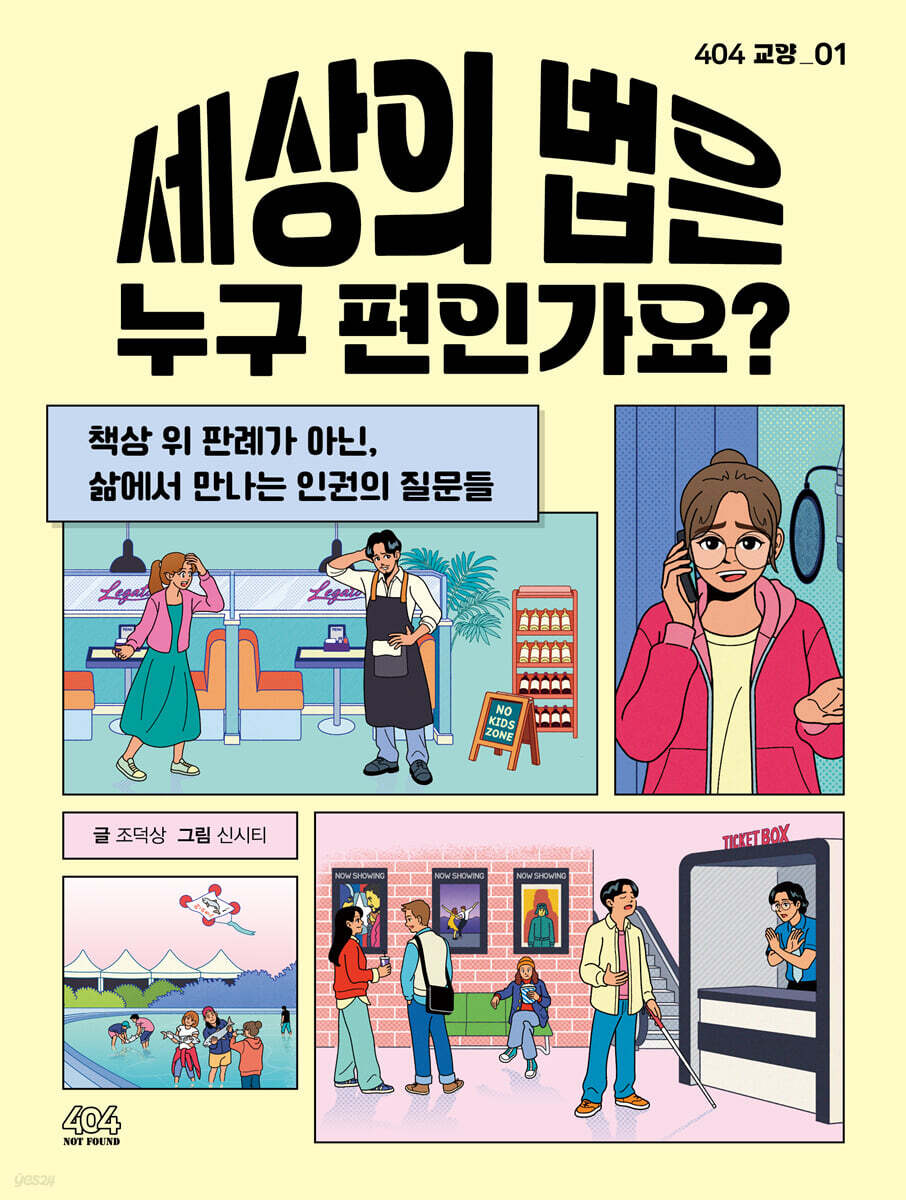
This book is based on six human rights incidents that have recently become controversial in Korean society.
We help young people become 'judges', listen to the arguments of both the plaintiff and the defendant, and develop their own human rights awareness by making their own judgments.
This course will go beyond simply imparting knowledge and will greatly help develop critical thinking and empathy skills.
A human rights story about changing the world with my own hands
Beyond the limitations of existing education, which lacks realistic examples and in-depth discussions, a new approach is needed that allows young people to directly experience and reflect on human rights issues.
In response to these social needs, a human rights knowledge book tailored to the youth's perspective, "Whose side is the law on?", was published.
This book is based on six human rights incidents that have recently become controversial in Korean society.
We help young people become 'judges', listen to the arguments of both the plaintiff and the defendant, and develop their own human rights awareness by making their own judgments.
This course will go beyond simply imparting knowledge and will greatly help develop critical thinking and empathy skills.
- You can preview some of the book's contents.
Preview
index
Chapter 1: No Kids Zones, Discrimination Against Children
Incident Report | Children under 10 years old are not permitted to enter _10
Is it discrimination against children vs. for the safety of guests? _16
Read this after the verdict | My Story of the No Kids Zone _21
The World Through Law | Plaintiff, Defendant, and Accused _28
Chapter 2: You should be able to ride rides and watch movies.
Incident Report Part 1 | Is Riding Amusement Rides Dangerous? _32
We are not in danger vs. We need to think about safety _36
Incident Report Part 2 | The Movie You Want to See But Can't _40
Discriminating against people with disabilities vs. There's a reason why it has to be that way _44
Read this after the verdict | Things you can only know by riding it yourself _48
The World Through Law | Finding Law and Case Law _54
Chapter 3_ So that mother's surname can be used equally
Incident Report | I Want to Pass on My Mother's Last Name _58
Using only the father's last name is wrong vs. following traditional principles _65
Read this after the verdict | Is 'fatherhood' a given? _70
The World Through Law | Courts and the Appellate System _76
Chapter 4: Stories of Discrimination in the Media
Incident Report | Discrimination Against Foreigners in Dramas _80
Even in dramas, there can be no discrimination vs. Dramas have freedom of expression _87
Read After the Verdict | Media and Hate Speech Issues _92
The World Through Law | Oral Arguments, Public Arguments _98
Chapter 5: AI and the Right to Voice
Incident Report | Whose Voice Is My Voice? _102
I need permission vs. I just did what the contract says _109
Read After the Verdict | Leveraging AI in Media _113
The World Through Law | Constitutional Court _120
Chapter 6: A World Where Animals Are Happy
Incident Report | Salmon Feel Pain Too _124
Bare-handed grabbing is animal abuse vs. not animal abuse _131
Read after the verdict | If there are 'human rights,' what about 'animal rights'? _135
The World Through Law | The Role of the National Human Rights Commission _142
Incident Report | Children under 10 years old are not permitted to enter _10
Is it discrimination against children vs. for the safety of guests? _16
Read this after the verdict | My Story of the No Kids Zone _21
The World Through Law | Plaintiff, Defendant, and Accused _28
Chapter 2: You should be able to ride rides and watch movies.
Incident Report Part 1 | Is Riding Amusement Rides Dangerous? _32
We are not in danger vs. We need to think about safety _36
Incident Report Part 2 | The Movie You Want to See But Can't _40
Discriminating against people with disabilities vs. There's a reason why it has to be that way _44
Read this after the verdict | Things you can only know by riding it yourself _48
The World Through Law | Finding Law and Case Law _54
Chapter 3_ So that mother's surname can be used equally
Incident Report | I Want to Pass on My Mother's Last Name _58
Using only the father's last name is wrong vs. following traditional principles _65
Read this after the verdict | Is 'fatherhood' a given? _70
The World Through Law | Courts and the Appellate System _76
Chapter 4: Stories of Discrimination in the Media
Incident Report | Discrimination Against Foreigners in Dramas _80
Even in dramas, there can be no discrimination vs. Dramas have freedom of expression _87
Read After the Verdict | Media and Hate Speech Issues _92
The World Through Law | Oral Arguments, Public Arguments _98
Chapter 5: AI and the Right to Voice
Incident Report | Whose Voice Is My Voice? _102
I need permission vs. I just did what the contract says _109
Read After the Verdict | Leveraging AI in Media _113
The World Through Law | Constitutional Court _120
Chapter 6: A World Where Animals Are Happy
Incident Report | Salmon Feel Pain Too _124
Bare-handed grabbing is animal abuse vs. not animal abuse _131
Read after the verdict | If there are 'human rights,' what about 'animal rights'? _135
The World Through Law | The Role of the National Human Rights Commission _142
Detailed image

Into the book
The book features a fictional court called 'Our Neighborhood Human Rights Court'.
And you'll become a juvenile judge in that court, and you'll personally pass judgment on the six cases presented in this book.
How can you make a judgment when you don't know much about human rights or the law? Don't worry.
To help you easily understand the details of each case, a trial researcher will create a report for each case.
And if you've read the report and made your own judgment, I'll share with you the actual incident that inspired the story.
It will also tell you what decisions the courts and the Constitutional Court made, and what happened after that.
--- p.5
This time, your honor, you have been assigned to try two cases involving people with disabilities.
The plaintiff in the first case is Hong Hee-kwan, a visually impaired person, and the defendant is the 'Miracle World' amusement park.
The plaintiff in the second case is also visually impaired Mr. Hong Hee-gwan, and the defendant is the 'Myeongjak' movie theater.
The plaintiff was denied entry to a ride at Miracle World because he was "visually impaired," and was unable to watch a movie at the Myeongjak Theater because the film did not provide the necessary assistive devices for the visually impaired.
The plaintiff claims that the defendants unfairly discriminated against him because he is disabled, and the defendants counter that they did not discriminate against him because of safety and cost issues.
I await the judge's wise decision in these two cases as well.
--- p.31
In 2019, a hearing-impaired couple went to High1 Resort in Jeongseon, Gangwon Province, and tried to ride the Alpine Coaster. However, the amusement park refused to allow them to ride, stating that "hearing-impaired people cannot hear announcements and may develop heart problems."
The hearing-impaired couple took the Alpine Coaster case to the National Human Rights Commission instead of the court, and the commission ruled that High1 Resort's refusal to allow the hearing-impaired to ride constituted "discrimination based on disability."
The National Human Rights Commission of Korea decided that since this amusement ride is easy to operate and even children can ride it alone, there would be no problem if safety precautions were sufficiently explained to the hearing impaired and safety signs were installed in the middle.
After the National Human Rights Commission's decision, High1 Resort installed reflective mirrors and warning signs on the rides to make them accessible to the hearing impaired.
--- p.50~51
Why is "patriarchy" a problem? It ignores the fact that both mothers and fathers give birth to and raise children together, and by restricting the use of only the father's surname, it discriminates against women's lineage within the family.
Also, among our language habits, we use the character "chin" (親, close) to refer to our father's family or relatives, and "oe" (外, outside, outside) to refer to our mother's family or relatives. If we look closely at these words, we see that they discriminate against our mother's family members within the family.
Patriarchy creates discrimination within the family, and this discrimination can lead to various conflicts between family members.
So, Korean patriarchy has been subject to a lot of criticism.
According to a July 2021 public opinion poll of South Korean citizens, 72% of respondents said that parents should be able to agree on their children's surnames.
Additionally, the UN Committee on the Elimination of Discrimination against Women, an international organization working to eliminate discrimination against women around the world, recommended in 2018 and 2024 that the Korean government "change the law to allow couples to freely decide the sex of their children."
And you'll become a juvenile judge in that court, and you'll personally pass judgment on the six cases presented in this book.
How can you make a judgment when you don't know much about human rights or the law? Don't worry.
To help you easily understand the details of each case, a trial researcher will create a report for each case.
And if you've read the report and made your own judgment, I'll share with you the actual incident that inspired the story.
It will also tell you what decisions the courts and the Constitutional Court made, and what happened after that.
--- p.5
This time, your honor, you have been assigned to try two cases involving people with disabilities.
The plaintiff in the first case is Hong Hee-kwan, a visually impaired person, and the defendant is the 'Miracle World' amusement park.
The plaintiff in the second case is also visually impaired Mr. Hong Hee-gwan, and the defendant is the 'Myeongjak' movie theater.
The plaintiff was denied entry to a ride at Miracle World because he was "visually impaired," and was unable to watch a movie at the Myeongjak Theater because the film did not provide the necessary assistive devices for the visually impaired.
The plaintiff claims that the defendants unfairly discriminated against him because he is disabled, and the defendants counter that they did not discriminate against him because of safety and cost issues.
I await the judge's wise decision in these two cases as well.
--- p.31
In 2019, a hearing-impaired couple went to High1 Resort in Jeongseon, Gangwon Province, and tried to ride the Alpine Coaster. However, the amusement park refused to allow them to ride, stating that "hearing-impaired people cannot hear announcements and may develop heart problems."
The hearing-impaired couple took the Alpine Coaster case to the National Human Rights Commission instead of the court, and the commission ruled that High1 Resort's refusal to allow the hearing-impaired to ride constituted "discrimination based on disability."
The National Human Rights Commission of Korea decided that since this amusement ride is easy to operate and even children can ride it alone, there would be no problem if safety precautions were sufficiently explained to the hearing impaired and safety signs were installed in the middle.
After the National Human Rights Commission's decision, High1 Resort installed reflective mirrors and warning signs on the rides to make them accessible to the hearing impaired.
--- p.50~51
Why is "patriarchy" a problem? It ignores the fact that both mothers and fathers give birth to and raise children together, and by restricting the use of only the father's surname, it discriminates against women's lineage within the family.
Also, among our language habits, we use the character "chin" (親, close) to refer to our father's family or relatives, and "oe" (外, outside, outside) to refer to our mother's family or relatives. If we look closely at these words, we see that they discriminate against our mother's family members within the family.
Patriarchy creates discrimination within the family, and this discrimination can lead to various conflicts between family members.
So, Korean patriarchy has been subject to a lot of criticism.
According to a July 2021 public opinion poll of South Korean citizens, 72% of respondents said that parents should be able to agree on their children's surnames.
Additionally, the UN Committee on the Elimination of Discrimination against Women, an international organization working to eliminate discrimination against women around the world, recommended in 2018 and 2024 that the Korean government "change the law to allow couples to freely decide the sex of their children."
--- p.70~71
Publisher's Review
Discrimination and inequality, it's time to stop!
A human rights story about changing the world with my own hands
Our society is changing rapidly these days, but human rights issues are also becoming more complex and diverse.
Discrimination and inequality experienced by socially vulnerable groups, including children, youth, people with disabilities, women, and immigrants, remain critical challenges that need to be addressed.
The importance of human rights education is growing day by day, especially during adolescence, when values are formed that respect the rights of oneself and others.
Beyond the limitations of existing education, which lacks realistic examples and in-depth discussions, a new approach is needed that allows young people to directly experience and reflect on human rights issues.
In response to these social needs, a human rights knowledge book tailored to the youth's perspective, "Whose side is the law on?", has been published.
This book is based on six human rights incidents that have recently become controversial in Korean society.
We help young people become "judges," listen to the arguments of both sides—the plaintiff and the defendant—and make their own judgments, thereby developing a sense of human rights.
This course will go beyond simply imparting knowledge and will greatly help develop critical thinking and empathy skills.
From no-kids zones to AI voices,
Deciding on the hottest human rights issues of our time!
"Whose side is the law on?" provides an easy and entertaining explanation of human rights issues that are currently unfolding around us.
The issue of children being restricted from entering no-kids zones, discrimination against people with disabilities in amusement parks, the issue of children's surnames due to patriarchy, the depiction of discrimination against foreigners in dramas, the copyright controversy over AI-processed voices, and even the debate over bare-handed salmon catching and animal abuse.
In the book's fictional "Human Rights Court," young readers become judges, examining various aspects of a case and considering the plaintiff, defendant, and even the social context.
This will help you develop a multifaceted perspective on human rights issues, moving beyond a fragmented understanding of facts, and develop the ability to logically express your thoughts.
It also includes friendly examples and a variety of questions to encourage young people to read and participate in a fun way.
This book is suitable as a human rights education textbook in conjunction with school curricula, and it will also serve as a useful guide for discussions between youth and parents at home or in book clubs.
A unique experience where you can directly consider and judge real-world human rights issues! With "Whose Side is the Law on?", you can grow into future citizens with a sound human rights awareness.
A human rights story about changing the world with my own hands
Our society is changing rapidly these days, but human rights issues are also becoming more complex and diverse.
Discrimination and inequality experienced by socially vulnerable groups, including children, youth, people with disabilities, women, and immigrants, remain critical challenges that need to be addressed.
The importance of human rights education is growing day by day, especially during adolescence, when values are formed that respect the rights of oneself and others.
Beyond the limitations of existing education, which lacks realistic examples and in-depth discussions, a new approach is needed that allows young people to directly experience and reflect on human rights issues.
In response to these social needs, a human rights knowledge book tailored to the youth's perspective, "Whose side is the law on?", has been published.
This book is based on six human rights incidents that have recently become controversial in Korean society.
We help young people become "judges," listen to the arguments of both sides—the plaintiff and the defendant—and make their own judgments, thereby developing a sense of human rights.
This course will go beyond simply imparting knowledge and will greatly help develop critical thinking and empathy skills.
From no-kids zones to AI voices,
Deciding on the hottest human rights issues of our time!
"Whose side is the law on?" provides an easy and entertaining explanation of human rights issues that are currently unfolding around us.
The issue of children being restricted from entering no-kids zones, discrimination against people with disabilities in amusement parks, the issue of children's surnames due to patriarchy, the depiction of discrimination against foreigners in dramas, the copyright controversy over AI-processed voices, and even the debate over bare-handed salmon catching and animal abuse.
In the book's fictional "Human Rights Court," young readers become judges, examining various aspects of a case and considering the plaintiff, defendant, and even the social context.
This will help you develop a multifaceted perspective on human rights issues, moving beyond a fragmented understanding of facts, and develop the ability to logically express your thoughts.
It also includes friendly examples and a variety of questions to encourage young people to read and participate in a fun way.
This book is suitable as a human rights education textbook in conjunction with school curricula, and it will also serve as a useful guide for discussions between youth and parents at home or in book clubs.
A unique experience where you can directly consider and judge real-world human rights issues! With "Whose Side is the Law on?", you can grow into future citizens with a sound human rights awareness.
GOODS SPECIFICS
- Date of issue: August 29, 2025
- Page count, weight, size: 144 pages | 170*225*20mm
- ISBN13: 9791193947432
- ISBN10: 119394743X
You may also like
카테고리
korean


korean

![GQ KOREA Mark (Monthly): December [2025]](http://librairie.coreenne.fr/cdn/shop/files/8ef265dbbfbf186523ed75ba7319009d.jpg?v=1765340328&width=3840)


