

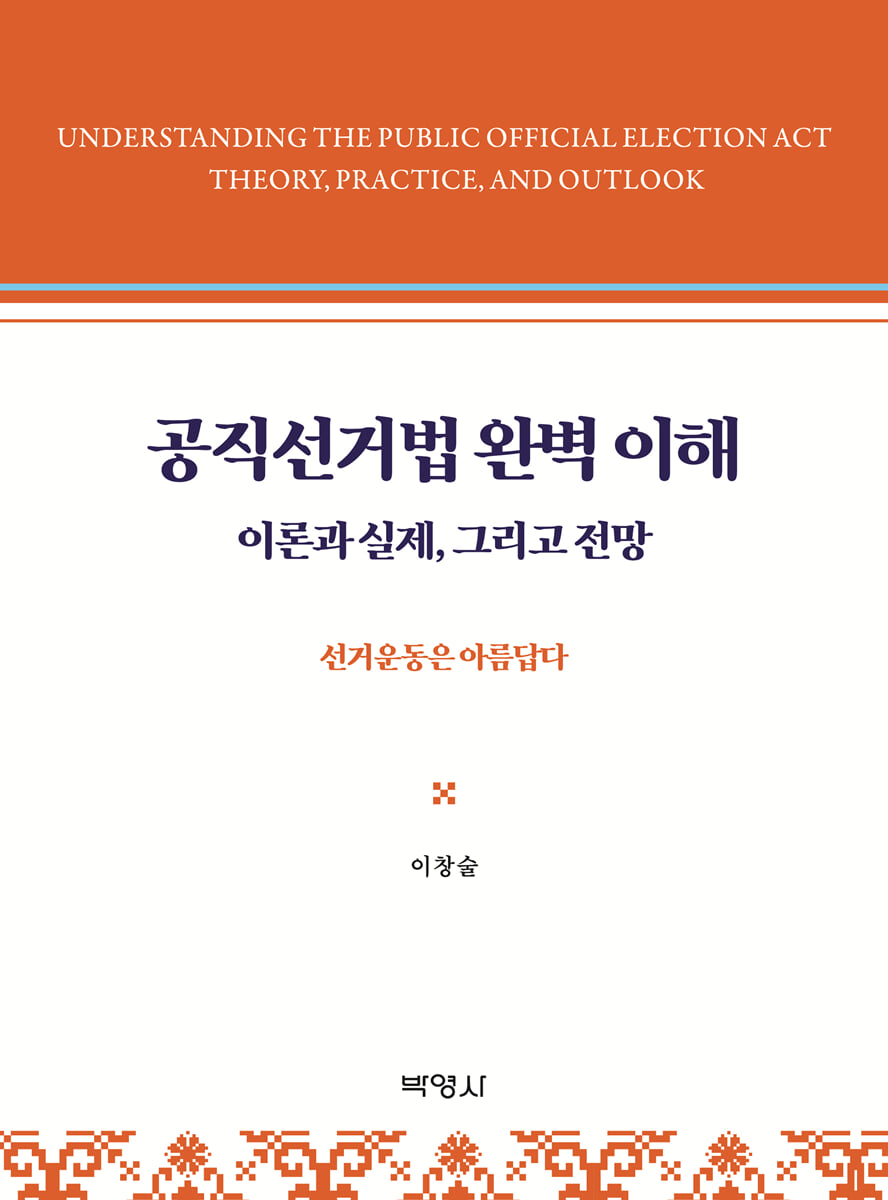
A Complete Understanding of the Public Official Election Act
 |
Description
Book Introduction
“Complete Understanding of the Public Official Election Act (Theory, Practice, and Prospects: Election Campaigning is Beautiful)” was designed to help voters understand the Public Official Election Act more easily and more clearly.
The theory is explained in an easy-to-understand manner, focusing on the provisions closely related to political expression among all provisions of the Public Official Election Act.
Rather than simply listing legal provisions, the content has been reorganized by status, subject, period, and case study to enable more intuitive understanding and use.
Additionally, this book attempts to systematically approach the Public Official Election Act from three perspectives: theory, practice, and prospects.
The theory is explained in an easy-to-understand manner, focusing on the provisions closely related to political expression among all provisions of the Public Official Election Act.
Rather than simply listing legal provisions, the content has been reorganized by status, subject, period, and case study to enable more intuitive understanding and use.
Additionally, this book attempts to systematically approach the Public Official Election Act from three perspectives: theory, practice, and prospects.
index
Chapter 1 Sanctions for Violations of the Public Official Election Act to Ensure Fairness in Elections
Chapter 2 Types of Political Activities
Chapter 3 Disciplinary Methods of the Public Official Election Act
Chapter 4 Regulations Related to Party Primary Elections for Political Parties' Candidate Recommendations
Chapter 5 Non-Election Campaign Activities
Chapter 6 Report on legislative activities of National Assembly members and local council members
Chapter 7 Acts Considered as Election Campaigning
Chapter 8: Possible Election Campaigns in Normal Times
Chapter 9: Regulations Related to YouTube, ChatGPT, Deepfake Videos, etc.
Chapter 10. Measures against illegal postings using information and communications networks, etc.
Chapter 11: Campaigning of Preliminary Candidates
Chapter 12 Restrictions on Election-Related Facilities Installation and Other Activities
Chapter 13 Restrictions on Distribution of Election-Related Materials, etc.
Chapter 14 Regulations Related to Publication Commemorations
Chapter 15 Regulations Related to Opinion Polls on Elections
Chapter 16: Restrictions on campaign spaces, including prohibition of door-to-door visits
Chapter 17 Restrictions on Individual Election Campaigns, etc.
Chapter 18 Restrictions on the Actions of Heads of Local Governments, etc.
Chapter 19 Restrictions on Group Election Campaigns, etc.
Chapter 20 Disciplines Related to the Press
Chapter 21. Publication of False Facts
Chapter 22: Defamation of Candidates
Chapter 23 Restrictions on Election-Related Money (Prohibition and Restrictions on Donations)
Chapter 24 Restrictions on Election-Related Bribery and Inducement of Interest
Chapter 25: Frequently Occurring Behaviors During Election Periods (Props, Street Banners, Internet Advertisements, etc.)
Chapter 26: Frequently occurring behaviors during election periods (speeches, interviews, rallies, etc.)
Chapter 27 Prohibition of Election Campaigning for Other Candidates, etc.
Chapter 28: Obstruction of Election Freedom
Chapter 29: Crimes of assault and disruption of election officials or facilities
Chapter 30 Regulations Related to Election Campaign Organizations, Election Officials, and Volunteers
Chapter 31: Disciplines Related to Women, the Disabled, Youth, and Students
Boron Election Fraud Conspiracy Theory and Fact Check
Chapter 2 Types of Political Activities
Chapter 3 Disciplinary Methods of the Public Official Election Act
Chapter 4 Regulations Related to Party Primary Elections for Political Parties' Candidate Recommendations
Chapter 5 Non-Election Campaign Activities
Chapter 6 Report on legislative activities of National Assembly members and local council members
Chapter 7 Acts Considered as Election Campaigning
Chapter 8: Possible Election Campaigns in Normal Times
Chapter 9: Regulations Related to YouTube, ChatGPT, Deepfake Videos, etc.
Chapter 10. Measures against illegal postings using information and communications networks, etc.
Chapter 11: Campaigning of Preliminary Candidates
Chapter 12 Restrictions on Election-Related Facilities Installation and Other Activities
Chapter 13 Restrictions on Distribution of Election-Related Materials, etc.
Chapter 14 Regulations Related to Publication Commemorations
Chapter 15 Regulations Related to Opinion Polls on Elections
Chapter 16: Restrictions on campaign spaces, including prohibition of door-to-door visits
Chapter 17 Restrictions on Individual Election Campaigns, etc.
Chapter 18 Restrictions on the Actions of Heads of Local Governments, etc.
Chapter 19 Restrictions on Group Election Campaigns, etc.
Chapter 20 Disciplines Related to the Press
Chapter 21. Publication of False Facts
Chapter 22: Defamation of Candidates
Chapter 23 Restrictions on Election-Related Money (Prohibition and Restrictions on Donations)
Chapter 24 Restrictions on Election-Related Bribery and Inducement of Interest
Chapter 25: Frequently Occurring Behaviors During Election Periods (Props, Street Banners, Internet Advertisements, etc.)
Chapter 26: Frequently occurring behaviors during election periods (speeches, interviews, rallies, etc.)
Chapter 27 Prohibition of Election Campaigning for Other Candidates, etc.
Chapter 28: Obstruction of Election Freedom
Chapter 29: Crimes of assault and disruption of election officials or facilities
Chapter 30 Regulations Related to Election Campaign Organizations, Election Officials, and Volunteers
Chapter 31: Disciplines Related to Women, the Disabled, Youth, and Students
Boron Election Fraud Conspiracy Theory and Fact Check
Detailed image

Publisher's Review
Democracy becomes more mature and beautiful through the participation and interest of the people.
Elections are not simply an act of choosing representatives; they are an important process that reflects the voices of the sovereign and shapes the future together.
It is a beautiful process of making democracy bloom.
Politics is the act of producing the best possible results under the constraints of reality, that is, the 'art of the possible' (Bismarck).
Its core foundation is elections.
In this process, the Public Official Election Act exists to ensure fair and transparent elections.
The Public Official Election Act is not the essence of politics.
It is a useful tool for good politics and a tool that sets direction like a compass.
“The north pole, which points to the North Pole, is always trembling at the tip of its needle, as if it is afraid of something.
As long as the thin needle tip trembles, it is clear that the chronometer has not forgotten its intention to fulfill the mission assigned to it, and you can trust the direction the needle tip points.
If the tip of the needle stops trembling and becomes fixed on one side, we should discard it.
As in “Discourse” by Min Young-gyu and Shin Young-bok, if the Public Official Election Act ceases to vibrate, resonate, and open, its role will be like a dead compass, losing its vitality and furthermore, it could act as a barrier to communication breakdown and a solid wall of oppression.
Every time we embark on the grand journey of elections, the Public Official Election Act continues to resonate and resonate, giving the political process the strength to move forward in the right direction.
Aristotle defined man as a political animal.
This means that we all must participate in politics as members of the community and work together to build our society.
Michael Palmer argues in “Politics for the Mourning” that “politics is about how we live together, how we shape society.”
This emphasizes that politics is not simply a power struggle, but a process in which we communicate and cooperate with each other for a better society.
Also, the great Greek politician Pericles said eloquently, “Just because you are not interested in politics, don’t think politics is not interested in you.”
This warns us of the impact that apathy toward politics can have on our lives, and it serves as a powerful argument for why all citizens should participate in politics.
However, our country's public official election law is being criticized for being overly regulatory-oriented and complex in its structure, making it unfriendly to voters.
It is so complexly intertwined, like the Matrix, that many people have difficulty understanding its contents.
It is said that the Public Official Election Act is more complicated than a musician handling an instrument.
This regulatory-focused legal system restricts free election campaigning, makes communication between voters and political actors difficult, and paradoxically, it acts as a barrier to participation and hinders a fair election process.
The Public Official Election Act should serve as a clear and friendly guide for political actors, including political parties and candidates, and as a musical score that leads to a beautiful democracy for the sovereign people.
The essence lies in simplicity, and simplicity is beautiful.
And small is beautiful.
The regulations of the Public Official Election Act should also be simple and small.
As the Constitutional Court stated, “It is self-evident that political expression should be ‘freedom as a principle, prohibition as an exception,’ and not ‘prohibition as a principle, permission as an exception.’ If political expression is excessively restricted for the sake of election fairness, new political figures or new political parties will not have sufficient opportunities to make themselves known, which may actually result in undermining the fairness of the election” (Constitutional Court Decision 2023 Heon-Ga12, etc.), the future Public Official Election Act should move in the direction of opening up wings of freedom of expression and a window of opportunity for the politically disadvantaged.
This is essential to fostering an election culture where we all freely share our opinions and diverse voices are fairly reflected.
When the Public Official Election Act develops in this direction, we will experience the true beauty of democracy.
Korean representative democracy operates on the foundation of capitalism.
However, we must protect the values of democracy from capital power, administrative power, and various social powers.
In order to ensure the fairness of elections, election campaigns by ordinary voters should not be broadly restricted, but election campaigns carried out by those with wealth, power, or influence that interfere with the people's right to free choice should be restricted.
In other words, election campaigns that are abusive and restrict the freedom of actual election campaigning or election campaigns that violate equal opportunity must be restricted.
Political philosopher Jurgen Habermas warned of the "colonization of the lifeworld" in the antagonistic relationship between capitalism and democracy, and emphasized that we must realize democracy in our daily lives and neighborhoods.
Everyday democracy and neighborhood democracy will enrich our lives and contribute to creating a fair and just society.
Everyday democracy and neighborhood democracy are only completed when the voices of each and every resident resonate.
Freedom of campaigning is like wings that allow your voice to be heard and heard by more people without being confined.
Freedom of election campaigning is the breath of neighborhood democracy and an essential condition for creating a fair and vibrant community.
Poet Kim Su-yeong asks this question in ‘Leaving the Palace One Day’.
“Why do I only get angry over small things? / Instead of that palace, instead of the palace’s lewdness, / I get angry because the 50 won ribs only come out with a lump of fat. / I get petty and angry, and I curse at the pig-like owner of the Seolleongtang restaurant. / I curse petty and / For once, I demand freedom of the press for the novelist who was arrested, and I oppose the dispatch of troops to Vietnam, and I fail to fulfill my freedom...
This poem makes us ask ourselves why we only get angry over small things and remain silent when things truly matter.
The Public Official Election Act is an important tool for protecting our democracy from the influence of capital and power.
We must not stop at being indignant over small things, but must speak out loud to protect the essence of democracy.
Therefore, in a representative democracy, election campaigns must be conducted beautifully as the most fair and essential process so that voters can freely form and decide their political opinions.
In order for freedom of expression to function properly, it must be guaranteed the "breathing space" necessary for its survival (Supreme Court Decision 2019 Do13328), and election campaigns are the flowers of democracy that bloom right in that space.
Election campaigning is beautiful! Election campaigning is a forum where political parties, candidates, and voters exchange ideas and share a vision for a better society.
In order for this process to be conducted more cleanly and fairly, a correct understanding and compliance with the Public Official Election Act is essential.
This book, “Complete Understanding of the Public Official Election Act (Theory, Practice, and Prospects: Election Campaigning is Beautiful),” was designed to help voters understand the Public Official Election Act more easily and more clearly.
The theory is explained in an easy-to-understand manner, focusing on the provisions closely related to political expression among all provisions of the Public Official Election Act.
Rather than simply listing legal provisions, the content has been reorganized by status, subject, period, and case study to enable more intuitive understanding and use.
Additionally, this book attempts to systematically approach the Public Official Election Act from three perspectives: theory, practice, and prospects.
While faithfully explaining the basic framework and theoretical background of the Public Official Election Act, it also serves as an 'explanatory note' and a practical 'guide' to ensure that the Public Official Election Act is implemented and applied appropriately through extensive case law and specific administrative interpretations by the National Election Commission that are accurate to reality.
In the outlook section, we examined the limitations and problems of the current Public Official Election Act and explored the direction of legal revision to establish a more free, fair, and effective legal system.
I hope this book will serve as a small grain of wheat and a humble light to create a more transparent and trustworthy election culture in our society by helping voters and political actors understand the Public Official Election Act in an easy and accurate way.
I hope this book will accompany you on your journey to create a better Korean community while sharing the beauty of election campaigning.
First published was "Understanding Political Funds Law: Theory, Practice, and Prospects" (2024).
Like Park Young-sa, this book is also a product of the collective intelligence of fellow National Election Commission staff.
This book is a distillation of the generous thoughts, wisdom, and stories gathered through the eyes and ears of our colleagues at the National Election Commission at all levels, who are struggling and dedicating themselves to protecting democracy in the midst of fierce election campaigns.
I took up the pen with the ethics of responsibility and conviction, which are fairness and justice.
I wanted to write in ink the waves of democracy hidden in the nature, strength, twists and turns, and secrets of the Public Official Election Act, which flow deeply and constantly like the winding river of real politics.
But the many are stronger than the few.
I hope that political laws such as the Public Official Election Act, the Political Funds Act, and the Political Parties Act will become the true pillars of the rule of law.
I wish the political relations law was for the citizens.
As a legal scholar put it, I hope that political relations law will also be a stepping stone to human rights, peace, and democracy.
“The problem is the relationship between the ruler and the law.
When the law is above the ruler, we call it the 'rule of law' or 'rule of law', and when the law is below the ruler, we call it the 'rule by law'.
The former law is a law that controls and restrains power in order to protect the freedom and rights of the people.
The latter law is the means by which rulers exercise their power and is law as violence.
The former law is a vessel that contains human rights, peace, and democracy, but the latter law merely serves as a conduit for a governing strategy that alienates and otherizes the people from politics.
So, unlike a democratic society where law governs politics, an authoritarian society uses violence disguised as law, rather than law, as a means of politics.
“It is an attempt to conceal and cover up the violence of the state through law.”*
Democracy is maintained based on the trust of the people, and its core lies in fair elections and the rule of law.
However, in the 21st century, in South Korea, which prides itself on being a K-democracy, conspiracy theories about election fraud are spreading like wildfire.
In the post-truth era, information distortion and the bias of YouTube's algorithm are being amplified.
Political actors, combining stubbornness, self-righteousness, violence, cunning, and ignorance, are using this as their political tool.
Here, bureaucracy centered on academic background and cowardly elites are shaking the foundations of democracy by reproducing the banality of evil while abdicating responsibility through compliance and sympathy.
Hannah Arendt said:
“Not thinking is the root of all evil.” Now is the time for us to think.
Will we succumb to the banality of evil, or will we defend democracy with logic and trust? We must choose.
Will we embrace conspiracy theories filled with lies and madness, or will we defend democracy with reason and common sense?
To all those I met on my commute to work who directly motivated and inspired me to write this book, I pray that their lives will become brighter, clearer, and richer through Carl Sagan's beautiful tribute.
Elections are not simply an act of choosing representatives; they are an important process that reflects the voices of the sovereign and shapes the future together.
It is a beautiful process of making democracy bloom.
Politics is the act of producing the best possible results under the constraints of reality, that is, the 'art of the possible' (Bismarck).
Its core foundation is elections.
In this process, the Public Official Election Act exists to ensure fair and transparent elections.
The Public Official Election Act is not the essence of politics.
It is a useful tool for good politics and a tool that sets direction like a compass.
“The north pole, which points to the North Pole, is always trembling at the tip of its needle, as if it is afraid of something.
As long as the thin needle tip trembles, it is clear that the chronometer has not forgotten its intention to fulfill the mission assigned to it, and you can trust the direction the needle tip points.
If the tip of the needle stops trembling and becomes fixed on one side, we should discard it.
As in “Discourse” by Min Young-gyu and Shin Young-bok, if the Public Official Election Act ceases to vibrate, resonate, and open, its role will be like a dead compass, losing its vitality and furthermore, it could act as a barrier to communication breakdown and a solid wall of oppression.
Every time we embark on the grand journey of elections, the Public Official Election Act continues to resonate and resonate, giving the political process the strength to move forward in the right direction.
Aristotle defined man as a political animal.
This means that we all must participate in politics as members of the community and work together to build our society.
Michael Palmer argues in “Politics for the Mourning” that “politics is about how we live together, how we shape society.”
This emphasizes that politics is not simply a power struggle, but a process in which we communicate and cooperate with each other for a better society.
Also, the great Greek politician Pericles said eloquently, “Just because you are not interested in politics, don’t think politics is not interested in you.”
This warns us of the impact that apathy toward politics can have on our lives, and it serves as a powerful argument for why all citizens should participate in politics.
However, our country's public official election law is being criticized for being overly regulatory-oriented and complex in its structure, making it unfriendly to voters.
It is so complexly intertwined, like the Matrix, that many people have difficulty understanding its contents.
It is said that the Public Official Election Act is more complicated than a musician handling an instrument.
This regulatory-focused legal system restricts free election campaigning, makes communication between voters and political actors difficult, and paradoxically, it acts as a barrier to participation and hinders a fair election process.
The Public Official Election Act should serve as a clear and friendly guide for political actors, including political parties and candidates, and as a musical score that leads to a beautiful democracy for the sovereign people.
The essence lies in simplicity, and simplicity is beautiful.
And small is beautiful.
The regulations of the Public Official Election Act should also be simple and small.
As the Constitutional Court stated, “It is self-evident that political expression should be ‘freedom as a principle, prohibition as an exception,’ and not ‘prohibition as a principle, permission as an exception.’ If political expression is excessively restricted for the sake of election fairness, new political figures or new political parties will not have sufficient opportunities to make themselves known, which may actually result in undermining the fairness of the election” (Constitutional Court Decision 2023 Heon-Ga12, etc.), the future Public Official Election Act should move in the direction of opening up wings of freedom of expression and a window of opportunity for the politically disadvantaged.
This is essential to fostering an election culture where we all freely share our opinions and diverse voices are fairly reflected.
When the Public Official Election Act develops in this direction, we will experience the true beauty of democracy.
Korean representative democracy operates on the foundation of capitalism.
However, we must protect the values of democracy from capital power, administrative power, and various social powers.
In order to ensure the fairness of elections, election campaigns by ordinary voters should not be broadly restricted, but election campaigns carried out by those with wealth, power, or influence that interfere with the people's right to free choice should be restricted.
In other words, election campaigns that are abusive and restrict the freedom of actual election campaigning or election campaigns that violate equal opportunity must be restricted.
Political philosopher Jurgen Habermas warned of the "colonization of the lifeworld" in the antagonistic relationship between capitalism and democracy, and emphasized that we must realize democracy in our daily lives and neighborhoods.
Everyday democracy and neighborhood democracy will enrich our lives and contribute to creating a fair and just society.
Everyday democracy and neighborhood democracy are only completed when the voices of each and every resident resonate.
Freedom of campaigning is like wings that allow your voice to be heard and heard by more people without being confined.
Freedom of election campaigning is the breath of neighborhood democracy and an essential condition for creating a fair and vibrant community.
Poet Kim Su-yeong asks this question in ‘Leaving the Palace One Day’.
“Why do I only get angry over small things? / Instead of that palace, instead of the palace’s lewdness, / I get angry because the 50 won ribs only come out with a lump of fat. / I get petty and angry, and I curse at the pig-like owner of the Seolleongtang restaurant. / I curse petty and / For once, I demand freedom of the press for the novelist who was arrested, and I oppose the dispatch of troops to Vietnam, and I fail to fulfill my freedom...
This poem makes us ask ourselves why we only get angry over small things and remain silent when things truly matter.
The Public Official Election Act is an important tool for protecting our democracy from the influence of capital and power.
We must not stop at being indignant over small things, but must speak out loud to protect the essence of democracy.
Therefore, in a representative democracy, election campaigns must be conducted beautifully as the most fair and essential process so that voters can freely form and decide their political opinions.
In order for freedom of expression to function properly, it must be guaranteed the "breathing space" necessary for its survival (Supreme Court Decision 2019 Do13328), and election campaigns are the flowers of democracy that bloom right in that space.
Election campaigning is beautiful! Election campaigning is a forum where political parties, candidates, and voters exchange ideas and share a vision for a better society.
In order for this process to be conducted more cleanly and fairly, a correct understanding and compliance with the Public Official Election Act is essential.
This book, “Complete Understanding of the Public Official Election Act (Theory, Practice, and Prospects: Election Campaigning is Beautiful),” was designed to help voters understand the Public Official Election Act more easily and more clearly.
The theory is explained in an easy-to-understand manner, focusing on the provisions closely related to political expression among all provisions of the Public Official Election Act.
Rather than simply listing legal provisions, the content has been reorganized by status, subject, period, and case study to enable more intuitive understanding and use.
Additionally, this book attempts to systematically approach the Public Official Election Act from three perspectives: theory, practice, and prospects.
While faithfully explaining the basic framework and theoretical background of the Public Official Election Act, it also serves as an 'explanatory note' and a practical 'guide' to ensure that the Public Official Election Act is implemented and applied appropriately through extensive case law and specific administrative interpretations by the National Election Commission that are accurate to reality.
In the outlook section, we examined the limitations and problems of the current Public Official Election Act and explored the direction of legal revision to establish a more free, fair, and effective legal system.
I hope this book will serve as a small grain of wheat and a humble light to create a more transparent and trustworthy election culture in our society by helping voters and political actors understand the Public Official Election Act in an easy and accurate way.
I hope this book will accompany you on your journey to create a better Korean community while sharing the beauty of election campaigning.
First published was "Understanding Political Funds Law: Theory, Practice, and Prospects" (2024).
Like Park Young-sa, this book is also a product of the collective intelligence of fellow National Election Commission staff.
This book is a distillation of the generous thoughts, wisdom, and stories gathered through the eyes and ears of our colleagues at the National Election Commission at all levels, who are struggling and dedicating themselves to protecting democracy in the midst of fierce election campaigns.
I took up the pen with the ethics of responsibility and conviction, which are fairness and justice.
I wanted to write in ink the waves of democracy hidden in the nature, strength, twists and turns, and secrets of the Public Official Election Act, which flow deeply and constantly like the winding river of real politics.
But the many are stronger than the few.
I hope that political laws such as the Public Official Election Act, the Political Funds Act, and the Political Parties Act will become the true pillars of the rule of law.
I wish the political relations law was for the citizens.
As a legal scholar put it, I hope that political relations law will also be a stepping stone to human rights, peace, and democracy.
“The problem is the relationship between the ruler and the law.
When the law is above the ruler, we call it the 'rule of law' or 'rule of law', and when the law is below the ruler, we call it the 'rule by law'.
The former law is a law that controls and restrains power in order to protect the freedom and rights of the people.
The latter law is the means by which rulers exercise their power and is law as violence.
The former law is a vessel that contains human rights, peace, and democracy, but the latter law merely serves as a conduit for a governing strategy that alienates and otherizes the people from politics.
So, unlike a democratic society where law governs politics, an authoritarian society uses violence disguised as law, rather than law, as a means of politics.
“It is an attempt to conceal and cover up the violence of the state through law.”*
Democracy is maintained based on the trust of the people, and its core lies in fair elections and the rule of law.
However, in the 21st century, in South Korea, which prides itself on being a K-democracy, conspiracy theories about election fraud are spreading like wildfire.
In the post-truth era, information distortion and the bias of YouTube's algorithm are being amplified.
Political actors, combining stubbornness, self-righteousness, violence, cunning, and ignorance, are using this as their political tool.
Here, bureaucracy centered on academic background and cowardly elites are shaking the foundations of democracy by reproducing the banality of evil while abdicating responsibility through compliance and sympathy.
Hannah Arendt said:
“Not thinking is the root of all evil.” Now is the time for us to think.
Will we succumb to the banality of evil, or will we defend democracy with logic and trust? We must choose.
Will we embrace conspiracy theories filled with lies and madness, or will we defend democracy with reason and common sense?
To all those I met on my commute to work who directly motivated and inspired me to write this book, I pray that their lives will become brighter, clearer, and richer through Carl Sagan's beautiful tribute.
GOODS SPECIFICS
- Date of issue: March 31, 2025
- Page count, weight, size: 1,156 pages | 188*257*60mm
- ISBN13: 9791130349343
- ISBN10: 1130349349
You may also like
카테고리
korean


korean

![GQ KOREA Mark (Monthly): December [2025]](http://librairie.coreenne.fr/cdn/shop/files/8ef265dbbfbf186523ed75ba7319009d.jpg?v=1765340328&width=3840)


