

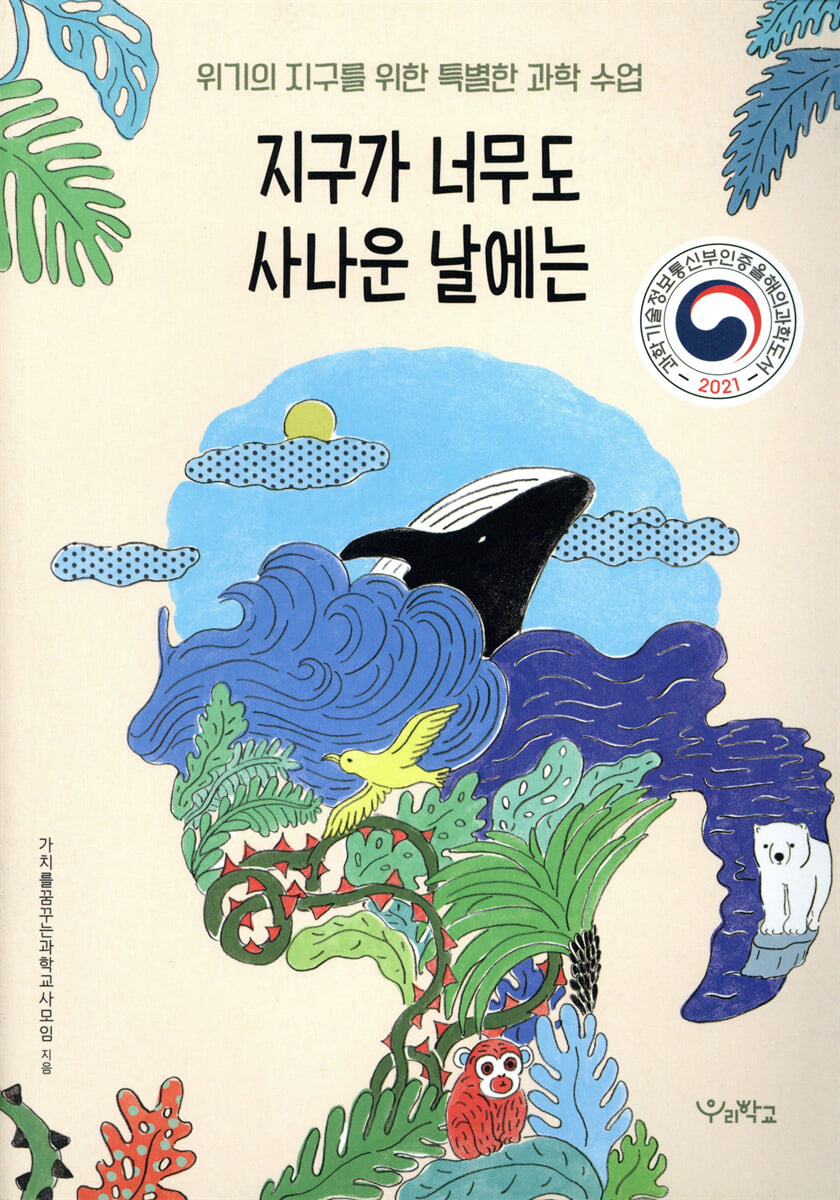
On days when the Earth is so cruel
 |
Description
Book Introduction
"On a Day When the Earth is Too Wild" is a collection of ten stories about the Earth and life told by passionate science teachers.
Is there anyone who doesn't know that the Earth is in crisis? Viral epidemics, heat waves, torrential rains, droughts, wildfires, and other signs of climate change are a powerful message from the Earth to humanity.
In today's world, where the Earth is so turbulent, the ability to read and respond to this message is a vital weapon for young people who will have to engage with the Earth for many years to come.
The teachers of the "Science Teachers' Association Dreaming of Values," who wrote this book, have consistently raised their voices about the duality of science and technology in schools for over twenty years, and based on this experience, they present a special science class for our planet in crisis.
As humanity engages in a game of Jenga with the Earth, where even a single piece could cause the planet to crumble, science teachers are urging young people to stop this reckless game and take them on a journey through the perilous landscape of the planet.
At the same time, by addressing the global crisis with verified data and figures rather than exaggerated risks, we help young people actively approach environmental issues with a sense of responsibility.
This is a must-read for days when it feels like there's no better future, days when we want to turn away and let things be, days when both our hearts and the Earth are in turmoil.
Is there anyone who doesn't know that the Earth is in crisis? Viral epidemics, heat waves, torrential rains, droughts, wildfires, and other signs of climate change are a powerful message from the Earth to humanity.
In today's world, where the Earth is so turbulent, the ability to read and respond to this message is a vital weapon for young people who will have to engage with the Earth for many years to come.
The teachers of the "Science Teachers' Association Dreaming of Values," who wrote this book, have consistently raised their voices about the duality of science and technology in schools for over twenty years, and based on this experience, they present a special science class for our planet in crisis.
As humanity engages in a game of Jenga with the Earth, where even a single piece could cause the planet to crumble, science teachers are urging young people to stop this reckless game and take them on a journey through the perilous landscape of the planet.
At the same time, by addressing the global crisis with verified data and figures rather than exaggerated risks, we help young people actively approach environmental issues with a sense of responsibility.
This is a must-read for days when it feels like there's no better future, days when we want to turn away and let things be, days when both our hearts and the Earth are in turmoil.
- You can preview some of the book's contents.
Preview
index
Foreword_For all of us who exist together in the vast universe, densely packed together on Earth.
1 Climate Change: A Churning Earth and the Sixth Mass Extinction
2 Viruses: Nature's Urgent Warning to Humanity
3 Factory Farming_Hello, non-human animals!
4 Roadkill_Why couldn't you avoid it on that road back then?
5 Foods of the Future: GMO Fries, Cell-Cultured Steaks, and Insect Cookies
6 Evolution_Time to read 『Origin of Species』 under the Tree of Life
7 Cosmos: A Cosmos Encountering Humanity Beyond Earth
8 Fine dust: small, toxic particles that obscure the blue sky.
9 Brain Science: A Look into Our Brain and Mind Through Memory and Brain Waves
10 New Drug Development: Putting the Brakes on the Racing Dream of Life Extension
1 Climate Change: A Churning Earth and the Sixth Mass Extinction
2 Viruses: Nature's Urgent Warning to Humanity
3 Factory Farming_Hello, non-human animals!
4 Roadkill_Why couldn't you avoid it on that road back then?
5 Foods of the Future: GMO Fries, Cell-Cultured Steaks, and Insect Cookies
6 Evolution_Time to read 『Origin of Species』 under the Tree of Life
7 Cosmos: A Cosmos Encountering Humanity Beyond Earth
8 Fine dust: small, toxic particles that obscure the blue sky.
9 Brain Science: A Look into Our Brain and Mind Through Memory and Brain Waves
10 New Drug Development: Putting the Brakes on the Racing Dream of Life Extension
Detailed image
Publisher's Review
Ten Stories About Earth and Life from Real Science Teachers
Is there anyone who doesn't realize that the Earth is in crisis? Viral infections, heat waves, torrential rains, droughts, wildfires, and other signs of climate change are a powerful message and warning from the Earth to humanity.
While it is important for adults who created this crisis to reflect, it is also crucial for young people, who will have a long-term relationship with the Earth, to understand the crisis facing our planet.
To this end, powerful science teachers stepped forward.
The teachers of the "Science Teachers' Association Dreaming of Values," who wrote the book, are powerful teachers who have consistently spoken out about the duality of science and technology and the social responsibility of science both inside and outside of school for over twenty years.
Based on the countless stories and hard-won experiences I have shared with children, I published a special science class for the Earth in crisis, “When the Earth is Too Violent.”
As humanity engages in a game of Jenga with the Earth, where even a single piece could cause the planet to crumble, science teachers guide young people through the perilous landscape of the planet, saying, “Let’s stop this reckless game!”
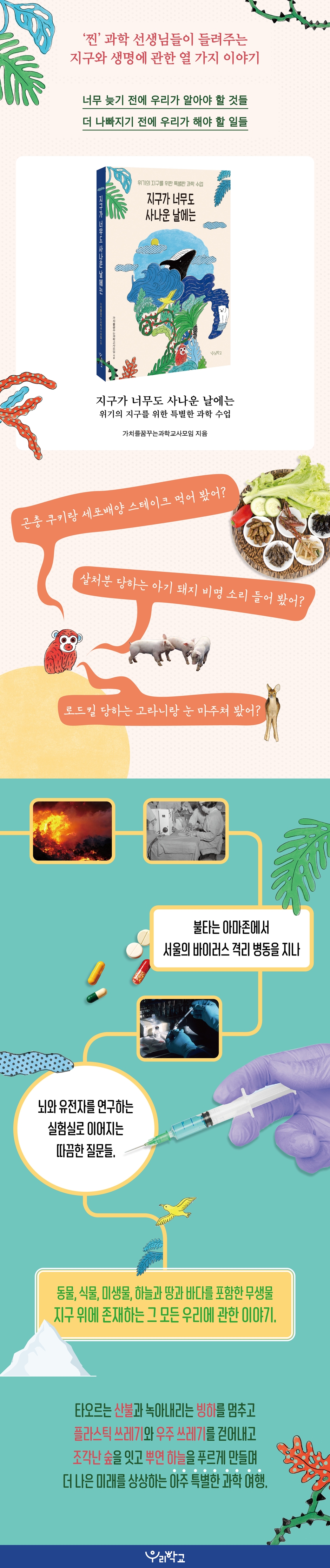
He talks about the future of food, asking children if they've tried insect cookies and cell-grown steak, and he takes them from the burning Amazon to Seoul's virus isolation wards and into labs studying brains and genes, never stopping to ask them pointed questions.
The film also delivers the unfiltered sounds of roadkill, young pigs being culled, and the screams of chicks from factory farms.
But it also tells us how to stop burning forest fires and melting glaciers, how to clean up plastic waste and space debris, and what it takes to reconnect fragmented forests and eliminate the tiny, toxic particles that blot out our blue skies.
The Best Environmental Science Textbook for Teens
The standard for ecological environmental education: asking and answering questions with science.
Today's youth are a generation that has experienced the benefits of scientific and technological civilization and the signs of climate change simultaneously since birth.
Even though we enjoy the benefits of cutting-edge science and technology, we have experienced the daily life of having to barely protect ourselves from viruses and fine dust with a mask, unable to step outside, since we were young.
Environmentalists' threats to children like these to abandon everything and return to nature are of no help.
Instead of instilling a heavy sense of guilt in young people, can't we foster a sense of positive responsibility for environmental issues? Instead of making them worry and sigh about a bleak future, can we encourage them to imagine how a better future can be achieved? This is possible if we present a fair and rational narrative informed by "science," not the one-sided claims of those who claim to be right.
Science teachers talk about the planet's crisis with verified data and numbers, rather than exaggerated risks and hypotheses.
Science is deeply involved in the Earth's crisis, but it was also the first to recognize the desperate message the Earth was sending.
This book calmly shows what is contained in the messages sent by the Earth and how those messages are connected to each other.
To do this, we summon all beings on Earth, not just endangered species.
These beings include everything beyond animals, plants, and microorganisms, including the atmosphere, oceans, soil, and glaciers, as well as the countless interactions between them.
This book is a story about all of the 'us' that exist on Earth.
Things We Need to Know Before It's Too Late
Things We Need to Do Before It Gets Too Bad
Anyone interested in the climate crisis and environmental issues will have seen this photo at least once and it will stay in their hearts for a long time.
This is a picture of children having fun playing in the water in the sunset-tinted sea, not a picture of polar bears on a melting glacier.
This ordinary photo takes on a completely different color the moment you read the title, “Children of Tuvalu.”
An island sinking due to global warming, a lonely sunset that seems to symbolize the impending destruction, yet the innocence of children jumping into the sea with all their might, unconcerned with all of this.
There is a sense of sadness at leaving the planet in crisis to the next generation, and a sense of hope that rests on the energy that only children possess.
This is what science teachers who teach future generations must think.
This book invites young people on a special scientific journey toward a better future.
On days when it seems like there will be no better future, days when you want to turn away and let things be, days when your heart is too fierce, this book is what you need.
If you're going on a long journey on a cold day, it's better to warm yourself with a hot soup than to briefly warm yourself by a fire.
On days when the Earth is too harsh, a solid science book will be a much more reliable companion than empty environmental protection cries.
Is there anyone who doesn't realize that the Earth is in crisis? Viral infections, heat waves, torrential rains, droughts, wildfires, and other signs of climate change are a powerful message and warning from the Earth to humanity.
While it is important for adults who created this crisis to reflect, it is also crucial for young people, who will have a long-term relationship with the Earth, to understand the crisis facing our planet.
To this end, powerful science teachers stepped forward.
The teachers of the "Science Teachers' Association Dreaming of Values," who wrote the book, are powerful teachers who have consistently spoken out about the duality of science and technology and the social responsibility of science both inside and outside of school for over twenty years.
Based on the countless stories and hard-won experiences I have shared with children, I published a special science class for the Earth in crisis, “When the Earth is Too Violent.”
As humanity engages in a game of Jenga with the Earth, where even a single piece could cause the planet to crumble, science teachers guide young people through the perilous landscape of the planet, saying, “Let’s stop this reckless game!”
He talks about the future of food, asking children if they've tried insect cookies and cell-grown steak, and he takes them from the burning Amazon to Seoul's virus isolation wards and into labs studying brains and genes, never stopping to ask them pointed questions.
The film also delivers the unfiltered sounds of roadkill, young pigs being culled, and the screams of chicks from factory farms.
But it also tells us how to stop burning forest fires and melting glaciers, how to clean up plastic waste and space debris, and what it takes to reconnect fragmented forests and eliminate the tiny, toxic particles that blot out our blue skies.
The Best Environmental Science Textbook for Teens
The standard for ecological environmental education: asking and answering questions with science.
Today's youth are a generation that has experienced the benefits of scientific and technological civilization and the signs of climate change simultaneously since birth.
Even though we enjoy the benefits of cutting-edge science and technology, we have experienced the daily life of having to barely protect ourselves from viruses and fine dust with a mask, unable to step outside, since we were young.
Environmentalists' threats to children like these to abandon everything and return to nature are of no help.
Instead of instilling a heavy sense of guilt in young people, can't we foster a sense of positive responsibility for environmental issues? Instead of making them worry and sigh about a bleak future, can we encourage them to imagine how a better future can be achieved? This is possible if we present a fair and rational narrative informed by "science," not the one-sided claims of those who claim to be right.
Science teachers talk about the planet's crisis with verified data and numbers, rather than exaggerated risks and hypotheses.
Science is deeply involved in the Earth's crisis, but it was also the first to recognize the desperate message the Earth was sending.
This book calmly shows what is contained in the messages sent by the Earth and how those messages are connected to each other.
To do this, we summon all beings on Earth, not just endangered species.
These beings include everything beyond animals, plants, and microorganisms, including the atmosphere, oceans, soil, and glaciers, as well as the countless interactions between them.
This book is a story about all of the 'us' that exist on Earth.
Things We Need to Know Before It's Too Late
Things We Need to Do Before It Gets Too Bad
Anyone interested in the climate crisis and environmental issues will have seen this photo at least once and it will stay in their hearts for a long time.
This is a picture of children having fun playing in the water in the sunset-tinted sea, not a picture of polar bears on a melting glacier.
This ordinary photo takes on a completely different color the moment you read the title, “Children of Tuvalu.”
An island sinking due to global warming, a lonely sunset that seems to symbolize the impending destruction, yet the innocence of children jumping into the sea with all their might, unconcerned with all of this.
There is a sense of sadness at leaving the planet in crisis to the next generation, and a sense of hope that rests on the energy that only children possess.
This is what science teachers who teach future generations must think.
This book invites young people on a special scientific journey toward a better future.
On days when it seems like there will be no better future, days when you want to turn away and let things be, days when your heart is too fierce, this book is what you need.
If you're going on a long journey on a cold day, it's better to warm yourself with a hot soup than to briefly warm yourself by a fire.
On days when the Earth is too harsh, a solid science book will be a much more reliable companion than empty environmental protection cries.
GOODS SPECIFICS
- Publication date: December 15, 2020
- Page count, weight, size: 192 pages | 426g | 148*210*20mm
- ISBN13: 9791190337588
- ISBN10: 1190337584
You may also like
카테고리
korean


korean

![GQ KOREA Mark (Monthly): December [2025]](http://librairie.coreenne.fr/cdn/shop/files/8ef265dbbfbf186523ed75ba7319009d.jpg?v=1765340328&width=3840)


