

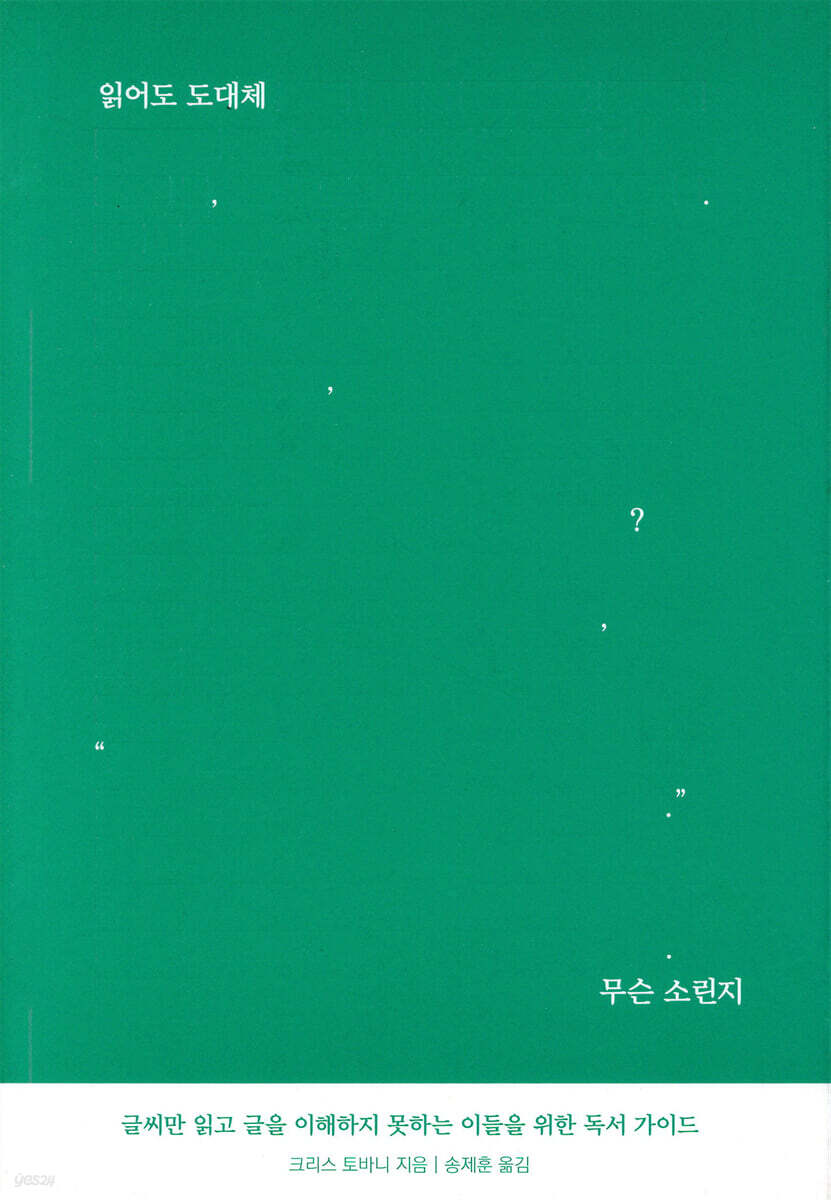
Even if I read it, what on earth does it mean?
 |
Description
Book Introduction
A reading guide for those who can't understand the text without reading it.
“Should we teach reading?” ask middle and high school teachers.
Their questions include the burden of a heavy curriculum and the question of where there are middle and high school students who cannot read.
Chris Tovarni answers yes to this question.
The author demonstrates through vivid examples how students (and adults!) who only read "letters" and cannot "read" can gain a new perspective on reading by providing practical reading strategies.
The author's humor and lively classroom scenes breathe life into this book, which emphasizes that "reading is thinking."
This book will provide new insights for teachers, parents, and general readers who want to utilize a variety of reading strategies depending on the nature and context of the text.
This book shows children discovering their own ability to read and think through books, through Chris's honesty and humor.
Chris shows how the power of thinking can be developed in heterogeneous classes like world literature or book discussions.
She shows that through free speech and a variety of teaching strategies, children can be taught to think for themselves to understand more.
-From Elin Oliver Keane's 'Foreword'
“Should we teach reading?” ask middle and high school teachers.
Their questions include the burden of a heavy curriculum and the question of where there are middle and high school students who cannot read.
Chris Tovarni answers yes to this question.
The author demonstrates through vivid examples how students (and adults!) who only read "letters" and cannot "read" can gain a new perspective on reading by providing practical reading strategies.
The author's humor and lively classroom scenes breathe life into this book, which emphasizes that "reading is thinking."
This book will provide new insights for teachers, parents, and general readers who want to utilize a variety of reading strategies depending on the nature and context of the text.
This book shows children discovering their own ability to read and think through books, through Chris's honesty and humor.
Chris shows how the power of thinking can be developed in heterogeneous classes like world literature or book discussions.
She shows that through free speech and a variety of teaching strategies, children can be taught to think for themselves to understand more.
-From Elin Oliver Keane's 'Foreword'
- You can preview some of the book's contents.
Preview
index
Translator's Note
introduction
Acknowledgements
Part 1: Stage Setup
Chapter 1: Reading with Illusion
1.
Setting Expectations | 2.
Disarming | My Important Books and Reading History
Chapter 2: The Reality of Reading
1.
I'll do anything except read | 2.
Even after reading it, I still don't understand what it means | 3.
Redefining Reading | 4.
Shouldn't you have learned this much in elementary school? | 5.
Things to talk about in Part 2
Part 2: Reading with Strategy
Chapter 3 Purpose of Reading: Accessibility Tools
1.
Purpose is the most important thing | 2.
Think Out Loud | 3.
Adding symbols to text | 4.
Using two-column notes | 5.
Using the Understanding Configuration Record Sheet | 6.
The Importance of Examples | Living Reading Guidance
Chapter 4: Talking to Text: Detecting the Roots of Obstacles to Understanding
1.
Finding Answers in Reality | 2.
How do you know you don't understand? | 3.
What do you do after you realize you don't understand? | 4.
Can you hear the voice? | 5.
What voice should I listen to? | 6.
Listening is important | Living Reading Guide
Chapter 5 Restoration of Meaning
1.
Rereading is just the beginning of a recovery strategy | 3.
Driving and Reading | 4.
Restoring meaning | 5.
Practice Makes Perfect | Living Reading Guide
Chapter 6: Connecting What You Know to What You Know
1.
Breaking Down the Boundaries | 2.
What does English have to do with history? | 3.
Knowledge or Experience? | 4.
I Have Nothing to Connect: Applications of the Class | 5.
How does connection help? | 6.
Connections Undo Confusion | Living Reading Maps
Chapter 7 Intellectual Curiosity
1.
Who asks and answers the questions? | 2.
Questions from the World Outside School | 3.
Asking questions in the text | 4.
Good readers always ask questions | 5.
Why should we teach questioning? | 6.
Questioning Practice | Living Reading Guide
Chapter 8: The Wrong Answer: Inferences That Go Too Far
1.
In my opinion | 2.
When teaching 'what', don't forget 'how' | 3.
Drawing a plausible conclusion | 4.
When you get stuck on words | 5.
What is inference? | 6.
Practice, practice, practice again | 7.
Visible and invisible text | 8.
The Right Balance | Living Reading Guide
Chapter 9 What to do now?
1.
Why You Should Teach Strategy | 2.
The last page is just the beginning
Part 3: Accessibility Tools
A.
2nd memo B.
Understanding Composition Record C.
Reading log
References
introduction
Acknowledgements
Part 1: Stage Setup
Chapter 1: Reading with Illusion
1.
Setting Expectations | 2.
Disarming | My Important Books and Reading History
Chapter 2: The Reality of Reading
1.
I'll do anything except read | 2.
Even after reading it, I still don't understand what it means | 3.
Redefining Reading | 4.
Shouldn't you have learned this much in elementary school? | 5.
Things to talk about in Part 2
Part 2: Reading with Strategy
Chapter 3 Purpose of Reading: Accessibility Tools
1.
Purpose is the most important thing | 2.
Think Out Loud | 3.
Adding symbols to text | 4.
Using two-column notes | 5.
Using the Understanding Configuration Record Sheet | 6.
The Importance of Examples | Living Reading Guidance
Chapter 4: Talking to Text: Detecting the Roots of Obstacles to Understanding
1.
Finding Answers in Reality | 2.
How do you know you don't understand? | 3.
What do you do after you realize you don't understand? | 4.
Can you hear the voice? | 5.
What voice should I listen to? | 6.
Listening is important | Living Reading Guide
Chapter 5 Restoration of Meaning
1.
Rereading is just the beginning of a recovery strategy | 3.
Driving and Reading | 4.
Restoring meaning | 5.
Practice Makes Perfect | Living Reading Guide
Chapter 6: Connecting What You Know to What You Know
1.
Breaking Down the Boundaries | 2.
What does English have to do with history? | 3.
Knowledge or Experience? | 4.
I Have Nothing to Connect: Applications of the Class | 5.
How does connection help? | 6.
Connections Undo Confusion | Living Reading Maps
Chapter 7 Intellectual Curiosity
1.
Who asks and answers the questions? | 2.
Questions from the World Outside School | 3.
Asking questions in the text | 4.
Good readers always ask questions | 5.
Why should we teach questioning? | 6.
Questioning Practice | Living Reading Guide
Chapter 8: The Wrong Answer: Inferences That Go Too Far
1.
In my opinion | 2.
When teaching 'what', don't forget 'how' | 3.
Drawing a plausible conclusion | 4.
When you get stuck on words | 5.
What is inference? | 6.
Practice, practice, practice again | 7.
Visible and invisible text | 8.
The Right Balance | Living Reading Guide
Chapter 9 What to do now?
1.
Why You Should Teach Strategy | 2.
The last page is just the beginning
Part 3: Accessibility Tools
A.
2nd memo B.
Understanding Composition Record C.
Reading log
References
Into the book
Our children learn well.
Children entering elementary school try to please their reading teachers.
In general, children learn well what their teachers teach.
Let's apply this scenario to children who are expected to do more as they grow up.
Children are required to work in groups to solve complex problems, conduct extensive research, and produce original results. They are also required to synthesize information from a variety of sources and present it concisely and coherently.
What do we teach our children to help them master these challenging tasks? In this book, we'll see that once children learn to think, they can effectively apply what they've learned in more complex situations.
--- p.11
I didn't learn how to read properly until I was in my 30s.
If it wasn't too late for me, it couldn't have been too late for Courtney either.
The opportunity for me to learn to read properly came by chance.
--- p.35
People who read well take for granted the rewards they enjoy in real life.
People who struggle with reading often struggle to experience the thrill of finishing a book.
They don't know how helpful it is to read and understand a single chapter of a textbook.
They don't know how much fun it is to escape the repetitive routine and dive into a book.
Quite a few students feel intimidated by grades, report cards, and special classes for underachieving students when they reach ninth grade.
Students who struggle with reading feel embarrassed by the label they are given, and because of this, they find reading unpleasant.
They try to avoid reading books at all costs.
The purpose and pleasure of reading have already disappeared.
--- p.37
The next day, Jerome was the first to step forward and announce.
Jerome was the toughest kid I've ever taught.
No one touched the child.
(As I write this, Jerome is serving a life sentence for murder after shooting someone to prove his loyalty to his organization.) When Jerome was the first to step forward, I was dazzled.
I was overcome with anxiety that he might make a mockery of the homework I gave him.
Jerome hid the book behind his back and walked forward, stumbling.
Everyone was holding their breath.
--- p.43
Books are a powerful tool that provides equal opportunities for all students.
Students know what it's like to not be able to read properly.
I also know what it's like to read something but not understand it.
And I know the tricks of reading by sight and the tricks of avoiding proper reading.
If you look around the classroom, you will see that there are many students who cannot read books properly.
However, the presentation class for the 'Important Book' assignment shows that even such students want to read books well.
Looking at the faces of the students I meet this new semester, I am reminded once again that we must transcend boundaries of race, religion, gender, and socioeconomic status.
This can only happen when we openly share our experiences with each other.
After all, no one would be scared by someone who said their favorite book was "Porky the Puppy."
--- p.45
As a teacher and reading instructor, I'm often asked why so many middle and high school students struggle with reading.
People who ask such questions are looking for simple solutions to very complex problems.
There is no such solution.
People's perception of reading is generally extremely simplistic.
Many people think of reading as simply reading words.
They don't realize that reading requires sophisticated thought processes and that reading actually becomes more difficult as students advance in grade level.
Today's middle and high school students are expected to read difficult texts in short periods of time, despite having received little or no reading instruction.
--- p.46
Understanding how meaning is constructed in a given passage is essential to understanding the text.
Knowing the meaning of a word does not mean understanding the text.
Even people with excellent reading skills can recall experiences where they knew the meaning of the words but couldn't understand the overall context of the text.
For example, let's say they're reading a document like a lease agreement or an income tax return.
If you look at the document word by word, it is clearly familiar English, but if you read all the parts together as a single text, the document feels like it was written in Greek.
Knowing the meaning of a word is just the beginning.
Reading strategies are needed to construct meaning.
Some parents say this:
"My child reads well, but I think he's having trouble understanding." What do these people think reading is? I can't help but be amazed that people equate a child's reading level with their ability to comprehend words.
To read is to think and to construct meaning.
This means more than just reading words.
Today, researchers define reading as a complex, repetitive thought process.
--- p.54
I hope that readers of this book will reconsider their role as teachers.
I hope you will review your current teaching methods and free yourself from the pressure of having to lead every class from beginning to end.
To do this, we must try to step back from the temptation to spoon-feed all the information to our students.
Moreover, we should not reduce the opportunities for students to read on their own just because they find it difficult to read.
Reading strategies should be taught to help students read the given reading material independently, and the reading materials provided to students should be interesting and not overly difficult.
Above all, teachers must be confident that they are qualified to conduct reading instruction.
The very act of reading books on your own is one of the qualities of an expert.
--- p.63
When teaching students how to approach text, teachers themselves should model how to use specific strategies.
To do this, you should first choose a text that is not too difficult.
Teachers should show students how specific access tools can help them retain ideas and use them to remember what they read later.
Teachers must provide feedback when students use access tools on their own.
And once students are comfortable with the tool, teachers should guide them to use it on more challenging texts and encourage them to use it outside the classroom.
The goal is to help students discover the usefulness of each comprehension strategy or access tool by experiencing for themselves how helpful it is when reading difficult texts.
--- p.86
The next class, as soon as the students entered the classroom, they started making excuses and muttering that they “didn’t understand a thing.”
I leaned back against the blackboard and quietly watched the students.
Students frantically flipped through the commentary, hoping to find some clue to understanding the plot.
“I’ll just take an F,” Rachel said.
“Even if I read it, I still don’t understand a single thing.”
--- p.98
Explain to students that they hear multiple voices when they read.
The teacher talks about what voices he hears when he reads a book.
Sometimes he points out that he hears his own voice pronouncing only the sounds of words.
(It is important to acknowledge that teachers themselves sometimes do this.) The teacher shares his own experience of how he changed this voice into a conversational voice.
Discuss how a conversational voice can take the reader away from the text, and explain how the teacher returns to the text when that happens.
--- p.117
Sometimes readers have information related to a topic in their heads but are unable to use it.
This background knowledge, if properly utilized, can be a powerful tool to help restore meaning.
Good readers know that connecting their own experiences or knowledge to the text they are reading greatly helps them understand it.
They use personal memories and experiences, information about the topic, the distinctive writing style of the author they know, and the structure of the text to visualize and predict it, ask questions and make inferences, and maintain focus to remember what they read for a long time.
--- p.124
Jason remembered the movie in great detail.
He was able to explain to me the desert terrain surrounding the base and the tight security facilities.
I asked Jason to reread the article and visualize the content of the article using movie scenes.
Then Jason began to understand the article he had complained was difficult without much difficulty.
I also came to understand why Groom Lake has no water and that it was named that way because it was a lake in prehistoric times.
Jason finally visualized a secret base in the middle of the desert, and was even able to deduce that the base was located there to keep people out.
--- p.129
When you come across an unfamiliar word while reading, you won't be able to understand its meaning just by reading it dozens of times.
In that case, you have to ask someone or look it up in a dictionary.
Which recovery strategy to use depends on the situation.
If a reader reads a text alone, it is difficult to expect help from others.
If you don't have a dictionary or aren't comfortable looking it up, you'll have to find another way.
At this time, the reader can infer the meaning through the context before and after the word.
If you have reason to believe that a word is unimportant, you might consciously skip it; if it appears once and never appears again, it may not be essential to your understanding of the text as a whole.
If a word appears repeatedly, it is likely to be important to the understanding of the entire text.
At this point, the reader can highlight the word and ask for help later.
In this way, readers can address the problems they encounter while reading the text while being aware of various alternatives.
--- p.136
Teachers are not particularly interested in breaking down boundaries between subjects.
However, if we teach that knowledge is closely related, students will be able to apply the information they gain from one subject to their classes in other subjects.
If teachers collaborate to design lessons and teach students how to use what they already know, the burden of digesting extensive course material will be reduced. Well-trained readers rely on background knowledge to understand text.
Students who use algebraic concepts in chemistry classes will find it easier to match coefficients in chemical equations.
The idea that math isn't necessary in science class is unstrategic.
Likewise, ignoring what readers already know is very detrimental to the reader.
Because if you don't use everything possible to understand the text, your understanding will be limited.
It is very difficult to read an unfamiliar text without considering background knowledge such as the author, genre, and related historical facts.
It is crucial for students to think across subject boundaries, and it is the teacher's job to teach them to do so.
--- p.147
The students were confused, wondering what Nico had done wrong, and Nico was staring at me.
After a brief pause, I said that we had just witnessed the way a great reader reads a book.
Nico smiled brightly.
I pointed out that Nico read beyond the words and made his own inferences about the soldier's actions.
Nico used his background knowledge to get into the soldier's mind and explain why he threw the milk carton.
“If Nico had just read the words out loud, he wouldn’t have been able to tell us that story.
“Nico connected the information in his head with the works we read.”
--- p.163
John wrote:
“Reading this article reminded me of the movie A River Runs Through It.
I haven't seen it yet, but from what I know, it's a movie about fishing and family love.
“I think it’s a good story, so I’m going to watch it.” John connected the text and the movie and even made a prediction.
A good reader is constantly making predictions and constantly checking whether those predictions are correct.
John made another connection when a rafter asked the writer, “I heard someone died rafting here last year. Is that true?”
“The moment I read that passage, I remembered a story my older brothers used to tell me when I was little.
I was always confused about whether to believe my brothers' stories or not.
“The story about someone dying in this article also doesn’t seem to be true.” The memory of his brothers teasing him led to his inference.
John visualized the rafting participants from the city being frightened by the rumors and made his own inference that the rumors were probably not credible.
--- p.169
A few years ago, I attended a workshop by Donald Graves, and I will never forget what I heard about Graves' reading habits.
He confessed that he rereads Tolstoy's Anna Karenina every year, and each time he sees something new in the text that he had not seen before and discovers something about himself that he had not known before.
He enjoyed discovering different meanings in the same text each year than in the previous year.
How great would be his disappointment if, when the year turned, he reread Anna Karenina and discovered nothing new about himself or the world!
--- p.214
I also need help when reading difficult and rigid texts, such as scientific papers or user manuals for home appliances.
Reading printed words alone is not enough.
Knowing a variety of ways to deal with difficult texts gives me a significant advantage over those who lack reading strategies.
There is no one-size-fits-all strategy for all texts.
Depending on the purpose of reading, strategies should be applied flexibly.
When I have to read a difficult text, I try to predict which parts will be difficult to understand.
And then decide which strategy to use and in what way.
It is about consciously thinking about and preparing for the part you will soon read in order to understand the part you are reading now.
Every text is different.
To read well, you need to use a variety of strategies.
--- p.229
Reading and understanding is a complex process.
There are no shortcuts to understanding text.
There are countless ways for our brains to navigate the layers of meaning in a text.
Good readers don't read all documents, books, and magazines in the same way.
Reading well means being aware of what you are thinking and choosing and using appropriate reading strategies based on the demands of the given task.
Children entering elementary school try to please their reading teachers.
In general, children learn well what their teachers teach.
Let's apply this scenario to children who are expected to do more as they grow up.
Children are required to work in groups to solve complex problems, conduct extensive research, and produce original results. They are also required to synthesize information from a variety of sources and present it concisely and coherently.
What do we teach our children to help them master these challenging tasks? In this book, we'll see that once children learn to think, they can effectively apply what they've learned in more complex situations.
--- p.11
I didn't learn how to read properly until I was in my 30s.
If it wasn't too late for me, it couldn't have been too late for Courtney either.
The opportunity for me to learn to read properly came by chance.
--- p.35
People who read well take for granted the rewards they enjoy in real life.
People who struggle with reading often struggle to experience the thrill of finishing a book.
They don't know how helpful it is to read and understand a single chapter of a textbook.
They don't know how much fun it is to escape the repetitive routine and dive into a book.
Quite a few students feel intimidated by grades, report cards, and special classes for underachieving students when they reach ninth grade.
Students who struggle with reading feel embarrassed by the label they are given, and because of this, they find reading unpleasant.
They try to avoid reading books at all costs.
The purpose and pleasure of reading have already disappeared.
--- p.37
The next day, Jerome was the first to step forward and announce.
Jerome was the toughest kid I've ever taught.
No one touched the child.
(As I write this, Jerome is serving a life sentence for murder after shooting someone to prove his loyalty to his organization.) When Jerome was the first to step forward, I was dazzled.
I was overcome with anxiety that he might make a mockery of the homework I gave him.
Jerome hid the book behind his back and walked forward, stumbling.
Everyone was holding their breath.
--- p.43
Books are a powerful tool that provides equal opportunities for all students.
Students know what it's like to not be able to read properly.
I also know what it's like to read something but not understand it.
And I know the tricks of reading by sight and the tricks of avoiding proper reading.
If you look around the classroom, you will see that there are many students who cannot read books properly.
However, the presentation class for the 'Important Book' assignment shows that even such students want to read books well.
Looking at the faces of the students I meet this new semester, I am reminded once again that we must transcend boundaries of race, religion, gender, and socioeconomic status.
This can only happen when we openly share our experiences with each other.
After all, no one would be scared by someone who said their favorite book was "Porky the Puppy."
--- p.45
As a teacher and reading instructor, I'm often asked why so many middle and high school students struggle with reading.
People who ask such questions are looking for simple solutions to very complex problems.
There is no such solution.
People's perception of reading is generally extremely simplistic.
Many people think of reading as simply reading words.
They don't realize that reading requires sophisticated thought processes and that reading actually becomes more difficult as students advance in grade level.
Today's middle and high school students are expected to read difficult texts in short periods of time, despite having received little or no reading instruction.
--- p.46
Understanding how meaning is constructed in a given passage is essential to understanding the text.
Knowing the meaning of a word does not mean understanding the text.
Even people with excellent reading skills can recall experiences where they knew the meaning of the words but couldn't understand the overall context of the text.
For example, let's say they're reading a document like a lease agreement or an income tax return.
If you look at the document word by word, it is clearly familiar English, but if you read all the parts together as a single text, the document feels like it was written in Greek.
Knowing the meaning of a word is just the beginning.
Reading strategies are needed to construct meaning.
Some parents say this:
"My child reads well, but I think he's having trouble understanding." What do these people think reading is? I can't help but be amazed that people equate a child's reading level with their ability to comprehend words.
To read is to think and to construct meaning.
This means more than just reading words.
Today, researchers define reading as a complex, repetitive thought process.
--- p.54
I hope that readers of this book will reconsider their role as teachers.
I hope you will review your current teaching methods and free yourself from the pressure of having to lead every class from beginning to end.
To do this, we must try to step back from the temptation to spoon-feed all the information to our students.
Moreover, we should not reduce the opportunities for students to read on their own just because they find it difficult to read.
Reading strategies should be taught to help students read the given reading material independently, and the reading materials provided to students should be interesting and not overly difficult.
Above all, teachers must be confident that they are qualified to conduct reading instruction.
The very act of reading books on your own is one of the qualities of an expert.
--- p.63
When teaching students how to approach text, teachers themselves should model how to use specific strategies.
To do this, you should first choose a text that is not too difficult.
Teachers should show students how specific access tools can help them retain ideas and use them to remember what they read later.
Teachers must provide feedback when students use access tools on their own.
And once students are comfortable with the tool, teachers should guide them to use it on more challenging texts and encourage them to use it outside the classroom.
The goal is to help students discover the usefulness of each comprehension strategy or access tool by experiencing for themselves how helpful it is when reading difficult texts.
--- p.86
The next class, as soon as the students entered the classroom, they started making excuses and muttering that they “didn’t understand a thing.”
I leaned back against the blackboard and quietly watched the students.
Students frantically flipped through the commentary, hoping to find some clue to understanding the plot.
“I’ll just take an F,” Rachel said.
“Even if I read it, I still don’t understand a single thing.”
--- p.98
Explain to students that they hear multiple voices when they read.
The teacher talks about what voices he hears when he reads a book.
Sometimes he points out that he hears his own voice pronouncing only the sounds of words.
(It is important to acknowledge that teachers themselves sometimes do this.) The teacher shares his own experience of how he changed this voice into a conversational voice.
Discuss how a conversational voice can take the reader away from the text, and explain how the teacher returns to the text when that happens.
--- p.117
Sometimes readers have information related to a topic in their heads but are unable to use it.
This background knowledge, if properly utilized, can be a powerful tool to help restore meaning.
Good readers know that connecting their own experiences or knowledge to the text they are reading greatly helps them understand it.
They use personal memories and experiences, information about the topic, the distinctive writing style of the author they know, and the structure of the text to visualize and predict it, ask questions and make inferences, and maintain focus to remember what they read for a long time.
--- p.124
Jason remembered the movie in great detail.
He was able to explain to me the desert terrain surrounding the base and the tight security facilities.
I asked Jason to reread the article and visualize the content of the article using movie scenes.
Then Jason began to understand the article he had complained was difficult without much difficulty.
I also came to understand why Groom Lake has no water and that it was named that way because it was a lake in prehistoric times.
Jason finally visualized a secret base in the middle of the desert, and was even able to deduce that the base was located there to keep people out.
--- p.129
When you come across an unfamiliar word while reading, you won't be able to understand its meaning just by reading it dozens of times.
In that case, you have to ask someone or look it up in a dictionary.
Which recovery strategy to use depends on the situation.
If a reader reads a text alone, it is difficult to expect help from others.
If you don't have a dictionary or aren't comfortable looking it up, you'll have to find another way.
At this time, the reader can infer the meaning through the context before and after the word.
If you have reason to believe that a word is unimportant, you might consciously skip it; if it appears once and never appears again, it may not be essential to your understanding of the text as a whole.
If a word appears repeatedly, it is likely to be important to the understanding of the entire text.
At this point, the reader can highlight the word and ask for help later.
In this way, readers can address the problems they encounter while reading the text while being aware of various alternatives.
--- p.136
Teachers are not particularly interested in breaking down boundaries between subjects.
However, if we teach that knowledge is closely related, students will be able to apply the information they gain from one subject to their classes in other subjects.
If teachers collaborate to design lessons and teach students how to use what they already know, the burden of digesting extensive course material will be reduced. Well-trained readers rely on background knowledge to understand text.
Students who use algebraic concepts in chemistry classes will find it easier to match coefficients in chemical equations.
The idea that math isn't necessary in science class is unstrategic.
Likewise, ignoring what readers already know is very detrimental to the reader.
Because if you don't use everything possible to understand the text, your understanding will be limited.
It is very difficult to read an unfamiliar text without considering background knowledge such as the author, genre, and related historical facts.
It is crucial for students to think across subject boundaries, and it is the teacher's job to teach them to do so.
--- p.147
The students were confused, wondering what Nico had done wrong, and Nico was staring at me.
After a brief pause, I said that we had just witnessed the way a great reader reads a book.
Nico smiled brightly.
I pointed out that Nico read beyond the words and made his own inferences about the soldier's actions.
Nico used his background knowledge to get into the soldier's mind and explain why he threw the milk carton.
“If Nico had just read the words out loud, he wouldn’t have been able to tell us that story.
“Nico connected the information in his head with the works we read.”
--- p.163
John wrote:
“Reading this article reminded me of the movie A River Runs Through It.
I haven't seen it yet, but from what I know, it's a movie about fishing and family love.
“I think it’s a good story, so I’m going to watch it.” John connected the text and the movie and even made a prediction.
A good reader is constantly making predictions and constantly checking whether those predictions are correct.
John made another connection when a rafter asked the writer, “I heard someone died rafting here last year. Is that true?”
“The moment I read that passage, I remembered a story my older brothers used to tell me when I was little.
I was always confused about whether to believe my brothers' stories or not.
“The story about someone dying in this article also doesn’t seem to be true.” The memory of his brothers teasing him led to his inference.
John visualized the rafting participants from the city being frightened by the rumors and made his own inference that the rumors were probably not credible.
--- p.169
A few years ago, I attended a workshop by Donald Graves, and I will never forget what I heard about Graves' reading habits.
He confessed that he rereads Tolstoy's Anna Karenina every year, and each time he sees something new in the text that he had not seen before and discovers something about himself that he had not known before.
He enjoyed discovering different meanings in the same text each year than in the previous year.
How great would be his disappointment if, when the year turned, he reread Anna Karenina and discovered nothing new about himself or the world!
--- p.214
I also need help when reading difficult and rigid texts, such as scientific papers or user manuals for home appliances.
Reading printed words alone is not enough.
Knowing a variety of ways to deal with difficult texts gives me a significant advantage over those who lack reading strategies.
There is no one-size-fits-all strategy for all texts.
Depending on the purpose of reading, strategies should be applied flexibly.
When I have to read a difficult text, I try to predict which parts will be difficult to understand.
And then decide which strategy to use and in what way.
It is about consciously thinking about and preparing for the part you will soon read in order to understand the part you are reading now.
Every text is different.
To read well, you need to use a variety of strategies.
--- p.229
Reading and understanding is a complex process.
There are no shortcuts to understanding text.
There are countless ways for our brains to navigate the layers of meaning in a text.
Good readers don't read all documents, books, and magazines in the same way.
Reading well means being aware of what you are thinking and choosing and using appropriate reading strategies based on the demands of the given task.
--- p.230
GOODS SPECIFICS
- Date of publication: August 20, 2020
- Page count, weight, size: 264 pages | 153*224*20mm
- ISBN13: 9791160870671
- ISBN10: 1160870675
You may also like
카테고리
korean


korean

![GQ KOREA Mark (Monthly): December [2025]](http://librairie.coreenne.fr/cdn/shop/files/8ef265dbbfbf186523ed75ba7319009d.jpg?v=1765340328&width=3840)


