

Reading Modern Korean History Through Elections Connected with Teenagers
 |
Description
Book Introduction
If we know about the presidential election, won't we be able to see our future?
-A story of modern history viewed through past presidential elections
This book covers a total of 18 presidential elections, from the first presidential election in 1948 to the 18th presidential election in 2012, as well as national assembly elections and local elections.
It is structured to make it easy to understand modern Korean history and the history of democracy.
By reading about the political situation during the presidential election, the candidates' campaign pledges, campaign methods, and election results, young people, the future voters, can see how the Republic of Korea we live in has changed and what processes democracy has gone through to develop.
Photos of election-related voting rates and turnout statistics, election publicity materials containing various political advertisements, and other materials provide a rich and vivid look at the history of democracy in our country.
Meanwhile, through the section titled 'Election Stories We Didn't Know', it provides information on various election-related stories that young people must know, such as why the voting age is 19 when the resident registration issuance age is 17, driver's license is 18, and civil service appointment is 18, how the local autonomy system in our country has developed, and when women were granted the right to vote around the world.
In the appendix, "Reading the Spirit of the Times in Presidential Inaugural Addresses," we examine the policies and national direction each president spoke of and briefly examine how much of them have been realized since taking office.
The idea is to find out through the inaugural addresses of the presidents which presidents correctly grasped the reality and presented a future, or which presidents lied.
-A story of modern history viewed through past presidential elections
This book covers a total of 18 presidential elections, from the first presidential election in 1948 to the 18th presidential election in 2012, as well as national assembly elections and local elections.
It is structured to make it easy to understand modern Korean history and the history of democracy.
By reading about the political situation during the presidential election, the candidates' campaign pledges, campaign methods, and election results, young people, the future voters, can see how the Republic of Korea we live in has changed and what processes democracy has gone through to develop.
Photos of election-related voting rates and turnout statistics, election publicity materials containing various political advertisements, and other materials provide a rich and vivid look at the history of democracy in our country.
Meanwhile, through the section titled 'Election Stories We Didn't Know', it provides information on various election-related stories that young people must know, such as why the voting age is 19 when the resident registration issuance age is 17, driver's license is 18, and civil service appointment is 18, how the local autonomy system in our country has developed, and when women were granted the right to vote around the world.
In the appendix, "Reading the Spirit of the Times in Presidential Inaugural Addresses," we examine the policies and national direction each president spoke of and briefly examine how much of them have been realized since taking office.
The idea is to find out through the inaugural addresses of the presidents which presidents correctly grasped the reality and presented a future, or which presidents lied.
- You can preview some of the book's contents.
Preview
index
preface
Modern Korean history reflected in past presidential elections
Chapter 1.
1st Presidential Election _ 1948, Korea's first general election
'Election by Male Heads of Households Only' during the US Military Government
People under 25 cannot vote.
South Korea's only general election
Cabinet-led system or presidential system?
Chapter 2.
The 2nd Presidential Election - 1952, held in just 8 days
Conflict between the National Assembly and Syngman Rhee
Is constitutional revision something that all the people desire?
Members of the National Assembly dragged away by the military police
An election without political views or promises
“I can’t live like this for another four years!”
The election results everyone expected
Chapter 3.
3rd Presidential Election - 1956, I can't live like this anymore, let's change it!
Shin Ik-hee as pro-Japanese, Jo Bong-am as pro-communist
I can't live like this, let's change it!
Let's not go to war!
Daegu ticket office closed
Seoul citizens hate the Liberty Korea Party
Students, stay still
“Obey, even if it is difficult!”
Chapter 4.
The 4th Presidential Election _ 1960, A Comprehensive Gift Set of Election Fraud
The deregistration of the Progressive Party and the execution of Cho Bong-am
Amendment to the National Security Act and the closure of the Kyunghyang Shinmun
Should I blame this world or the Liberal Party?
Secret directives from the Minister of the Interior
Election fraud causes students to shed blood
The Second Republic and the Revival of Local Autonomy
Chapter 5.
5th Presidential Election _ 1963, What is Liberal Democracy?
Military regime that came to power through a coup
The Democratic Republican Party and the Four Major Suspicions
Yun Bo-seon and Park Chung-hee's debate on "liberal democracy"
“Let’s pick a new worker and treat him like an ox.”
Rural areas vote for the ruling party, urban areas vote for the opposition party.
Chapter 6.
The 6th Presidential Election _ 1967: A Flood of Development Promises
The military regime's humiliating diplomacy toward Japan
The Republican Party's Hundred Promises
"Let's complete the modernization of our country."
National land development plan announced the day before the election
Is "Paldogangsan" a national promotional film?
The winds of regionalism begin to blow
Chapter 7.
The 7th Presidential Election: 1971, The Winds of Change Blow
Deleted presidential re-election clause
Kim Dae-jung's election wind
The Battle of 'Sarangbang' and 'Gwangjang'
Falling into the black hole of regionalism
Chapter 8.
The 8th to 12th Presidential Elections _ 1972-1981, the Era of Gymnasium Elections
“I will never ask you for your votes again.”
The Yushin Constitution and the Gymnasium Election
The End of the Yushin Regime and the 10th Presidential Election
A presidential election without politicians
Chapter 9.
The 13th Presidential Election - 1987, the first direct election in 16 years
"The ruling and opposition parties must agree to amend the Constitution to a direct election system."
Who is the right person to end military rule?
Failed to change the regime
Chapter 10.
14th-18th Presidential Elections _ 1992-2012, Our Election, Our Era
“Let’s change it this time.”
Liquidation of the Three Kims or a Change of Government?
The rise of the Internet and the demise of "old politics."
A world where people are happy
Appendix: Reading the Spirit of the Times through the President's Inaugural Address
References
Modern Korean history reflected in past presidential elections
Chapter 1.
1st Presidential Election _ 1948, Korea's first general election
'Election by Male Heads of Households Only' during the US Military Government
People under 25 cannot vote.
South Korea's only general election
Cabinet-led system or presidential system?
Chapter 2.
The 2nd Presidential Election - 1952, held in just 8 days
Conflict between the National Assembly and Syngman Rhee
Is constitutional revision something that all the people desire?
Members of the National Assembly dragged away by the military police
An election without political views or promises
“I can’t live like this for another four years!”
The election results everyone expected
Chapter 3.
3rd Presidential Election - 1956, I can't live like this anymore, let's change it!
Shin Ik-hee as pro-Japanese, Jo Bong-am as pro-communist
I can't live like this, let's change it!
Let's not go to war!
Daegu ticket office closed
Seoul citizens hate the Liberty Korea Party
Students, stay still
“Obey, even if it is difficult!”
Chapter 4.
The 4th Presidential Election _ 1960, A Comprehensive Gift Set of Election Fraud
The deregistration of the Progressive Party and the execution of Cho Bong-am
Amendment to the National Security Act and the closure of the Kyunghyang Shinmun
Should I blame this world or the Liberal Party?
Secret directives from the Minister of the Interior
Election fraud causes students to shed blood
The Second Republic and the Revival of Local Autonomy
Chapter 5.
5th Presidential Election _ 1963, What is Liberal Democracy?
Military regime that came to power through a coup
The Democratic Republican Party and the Four Major Suspicions
Yun Bo-seon and Park Chung-hee's debate on "liberal democracy"
“Let’s pick a new worker and treat him like an ox.”
Rural areas vote for the ruling party, urban areas vote for the opposition party.
Chapter 6.
The 6th Presidential Election _ 1967: A Flood of Development Promises
The military regime's humiliating diplomacy toward Japan
The Republican Party's Hundred Promises
"Let's complete the modernization of our country."
National land development plan announced the day before the election
Is "Paldogangsan" a national promotional film?
The winds of regionalism begin to blow
Chapter 7.
The 7th Presidential Election: 1971, The Winds of Change Blow
Deleted presidential re-election clause
Kim Dae-jung's election wind
The Battle of 'Sarangbang' and 'Gwangjang'
Falling into the black hole of regionalism
Chapter 8.
The 8th to 12th Presidential Elections _ 1972-1981, the Era of Gymnasium Elections
“I will never ask you for your votes again.”
The Yushin Constitution and the Gymnasium Election
The End of the Yushin Regime and the 10th Presidential Election
A presidential election without politicians
Chapter 9.
The 13th Presidential Election - 1987, the first direct election in 16 years
"The ruling and opposition parties must agree to amend the Constitution to a direct election system."
Who is the right person to end military rule?
Failed to change the regime
Chapter 10.
14th-18th Presidential Elections _ 1992-2012, Our Election, Our Era
“Let’s change it this time.”
Liquidation of the Three Kims or a Change of Government?
The rise of the Internet and the demise of "old politics."
A world where people are happy
Appendix: Reading the Spirit of the Times through the President's Inaugural Address
References
Detailed image
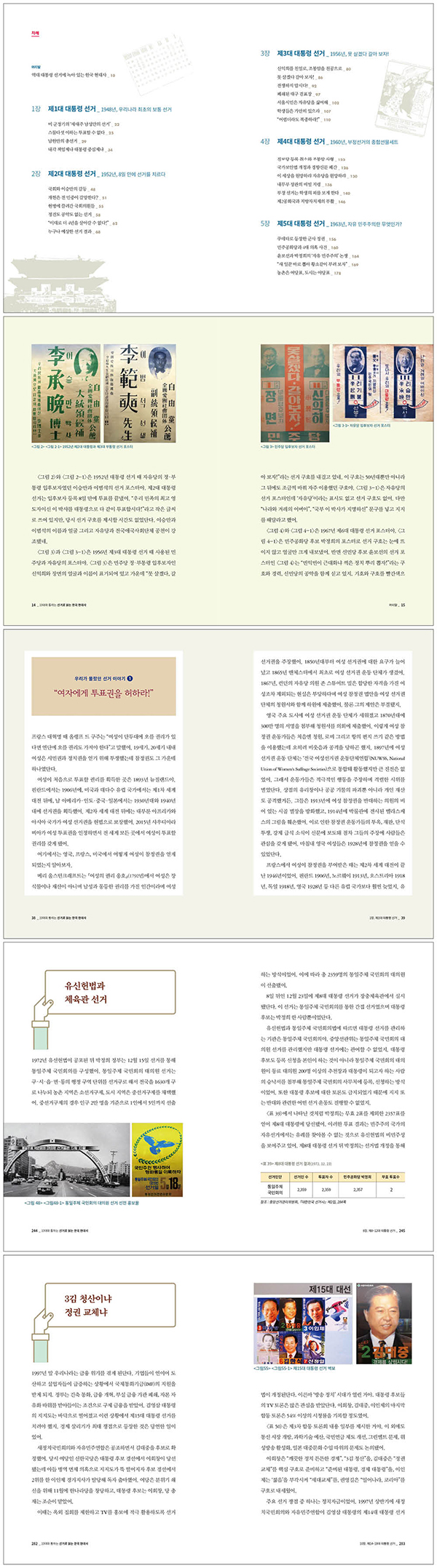
Into the book
Looking at the voting age around the world, 5 countries have 16, 4 have 17, and 144 have 18, with Korea being the only country with 19.
The voting age for obtaining political rights is the lowest in the most developing countries.
--- From the text
There are many cases where public opinion or sentiment expressed through elections is not properly reflected.
We cannot know whether the representatives elected by the people will respect democracy or act against it.
Nevertheless, the general election system and direct election system can be said to be the flower of democracy.
So, in modern Korean history, the direct election of the president and members of the National Assembly has emerged as an important issue for democratization.
--- From the text
Women first gained the right to vote in New Zealand in 1893.
In Finland, the right to vote was gained in 1906, in the United States and most European countries after World War I, and in South America, India, China, and Japan in the 1930s and 1940s.
After World War II, most African and Asian countries guaranteed women's suffrage in their constitutions.
In 2015, Saudi Arabia granted women the right to vote, making it the first country in the world to do so.
--- From the text
Looking back at past elections, I see that while the number of 'promises' has increased, there have been many times when they ended up as 'empty promises'.
The reason I looked into it is because, even though it was an ‘empty promise,’ it contained the spirit of the times.
During election periods, many people jump into politics and all kinds of talk goes back and forth.
You can see the flow of the times by looking at elections.
The voting age for obtaining political rights is the lowest in the most developing countries.
--- From the text
There are many cases where public opinion or sentiment expressed through elections is not properly reflected.
We cannot know whether the representatives elected by the people will respect democracy or act against it.
Nevertheless, the general election system and direct election system can be said to be the flower of democracy.
So, in modern Korean history, the direct election of the president and members of the National Assembly has emerged as an important issue for democratization.
--- From the text
Women first gained the right to vote in New Zealand in 1893.
In Finland, the right to vote was gained in 1906, in the United States and most European countries after World War I, and in South America, India, China, and Japan in the 1930s and 1940s.
After World War II, most African and Asian countries guaranteed women's suffrage in their constitutions.
In 2015, Saudi Arabia granted women the right to vote, making it the first country in the world to do so.
--- From the text
Looking back at past elections, I see that while the number of 'promises' has increased, there have been many times when they ended up as 'empty promises'.
The reason I looked into it is because, even though it was an ‘empty promise,’ it contained the spirit of the times.
During election periods, many people jump into politics and all kinds of talk goes back and forth.
You can see the flow of the times by looking at elections.
--- From the text
Publisher's Review
The history of democracy in our country as seen through the presidential election
A look at the presidential elections in this book reveals just how turbulent and twisted our country's democracy has been through its history.
Although elections are called the flower of democracy, there have been many instances in our modern history where the will of the people was not properly reflected in elections.
However, the people have been developing democracy through elections, albeit slowly, in the face of dictatorship.
South Korea has produced 11 presidents through 18 presidential elections.
However, the first president, Syngman Rhee, was elected four times in an attempt to remain in power for a long time, but he committed election fraud and was forced to step down during the April 19 Revolution.
Park Chung-hee, who took power through the May 16 coup and was elected as the 5th president, even revised the constitution to his advantage and became president five times. However, his dictatorial rule provoked resistance from the people and he was eventually assassinated by his close associates.
Chun Doo-hwan, who came to power through the December 12 coup, was elected as the 11th and 12th president twice through gymnasium elections, but accepted the direct presidential election system through the June Democracy Movement, and was arrested and imprisoned after leaving office.
Three presidents, Syngman Rhee, Park Chung-hee, and Chun Doo-hwan, abused their power and committed illegal acts while serving as president for a total of 11 terms, but the people continuously resisted, demanding democracy.
And recently, the 18th President, Park Geun-hye, committed a state affairs scandal and faced nationwide protests, including candlelight vigils, and was removed from office by the Constitutional Court in March 2017.
A look at the presidential elections in this book reveals just how turbulent and twisted our country's democracy has been through its history.
Although elections are called the flower of democracy, there have been many instances in our modern history where the will of the people was not properly reflected in elections.
However, the people have been developing democracy through elections, albeit slowly, in the face of dictatorship.
South Korea has produced 11 presidents through 18 presidential elections.
However, the first president, Syngman Rhee, was elected four times in an attempt to remain in power for a long time, but he committed election fraud and was forced to step down during the April 19 Revolution.
Park Chung-hee, who took power through the May 16 coup and was elected as the 5th president, even revised the constitution to his advantage and became president five times. However, his dictatorial rule provoked resistance from the people and he was eventually assassinated by his close associates.
Chun Doo-hwan, who came to power through the December 12 coup, was elected as the 11th and 12th president twice through gymnasium elections, but accepted the direct presidential election system through the June Democracy Movement, and was arrested and imprisoned after leaving office.
Three presidents, Syngman Rhee, Park Chung-hee, and Chun Doo-hwan, abused their power and committed illegal acts while serving as president for a total of 11 terms, but the people continuously resisted, demanding democracy.
And recently, the 18th President, Park Geun-hye, committed a state affairs scandal and faced nationwide protests, including candlelight vigils, and was removed from office by the Constitutional Court in March 2017.
GOODS SPECIFICS
- Date of issue: April 19, 2017
- Page count, weight, size: 320 pages | 536g | 152*221*18mm
- ISBN13: 9791188215010
- ISBN10: 1188215019
You may also like
카테고리
korean


korean

![GQ KOREA Mark (Monthly): December [2025]](http://librairie.coreenne.fr/cdn/shop/files/8ef265dbbfbf186523ed75ba7319009d.jpg?v=1765340328&width=3840)


