

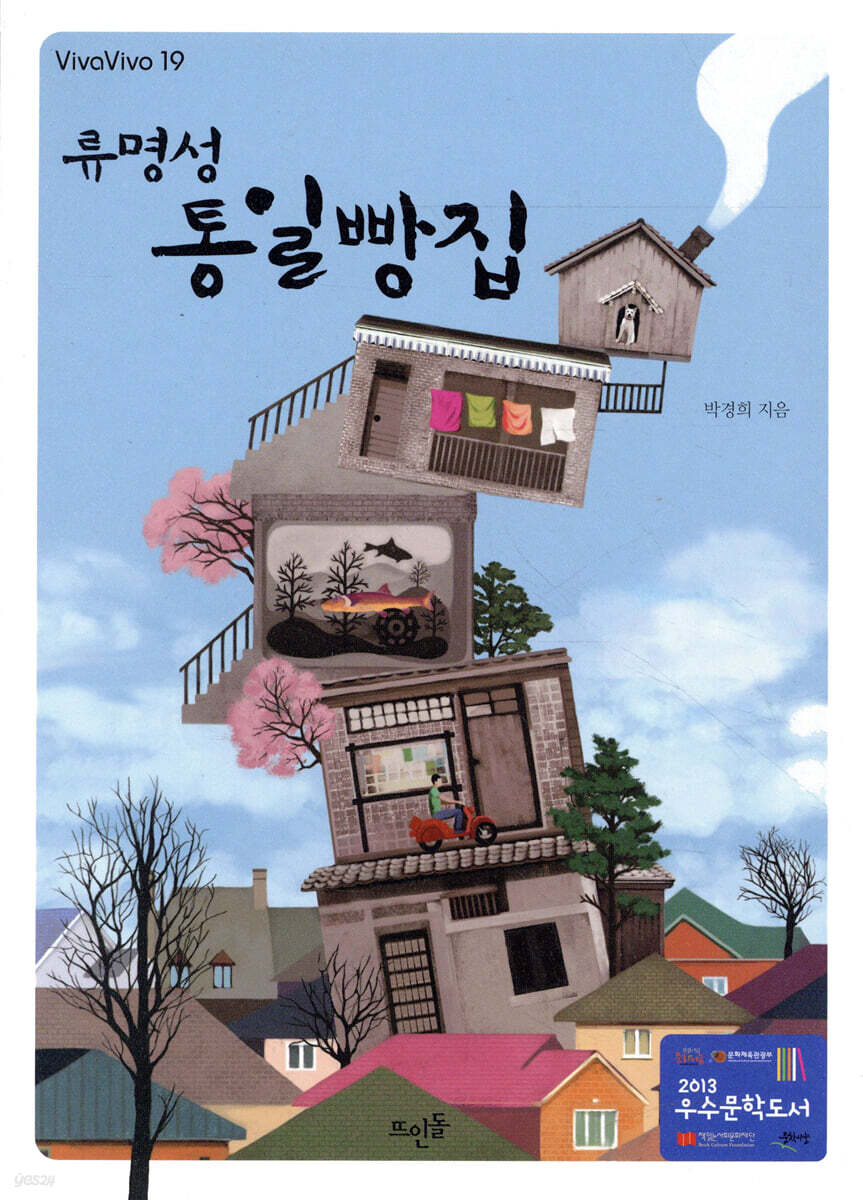
Ryu Myeong-seong's Tongil Bakery
 |
Description
Book Introduction
Now, we live and breathe together in this land called the Republic of Korea.
The story of North and South Korean youth begins!
It focuses on the lives and sorrows of North Korean defectors, the process of defecting from North Korea, and the communication between North and South Korean youth.
Like Joo-hee, who dislikes the North Korean mother and daughter who defected from North Korea, we discover our own prejudices toward defectors. We also observe the unfamiliar image of South Korea that defectors perceive through Myeong-seong's pitying gaze toward Sarah, who is dieting to escape poverty.
It is also characterized by being lively and serious.
As it is a story about young people, you can feel the joy and liveliness of learning about the unfamiliar North Korea, unlike existing works about North Korean defectors.
Joo-hee becomes a family with a North Korean defector mother and daughter; Da-kyung is drawn to Ki-cheol, who never gives up; Kang-hee is betrayed by her older sister, who followed her like a mother; Yeon-mi takes in and raises a stray dog named Myeong-gu; Myeong-seong misses his younger sibling he left behind in the North while watching Sera; and Eun-hui fills her knowledge and heals her wounds at a bookstore instead of going to school.
Their stories freely cross time and space, serving as a crossroads between the South and the North.
How about taking this opportunity to get to know each other through various stories, including the characters' turbulent pasts and the relationships between South and North Koreans?
Throughout the work, there are materials that identify with the characters or amplify emotions through the characters' situations, which evoke compassion for the lives that 'struggle to survive.'
Everyone has a precious life, and therefore, that life deserves to be respected.
The author's experience of constantly communicating with North Korean defector youth has created vivid characters with diverse stories, and guides us into a North Korea we never knew existed.
These six novels, which travel between past and present, South and North Korea, offer an opportunity to rethink the concept of unification.
The story of North and South Korean youth begins!
It focuses on the lives and sorrows of North Korean defectors, the process of defecting from North Korea, and the communication between North and South Korean youth.
Like Joo-hee, who dislikes the North Korean mother and daughter who defected from North Korea, we discover our own prejudices toward defectors. We also observe the unfamiliar image of South Korea that defectors perceive through Myeong-seong's pitying gaze toward Sarah, who is dieting to escape poverty.
It is also characterized by being lively and serious.
As it is a story about young people, you can feel the joy and liveliness of learning about the unfamiliar North Korea, unlike existing works about North Korean defectors.
Joo-hee becomes a family with a North Korean defector mother and daughter; Da-kyung is drawn to Ki-cheol, who never gives up; Kang-hee is betrayed by her older sister, who followed her like a mother; Yeon-mi takes in and raises a stray dog named Myeong-gu; Myeong-seong misses his younger sibling he left behind in the North while watching Sera; and Eun-hui fills her knowledge and heals her wounds at a bookstore instead of going to school.
Their stories freely cross time and space, serving as a crossroads between the South and the North.
How about taking this opportunity to get to know each other through various stories, including the characters' turbulent pasts and the relationships between South and North Koreans?
Throughout the work, there are materials that identify with the characters or amplify emotions through the characters' situations, which evoke compassion for the lives that 'struggle to survive.'
Everyone has a precious life, and therefore, that life deserves to be respected.
The author's experience of constantly communicating with North Korean defector youth has created vivid characters with diverse stories, and guides us into a North Korea we never knew existed.
These six novels, which travel between past and present, South and North Korea, offer an opportunity to rethink the concept of unification.
- You can preview some of the book's contents.
Preview
index
Recommendation
Ryu Myeongseong's Tongil Bakery_Myeongseong and Sarah
Quickly_Joohee and Yeonsuk
Otukki Keychain_Gi-cheol and Da-kyung
Abai Sundae_Yeonmi and Myeonggu
Jagsani_Kanghee and Aeshim
The Book Thief_Eun-Hwi and the Man
Author's Note
Ryu Myeongseong's Tongil Bakery_Myeongseong and Sarah
Quickly_Joohee and Yeonsuk
Otukki Keychain_Gi-cheol and Da-kyung
Abai Sundae_Yeonmi and Myeonggu
Jagsani_Kanghee and Aeshim
The Book Thief_Eun-Hwi and the Man
Author's Note
Publisher's Review
Six short stories that bring together young people from North and South Korea.
Beginning in 2004, domestic youth literature has been publishing works on increasingly diverse topics.
The youth novel “Ryu Myeong-seong’s Unification Bakery,” which contributes greatly to diversity, has been published.
While dealing with the subject of North Korean defectors, a rare subject, this is a new style of work that focuses on North and South Korean youth communicating with each other, unlike some works that focus on the lives of defectors or the process of defecting.
Reading the stories of North and South Korean protagonists, we can discover our own perspectives and prejudices toward North Korean defectors, like Joo-hee, who dislikes the North Korean mother and daughter who defected from North Korea. We can also feel the unfamiliarity with the reality of South Korean society as seen by North Korean defectors, like Myeong-seong, who feels sorry for Sarah, who is dieting to escape poverty.
Although it contains the story of a North Korean defector, it is not as gloomy as other works.
This work is both lively and serious, as it is a story about young people, with the liveliness of the characters, the joy of learning about the unfamiliar North Korea, and the freshness that completely shatters our prejudices.
Just like Dang-gyeong and Gi-cheol, who grew up in different environments but understand each other's pain, this work will become a new window for the two Koreas to understand each other by becoming a point of intersection between the South and the North.
A work that combines the symbolism of characters and materials
The appeal of this work lies in its excellent material that makes readers more immersed in the protagonist's psychology and situation.
'Your name is Jagsani? You've been treated like a VIP.
I came here after almost dying… … .’ - From “Jagsani” on page 122 Kang-hee, who lost his mother while risking his life crossing the Tuman River, and the Jagsani, a freshwater fish from the Tuman River that the aquarium owner brought in with great difficulty and treasures, form a contrast with Kang-hee’s life.
The yellow dog was crouching in the alleyway of the house.
Suddenly, tears poured down.
I remembered myself wandering around the Chinese border to meet my mother. - Page 97, from "Abai Sundae" Yeonmi feels a sense of kinship with the stray dog, Monggu, who is in a similar situation to her.
In this way, this work stands out with materials that identify with the characters or amplify the characters' situations.
These materials make us respect life, as they touch our hearts with the vitality of everyone struggling to 'live'.
Author Park Kyung-hee, who had no choice but to write a novel about North Korean defectors.
Writers often say that stories come to them and that's when they write their works.
'The story has come to me.' I think these words are fitting for Park Kyung-hee, the author of 'Ryu Myeong-seong's Unification Bakery.'
By chance, the author taught writing at the Sky Dream School, an alternative school for North Korean defector youth, for three years.
The writing contains human stories, and ultimately, the lives of North Korean defectors before the author, so the author continuously communicated with them even after class.
This communication has created vivid characters with diverse stories, and has revealed aspects of North Korea that we did not know about, such as its curriculum, slang, and daily life.
The life of a person who has put death on the line would not be enough for a single book, but the author travels back and forth between the South and the North without a hitch in six novels.
Perhaps it was because of the experience of a writer who had been active for 30 years.
The six novels are structured to freely move through time and space, and include the characters' pasts, their relationships with South Koreans, and even material that adds depth to the works.
A complex and long story is told concisely and warmly.
Recommendation
It is our past and present, both close and unfamiliar.
Through the main characters who try to live a good life even in hardship, we can see the appearance of people called defectors.
By re-engraving our stories through our work, we discovered why we must live better and happier than anyone else.
- Kim Seon-gyeong (North Korean defector, Hankuk University of Foreign Studies)
I thought North Korea was a distant country, someone else's business.
But as the situation in North Korea became increasingly clear in the books I was reading, my thoughts changed.
It seems that what we need to learn about North Korea is not the theories taught in school, but the stories of the people in books.
After reading this book, you will feel like each day is a precious gift.
- Park Yeo-ju (student at Poongmoon Girls' High School)
Beginning in 2004, domestic youth literature has been publishing works on increasingly diverse topics.
The youth novel “Ryu Myeong-seong’s Unification Bakery,” which contributes greatly to diversity, has been published.
While dealing with the subject of North Korean defectors, a rare subject, this is a new style of work that focuses on North and South Korean youth communicating with each other, unlike some works that focus on the lives of defectors or the process of defecting.
Reading the stories of North and South Korean protagonists, we can discover our own perspectives and prejudices toward North Korean defectors, like Joo-hee, who dislikes the North Korean mother and daughter who defected from North Korea. We can also feel the unfamiliarity with the reality of South Korean society as seen by North Korean defectors, like Myeong-seong, who feels sorry for Sarah, who is dieting to escape poverty.
Although it contains the story of a North Korean defector, it is not as gloomy as other works.
This work is both lively and serious, as it is a story about young people, with the liveliness of the characters, the joy of learning about the unfamiliar North Korea, and the freshness that completely shatters our prejudices.
Just like Dang-gyeong and Gi-cheol, who grew up in different environments but understand each other's pain, this work will become a new window for the two Koreas to understand each other by becoming a point of intersection between the South and the North.
A work that combines the symbolism of characters and materials
The appeal of this work lies in its excellent material that makes readers more immersed in the protagonist's psychology and situation.
'Your name is Jagsani? You've been treated like a VIP.
I came here after almost dying… … .’ - From “Jagsani” on page 122 Kang-hee, who lost his mother while risking his life crossing the Tuman River, and the Jagsani, a freshwater fish from the Tuman River that the aquarium owner brought in with great difficulty and treasures, form a contrast with Kang-hee’s life.
The yellow dog was crouching in the alleyway of the house.
Suddenly, tears poured down.
I remembered myself wandering around the Chinese border to meet my mother. - Page 97, from "Abai Sundae" Yeonmi feels a sense of kinship with the stray dog, Monggu, who is in a similar situation to her.
In this way, this work stands out with materials that identify with the characters or amplify the characters' situations.
These materials make us respect life, as they touch our hearts with the vitality of everyone struggling to 'live'.
Author Park Kyung-hee, who had no choice but to write a novel about North Korean defectors.
Writers often say that stories come to them and that's when they write their works.
'The story has come to me.' I think these words are fitting for Park Kyung-hee, the author of 'Ryu Myeong-seong's Unification Bakery.'
By chance, the author taught writing at the Sky Dream School, an alternative school for North Korean defector youth, for three years.
The writing contains human stories, and ultimately, the lives of North Korean defectors before the author, so the author continuously communicated with them even after class.
This communication has created vivid characters with diverse stories, and has revealed aspects of North Korea that we did not know about, such as its curriculum, slang, and daily life.
The life of a person who has put death on the line would not be enough for a single book, but the author travels back and forth between the South and the North without a hitch in six novels.
Perhaps it was because of the experience of a writer who had been active for 30 years.
The six novels are structured to freely move through time and space, and include the characters' pasts, their relationships with South Koreans, and even material that adds depth to the works.
A complex and long story is told concisely and warmly.
Recommendation
It is our past and present, both close and unfamiliar.
Through the main characters who try to live a good life even in hardship, we can see the appearance of people called defectors.
By re-engraving our stories through our work, we discovered why we must live better and happier than anyone else.
- Kim Seon-gyeong (North Korean defector, Hankuk University of Foreign Studies)
I thought North Korea was a distant country, someone else's business.
But as the situation in North Korea became increasingly clear in the books I was reading, my thoughts changed.
It seems that what we need to learn about North Korea is not the theories taught in school, but the stories of the people in books.
After reading this book, you will feel like each day is a precious gift.
- Park Yeo-ju (student at Poongmoon Girls' High School)
GOODS SPECIFICS
- Date of issue: March 15, 2013
- Page count, weight, size: 176 pages | 308g | 152*210*20mm
- ISBN13: 9788958074205
- ISBN10: 8958074205
You may also like
카테고리
korean


korean

![GQ KOREA Mark (Monthly): December [2025]](http://librairie.coreenne.fr/cdn/shop/files/8ef265dbbfbf186523ed75ba7319009d.jpg?v=1765340328&width=3840)


