

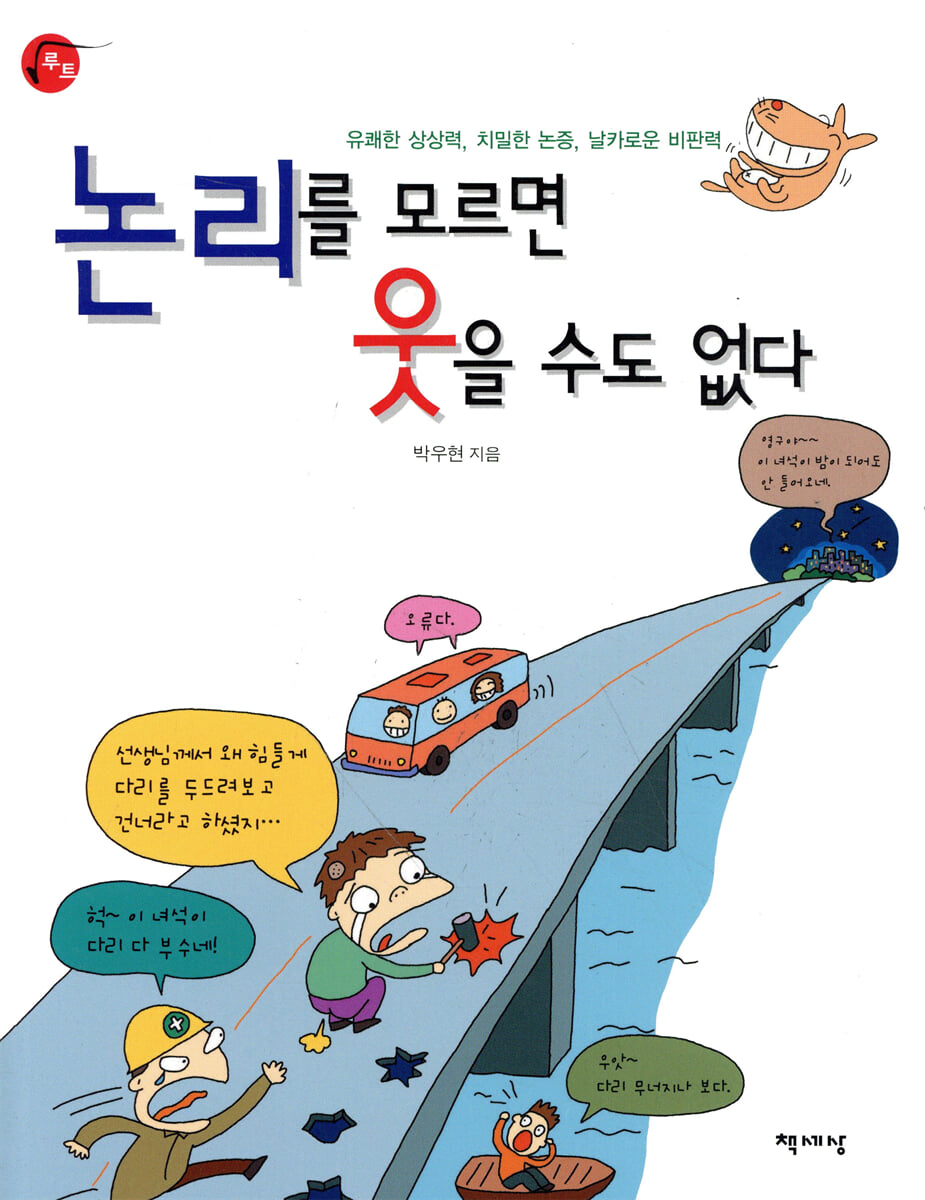
If you don't know the logic, you can't laugh.
 |
Description
Book Introduction
'Easy and fun' logic.
This is a slogan that is always put forth in logic books aimed at teenagers.
If difficult and rigid logic could be easily studied, it would be a welcome change not only for students preparing for essay exams, but also for everyone who is often intimidated by the word logic.
However, the fact that everyone has it as a goal means that it is equally difficult to achieve. Isn't a logic textbook that is both easy and thorough a dream that has yet to be realized?
The book "You Can't Laugh Without Knowing Logic" challenges this challenge by using the device of humor.
In other words, this book naturally presents 'how to read, write, speak, and think accurately' by explaining the basic concepts and principles of logic while analyzing the problems of logic contained in humor.
This book, which combines logic and humor while also providing various information and food for thought through short 'side notes' placed throughout, 'problems to think about and solutions' that clearly review the core of each chapter, and even adds humorous illustrations, satisfies the slogan of easy and fun logic, and can be a successful example of incorporating depth into the content based on the author's experience teaching logic at university for a long time.
This is a slogan that is always put forth in logic books aimed at teenagers.
If difficult and rigid logic could be easily studied, it would be a welcome change not only for students preparing for essay exams, but also for everyone who is often intimidated by the word logic.
However, the fact that everyone has it as a goal means that it is equally difficult to achieve. Isn't a logic textbook that is both easy and thorough a dream that has yet to be realized?
The book "You Can't Laugh Without Knowing Logic" challenges this challenge by using the device of humor.
In other words, this book naturally presents 'how to read, write, speak, and think accurately' by explaining the basic concepts and principles of logic while analyzing the problems of logic contained in humor.
This book, which combines logic and humor while also providing various information and food for thought through short 'side notes' placed throughout, 'problems to think about and solutions' that clearly review the core of each chapter, and even adds humorous illustrations, satisfies the slogan of easy and fun logic, and can be a successful example of incorporating depth into the content based on the author's experience teaching logic at university for a long time.
index
prolog
Part 1: Inference
Chapter 1: Won Bin's Love Letter: The Core of Words and Writing: Relationships
Chapter 2: The Reason Yesul Doesn't Like Hodong - Inference
Chapter 3: Socrates is a dog... ...! - Find the premise and conclusion.
Chapter 4: Hye-gyo and Rain's Love Story - Deduction and Induction
Chapter 5: The Dumb Chicken's Complaint and the Laws of Science: The Pros and Cons of Inductive Reasoning
Chapter 6: What Matters Most Is Unseen: The Pros and Cons of Deductive Reasoning
Chapter 7: Logic is Love - Analogical Reasoning
Chapter 8: If I follow my parents, love will cry, and if I follow love, my parents will cry—a dilemma.
Part 2: Concepts and Definitions
Chapter 9: What People from Jeolla Province and Gyeongsang Province Have in Common: The Concept of Genus and the Concept of Species
Chapter 10: Mother's Animal and Heesu's Animal—Concept
Chapter 11: The Man with Glasses and the Unmarried Man—Distinction and Classification
Chapter 12: Why I'm Bald - Definition 1
Chapter 13: Is a Plucked Chick a Human? - Definition 2
Part 3 Error
Chapter 14: Black-and-white logic and self-contradiction
Chapter 15: If snakes eat each other's tails—Circular reasoning
Chapter 16: The Nature of Humor and Laughter—A Funny Fallacy 1
Chapter 17: Low-Level Gags, High-Level Gags—Funny Errors 2
Epilogue
Part 1: Inference
Chapter 1: Won Bin's Love Letter: The Core of Words and Writing: Relationships
Chapter 2: The Reason Yesul Doesn't Like Hodong - Inference
Chapter 3: Socrates is a dog... ...! - Find the premise and conclusion.
Chapter 4: Hye-gyo and Rain's Love Story - Deduction and Induction
Chapter 5: The Dumb Chicken's Complaint and the Laws of Science: The Pros and Cons of Inductive Reasoning
Chapter 6: What Matters Most Is Unseen: The Pros and Cons of Deductive Reasoning
Chapter 7: Logic is Love - Analogical Reasoning
Chapter 8: If I follow my parents, love will cry, and if I follow love, my parents will cry—a dilemma.
Part 2: Concepts and Definitions
Chapter 9: What People from Jeolla Province and Gyeongsang Province Have in Common: The Concept of Genus and the Concept of Species
Chapter 10: Mother's Animal and Heesu's Animal—Concept
Chapter 11: The Man with Glasses and the Unmarried Man—Distinction and Classification
Chapter 12: Why I'm Bald - Definition 1
Chapter 13: Is a Plucked Chick a Human? - Definition 2
Part 3 Error
Chapter 14: Black-and-white logic and self-contradiction
Chapter 15: If snakes eat each other's tails—Circular reasoning
Chapter 16: The Nature of Humor and Laughter—A Funny Fallacy 1
Chapter 17: Low-Level Gags, High-Level Gags—Funny Errors 2
Epilogue
Publisher's Review
If you know logic, you can see the world clearly.
So why does this book ask us to think logically while listening to humor? Propositions, inferences, axioms, deduction and induction... For those who would rather avoid such thorny logic than for essay exams, and for those who say they don't understand why they should learn logic, this book offers a clear answer.
The purpose of learning logic is to understand and comprehend other people's speech and writing more clearly.
By eliminating errors through logic, we can fully understand each other when we use speech and writing correctly.
Therefore, logic can be said to be a tool for everyday life that not only helps us understand language but also makes our lives and the world more clear and beautiful.
This book presents a clear goal for studying logic, and through humorous humor and anecdotes, it demonstrates that logical argument is the starting point of all discussion and how logic can exert practical power in everyday life.
People who often struggle with communication, who often regret speaking out loud and then dominating the group, who struggle to understand the passages on essay tests or who can't understand why they receive low scores despite their well-written answers... these people will most likely empathize with the necessity of the logic this book discusses.
Understand 'relationships' and eliminate 'errors'
The reason this book chose humor as a material for studying logic is because humor is the most effective tool for revealing the core of logic.
According to the author, the core of logic is relationships, and the objects of logic are sentences made up of relationships between premises and conclusions.
Errors occur when the relationship between sentences is not appropriate, when the relationship between the premise and the conclusion is wrong, and the essence of humor lies in errors.
It is the inherent stupidity, the digression, the faulty basis and the wrong conclusions in humor that make it funny.
So if you understand why humor makes you laugh, you understand the fallacy, you understand the core of the logic.
The author analyzes various errors contained in various humor, but this is not, of course, to question the illogicality of humor.
The goal of this process is to accurately identify errors and achieve the logical goal of error removal and clear understanding.
Examine Why It's Funny - Develops Creative Imagination and Critical Thinking
In this way, humor goes beyond being a source of energy for everyday life and becomes an excellent tool for studying logic.
So the author says to use a lot of humor when talking to other people, and to laugh a lot when you hear funny jokes.
But after laughing out loud, you have to figure out why it was funny.
Because we can laugh properly when we properly recognize the logical errors contained in humor.
Moreover, this analysis helps develop not only logical thinking but also creative imagination and critical thinking skills.
This is because you can develop this ability by training yourself to find the basis for humor and examine its validity.
For example, let's look at the following story.
The Greek Academy was pondering how to define humans, and finally decided that humans are featherless bipeds (animals that walk on two feet).
When the philosopher Diogenes heard this, he caught a chick, plucked out all its feathers, and threw it into the Academy.
Diogenes's actions are a counter-question: 'So, is a chick with no feathers also a human?'
The author uses this story as an example to explain that a definition that is "too broad in its content" like the definition of the Academy is not a correct definition, and that "the meaning of a definition should not change in any way even if the subject and predicate are changed."
In this way, studying logic through humor is a process of discovering the world of intricate logic hidden within the quirky humor, and it is a fun experience where you can encounter the delightful imagination and sharp critical spirit contained within humor.
A useful logic guide for everyone, from middle school students to adults.
This book, which explains logic with various humor and examples, features many characters.
However, if you look closely, you can see that the characters in the story gradually grow from middle school students to adults.
In the first chapter, the protagonist who made us think about the relationship between sentences through an awkward love letter was a middle school student, but in the part explaining deductive and inductive reasoning, a high school student appears, and when explaining concepts and definitions, a man and a woman on a date are used as the subject.
Of course, not all stories follow this structure, but generally, the characters are arranged in this order to allow for the story to progress to higher levels little by little.
Just as the characters in the story grow older and learn the principles of logic one by one, readers also feel the power of logic gradually deepening as they turn the pages.
Beyond the humorous device, this meticulous attention to detail makes this book a useful guide for anyone, from middle school students to adults, in building a foundation in logic.
So why does this book ask us to think logically while listening to humor? Propositions, inferences, axioms, deduction and induction... For those who would rather avoid such thorny logic than for essay exams, and for those who say they don't understand why they should learn logic, this book offers a clear answer.
The purpose of learning logic is to understand and comprehend other people's speech and writing more clearly.
By eliminating errors through logic, we can fully understand each other when we use speech and writing correctly.
Therefore, logic can be said to be a tool for everyday life that not only helps us understand language but also makes our lives and the world more clear and beautiful.
This book presents a clear goal for studying logic, and through humorous humor and anecdotes, it demonstrates that logical argument is the starting point of all discussion and how logic can exert practical power in everyday life.
People who often struggle with communication, who often regret speaking out loud and then dominating the group, who struggle to understand the passages on essay tests or who can't understand why they receive low scores despite their well-written answers... these people will most likely empathize with the necessity of the logic this book discusses.
Understand 'relationships' and eliminate 'errors'
The reason this book chose humor as a material for studying logic is because humor is the most effective tool for revealing the core of logic.
According to the author, the core of logic is relationships, and the objects of logic are sentences made up of relationships between premises and conclusions.
Errors occur when the relationship between sentences is not appropriate, when the relationship between the premise and the conclusion is wrong, and the essence of humor lies in errors.
It is the inherent stupidity, the digression, the faulty basis and the wrong conclusions in humor that make it funny.
So if you understand why humor makes you laugh, you understand the fallacy, you understand the core of the logic.
The author analyzes various errors contained in various humor, but this is not, of course, to question the illogicality of humor.
The goal of this process is to accurately identify errors and achieve the logical goal of error removal and clear understanding.
Examine Why It's Funny - Develops Creative Imagination and Critical Thinking
In this way, humor goes beyond being a source of energy for everyday life and becomes an excellent tool for studying logic.
So the author says to use a lot of humor when talking to other people, and to laugh a lot when you hear funny jokes.
But after laughing out loud, you have to figure out why it was funny.
Because we can laugh properly when we properly recognize the logical errors contained in humor.
Moreover, this analysis helps develop not only logical thinking but also creative imagination and critical thinking skills.
This is because you can develop this ability by training yourself to find the basis for humor and examine its validity.
For example, let's look at the following story.
The Greek Academy was pondering how to define humans, and finally decided that humans are featherless bipeds (animals that walk on two feet).
When the philosopher Diogenes heard this, he caught a chick, plucked out all its feathers, and threw it into the Academy.
Diogenes's actions are a counter-question: 'So, is a chick with no feathers also a human?'
The author uses this story as an example to explain that a definition that is "too broad in its content" like the definition of the Academy is not a correct definition, and that "the meaning of a definition should not change in any way even if the subject and predicate are changed."
In this way, studying logic through humor is a process of discovering the world of intricate logic hidden within the quirky humor, and it is a fun experience where you can encounter the delightful imagination and sharp critical spirit contained within humor.
A useful logic guide for everyone, from middle school students to adults.
This book, which explains logic with various humor and examples, features many characters.
However, if you look closely, you can see that the characters in the story gradually grow from middle school students to adults.
In the first chapter, the protagonist who made us think about the relationship between sentences through an awkward love letter was a middle school student, but in the part explaining deductive and inductive reasoning, a high school student appears, and when explaining concepts and definitions, a man and a woman on a date are used as the subject.
Of course, not all stories follow this structure, but generally, the characters are arranged in this order to allow for the story to progress to higher levels little by little.
Just as the characters in the story grow older and learn the principles of logic one by one, readers also feel the power of logic gradually deepening as they turn the pages.
Beyond the humorous device, this meticulous attention to detail makes this book a useful guide for anyone, from middle school students to adults, in building a foundation in logic.
GOODS SPECIFICS
- Date of issue: November 30, 2004
- Page count, weight, size: 206 pages | 454g | 175*225*20mm
- ISBN13: 9788970134765
- ISBN10: 897013476X
You may also like
카테고리
korean


korean

![GQ KOREA Mark (Monthly): December [2025]](http://librairie.coreenne.fr/cdn/shop/files/8ef265dbbfbf186523ed75ba7319009d.jpg?v=1765340328&width=3840)


