

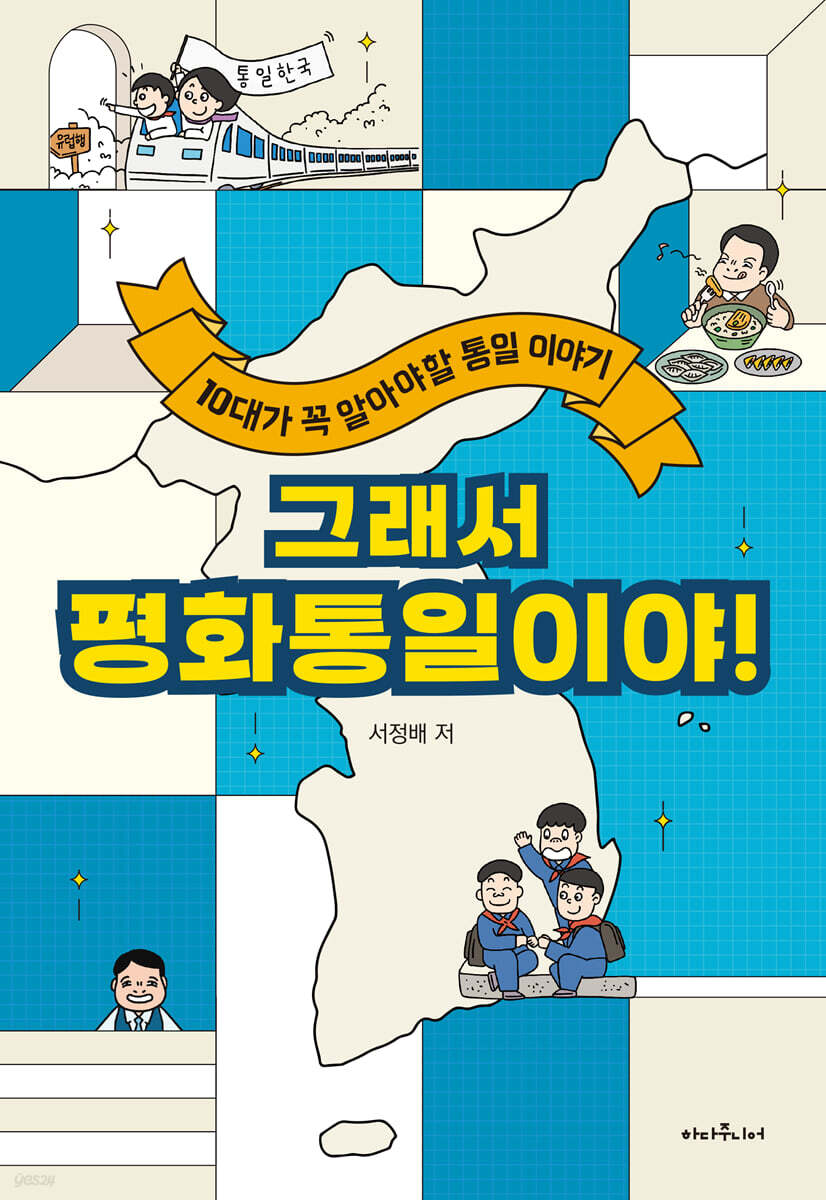
So it's peaceful unification!
 |
Description
Book Introduction
A story of unification for teenagers in a time of crisis on the Korean Peninsula.
Publication of "So, Peaceful Unification!"
As peace on the Korean Peninsula is threatened and the will of young people for unification weakens, a story of peaceful unification has been published for teenagers, the future leaders.
"So, it's Peaceful Unification!" (Hada Junior) consists of 36 engaging stories centered around three themes: the division of the Korean Peninsula, friends in North Korea, and peaceful unification. It helps young people understand the issue of unification easily and naturally.
Publication of "So, Peaceful Unification!"
As peace on the Korean Peninsula is threatened and the will of young people for unification weakens, a story of peaceful unification has been published for teenagers, the future leaders.
"So, it's Peaceful Unification!" (Hada Junior) consists of 36 engaging stories centered around three themes: the division of the Korean Peninsula, friends in North Korea, and peaceful unification. It helps young people understand the issue of unification easily and naturally.
- You can preview some of the book's contents.
Preview
index
On publication
Chapter 1: The Story of the Division of the Korean Peninsula
01.
Why was the Korean Peninsula divided?
02.
Why is true liberation unification?
03.
What were the consequences of the Korean War, a national tragedy?
04.
Is the ceasefire line created by the war different from the 38th parallel?
05.
Why doesn't the pain of division, military confrontation, and scattered people ever end?
06.
Why do we hate and fight each other?
07.
Are South and North Korea one country? Two countries? What is their relationship?
08.
Why does North Korea insist on a "hostile relationship between the two countries"?
09.
What are the lessons of German reunification?
10.
How much dialogue have North and South Korea had?
11.
How did inter-Korean exchanges and cooperation proceed?
12.
What kind of unification do we hope for?
Chapter 2: Stories from North Korean Friends
01.
The two faces of North Korea?
02.
Why on earth is North Korea developing nuclear weapons?
03.
North Korean friends, why should we know?
04.
What can you buy at a market in North Korea?
05.
Do your North Korean friends like tteokbokki too?
06.
Is love marriage possible in North Korea?
07.
Are there idol groups like Red Velvet in North Korea?
08.
What is school life like for your North Korean friends?
09.
What is organizational life and military life like?
10.
What do you do during vacations and holidays?
11.
Do your friends in North Korea also use the Internet and cell phones?
12.
What do our North Korean friends think of us?
Chapter 3: The Story of Peaceful Unification
01.
Is the Korean Peninsula truly peaceful now?
02.
Is it possible to create a 'nuclear-weapon-free Korean Peninsula'?
03.
Can we move beyond hatred and conflict toward reconciliation and peace?
04.
Let's imagine a future of a happy, unified Korea.
05.
Is it okay to oppose unification?
06.
Still, is unification our wish? Will the benefits outweigh the costs?
07.
Separated families need to meet more often, and human rights in North Korea need to improve!
08.
'Unification Comes First', Together with North Korean Defectors!
09.
Let's increase dialogue and cooperation!
10.
The Korean Peninsula, become a beacon of world peace!
11.
Let's talk about 'peaceful unification' at school and at home!
12.
The protagonist of peaceful unification is me!
Chapter 1: The Story of the Division of the Korean Peninsula
01.
Why was the Korean Peninsula divided?
02.
Why is true liberation unification?
03.
What were the consequences of the Korean War, a national tragedy?
04.
Is the ceasefire line created by the war different from the 38th parallel?
05.
Why doesn't the pain of division, military confrontation, and scattered people ever end?
06.
Why do we hate and fight each other?
07.
Are South and North Korea one country? Two countries? What is their relationship?
08.
Why does North Korea insist on a "hostile relationship between the two countries"?
09.
What are the lessons of German reunification?
10.
How much dialogue have North and South Korea had?
11.
How did inter-Korean exchanges and cooperation proceed?
12.
What kind of unification do we hope for?
Chapter 2: Stories from North Korean Friends
01.
The two faces of North Korea?
02.
Why on earth is North Korea developing nuclear weapons?
03.
North Korean friends, why should we know?
04.
What can you buy at a market in North Korea?
05.
Do your North Korean friends like tteokbokki too?
06.
Is love marriage possible in North Korea?
07.
Are there idol groups like Red Velvet in North Korea?
08.
What is school life like for your North Korean friends?
09.
What is organizational life and military life like?
10.
What do you do during vacations and holidays?
11.
Do your friends in North Korea also use the Internet and cell phones?
12.
What do our North Korean friends think of us?
Chapter 3: The Story of Peaceful Unification
01.
Is the Korean Peninsula truly peaceful now?
02.
Is it possible to create a 'nuclear-weapon-free Korean Peninsula'?
03.
Can we move beyond hatred and conflict toward reconciliation and peace?
04.
Let's imagine a future of a happy, unified Korea.
05.
Is it okay to oppose unification?
06.
Still, is unification our wish? Will the benefits outweigh the costs?
07.
Separated families need to meet more often, and human rights in North Korea need to improve!
08.
'Unification Comes First', Together with North Korean Defectors!
09.
Let's increase dialogue and cooperation!
10.
The Korean Peninsula, become a beacon of world peace!
11.
Let's talk about 'peaceful unification' at school and at home!
12.
The protagonist of peaceful unification is me!
Into the book
The Korean Peninsula is still in a state of armistice, a temporary halt to the war.
We live in fear that war could break out again at any time.
The Korean Peninsula, including the area near the Military Demarcation Line, has become the place with the largest concentration of military forces in the world.
The DMZ and its surroundings are littered with landmines, and heavily armed soldiers are firing at each other.
In particular, the maritime border in the West Sea is not fixed, so there remains a risk that unexpected conflicts could occur at any time.
North Korea's military threats, including nuclear weapons and missiles, continue to grow.
---p.30
Even in unified Germany, there were difficulties at first.
West Germans and East Germans would fight, teasing each other by calling each other "Ossi" (meaning lazy) and "Bessi" (meaning show-off).
But now, 30 years later, we understand each other better, and there's less discrimination based on where we're from.
In fact, in the 2010s, people who grew up in East Germany became the president and chancellor of Germany.
---p.46
What has the relationship between South and North Korea been like so far? As of 2024, the two Koreas have met and discussed a staggering 667 times, supporting and interacting with each other in various ways.
---p.48
Just because we become one 'again' doesn't mean we have to go back to the way we were before.
South and North Korea will become one again based on liberal democracy and a market economy.
We can say that it is 'unification' in which all people living on the Korean Peninsula in the future create a new community together.
(Page 56)
North Korea's market is a little different from ours.
It's rare to see families like ours going together to see things and have snacks.
It's mostly older women who sell things, and mothers who come to buy things.
It is difficult for men to do business in the market because they have to go to a fixed job.
In addition to the people selling goods, there are also 'grasshopper vendors' who wander around selling goods, people who deliver goods, and people who manage the market.
---p.70
North Korean young people have to go to the military for a long time after graduating from high school.
Men serve in the military for nearly 10 years, and women serve in the military for about 7 years.
So, there are fewer opportunities to date.
Still, young people can't hide their feelings for each other, right? They say that when you like someone, the man usually approaches first and says, "Let's be friends!" (meaning, "Let's date!"), and that's when the relationship begins.
---p.78
North Korea also makes YouTube videos and shows them to people in other countries.
In 2019, a North Korean woman named Eun-ah introduced Pyongyang in English on a channel called Echo of DPRK.
Since then, other North Korean friends like 'Yumi' and 'Songmi' have also created vlogs showing daily life in North Korea in English or Chinese.
---p.98
Above all, we need to escape the current situation where we live like an “island nation that is not an island” in the southern part of the Korean Peninsula, which has been cut off at the waist.
We used to live on a peninsula surrounded by the sea on three sides and connected to the continent to the north, but now the middle of the Korean Peninsula is divided.
When unification happens, we will be able to travel by train, car, or bicycle across the vast plains of Manchuria in China and Siberia in Russia.
---p.117
It is also true that unification requires money.
This is called the 'cost of unification', and it refers to all the costs involved in preparing for and achieving unification, as well as in unifying the economy and society thereafter.
However, this cost can vary greatly depending on the method and timing of unification.
If North Korea suddenly falls into chaos or unifies suddenly like Germany, it will cost a lot of money.
However, if we live in peace for a long time, interact with each other, and prepare for unification step by step, we can reduce the cost significantly.
We live in fear that war could break out again at any time.
The Korean Peninsula, including the area near the Military Demarcation Line, has become the place with the largest concentration of military forces in the world.
The DMZ and its surroundings are littered with landmines, and heavily armed soldiers are firing at each other.
In particular, the maritime border in the West Sea is not fixed, so there remains a risk that unexpected conflicts could occur at any time.
North Korea's military threats, including nuclear weapons and missiles, continue to grow.
---p.30
Even in unified Germany, there were difficulties at first.
West Germans and East Germans would fight, teasing each other by calling each other "Ossi" (meaning lazy) and "Bessi" (meaning show-off).
But now, 30 years later, we understand each other better, and there's less discrimination based on where we're from.
In fact, in the 2010s, people who grew up in East Germany became the president and chancellor of Germany.
---p.46
What has the relationship between South and North Korea been like so far? As of 2024, the two Koreas have met and discussed a staggering 667 times, supporting and interacting with each other in various ways.
---p.48
Just because we become one 'again' doesn't mean we have to go back to the way we were before.
South and North Korea will become one again based on liberal democracy and a market economy.
We can say that it is 'unification' in which all people living on the Korean Peninsula in the future create a new community together.
(Page 56)
North Korea's market is a little different from ours.
It's rare to see families like ours going together to see things and have snacks.
It's mostly older women who sell things, and mothers who come to buy things.
It is difficult for men to do business in the market because they have to go to a fixed job.
In addition to the people selling goods, there are also 'grasshopper vendors' who wander around selling goods, people who deliver goods, and people who manage the market.
---p.70
North Korean young people have to go to the military for a long time after graduating from high school.
Men serve in the military for nearly 10 years, and women serve in the military for about 7 years.
So, there are fewer opportunities to date.
Still, young people can't hide their feelings for each other, right? They say that when you like someone, the man usually approaches first and says, "Let's be friends!" (meaning, "Let's date!"), and that's when the relationship begins.
---p.78
North Korea also makes YouTube videos and shows them to people in other countries.
In 2019, a North Korean woman named Eun-ah introduced Pyongyang in English on a channel called Echo of DPRK.
Since then, other North Korean friends like 'Yumi' and 'Songmi' have also created vlogs showing daily life in North Korea in English or Chinese.
---p.98
Above all, we need to escape the current situation where we live like an “island nation that is not an island” in the southern part of the Korean Peninsula, which has been cut off at the waist.
We used to live on a peninsula surrounded by the sea on three sides and connected to the continent to the north, but now the middle of the Korean Peninsula is divided.
When unification happens, we will be able to travel by train, car, or bicycle across the vast plains of Manchuria in China and Siberia in Russia.
---p.117
It is also true that unification requires money.
This is called the 'cost of unification', and it refers to all the costs involved in preparing for and achieving unification, as well as in unifying the economy and society thereafter.
However, this cost can vary greatly depending on the method and timing of unification.
If North Korea suddenly falls into chaos or unifies suddenly like Germany, it will cost a lot of money.
However, if we live in peace for a long time, interact with each other, and prepare for unification step by step, we can reduce the cost significantly.
---p.126
Publisher's Review
(The Korean Peninsula in Crisis) A Story of Unification for Teenagers
Publication of "So, Peaceful Unification!"
As peace on the Korean Peninsula is threatened and the will of young people for unification weakens, a story of peaceful unification has been published for teenagers, the future leaders.
"So, it's Peaceful Unification!" (Hada Junior) consists of 36 engaging stories centered around three themes: the division of the Korean Peninsula, friends in North Korea, and peaceful unification. It helps young people understand the issue of unification easily and naturally.
The author is Dr. Seo Jeong-bae, who has personally experienced changes in inter-Korean relations at the Ministry of Unification for 32 years.
He has worked at the forefront of inter-Korean exchange and conflict, serving as the Director of the Education Planning Department of the Ministry of Unification, Director of the Humanitarian Cooperation Bureau, Director of the Planning and Coordination Office, and Director of Hana One.
Having recently earned a Ph.D. in North Korean Studies, he wrote this book to share vivid insights about peaceful unification of the Korean Peninsula with teenagers, drawing on his extensive field experience.
According to a recent survey released by the National Institute for Unification Education, the percentage of young people who responded that “unification is necessary” has decreased to 47.6%, and the percentage who view North Korea as an object of “wariness and hostility” has reached an all-time high of 63.2%.
The reasons given for why ‘unification is not necessary’ included ‘social chaos after unification,’ ‘economic burden,’ and ‘aversion to North Korea’s military provocations.’
This does not mean that young people are indifferent to unification, but rather that they lack opportunities to discuss and think about peace and unification issues together in school and society.
"So, Peaceful Unification!" is an attempt to make young people perceive unification not as a distant and unfamiliar topic, but as a realistic issue connected to their future, based on this awareness of the problem.
Dr. Seo said, “The unification of the Korean Peninsula, which will occur in the future, will be the greatest historical event for the younger generation,” and emphasized, “Today’s youth must actively participate in creating a peaceful and prosperous Korean Peninsula.”
Eighty years after liberation and division, the Korean Peninsula still bears the scars of war and hatred.
North Korea has declared that it will no longer consider South Korea a potential candidate for reunification, asserting that the two countries maintain a hostile relationship, and military tensions and mutual distrust are growing.
However, the author emphasizes that “we must not lose hope.”
“The South and the North must continuously discuss ways to meet, reconcile, and prosper together in peace. If we continue these discussions and put them into practice over the next decade, 2045 could be the 100th anniversary of true liberation, not the 100th anniversary of division,” he said.
This book presents unification not as a vague political ideal, but as a realistic issue that determines the future of young people.
Rather than dividing the pros and cons of unification, we should ask why we should consider unification and how we can prepare for and imagine it.
It warmly and powerfully conveys the message that the free and creative thoughts and actions of young people can change the future of the Korean Peninsula.
Every year, May's Unification Education Week and June's Patriots and Veterans Month are important times to think about the future of the Korean Peninsula.
This book will provide a good opportunity to discuss peace and unification with family and school friends.
This book is expected to be a small but powerful first step for the teenagers who will open the future of the Korean Peninsula.
Publication of "So, Peaceful Unification!"
As peace on the Korean Peninsula is threatened and the will of young people for unification weakens, a story of peaceful unification has been published for teenagers, the future leaders.
"So, it's Peaceful Unification!" (Hada Junior) consists of 36 engaging stories centered around three themes: the division of the Korean Peninsula, friends in North Korea, and peaceful unification. It helps young people understand the issue of unification easily and naturally.
The author is Dr. Seo Jeong-bae, who has personally experienced changes in inter-Korean relations at the Ministry of Unification for 32 years.
He has worked at the forefront of inter-Korean exchange and conflict, serving as the Director of the Education Planning Department of the Ministry of Unification, Director of the Humanitarian Cooperation Bureau, Director of the Planning and Coordination Office, and Director of Hana One.
Having recently earned a Ph.D. in North Korean Studies, he wrote this book to share vivid insights about peaceful unification of the Korean Peninsula with teenagers, drawing on his extensive field experience.
According to a recent survey released by the National Institute for Unification Education, the percentage of young people who responded that “unification is necessary” has decreased to 47.6%, and the percentage who view North Korea as an object of “wariness and hostility” has reached an all-time high of 63.2%.
The reasons given for why ‘unification is not necessary’ included ‘social chaos after unification,’ ‘economic burden,’ and ‘aversion to North Korea’s military provocations.’
This does not mean that young people are indifferent to unification, but rather that they lack opportunities to discuss and think about peace and unification issues together in school and society.
"So, Peaceful Unification!" is an attempt to make young people perceive unification not as a distant and unfamiliar topic, but as a realistic issue connected to their future, based on this awareness of the problem.
Dr. Seo said, “The unification of the Korean Peninsula, which will occur in the future, will be the greatest historical event for the younger generation,” and emphasized, “Today’s youth must actively participate in creating a peaceful and prosperous Korean Peninsula.”
Eighty years after liberation and division, the Korean Peninsula still bears the scars of war and hatred.
North Korea has declared that it will no longer consider South Korea a potential candidate for reunification, asserting that the two countries maintain a hostile relationship, and military tensions and mutual distrust are growing.
However, the author emphasizes that “we must not lose hope.”
“The South and the North must continuously discuss ways to meet, reconcile, and prosper together in peace. If we continue these discussions and put them into practice over the next decade, 2045 could be the 100th anniversary of true liberation, not the 100th anniversary of division,” he said.
This book presents unification not as a vague political ideal, but as a realistic issue that determines the future of young people.
Rather than dividing the pros and cons of unification, we should ask why we should consider unification and how we can prepare for and imagine it.
It warmly and powerfully conveys the message that the free and creative thoughts and actions of young people can change the future of the Korean Peninsula.
Every year, May's Unification Education Week and June's Patriots and Veterans Month are important times to think about the future of the Korean Peninsula.
This book will provide a good opportunity to discuss peace and unification with family and school friends.
This book is expected to be a small but powerful first step for the teenagers who will open the future of the Korean Peninsula.
[Recommendation]
“I had no great difficulty reading and understanding it, and more than anything, after reading the book, I became interested in unification and the history of the Korean Peninsula.
The stories related to unification were interesting, and since there are 'thought sharing' sections here and there, I think it would be good to read with friends.
I think this is a really great book that gets elementary school students like me interested in unification.
“That’s great!”
Choi Seo-hyung, 6th grade, Pureunsaem Elementary School, Yangju-si
“I had no interest in North Korea and didn’t know much about it, but after reading this book, I learned a lot about the lives and culture of North Korean people.
It also made me think again about why we need unification and how we should work to achieve it.”
-Won Rubin, 6th grade, Bucheon Soan Elementary School
"There wasn't anything particularly difficult. I originally had no interest in unification, and I wondered if it was even worth it. But after reading this book, I've come to understand North Korea better and my thoughts have changed.
“I think that if unification happens soon and North and South Korea become one, many better things will happen!”
-An Seo-jeong, first year student at Haenuri Middle School
“I saw on TV a while ago a North Korean prisoner of war, Hyung-ah, who was captured in Ukraine.
"That brother, with his familiar face, who seems like someone I've seen in my neighborhood, speaking the same language as us, is he a stranger to us? Or is he a compatriot with whom I can share our joys and sorrows? I've always thought that unification with North Korea would be undesirable, and that South Korea and North Korea were distinct countries. But after reading this book, I realized we're actually halves of a circle."
-Oh Yoon, 1st year student at Myeongil Middle School [Recommendation]
“I had no great difficulty reading and understanding it, and more than anything, after reading the book, I became interested in unification and the history of the Korean Peninsula.
The stories related to unification were interesting, and since there are 'thought sharing' sections here and there, I think it would be good to read with friends.
I think this is a really great book that gets elementary school students like me interested in unification.
“That’s great!”
Choi Seo-hyung, 6th grade, Pureunsaem Elementary School, Yangju-si
“I had no interest in North Korea and didn’t know much about it, but after reading this book, I learned a lot about the lives and culture of North Korean people.
It also made me think again about why we need unification and how we should work to achieve it.”
-Won Rubin, 6th grade, Bucheon Soan Elementary School
"There wasn't anything particularly difficult. I originally had no interest in unification, and I wondered if it was even worth it. But after reading this book, I've come to understand North Korea better and my thoughts have changed.
“I think that if unification happens soon and North and South Korea become one, many better things will happen!”
-An Seo-jeong, first year student at Haenuri Middle School
“I saw on TV a while ago a North Korean prisoner of war, Hyung-ah, who was captured in Ukraine.
"That brother, with his familiar face, who seems like someone I've seen in my neighborhood, speaking the same language as us, is he a stranger to us? Or is he a compatriot with whom I can share our joys and sorrows? I've always thought that unification with North Korea would be undesirable, and that South Korea and North Korea were distinct countries. But after reading this book, I realized we're actually halves of a circle."
-Oh Yoon, first year student at Myeongil Middle School
“I had no great difficulty reading and understanding it, and more than anything, after reading the book, I became interested in unification and the history of the Korean Peninsula.
The stories related to unification were interesting, and since there are 'thought sharing' sections here and there, I think it would be good to read with friends.
I think this is a really great book that gets elementary school students like me interested in unification.
“That’s great!”
Choi Seo-hyung, 6th grade, Pureunsaem Elementary School, Yangju-si
“I had no interest in North Korea and didn’t know much about it, but after reading this book, I learned a lot about the lives and culture of North Korean people.
It also made me think again about why we need unification and how we should work to achieve it.”
-Won Rubin, 6th grade, Bucheon Soan Elementary School
"There wasn't anything particularly difficult. I originally had no interest in unification, and I wondered if it was even worth it. But after reading this book, I've come to understand North Korea better and my thoughts have changed.
“I think that if unification happens soon and North and South Korea become one, many better things will happen!”
-An Seo-jeong, first year student at Haenuri Middle School
“I saw on TV a while ago a North Korean prisoner of war, Hyung-ah, who was captured in Ukraine.
"That brother, with his familiar face, who seems like someone I've seen in my neighborhood, speaking the same language as us, is he a stranger to us? Or is he a compatriot with whom I can share our joys and sorrows? I've always thought that unification with North Korea would be undesirable, and that South Korea and North Korea were distinct countries. But after reading this book, I realized we're actually halves of a circle."
-Oh Yoon, 1st year student at Myeongil Middle School [Recommendation]
“I had no great difficulty reading and understanding it, and more than anything, after reading the book, I became interested in unification and the history of the Korean Peninsula.
The stories related to unification were interesting, and since there are 'thought sharing' sections here and there, I think it would be good to read with friends.
I think this is a really great book that gets elementary school students like me interested in unification.
“That’s great!”
Choi Seo-hyung, 6th grade, Pureunsaem Elementary School, Yangju-si
“I had no interest in North Korea and didn’t know much about it, but after reading this book, I learned a lot about the lives and culture of North Korean people.
It also made me think again about why we need unification and how we should work to achieve it.”
-Won Rubin, 6th grade, Bucheon Soan Elementary School
"There wasn't anything particularly difficult. I originally had no interest in unification, and I wondered if it was even worth it. But after reading this book, I've come to understand North Korea better and my thoughts have changed.
“I think that if unification happens soon and North and South Korea become one, many better things will happen!”
-An Seo-jeong, first year student at Haenuri Middle School
“I saw on TV a while ago a North Korean prisoner of war, Hyung-ah, who was captured in Ukraine.
"That brother, with his familiar face, who seems like someone I've seen in my neighborhood, speaking the same language as us, is he a stranger to us? Or is he a compatriot with whom I can share our joys and sorrows? I've always thought that unification with North Korea would be undesirable, and that South Korea and North Korea were distinct countries. But after reading this book, I realized we're actually halves of a circle."
-Oh Yoon, first year student at Myeongil Middle School
GOODS SPECIFICS
- Date of issue: April 23, 2025
- Page count, weight, size: 150 pages | 150*220*20mm
- ISBN13: 9788997170753
- ISBN10: 8997170759
- KC Certification: Certification Type: Conformity Confirmation
You may also like
카테고리
korean


korean

![GQ KOREA Mark (Monthly): December [2025]](http://librairie.coreenne.fr/cdn/shop/files/8ef265dbbfbf186523ed75ba7319009d.jpg?v=1765340328&width=3840)


