

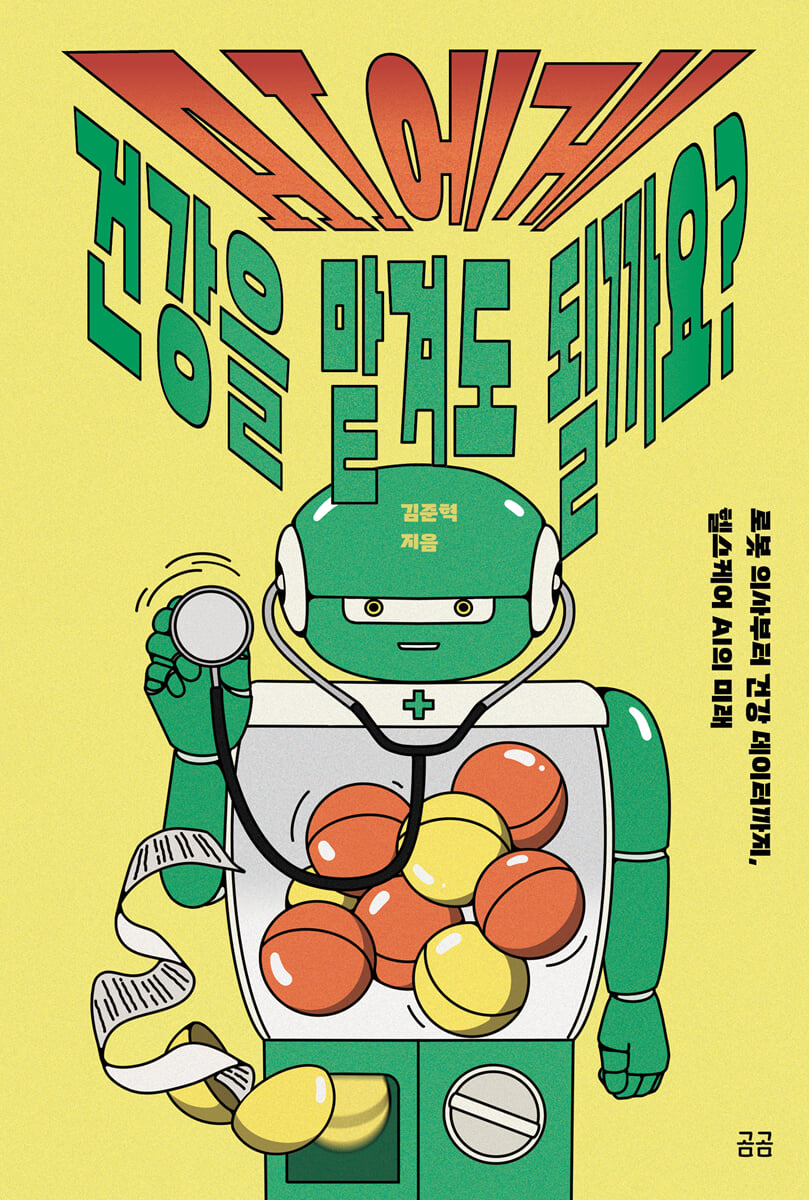
Should we trust AI with our health?
 |
Description
Book Introduction
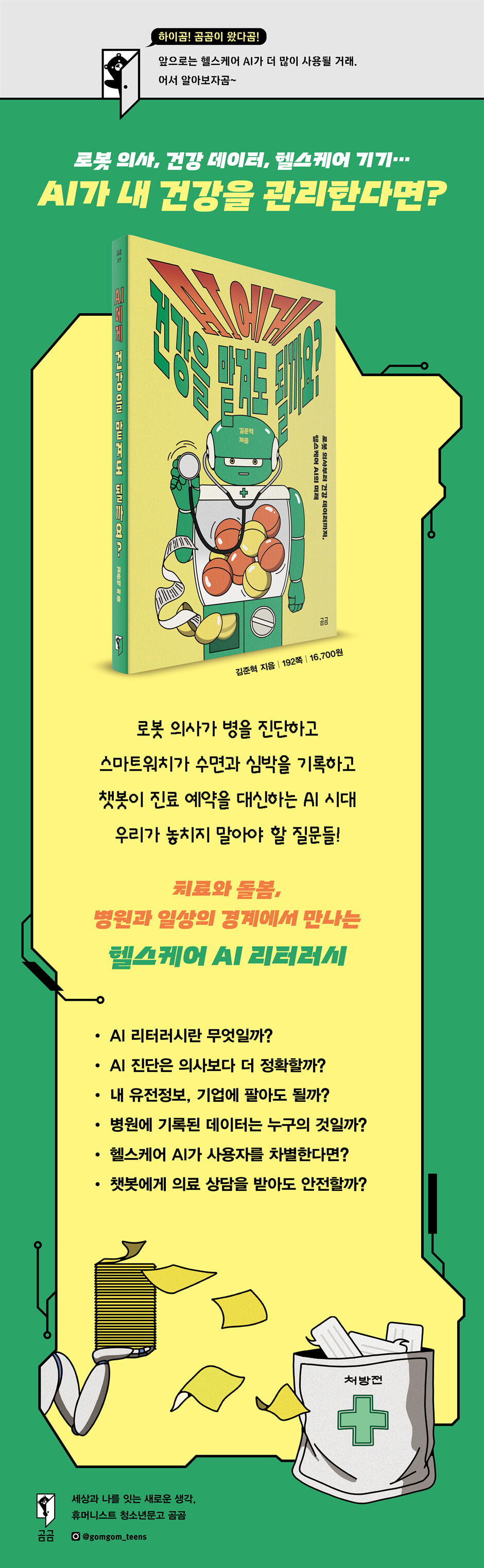
What if AI managed my health?
Robot doctors, health data, healthcare devices...
Essential Literacy in the AI Era from a Medical Ethicist
AI is now beginning to assist or replace human tasks in many areas. In healthcare, a field leading the way in AI adoption, healthcare devices and software are already managing daily health, not just in hospitals.
The range is expanding, from smartwatches that track and monitor heart rate and sleep rhythms to conversational AI that interprets medical information and the ingredients of prescription medications.
An era where AI diagnoses and manages my health.
Is it safe to trust AI with our health? Are we fully prepared to use AI without adverse side effects? Medical ethicist Kim Jun-hyeok revisits the topic of "health" amidst the rapidly permeating AI technology and discourse in our daily lives.
"Should We Entrust Our Health to AI?" is a book that explores the changing medical landscape due to AI from the perspective of young people.
It addresses key questions that influence career choices, such as "Will AI replace human doctors?", as well as the opportunities, limitations, and ethical challenges created by healthcare AI.
How are the technologies and data surrounding our health evolving? How can we ensure the fairness of health data and the rights of patients and healthcare professionals? Let's delve into the fundamentals of healthcare AI literacy, which protects citizens' health and rights.
Robot doctors, health data, healthcare devices...
Essential Literacy in the AI Era from a Medical Ethicist
AI is now beginning to assist or replace human tasks in many areas. In healthcare, a field leading the way in AI adoption, healthcare devices and software are already managing daily health, not just in hospitals.
The range is expanding, from smartwatches that track and monitor heart rate and sleep rhythms to conversational AI that interprets medical information and the ingredients of prescription medications.
An era where AI diagnoses and manages my health.
Is it safe to trust AI with our health? Are we fully prepared to use AI without adverse side effects? Medical ethicist Kim Jun-hyeok revisits the topic of "health" amidst the rapidly permeating AI technology and discourse in our daily lives.
"Should We Entrust Our Health to AI?" is a book that explores the changing medical landscape due to AI from the perspective of young people.
It addresses key questions that influence career choices, such as "Will AI replace human doctors?", as well as the opportunities, limitations, and ethical challenges created by healthcare AI.
How are the technologies and data surrounding our health evolving? How can we ensure the fairness of health data and the rights of patients and healthcare professionals? Let's delve into the fundamentals of healthcare AI literacy, which protects citizens' health and rights.
- You can preview some of the book's contents.
Preview
index
Preface: We Need a New Literacy
1.
What is Healthcare AI?
2.
Where is healthcare AI used?
3.
Will doctors and nurses be replaced by AI?
4.
Healthcare AI: How Can It Help Me Outside the Hospital?
5. Do you have a skill called AI literacy?
6.
Is it okay to sell genetic information?
7.
Whose hospital information is this?
8.
Can I ask ChatGPT some medical knowledge?
9.
There's a phenomenon called the 'AI black box'?
10.
What if healthcare AI discriminates against me?
11.
We too have the right to develop and utilize healthcare AI!
12. A world without AI literacy
References
1.
What is Healthcare AI?
2.
Where is healthcare AI used?
3.
Will doctors and nurses be replaced by AI?
4.
Healthcare AI: How Can It Help Me Outside the Hospital?
5. Do you have a skill called AI literacy?
6.
Is it okay to sell genetic information?
7.
Whose hospital information is this?
8.
Can I ask ChatGPT some medical knowledge?
9.
There's a phenomenon called the 'AI black box'?
10.
What if healthcare AI discriminates against me?
11.
We too have the right to develop and utilize healthcare AI!
12. A world without AI literacy
References
Detailed image
Into the book
AI is very closely related to our lives.
Even a moment's thought brings to mind a series of questions:
"Should I choose AI-based services at the hospital when I'm sick?" "When moving, should I choose a home where AI systems can be installed (or where they already exist)?" "What about my car? What about school?"... These choices clearly have a significant impact on maintaining a healthy daily life.
So, whether we like it or not, we have to make choices about these questions.
Here and now, we're going to think together about healthcare AI.
To make better choices, to enjoy health with the help of technology, and to not be led around by such technology.
--- Main text「2.
Where is healthcare AI used?
Do we really want to be treated by AI doctors instead of human doctors? This question is, in fact, the core of this book, which explores healthcare AI.
Most people wonder what and how much science and technology will make possible today.
In other words, we are looking at healthcare AI from the perspective of a 'technology provider.'
But when it comes to medicine, questions from that perspective are actually secondary.
More importantly, do we need the technology and what does it mean to us?
We need to think about healthcare AI from the perspective of a “technology user,” not a “technology provider.”
Before applying this to specific cases, let's first ask a question in the medical field: Do we need AI robot doctors?
--- Main text「3.
Will doctors and nurses be replaced by AI?
The important thing here is to distinguish between “creating data” and “having rights to data.”
Facts themselves, such as blood test results or diagnoses, are generally not copyrightable.
On the other hand, a database that a hospital collects data and builds in a specific format may have certain rights attached to it.
That doesn't mean that those rights can erase a patient's right to control.
Conversely, patient control should not completely override the hospital's obligations to keep records or the safety of medical care.
Ultimately, the key is to clearly define and manage who accesses and uses it, for what purpose, to what extent, and on what basis.
Even a moment's thought brings to mind a series of questions:
"Should I choose AI-based services at the hospital when I'm sick?" "When moving, should I choose a home where AI systems can be installed (or where they already exist)?" "What about my car? What about school?"... These choices clearly have a significant impact on maintaining a healthy daily life.
So, whether we like it or not, we have to make choices about these questions.
Here and now, we're going to think together about healthcare AI.
To make better choices, to enjoy health with the help of technology, and to not be led around by such technology.
--- Main text「2.
Where is healthcare AI used?
Do we really want to be treated by AI doctors instead of human doctors? This question is, in fact, the core of this book, which explores healthcare AI.
Most people wonder what and how much science and technology will make possible today.
In other words, we are looking at healthcare AI from the perspective of a 'technology provider.'
But when it comes to medicine, questions from that perspective are actually secondary.
More importantly, do we need the technology and what does it mean to us?
We need to think about healthcare AI from the perspective of a “technology user,” not a “technology provider.”
Before applying this to specific cases, let's first ask a question in the medical field: Do we need AI robot doctors?
--- Main text「3.
Will doctors and nurses be replaced by AI?
The important thing here is to distinguish between “creating data” and “having rights to data.”
Facts themselves, such as blood test results or diagnoses, are generally not copyrightable.
On the other hand, a database that a hospital collects data and builds in a specific format may have certain rights attached to it.
That doesn't mean that those rights can erase a patient's right to control.
Conversely, patient control should not completely override the hospital's obligations to keep records or the safety of medical care.
Ultimately, the key is to clearly define and manage who accesses and uses it, for what purpose, to what extent, and on what basis.
--- Main text「7.
From "Whose hospital information is this?"
From "Whose hospital information is this?"
Publisher's Review
Into the hospital and everyday landscape transformed by AI
The future of medicine opens at the boundaries of diagnosis, treatment, and care.
Healthcare AI with Rich Case Studies
Diagnosis and treatment, which were previously only available in hospitals, have expanded into everyday life with the advent of healthcare AI.
AI is beginning to intervene more directly in our lives without any reasonable regulations or controls in place.
The author highlights the various conflicts, dilemmas, and uncertainties that can arise when machine learning meets human judgment in the medical field, where there are no right answers.
To address these issues, this book presents concrete, realistic examples rather than listing difficult medical terms or engineering concepts, making it easier for readers to understand the relationship between AI and health.
For example, it vividly depicts real-life scenes of healthcare AI in action, including a wealth of virtual cases, such as Taeyoon, a middle school student receiving acne counseling from an AI chatbot, and Insu, a disabled person receiving support for daily life with smart devices.
These cases go beyond simple technical demonstrations; they raise questions that connect to our own lives, such as, "Should I choose AI-enabled services at a hospital when I'm sick?" or "Should I look for a home that can accommodate AI systems when I move?"
Following the author's thoughtful perspective, readers can easily empathize with and carefully consider the somewhat unfamiliar issues at the intersection of technology, ethics, and society as "their own story."
What began as a simple question has led to a discussion that touches on a variety of topics, encompassing philosophy and ethics, such as how trustworthy AI's judgment can be, who should be held accountable for errors, and how to ensure fairness.
The book is organically woven with experiments and historical contexts that support its arguments, making it ideal for reading and discussing with youth and citizens, or for use in essay writing classes.
Beyond medicine, for us living in the technological age
- AI Era Technology Ethics for Biomedical Engineering Aspirants
- Critical thinking skills to protect my health
AI is efficient, but healthcare isn't just about efficiency.
"Should We Trust AI with Our Health?" illustrates both the risks and the possibilities of AI-driven "probability-based medicine." AI learns vast amounts of data to make diagnoses, but the meaning of those probabilities differs from the clinical judgments of medical professionals. As AI expands beyond hospitals into our daily lives and personal smart devices, a societal consensus is needed to ensure the technology operates fairly and safely.
For the generation that will have to live with AI, it is crucial to develop a critical understanding of technology and the ability to make independent decisions.
"Should We Entrust Our Health to AI?" is a youth education book that ponders the "coexistence of technology and humans" at the forefront of AI and medicine.
The author emphasizes that “the right to utilize AI is not exclusive to experts,” and that everyone must understand the operating principles and ethical standards of healthcare AI.
The "AI literacy" proposed in this book goes beyond simple technological understanding; it is civic education for sound judgment and responsible choices.
This book will serve as an essential starting point for young people aspiring to pursue careers in medicine or engineering, as well as for readers seeking to understand the relationship between AI and medicine.
The future of medicine opens at the boundaries of diagnosis, treatment, and care.
Healthcare AI with Rich Case Studies
Diagnosis and treatment, which were previously only available in hospitals, have expanded into everyday life with the advent of healthcare AI.
AI is beginning to intervene more directly in our lives without any reasonable regulations or controls in place.
The author highlights the various conflicts, dilemmas, and uncertainties that can arise when machine learning meets human judgment in the medical field, where there are no right answers.
To address these issues, this book presents concrete, realistic examples rather than listing difficult medical terms or engineering concepts, making it easier for readers to understand the relationship between AI and health.
For example, it vividly depicts real-life scenes of healthcare AI in action, including a wealth of virtual cases, such as Taeyoon, a middle school student receiving acne counseling from an AI chatbot, and Insu, a disabled person receiving support for daily life with smart devices.
These cases go beyond simple technical demonstrations; they raise questions that connect to our own lives, such as, "Should I choose AI-enabled services at a hospital when I'm sick?" or "Should I look for a home that can accommodate AI systems when I move?"
Following the author's thoughtful perspective, readers can easily empathize with and carefully consider the somewhat unfamiliar issues at the intersection of technology, ethics, and society as "their own story."
What began as a simple question has led to a discussion that touches on a variety of topics, encompassing philosophy and ethics, such as how trustworthy AI's judgment can be, who should be held accountable for errors, and how to ensure fairness.
The book is organically woven with experiments and historical contexts that support its arguments, making it ideal for reading and discussing with youth and citizens, or for use in essay writing classes.
Beyond medicine, for us living in the technological age
- AI Era Technology Ethics for Biomedical Engineering Aspirants
- Critical thinking skills to protect my health
AI is efficient, but healthcare isn't just about efficiency.
"Should We Trust AI with Our Health?" illustrates both the risks and the possibilities of AI-driven "probability-based medicine." AI learns vast amounts of data to make diagnoses, but the meaning of those probabilities differs from the clinical judgments of medical professionals. As AI expands beyond hospitals into our daily lives and personal smart devices, a societal consensus is needed to ensure the technology operates fairly and safely.
For the generation that will have to live with AI, it is crucial to develop a critical understanding of technology and the ability to make independent decisions.
"Should We Entrust Our Health to AI?" is a youth education book that ponders the "coexistence of technology and humans" at the forefront of AI and medicine.
The author emphasizes that “the right to utilize AI is not exclusive to experts,” and that everyone must understand the operating principles and ethical standards of healthcare AI.
The "AI literacy" proposed in this book goes beyond simple technological understanding; it is civic education for sound judgment and responsible choices.
This book will serve as an essential starting point for young people aspiring to pursue careers in medicine or engineering, as well as for readers seeking to understand the relationship between AI and medicine.
GOODS SPECIFICS
- Date of issue: November 17, 2025
- Page count, weight, size: 192 pages | 135*200*20mm
- ISBN13: 9791170873952
- ISBN10: 1170873952
You may also like
카테고리
korean


korean

![GQ KOREA Mark (Monthly): December [2025]](http://librairie.coreenne.fr/cdn/shop/files/8ef265dbbfbf186523ed75ba7319009d.jpg?v=1765340328&width=3840)


