

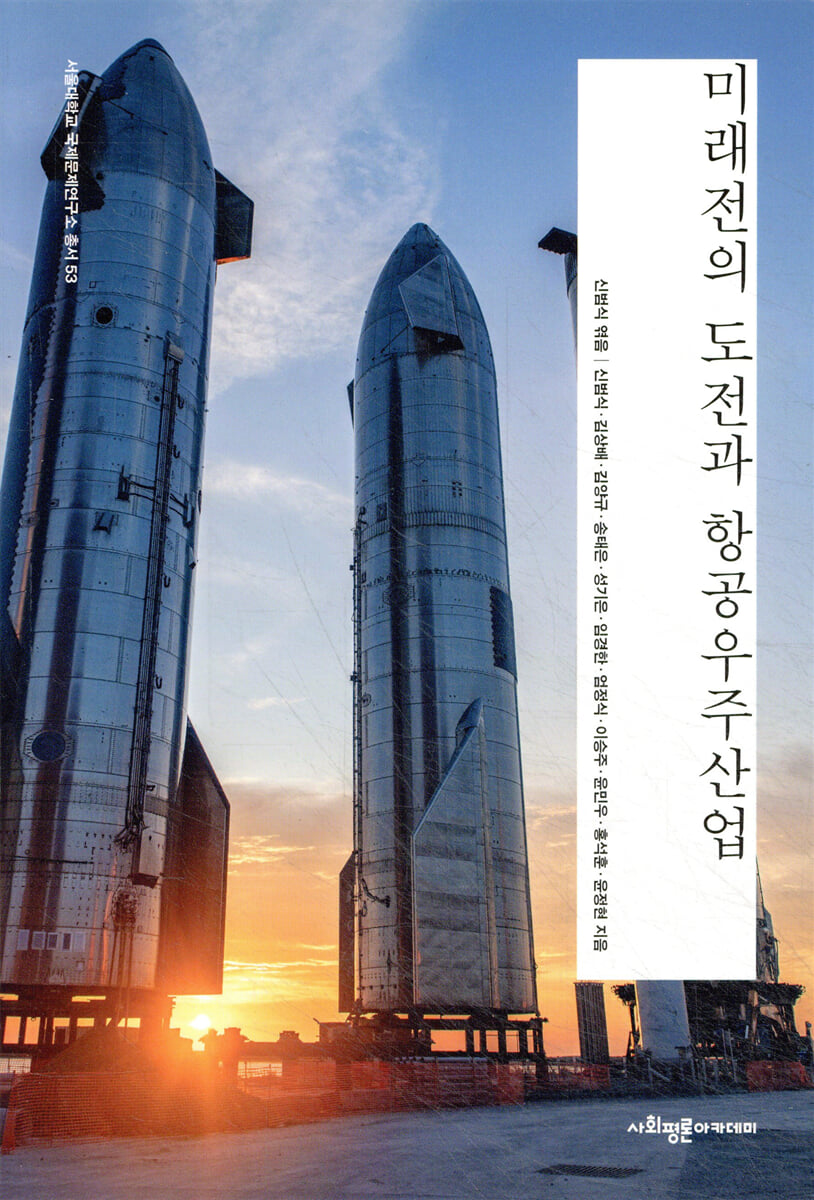
Challenges of Future Warfare and the Aerospace Industry
 |
Description
Book Introduction
Based on an understanding of the changes in the future battlefield, we seek a conceptual and theoretical framework for analyzing the positions and strategies that the aviation and space industries should adopt.
Presents a practical and specific strategy for the Korean aerospace industry and provides a logic for its implementation.
This book is the result of group research that has been ongoing for over two years.
In 2021, the Seoul National University Institute of International Studies formed a research team to comprehensively study the changing security environment in Korea, the multifaceted challenges it poses, and responses to those challenges.
The first result was published as 『Challenges of the International Security Environment and the Korean Peninsula』 (Social Criticism Academy, February 2023), and the second result was published as 『Challenges of Future Warfare and the Aerospace Industry』.
We hope that this will serve as a meaningful starting point for future research that connects the topics of security, defense, and industry.
This book analyzes the concept of future warfare and the background to its full-scale emergence, explores the response plans of the Korean Army, Navy, and Air Force, and introduces the efforts of the world's major military powers to foster the aerospace industry and enhance space military capabilities. By doing so, it provides a broad discussion of the direction and strategies our military and related industries should take in the changing security environment.
Through this, the authors will be able to analyze the implications of future warfare from the perspectives of international politics and national policy, thereby providing a foundation for a comprehensive and holistic understanding of the responses of the public, private, and military sectors.
Presents a practical and specific strategy for the Korean aerospace industry and provides a logic for its implementation.
This book is the result of group research that has been ongoing for over two years.
In 2021, the Seoul National University Institute of International Studies formed a research team to comprehensively study the changing security environment in Korea, the multifaceted challenges it poses, and responses to those challenges.
The first result was published as 『Challenges of the International Security Environment and the Korean Peninsula』 (Social Criticism Academy, February 2023), and the second result was published as 『Challenges of Future Warfare and the Aerospace Industry』.
We hope that this will serve as a meaningful starting point for future research that connects the topics of security, defense, and industry.
This book analyzes the concept of future warfare and the background to its full-scale emergence, explores the response plans of the Korean Army, Navy, and Air Force, and introduces the efforts of the world's major military powers to foster the aerospace industry and enhance space military capabilities. By doing so, it provides a broad discussion of the direction and strategies our military and related industries should take in the changing security environment.
Through this, the authors will be able to analyze the implications of future warfare from the perspectives of international politics and national policy, thereby providing a foundation for a comprehensive and holistic understanding of the responses of the public, private, and military sectors.
index
introduction
Chapter 1: Challenges of Future Warfare and the Aerospace Industry's Response
I.
preface
II.
Key development directions for future warfare
III.
The Challenges of Future Warfare and the Military's Response
IV.
Aerospace Industry Response
V.
The book's structure and main arguments
VI.
Strategy and Challenges
Part 1: The Challenge of Future Warfare
Chapter 2: The Complex Geopolitics of the Changing Future War Environment: Implications for the Aerospace Industry
I.
preface
II.
Innovation in weapons systems and transformation of military operations
III.
Complexity of battlespace and transformation of warfare styles
IV.
The Rise of Future Warfare and the Transformation of International Politics
V.
Conclusion: Implications for the Aerospace Industry
Chapter 3: "Space as a Battlefield" and Future Deterrence Strategies: Changes in US-China Security Strategy and Korea
I.
The world security order at a turning point
II.
Theory of Force and Two Forms of Force
III.
U.S. Security Strategy: Integrated Deterrence
IV.
China's Security Strategy: Intelligent Warfare
V.
Theoretical Implications: From Coercion by Punishment to Coercion by Denial
VI.
Conclusion: Korea's Security Strategy and the Aerospace Industry
Chapter 4: Future Information Warfare and Space Satellites
I.
introduction
II.
The Relationship Between Space and Information Warfare
III.
Characteristics of recent space surveillance and reconnaissance activities
IV.
Perspectives on U.S. Space Assets and Space Policy
V.
conclusion
Part 2: Future Warfare and the Military's Response
Chapter 5: The Emergence of Multidomain Operations and the Transformation of Future Battlefields
I.
preface
II.
The emergence and concept of multi-domain operations as viewed by the Army
III.
The Army's Role in Multidomain Operations
IV.
The Army's Role in Joint and Combined Multidomain Operations
V.
Conclusion
Chapter 6: Future Maritime Space Power and Multidomain Operations
I.
preface
II.
Diagnosis and Outlook of the Indo-Pacific Security Situation
III.
The Future of War and Naval Operations
IV.
Maritime space power and multi-domain operations
V.
Conclusion
Chapter 7: Future Warfare Prospects and the Development Direction of the ROK Air Force in the Air-Space Intersection
I.
introduction
II.
Future Warfare Outlook and the Air Force's Future Warfare Implementation Concept
III.
Future Aerospace Threats and Vulnerabilities
IV.
The future direction of the ROK Air Force in the air-space intersection
V.
conclusion
Part 3: Future Warfare and the Aerospace Industry's Response
Chapter 8: The US-China Space Race in the Age of Space Militarization and Commercialization
I.
Introduction: The Interplay of Technology, Industry, and Strategic Competition
II.
New trends in the space industry
III.
US-China Strategic Competition in Commercializing the Space Industry
IV.
US-China strategic competition
V.
conclusion
Chapter 9: Space Military Strategies of Major Powers: Russia and India
I.
preface
II.
Implications of the Aerospace Sector in National Defense Strategy
III.
Russia's Space Defense Strategy
IV.
India's Space Defense Strategy
V.
Conclusion: Implications of the Russia-India Cases and Implications for Korea
Chapter 10: Future Warfare Technology Competition in the Aerospace Industry
I.
Entering
II.
Changing aspects of future warfare and space power
III.
Development and competition in space science and technology
IV.
Conclusion: The Direction of Development of Space Science and Technology in Korea
Chapter 11: Directions for Korean Public-Private Cooperation to Strengthen the Future Space Industry
I.
introduction
II.
The significance of public-private cooperation in the space industry
III.
The rise of the new space era has transformed the landscape of space industry and public-private cooperation.
IV.
Exploring the Direction of "Korean-Style Public-Private Cooperation in the New Space Era"
V.
conclusion
Chapter 1: Challenges of Future Warfare and the Aerospace Industry's Response
I.
preface
II.
Key development directions for future warfare
III.
The Challenges of Future Warfare and the Military's Response
IV.
Aerospace Industry Response
V.
The book's structure and main arguments
VI.
Strategy and Challenges
Part 1: The Challenge of Future Warfare
Chapter 2: The Complex Geopolitics of the Changing Future War Environment: Implications for the Aerospace Industry
I.
preface
II.
Innovation in weapons systems and transformation of military operations
III.
Complexity of battlespace and transformation of warfare styles
IV.
The Rise of Future Warfare and the Transformation of International Politics
V.
Conclusion: Implications for the Aerospace Industry
Chapter 3: "Space as a Battlefield" and Future Deterrence Strategies: Changes in US-China Security Strategy and Korea
I.
The world security order at a turning point
II.
Theory of Force and Two Forms of Force
III.
U.S. Security Strategy: Integrated Deterrence
IV.
China's Security Strategy: Intelligent Warfare
V.
Theoretical Implications: From Coercion by Punishment to Coercion by Denial
VI.
Conclusion: Korea's Security Strategy and the Aerospace Industry
Chapter 4: Future Information Warfare and Space Satellites
I.
introduction
II.
The Relationship Between Space and Information Warfare
III.
Characteristics of recent space surveillance and reconnaissance activities
IV.
Perspectives on U.S. Space Assets and Space Policy
V.
conclusion
Part 2: Future Warfare and the Military's Response
Chapter 5: The Emergence of Multidomain Operations and the Transformation of Future Battlefields
I.
preface
II.
The emergence and concept of multi-domain operations as viewed by the Army
III.
The Army's Role in Multidomain Operations
IV.
The Army's Role in Joint and Combined Multidomain Operations
V.
Conclusion
Chapter 6: Future Maritime Space Power and Multidomain Operations
I.
preface
II.
Diagnosis and Outlook of the Indo-Pacific Security Situation
III.
The Future of War and Naval Operations
IV.
Maritime space power and multi-domain operations
V.
Conclusion
Chapter 7: Future Warfare Prospects and the Development Direction of the ROK Air Force in the Air-Space Intersection
I.
introduction
II.
Future Warfare Outlook and the Air Force's Future Warfare Implementation Concept
III.
Future Aerospace Threats and Vulnerabilities
IV.
The future direction of the ROK Air Force in the air-space intersection
V.
conclusion
Part 3: Future Warfare and the Aerospace Industry's Response
Chapter 8: The US-China Space Race in the Age of Space Militarization and Commercialization
I.
Introduction: The Interplay of Technology, Industry, and Strategic Competition
II.
New trends in the space industry
III.
US-China Strategic Competition in Commercializing the Space Industry
IV.
US-China strategic competition
V.
conclusion
Chapter 9: Space Military Strategies of Major Powers: Russia and India
I.
preface
II.
Implications of the Aerospace Sector in National Defense Strategy
III.
Russia's Space Defense Strategy
IV.
India's Space Defense Strategy
V.
Conclusion: Implications of the Russia-India Cases and Implications for Korea
Chapter 10: Future Warfare Technology Competition in the Aerospace Industry
I.
Entering
II.
Changing aspects of future warfare and space power
III.
Development and competition in space science and technology
IV.
Conclusion: The Direction of Development of Space Science and Technology in Korea
Chapter 11: Directions for Korean Public-Private Cooperation to Strengthen the Future Space Industry
I.
introduction
II.
The significance of public-private cooperation in the space industry
III.
The rise of the new space era has transformed the landscape of space industry and public-private cooperation.
IV.
Exploring the Direction of "Korean-Style Public-Private Cooperation in the New Space Era"
V.
conclusion
Publisher's Review
The book's structure and main arguments
This book, which addresses the military's and industry's responses to the challenges of future warfare, is largely divided into three parts. Part 1, "The Challenges of Future Warfare," covers the theoretical implications of the concept of future warfare, which refers to the way wars will be waged in the future, as well as the political, military, security, and technological backgrounds, and the challenges posed by the rise of future warfare.
Specifically, each chapter traces and forecasts the development of future warfare through discussions on the background of the rise of future warfare and its complex geopolitical implications, the emergence of future military and security deterrence strategies surrounding space, and the development of space technology as a countermeasure to future information warfare, and views space as a strategic stage for this development.
Chapter 2, “The Complex Geopolitics of the Changing Environment of Future Warfare: Implications for the Aerospace Industry” (Kim Sang-bae), examines the changing environments in science and technology, military security, and international politics that are forming the backdrop for the rise of future warfare from the perspective of complex geopolitical transformation.
Chapter 3, “Space as a Battlefield and Future Deterrence Strategy: Changes in US-China Security Strategy and Korea” (Yang-gyu Kim), explains that the essence of the US-China strategic competition in the military security dimension, which is currently manifested as a confrontation between “Integrated Deterrence” and “Intelligent Warfare,” is a paradigm shift from “deterrence by punishment,” which relied on the powerful retaliatory capabilities of nuclear weapons during the Cold War, to “deterrence by denial,” which is based on new technologies in the areas of artificial intelligence and long-range reconnaissance and strike.
Chapter 4, “Future Information Warfare and Space Satellites” (Song Tae-eun), examines the current significance of space as an emerging security space, emphasizing its characteristics as a strategic space where information operations are directly conducted by supporting military activities on land and sea and connecting with cyberspace. It also predicts that space will emerge as a major battlefield with an even greater role in future information warfare.
Part 2, “Future Warfare and the Military’s Response,” covers the Army, Navy, and Air Force’s understanding of the emergence of future warfare as a new paradigm for waging war, as well as the response plans of each military branch.
Each chapter analyzes the ROK military's response to the introduction of the Multi-Domain Operation (MDO) concept due to the spatiotemporal expansion of the operational domain, the resulting overlap of the existing air, ground, and sea operational domains, and the expansion of the operational domain into space, from the perspectives of the Army, Navy, and Air Force, focusing on key tasks such as expanding interoperability between military branches, fostering maritime-based space operational capabilities, and enhancing operational capabilities in the air-space intersection.
Chapter 5, “The Emergence of Multidomain Operations and the Transformation of the Future Battlefield” (Seong Gi-eun), points out that the concept of multidomain operations, which originated in the U.S. Army in the mid-2010s, was part of the evolution of military strategy in response to the changes in the future battlefield brought about by the advancement of advanced science and technology.
In particular, changes in the future battlefield are calling for the expansion of operational areas into space and cyberspace, the overlapping of operational areas between military branches, and the expansion of deep-space areas between friendly and enemy forces in the operational guidelines centered on close-area areas.
Chapter 6, “Future Maritime Space Power and Multi-Domain Operations” (Kyunghan Lim), examines maritime-based space power and multi-domain operations in areas ranging from the ocean, including underwater, to outer space, in the context of future warfare specialized in the maritime field.
Chapter 7, “Future Warfare Outlook and the Development Direction of the ROK Air Force in the Air-Space Intersection” (by Eom Jeong-sik), argues that the ROK Air Force must utilize the air-space intersection to secure and sustain air superiority in future battlefields that may occur on the Korean Peninsula.
This is because the use of this cross-domain can not only increase the effectiveness and efficiency of air operations, but also achieve 'cross-domain connectivity, access, and access denial.'
Part 3, “Future Warfare and the Aerospace Industry’s Response,” discusses the aerospace industry’s response to the rise of future warfare presented in Chapter 1, across governments and the private sector in major countries around the world, including Korea.
Each chapter examines the challenges of future warfare, the military's response, and the various aspects of the aerospace industry's resulting responses, focusing on topics such as the development and competition in the space industries of the United States and China, the recent space military strategies of Russia and India, technological competition in the aerospace industry among the world's major countries, and cooperation between the government and the private sector to strengthen the Korean aerospace industry.
Chapter 8, “The US-China Space Competition in the Era of the Militarization and Commercialization of Space” (by Seung-ju Lee), analyzes the connection between China’s “space rise,” which has become visible since 2015, and the current US-China strategic competition, as well as its impact on the US’s hegemonic position in space.
He points out that the structural factor of strategic competition between the US and China served as an impetus for the Xi Jinping government of China to intensively foster the space industry as a new field of the "Chinese Dream" at the national strategic level.
Chapter 9, “Space Military Strategies of Major Powers: Russia and India” (Yoon Min-woo), examines the recent space military strategies of Russia and India, which are in the second tier in terms of space military power, and draws implications for South Korea’s space military strategy from them.
The author points out that Russia and India are space military powers that are ahead of South Korea, making them suitable real-world examples for South Korea to benchmark as models for its space military development.
Chapter 10, “Future Warfare Technology Competition in the Aerospace Industry” (Hong Seok-hoon), examines the international landscape of space science and technology competition, driven by the changing nature of warfare in the era of the Fourth Industrial Revolution and the emergence of space as a future battlefield. It also analyzes the current state of Korean science and technology development and key challenges related to this.
Chapter 11, “Directions for Korean Public-Private Cooperation to Strengthen the Future Space Industry” (Jeong-Hyeon Yoon), captures the important commonality that, as the current space industry enters a new leap forward, dubbed the “New Space” era, discussions are actively underway among major countries on new public-private cooperation that will lead changes in the landscape of the space industry.
The author argues that a more careful and detailed examination is needed to determine whether the New Space discourse is also valid for latecomers to space development like Korea.
This book, which addresses the military's and industry's responses to the challenges of future warfare, is largely divided into three parts. Part 1, "The Challenges of Future Warfare," covers the theoretical implications of the concept of future warfare, which refers to the way wars will be waged in the future, as well as the political, military, security, and technological backgrounds, and the challenges posed by the rise of future warfare.
Specifically, each chapter traces and forecasts the development of future warfare through discussions on the background of the rise of future warfare and its complex geopolitical implications, the emergence of future military and security deterrence strategies surrounding space, and the development of space technology as a countermeasure to future information warfare, and views space as a strategic stage for this development.
Chapter 2, “The Complex Geopolitics of the Changing Environment of Future Warfare: Implications for the Aerospace Industry” (Kim Sang-bae), examines the changing environments in science and technology, military security, and international politics that are forming the backdrop for the rise of future warfare from the perspective of complex geopolitical transformation.
Chapter 3, “Space as a Battlefield and Future Deterrence Strategy: Changes in US-China Security Strategy and Korea” (Yang-gyu Kim), explains that the essence of the US-China strategic competition in the military security dimension, which is currently manifested as a confrontation between “Integrated Deterrence” and “Intelligent Warfare,” is a paradigm shift from “deterrence by punishment,” which relied on the powerful retaliatory capabilities of nuclear weapons during the Cold War, to “deterrence by denial,” which is based on new technologies in the areas of artificial intelligence and long-range reconnaissance and strike.
Chapter 4, “Future Information Warfare and Space Satellites” (Song Tae-eun), examines the current significance of space as an emerging security space, emphasizing its characteristics as a strategic space where information operations are directly conducted by supporting military activities on land and sea and connecting with cyberspace. It also predicts that space will emerge as a major battlefield with an even greater role in future information warfare.
Part 2, “Future Warfare and the Military’s Response,” covers the Army, Navy, and Air Force’s understanding of the emergence of future warfare as a new paradigm for waging war, as well as the response plans of each military branch.
Each chapter analyzes the ROK military's response to the introduction of the Multi-Domain Operation (MDO) concept due to the spatiotemporal expansion of the operational domain, the resulting overlap of the existing air, ground, and sea operational domains, and the expansion of the operational domain into space, from the perspectives of the Army, Navy, and Air Force, focusing on key tasks such as expanding interoperability between military branches, fostering maritime-based space operational capabilities, and enhancing operational capabilities in the air-space intersection.
Chapter 5, “The Emergence of Multidomain Operations and the Transformation of the Future Battlefield” (Seong Gi-eun), points out that the concept of multidomain operations, which originated in the U.S. Army in the mid-2010s, was part of the evolution of military strategy in response to the changes in the future battlefield brought about by the advancement of advanced science and technology.
In particular, changes in the future battlefield are calling for the expansion of operational areas into space and cyberspace, the overlapping of operational areas between military branches, and the expansion of deep-space areas between friendly and enemy forces in the operational guidelines centered on close-area areas.
Chapter 6, “Future Maritime Space Power and Multi-Domain Operations” (Kyunghan Lim), examines maritime-based space power and multi-domain operations in areas ranging from the ocean, including underwater, to outer space, in the context of future warfare specialized in the maritime field.
Chapter 7, “Future Warfare Outlook and the Development Direction of the ROK Air Force in the Air-Space Intersection” (by Eom Jeong-sik), argues that the ROK Air Force must utilize the air-space intersection to secure and sustain air superiority in future battlefields that may occur on the Korean Peninsula.
This is because the use of this cross-domain can not only increase the effectiveness and efficiency of air operations, but also achieve 'cross-domain connectivity, access, and access denial.'
Part 3, “Future Warfare and the Aerospace Industry’s Response,” discusses the aerospace industry’s response to the rise of future warfare presented in Chapter 1, across governments and the private sector in major countries around the world, including Korea.
Each chapter examines the challenges of future warfare, the military's response, and the various aspects of the aerospace industry's resulting responses, focusing on topics such as the development and competition in the space industries of the United States and China, the recent space military strategies of Russia and India, technological competition in the aerospace industry among the world's major countries, and cooperation between the government and the private sector to strengthen the Korean aerospace industry.
Chapter 8, “The US-China Space Competition in the Era of the Militarization and Commercialization of Space” (by Seung-ju Lee), analyzes the connection between China’s “space rise,” which has become visible since 2015, and the current US-China strategic competition, as well as its impact on the US’s hegemonic position in space.
He points out that the structural factor of strategic competition between the US and China served as an impetus for the Xi Jinping government of China to intensively foster the space industry as a new field of the "Chinese Dream" at the national strategic level.
Chapter 9, “Space Military Strategies of Major Powers: Russia and India” (Yoon Min-woo), examines the recent space military strategies of Russia and India, which are in the second tier in terms of space military power, and draws implications for South Korea’s space military strategy from them.
The author points out that Russia and India are space military powers that are ahead of South Korea, making them suitable real-world examples for South Korea to benchmark as models for its space military development.
Chapter 10, “Future Warfare Technology Competition in the Aerospace Industry” (Hong Seok-hoon), examines the international landscape of space science and technology competition, driven by the changing nature of warfare in the era of the Fourth Industrial Revolution and the emergence of space as a future battlefield. It also analyzes the current state of Korean science and technology development and key challenges related to this.
Chapter 11, “Directions for Korean Public-Private Cooperation to Strengthen the Future Space Industry” (Jeong-Hyeon Yoon), captures the important commonality that, as the current space industry enters a new leap forward, dubbed the “New Space” era, discussions are actively underway among major countries on new public-private cooperation that will lead changes in the landscape of the space industry.
The author argues that a more careful and detailed examination is needed to determine whether the New Space discourse is also valid for latecomers to space development like Korea.
GOODS SPECIFICS
- Date of issue: September 30, 2023
- Page count, weight, size: 408 pages | 152*224*30mm
- ISBN13: 9791167071279
- ISBN10: 1167071271
You may also like
카테고리
korean


korean

![GQ KOREA Mark (Monthly): December [2025]](http://librairie.coreenne.fr/cdn/shop/files/8ef265dbbfbf186523ed75ba7319009d.jpg?v=1765340328&width=3840)


