

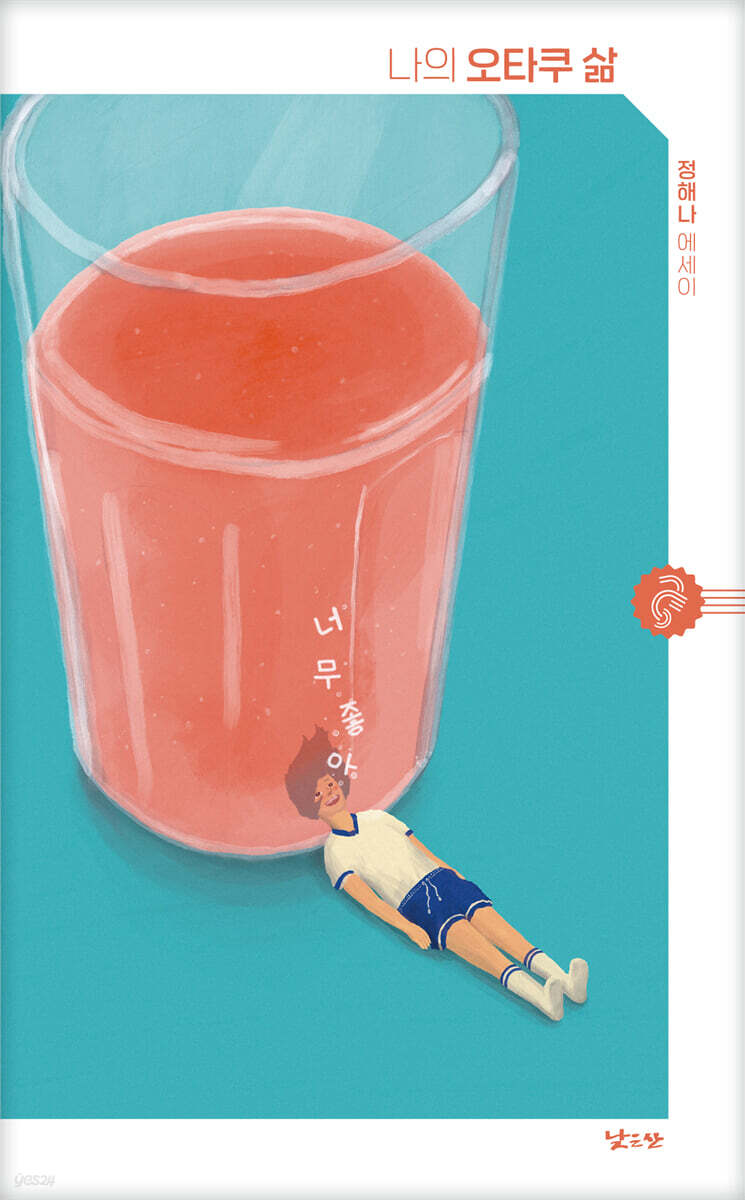
My Otaku Life
 |
Description
Book Introduction
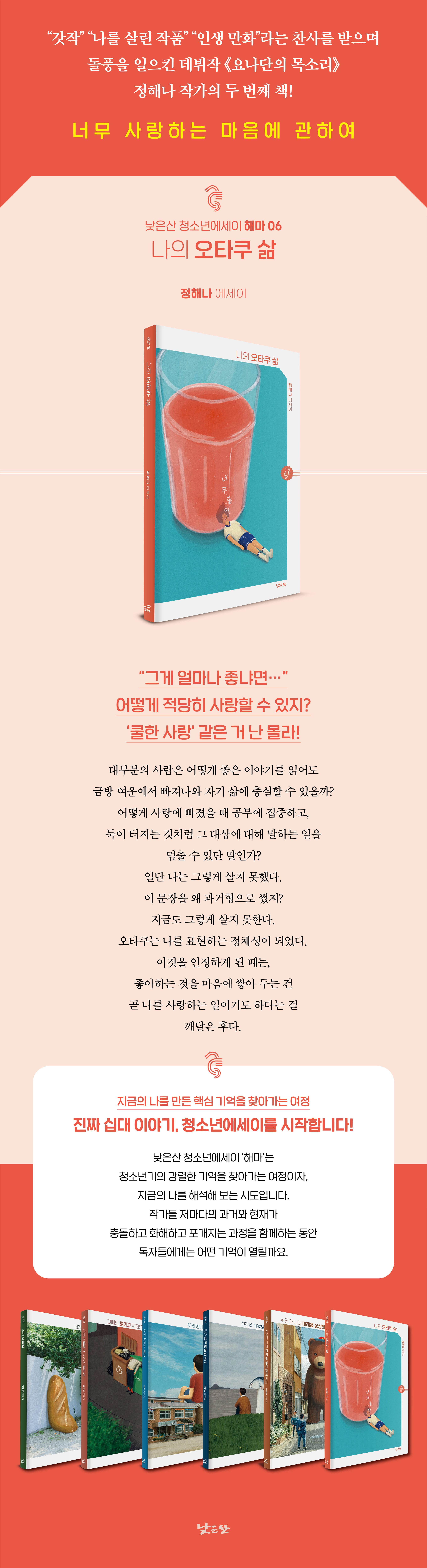
Author Haena Jeong, who delicately portrayed the heart of a teenager who deeply loves someone in “Jonathan’s Voice,” has returned with an essay titled “My Otaku Life,” which unravels her life as an otaku since her teenage years.
This is the second book to be released in three years since the publication of the debut work that swept major awards such as the Today's Cartoon Award, Bucheon Cartoon Award for New Artist, Women's Cartoonist Award, and Rainbow Bookmark Queer Literature Award after gathering attention through word of mouth on small platforms and the huge success of funding on Tumblbug. It is also the sixth volume in the Low Mountain Youth Essay 'Seahorse' series.
This isn't a comic, but an essay for teenagers? Readers who have been waiting for a new work might find the author's actions somewhat puzzling.
No need to worry.
You'll be captivated by how a story-obsessed teenager becomes an adult who creates stories, and you'll be sucked into the brisk and fast-paced prose, which is quite different from the first book.
The passion to love what you love with all your might, to the point where you can't just say "fan" or "maniac" and insist on using the word "otaku" outright, will excite even the reader.
This is the second book to be released in three years since the publication of the debut work that swept major awards such as the Today's Cartoon Award, Bucheon Cartoon Award for New Artist, Women's Cartoonist Award, and Rainbow Bookmark Queer Literature Award after gathering attention through word of mouth on small platforms and the huge success of funding on Tumblbug. It is also the sixth volume in the Low Mountain Youth Essay 'Seahorse' series.
This isn't a comic, but an essay for teenagers? Readers who have been waiting for a new work might find the author's actions somewhat puzzling.
No need to worry.
You'll be captivated by how a story-obsessed teenager becomes an adult who creates stories, and you'll be sucked into the brisk and fast-paced prose, which is quite different from the first book.
The passion to love what you love with all your might, to the point where you can't just say "fan" or "maniac" and insist on using the word "otaku" outright, will excite even the reader.
- You can preview some of the book's contents.
Preview
index
Entering
My Social Studies Teacher
A comic series that has been running for 50 years
Yecheon Cultural Center Audience Member Incident
Theater otakus also make pilgrimages
Go play with your imaginary friend!
The world of Kwon Kyo-jeong
Being a fan of a work that never returns
Chicago Taj Mahal Sandwich
I love, I am sad, I love again
To Scripps
My Social Studies Teacher
A comic series that has been running for 50 years
Yecheon Cultural Center Audience Member Incident
Theater otakus also make pilgrimages
Go play with your imaginary friend!
The world of Kwon Kyo-jeong
Being a fan of a work that never returns
Chicago Taj Mahal Sandwich
I love, I am sad, I love again
To Scripps
Detailed image
Into the book
When I read that scene, I stopped turning the pages and repeated Maya's lines out loud.
(Looking a little angry) “Look, you’re getting angry again!”
(Teasingly) “Look! You’re going to get angry again soon, aren’t you?”
(As if troubled) “Look, you’re getting angry again so quickly…….”
Indeed, it seemed that Midori's personality changed depending on the expression!
--- From the text "A Life Comic That Has Been 'Serialized' for 50 Years"
My first impression of "The History Boys" was, "I don't know what it's talking about, but it's fun!" It was the first time in my life I'd ever felt that way.
This play, which features British high school students and their teachers preparing for the entrance exams to prestigious universities such as Oxford and Cambridge, features a continuous flow of Western literary figures, names from British history, poetry, and lines from old movies that I had never heard of before.
I didn't even understand half of what the characters were saying.
But it was fun! It was amazing how compatible the two could be.
--- From the text "Theater Otakus Also Go on a Pilgrimage"
In the age of social media, who would send such a beautiful postcard? I turned the postcard over and looked at the back, and there was a familiar name written in a very illegible handwriting.
Alan Bennett had read my letter and sent me a reply! I was speechless, deciphering the cryptic handwriting. He told me it was rare to receive letters from Korea, that he'd enjoyed writing "The History Boys," and that he was glad I liked it.
I wonder if the inspiration was really that happy?
--- From the text "Theater Otakus Also Go on a Pilgrimage"
But one day, Yaji shouted this to Robbie, who was messing around as usual.
“Go play with your imaginary friend!”
I racked my brain for a moment to understand what those words meant.
The words 'imaginary friend' immediately brought Harry and Black to mind.
I was even more shocked than I was by the fact that there was a word to describe them, because the expression 'play with your imaginary friend' was assumed to be a very derogatory remark meaning 'You don't have any friends in real life, so make up some imaginary friends and play alone, you loser!'
--- From the text "Go and play with your imaginary friend!"
I liked all the works that interested me, and what on earth is the identity of this author who created them into works?
At this point, isn't it true that I'm living in the Kwon Kyo-jung universe?
--- From the text “The World of Kwon Kyo-jeong”
I love this play so much that I will go see the real Taj Mahal someday, and I will go see it again wherever it is performed.
Even if you have to save money on food and tighten your belt.
Then, if a stranger came up to me and asked me to buy him a sandwich, I would gladly go to a restaurant with him. I hope that I, a small person, will be given that opportunity.
--- From the text "Chicago Taj Mahal Sandwich"
Two summers after the end of 'Fun Home', my sister passed away.
I ended up going to a real funeral, not a staged funeral.
The funeral, which lasted three days and three nights, was not fun, but strangely enough, it was sometimes funny.
I cried out loud in sorrow, laughed while talking about the deceased, and thought that a funeral is a ceremony to comfort the hearts of the living rather than to honor the dead.
I was reminded again of the musical I loved so much, overflowing with contradictions.
(Looking a little angry) “Look, you’re getting angry again!”
(Teasingly) “Look! You’re going to get angry again soon, aren’t you?”
(As if troubled) “Look, you’re getting angry again so quickly…….”
Indeed, it seemed that Midori's personality changed depending on the expression!
--- From the text "A Life Comic That Has Been 'Serialized' for 50 Years"
My first impression of "The History Boys" was, "I don't know what it's talking about, but it's fun!" It was the first time in my life I'd ever felt that way.
This play, which features British high school students and their teachers preparing for the entrance exams to prestigious universities such as Oxford and Cambridge, features a continuous flow of Western literary figures, names from British history, poetry, and lines from old movies that I had never heard of before.
I didn't even understand half of what the characters were saying.
But it was fun! It was amazing how compatible the two could be.
--- From the text "Theater Otakus Also Go on a Pilgrimage"
In the age of social media, who would send such a beautiful postcard? I turned the postcard over and looked at the back, and there was a familiar name written in a very illegible handwriting.
Alan Bennett had read my letter and sent me a reply! I was speechless, deciphering the cryptic handwriting. He told me it was rare to receive letters from Korea, that he'd enjoyed writing "The History Boys," and that he was glad I liked it.
I wonder if the inspiration was really that happy?
--- From the text "Theater Otakus Also Go on a Pilgrimage"
But one day, Yaji shouted this to Robbie, who was messing around as usual.
“Go play with your imaginary friend!”
I racked my brain for a moment to understand what those words meant.
The words 'imaginary friend' immediately brought Harry and Black to mind.
I was even more shocked than I was by the fact that there was a word to describe them, because the expression 'play with your imaginary friend' was assumed to be a very derogatory remark meaning 'You don't have any friends in real life, so make up some imaginary friends and play alone, you loser!'
--- From the text "Go and play with your imaginary friend!"
I liked all the works that interested me, and what on earth is the identity of this author who created them into works?
At this point, isn't it true that I'm living in the Kwon Kyo-jung universe?
--- From the text “The World of Kwon Kyo-jeong”
I love this play so much that I will go see the real Taj Mahal someday, and I will go see it again wherever it is performed.
Even if you have to save money on food and tighten your belt.
Then, if a stranger came up to me and asked me to buy him a sandwich, I would gladly go to a restaurant with him. I hope that I, a small person, will be given that opportunity.
--- From the text "Chicago Taj Mahal Sandwich"
Two summers after the end of 'Fun Home', my sister passed away.
I ended up going to a real funeral, not a staged funeral.
The funeral, which lasted three days and three nights, was not fun, but strangely enough, it was sometimes funny.
I cried out loud in sorrow, laughed while talking about the deceased, and thought that a funeral is a ceremony to comfort the hearts of the living rather than to honor the dead.
I was reminded again of the musical I loved so much, overflowing with contradictions.
--- From the text “Love, grieve, and love again”
Publisher's Review
“Newly Created” “Jonathan’s Voice” by Haena Jeong
Returning after 3 years with his own story, not fiction!
How can I love moderately?
"I couldn't live like that.
No, I still can't live like that."
Talking about my life as an otaku
Author Haena Jeong, who delicately portrayed the heart of a teenager who deeply loves someone in “Jonathan’s Voice,” has returned with an essay titled “My Otaku Life,” which unravels her life as an otaku since her teenage years.
This is the second book to be released in three years since the publication of the debut work that swept major awards such as the Today's Cartoon Award, Bucheon Cartoon Award for New Artist, Women's Cartoonist Award, and Rainbow Bookmark Queer Literature Award after gathering attention through word of mouth on small platforms and the huge success of funding on Tumblbug. It is also the sixth volume in the Low Mountain Youth Essay 'Seahorse' series.
This isn't a comic, but an essay for teenagers? Readers who have been waiting for a new work might find the author's actions somewhat puzzling.
No need to worry.
You'll be captivated by how a story-obsessed teenager becomes an adult who creates stories, and you'll be sucked into the brisk and fast-paced prose, which is quite different from the first book.
The passion to love what you love with all your might, to the point where you can't just say "fan" or "maniac" and insist on using the word "otaku" outright, will excite even the reader.
"How can most people, even after reading a good story, quickly snap out of it and get back to their own lives? How can they focus on their studies when they're in love and stop talking about it like a dam bursting? Well, I couldn't live that way.
"Why did I write this sentence in the past tense? I still can't live like that." (p. 7)
The world of otaku overflowing with adverbs
About loving "too much" rather than just being cool
This book contains many 'adverbs of degree' such as very, too, extremely, extremely, really, and really.
Even without Stephen King's famous saying, "The road to hell is paved with adverbs," editors are known to be wary of excessive adverbs and tend to trim them down except where absolutely necessary.
But I couldn't leave out a single one from this book.
This is because I wanted to convey to the readers the feeling of the enthusiastic cheers of self-proclaimed and self-proclaimed 'otakus' exploding like firecrackers.
When I think of the directing skills of space and restraint shown in “The Voice of Jonathan,” I can’t help but smile at the noisy procession of adverbs who continue to say, “How good is that…” in excited voices throughout.
How can you possibly sum up such a wonderful, truly funny, truly amazing, and deeply engaging play, people, and comics in one simple word: “I like it.”
Even in an age that praises 'cool love,' there is an honest power conveyed by a sticky, innocence soaked with tears and snot.
The author says, “I don’t want to say the obvious thing like, ‘I couldn’t love as intensely as I did as a teenager,’” but it’s clear that this passion began in his teens.
“It is true that my experiences with fandom since my youth have made up a large part of me.
“If I hadn’t fallen in love with novels, comics, movies, and music back then, and if I hadn’t experienced the separation that happens the moment I close the book or the ending credits roll, I would have grown up to be a very different person.” (p. 10)
The time spent accumulating what you like in your heart
It was finally time to love me
The legendary theatrical cartoon 『Glass Mask』 was what brought out the author's otaku nature.
After being captivated by the charm of this “creepy and funny” comic and enjoying “one-man shows in the corner of my room” as a teenager, I took every theater class available to non-majors in college and eventually became a theater/musical nerd who saw 100 performances a year.
It's cute to see a show dozens of times, get autographs from the actors, participate in various events, and even draw fan art to dedicate.
It gets a little scary when you follow local performances, draw cartoons of people begging you to come see them (a waste of talent), post them on social media, make your own merchandise and place it in theaters, and become irrationally captivated by fictional characters.
But I am truly humbled by the fact that they go hungry to pay for the tickets, travel without hesitation to the locations of their favorite works, whether in England or America, and obtain and read the scripts in the original language.
In particular, the scene where Scripps, my favorite character in the play "The History Boys," flies all the way to Oxford, England, and enters a church on the other side of the world just because he was mentioned to be attending a university communion service is a highlight of this book.
The scene where the author, who grew up in a pastor's family but had avoided church for years, sheds tears at the sound of a student choir singing hymns during a service he attended for the first time in years, and meets the child who would become the protagonist of his first work is so thrilling that it feels like he is witnessing it firsthand.
The moment I heard the beautiful harmony of the a cappella choir, tears suddenly burst out uncontrollably.
In a church in a foreign country, I was overcome by a whirlwind of emotions I had never expected.
At the same time, I realized that I had to draw comics, that I had a story to tell the world, and that the main character of that story was going to be a kid who sang hymns.
That day, I missed the bus and wandered through the dark streets of Oxford with puffy eyes. A few days later, I began writing "The Voice of Jonathan" on the train to Yorkshire. (pp. 58-59)
In this book, 'otaku' does not simply mean 'a person obsessed with a specific object.'
Thanks to this extraordinary love, the author finds the courage to travel alone to an unfamiliar country, achieves his dream of becoming a cartoonist, and develops a sense of storytelling.
It doesn't matter if you don't know anything about the plays he said were "so loved that it changed my life," or "Glass Mask," which has been "unfinished" for 50 years, or "Kwon Kyo-jeong," whom he studied from all the works he could find, from closed comic rental stores to used comic sales sites, and who he considered his role model.
This is because readers also get to know the waves of emotions that come and go with the author, such as meeting, parting with, and missing the story they love.
The time you spend cherishing what you love is the time you spend loving yourself.
Love, which always brings sadness because of the feeling that it can never be reached, does not stop there but leads us into a wider world.
▶Introducing the Seahorse Series
The joy of reading essays for teenagers too!
We live in an age of essay overflow, where we can encounter all sorts of stories and lives in books.
But maybe it's because it's somewhat distant from the reality of teenagers.
Essays have long been considered the preserve of adult readers.
"This is exactly my story!" Shouldn't we also provide opportunities for young readers to hear stories they can relate to, or stories from people who have had experiences different from their own?
This is the background for planning the youth essay.
The times I cried, laughed, met, broke up, got absorbed in, ignored, liked, and disliked piled up one by one to become who I am today.
So we are also the sum total of our memories.
Memory is the device that makes each of us unique, and it is also a person's identity in itself.
The place that makes this possible is the hippocampus in our heads.
A place where memories are received, stored, and reproduced.
This is where the youth essay series 'Hippocampus' was born.
As each author's past and present collide, become entangled, reconcile, and overlap, stories with different charms and individualities are created.
I hope that young readers will also discover their own stories and fully enjoy the joy of reading essays as they embark on a journey to discover the powerful memories that shaped who they are today.
Above all, I hope to experience the mystery of connecting with a book.
Returning after 3 years with his own story, not fiction!
How can I love moderately?
"I couldn't live like that.
No, I still can't live like that."
Talking about my life as an otaku
Author Haena Jeong, who delicately portrayed the heart of a teenager who deeply loves someone in “Jonathan’s Voice,” has returned with an essay titled “My Otaku Life,” which unravels her life as an otaku since her teenage years.
This is the second book to be released in three years since the publication of the debut work that swept major awards such as the Today's Cartoon Award, Bucheon Cartoon Award for New Artist, Women's Cartoonist Award, and Rainbow Bookmark Queer Literature Award after gathering attention through word of mouth on small platforms and the huge success of funding on Tumblbug. It is also the sixth volume in the Low Mountain Youth Essay 'Seahorse' series.
This isn't a comic, but an essay for teenagers? Readers who have been waiting for a new work might find the author's actions somewhat puzzling.
No need to worry.
You'll be captivated by how a story-obsessed teenager becomes an adult who creates stories, and you'll be sucked into the brisk and fast-paced prose, which is quite different from the first book.
The passion to love what you love with all your might, to the point where you can't just say "fan" or "maniac" and insist on using the word "otaku" outright, will excite even the reader.
"How can most people, even after reading a good story, quickly snap out of it and get back to their own lives? How can they focus on their studies when they're in love and stop talking about it like a dam bursting? Well, I couldn't live that way.
"Why did I write this sentence in the past tense? I still can't live like that." (p. 7)
The world of otaku overflowing with adverbs
About loving "too much" rather than just being cool
This book contains many 'adverbs of degree' such as very, too, extremely, extremely, really, and really.
Even without Stephen King's famous saying, "The road to hell is paved with adverbs," editors are known to be wary of excessive adverbs and tend to trim them down except where absolutely necessary.
But I couldn't leave out a single one from this book.
This is because I wanted to convey to the readers the feeling of the enthusiastic cheers of self-proclaimed and self-proclaimed 'otakus' exploding like firecrackers.
When I think of the directing skills of space and restraint shown in “The Voice of Jonathan,” I can’t help but smile at the noisy procession of adverbs who continue to say, “How good is that…” in excited voices throughout.
How can you possibly sum up such a wonderful, truly funny, truly amazing, and deeply engaging play, people, and comics in one simple word: “I like it.”
Even in an age that praises 'cool love,' there is an honest power conveyed by a sticky, innocence soaked with tears and snot.
The author says, “I don’t want to say the obvious thing like, ‘I couldn’t love as intensely as I did as a teenager,’” but it’s clear that this passion began in his teens.
“It is true that my experiences with fandom since my youth have made up a large part of me.
“If I hadn’t fallen in love with novels, comics, movies, and music back then, and if I hadn’t experienced the separation that happens the moment I close the book or the ending credits roll, I would have grown up to be a very different person.” (p. 10)
The time spent accumulating what you like in your heart
It was finally time to love me
The legendary theatrical cartoon 『Glass Mask』 was what brought out the author's otaku nature.
After being captivated by the charm of this “creepy and funny” comic and enjoying “one-man shows in the corner of my room” as a teenager, I took every theater class available to non-majors in college and eventually became a theater/musical nerd who saw 100 performances a year.
It's cute to see a show dozens of times, get autographs from the actors, participate in various events, and even draw fan art to dedicate.
It gets a little scary when you follow local performances, draw cartoons of people begging you to come see them (a waste of talent), post them on social media, make your own merchandise and place it in theaters, and become irrationally captivated by fictional characters.
But I am truly humbled by the fact that they go hungry to pay for the tickets, travel without hesitation to the locations of their favorite works, whether in England or America, and obtain and read the scripts in the original language.
In particular, the scene where Scripps, my favorite character in the play "The History Boys," flies all the way to Oxford, England, and enters a church on the other side of the world just because he was mentioned to be attending a university communion service is a highlight of this book.
The scene where the author, who grew up in a pastor's family but had avoided church for years, sheds tears at the sound of a student choir singing hymns during a service he attended for the first time in years, and meets the child who would become the protagonist of his first work is so thrilling that it feels like he is witnessing it firsthand.
The moment I heard the beautiful harmony of the a cappella choir, tears suddenly burst out uncontrollably.
In a church in a foreign country, I was overcome by a whirlwind of emotions I had never expected.
At the same time, I realized that I had to draw comics, that I had a story to tell the world, and that the main character of that story was going to be a kid who sang hymns.
That day, I missed the bus and wandered through the dark streets of Oxford with puffy eyes. A few days later, I began writing "The Voice of Jonathan" on the train to Yorkshire. (pp. 58-59)
In this book, 'otaku' does not simply mean 'a person obsessed with a specific object.'
Thanks to this extraordinary love, the author finds the courage to travel alone to an unfamiliar country, achieves his dream of becoming a cartoonist, and develops a sense of storytelling.
It doesn't matter if you don't know anything about the plays he said were "so loved that it changed my life," or "Glass Mask," which has been "unfinished" for 50 years, or "Kwon Kyo-jeong," whom he studied from all the works he could find, from closed comic rental stores to used comic sales sites, and who he considered his role model.
This is because readers also get to know the waves of emotions that come and go with the author, such as meeting, parting with, and missing the story they love.
The time you spend cherishing what you love is the time you spend loving yourself.
Love, which always brings sadness because of the feeling that it can never be reached, does not stop there but leads us into a wider world.
▶Introducing the Seahorse Series
The joy of reading essays for teenagers too!
We live in an age of essay overflow, where we can encounter all sorts of stories and lives in books.
But maybe it's because it's somewhat distant from the reality of teenagers.
Essays have long been considered the preserve of adult readers.
"This is exactly my story!" Shouldn't we also provide opportunities for young readers to hear stories they can relate to, or stories from people who have had experiences different from their own?
This is the background for planning the youth essay.
The times I cried, laughed, met, broke up, got absorbed in, ignored, liked, and disliked piled up one by one to become who I am today.
So we are also the sum total of our memories.
Memory is the device that makes each of us unique, and it is also a person's identity in itself.
The place that makes this possible is the hippocampus in our heads.
A place where memories are received, stored, and reproduced.
This is where the youth essay series 'Hippocampus' was born.
As each author's past and present collide, become entangled, reconcile, and overlap, stories with different charms and individualities are created.
I hope that young readers will also discover their own stories and fully enjoy the joy of reading essays as they embark on a journey to discover the powerful memories that shaped who they are today.
Above all, I hope to experience the mystery of connecting with a book.
GOODS SPECIFICS
- Date of issue: August 20, 2025
- Page count, weight, size: 148 pages | 115*185*10mm
- ISBN13: 9791155251836
You may also like
카테고리
korean


korean

![GQ KOREA Mark (Monthly): December [2025]](http://librairie.coreenne.fr/cdn/shop/files/8ef265dbbfbf186523ed75ba7319009d.jpg?v=1765340328&width=3840)


